Showing posts with label Steve Nash. Show all posts

Friday, October 8, 2021

Top 100 NBA Players: #23 - Steve Nash


Steve Nash

Teams

Phoenix Suns - 1996-98, 2004-12

Dallas Mavericks - 1998-04

Los Angeles Lakers - 2012-14


Playoffs

Appearances - 12 (1997,1998,2001,2002,2003,2004,2005,2006,2007,2008,2010,2013)

Conference Finals - 4 (2003,2005,2006,2010)

NBA Finals - 0

Championships - 0


Awards and Honors

MVP - 2 (2005,2006,2007)

All-NBA First Team - 3 (2005,2006,2007,2008,2010,2011)

All-NBA Second Team - 2 (2002,2003,2004,2008,2009,2010,2012)

All-NBA Third Team - 2 (2002,2003)

Hall of Fame - 2018

*(actual in bold, deserved in italics)


All-Time Ranks

Free Throw Percentage - #2

Total Assists - #3

Assists Per Game - #10

Three-Point Percentage - #11

Three-Pointers Made - #26

Total Points - #92


League Leads

Free Throw Percentage (#1-2006,2010, #2-2004, #3-2003,2009,2011, #4-2001,2012, #5-2002,2007,2008)

Total Assists (#1-2005,2006,2007,2010,2011,2012, #2-2004,2008, #3-2009) 

Assists Per Game (#1-2005,2006,2007,2010,2011, #2-2008,2012, #3-2004,2009)

Three-Point Percentage (#2-2007,2008, #5-2002,2013)


After averaging 17.0 points and 6.0 assists as a senior at Santa Clara, Steve Nash was selected by the Phoenix Suns with the 15th overall pick in the NBA Draft.

Nash didn't play much as a rookie, since he was playing behind Kevin Johnson and Jason Kidd, and he only averaged 3.3 points that year. His playing time increased in his second year, and he raised his scoring to 9.1 per game, but the chance of him becoming a starter in Phoenix were slim. After the season, he was traded to the Dallas Mavericks, where he was given the opportunity to start.

Nash got a lot more playing time upon arriving in Dallas, but still didn't show much improvement over the next couple of seasons, failing to reach double digits in scoring in either season. He finally took his first big step forward in 2000-01, when he averaged 15.6 points and 7.3 assists per game and helped Dallas and Dirk Nowitzki make the playoffs for the first time in a decade.

He raised his scoring average up over 17 points per game in each of the next 2 seasons, and in 2003 he and Nowitzki led Dallas all the way to the Conference Finals for only the second time in team history, where they lost to the San Antonio Spurs in 6 games. The next year, the team added a couple new scorers, so Nash's scoring dropped to 14.5 per game, but he did increase his assist average to 8.8. After the season he wanted to resign with Dallas, but Phoenix offered a longer contract and more money, so he returned to the Suns.

His first season back in Phoenix was the best of his career. He averaged 15.5 points and led the league with 11.5 assists per game, and led the Suns to the best record in the league, a 33-game improvement over the previous season, which led to Nash being named the league MVP for the season, only the third point guard to win the award, after Magic Johnson and Bob Cousy. He led the Suns past Memphis and Dallas in the playoffs, but they lost to the Spurs in the Conference Finals.

Amar'e Stoudemire was injured before the next season, which forced Nash to take on a bigger role, and he responded by leading the league in assists again with 10.5 per game while setting career highs in scoring (18.8) and rebounds (4.1). He also became the 4th member of the 50-40-90 Club, averaging .512 from the field, .439 from three, and a league-leading .921 from the free throw line. All of this earned him another MVP award, and he led the depleted Suns back to the Conference Finals, where they fell to the Mavericks this time.

He was great again the next year, averaging 18.6 points and 11.6 assists, leading the league for the third straight year, and he came up just one free throw short of making the 50-40-90 club again. He had a better statistical season but finished as the runner-up to Dirk Nowitzki in the MVP voting, thanks to Dallas having the league's best record. In the playoffs, San Antonio again knocked off the Suns, this time in a very controversial second-round series.

Nash finished with averages of 50-40-90 for the second time in 2007-08, becoming only the second player to achieve it twice, after Larry Bird, but Phoenix ran into the Spurs again in the playoffs, falling to their nemesis in the first round, the third time in 4 years they had knocked Phoenix out.

The Suns got a new coach in 2008-09, and the result was Nash's worst year since returning to Phoenix, with only 15.7 points and 9.7 assists per game, and no playoff appearance for Nash for the first time since 2000, though he did reach the 50-40-90 threshold again, becoming the first to ever do it 3 times.

With Alvin Gentry taking over at coach late in the previous season, Phoenix got back on track in 2009-2010, with Nash again leading the league in assists with 11.0 per game and free throw percentage with a career high .938. He also led Phoenix back to the Conference Finals, the 4th time in his career he got that far, but they lost to the Lakers in 6 games, ending their run.

Nash led the league in assists for the 5th and final time in 2011, but after nearly the entire roster had been changed from the previous season, the Suns missed the playoffs. He set a career high in field goal percentage the next year, with .532, but Nash's scoring had dropped to 12.5 per game and the team missed the playoffs again.

Nash was traded to the Lakers before the next season, but struggled through an injury-plagued season, missing 32 games due to hip, hamstring, and led injuries. The leg issues continued the next year, and he only appeared in 15 games before being shut down for the season. He announced that he would play one final season, but he injured his back in the preseason and did not end up playing a single game. He announced his retirement shortly before the end of the season.

When he retired, Nash was the best free throw shooter in history, and now sits behind only Stephen Curry on the all-time list. He's also #11 in three-point percentage, making a case for him to be one of the greatest shooters of all time. He is also #3 on the all-time assist list, trailing only Stockton and Kidd, and he won 5 assist titles during his career. He was a 2-time MVP and is by far the greatest player to never reach the NBA Finals, and one of the greatest players of all time.


Tuesday, September 20, 2016

Top 100 NBA Players: #7 - Larry Bird


Larry Bird

Larry Bird was one of the most dominant players of the 1980's, and he put together one of the greatest 4-year runs of any player in NBA history, but back problems ended his career prematurely and prevented him from fulfilling him potential as possibly the greatest player of all time.

When Larry Bird and Magic Johnson arrived in the NBA in 1979, they were perhaps the most anticipated pair of rookies in history, and they did not disappoint. Nearly every season for the next decade ended with one of them hoisting the championship trophy, with three of those belonging to Larry Bird and the Boston Celtics. Bird was their best player from the day he entered the league until the day he walked away.

In just his second season in the NBA, he had arrived as one of the top 5 players in the NBA, and Boston finished the season with the league's top record. That season, Bird won his first NBA championship, but was not awarded the Finals MVP award because of a subpar performance in the Finals, although it's pretty obvious from looking at the overall playoff statistics of Bird and Cedric Maxwell, who won the award, that Bird was the team's best player:

Bird - 21.9 pts, 14.0 reb, 6.1 ast, 2.3 stl, 1.0 blk, .470 FG%, .375 3P%, .894 FT%
Maxwell - 16.1 pts, 7.4 reb, 2.7 ast, 0.7 stl, 0.9 blk, .580 FG%, .818 FT%

Bird was the better player of the two by far, but because of the perception that he wasn't playing as well as he normally did, he was not rewarded with the MVP he deserved. A couple of years later, Bird turned his game up to another level and ensured that he would not be denied any award he deserved again.

For the next four seasons, Bird was easily the best player in the league, piling up some of the most dominant seasons in history right in a row, and each of those four seasons ended in the NBA Finals, with two titles and two seasons as the runner-up. His stats over those four seasons are incredible, as you can see below:

Bird (1983-1987) - 26.6 pts, 9.9 reb, 6.9 ast, 1.8 stl, .509 FG%, .395 3P%, .894 FT%

Only five other players have ever had shooting percentages that high during a single season, including Steve Nash and Kevin Durant, and only one other player ever reached those heights in the three major categories for a full season, Oscar Robertson. Bird had one more great season left, in which he set career highs in scoring average, shooting percentage, and free throw percentage, but by that time a new, younger force had emerged as the league's top player, a young man named Michael Jordan.

The next season, Bird only played in the first six games before ending his season early to have surgery on both feet, and once he returned, back issues prevented him from ever regaining the form he had before the injuries. The Celtics never made it back to the Conference Finals during the final years of Bird's career, but with all he accomplished in a relatively short time, there is no way to argue that he doesn't belong in the discussion as one of the best players of all time.

Friday, September 9, 2016

Top 100 NBA Players: #20 - Dirk Nowitzki


Dirk Nowitzki

Dirk has been a very consistent player throughout his time in the NBA, all as a Maverick. For 12 straight seasons, he averaged at least 20 points per game. Contrast that with Kevin Garnett, with whom he has many similarities, and you'll notice that Garnett only recorded 9 consecutive seasons of 20 or more points. During that entire time, he missed fewer than 10 games in each and every season, which meant that they could count on those 20 points every night.

When Dirk first arrived in Dallas, the team still belonged to Michael Finley. After two seasons, the torch was passed to the big German, who led Dallas to its first playoff berth in over a decade, a feat that he has duplicated in the following 11 seasons as well. Kevin Garnett, meanwhile, missed the playoffs in three straight seasons with Minnesota.

Dirk is also one of only 8 players in history to finish an entire season with a 50-40-90, meaning 50% or better from the field, 40% or better from long range, and 90% or better from the free throw line. It requires a very accurate and complete offensive player to accomplish that, and among the other names that grace the list are Larry Bird, Steve Nash, Reggie Miller, Kevin Durant, and Stephen Curry. 

Nowitzki has never been known as a great rebounder, especially considering that he is 7 feet tall. He has never finished a season averaging over 10 rebounds per game, but in the playoffs, he has always turned it up a notch, grabbing at least 10 rebounds per game in 8 straight postseason campaigns. So not only did he get his team to the playoffs every year, he also stepped it up when he got there.

During his reign as the Mavericks' superstar, Dirk has led three deep playoff runs. In 2003, he took Dallas to the Western Conference Finals, where they lost to the eventual champion San Antonio Spurs. After a few seasons that ended in disappointment, he took them a step farther in 2006, getting them to the Finals, where they took a 2-0 lead and were minutes away from going up 3-0 before things fell apart and they lost to Miami. Then in 2011, he was able to take a team with no other star all the way back to the Finals to face the same Heat team, except that Miami had three superstars to Dallas' one, but Dirk trumped those three and took home the Finals MVP in the process, during his 13th season in the league.

Saturday, August 27, 2016

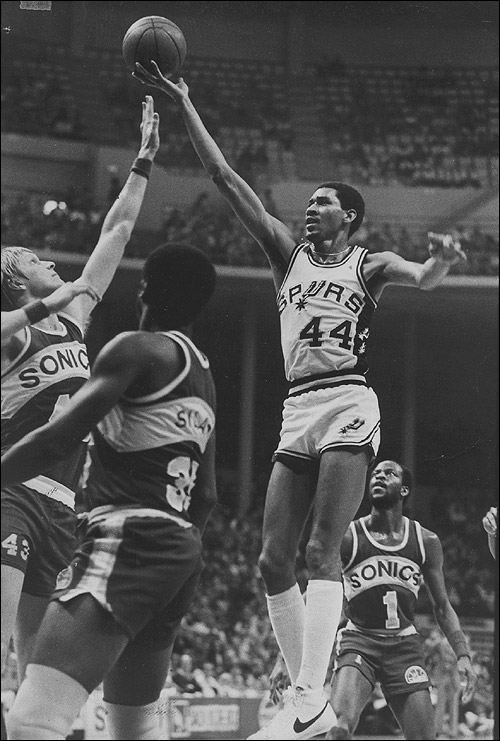
Top 100 NBA Players: #36 - George Gervin


George Gervin

George Gervin was an amazing scorer and a big star for a number of years, but more than anyone else who reached this high on the list, he was not a winner. He was known for being somewhat selfish, but it doesn't diminish how great he was offensively.

Gervin was a four time scoring leader, and is one of 7 players all-time to win three straight scoring titles. In 1980 he averaged 33.1 points per game, and he eclipsed 30 points again 2 years later, when he again led the league with 32.3 nightly. He was twice the MVP runner-up, in 1978 and 1979, but he probably should have won in 1979, when it was given to Moses Malone. Here are how their numbers stacked up that season:

Malone - 24.8 pts, 17.6 reb, 1.8 ast, 1.5 blk, .540 FG%, .739 FT%
Gervin - 29.6 pts, 5.0 reb, 2.7 ast, 1.1 blk, .541 FG%, .826 FT%

Moses led the league in rebounding that year, and Gervin in scoring, so both were obvious candidates. In the other four categories, Gervin was obviously the better player, especially if you know that Gervin was a shooting guard and Malone was a center, because Gervin shot a higher percentage than the MVP that year, and blocked nearly as many shots.

Gervin was the best player on his team for nearly his entire career, but he never saw much playoff success in that role. His best finish was losing in the Conference Finals three times, making him the best player to never play in the NBA Finals, joining Dominique Wilkins, Steve Nash, Alex English, and Vince Carter on that dubious list.

For six straight seasons, Gervin was one of the top 3 players in the NBA, but because of his playoff failings he is usually not considered to be on the same level as those who were his peers during those years, including Moses Malone, Magic Johnson, and Kareem Abdul-Jabbar. His averages over that time were spectacular, and they are listed below:

Gervin (1977-1983) - 29.2 pts, 5.0 reb, 3.0 ast, 1.3 stl, .514 FG%, .834 FT%

Gervin had the disadvantage of never having a true star for a teammate. As the only star in San Antonio for a long time, he did get them to the playoffs in every season of his career, even though he couldn't get them through to the Finals. His career was still very impressive, even though it only lasted for 10 NBA seasons.

Sunday, August 7, 2016

Top 100 NBA Players: #57 - Shawn Marion


Shawn Marion

Shawn Marion is one of those guys who has been forgotten somewhat over the past 5 years, but if you saw him play in his prime, you will remember him as a great all-around player who contributed to a lot of good teams.

In just his second season, Marion showed the all-around skills that would make him a star. That year he averaged 17.3 points, 10.7 rebounds, 1.7 steals, and 1.4 blocks, and he continued to improved from there. From 2002 to 2007, he was incredibly solid, improving his numbers across the board and helping the Suns become annual contenders. His stats from that period are listed below:

Marion - 19.8 pts, 10.4 reb, 2.1 ast, 2.1 stl, 1.4 blk, .481 FG%, .831 FT%

His best season came in 2006, when Amare Stoudemire was out with an injury. Marion took on the team's starring role that season and helped keep them relevant without their best player, putting up the stat line below:

Marion - 21.8 pts, 11.8 reb, 1.8 ast, 2.0 stl, 1.7 blk, .525 FG%, .809 FT%

The points, rebounds, and field goal percentage were all career highs, and he remained their best player through that season's playoff run, which ended in the conference finals for the second straight season.

Marion has played on three teams that made deep playoff runs, and had a major part in all three. In 2004, he was the third-best player on the Suns team that made the Western Conference Finals, playing behind Amare and Steve Nash. The next season, Amare went down with an injury, so Marion stepped into his role and led the Suns to the Conference Finals again, this time as their best player. His most recent playoff run happened in 2011, as he helped the Mavericks win their first championship as the #3 player on the team.

Marion is one of only 5 players in NBA history to amass over 1500 steals and 1000 blocks in his career, and the others are all pretty recognizable names: Julius Erving, Hakeem Olajuwon, Kevin Garnett, and Karl Malone. He led the league in total steals twice, and finished in the top 10 in rebounding 6 times, despite being only 6-7. Taken all together, you have to recognize that the Matrix really was the a star player worthy of being remembered as one of the best of all time.

Tuesday, August 2, 2016

Top 100 NBA Players: #63 - Chris Paul


Chris Paul

Chris Paul may seem like a strange choice to put above all-time assist leader John Stockton and 2-time MVP Steve Nash in these rankings, especially since he has had even less playoff success than either of those better-known stars.

The first thing that really helps Chris Paul is that he has been the star of his team for nearly every season of his career, while Nash was only the best on his team during the season Amare missed due to a major knee injury, and Stockton was never the best player on his team. Being the best player on his team means that Paul had more to do with his team's successes, which nearly balances out the fact that he hasn't reached the Conference Finals yet.

Chris Paul is also a better scorer than either of those other point guards, with a career average of 18.8 per game, higher than Stockton ever averaged in any season and tied with Nash's career high. His career rebounding average of 4.4 is higher than either of the others ever reached in a single season as well, meaning that Paul contributes in more categories more consistently than the stars.

All 3 of these guards have been league leaders in assists multiple times, with Stockton the all-time standard with 9 straight seasons leading the league, while Nash had 5 seasons and Paul has already accumulated 4. Nash was never known for his defense, but Stockton holds the all-time total steals record, and Paul is the most likely to break it, with 6 seasons leading the league to Stockton's two.

The biggest thing that has pushed Chris Paul ahead in the rankings are his 3 seasons in which he led the league in both assists and steals in the same season. The first two came when he was playing in New Orleans, and both times he also averaged over 21 points per game as well, and the other came with the Clippers, with an average of 19 points per game. He was the best player on his team in all 3 of those seasons, and twice he led his team into the second round of the playoffs in those seasons.

In the first season Stockton led the league in steals and assists, he averaged 17 points per game on a team led by Karl Malone and saw his team swept in the first round. The second time his scoring dipped to 15.8, but he and Malone did get the Jazz to the Conference Finals, though Malone had more to do with it than Stockton.

Overall, the reason that Paul has reached a little higher in the rankings is that he has had several seasons where he ranked as one of the premier stars in the league, one that could be considered a potential MVP, while Stockton never really reached that level. He hasn't gone deep into the playoffs yet, but he still has plenty of time and a solid team around him, so maybe someday he will be good enough to reach the top 50.

Friday, July 29, 2016

Top 100 NBA Players: #68 - Amare Stoudemire


Amare Stoudemire

Amare Stoudemire was one of the best players in the league for a decade, despite missing chunks of time for 3 separate injuries over that time. He was even named to the All-NBA First Team the season after he had two major knee surgeries, and he still kept going.

Amare started out on the fast track. In just his third year he was the #3 player in the entire league, although he didn't get recognized for it at the time because everyone fell in love with new teammate Steve Nash. People attributed Amare's great season to Nash's skill at getting him the ball, and while it had to have helped, there's no doubt that he was improving also. Here are his numbers from that season:

Stoudemire - 26.0 pts, 8.9 reb, 1.6 blk, .559 FG%

His numbers were even better in the playoffs that year, when he led the Suns to the Western Conference Finals as their best player. Yes, you read that right, and this is coming from one of the biggest Steve Nash fans you will ever meet. Here are his playoff stats:

Stoudemire - 29.9 pts, 10.7 reb, 2.0 blk, .539 FG%

The argument that Nash made Stoudemire was put to the test when Amare left Nash's side for the first time in 6 years to play in New York, and the result was one of his best seasons, despite what many Suns fans predicted. It only goes to show that Amare really was a superstar player in Phoenix, and that he really could have won the 2006 MVP if he hadn't blown out his knee.

Amare once again took the Suns to the Western Conference Finals in 2010, although he didn't play as well in the playoffs, allowing Jason Richardson to take the title of Best Sun in the playoffs, and as a result they once again failed to make the Finals.

Other than the season that was virtually lost to injury and his rookie season, Amare averaged over 20 points and 8 rebounds per game in each of his first 9 seasons, and he shot over 50% in nearly every season he played. He was in the top 10 in scoring 4 times and in shooting percentage 6 times. All that came before he turned 30 years old, but that is when his decline began, which is why he isn't any higher on this list.

Sunday, July 24, 2016

Top 100 NBA Players: #73 - Steve Nash


Steve Nash

Steve Nash is one of my favorite players of all time, so it hurts a little bit to have to put him clear down here on the all-time list, but he has been slightly overrated by the fact that he won two MVP awards that he probably shouldn't have. But just because I don't quite feel he was MVP-worthy does not mean that he his shown some major feats of greatness during his career.

Steve Nash is the holder of several impressive records. One of the biggest is that he has the highest free throw percentage in the history of the NBA. Only three players can claim an overall free throw percentage over 90% for their career, and Nash is one of them. In 2010, he broke John Stockton's record as the oldest player to lead the league in assists, and he broke it by 3 years. The following year, he did it again, setting the bar even higher by winning the assist title at age 37. There has never been a point guard who played that well that late in his career, and that includes Jason Kidd and Stockton.

He is also one of the few players in history to achieve a 50-40-90 season, shooting 50% from the field, 40% from long range, and 90% from the free throw line. Only seven players have ever achieved this: Larry Bird, Dirk Nowitzki, Reggie Miller, Mark Price, Kevin Durant, Stephen Curry, and Nash. But Nash hasn't just joined that club, he is the captain of it. Nash has achieved it 4 times, including three straight seasons from 2007-2010, while the other 6 have done it only seven times combined. Nash barely missed out on making it five straight years with the 2006-07 season, when he finished the season shooting .899 from the free throw line. He was arguably the best in-game shooter in the history of the NBA when he retired, although Stephen Curry looks like he will probably take that title from him.

Steve Nash is one of only two MVP's in history to never make an appearance in the NBA Finals (the other is 2011 winner Derrick Rose). Even with that fact, he didn't have a complete lack of playoff success. He was a top 3 player on 4 Western Conference Finalists, but he was never able to get over that hump. In addition to his eight seasons in the top 3 in assists in the league, which includes 5 times as #1, he also led all playoff players in assists average 4 times, with an average of 13.3 per game in 2007 as his best performance.

I said earlier that I didn't believe Nash should have won those two MVP awards. It hurts more than you can imagine for me to write that, but it's true. In 2005, when he won his first award, Nash was credited with the Suns' success because he was the new guy in town, but Amare was very impressive that year, and probably should have won the award himself. Here are their stats from that season:

Stoudemire - 26.0 pts, 8.9 reb, 1.6 ast, 1.6 blk, .559 FG%, .733 FT%
Nash - 15.5 pts, 3.3 reb, 11.5 ast, .502 FG%, .431 3P%, .887 FT%

Each was impressive in his own right, but because Amare showed so much improvement that year, people assumed it was because of Nash. Having a great point guard to get you the ball has to help, but it also can't hurt that Amare was 22 years old and still growing as a player. The next year, Amare went down with a knee injury, and the Suns weren't expected to go anywhere, but Nash led them to a respectable record and a return trip to the Conference Finals, so he was able to repeat as MVP, but Dirk led the Mavericks to a better record with better numbers, which are listed below:

Nowitzki - 26.6 pts, 9.0 reb, 2.8 ast, .480 FG%, .406 3P%, .901 FT%
Nash - 18.8 pts, 4.2 reb, 10.5 ast, .512 FG%, .439 3P%, .921 FT%

Nash's resume was definitely stronger statistically in 2006, but his team was not one of the top 3 record-wise in the league, which makes him the only MVP in the past 30 years who can say that. As great as he was, the lack of championships drags him down, as does the fact that his MVP's may not have been deserved.

Tuesday, July 19, 2016

Top 100 NBA Players: #79 - Chauncey Billups


Chauncey Billups

Chauncey Billups was one of the most successful playoff players in modern years, leading his team to the Conference Finals in 7 straight years, a streak that has only been matched by two players in the past 35 years, Magic Johnson and Kareem Abdul-Jabbar. He may not have ever been considered a superstar, but he was a star player for nearly a decade, and a winner for most of that time.

On six of those 7 Conference Final teams, Billups was one of the top 3 players on his team, first for the Pistons teams that kept making deep playoff runs, then for Denver after a trade took him out west. Here are his stats for those seasons in the regular season and the playoffs.

Billups (Regular Season) - 17.1 pts, 3.3 reb, 6.4 ast
Billups (Playoffs) - 18.0 pts, 3.5 reb, 6.0 ast

You can see that he kicked it up one notch in the playoffs, but others have made more impressive jumps. When the Pistons won the NBA Finals, Billups was voted the MVP, even though Rip Hamilton was probably a better player throughout those playoffs, as you can see from these numbers:

Billups - 16.4 pts, 3.0 reb, 5.9 ast
Hamilton - 21.5 pts, 4.6 reb, 4.2 ast

Billups was definitely the best player for Detroit in their return trip to the Finals the next year, when he bumped those averages up to 18.7 points, 4.3 rebounds, and 6.5 assists, but Detroit lost to the Spurs, costing him a chance at consecutive Finals MVP's.

Billups is also one of the best free throw shooters of all time, with a career average of .894, which places him in sixth place in NBA history, behind only Steve Nash, Rick Barry, Stephen Curry, Mark Price, and Peja Stojakovic. His clutch free throw shooting was a very important reason for his success, because his team was able to keep one of its best players on the floor at the most important times.

Sunday, July 17, 2016

Top 100 NBA Players: #81 - Michael Finley


Michael Finley

Michael Finley may seem like an odd choice to be included among the greatest players of all time, since most people have already forgotten how good he was early in his career. He started his career in Phoenix, but after he was traded to Dallas as the main piece in the Jason Kidd trade, his career really took off. Over the next six seasons, he was one of the top players in the entire league.

For the next three seasons, he was the top player in Dallas and was one of the top 10 players overall for two of those seasons, but Dallas failed to make the playoffs with him leading the way. That all changed in 2001, when Dirk Nowitzki came into his own and became the Mavericks' star, with Finley as his star sidekick. Over the next three seasons they made two trips to the second round followed by an appearance in the Conference Finals. Here are his numbers over those seasons:

Finley as star (1997-2000) - 21.6 pts, 5.7 reb, 5.0 ast, 1.4 stl
Finley as sidekick (2000-2003) - 20.5 pts, 5.4 reb, 3.6 ast, 1.2 stl
Finley in playoffs (2000-2003) - 20.0 pts, 5.7 reb, 3.2 ast, 1.3 stl

As you can see, there wasn't a huge dropoff in Finley's production when Dirk took over in Dallas, which explains why they were suddenly so much more successful. Most championship teams have at least two of the top 100 players on their roster, but unfortunately Dirk and Steve Nash had not yet reached their peak when Finley was at his, but with a couple more years together, Dallas could have won their first title a few years earlier.

Within two years of that trip to the Conference Finals, both Nash and Finley had left town, Nash to Phoenix and Finley to San Antonio. The next year Dallas made the Finals without them (in fact, they beat both of them on their way there), but they sure could have used them against Miami. Finley did get his championship in 2007, but by that time he was just a backup and wasn't a significant part of the title team.

Saturday, May 26, 2012

Top 100 NBA Players: #5


Kobe Bryant

(Kalb: #18, Simmons: #15, BBR: #68)

Among all active NBA players, Kobe Bryant is ranked the highest on this list. Part of it is due to his 2 scoring titles. Part of it could be his 5 championship rings, more than any other active player. And part of it can be traced to how well he has played for such a long period of time.

Kobe, like most of the other active players near the top of the all-time greats, started out with an advantage. Because he did not attend college, he has had more seasons in which to pile up numbers. Of the top 5 active players on this list, only Tim Duncan attended any college, and only three active players on this list are college graduates (the others are Steve Nash and Grant Hill).

A few years ago, there was a big uproar because Kobe Bryant had never won an MVP award, and people thought it was a travesty that one had never been awarded to him. But if you remember, he wasn't even the best player on his own team until 2004-05, and that was the first of three straight seasons in which the Lakers didn't even win a playoff series. The fact is, until 2008, there was no way Kobe could have won an MVP, despite the fact that he was easily the best player to never have won. That season, playing with a new attitude, he won the only MVP he ever deserved. Here is a comparison of he and LeBron James from that season:

Kobe - 28.3 pts, 6.3 reb, 5.4 ast, 1.8 stl, 0.5 blk, .459 FG%, .361 3P%, .840 FT%
LeBron - 30.0 pts, 7.9 reb, 7.2 ast, 1.8 stl, 1.1 blk, .484 FG%, .315 3P%, .712 FT%

Looking strictly at the numbers, LeBron was the better player that year, but the Lakers finished 12 games ahead of Cleveland in the win column, and advanced two rounds farther in the playoffs, so Kobe was the more valuable player that season, and he is the only player in the last 7 years to supplant LeBron as the best player for an entire season.

Kobe has played in 7 NBA Finals and won 5 championships, and though he was not the best player the first four times he reached the Finals, he was easily the best #2 player ever on a championship team. Think about it: two of the 6 greatest players in history were on the same team at the same time during their best years. Had their egos not clashed, we may have been looking at the greatest dynasty in history. Instead, we have two great players who had their best years together but were still able to win titles later on with different supporting casts.

Kobe has the sort of resume necessary to be considered one of the greatest of all time. He has the longevity, with 16 years under his belt despite being only 33 years old. He's a great offensive player, as shown by his pair of scoring titles and his 10 All-NBA First Team appearances. He's also great on defense, making First Team All-Defense 9 times, and he's a winner, with enough championships to fill up one hand. The biggest thing that has held him back was that lull in the middle of his career, missing the playoffs or losing in the first round three straight times in what should have been his best years. He will probably move even higher on this list, since he is still one of the top player in the game today, but his ceiling is probably at #2 because of what he left on the table in the middle of his career.


From this chart you can see that Shaq peaked right where he should have, and that Kobe's peak is facing the wrong direction. Why is Kobe ranked ahead of Shaq? First of all, he recovered from that valley and became just as good again, making up for his weak years with longevity that actually mattered, unlike Shaq's later years. It also helps that Kobe won two more rings without Shaq in three tries, while won only one more, and he wasn't even the best player on the team at that point. It's that extra title and his ability to maintain his high level of play for so long that allowed Kobe to surpass Shaq among the all-time greatest players.

Thursday, May 10, 2012

Top 100 NBA Players: #8


Larry Bird

(Kalb: #6, Simmons: #5, BBR: #8)

Larry Bird was one of the most dominant players of the 1980's, and he put together one of the greatest 4-year runs of any player in NBA history, but back problems ended his career prematurely and prevented him from fulfilling him potential as possibly the greatest player of all time.

When Larry Bird and Magic Johnson arrived in the NBA in 1979, they were perhaps the most anticipated pair of rookies in history, and they did not disappoint. Nearly every season for the next decade ended with one of them hoisting the championship trophy, with three of those belonging to Larry Bird and the Boston Celtics. Bird was their best player from the day he entered the league until the day he walked away.

In just his second season in the NBA, he had arrived as one of the top 5 players in the NBA, and Boston finished the season with the league's top record. That season, Bird won his first NBA championship, but was not awarded the Finals MVP award because of a subpar performance in the Finals, although it's pretty obvious from looking at the overall playoff statistics of Bird and Cedric Maxwell, who won the award, that Bird was the team's best player:

Bird - 21.9 pts, 14.0 reb, 6.1 ast, 2.3 stl, 1.0 blk, .470 FG%, .375 3P%, .894 FT%
Maxwell - 16.1 pts, 7.4 reb, 2.7 ast, 0.7 stl, 0.9 blk, .580 FG%, .818 FT%

Bird was the better player of the two by far, but because of the perception that he wasn't playing as well as he normally did, he was not rewarded with the MVP he deserved. A couple of years later, Bird turned up his game to another level and ensured that he would not be denied any award he deserved again.

For the next four seasons, Bird was easily the best player in the league, piling up some of the most dominant seasons in history right in a row, and each of those four seasons ended in the NBA Finals, with two titles and two seasons as the runner-up. His stats over those four seasons are incredible, as you can see below:

Bird (1983-1987) - 26.6 pts, 9.9 reb, 6.9 ast, 1.8 stl, .509 FG%, .395 3P%, .894 FT%

Only four other players have ever had shooting percentages that high during a single season, including Steve Nash, and only one other player ever reached those heights in the three major categories for a full season, Oscar Robertson. Bird had one more great season left, in which he set career highs in scoring average, shooting percentage, and free throw percentage, but by that time a new, younger force had emerged as the league's top player, a young man named Michael Jordan.

The next season, Bird only played in the first six games before ending his season early to have surgery on both feet, and once he returned, back issues prevented him from ever regaining the form he had before the injuries. The Celtics never made it back to the Conference Finals during the final years of Bird's career, but with all he accomplished in a relatively short time, there is no way to argue that he doesn't belong in the discussion as one of the best players of all time.


Bird's career did not last as long as Duncan's, and he does not have as many championships either, but he did lead one more team to the Finals, and the level of play he reached during the prime of his career was far beyond anything Duncan was ever able to do, but another championship this season could push Duncan close enough that he could pass Bird at some point in the near future.

Friday, March 2, 2012

Top 100 NBA Players: #17


Dirk Nowitzki

(Simmons: #37, BBR: #18)

Dirk Nowitzki made the leap from just outside the top 20 to solidly inside because of one magical season that just concluded. Without his breakthrough, when he was finally able to prove that he could win when it counted, he would not be ranked this high, but last season changed that.

Dirk has been a very consistent player throughout his time as a Maverick. For 11 straight seasons, he averaged at least 20 points per game. Contrast that with Kevin Garnett, with whom he has many similarities, and you'll notice that Garnett only recorded 9 consecutive seasons of 20 or more points. During that entire time, he missed fewer than 10 games in each and every season, which meant that they could count on those 20 points every night.

When Dirk first arrived in Dallas, the team still belonged to Michael Finley. After two seasons, the torch was passed to the big German, who led Dallas to its first playoff berth in over a decade, a feat that he has duplicated in every season since, with that streak currently at 11 straight seasons as well. Kevin Garnett, meanwhile, missed the playoffs in three straight seasons with Minnesota.

Dirk is also one of only 7 players in history to finish an entire season with a 50-40-90, meaning 50% or better from the field, 40% or better from long range, and 90% or better from the free throw line. It requires a very accurate and complete offensive player to accomplish that, and among the other names that grace the list are Larry Bird, Steve Nash, and Reggie Miller. Of all of them, Dirk had the second-highest scoring average in his special season, with only Bird topping him.

Nowitzki has never been known as a great rebounder, especially considering that he is 7 feet tall. He has never finished a season averaging over 10 rebounds per game, but in the playoffs, he has always turned it up a notch, grabbing at least 10 rebounds per game in 8 straight postseason campaigns. So not only did he get his team to the playoffs every year, he also stepped it up when he got there.

During his reign as the Mavericks' superstar, Dirk has led three deep playoff runs. In 2003, he took Dallas to the Western Conference Finals, where they lost to the eventual champion San Antonio Spurs. After a few seasons that ended in disappointment, he took them a step farther in 2006, getting them to the Finals, where they took a 2-0 lead and were minutes away from going up 3-0 before things fell apart and they lost to Miami. Then in 2011, he was able to take a team with no other star all the way back to the Finals to face the same Heat team, except that Miami had three superstars to Dallas' one, but Dirk trumped those three and took home the Finals MVP in the process, during his 13th season in the league.


Nowitzki and Pippen followed pretty similar paths for a while in their careers, until Dirk became a monster for a couple of years. Pippen hit the wall after 10 seasons, then became a solid role player for a few years before becoming a bench player. Dirk, however, has remained a superstar through 13 seasons, long after most players start to falter. Pippen obviously has the edge in championships, but Dirk was the leader of two Finals teams, which neither Pippen nor Garnett can claim, and he won a title with very little help, while Garnett had a lot of help and Pippen was the help. 

Thursday, September 1, 2011

Top 100 NBA Players: #34


George Gervin

(Kalb: #26, Simmons: #34, BBR: #41)

George Gervin was an amazing scorer and a big star for a number of years, but more than anyone else who reached this high on the list, he was not a winner. He was known for being somewhat selfish, but it doesn't diminish how great he was offensively.

Gervin was a four time scoring leader, and is one of 6 players all-time to win three straight scoring titles. In 1980 he averaged 33.1 points per game, and he eclipsed 30 points again 2 years later, when he again led the league with 32.3 nightly. He was twice the MVP runner-up, in 1978 and 1979, but he probably should have won in 1979, when it was given to Moses Malone. Here are how their numbers stacked up that season:

Malone - 24.8 pts, 17.6 reb, 1.8 ast, 1.5 blk, .540 FG%, .739 FT%
Gervin - 29.6 pts, 5.0 reb, 2.7 ast, 1.1 blk, .541 FG%, .826 FT%

Moses led the league in rebounding that year, and Gervin in scoring, so both were obvious choices. In the other four categories, Gervin was obviously the better player, especially if you know that Gervin was a shooting guard and Malone was a center, because Gervin shot a higher percentage than the MVP that year, and blocked nearly as many shots.

Gervin was the best player on his team for nearly his entire career, but he never saw much playoff success in that role. His best finish was losing in the Conference Finals three times, making him the best player to never play in the NBA Finals, joining Dominique Wilkins, Steve Nash, Alex English, Vince Carter, and Tracy McGrady on that dubious list.

For six straight seasons, Gervin was one of the top 3 players in the NBA, but because of his playoff failings he is usually not considered to be on the same level as those who were at his level during those years, including Moses Malone, Magic Johnson, and Kareem Abdul-Jabbar. His averages over that time were spectacular, and they are listed below:

Gervin (1977-1983) - 29.2 pts, 5.0 reb, 3.0 ast, 1.3 stl, .514 FG%, .834 FT%

Gervin had the disadvantage of never having a true star for a teammate. As the only star in San Antonio for a long time, he did get them to the playoffs in every season of his career, even though he couldn't get them through to the Finals. His career was still very impressive, even though it only lasted for 10 NBA seasons.


Payton may have been the better defensive player by far, but Gervin's offensive prowess was so great that there is no doubt he was better than Payton. Gervin's first 7 NBA seasons were all at least as good as Payton's best season, so even though Payton lasted much longer, Gervin got much higher. While Gervin was not a great playoff player, Payton's overall playoff success wasn't much better, so Gervin is definitely higher up on the list.

Sunday, August 14, 2011

Top 100 NBA Players: #50


Shawn Marion

(BBR: #79)

Shawn Marion is easily the most surprising member of my all-time top 50. Only one other member of my top 50 doesn't appear on either Elliott Kalb's top 50 or Bill Simmons' top 96, and you'll see him at #40. Marion asked out of Phoenix because he felt he wasn't getting the credit he deserved, and I have to agree, which is why he's here.

In just his second season, Marion showed the all-around skills that would make him a star. That year he averaged 17.3 points, 10.7 rebounds, 1.7 steals, and 1.4 blocks, and he continued to improved from there. From 2002 to 2007, he was incredibly solid, improving his numbers across the board and helping the Suns become annual contenders. His stats from that period are listed below:

Marion - 19.8 pts, 10.4 reb, 2.1 ast, 2.1 stl, 1.4 blk, .481 FG%, .831 FT%

Marion has played on three teams that made deep playoff runs, and had a major part in all three. In 2004, he was the third-best player on the Suns team that made the Western Conference Finals, playing behind Amare and Steve Nash. The next season, Amare went down with an injury, so Marion stepped into his role and led the Suns to the Conference Finals again, this time as their best player. His most recent playoff run happened just a few months ago, as he helped the Mavericks win their first championship as the #3 player on the team.

Marion is one of only 5 players in NBA history to amass over 1500 steals and 1000 blocks in his career, and the others are all pretty recognizable names: Julius Erving, Hakeem Olajuwon, Kevin Garnett, and Karl Malone. He led the league in total steals twice, and finished in the top 10 in rebounding 6 times, despite being only 6-7. Taken all together, you have to recognize that the Matrix really was the star he thought he was.


You may not realize it, but Marion was actually better than Webber for the majority of their playing careers. Their per-game averages were pretty similar, but Marion was a much better free throw shooter and had a lot more playoff success than Webber, not to mention the fact that he rarely missed time with injuries, which Webber did with great regularity. Marion definitely has had the kind of career that needs to be remembered.

Thursday, August 11, 2011

Top 100 NBA Players: #53


Tracy McGrady

(Kalb: #41, Simmons: #75, BBR: #51)

Tracy McGrady is another example of a player whose promising career was derailed by injury too early, but when he was good, he was really good. He twice led the entire league in scoring before he turned 25, and he averaged at least 20-5-5 six times.

McGrady came straight to the NBA from high school, but he didn't become a star until his 4th season, when he would have been a college senior. That's the season when he left Toronto and Vince Carter's shadow and became a star in his own right in Orlando. That year he improved his scoring average by 11.4 points and won the Most Improved Player Award while making the All-Star team and All-NBA Second Team.

He continued to improve over the next two years, until the 2003 season, when he led the league with 32.1 points per game while grabbing 6.5 rebounds and passing out 5.5 assists per game. That year he also shot a career-high .457 from the field, which would drop off considerably every season afterward. After one more season of leading the league in scoring, he was traded to the Houston Rockets for Steve Francis.

In Houston he continued to be a star, but he only finished in the top 10 in scoring twice in 5 full seasons, and he missed 113 games over that time, which caused the Rockets to struggle in the postseason. In fact, McGrady is probably the best player in NBA history who never got past the first round of the playoffs. It wasn't really his fault, because his postseason numbers were pretty impressive. Just look at what he did from 2001 to 2005:

McGrady - 31.6 pts, 6.8 reb, 6.1 ast, 1.5 stl

While he may have failed to advance in the playoffs and fell from his peak far too early, McGrady has to be remembered as a great player. He averaged over 20 points per game in 8 straight seasons, led the league in scoring twice, and made the All-NBA First Team twice. It sad to say that at age 31, he's probably washed up and past his prime.


Nash has a little advantage over McGrady in playoff success, and a definite lead in longevity, but McGrady was so good early in his career that Nash can't really argue that he's the better player. Nash could pass McGrady if he is able to continue to contribute over the next couple years, but for now McGrady's career accomplishments are just a little bit more impressive.

Wednesday, August 10, 2011

Top 100 NBA Players: #54


Steve Nash

(Simmons: #38, BBR: #31)

Steve Nash is one of my favorite players of all time, so it hurts a little bit to have to put him clear down here on the all-time list, but he has been slightly overrated by the fact that he won two MVP awards that he probably shouldn't have. But just because I don't quite feel he was MVP-worthy does not mean that he his shown some major feats of greatness during his career.

Steve Nash is the holder of several impressive records. One of the biggest is that he has the highest free throw percentage in the history of the NBA. Only two players can claim an overall free throw percentage over 90% for their career, and Nash is one of them. In 2010, he broke John Stockton's record as the oldest player to lead the league in assists, and he broke it by 3 years. The following year, he did it again, setting the bar even higher by winning the assist title at age 37. There has never been a point guard who played this well this late in his career, and that includes Jason Kidd and Stockton.

He is also one of only five players in history to achieve a 50-40-90 season, shooting 50% from the field, 40% from long range, and 90% from the free throw line. Only five players have ever achieved this: Larry Bird, Dirk Nowitzki, Reggie Miller, Mark Price, and Nash. But Nash hasn't just joined that club, he is the captain of it. Nash has achieved it 4 times, including three straight seasons from 2007-2010, while the other 4 have done it only five times combined. Nash barely missed out on making it five straight years in the 2006-07 season, when he finished the season shooting .899 from the free throw line. He is, without a doubt, the best in-game shooter in the history of the NBA.

Steve Nash is one of only two MVP's in history to never make an appearance in the NBA Finals (the other is 2011 winner Derrick Rose). Even with that fact, he hasn't had a complete lack of playoff success. He has been a top 3 player on 4 Western Conference Finalists, but he has never been able to get over that hump. In addition to his eight seasons in the top 3 in assists in the league, which includes 5 times as #1, he has also led all playoff players in assists average 4 times, with an average of 13.3 per game in 2007 as his best performance.

I said earlier that I didn't believe Nash should have won those two MVP awards. It hurts more than you can imagine for me to write that, but it's true. In 2005, when he won his first award, Nash was credited with the Suns' success because he was the new guy in town, but Amare was very impressive that year, and probably should have won the award himself. Here are their stats from that season:

Stoudemire - 26.0 pts, 8.9 reb, 1.6 ast, 1.6 blk, .559 FG%, .733 FT%
Nash - 15.5 pts, 3.3 reb, 11.5 ast, .502 FG%, .431 3P%, .887 FT%

Each was impressive in his own right, but because Amare showed so much improvement that year, people assumed it was because of Nash. Having a great point guard to get you the ball has to help, but it also can't hurt that Amare was 22 years old and still growing as a player. The next year, Amare went down with a knee injury, and the Suns weren't expected to go anywhere, but Nash led them to a respectable record and a return trip to the Conference Finals, so he was able to repeat as MVP, but Dirk led the Mavericks to a better record with better numbers, which are listed below:

Nowitzki - 26.6 pts, 9.0 reb, 2.8 ast, .480 FG%, .406 3P%, .901 FT%
Nash - 18.8 pts, 4.2 reb, 10.5 ast, .512 FG%, .439 3P%, .921 FT%

Nash's resume was definitely stronger statistically in 2006, but his team was not one of the top 3 record-wise in the league, which makes him the only MVP in the past 25 years who can say that. There's no doubt that he's a star player, and he may not be done yet. He could still make a run at the top 50 of all time, but it might take a championship to do it.


The interesting thing about Nash is how he started rising to his peak at the point in his career where most players start to drop from relevance. His peak is higher and has lasted longer than Hamilton's, but Hamilton's playoff success kept him somewhat close to Nash overall. Nash, even though he's several years older than Hamilton, still has a chance to add to his career accomplishments, while Rip seems to be on the downside of his career.

Saturday, August 6, 2011

Top 100 NBA Players: #58


Amare Stoudemire

(BBR: #58)

Amare Stoudemire has been one of the best players in the league for the past decade, despite missing chunks of time for 3 separate injuries over that time. He was named to the All-NBA First Team the season after he had two major knee surgeries, and he still isn't slowing down.

Amare started out on the fast track. In just his third year he was the #3 player in the entire league, although he didn't get recognized for it at the time because everyone fell in love with new teammate Steve Nash. People attributed Amare's great season to Nash's skill at getting him the ball, and while it had to have helped, there's no doubt that he was improving also. Here are his numbers from that season:

Stoudemire - 26.0 pts, 8.9 reb, 1.6 blk, .559 FG%

His numbers were even better in the playoffs that year, when he led the Suns to the Western Conference Finals as their best player. Yes, you read that right, and this is coming from one of the biggest Steve Nash fans you will ever meet. Here are his playoff stats:

Stoudemire - 29.9 pts, 10.7 reb, 2.0 blk, .539 FG%

The argument that Nash made Stoudemire was put to the test last season, when Amare left Nash's side for the first time in 6 years to play in New York, and the result was one of his best seasons yet, despite what many Suns fans predicted. It only goes to show that Amare really was a superstar player in Phoenix, and that he really could have won the 2006 MVP if he hadn't blown out his knee.

Amare once again took the Suns to the Western Conference Finals in 2010, although he didn't play as well in the playoffs, allowing Jason Richardson to take the title of Best Sun in the playoffs, and as a result they once again failed to make the Finals.

Other than the season that was virtually lost to injury and his rookie season, Amare has always averaged over 20 points and 8 rebounds per game, and he was shot over 50% in six straight seasons. He has been in the top 10 in scoring 4 times and in shooting percentage 5 times. All that, and he is still only 28 years old, with plenty of time to progress as a player before he starts declining.


Amare is not the scorer that Dantley was, but he's already experienced much more playoff success than Dantley, and has also shot the ball better and rebounded it more often than Dantley. He's made more appearances on the All-NBA Team and been traded less. It all adds up to Amare being a better overall player than Dantley, and his best may be still to come.

Monday, August 1, 2011

Top 100 NBA Players: #63


Chauncey Billups

(BBR: #65)

Chauncey Billups has been one of the most successful playoff players in modern years, leading his team to the Conference Finals in 7 straight years, a streak that has only been matched by two players in the past 30 years, Magic Johnson and Kareem Abdul-Jabbar. He may not have ever been considered a superstar, but he has been a star player for nearly a decade now, and a winner for most of that time.

On six of those 7 Conference Final teams, Billups was one of the top 3 players on his team, first for the Pistons teams that kept making deep playoff runs, then for Denver after a trade took him out west. Here are his stats for those seasons in the regular season and the playoffs.

Billups (Regular Season) - 17.1 pts, 3.3 reb, 6.4 ast
Billups (Playoffs) - 18.0 pts, 3.5 reb, 6.0 ast

You can see that he kicked it up one notch in the playoffs, but others have made more impressive jumps. When the Pistons won the NBA Finals, Billups was voted the MVP, even though Rip Hamilton was probably a better player throughout those playoffs, as you can see from these numbers:

Billups - 16.4 pts, 3.0 reb, 5.9 ast
Hamilton - 21.5 pts, 4.6 reb, 4.2 ast

Billups was definitely the best player for Detroit in their return trip to the Finals the next year, when he bumped those averages up to 18.7 points, 4.3 rebounds, and 6.5 assists, but Detroit lost to the Spurs, costing him a chance at consecutive Finals MVP's.

Billups is also one of the best free throw shooters of all time, with a career average of .894, which places him in fifth place in NBA history, behind only Steve Nash, Rick Barry, Mark Price, and Peja Stojakovic. His clutch free throw shooting has been a very important reason for his success, because his team was able to keep one of its best players on the floor at the most important times.


It's hard to argue that Billups was a better player than Jones, especially when you look at the comparison in the chart above. We also know that both were top 3 players on some of the best teams during their prime years, but Jones was able to make the NBA Finals a lot more often than Billups. One major difference that shouldn't be overlooked is the fact that the NBA Finals was only the second or third round of the playoffs during the Celtics' glory years, which Jones was a part of. Today, the Conference Finals is the third round of the playoffs, so Billups' run of playoff success is just as impressive as Jones', and Billups has the added bonus of saying he was the best player on a Finals team, which Jones never was.

Saturday, July 30, 2011

Top 100 NBA Players: #65


Michael Finley

(BBR: #146)

Michael Finley may seem like an odd choice to be included among the greatest players of all time, since most people have already forgotten how good he was early in his career. He started his career in Phoenix, but after he was traded to Dallas as the main piece in the Jason Kidd trade, his career really took off. Over the next six seasons, he was one of the top players in the entire league.

For the next three seasons, he was the top player in Dallas and was one of the top 10 players overall for two of those seasons, but Dallas failed to make the playoffs with him leading the way. That all changed in 2001, when Dirk Nowitzki came into his own and became the Mavericks' star, with Finley as his star sidekick. Over the next three seasons they made two trips to the second round followed by an appearance in the Conference Finals. Here are his numbers over those seasons:

Finley as star (1997-2000) - 21.6 pts, 5.7 reb, 5.0 ast, 1.4 stl
Finley as sidekick (2000-2003) - 20.5 pts, 5.4 reb, 3.6 ast, 1.2 stl
Finley in playoffs (2000-2003) - 20.0 pts, 5.7 reb, 3.2 ast, 1.3 stl

As you can see, there wasn't a huge dropoff in Finley's production when Dirk took over in Dallas, which explains why they were suddenly so much more successful. Most championship teams have at least two of the top 100 players on their roster, but unfortunately Dirk and Steve Nash had not yet reached their peak when Finley was at his, but with a couple more years together, Dallas could have won their first title a few years earlier.

Within two years of that trip to the Conference Finals, both Nash and Finley had left town, Nash to Phoenix and Finley to San Antonio. The next year Dallas made the Finals without them (in fact, they beat both of them on their way there), but they sure could have used them against Miami. Finley did get his championship in 2007, but by that time he was just a backup and wasn't a significant part of the title team.


Looking at this chart, you can see that Finley was just slightly better than Carmelo through the early part of their respective careers, and each helped guide one team to the Western Conference Finals during their peak seasons. The edge goes to Finley for now, because he spent two years as one of the league's ten best, while Carmelo has yet to reach that plateau. Anthony should easily pass him with one more year under his belt, but through eight seasons Finley was slightly better.