Michael Jordan
Ask 100 people who the greatest player of all time is, and the top response will most likely be Michael Jordan, but it would be far from a landslide. Many others would get a significant number of votes, from Wilt Chamberlain, Bill Russell, and Oscar Robertson to Shaquille O'Neal, Kobe Bryant, and even LeBron James. So what makes Michael Jordan the best player of all time?There are five factors that I feel qualify a player to be considered one of the greatest of all time. Those are offensive and defensive prowess, regular season and playoff dominance, and longevity. By using these 5 factors, I'll show that Michael Jordan is the greatest player of all time.First, offensive prowess. The purpose of offense is to score points, and there has never been a greater scorer than Michael Jordan. Wilt Chamberlain may own the record for points in a game and points per game for a full season, but Michael Jordan owns the record for most points per game over a full career. The five players with the highest career scoring averages are, in order:Michael JordanWilt ChamberlainKevin DurantElgin BaylorLeBron JamesNext, defensive prowess. This one is a little tougher to define, especially since the All-Defensive Team has only existed since 1969, Bill Russell's final season. Three players have appeared on the All-Defensive First Team nine times in their career, and if you add in Bill Russell and Wilt Chamberlain, both of whom were said to have blocked at least 8 shots in a game quite regularly, this is the list you come up with:Michael JordanKobe BryantKevin GarnettBill RussellWilt ChamberlainThen let's consider regular season dominance. Michael Jordan was the best player in the league for his final 9 seasons with the Chicago Bulls, and would have made it at least 11 if he hadn't kept retiring prematurely. He was the best player in 1988, and he was the best player in 1998, a feat only Kareem can match with his 1970 and 1980 seasons. The list of players who spent the longest time as the league's top star is as follows:Wilt ChamberlainMichael JordanKareem Abdul-JabbarLeBron JamesLarry BirdPerhaps the most important category is playoff dominance. The whole point of playing the game is to win championships, and Jordan was the best player on more champions than anybody but Bill Russell. He made 6 trips to the NBA Finals in his career, and won all 6 times. The record for highest scoring average in a Finals series is 41.0, and it's no surprise that Jordan holds that record for his performance against the Phoenix Suns in 1993. Here is the list of the players who have led their teams to the most championships:Bill RussellMichael JordanMagic JohnsonTim DuncanShaquille O'NealLarry Bird
LeBron James
Finally, let's look at longevity. When looking at this category, I'm looking at more than just playing for a long time. You must also play at a high level for a long period of time, and Michael Jordan fits that bill as well. In his first game after turning 40, he obliterated the old record for points by a player of that age. Kareem had held the record of 27, but Jordan poured in 43 that night, and scored at least 30 points 9 other times after his 40th birthday, meaning he owns the 10 highest-scoring games for a 40-year old player. Here are the 5 players who had the most productive seasons after the age of 35:Karl MaloneElgin BaylorKareem Abdul-JabbarMichael JordanJerry WestThere's only one player that appears on all 5 of these lists, and you've probably already guessed who that is. It's also worth noting that only two other players appear even 3 times on these lists, and those are Wilt Chamberlain and LeBron James, the two players I ranked just behind Jordan. Michael Jordan is the only player in history who has been dominant in every important facet of the game, which is what makes him the greatest of all time.With that in mind, are there any current players that have a chance at displacing Jordan at the top? In my opinion, there are several that have a chance. The obvious one is LeBron James, who has already cracked three of these lists, and has already made the All-Defensive First Team six times, and has a head start on the longevity since he started so young. Another is Kevin Durant, who is a great offensive player and is improving on defense, and also entered the league very young, which could help his longevity. Russell Westbrook and Stephen Curry are also young and showing some promise, but do they have what it takes to be considered the greatest? It will be fun to watch and find out.
Kareem Abdul-Jabbar
Kareem Abdul-Jabbar dominated the 1970's in a way no decade has been dominated before or since, then adjusted to his role as sidekick to another superstar better than any other player in history, which allowed him to finish his career with 6 championships and 10 NBA Finals appearances.There was no doubt that Kareem (then Lew Alcindor) would be the top pick in the 1969 NBA Draft, after he led UCLA to an 88-2 record in 3 seasons and 3 straight NCAA championships, where he was named the Most Outstanding Player each time. He easily won the Rookie of the Year trophy, and should have been given the MVP as well, but it was awarded to Willis Reed, who led the New York Knicks to the league's best record and their first championship that season. Here are how their numbers stacked up that year:Alcindor - 28.8 pts, 14.5 reb, 4.1 ast, .518 FG%, .653 FT%Reed - 21.7 pts, 13.9 reb, 2.0 ast, .507 FG%, .756 FT%Although Reed may have led his team to a few more wins (Milwaukee had the second-best record), it's very easy to see that Kareem had the bigger impact, leading a team in its second year of existence to the league's second-best record and a trip to the Conference Finals. In fact, from 1969-1980, a span of 11 seasons, Kareem was the best player 8 times, with the only exceptions coming in two seasons in which he missed time with a broken hand and one season in which George Gervin was on top of his game. He holds the record for most MVP's won, with 6, but I believe he should have been awarded 8.Even with how great he was for so long, he was only able to make it to 3 NBA Finals during his time as team leader, winning twice. There were even two seasons right during his peak seasons in which his teams missed the playoffs completely, which no other top 10 player can say. That all changed in 1981, when Magic Johnson became the center of the Lakers' offense and Kareem became their #2 star.In the final 8 seasons of Kareem's career in Los Angeles, the Lakers made it to the Finals 7 times, and Kareem was a major contributor for most of those teams, although by the time he retired he was not near the player he had once been, posting just 10 points per game along with fewer than 5 rebounds.Kareem is the NBA's all-time leader in All-Star appearances, MVP awards, points scored, and minutes played, and he is also one of only 3 players in history to win the scoring title, MVP, and Finals MVP in the same season, along with Michael Jordan and Shaquille O'Neal. That season was 1971, just his second season as a pro, when he averaged 31.7 points and 16.0 rebounds, took 133 out of 153 MVP votes, then led Milwaukee to the title by winning 12 of 14 in the playoffs and sweeping the Baltimore Bullets in the Finals. He was the first to do it, and it wouldn't happen again for 20 years, when Jordan won his first title.
Kobe Bryant
Kobe, like most of the other recent players near the top of the all-time greats, started out with an advantage. Because he did not attend college, he had more seasons in which to pile up numbers. Of the top 7 active players on this list, none played more than 2 seasons of college basketball.About a decade ago, there was a big uproar because Kobe Bryant had never won an MVP award, and people thought it was a travesty that one had never been awarded to him. But if you look at it, he wasn't even the best player on his own team until 2004-05, and that was the first of three straight seasons in which the Lakers didn't even win a playoff series. The fact is, until 2008, there was no way Kobe could have won an MVP, despite the fact that he was easily the best player to never have won. That season, playing with a new attitude, he won the only MVP he ever deserved. Here is a comparison of him and LeBron James from that season:Kobe - 28.3 pts, 6.3 reb, 5.4 ast, 1.8 stl, 0.5 blk, .459 FG%, .361 3P%, .840 FT%LeBron - 30.0 pts, 7.9 reb, 7.2 ast, 1.8 stl, 1.1 blk, .484 FG%, .315 3P%, .712 FT%Looking strictly at the numbers, LeBron was the better player that year, but the Lakers finished 12 games ahead of Cleveland in the win column, and advanced two rounds farther in the playoffs, so Kobe was the more valuable player that season, and he was the only player from 2006 to 2013 to supplant LeBron as the best player for an entire season.Kobe played in 7 NBA Finals and won 5 championships, and though he was not the best player the first four times he reached the Finals, he was easily the best #2 player ever on a championship team. Think about it: two of the 9 greatest players in history were on the same team at the same time during their best years. Had their egos not clashed, we may have been looking at the greatest dynasty in history. Instead, we have two great players who had their best years together but were still able to win titles later on with different supporting casts.Kobe has the sort of resume necessary to be considered one of the greatest of all time. He has the longevity, with 15 years as a star player. He's a great offensive player, as shown by his pair of scoring titles and his 11 All-NBA First Team appearances. He's also great on defense, making First Team All-Defense 9 times, and he's a winner, with enough championships to fill up one hand. The biggest thing that held him back was that lull in the middle of his career, missing the playoffs or losing in the first round three straight times in what should have been his best years.
Karl Malone
How can a player who never won a championship be ranked at #8, ahead of many of the greatest champions of all time? By being consistently among the best players in the league for a longer period than any other player in history, with the possible exception of Kareem Abdul-Jabbar.Karl Malone was never the best player in the NBA for any single season, but he spent a longer period of time as the second-best player in the league than anyone else, and he led his team to the playoffs in each of his 19 seasons, making 3 appearances in the Finals and 3 more in the Conference Finals.Malone was awarded two MVP awards during his career, but neither one was deserved. He won the first because voters were tired of picking one superstar, and he won the other because they weren't ready to recognize a new superstar yet. The first came in 1997, when he somehow beat out Michael Jordan to win the league's top individual award, but the numbers tell a different story:Malone - 27.4 pts, 9.9 reb, 4.5 ast, 1.4 stl, .550 FG%, .755 FT%Jordan - 29.6 pts, 5.9 reb, 4.3 ast, 1.7 stl, .486 FG%, .833 FT%The two players each beat the other in 3 of these categories, which puts them pretty close to each other, but the Bulls won 5 more games than the Jazz that season, picking up 69 wins in all, tying the second-best record of all time, behind only their 72-10 record from the previous season, when Jordan took 109 out of 113 first-place votes for MVP.Two years later, Malone was awarded his second MVP, but I feel that the voters weren't ready to hand the award to second-year player Tim Duncan, who had been nearly as good offensively and much better defensively than Malone, even with both teams finishing with identical records. I broke down the statistics on this one when I introduced Tim Duncan back at #10, if you want to look at it in more detail.All of this would seem to drag Malone down a couple of spots, but there are also several very impressive aspects of Malone's career. Consider that he is one of only 2 players ever to average over 20 points per game for 17 straight seasons, along with Kareem, and he is also #2 all time in points scored, to Kareem as well. He never led the league in any major statistical category, but he was always among the league leaders in points and rebounds.The fact that he played 19 seasons is pretty impressive in itself, and the fact that he made the playoffs in each of those seasons is more impressive still, but when you consider that he was not just playing, but playing at an All-Star level clear up to the end, that is something that sets him apart. He is the oldest player ever to record a triple-double, doing it at age 40 during his final season, and is also the oldest player ever to score 50 points, doing it at age 36 in a playoff game. He is also the oldest player ever to start for an NBA Finals team, holding the power forward position for the Los Angeles Lakers in his final season, the only time in his career he wasn't the best player on his team.Malone's run as the league's #2 man almost as impressive. He first cracked the league's top 5 in 1988, when he was just 24 years old, and remained there until he was 36 years old in the year 2000, a run of 13 consecutive seasons. He was definitely the second-best player in the league for each of Michael Jordan's final three seasons with the Bulls, and seemed poised to take over as the top player when Tim Duncan strode in and dominated the 1999 season. Then, when Duncan was hurt near the end of the 2000 season, it seemed once again that an opening had been created for Malone, but Shaq stepped in to fill the void instead, and Malone lost his final chance to be the league's alpha dog.In addition to him playing at a high level for so many years, he also rarely missed a game. Until his final season, he never missed more than 2 games in a single season, and nearly half the games he missed up to that point were due to suspensions. He was given the nickname "the Mailman" because he always delivered, and even though he may have missed a couple of deliveries in the Finals, can you really fault him for not being able to beat Michael Jordan at his peak? Malone played at a higher level for a longer period of time than any other player in the history of the NBA, and that's why he's the #8 player of all time.
Shaquille O'Neal
Shaq was one of the most physically imposing players in the history of any sport, and for a few years in his prime, he was absolutely unstoppable. He wasn't always the best player during the regular season, and he did battle a lot of injuries over the years, but he always turned his game up a notch during the playoffs, and he has plenty of rings to show for it.When Shaq was drafted, there was no doubt that he would be the #1 overall pick, and the Rookie of the Year was practically a foregone conclusion as well, as the big man averaged 23.4 points, 13.9 rebounds, and 3.5 blocks per game as a rookie. It was also the first of only 2 times in his career that his team would fail to make the playoffs, losing the tiebreaker to the Indiana Pacers and landing back in the lottery.His third season in the NBA was a memorable one. He led the league in scoring, led Orlando to the NBA Finals for the first time, and earned the distinction of being the last player to win a playoff series against Michael Jordan, although it should be noted that Jordan had just returned two months earlier from his baseball retirement. He should have won the MVP that year, but it was given to David Robinson instead, because he led the Spurs to the league's best record, but Shaq's numbers in leading Orlando to the top seed in the East were a bit better:O'Neal - 29.3 pts, 11.4 reb, 2.7 ast, 2.4 blk, .583 FG%, .533 FT%Robinson - 27.6 pts, 10.8 reb, 2.9 ast, 3.2 blk, .530 FG%, .774 FT%Robinson certainly had a strong argument for the MVP, but Shaq was slightly better, and he proved it in the playoffs, although he was severely outplayed in the Finals by Hakeem Olajuwon as Orlando was swept. The next time he reached the Finals, he made sure the outcome was different.Shaq struggled through a few injury-plagued years before finally hitting his stride in 2000 with the Lakers, and what a stride it was. He set career-highs is scoring and assists, and nearly beat his career highs in rebounding and blocks. That was also the year he won his only MVP award, and it wasn't even close. Karl Malone was arguably the next best player that year, but look at the difference in production:O'Neal - 29.7 pts, 13.6 reb, 3.8 ast, 3.0 blk, .574 FG%, .524 FT%Malone - 25.5 pts, 9.5 reb, 3.7 ast, 0.9 blk, .509 FG%, .797 FT%The only category in which Malone was superior was free throw shooting, which comes as no surprise to anyone who ever saw Shaq play. The next season he should have won another MVP, but it was awarded to Allen Iverson, who led the league in scoring and earned Philadelphia the top seed in the East, even though they finished with the same record as the Lakers. Here are their stats from that season:O'Neal - 28.7 pts, 12.7 reb, 3.7 ast, 2.8 blk, .572 FG%, .513 FT%Iverson - 31.1 pts, 3.8 reb, 4.6 ast, 2.5 stl, .420 FG%, .814 FT%Once again, Shaq was horrible from the line, but Iverson was equally bad from the field, so those cancel each other out. Shaq's blocks and Iverson's steals are also nearly equal, and Iverson scored a few more points, but the difference is in rebounds and assists. Iverson was just average in both categories, even though he played point guard, while Shaq was a great rebounder. This award should have been Shaq's, but he got his revenge in the Finals, where they dominated the 76ers and took home their second straight title in 5 games.The Lakers would again win the championship in 2002, which put Shaq in some very exclusive company. Only 3 players had ever led teams to 3 consecutive titles, and O'Neal was the fourth, joining George Mikan, Bill Russell, and Michael Jordan. And though he was never the best player on a champion again, he did lead the Lakers back to the Finals once more, in 2004, and won a title as D-Wade's sidekick in 2006 for Miami.Overall, despite his shortcomings at the line and the relatively short period that he was on top, O'Neal dominated the game at a level not seen since Wilt's heyday, and when he put everything into it, nobody could stop him. He retired with 4 championships, 3 Finals MVP's, one regular MVP, and 8 seasons as one of the top 5 players in the league.
Tim Duncan
Tim Duncan was one of the most consistent players in NBA history, and though his quiet demeanor makes him easy to overlook, he played at such a high level since the day he entered the league and saw so much success that he can't be left out of the top 10.When Duncan arrived in the NBA in 1997 as the #1 overall pick, he was paired with recent MVP and fellow big man David Robinson in the frontcourt for the San Antonio Spurs, and he immediately established himself as one of the best players in the league. In fact, during his rookie season, only Karl Malone and Michael Jordan were better, and Duncan won the Rookie of the Month award every month of the season and was nearly a unanimous choice for Rookie of the Year.The next season, with Jordan gone, Duncan took advantage of the void at the top and became the best player in the NBA in just his second season as a pro. His nearest competition that year was fellow power forward Karl Malone, and though Malone was voted MVP that season, Duncan took the more impressive trophy home that season, earning his first Finals MVP award. I believe that he should have won both awards that season, and here are the numbers for both players to show why:Duncan - 21.7 pts, 11.4 reb, 2.4 ast, 2.5 blk, .495 FG%, .690 FT%Malone - 23.8 pts, 9.4 reb, 4.1 ast, 0.6 blk, .493 FG%, .788 FT%Malone was a slightly better offensive player than Duncan that year, but Duncan was easily the better defensive player, and the two teams ended up with identical records to finish the regular season, so Duncan should have been rewarded, but was overlooked because Malone was more experienced.San Antonio was unable to repeat as champions the following season, because Duncan injured his knee right before the playoffs and the Spurs lost in the first round. After working hard for a couple seasons to get back to his peak level again, Duncan again became the league's dominant player in 2002, edging out Kobe and Shaq as the best players during the regular season and winning the MVP award. Unfortunately, he and the Spurs were no match for the Lakers in the playoffs, who knocked them out in the second round.The next season, Duncan was once again the top player in the league and headed to the playoffs with his second MVP in hand, with different results this time. When they met up with the Lakers in the second round again, they avenged their previous losses and knocked out the 3-time defending champs in 6 games, clearing the path for Duncan to earn his second championship ring and the Finals MVP award to go with it.Duncan remained one of the top 10 players in the league for the next several years, and the Spurs were perennial championship contenders, which is of itself a testament to his greatness. He just retired after his 19th season, and the Spurs made the playoffs in each of those seasons, winning 5 championships along the way. Duncan has won two MVP's and 3 Finals MVP's, although each of those numbers should have been increased by one, since Duncan didn't earn the MVP he deserved in 1999, and he was still the best Spur on the 2007 championship team, despite the fact that Tony Parker was awarded that season's Finals MVP.There are only two other players who can claim that they were the best player for that many regular seasons and for that many championship teams as well: George Mikan and Michael Jordan. While Duncan lost a step over the last few years, he was still one of the best players on one of the best teams in the league in his 18th season, and still ranked as one of the top 20 players in the league at age 37. The five titles San Antonio won during the Duncan era puts San Antonio at #4 all time in total titles, behind only the Lakers, Celtics, and Bulls. About the only bad thing you can say about him is that he was never able to defend a championship the following year.
Bill Russell
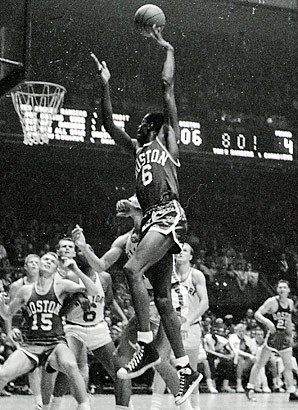
Bill Russell is usually on the short list of players considered to be the best of all time, and most experts rank him among the top 4 players of all time, but my formula ranks him significantly lower. I mean no disrespect in ranking him this low, but when you look at the facts, it just makes sense.As I described earlier in my biography of Oscar Robertson, Russell played in an era of inflated statistics, so when you look at his career averages of 15.1 points and 22.5 rebounds per game, you must remember that those numbers are much higher due to the faster pace of the game and the lower shooting percentages that produced more available rebounds. If you adjust his stats for deflation to today's rates, his career numbers would be 12.1 points and 13.3 rebounds per game. That would still place him among the greatest rebounders of all time, but makes him quite mediocre offensively.In order to be considered one of the all-time greatest players, a player needs to be exceptional in multiple facets of the game, whether it is offense, defense, longevity, or winning. Russell was a subpar offensive player, shooting just 44% from the field and 56% from the line for his career, and his longevity was decent at 13 seasons. Russell is, however, one of the game's greatest defensive players, and if blocked shots had been counted during his career, it may have been possible to rank him higher, but there is no way to prove what he did during those years.When it comes to winning, there was no one better. In his 13 seasons in the NBA, he won 11 NBA Championships. The two times he didn't when occurred when he was injured and unable to compete or worn out from his first season as both a player and a coach. Of those 11 title teams, Russell was the best player on 8, the famous 8 consecutive titles that covered most of the 1960's. During their first title run the Celtics were still Bob Cousy's team, and by the time they won their final two titles they had become John Havlicek's team. The Finals MVP award did not exist during his career, but if it had, he would have deserved to win it eight times, and in recognition of that the NBA renamed the Finals MVP award after him in 2009.There are only 4 players in history who can claim they were the best player on at least 3 consecutive title teams: George Mikan, Bill Russell, Michael Jordan, and Shaquille O'Neal. There are only a few others who can even claim they were the best on 3 total, such as Bird, Magic, Duncan, Havlicek, and LeBron. Besides those titles in the NBA, he also won a gold medal in the 1956 Olympics, as well as 2 national championships in his final two years at the University of San Francisco. So despite his shortcomings on the offensive side of the ball and his average longevity, Russell will always have a place among the game's greats.
Hakeem Olajuwon
Hakeem Olajuwon is undoubtedly one of the greatest centers of all time and easily the best modern defensive center the NBA has seen. He is the best player who was not born as a United States citizen, and he peaked at exactly the right time, which allowed him to win a couple of championships and cement his place as one of the all-time greats.Hakeem grew up primarily playing soccer in his native Nigeria, but when he was introduced to basketball as a teenager, he knew he had found his calling in life. He was only offered a spot on one college team, at the University of Houston, and after a couple of years training with local pro and NBA MVP Moses Malone, Olajuwon led the Cougars to two consecutive national championship games before being drafted by the Houston Rockets as the #1 pick in the NBA Draft, two spots ahead of Michael Jordan.The Rockets started seeing success pretty quickly, making it to the NBA Finals in Hakeem's second season, where they lost to the Boston Celtics, whose 1986 team is regarded as one of the greatest teams in history. It looked like the Rockets were going to be a force for years to come, but because of a series of injuries to Ralph Sampson and their inability to get any decent players to play with Olajuwon, Houston suffered through several disappointing seasons.Everything finally came together in 1993-94, beginning with the retirement of Michael Jordan in the offseason. Olajuwon took advantage of the hole left at the top of the league and had one of the most impressive seasons in history, becoming the only player ever to win the regular season MVP, Finals MVP, and Defensive Player of the Year Award in the same season.The next year, things didn't look quite as good, with David Robinson and the Spurs dominating the regular season and Olajuwon dealing with some health issues near the end of the year, but with a late-season trade that brought college teammate Clyde Drexler to town, the Rockets were able to become the lowest-seeded team in history to win the NBA Finals, and Olajuwon repeated as Finals MVP.Olajuwon is well-known as a great shot-blocker, and he still holds the record for most shots blocked in a career, although they have only been recorded for half of the league's history. Not only was he great at blocking shots, he was always among the leaders in steals as well, and in 1989 he became the only player in history to record more than 200 blocks and 200 steals in the same season. In fact, there have only been 8 seasons in which a player reached 150-150, and four of those belong to Olajuwon. He is definitely one of the greatest defensive players of all time.Olajuwon was also great on the offensive end of the court, averaging over 20 points per game for 13 consecutive seasons to start his career, and his moves in the low post have become legendary, especially his patented "Dream Shake," which involved numerous fakes and spins and allowed him to get a ton of easy shots near the hoop. He now hosts a camp each summer where he teaches footwork in the paint, and many NBA stars have trained with him, including Yao Ming, Kobe Bryant, and LeBron James.What really made Olajuwon great is that he stepped up his game when it mattered most, especially against the toughest competition. During his two championship seasons, he outplayed David Robinson, Shaquille O'Neal, and Patrick Ewing in the playoffs, and also beat teams led by Karl Malone and Charles Barkley. When Robinson won the regular season MVP in 1995, Olajuwon made a point of completely dismantling him in the Western Conference Finals, and Robinson was never the same player again.The thing that held him back from making the all-time top 10 was that his three-year peak was relatively short for a great player, and happened to coincide nicely with Jordan's first retirement, then abruptly ended when Jordan returned. He played in an era with many other great centers, and he was the best of any of them during his peak years, but he was only one of the top 5 players in the league for 5 seasons, which was a relatively short period, especially when compared to the players that make up my top 10.
Dwyane Wade
Dwyane Wade is one of the greatest players still active in the NBA, at #2 among currently active players, and he has the accolades to prove it. He is an Olympic Gold Medalist, three-time NBA Champion, former scoring leader, and Finals MVP. In his thirteen seasons in the NBA, he has ranked as one of the top 5 players seven times.Wade's career highlight came in his third season, when he led the Heat to their first NBA Championship as the team's best player, which earned him the Finals MVP award. John Hollinger rated his performance as the best in NBA Finals history, even better than anything that Michael Jordan ever did. Here are his numbers from those playoffs:Wade - 28.4 pts, 5.9 reb, 5.7 ast, 2.2 stl, 1.1 blk, .497 FG%, .378 3P%, .808 FT%In addition to the overall totals, Wade had some amazing performances in the Finals. In three straight games he scored at least 36 points, all leading to Heat victories, which were much needed after they began with an 0-2 deficit. There was no doubt that Wade was the reason they were able to overcome the Mavericks and win the title, even with Shaq, the most dominant player of the previous decade, playing beside him.Wade spent a good portion of the next two season on the injured list, leading many to think that he was destined to become the next Penny Hardaway rather than the next Michael Jordan, but he bounced back strong, missing six games or fewer in each of the next three years and ranking in the top 5 players in the league for 5 straight years.In 2010, Wade relinquished his role as the best player in Miami in order to bring LeBron James into the fold, and the move paid off, as Miami finally returned to the NBA Finals, losing in six games in a rematch with the Dallas Mavericks. Although he was only the #2 player on his team, he was also the #2 player in the league during the regular season, behind only LeBron, although in the playoffs, Wade regained his role as the best Heat player and was the biggest reason for their run to the Finals. Here are his and LeBron's stats for the regular season and the playoffs:Wade (Regular) - 25.5 pts, 6.4 reb, 4.6 ast, 1.5 stl, 1.1 blk, .500 FG%, .306 3P%, .758 FT%Wade (Playoffs) - 24.5 pts, 7.1 reb, 4.4 ast, 1.6 stl, 1.3 blk, .485 FG%, .269 3P%, .777 FT%James (Regular) - 26.7 pts, 7.5 reb, 7.0 ast, 1.6 stl, 0.6 blk, .510 FG%, .330 3P%, .759 FT%James (Playoffs) - 23.7 pts, 8.4 reb, 5.9 ast, 1.6 stl, 1.2 blk, .466 FG%, .353 3P%, .763 FT%Overall, Wade played at almost exactly the same level in the playoffs as during the regular season, while James saw large dips in both scoring and shooting percentage, both very important categories for a team's leading scorer. The following season he was nearly as good, and this time the Heat were able to get it done in the playoffs, with LeBron earning his first title while Wade got his second, with a scoring average of more than 20 points per game in both the regular season and the playoffs.
He was still a decent player on the next year's championship team, earning a third title while LeBron got even better. They reached the Finals again the next season, but Wade's contributions had decreased, although he was still a solid star player. He has continued to score over 19 points per game, which he has done for 12 straight seasons. In all, he has reached 5 NBA Finals, with 4 of those coming while he was a superstar, and three of those coming with rings.
Kevin Garnett
Kevin Garnett is one of four active players to appear among the top 20 players of all time, and even though he is built like a praying mantis, he was a force in professional basketball for 18 seasons, and he is still playing into his 22nd season, making him by far the most experienced player remaining in the league.Garnett was a major trail blazer for the current generation of NBA stars, jumping straight to the league from high school, the first player in 20 years to do so, but his success caused many to follow in his footsteps, from future stars like Kobe, LeBron, and Amare to busts like Korleone Young, DeSagana Diop, and Kwame Brown. Three of the four active players among my top 20 did not attend college, and who knows if that would have happened without Garnett taking a risk in 1995.Garnett was drafted by the Minnesota Timberwolves, and it is because of him that the franchise even has any history to celebrate. They made the playoffs for the first time in Garnett's second year, which started a string of 8 consecutive playoff appearances, since which they have not returned to the postseason. Garnett was the team's best player every time they made the playoffs, and during that run he missed a total of 11 games, an incredible feat for a player who looks so fragile.The eighth year of that run was a magical one for Garnett and the Timberwolves. It was the only time in franchise history that the Wolves won a playoff series, and they actually won two of them, advancing clear to the Western Conference Finals, where the Lakers dispatched them on their way to a three-peat. Garnett was named the MVP that season, and there is absolutely no doubt in my mind that he deserved it. In my opinion, the only more dominant season in the last 20 years was Shaq's 2000 campaign. Here is a comparison of Garnett and Kobe Bryant, his nearest competitor, from that season:Garnett - 24.2 pts, 13.9 reb, 5.0 ast, 1.5 stl, 2.2 blk, .499 FG%, .791 FT%Bryant - 24.0 pts, 5.5 reb, 5.1 ast, 1.7 stl, 0.4 blk, .438 FG%, .852 FT%I don't think I even need to do any explanation as to why Garnett was the MVP, because the numbers do the talking. In NBA history, there have only been six times that a player has matched Garnett's scoring, rebounding, and assists numbers from that season in any single year. It was done by Wilt three times, Kareem twice, and Elgin Baylor once. The most recent of those seasons was Kareem in 1976, and it hasn't been done by anyone but Garnett since.After that season the Timberwolves sank back into mediocrity, with Garnett toiling away as a superstar on a bad team, until the summer of 2007, when he was rescued by the Boston Celtics, who had decided they wanted to pursue a championship, since it had been over a decade since they had really tried, and with Garnett leading the way, Boston won their first title in over two decades. Paul Pierce was named the Finals MVP, but I think the award should have gone to Garnett, and here are the stats from the playoffs to back up my point:Garnett - 20.4 pts, 10.5 reb, 3.3 ast, 1.3 stl, 1.1 blk, .495 FG%, .810 FT%Pierce - 19.7 pts, 5.0 reb, 4.6 ast, 1.1 stl, 0.3 blk, .441 FG%, .802 FT%Okay, now I'm no expert (well, maybe I am), but when one player is better in 6 of 7 statistical categories, and the other is reasonably close, that player is better, especially since being teammates eliminates the pace factor from the argument. Garnett was the MVP of the 2008 Finals, but Celtics fans helped select Pierce because he stuck with the team through the tough times.Two years later, Boston returned to the NBA Finals, but this time Garnett was no longer the star, his body having finally worn down after playing over 1100 games in the NBA, but he was still one of the team's leaders, and he earned that second trip to the Finals, something very few superstars have gone without. In his career, Garnett won a championship, an MVP, and a Defensive Player of the Year award. He's a great all-around player, and he finally got to prove he was a winner while he was still a relevant superstar.
David Robinson
David Robinson was one of the most impressive physical specimens to ever take the court to play basketball, and at one point he was widely considered to be the successor to Michael Jordan as the superstar of the NBA. According to Bill Simmons, "if we ever start cloning basketball players someday, Jordan, LeBron and Robinson will be one-two-three in some order."Robinson was so highly though of early in his career that when the time came to pick the players for the first Dream Team to compete in the 1992 Olympics, Robinson was the committee's unanimous #4 choice, behind only Jordan, Bird, and Magic. At that point, Robinson had completed only 3 season in the NBA, during which time he had been named the unanimous Rookie of the Year, Defensive Player of the Year, and two-time All-NBA First Team and All-Defensive First Team center.Robinson's peak corresponded with Michael Jordan's first retirement, which made many believe that he would become a completely dominant force and start to make a collection of MVP's and NBA titles, but Hakeem Olajuwon took advantage of Jordan leaving and finally earned two titles of his own before MJ returned. From 1994-96, Robinson was easily one of the top 3 players in the league, but was never the unquestioned superstar. Here are his stats compared with other top players from those seasons:Robinson (1994) - 29.8 pts, 10.7 reb, 4.8 ast, 1.7 stl, 3.3 blk, .507 FG%, .749 FT%Olajuwon (1994) - 27.3 pts, 11.9 reb, 3.6 ast, 1.6 stl, 3.7 blk, .528 FG%, .716 FT%Robinson (1995) - 27.6 pts, 10.8 reb, 2.9 ast, 1.7 stl, 3.2 blk, .530 FG%, .774 FT%O'Neal (1995) - 29.3 pts, 11.4 reb, 2.7 ast, 0.9 stl, 2.4 blk, .583 FG%, .533 FT%Robinson (1996) - 25.0 pts, 12.2 reb, 3.0 ast, 1.4 stl, 3.3 blk, .516 FG%, .761 FT%Jordan (1996) - 30.4 pts, 6.6 reb, 4.3 ast, 2.2 stl, 0.5 blk, .495 FG%, .834 FT%None of those seasons had a clear top player, but in each case I would place Robinson one step below his nearest competition due to their higher level of playoff success in those seasons. His peak came to an abrupt end the next season, when back and foot injuries limited him to only 6 games and caused the Spurs to miss the playoffs for the first time since his arrival.In a way that season was also a blessing in disguise, as their horrible record earned them the top pick in the NBA Draft, which gave them Tim Duncan, the perfect complement to Robinson on the inside. That combination gave the Spurs their first two championships, the first with Duncan narrowly edging Robinson for the Finals MVP, and the second coming by a much wider margin.One of the signature moments of Robinson's career came on the closing day of the 1994 season, when he and Shaq were in a tight race for the scoring title in the first season someone besides Michael Jordan was sitting at the top in 8 years. Shaq had put up 32 points earlier in the day, so Robinson knew exactly what he needed to do, and he had the perfect opponent, the Los Angeles Clippers. He scored 71 points that day, destroying Gervin's old team record of 63 and taking the scoring title on the very last day.
Patrick Ewing
Patrick Ewing is remembered for never having won an NBA title, but he was one of the top centers in the entire league for a decade, and he never missed more than 6 games in a season over that span, during which the New York Knicks made the playoffs every year with Ewing as their star player.Ewing hit his peak in 1989-90, when he ranked as the third-best player in the entire league and the top center, falling behind only Michael Jordan and Charles Barkley in overall value. He was 27 years old at the time, and he appeared to be the next dominant center, although he never did dominate the game the way many expected. Here are his stats from his best season:Ewing - 28.6 pts, 10.9 reb, 2.2 ast, 1.0 stl, 4.0 blk, .551 FG%, .775 FT%You read that right. Besides averaging over 28 points and 10 rebounds every night, he was blocking 4 shots on average in every game. From there he kind of plateaued, maintaining his standing as one of the top 10 players in the league, but falling behind fellow centers David Robinson, Hakeem Olajuwon, and Shaquille O'Neal in production. Overall, he was still very impressive over the six seasons from 1989-1995, and those stats are below:Ewing - 25.3 pts, 11.3 reb, 2.3 ast, 1.0 stl, 2.8 blk, .515 FG%, .749 FT%That is what the Knicks were able to expect from Ewing every night for 6 straight years, quite impressive considering that no center today comes close to those numbers in a single season. For all the numbers he put up and all the seasons that they made the playoffs, Ewing still never saw big playoff success. The Knicks won their first round series nearly every season, but lost in the second round almost every time. The only two exceptions were 1993 and 1994, when they made the Eastern Conference Finals once and the NBA Finals after that, where they were beaten in 7 games by Houston.Ewing hung around for a long time after his peak, but became less and less effective and was no longer the focal point of the Knicks' team, so when he finally made it back to the NBA Finals in 1999, he was more of an afterthought on a team featuring Latrell Sprewell, Allan Houston, and Marcus Camby. He never did get that elusive ring, which is the biggest reason that he's only at #34 all time.
Vince Carter
In Bill Simmons' The Book of Basketball, he uses his entire section on Vince Carter to complain about how Vince Carter would have been a better player if he had just cared more, and he has a point, which I will show you later, but when he was healthy and motivated, he showed the potential to be one of the best players of all time.Vince Carter averaged over 20 points per game for 10 consecutive seasons, and he also averaged over 4 rebounds and 3 assists for that entire time as well. In his best season, 2000-2001, he averaged 27.6 points per game, fifth in the league, while averaging 5.5 rebounds and 3.9 assists as well. That year he also took Toronto to their first playoff series win, playing just as well in the playoffs as the regular season. That season, the only player in the league who was definitely better than Vince was Shaq, who had hit his prime.Unfortunately, Carter was slowed by injuries over the next two seasons, and Toronto's momentum slowed, causing Vince to decide he didn't want to try anymore. He finally gave up in the beginning of the 2004-05 season, showing so little effort that it came as no surprise when he admitted after a trade to New Jersey that he hadn't been trying in Toronto. Here are his pre- and post-trade stats for that season:Carter (TOR) - 15.9 pts, 3.3 reb, 3.1 ast, .411 FG%, .322 3P%, .694 FT%Carter (NJN) - 27.5 pts, 5.9 reb, 4.7 ast, .462 FG%, .425 3P%, .817 FT%The fact that he tanked that badly was so shameful that if I wasn't basing this top 100 on statistics and winning, I would have moved him down several spots. He is one of the most selfish players of all time, which is the reason he has seen so little playoff success. When he reached New Jersey, they immediately stopped competing for championships. The same thing happened in Orlando and Phoenix. Coincidence? Probably not.There is no doubt that Vince Carter is a great player. His career scoring average is still over 18 per game. He has a highlight reel full of amazing dunks. He could do anything on the offensive end, but he could have been so much more. Even considering all of that, is it so bad to be one of the 50 greatest players of all time? I guess not.