Tamara Vasilyevna Lazakovich was born on March 11, 1954 in Gusevo, USSR (currently part of Russia), and was raised in what is now Belarus. She began gymnastics at age 6, and was quickly noticed and taken into training. By the time she was 16 she had made the Soviet national team, and she won 5 medals at the 1971 European Championships.
She was part of a strong Soviet team that went to the 1972 Olympics in Munich. They had won the past 5 Olympic gold medals in the team event, and 1972 was no different. The team had the highest scores in 3 of the 4 portions of the event, falling slightly behind East Germany in the Uneven Bars, but they outscored the East Germans by 3.95 points to win their 6th gold medal in a row as a nation.
In the individual all-around, the top 26 competitors from the team event were selected to compete, with half of their score coming from their performances in the team event, and the rest coming from another round of the same events. Lazakovich qualified in 4th place, behind Karin Janz of East Germany and 2 Soviet teammates, but after Olga Korbut fell twice on the uneven bars, Lazakovich was able to move up and take the bronze medal.
In the individual event finals, the top 6 were taken for each apparatus from the team event to compete for the medals. Lazakovich qualified for 3 finals, just missing out in uneven bars, where she finished 7th. She qualified 3rd in the floor exercise, behind the same two teammates, but Olga Korbut had the best final and moved up to gold over Lyudmila Turishcheva, while Lazakovich held her position for bronze, a medal sweep for the USSR.
In the vault, she was the final qualifier to make the final, and her score in the final was lower than the others, so she remained in 6th. She was the top qualifier in the balance beam, and even improved on her score in the final, but Korbut had another great performance, which pushed her ahead of her teammate, leaving Lazakovich with the silver.
She suddenly retired immediately after the Olympics, and while no official reason was ever given, the rumor is that she tried to defect to West Germany after the Olympics, but was caught, so the Soviets refused to let her compete internationally again. She worked for many years as a gymnastics coach, but she was unhappy with her life, which led to alcoholism, which led to her early death, on November 1, 1992 in Vitebsk, Belarus. She only appeared in the Olympics once, but finished in the top 7 of every one of her events, and won 4 medals. Even though it's a small sample, she still proved herself to be one of the greatest Olympians of all time.
Valarie Carolyn Allman was born on February 23, 1995 in Newark, Delaware, and grew up in Hershey, Pennsylvania. While attending Stanford, she participated in the World Junior Championships as a freshman, and took a silver medal in her first major international competition.
Though she had never won a major international competition before competing in the 2020 Olympics, she was considered one of the favorites, as she had been able to beat the other favorites in some recent meets. Her throw of 66.42 meters was the best in the qualifying round, and she opened the final with a throw of 68.98, which stood up for the rest of the day, and she won gold by more than 2 meters.
Before her Olympic win, she had never won a medal at the World Championships, but in the next two years, she won bronze and then silver. This made her the favorite heading into the 2024 Olympics, along with Feng Bin, who had won the 2023 World Championship. She took only 1 throw in qualifying, but it was more than enough, with 69.59 meters beating all others by more than 4 meters.
In the final, she completed 4 throws, each traveling more than 68 meters, a mark no one else reached in the entire competition, meaning that Allman's five throws were the 5 longest of the Olympics. She easily won her second straight gold.
In 2025, she won her first World Championship, and also set a new national record with a throw of 73.52 meters in April. Earlier this year, she married Zeb Sion, her longtime coach. She has only competed twice in the Olympics so far, but won both by a big margin, and she only appears to be getting stronger, so she could climb even higher among the ranks of the greatest Olympians of all time.
Alexandra Rose Raisman was born on May 25, 1994 in Needham, Massachusetts. Her mother had been a gymnast in high school, and got her started in gymnastics almost as soon as she could walk. After her junior year of high school, she was part of the gold medal-winning team at the World Championships, and she completed her senior year online in order to train for the 2012 Olympics.
The first event in London was the Individual All-Around, which allowed a maximum of 2 athletes per country into the final. Jordyn Wieber was the defending world champion and was expected to win, but she finished 3rd among the Americans, and 4th overall in qualifying, so Gabby Douglas and Raisman went to the final. Douglas ended up winning the gold, while Raisman tied for third, but lost the bronze medal in a tiebreaker to Aliya Mustafina of Russia.
Having 3 of the top 4 scores in qualifying gave the USA the best overall score entering the team competition, and they ended up running away with the gold, more than 5 points ahead of Russia. Raisman put up the best overall score in floor exercise and a solid performance in balance beam, as the USA had the best overall score in 3 of the 4 parts.
Raisman qualified for 2 event finals, the balance beam and the floor exercise. In the balance beam, she qualified fifth, and she was the final athlete to compete, and when the scores were announced, she was in 4th, but her coach appealed her difficulty score, and upon review, her score was raised by 0.1, which put her into a tie for 3rd, which she won on a tiebreaker to get the bronze she missed in the all-around.
In the floor exercise, she was the top qualifier by 0.26 points, and even though she went third, she left no doubt that she would win the gold medal. Her routine had the highest difficulty score of any competitor, but she also earned the best execution score, and she ended up winning the gold medal by a margin of 15.6 to 15.2 over the nearest competitor.
She was injured soon after the Olympics, and spent 2 years working her way back to make sure she was ready to compete again at the highest level, and upon her return, it was clear that she was ready, and she immediately made the national team again. The team repeated as world champions in 2015, heading into the 2016 on a high note.
In the 2016 individual all-around, Gabby Douglas missed out on the final even though she was #3 in qualifying, because the two ahead of her were Americans Raisman and Simone Biles. In the final, Biles had the best score in three of the four sections, and Raisman was #2 in the same 3 events, putting those two far ahead of anyone else for the gold and the silver.
In the team event, the Americans were huge favorites due to having the top 3 qualifiers. Raisman was jokingly nicknamed "Grandma" by her teammates, due to her being the oldest on the team at 22. Raisman performed in 3 events in the final, and the USA had the best score in all 4 portions of the event, giving them a runaway gold medal, more than 8 points ahead of Russia.
She only qualified for one event final, the floor exercise, where she was the defending champion. Her final score ended up almost as high as in the previous Olympics, but Biles' difficulty score was so high that she took the gold by almost 0.5, with Raisman taking the silver.
She didn't compete again after the 2016 Olympics, but didn't officially retire until early 2020. Her 6 total Olympic medals are the third most by an American gymnast, and she very nearly had a 7th one. She was a master at the floor exercise, and twice finished among the top 4 in the individual all-around, making her one of the greatest Olympians of all time.
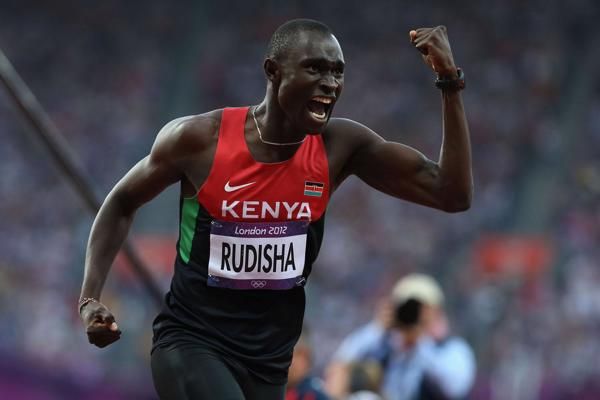
David Lekuta Rudisha was born on December 17, 1988 in Kilgoris, Kenya, the son of Daniel Rudisha, who had won a silver medal for Kenya in the 1968 Olympics. Like his father, he chose to run in the middle distance races, though his father favored the 400m, while David became a specialist in the 800m.
When he was 21 years old, he broke the world record in the 800m, which had been held by Wilson Kipketer, a Kenyan-born Danish runner, for 13 years, and then broke it again a week later. He went on to win the Kenyan Olympic trials in 2012, earning himself his first shot at the Olympics.
At the Olympics, he won what is considered the greatest 800m race of all time. Rudisha led the entire way, and by the end he had set a new world record of 1:40.91, the first, and so far only, time in history that a runner had gotten under 1:41. All three medalists beat the old Olympic record, 3 runners set new national records, and 7 of the 8 finalists set new personal best times. All 8 finalists ran faster than the previous 3 gold medal times.
Rudisha sat out most of 2013 with an injury, but came back mostly healthy in 2014, and by 2015 he had won the World Championship in the 800m. He qualified again for the Olympics, but this time his teammate, Alfred Kipketer, led most of the race, with Rudisha staying close behind. Just before the final curve, Rudisha pulled ahead, then sprinted for the finish, winning by nearly half a second to successfully defend his gold medal, becoming the first to achieve that since 1964.
He was very unlucky over the next several years. He was in a car crash in 2019, then was injured in training in 2021, forcing him to miss the Olympics, then was in a plane crash in 2022, where he was one of only 5 survivors. He has since retired from competitive racing. Though he only ran two races in the Olympics, his world record time from 2012 still stands, and he has held the world record continuously for the past 16 years, and has the three fastest times of all time, all of which helps to make him one of the greatest Olympians of all time.
Agnes Edit Klein was born on January 9, 1921 in Budapest, Hungary, and began training in gymnastics at the age of 4. By age 16, she was the Hungarian National Champion, and was expected to compete in the 1940 Olympics, but those and the 1944 Olympics were not held due to World War II. Also as a result of the war, Agnes changed her surname to Keleti in order to sound less Jewish, and she lost her father in the Auschwitz concentration camp.
After the war, she returned to competition, and qualified for the 1948 Olympics, but was injured shortly before the games started and was forced to sit out again. By the time 1952 came around, Keleti was already 31 years old, far older than most Olympic gymnasts, but she still made the team and went to Helsinki to finally make her Olympic debut.
In her first Olympics, Keleti won her best event, the floor exercise, which gave her her first gold medal, and she also finished in bronze position in the uneven bars, giving her a pair of individual medals. She also came in 4th in the balance beam, all of which combined to put her in 6th place in the individual all-around, with her poor score in the vault dragging her down.
In the team all-around event, the Soviet Union won in their first ever Olympic appearance as a nation, and they would never lose the event in an Olympics in which they participated. Hungary, led by Keleti and Margit Korondi, won the silver medal. They had the best overall score in the floor exercise, and were #2 in the other 3 events, behind the USSR in each.
The final event that year was the team portable apparatus, which is similar to what is known as rhythmic gymnastics today, with the full team dancing around with ribbons, balls, hoops, etc. The Hungarian team performed well, finishing with the bronze medal, giving Keleti 4 total medals at her first Olympics.
Though she was already beyond the normal age for a gymnast, Keleti continued to compete, and again made the team for the 1956 Olympics. This time, she won gold in 3 individual events, the floor exercise, uneven bars, and balance beam, but finished 23rd in the vault, always her worst event, which meant that she finished with the silver medal in the individual all-around, even though she was the best in 3 of the 4 events.
Just as in the previous Olympics, the USSR took the gold medal in the team event, but this time Hungary made it really close, losing by just over a point, with Keleti contributing the highest score. After that, the team portable apparatus event was held for the final time, and this time Hungary was able to take the gold, just ahead of Sweden, who had won 4 years earlier. This gave Keleti 4 golds and 2 silvers at age 35, making her the oldest female gymnast ever to win gold.
Just before the 1956 Olympics, the USSR invaded Hungary, and as a result, Keleti decided not to return from Melbourne. The next year, she emigrated to Israel, where she competed for a couple more years before retiring and becoming a coach for the next 30+ years. She eventually returned to Hungary in 2015.
In 2019, she became the oldest living Olympic champion, then celebrated her 100th birthday in 2021. In 2023, she became the oldest Olympic champion in history, and she finally passed away on January 2, 2025 in her hometown of Budapest, just a week short of her 104th birthday. Even though she got a late start to her Olympic career, she was amazing when she finally competed, winning 5 golds and 10 total medals, and she is definitely one of the greatest Olympians of all time.
Marianne Vos was born on May 13, 1987 in 's-Hertogenbosch, the Netherlands, and began racing bicycles when she was 6 years old, tagging along with her older brother. She was allowed to train with her brother's team, but was not allowed to compete because she was too young at the time, but as soon as she turned 8, she joined the races as well, and when she was 15, she won her first national championship.
She is primarily a road cyclist, but in 2008 she qualified for the Beijing Olympics in both road and track cycling. In the road race, two dozen riders remained together until the last lap, when 5 riders broke away from the pack. Vos remained with the main pack, and was the first of the pursuers to cross the finish line, getting her a 6th place finish. The individual time trial was next, held on the same course as the road race, but consisting of a single timed lap by each rider. Vos finished near the middle of the 25 riders, just over 2 minutes behind the gold medal time.
Next, she competed in the track cycling points race, where she was the current world champion. The race consists of 100 laps of the track, with every 10th lap being a sprint, where the first 4 finishers are awarded points, and the racer with the most points at the end winning gold. She won the first sprint, and by the halfway point was solidly in the lead. She held back during the 6th sprint lap, then took advantage of her tired opponents to take off ahead of the field, lapping everyone, which earned her 20 points, which was equivalent to winning 4 sprints. After that, she only needed to finish the race to earn gold.
She fractured her collarbone during a race in May 2012, two months before the Olympics, and took over a month off to recover, then competed in the Dutch Olympic trials to make the road racing team. She had been the runner-up at the last 5 world championships in road racing, but was considered the favorite in London.
The pack all stayed together through the first 100km of the race, but with 40km to go, a Russian rider attempted to break away from the pack. Vos and two other riders followed, creating a breakaway pack of 4 riders. The American punctured a tire soon afterward, and the three leaders were left to compete for the medals. As the finish closed in, Vos and Lizzie Armitstead of Great Britain pulled slightly ahead and sprinted for the finish, with Vos winning by a nose, and the majority of the racers coming across the line 27 seconds later. Vos now had a gold medal in each of her cycling disciplines.
She competed in the time trial a few days later, but finished in the middle of the pack, just like 4 years earlier. She took some time off in 2015 and 2016, but returned to compete in the 2016 Olympic road race, but this time, she fell behind the first two packs of riders, and ended up finishing 9th, more than a minute behind the winner.
She competed again in 2020, which saw 5 riders break away from the pack only 2 km into the race, which was rare. Vos stayed with the main pack, which eventually fell more than 10 minutes behind the leaders. With 40km left, a rider from Austria broke away from the leaders and built a huge lead, while Vos and the rest of the pack caught up with the others breakaway riders. In the end, Vos ended up in 5th place, her 4th straight top 10 finish in the event in the Olympics.
She raced in her 5th Olympics in 2024, again just in the road race. With 22 km remaining, she was one of 3 riders to break away from the pack, one of which dropped back to the pack at the next big climb. Two other riders caught up soon afterward, and the four remained together until 3 km remained, at which point Kristen Faulkner of the USA pulled away from the others, who were unable to match pace, leaving 3 riders to fight for 2 medals. All three were even at the final sprint, but Vos was ahead by a tire at the finish, giving her a silver medal.
Vos is still actively competing in cycling events, and given her history of always finishing near the top in road races, there is no reason to believe that she won't continue to compete for Olympic medals, but what she has done so far has already made her one of the greatest Olympians of all time.
Iolanda Balas was born on December 12, 1936 in Timisoara, Romania, to Hungarian parents. Her father served in the Hungarian army during World War II and was captured by the Soviets, who eventually returned him to Hungary, where he was forced to stay. Balas and her mother tried to return to Hungary to reunite the family after the war, but were not allowed to leave by the Romanian government.
She began jumping at age 13, and by 1955, when she was 18 years old, she had set the world record with a jump of 1.75 meters (5'9"). She went to the 1956 Olympics in Melbourne as the favorite as a result, and easily cleared both heights in qualifying, along with 17 others jumpers. She was one of 6 jumpers to clear 1.64 meters without missing a jump, and one of 10 to clear the height eventually.
Only 7 jumpers were able to succeed at 1.67 meters, with 4 doing it on the first try, while Balas needed a second attempt. and 2 others made in on the third and final try. When the bar went up to 1.7 meters, only Millie McDaniel of the USA was successful, giving her the gold medal. She then had the bar raised to 1.76 meters, which she cleared on her second attempt to break Balas' world record. Because she had missed a jump on the previous height, Balas was awarded 5th place behind the jumpers who didn't need an extra attempt.
Balas took the world record back in 1958, becoming the first woman to reach 1.8 meters, and she was once again the favorite in 1960 in Rome. She was the last to start jumping that year, waiting until the bar was at 1.6 meters to take her first attempt, which she made easily. 15 jumpers cleared 1.65 meters to advance to the final round, but only 6 had made it without a miss.
The entire field cleared 1.65 again in the final, but 10 jumpers were unable to get to 1.68, leaving 5 jumpers, none of whom had missed yet. Three jumpers were successful on the first jump at 1.71, with another making it on her final attempt, but at 1.73, only Balas was successful, and she had her first gold, but she didn't stop there, going over at 1.77, then 1.81, and then 1.85, before failing at 1.87. Her new Olympic record jump was about 6'1", 6 inches higher than any other jumper in the competition.
The next year, she set another new world record of 1.91 meters (6'3"), which would not be broken for 10 years. She had a torn ankle tendon when the 1964 Olympics came around, but competed anyway. At that point she hadn't lost a single competition in 8 years, since her failure in her first Olympics, but she was seen as possibly vulnerable due to the injury.
15 jumpers cleared 1.68 meters to qualify for the final, but 3 dropped when attempting that height again in the final. One more was lost at 1.71, but the field really narrowed at 1.74, with 7 missing at that height. Balas skipped that height to nurse her injury, but made it over 1.76 on her first jump, along with Michele Mason Brown of Australia, with one other jumper making it on the final attempt.
All 3 were successful again at 1.78, but the Soviet challenger dropped off at 1.8. At 1.82, Mason-Brown was unable to clear, giving Balas a second straight gold medal, but she kept going despite her injury, clearing both 1.86 and 1.90 on the first try, setting a new Olympic record. She then attempted to break her world record by jumping 1.92, but missed on all 3 attempts. She had again beaten all of her competition by a big margin.
She sat out for the next few years due to injury before officially retiring in 1967, at which point she married her coach, Ioan Soter, and became a physical education teacher. If she had performed up to her potential in her first Olympics, she would have been much higher on this list, but as it stands, her two dominant gold medal wins still make her one of the greatest Olympians of all time.
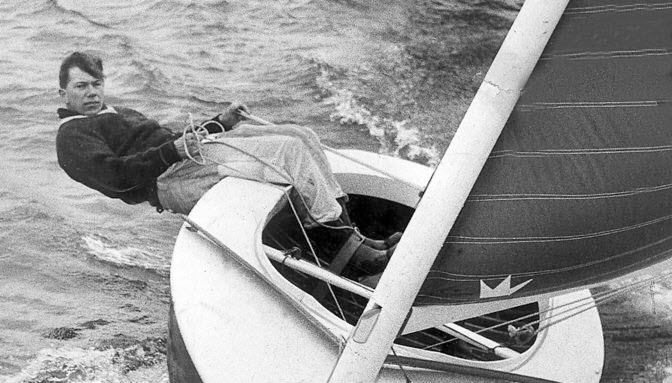
Paul Bert Elvstrom was born on February 25, 1928 in Hellerup, Denmark. His father was a sea captain who died when Paul was young. He lived right along the strait between Denmark and Sweden, and became obsessed with sailing from a very young age. A neighbor who recognized his talent and interest gave him his first boat.
His first Olympic appearance came in 1948, when he was just 20 years old. He competed in the one-person heavyweight dinghy, which used a boat called the Firefly that year, which was usually manned by two sailors. All competitors sailed in 7 races, with scores given after each race based on order of finish, and each sailor's worst race not counted.
Elvstrom got his worst race out of the way early, as he failed to finish the first race, resulting in no points scored. He improved over the next several races, and was in 8th place after the fifth race, but after winning the final two races, he pulled into the lead and walked away with a gold medal.
After the 1948 Olympics, 4th-place finisher Rickard Sarby of Sweden designed a new ship which he called the Finn, which was designed for a single sailor, and became the model used in the event starting in 1952. Elvstrom returned to defend his gold medal, and had an easy time of it, winning 3 of the first 4 races outright, which gave him a big enough lead that he could have skipped the final 3 races and still won the gold. Instead, he finished 3rd, 4th, and 1st in those three races and ended up with the largest win ever in the event.
He was expected to win again in 1956, and he started out well, winning the first race, but he struggled in the next two races, finishing in the middle of the pack in each, which left him in second place nearly halfway through. After that point, he figured it out, winning 4 straight races to run away with the gold medal yet again.
He returned in 1960 looking to make history. No Olympian had ever won the same individual event 4 straight times, and he was favored to be the first. He won 3 of the first 6 races, and finished in the top 5 in the others, leaving him with a large enough lead that he didn't need to compete in the final race, so he sat out and took the easy gold.
He skipped the 1964 Olympics, then made his return in 1968, but in a different event, the two-person keelboat, sailing with partner Poul Mik-Meyer. The pair remained in contention for a medal throughout the competition, and was in third place entering the final race, but they already couldn't reach gold at that point. Unfortunately, they finished 5th in that race, which put them in 4th place overall, leaving them just short of a medal.
In 1968, he competed in the three-person keelboat, which was shortened to 6 races due to the hostage situation in the Olympic village, but his team finished around the middle in the first two races, leaving them far behind the pack. They won the third race, which put them in 5th overall, but they dropped to 12th after race four, and after they bumped another boat in race five, resulting in a disqualification, and they refused to finish the event in protest.
He skipped the next two Olympic games, but returned in 1984 to compete in Los Angeles in the Multihull event, partnering with his daughter, Trine. They kept themselves in third place through the first four races, but then fell to 4th place after finishing #14 in race five, and remained there for the rest of the event, falling just short of a medal again.
The father-daughter pair returned for one final attempt at a medal in 1988, but they only finished in the top 5 in one race, and were never in medal contention. His Olympic career spanned 40 years, and he competed in 8 different games, and while he was in contention for medals late in his career, winning 4 straight gold medals in the same event made his one of the greatest Olympians of all time.
Laszlo Papp was born on Mar 25, 1926 in Budapest, Hungary, and began boxing at the age of 16. His training was interrupted soon afterward by World War II, but as soon as the war ended, he picked up his gloves again, and became one of the greatest boxers ever.
He made his Olympic debut in 1948 in London, and he made a big splash immediately. He knocked out his first opponent in the second round, then won on a TKO early in his next match, followed by a first-round knockout in the quarterfinals. His next two fights were a little tougher, but he still won both in unanimous decisions, with the final coming over Johnny Wright, who was in front of his home crowd.
In 1952, new weight classes were added to the Olympic boxing schedule, allowing Papp to fight in the light middleweight division instead of middleweight, where he had won in 1948. He started out dominant again in Helsinki, with two straight second-round knockouts to open the tournament, followed by 3 straight unanimous decisions to give him his second straight gold medal.
The field in Melbourne in 1956 was much smaller, and Papp was a big favorite to win again, which would make him the first boxer ever to win 3 gold medals. After a first-round bye, he knocked out his first opponent in the third round, then defeated the defending European champion by unanimous decision in the semifinal. He faced Jose Torres, an American from Puerto Rico, in the final, and won again by decision, but for the first time it was not unanimous, but it didn't matter, as Papp had made history with his 3rd gold medal.
Turning pro was not allowed in communist Hungary, so when Papp turned pro in 1957, he did all of his training and fighting in Austria. He fought 29 professional fights over the next 7 years, never losing a single fight, before Hungary revoked his visa, ending his pro career, making him one of the few fighters to ever retire without a loss.
It may have been a long time ago, but Papp was completely dominant right up until his final Olympic bout, winning nearly half of his bouts by KO or TKO. He was the first boxer ever, and one of only 3 so far, to win 3 Olympic gold medals, and is definitely one of the greatest Olympians of all time.
Mario Cesar Kindelan Mesa was born on August 10, 1971 in Holguin, Cuba, and began boxing at a young age, then began boxing in international tournaments in 1993, winning the Caribbean Games title that year. He went on to win his first World Championship in 1999, which was near the beginning of a winning streak that lasted more than 5 years.
He entered his first Olympics in 2000 as a big favorite in the lightweight division, having won every major tournament in the past 2 years, and he won all 4 of his bouts easily, including a TKO in the second round and a 14-4 domination in the gold medal match.
He didn't lose a single match between the 2000 and 2004 Olympics, including World Championship victories in 2001 and 2003, plus wins at the Goodwill Games and the Pan Am Games. He was already a heavy favorite heading into Athens when he got more good news: the silver medalist from the 2003 World Championships did not qualify for the Olympics.
His path to the gold medal match in 2004 was extremely smooth. After a first round TKO, he won each of his next three bouts by double digits, setting up a showdown with Amir Khan, a 17-year-old British phenom who had been just as dominant so far. The match was the closest that Kindelan faced in 2004, but he still won handily, 30-22, taking his second Olympic gold.
He retired right after that match, with his 5-year winning streak intact. Turning pro is frowned upon in Cuba, so he never had any earnings from his boxing career, and years later, he attempted to sell his 2004 gold medal, but Khan stepped up and gave him $5000 and told him to keep the medal. Though he only competed in the Olympics twice, he won every bout easily, making him one of the greatest Olympians of all time.
Mijain Lopez Nunez was born on August 20, 1982 in Entronque de Herradura, Cuba, and began wrestling when he was just 10 years old. His older brother, Michel, was an amateur boxer who competed in the 2004 Olympics, winning a bronze medal.
Mijain also made his Olympic debut in 2004, competing in the super-heavyweight class of Greco-Roman wrestling, which was now considered wide open due to the retirement of Aleksandr Karelin, who had dominated for over a decade. The wrestlers were split into 6 pools of three to four wrestlers, with the winner of each pool advancing to the knockout round. Lopez beat both opponents in his pool without surrendering a point, but lost 2-0 in the next round to Khasan Baroyev of Russia, the eventual gold medalist. It would be the only loss of Lopez's Olympic career.
He won the World Championship in both 2005 and 2007, losing to Baroyev in 2006, so the winner was expected to be one of the two. Lopez won each of his three matches by at least 3 points, setting up a showdown with Baroyev for the gold, but Lopez dominated him, winning 6-1 to win the gold medal. Several years later, Baroyev's sample from 2008 tested positive for PEDs, and his silver medal was taken away.
Lopez won the next 2 World Championships, but came in second in 2011, right before the next Olympics, to Riza Kayaalp of Turkey. Although both men who had previously beaten him were competing in 2012, Lopez was still a big favorite, and he cruised to the final match without giving up a point, beating Kayaalp in the semifinal. Baroyev lost early, so Lopez faced Heiki Nabi of Estonia, who had just moved up from heavyweight class, for the gold, and won easily, 3-1, to successfully defend his gold medal.
Lopez and Kayaalp's rivalry grew over the next few years, as they faced off in the World Championship final in both 2014 and 2015, with Lopez victorious first, and Kayaalp the next year. By 2016, they were expected to meet again with Olympic gold on the line, and that's exactly what happened, with neither one giving up a point before the final. The final, though, belonged to Lopez, who beat his rival 6-0 to take his third straight gold, only the second wrester ever to win 3 in a row, after Karelin.
Lopez failed to medal in the World Championships over the next few years, so when he went to Tokyo to defend his title again, he was not the favorite for the first time in a long time. That would be Kayaalp, who was defending World Champion again. Lopez won by shutout in his first two matches, setting up a rematch with the favorite, and just like last time, he shut him out, 2-0 this time. He went on to win the gold in another shutout, meaning he didn't give up a single point on his way to gold medal #4.
Lopez didn't compete in any international events over the next two years, but decided to return for the 2024 Olympics to try for an unprecedented 5th straight wrestling gold. He faced the favorite, Amin Mirzazadeh of Iran, in the second round, and beat him 3-1, clearing a path for another triumph. His final two matches were easier, and he won the gold medal 6-0 in the final match, making him the first Olympian in history to win gold in the same individual event 5 times.
Immediately after winning gold, Lopez removed his shoes and left them in the middle of the mat, a common practice among wresters to signify their retirement. He was just days short of his 42nd birthday at the time, and had just made history, so it was a perfect time to end his career as one of the greatest Olympians of all time.
Darrell Owen Pace was born on October 23, 1956 in Cincinnati, Ohio, and took up archery at the age of 13, and quickly became an expert, being named to the national team for the World Championships at age 16. After that, he won the national archery championship 4 years in a row., and won the World Championship in 1975, when he was 18.
Even though he was only 19 years old, he was the favorite to win gold in 1976 in Montreal. At the time, archery events consisted of 72 shots each at 4 different distances, ranging from 30 meters to 90 meters, with the highest overall score winning gold. Pace had the best score at each of the 4 distances to run away with the gold medal by 69 points, an absolutely dominant performance.
Pace won the American title again in both 1978 and 1980, and another World Championship in 1979, and was the favorite to repeat as gold medalist in Moscow, but America's boycott of those games prevented him from getting a second gold medal at the time.
By 1984, Pace had a challenger in Rick McKinney, a fellow American, who had beaten him for the World Championship in 1977 and 1983. It was expected to be a close competition, but Pace had a repeat of his previous Olympic performance, shooting the best score at each distance, and winning the gold by 52 points over McKinney, who took silver on his final shot.
Pace competed again in 1988 in Seoul, where the format for the event was changed. It began with a round of 36 arrows from each distance, with the top 24 advancing to the next round. After that, each round consisted of 9 arrows from each distance, with the field cut down to 18, then 12, then down to 8 for the final.
Pace took it easy in the first round, qualifying in 19th place, then squeaked through to the next round in 18th place. He tried harder in the quarterfinals, shooting the top score, but in the semifinals he came in 9th, just 2 points short of making the final, the first time he had failed to win the event. The eventual winner was a surprise: Jay Barrs, a fellow American.
He also competed in the team event in 1988, which was a new addition to the Olympics. 3 archers represented each country, with Pace being joined by Barrs and McKinney. The individual qualifying scores were used to rank the teams, with the USA entering the event seeded #2 behind the home team, South Korea.
12 teams competed in the first round, with each archer shooting 9 arrows at each distance, and the top 8 teams advancing to the final. America shot the best score in that round, while Korea took it easy, knowing they would make the final easily. In the final, the US had the best score in the 30m by 3 points over Korea, and held on to the lead over the next 2 distances, leading by 2 entering the 90m portion, but the Koreans outscored America by 16 in the final distance to take the gold, leaving the Americans with a silver.
Pace retired from competition after his 3rd Olympics. He was so far ahead of everyone else in the world during his two Olympic title runs that you can't help but wonder if he should have had a third gold medal, but even without it, he is one of the greatest Olympians of all time.
Veronica Angella Campbell was born on May 15, 1982 in Clarks Town, Jamaica, into a family of 10 children. She attended school in Jamaica up through high school, then move to the United States for college, first at Barton County Community College, then the University of Arkansas.
She made her first Olympic team at age 18, competing in the 4x100 m relay in Sydney. The USA was the favorite in the event, led by Marion Jones, and the Bahamas was defending World Champion, but with Campbell running the second leg, Jamaica posted the best times in each of the first two rounds. In the final, the Bahamas sprinted out to an early lead, and while Jamaica and the USA kept it somewhat close, they couldn't catch up, and Jamaica ended up with the silver medal.
By 2004 she was starting to come into her own. She qualified for 3 events in Athens, starting with the 100m. She won her first heat, then came in second in her next heat, just .01 second slower than her first race. She also came in #2 in her semifinal heat, but was only .01 second short of the fastest time, before running the final in 10.97 seconds, which earned her the bronze medal in her first individual Olympic event.
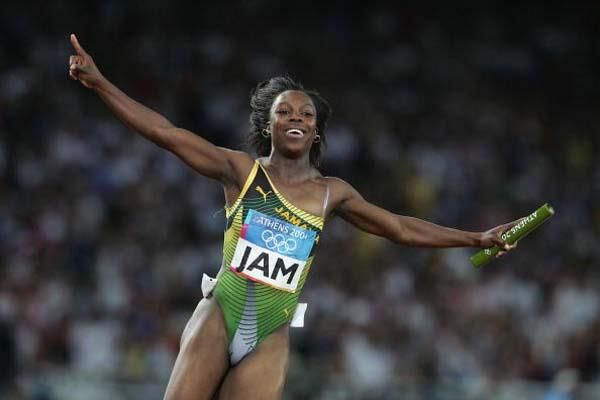
Next up was the 200m, an event she hadn't lost in 4 years, but mostly against college competition. She and Allyson Felix were considered the favorites, and Felix ran the best time in the first round, but Campbell had the best time in the final 3 rounds, including the final, where she pulled into the lead on the curve and never looked back, beating Felix by .13 seconds to win gold and become the first Jamaican woman to win an Olympic sprint title.
Her final event was the 4x100m relay, where the USA was again the favorite. The US ran the fastest time in the heats by far, but missed the second baton exchange, leaving Jamaica alone in the lead, and Campbell ran a great anchor leg with a big lead to give Jamaica the gold by more than half a second, the first time Jamaica had won the event.
In 2007, she married Omar Brown, another Jamaican sprinter, and also 3 medals in the World Championships, gold in the 100m, with silvers in the 200m and the relay. At the Olympic Trials, she finished 4th in the 100m, which meant she didn't qualify for the individual event, but she did qualify for the relay, and to defend her title in the 200m.
The 200m was far from a sure thing, as she had lost every race to Felix since beating her in the 2004 Olympics, including 2 World Championships, but she cruised through all 3 rounds of heats, including a quarterfinal where she finished just ahead of Felix. In the final, she was just to the left of Felix, giving her a clear view of her around the curve, where she was able to close the gap to take the lead as the headed into the straightaway, and then she maintained her lead to the tape, winning a repeat gold by .19 seconds, becoming just the second woman to win the event twice.
Jamaica was expected to dominate the 4x100m relay, since they had the three medalists from the 100m race, but Campbell-Brown running the anchor leg. The USA was their only possible competition, but they had a botched handoff in the heats, so Jamaica was running for the world record in the final, until they mistimed the first handoff and failed to finish the race.
In 2011, she won her first 200m World Championship, making her one of the favorites to win a third straight Olympic gold in the event. She started out the 2012 Olympics with the 100m, where the favorite was Shelly Ann Fraser-Pryce, the defending champion, also from Jamaica, and the event went just as expected, with Fraser-Pryce winning, and Campbell-Brown coming in with the third-fastest time in every round, earning a bronze medal.
Next was the 200m, where she was finally defending World Champion, and she cruised through the heat to advance to the semifinal, where she won a tough heat to advance to the final again. This time, it was Felix who had the best time on the curve and pulled away to win gold, while Campbell-Brown ended up in 4th place, half a second behind Felix's winning time.
After that disappointment, she joined the Jamaican team for the relay, where they were co-favorites with the USA, as long as the two teams were able to pass the baton cleanly, which they had each failed to do 4 years earlier. Jamaica looked to be in the lead after the first leg, but Felix pulled ahead by a bit before the halfway point. Campbell-Brown took the third leg for Jamaica, and made up some ground on the US, but they were still behind when Carmelita Jeter took the baton for the US and pulled away down the stretch to set a new world record, while Jamaica took silver just short of the old world record.
She qualified for her 5th Olympic team in 2016, in the 200m and the relay, but the 200m didn't work out for her this time. She came in 3rd in her first heat, and her time ended up being .03 seconds too slow to advance to the next round, the first time she had failed to make the final.
She ran in the 4x100m relay for the fifth straight Olympics, and once again, it was expected to be a contest between Jamaica and the USA. Jamaica won their heat to advance to the final, while the USA advanced after being interfered with on a handoff. In the final, the two were practically tied at the halfway point, when Campbell-Brown took the baton, but English Gardner from the US ran a blistering leg to leave her in the dust, and American won easily on the homestretch, giving Jamaica another silver in the event.
Campbell-Brown retired after the Rio Olympics, with 8 total medals across 5 Olympic games. Jamaica had already started to build a reputation in sprint events before she arrived, but she was the woman who established Jamaica as a power in the women's sprint events, and her performances, especially in winning the 200m back-to-back, makes her one of the greatest Olympians of all time.
Lorenzo Mario Morigi was born on Dec 28, 1895 in Ravenna, Italy. He fought in World War I with the Italian Army, where he was known as a marksman, and joined the Italian Fascist Party soon afterward. He rose through the ranks of the party, and even killed a would-be assassin of his party leader in 1927.
He was selected to travel to Los Angeles for the 1932 Olympics, where he participated in the Rapid-Fire Pistol event. The event began with 3 rounds of 6 targets, which were visible for a total of 8 seconds. Shots were fired from 25 meters away, and all shooters to hit all 18 targets advanced to the next round. 12 of the 18 shooters made it through round one.
After the first round, the time was reduced for each round, so the 6 targets were only visible for 6 total seconds in the next round. Only 1 shooter failed in that round, and the other 11 moved on. It was reduced to 4 seconds in the next round, which knocked the field down to 6, followed by a 3-second round, which cut the field in half again.
The final round consisted of just the final 3 shooters, who were given only 2 seconds to hit all 6 targets. Domenico Matteucci, also of Italy, was only able to hit 3 in that round, with Heinz Hax of Germany hitting 4. Morigi stepped up and hit all 6 targets once again, hitting the final one just as it turned away, making him the winner with a perfect 42 shots out of 42 attempts in only 39 seconds.
He remained active in the Fascist Party after the Olympics, serving in the legislature for years. He never competed again in the Olympics, and eventually passed away on April 13, 1962 in Bologna, Italy. Though he only competed in a single event in his career, he never missed a single shot, making him one of the greatest Olympians of all time.
Aleksandr Aleksandrovich Bolshunov was born on December 31, 1996 in Podyvotye, Russia, near the borders with Ukraine and Belarus. His father coached and trained him in skiing from a young age, then took him to Bryansk Sports School for further training when he was 14 years old.
After several years racing as a junior, he advanced to the senior circuit in 2017, and climbed the rankings quickly, becoming good enough to make the Russian Olympic team in 2018, though not competing under the Russian flag due to the country's Olympic ban due to widespread doping.
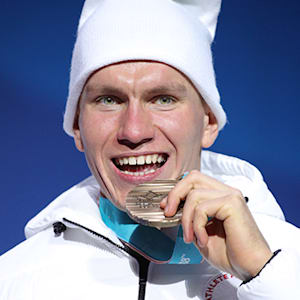
Bolshunov's first event was the Sprint, the shortest event in Cross Country, and he finished 3rd in qualifying, then easily advanced through two rounds to make it to the final. Johannes Hosflot Klaebo won the final by a little more than a second, with Bolshunov finishing third by .02 seconds behind Federico Pellegrino in a photo finish, earning a bronze medal in his first Olympic event.
His next event was the relay, with each skier covering 10 km. Bolshunov skied the second leg, starting out just barely in second place, but quickly taking a big lead, which he held throughout his portion, giving his team a 25 second lead heading into the second half of the event. Unfortunately, the Norwegians dominated the second half of the race, and the Russians had to settle for silver, nearly 10 seconds behind the winners.
The team sprint was next, with Bolshunov teamed up with Denis Spitsov, each running 3 legs of about 1500 meters each. A little more than halfway through the final, with Bolshunov running his second leg and holding a slight lead, Klaebo took off from behind him, and Bolshunov was not able to keep up, instead staying with the trailing pack. Not much changed the rest of the way, and the Russians took another silver medal.
The final race of the Olympics was the 50 km, the longest of all the races. Bolshunov stayed with the lead pack as it dwindled from 15 to 7 down to just 3 at the halfway point. Bolshunov chose to change his skis early in the race, while Iivo Niskanen of Finland waited until they reached 42km, allowing Bolshunov to take a lead of 14 seconds at one point. Niskanen started his attach with 1 km to go, and Bolshunov didn't have enough left to keep up, and took his third straight silver medal of the games after losing by 18 seconds.
In 2021, he won his first World Championship gold in the 30 km skiathlon, just in time for a return to the Olympics. The skiathlon combines the two forms of cross-country skiing, classical (straight line) and freestyle (skating style). The skiathlon was his first event at the 2022 Olympics, and he led the entire way, leading Niskanen by a second at the pit stop before speeding away in the freestyle portion, winning the gold medal by a minute and 11 seconds, his first Olympic win.
He decided to skip the sprint event a couple of days later, so his next event was the 15 km classical, which was Niskanen's specialty, and he was not able to keep up with the Finn, trailing the entire way and coming in second by a margin of 23 seconds. Next up was the relay, where he again ran the second leg, and this time he was given a 34 second lead to begin with, which he extended to a full minute, a margin his teammates were able to maintain on their way to an upset gold over Norway.
In the team sprint, he was paired with Aleksandr Terentyev this time, and in the final the top three teams, Russia, Norway, and Finland, stayed close together through the first 5 sections, but at the beginning of the final leg, Klaebo pulled away, giving Norway the gold, while Russia ended up a couple of seconds behind Finland to end up in bronze position.
The final race was the 50km, though it was actually shortened to 30km due to weather. The entire field stayed together for the first 10km, with Bolshunov and 14 others pulling away at that point. The leaders dwindled down to 8 in the final section, when Bolshunov pulled away on his own with 6 km to go, finishing the race 5.5 seconds ahead of anyone else, winning his third silver in Beijing.
Right after the Olympics, Russia invaded Ukraine, resulting in the country and its athletes being banned from the Olympics, instead of just the country like before. Bolshunov is a vocal supporter of the invasion, and has called the most recent Olympics illegitimate due to the exclusion of his country. Despite all of this, he has shown already that he is one of the greatest Olympic athletes of all time.
Emil Zatopek was born on September 19, 1922 in Koprivnice, Czechoslovakia, the seventh child in a large family, and started working at the local show factory when he was 16. One day, a coach picked out a few of the young workers at the factory and ordered them to run in a local race. Zatopek came in second, but he caught the running bug.
In 1944, he broke the national records in the 2000, 3000, and 5000 meter races. He continued improving, and by 1948 was expected to challenge for Olympic medals. His first event was the 10000m, where the favorite was Viljo Heino of Finland, the world record holder, and Heino led for the first 3000 meters before Zatopek overtook him. The two remained close for the next 3000 meters, but after Heino made a push to take back the lead, Zatopek pushed harder and pulled away, and Heino dropped out soon after. By the finish, Zatopek was ahead of the next racer by 48 seconds, and had lapped all but two other runners.
His next race was the 5000m, which took place in a heavy rainstorm. He took the lead early, with a pack of three other runners keeping pace behind him, but Gaston Reiff of Belgium made a move at the start of the ninth lap and pulled away from the others. He was ahead by 30 meters at the start of the final lap, and Zatopek made a hard push through the entire lap, but ended up falling short by 0.2 seconds and had to take the silver.
He broke the world record in the 10000m five times over the next four years, and didn't lose a single race over that time, so he was a big favorite to repeat in Helsinki in 1952. It was his first event, and once he took the lead in the 6th lap, he never looked back, beating the runner-up by more than 15 seconds and setting a new Olympic record, though he was still nearly 15 seconds short of his own world record.
Next up was the 5000m, where he was also the favorite, but this one would be much closer. Zatopek took the lead early, with 4 others keeping pace for several laps, and by the final lap, there was still a group of 4 runners led by Zatopek all together. The others all moved past him early in the final lap, but as the rounded the final corner, Zatopek shifted gears and passed all 3, winning the event by 0.8 seconds over Alain Mimoun of France, who had been runner-up to Zatopek in all 3 of his gold medal wins.
A few hours after winning that race, Zatopek watched his wife win the gold medal in the javelin throw, bringing yet another Olympic victory to the family. A few days later, Zatopek decided to try running the marathon, a race he had never run before. Jim Peters of Great Britain, the pre-race favorite, shot out fast, while Zatopek hung back with a couple of other runners. About halfway through, Peters started to slow down, and was passed by Zatopek and Gustaf Jansson of Sweden, but Zatopek never slowed down, eventually pulling away from Jansson and winning the race by over 2.5 minutes and setting a new Olympic record. He was the first to ever win all 3 distance events in the same Olympics, and so far the only one.
He planned to defend his Olympic titles in 1956, but suffered a hernia not long before the Olympics, which required surgery. He began training again as soon as he was allowed, but decided to only run the marathon in Melbourne, finishing in 6th place, about 4.5 minutes behind Mimoun, the winner. After finishing, Mimoun waited for Zatopek at the finish line, excited to share his victory, and Zatopek responded by saluting Mimoun.
He retired the next year, though his wife kept competing, winning the silver medal in 1960 before she hung it up. Zatopek had a falling out with the Communist Party in 1968, and was forced to work in menial jobs for the remainder of his life, but he deserves to be remembered as one of the greatest Olympians of all time.
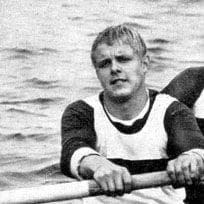
Siegfried Brietzke was born on June 12, 1952 in Rostock, East Germany. He started rowing when he was 15 years old after seeing a TV commercial that was recruiting tall boys to become competitive rowers. Within 3 years, he had taken gold in the coxless pairs at the World Junior Rowing Championships with Wolfgang Mager, his longtime rowing partner.
The pair qualified for the 1972 Olympics in Munich, and were considered to be one of the favorites, since another East German pair had won the event in the previous Olympics. They won their heat by more than 5.5 seconds, which advanced them to the semifinals, where they again posted the best time to advance to the final race. They were in 6th place halfway through the final, more than 6 seconds behind the leaders, but then they turned on the jets, outpacing all of the other boats by at least 9 seconds down the backstretch, giving them a victory by nearly 4 seconds.
After coming in 4th place at the 1973 European championships, the pair switched events to the coxless fours, adding Stefan Semmler and Andreas Decker to the team. They went on to win the World Championship in 1974 and 1975, making them big favorites to win gold in Montreal in 1976. They followed through with ease, setting Olympic records in all 3 of their races, and winning in the final over a surprising team from Norway by almost 4 seconds.
Before the next Olympics, the same team won two more World Championships, but had been upset by the USSR team in 1978, so it was bad news when Brietzke's longtime partner Mager injured his hand just before the Olympics and had to be replaced by Jurgen Thiele as the headed to Moscow. Both the East Germans and the Soviets won their heats by more than 13 seconds, setting up a showdown for the gold, but it wasn't really a contest, as the East German team led by at least 2 seconds the entire way, winning Brietzke his third straight gold medal.
Brietzke stopped rowing competitively after Moscow, and since East Germany boycotted 1984 anyway, he wouldn't have been able to compete again anyway, so his Olympic career ended with 3 gold medals in 3 attempts, and none of them was particularly close. The fact that he never lost and was never challenged makes him one of the greatest Olympians of all time.
Shuji Tsurumi was born on January 29, 1938 in Tokyo, Japan, and made the Japanese Olympic gymnastic team just as they were rising. The Japanese had won the team silver medal in 1956, the first time they had won a team gymnastics medal.
Tsurumi contributed immediately upon making the team, taking 4th place in the Individual All-Around competition in Rome in 1960, falling one point short of winning a medal. All 6 Japanese team members finished among the top 9 in the Individual All-Around, with Tsurumi the second-highest scorer on the team behind Takashi Ono. Those performances led to the Japanese winning the team gold for the first time, 2.5 points ahead of the defending champion Soviets.
Tsurumi qualified for the event finals in two events, the vault and the pommel horse. He was the sixth and final qualifier in the vault, with a 9.5, which he improved to 9.65 in the final, but he still finished 6th. He was also the final qualifier in the pommel horse, but his final routine pushed him ahead of 3 other finalists, earning him a bronze medal.
In 1964, the Olympics went to Tokyo for the first time, and the Japanese were excited to compete in front of their home fans. In the Individual All-Around, the gold went to Tsurumi's teammate, Yukio Endo, by just over half a point, but Tsurumi took the silver in his hometown. This time all 6 Japanese team members were in the top 11, and they again won the team gold by 2.5 points ahead of the USSR.
This time Tsurumi qualified for 4 individual event finals, the same two as before, plus rings and parallel bars. He qualified 5th in the rings, and didn't improve in the final. He was the #3 qualifier in the pommel horse, where he had won bronze 4 years earlier, but this time he improved to win the silver, losing only to Miroslav Cerar of Yugoslavia, considered by many to be the greatest pommel horse athlete of all time.
Just like 4 years earlier, he was the final qualifier in the vault, but unlike last time, he was able to improve his standing, moving up to 4th place, falling less than one tenth of a point short of another medal. He was #2 in qualifying in the parallel bars, behind Endo, but after Endo had a nearly flawless routine to clinch the gold, Tsurumi was forced to settle for the silver, his third individual silver of 1964.
He continued competing for a couple more years, winning all-around individual silver in the 1966 World Championships, but he retired before the 1968 Olympics came around. He was a big part of the first two team championships of the Japanese gymnastics dynasty, and was in the top 4 of the individual competition both times. That, plus his 6 total Olympic medals, make him one of the greatest Olympians of all time.
Matthew Nicholas Biondi was born on October 8, 1965 in Moraga, California, and began swimming at a young age. He was a standout swimmer and water polo player in high school, and earned a scholarship for both to Cal.
As a freshman, he helped Cal win the national water polo title, but was not as successful in his races, only earning a medal in a relay, but he surprised everyone by finishing 4th in the 100m at the US Olympic Trials, which earned him a spot on the relay team in Los Angeles. He swam the 3rd leg of the 4x100 freestyle relay, and entered the pool just slightly behind Australia for the lead, but by the time he handed it off to anchor Rowdy Gaines, the USA was ahead by 0.4 seconds, and they ended up winning by 0.65 seconds and set a new world record.
Buoyed by his performance at the Olympics, Biondi went on a run over the next 3 years, winning every NCAA freestyle sprint title but one in that span, plus all of the freestyle relays, for a total of 14 NCAA titles. He also set numerous world records, becoming the first man to swim 100m in less than 49 seconds, and at one point he held the top 10 times of all time in that event. Heading into the 1988 Olympics, he qualified for 7 events, attempting to match Mark Spitz's record of 7 golds from the 1972 Olympics.
His dream of 7 gold medals didn't last long. His first event was the 200m freestyle, and he led the final through the final turn, but didn't have as much left in the tank as Duncan Armstrong of Australia, who sprinted out of third at the turn to win in world record time, with Biondi falling to bronze. In his next event, the 100m butterfly, he led the entire race, but was passed on the final stroke by Anthony Nesty of Suriname, losing by .01 seconds, the closest margin possible, leaving him with a silver.
Later that day, he swam the anchor leg of the 4x200 freestyle relay, entering the pool nearly a full second behind East Germany, but he quickly made up the difference, taking the lead before he was halfway done, and he ended up more than a second ahead after swimming the fastest relay split in history, while also setting a team world record in the event.
The next day was the 100m freestyle, his best event, and he finally won his first individual gold medal by setting a new Olympic record of 48.63 seconds, which was just short of his own world record from the Olympic trials. The next day he swam an even faster 100m as the anchor in the 4x100m freestyle relay, and the USA beat the USSR by nearly 2 seconds as they set another world record.
Next up was the 50m freestyle, where Biondi was a former world record holder, but he was facing the current record holder, Tom Jager, also American, in the final. Biondi got a great start off the blocks, and led the entire way across the pool, setting another world record of 22.14 in winning his 4th straight gold of the games.
The next day he finished off his Olympic run with the 4x100 medley relay, swimming the butterfly third leg. The US was a huge favorite in this one, and they lived up to it, winning by more than 2 seconds and setting yet another world record, the 4th Biondi was a part of in Seoul. Even though he didn't get his 7 golds, he did win 7 medals, a huge accomplishment.
He returned for one final hurrah in 1992, qualifying in 4 events for Barcelona. He started out with the 100m, his signature event, and led at the turn, but swam one of the slowest back halves of his career coming back, and he fell to 5th, the first time he had ever failed to medal in the Olympics.
He made up for it the next day in the 4x100m freestyle relay final, where he swam the second leg. The US was in 4th place after the first swimmer, but Biondi passed the field to give them a lead of more than half a second at the midway point, and they never gave up the lead, finishing nearly a second ahead of the Unified Team for gold, just short of their world record from 4 years earlier.
The 50m freestyle was supposed to be a rematch between Biondi and Jager, the only 2 swimmers to hold the world record in the past 7 years, but Aleksandr Popov of the Unified Team surprised everyone by winning the event, after he had also pulled off an upset in the 100m. Biondi still came in second ahead of Jager, but had to settle for the silver. The next day he swam the anchor leg in the 4x100 medley relay heat, which qualified the USA for the final, where he was replaced by Jon Olsen, and the USA went on to win another gold in world record time, giving Biondi his 8th gold medal overall.
He retired right after the 1992 Olympics, having won 11 medals in 12 events, 8 of them gold, though 6 of the golds came in relays. He later went on to become a math teacher and swimming coach. He made a valiant attempt at winning 7 events in Seoul, and even though he didn't quite get there, his impressive haul over 3 Olympics makes him one of the greatest Olympians of all time.


:max_bytes(150000):strip_icc():focal(999x0:1001x2)/GettyImages-1234411789-2000-48f59779614146558633b755793b867c.jpg)