Sydney Michelle McLaughlin was born on August 7, 1999 in New Brunswick, New Jersey, into a family of track stars. Her father was a 3-time All-American and competed at the Olympic trials in 1984, and her mother ran the 800m in 2:12 in high school, so it was no surprise that she started running at an early age, and excelling at it.
When she was 15, she won the 400m Hurdles at the World Youth Championships, then the next year took third place in the US Olympic Trials, earning her a spot on the team at age 16, the youngest American track Olympian in more than 30 years. Her first Olympic experience ended with a 5th place finish in her semifinal heat, but there was a lot more to come.
In 2019, she came in 2nd at the World Championships, just 0.07 seconds behind defending gold medalist Dalilah Muhammad (#62), and in 2021, she not only beat her at the US Olympic Trials, she broke her world record as well, lowering it to 51.9 seconds, making her the first woman ever to break 52 seconds.
The two would face off again a couple months later at the Tokyo Olympics, where both easily advanced to the final. In that race, Muhammad took the early lead, and was a step ahead of McLaughlin at the 8th hurdle, but McLaughlin caught up by the final hurdle, then had a stronger finishing kick to beat her rival for gold, while also lowering the world record again, this time to 51.46 seconds.
She also ran in the 4x400m relay later that week, with a powerhouse team expected to dominate. She ran the first leg in 50.2 seconds, handing off to Allyson Felix with a tiny lead over Poland. Felix, Muhammad, and Athing Mu (#85), stretched the lead throughout the rest of the race, and by the end, the Americans had won by 3.68 seconds.
In 2022, she won her first World Championship gold medal, and broke her own world record again, setting it down to 50.68 seconds, making her the first to ever break 51 seconds as well. She injured her knee shortly before the 2023 World Championships, and was unable to defend the title, but she was healthy before the 2024 Olympic Trials, where she broke the record again, this time by just 0.03 seconds.
In Paris, she was the clear favorite to win the 400m hurdles again. She reached the final easily, then after a brief early challenge from Femke Bol of the Netherlands, she pulled away before the halfway point, and came across the finish line 1.5 seconds ahead of anyone else, and setting a new world record for the 6th time in just over 3 years.
She also competed again in the 4x400m relay, where they were again favored. She took the second leg, and was given a lead of 0.77 seconds when she started, which she expanded to 2.63 seconds by the end of her lap, which was the fastest of the entire competition by almost a full second. The final two runners also ran great times, and the USA won by 4.23 seconds in another dominant showing for gold.
McLaughlin was married in 2024, and now competes under the hyphenated name Sydney McLaughlin-Levrone. She gave birth to her first child less than 3 months ago, and is naturally taking a break from competing, but she expects to be back on the track next year, aiming for more gold medals in Los Angeles in 2028. Even if she doesn't get there, her performances at the last 2 Olympics have already made her one of the greatest Olympians of all time.
Paavo Johannes Nurmi was born on June 13, 1897 in Turku, Finland, into a poor family, where running was just a part of everyday life. He dropped out of school at age 12 to help support his family, and began training as a runner after hearing about the successes of Hannes Kolehmainen, a fellow Finn, at the 1912 Olympics. After a stint in the army during the Finnish civil war, he qualified to compete in the 1920 Olympics.
His first Olympic event was the 5000m, where he was one of 12 runners to qualify for the final. In the final race, he and Joseph Guillemot of France pulled away from the field after just two laps, and the two ran together for the rest of the race, until just 200m remained, at which point Guillemot had a finishing kick that left him 4.4 seconds ahead of Nurmi, who took the silver medal. It would be the only race in his career in which he lost to a runner from another country.
The 10000m was next, and since the world record holder had been killed in World War I, the two leaders from the 5000m were the favorites. Those two, along with James Wilson of Great Britain, led the way for most of the race, and when the pack nearly caught them with 5 laps to go, they picked up the pace and pulled away. Nurmi took the lead at the beginning of the final lap, and didn't allow the others a chance to pass him, and he won the race by 4.7 seconds to earn his first gold medal.
Next was the cross country race, which was supposed to be 10000m, but ended up closer to 8000m. Medals were awarded for the top 3 individuals, as well as the top 3 teams, which were scored based on the finishing order of their top 3 runners. Guillemot sprained his ankle halfway through the race, and Nurmi only had one real challenger, Eric Backman of Sweden, but he came through and won by 2.6 seconds to take another gold medal. Since the next two Finns finished 3rd and 6th, the team won gold solidly, as their placements added up to 10, far ahead of the Brits, with 21.
After the Olympics, Nurmi was able to afford to get electric lighting and running water for his family. He also began experimenting with his pace, running with a stopwatch for the rest of his career, in an attempt to make himself impossible to beat. Over the next 2 years, he set world records in the mile, the 1500m, 2000m, 3000m, 5000m, and 10000m. He is still the only athlete in history to hold world records in the mile, 5000m, and 10000m at the same time. He also graduated with an engineering degree in 1923.
He suffered a knee injury early in 1924, but was able to recover in time for the Olympic trials, where he qualified while setting new world records in the 1500m and 5000m just an hour apart. In the Olympics, which were contested on a 500m track, rather than today's familiar 400m version, he started with the 1500m. Ray Watson of the USA was able to keep pace with him through 2 laps, but fell back at the start of the last lap, and Nurmi coasted to the finish to conserve energy, still setting a new Olympic record in the process by 3 seconds.
42 minutes later, he competed in the 5000m. Ville Ritola (#89), and Edvin Wide of Sweden tried to tire him out by setting a fast pace early, so Nurmi abandoned his stopwatch and pushed to catch the leaders at the 2000m mark. Wide fell behind by 3000m, and Nurmi pulled ahead at 4000m, then held off his teammate for the last 2 laps and won the race by 0.2 seconds.
The cross country race was next, and the temperature that day was over 100 degrees, which caused most of the runners to drop out before the end of the race. Nurmi and Ritola took the lead early, but Ritola could not keep pace, and Nurmi won easily, by almost a minute and a half. He ended up getting the team gold as well, when his other teammate, Heikki Liimatainen, was able to cross the finish line after becoming disoriented near the finish, spending nearly two minutes stumbling toward the line before he finally made it.
His Olympics concluded the next day with the 3000m team race, which was run on the track with the same scoring system as the cross country team event. Nurmi and Ritola finished in the top 2 spots easily, and when their teammate, Elias Katz, finished in 5th, they won the gold medal in a runaway. This was Nurmi's fifth gold medal in Paris, which is still the most ever won by a track athlete in a single Olympics.
Nurmi spent 5 months touring the United States the next year, competing in 55 races in that time, which wore him down, and he slowed his training schedule over the next year. In 1926, he set a new 3000m world record in Sweden, but one of the Swedish runners spent the whole race interfering with his pace, and he vowed to never compete against him again, which came back to bite him later in his career.
He threatened not to compete in the 1928 Olympics, but he and the Finnish Olympic committee were finally able to make peace over his refusal to compete against the Swedish runners in recent years, and he made the team. He started his Olympics that year with the 10000m, his favorite race, and it started with himself, Ritola, and Wide running away from the field, then Wide dropping behind at 8000m. Ritola led the entire race up to 9000m, but then Nurmi pulled ahead of him and held him off down the stretch, winning by 0.6 seconds for his 9th career gold medal.
In the 5000m, the same three runners pulled away from the field again, and again, Wide fell behind late in the race, while the pair of Finns stayed together. This time, Ritola was the one who was able to pull away late, beating Nurmi for the only time in his career, by a margin of 2 seconds, while Nurmi was able to hold off a late charge from Wide to win the silver.
His final event was the steeplechase, which he hadn't run before, and in the heats, he fell on the first water jump, spraining his ankle and hip, but still finished fast enough to make the final. The day after the 5000m final, he ran in the steeplechase final, and after Ritola wore out early and dropped out, it was down to Nurmi and Toivo Loukola of Finland, but Loukola was able to leave Nurmi behind, and Nurmi had to settle for finishing with another silver.
He decided that he would compete in one final Olympics in 1932, planning to compete in just the 10000m and the marathon, but his plans were foiled when he was suspended by the IAAF for competing as a professional, which he hadn't. Finland's Olympic committee investigated and found that the allegations were untrue, and he went to Los Angeles to compete, but the ruling was upheld 3 days before the Olympics started, and he was forced to sit out. It turns out that the IAAF chairman was from Sweden, and that he had forced Germany to lie about making payments to Nurmi for a race in 1931, still holding a grudge from the 1926 incident.
Nurmi continued to run, refusing to turn pro, while he appealed the IAAF decision, but he lost his appeal in 1934, and his ban became permanent, even though it was based on lies. At that point, he retired from competition. He competed in 12 events over 3 Olympic Games, and never finished worse than 2nd place, winning 9 gold medals and 3 silvers in all. His record of 5 track gold medals in a single Olympics still stands, and he is obviously one of the greatest Olympians of all time.
Robert Beamon was born on August 29, 1946 in Jamaica, New York, and was orphaned before he was a year old, so he was raised by his grandmother. His talent was discovered by the track coach at his high school, and in his senior year, he set the national high school triple jump record. After his grandmother's death, he started college at UTEP on a track scholarship.
Before the 1968 Olympics, he had beaten the old world record in the long jump, but it didn't count as a world record because of excessive wind, but he was still one of the favorites to win gold in Mexico City, along with world record holder Ralph Boston. In the qualifying round, Boston broke the Olympic record with a jump of 8.27 meters on his first jump. Beamon fouled on his first two attempts, so he decided to jump from farther back on his final attempt to ensure that he would qualify for the final, which he did, with a jump of 8.19 meters.
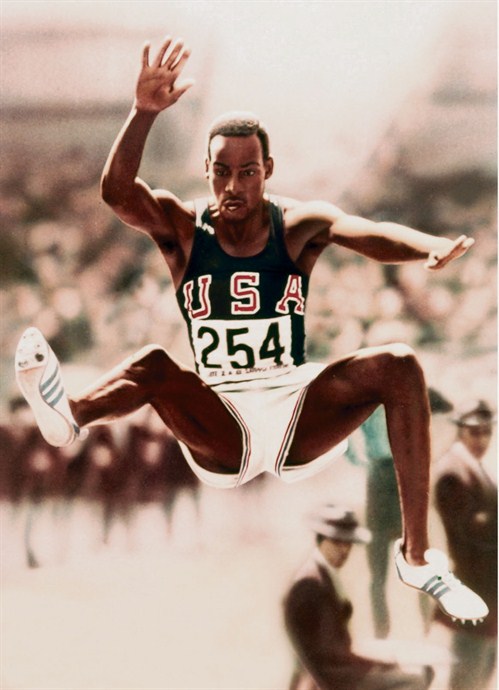
Beamon was the 4th jumper in the final, and after the first three fouled, Beamon started down the runway without any mark in the sand to aim for. He hit the takeoff board perfectly, and landed at a distance of 8.9 meters, destroying the old world record of 8.35 held by Boston. 8.35 meters is 27'4.75", while 8.9 meters is 29'2.5", meaning that he was the first man to ever jump more than 28 feet or 29 feet, and he also made the biggest change in the world record in history, as nobody before him had ever moved it more than 0.15 meters.
The competition continued, though the winner was already a foregone conclusion. Beamon attempted one more jump, which went 8.04 meters, and nobody else made it any further than 8.19. Beamon passed on his final 4 jumps, since they weren't necessary, and walked away with an easy and amazing gold medal. His world record was not broken until 1991, and it is still the Olympic record and the second-longest jump in history.
He had been kicked off the UTEP track team shortly before the Olympics due to his joining a boycott of BYU due to racist policies then in effect, but he went back to school and earned a degree in sociology. He later went on to coach college track and work as a graphic artist. While his Olympic career consisted of just one event, and many claim that the elevation aided him, he was the only jumper to surpass the world record that day, and he jumped nearly 2 feet farther than anyone else. He is definitely one of the greatest Olympians of all time.
Otis Harris Jr. was born on June 30, 1982 in Edwards, Mississippi, and was a track All-American in high school. He attended the University of South Carolina, where he won a relay gold in the NCAA Championship, along with an individual silver.
He made the US Olympic team that went to Athens in 2004, where he would compete in 2 events. He started with the 400m, where he lost his first heat by 0.02 seconds, then had the exact same result in his semifinal heat, but automatically advanced to the final. In the final, he took an early lead, and held it for more than half the race, before his two American teammates caught him by the end of the final curve. Down the homestretch, Jeremy Wariner had a little more left in the tank, and Harris took the silver medal, 0.16 seconds behind.
The three Americans who swept the 400m medals joined together a few days later in the 4x400m relay. Harris took the leadoff leg, and gave the Americans a lead of almost a full second after his lap was done. Derrick Brew (#80) extended it to 2.5 seconds by the midway point, Wariner made it 3.5 seconds, and by the end, they had won the gold medal by 4.69 seconds, the most dominant relay performance in Olympic history.
Harris retired from competition at the end of the year, first returning to South Carolina to serve as an assistant track coach, then becoming a high school track coach. He has recently moved into law enforcement, serving as courtroom security. Even though his Olympic career was very short, he was part of the most dominant relay team in history, and nearly won an individual gold as well, making him one of the greatest Olympians of all time.
Shelly-Ann Fraser was born on December 27, 1986 in Waterhouse, Jamaica, and was a good sprinter from the time she was a small girl. As a young adult, she was somewhat nervous about competing in big competitions, and wasn't super dedicated to training, but after going to the World Championships in 2007 as a relay alternate, she realized that she enjoyed the experience, and became more focused on her craft, and the results were almost immediate.
The next year, she finished second in the Jamaican Olympic trials in the 100m, earning a coveted spot on the team headed to Beijing. Once there, Fraser won each of her 3 heats to advance to the final, along with her two Jamaican teammates. In the final, Sherone Simpson of Jamaica had a slight lead on Fraser early, but Fraser pulled away in the second half to win easily by 0.2 seconds, with Simpson and Kerron Stewart of Jamaica tying for the silver medal, giving Jamaica all 3 medals, and Fraser her first gold in her first Olympic event.
With the top three 100m runners on the team, Jamaica was expected to cruise to victory in the 4x100m relay, and they had the fastest time in the semifinal heat, but in the final, after Fraser had given them the lead on the first leg, they missed the second handoff and were disqualified.
She won the 100m World Championship the next year, becoming just the second woman ever to win the two major titles in back-to-back years. The following year, she was suspended for 6 months for testing positive for oxycodone, which is not performance-enhancing, but required to be disclosed, which she failed to do. She was married in early 2011, and changed her last name to Fraser-Pryce, then spent much of the year recovering from a calf injury.
Because of the rough couple of years she had endured, it was a bit of a surprise when Fraser-Pryce won both the 100m and the 200m at the Jamaican Olympic trials, earning her spot on the team headed to London. In the 100m, she won both of her heats to get back to the final, and she had the best start in the final, but by the halfway point, Carmelita Jeter of the USA had pulled even, and the two remained tied right through the finish, where Fraser-Pryce was able to win the gold with a lean at the line, triumphing by .03 seconds to become the third woman ever to repeat as 100m champion.
In the 200m, she won her first heat, but came in second to Sanya Richards-Ross of the USA in her semifinal, though both advanced to the final. In the final race, Allyson Felix of the USA took a slight lead by the end of the turn over Jeter, then pulled away down the stretch to win gold, while Fraser-Pryce came from behind to pass Jeter at the finish to end up with a silver medal.
Her final event in London was the 4x100m relay, which was expected to come down to Jamaica and the USA, who had the top five 100m runners between them. Fraser-Pryce gave Jamaica a small lead after her lead-off leg, but on the second leg, Felix pulled away from Simpson, and the USA had a solid lead the rest of the way, beating Jamaica by 0.59 seconds in world record time, giving Fraser-Pryce another silver medal.
She had graduated from college just before the London Olympics, and felt that she was able to focus more fully on her training after that. In 2013, she won all 3 of her events at the World Championship, the first woman ever to do that. She also became the first woman ever to own the Olympic and WC 100m titles at the same time twice.
In early 2016, she injured her toe, which made running difficult, so she didn't run in many events, but she still was able to qualify for the Olympic team. She was attempting to become the first woman ever to win the 100m three straight times, and she won both of her heats to reach the final, but in the last race, her teammate, Elaine Thompson, got off to a better start and would not be caught, while Fraser-Pryce finished third to take the bronze medal.
She also ran the anchor leg for Jamaica in the 4x100m relay. It was again expected to be a battle between Jamaica and the USA, but the Americans held the lead the entire way, despite Jamaica's efforts to catch up on the middle legs. Fraser-Pryce was behind by a bit when she took the baton, and was unable to catch up, and Jamaica ended up 0.35 seconds behind and took another silver medal in the event.
In 2017, Fraser-Pryce gave birth to her first child via emergency C-section, which took her away from training for a long time, but she started training again 11 weeks after giving birth, and ran in her first meet in Jamaica in May 2018. By 2019, she was back to form, and even won the 100m World Championship, becoming the oldest woman ever to win the event, and the first mother to win it in 24 years.
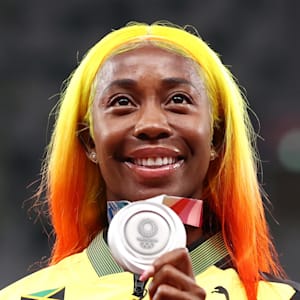
In early 2021, she ran a new personal best in the 100m, then won the Jamaican Olympic trials in both the 100m and the 200m, despite being 34 years old. She went to Tokyo for her 4th Olympics, where she and Thompson, now Elaine Thompson-Herah, were the favorites in the 100m. Both won their heats to advance to the final, and they were even early, but Thompson-Herah maintained her top speed longer, and Fraser-Pryce finished 0.13 seconds behind to take silver, her fourth straight medal in the event, making her the first athlete ever to win four 100m medals, regardless of gender.
In the 200m, the first half went almost the same as the 100m, with an even start, followed by Thompson-Herah pulling away by the end of the turn. On the straightaway, she pulled away to win in the second-fastest time ever, while Fraser-Pryce was passed twice on the way home, finishing 0.07 seconds short of a medal in 4th place.
Jamaica had swept the medals in the 100m, making them clear favorites in the 4x100m relay. Fraser-Pryce ran the third leg, and Jamaica had the lead through the first half, though just barely ahead of the USA. Fraser-Pryce was also unable to pull away, handing off to Shericka Jackson with a tiny lead, but the USA had a rough handoff, and that enabled Jamaica to finally create some space, and they won by 0.43 seconds, finally getting Fraser-Pryce her first relay gold.
She considered retirement after the Olympics, but decided to keep competing since she had run personal bests in both of her events in 2021, and she made history again in 2022 when she won her 5th 100m World Championship, becoming the first ever to win 5, and the oldest athlete ever to win a track world championship. She suffered a knee injury in 2023, which hampered her training over the next year, but she still qualified for her 5th Olympics.
She went to Paris in 2024 to try for a fifth medal in the 100m, and she got off to a good start, leading early in her first heat, but she injured her hamstring late in the race and finished second, which advanced her to the semifinal, but she was unable to continue and withdrew from the competition.
She competed through the world championship in 2025, after which she retired at age 38. Her longevity was legendary, and she won medals at 4 straight Olympic games, finishing her career with 8 total medals, including the pair of 100m golds she won to kick off her career. She is obviously one of the greatest Olympians of all time.
Frank Kent Foss was born on May 9, 1895 in Chicago, Illinois. He won the I4CA Championship in 1915 and 1916 while attending Cornell University, and then won the AAU championships in both 1919 and 1920. He had vaulted 4.05 meters in 1919, which was higher than the world record, but it was never officially verified to count as a world record.
He went to Antwerp in 1920 to compete in the Summer Olympics, where he was the favorite going in, and he didn't disappoint. 9 vaulters cleared 3.6 meters in the qualifying round to advance to the final, but two of them were unable to repeat that in the final round. Of the 7 who did clear 3.6, only two made it any farther, with Henry Petersen of Denmark joining Foss in making it over 3.7, but Petersen was unable to clear any further heights. Foss continued to raise the bar, both literally and figuratively, and by the end he had cleared 4.09 meters, setting a new world record, and winning the gold medal by 0.39 meters, or 15.4 inches, which is still the largest margin of victory in Olympic history.
After the Olympics, Foss stopped competing, and started working in the meatpacking industry for the rest of his life. He passed away on April 5, 1989 in Hinsdale, Illinois, a suburb of Chicago. Even though he only competed in one Olympic event, he set a world record in that event, and had the largest margin of victory ever, making him one of the greatest Olympians of all time.
Maurice Greene was born on July 23, 1974 in Kansas City, Kansas, and played football and ran track in high school, but focused exclusively on track after getting a scholarship to the University of Kansas. He competed in his first World Championship in 1995, and won his first one in 1997. In 1999, he won the 100m, 200m, and 4x100m relay at the world championships, just the third man ever to do that, after Carl Lewis and Michael Johnson.
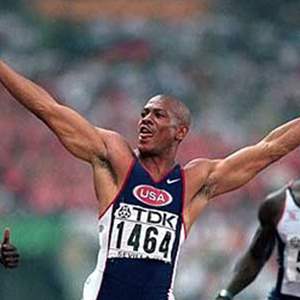
He also set the world record in the 100m in 1999, dropping it to 9.79 seconds. In the Sydney Olympics, he opened with the 100m, and after winning his first two races easily, he had the fastest time in the semifinals, then went on to win the final in a time of 9.87 seconds, 0.12 seconds ahead of the silver medalist, to earn his first Olympic gold medal.
Greene also ran the anchor leg for the USA in all 3 rounds of the 4x100m relay the next week. They had the fastest time in each of the first two rounds, and weren't challenged in the final, where Greene was handed a comfortable lead and coasted to the finish for another gold medal, this one by 0.29 seconds over Brazil.
Greene repeated as 100m World Champion in 2001, but struggled with injuries over the next couple of years. He watched Tim Montgomery break his world record in 2002, but then he got it back when Montgomery failed a drug test. He recovered in time to make the Olympic team that was headed to Athens in 2004.
He again started with the 100m, and he again won his first two heats, but in the semifinal, he came in 3rd, even though he ran it in 9.97 seconds. In the final, it was an extremely close race, with 4 runners within .04 seconds of each other, but Greene ended up taking the bronze medal in that mass finish, .02 seconds short of another gold.
Greene again ran the anchor leg for the favored Americans in the 4x100m relay, in which they easily made the final. In that race, the first two handoffs for the USA were clunky, and it allowed the British team to gain the lead, but after a good handoff to Greene, he bolted for the finish, but came up just short, losing by .01 second to end up with a silver medal.
His world record was beaten in 2005 by Asafa Powell, who lowered it to 9.76 seconds, and by 2008, Greene had retired from athletics. He has since worked as a track coach and PE teacher. He had a very strong peak, but it only coincided with one Olympic games, which is why he only has 2 gold medals, but he was extremely close to 2 more while coming off nagging injuries, and for all of that, he is one of the greatest Olympians of all time.
Dalilah Muhammad was born on February 7, 1990 in Jamaica, New York, and began training as a runner when a local coach saw her running through the streets at age 7. When she was 17, she won the World Youth Championship in the 400m hurdles, then after graduating from high school, moved across the country to attend USC.
While at USC, she competed in the 2012 US Olympic trials, but failed to make the team. The next year, she took silver in the World Championships in the hurdles, but injuries slowed her down over the next couple of years, and she returned to competition just before the 2016 Olympic trials, where she won, earning her place on the team heading to Rio.
When she got to the Olympics, the favorite was Zuzana Hejnova of Czechia, who had won the last 2 World Championships, but Muhammad started to get noticed after running the fastest time in the semifinal round. By the fourth hurdle in the final, Muhammad had a clear lead, and she never let anyone else make it close, winning the race by 0.42 seconds to become the first American woman to ever win the event.
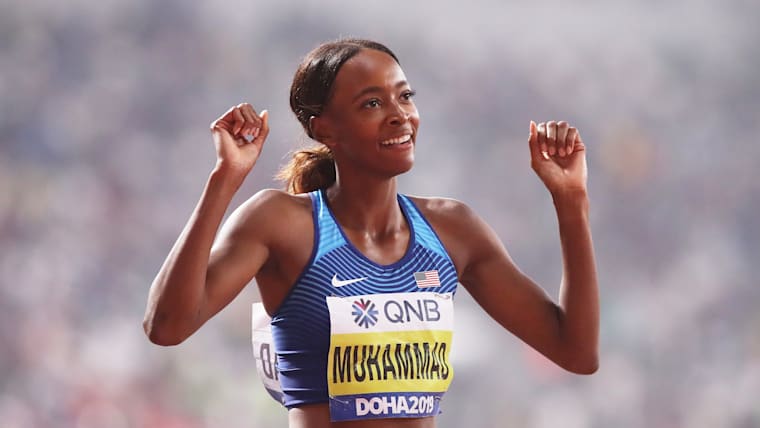
After finishing second in the 2017 World Championships, she set a new world record at the US Championship in 2019, then added a World Championship win later that year, also setting a new world record in the process. But at the 2021 Olympic trials, she finished second behind Sydney McLaughlin, who broke the world record again, setting it at 51.9 seconds.
The pair was expected to fight it out for gold in Tokyo, and the race lived up to expectations. Muhammad took the lead early, and was a step ahead of McLaughlin and Femke Bol of the Netherlands through the 8th hurdle, but McLaughlin closed the gap by the final hurdle, then had a better finishing kick to win gold. Both runners broke the previous world record, but Muhammad lost by 0.12 seconds.
Both of them also competed in the 4x400m relay later that week, and the squad that ran in the final was one of the strongest ever assembled. McLaughlin ran the first leg, and held a slight lead when she handed off to Allyson Felix, who extended the lead to 5 meters when Muhammad took the baton and pulled away, leaving a gap of 15 meters at the final handoff. Athing Mu (#85 in this countdown) ran the anchor leg, and the USA won by nearly 4 seconds.
She tried to make the US team for the 2024 Olympics, but did not qualify after the trials. She is still running, and has even started running the 800 meters this year, possibly with an eye toward the 2028 games, but she is starting to age out of competitive running. Even with her limited Olympic experience, she had two very strong gold medal wins, plus a silver medal that was faster than the world record, and she stands today as one of the greatest Olympians of all time.
Rai Benjamin was born on July 27, 1997 in Mount Vernon, New York, and was a 3-time New York State Champion in the hurdles before he graduated, first attending UCLA for a year, then USC for 2. He then decided to turn pro, but it took a year before he was approved to compete for the USA, because he had competed as a teen for Antigua & Barbuda, his father's home country, in one meet.
After winning silver in the 400m hurdles at the 2019 World Championships, Benjamin won the US Olympic Trials in 2021 in a personal-best time to qualify for the Tokyo Games. In the 400m hurdles, the favorite was Karsten Warholm of Norway, who had just broken the 33-year-old world record, setting it at 46.7 seconds. Warholm started fast, but Benjamin caught up by the third hurdle, then briefly lost his stride and fell behind again. He slowly worked his way back through the rest of the race, sitting just behind Warholm over the last hurdle, but his finish wasn't fast enough, and he took the silver medal with a time of 46.17 seconds, more than 0.5 faster than the world record, and still not good enough for gold.
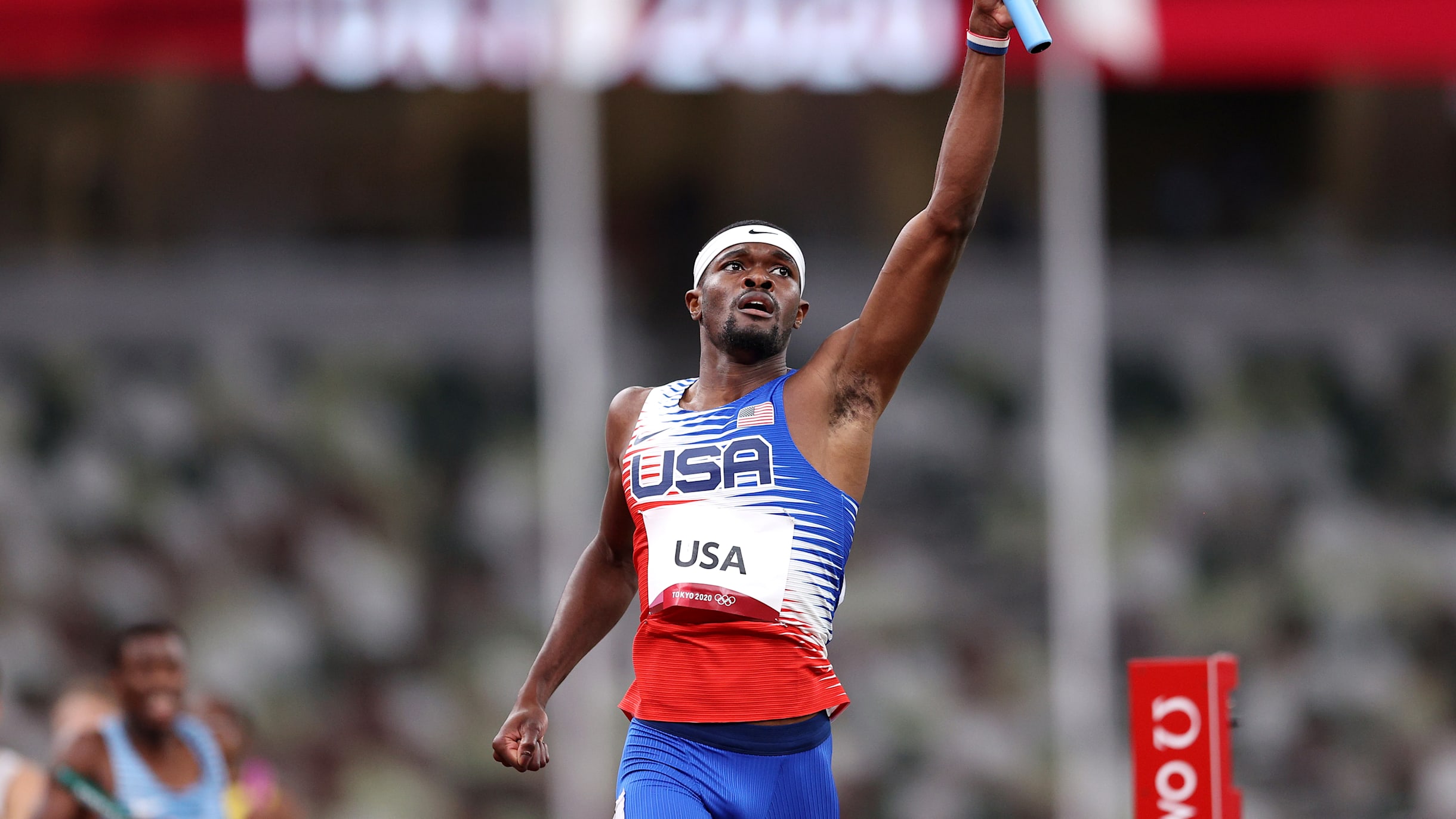
He also competed in the 4x400m relay, where he ran the anchor leg for the favored Americans in the final. The USA was behind Botswana after the first lap, but took a slight lead by the midway point. The third American runner extended the lead to 0.7 seconds when he handed off to Benjamin, who ran the fastest leg of anyone in the race, finishing in 43.4 seconds to give team USA the gold by almost 1.5 seconds.
When he returned to the Olympics in 2004, the competition was the same, with Warholm and bronze medalist Alison dos Santos both competing and among the favorites. Benjamin won both of his heats, but Warholm had his signature fast start in the final, leading Benjamin clear until the 9th hurdle, when Benjamin pulled ahead, then turned on the jets, finishing the race 0.6 seconds ahead of his rival to take the gold medal.
He also ran the anchor leg in the 4x400m relay again, but it ended up much closer this time. Botswana led after the first lap again, and Great Britain passed both to take the lead at the halfway point, but Bryce Deadmon passed them both on the third leg to give Benjamin a lead of 0.24 seconds going into his leg, which turned out to be just enough, as Letsile Tebogo of Botswana ran the fastest leg of the race to nearly catch him, but Benjamin ran the second-fastest time of all to hold him off and win another gold, this time setting a new Olympic record in the process.
Last year, Benjamin announced that he would be focusing more on the 400m than the hurdles going forward, but two weeks ago he ran the hurdles in a meet in Switzerland and won the race, so he may be able to win more than 2 medals at the next Olympics in Los Angeles. Even if he doesn't, he has already established himself as one of the greatest Olympians of all time.
Yohan Blake was born on December 26, 1989 in Saint James, Jamaica, and grew up playing cricket, but after a coach saw how fast he could run, he was encouraged to become a sprinter. In 2009, he became the youngest sprinter ever to break 10 seconds in the 100m, though his record was broken 6 months later. In 2011, he became the youngest-ever World Champion in the 100m, a record he still holds.
He made the Jamaican Olympic team in 2012 by beating Usain Bolt in the Olympic trials, and in the 100m event, he won both of his heats to advance to the final, where he was joined by Bolt, along with Tyson Gay and Justin Gatlin from the USA. Bolt was the defending Olympic champion and world record holder, while Blake was the defending world champion, but in the final, Bolt came from behind early to pass the field and finish in 9.63 seconds, while Blake finished just behind in 9.75 seconds, the fastest Olympic time ever not by Bolt, winning the silver medal.
In the 200m, Blake had also beaten Bolt in the Olympic trials, but Bolt was healthier now, and was the favorite after winning the 100m. Blake again won both of his heats to advance to the final, but Bolt ran a blistering curve and was 2 meters ahead of Blake entering the straightaway. He was not able to make up any distance, but he finished in 19.44 seconds, 0.12 behind Bolt, to win another silver medal, again in the fastest Olympic time ever not by Bolt.
The two medalists teamed up with Nesta Carter and Michael Frater in the 4x100m relay a couple of days later, and they were the favorites, with only the USA given any chance to beat them. Carter gave Jamaica a slight lead on the first leg, which Frater and Blake were able to maintain, and then Bolt took the baton and pulled away slightly to beat the Americans by 0.2 seconds to set a new world record and take home the gold.
He returned to the Olympics in 2016 in Rio, after recovering from multiple hamstring injuries since 2012, competing in the same 3 events. In the 100m, he won his prelim heat, but came in 2nd in his next heat, behind Justin Gatlin, who had won silver at the World Championships the year before, but he still reached the final. In the final, Bolt made his patented move during the middle of the race, while Blake was left chasing, and this time he finished just short of a medal, 0.02 second short of taking the bronze.
In the 200m, he had the third-fastest time in the prelim, but after finishing 6th in his semifinal race, he failed to reach the final. The Jamaicans were still heavy favorites in the 4x100m relay, and Blake was given the second leg in the final, which they won for the third straight Olympics, this time by 0.33 seconds, but not in world record time this time.
Blake returned to compete in Tokyo in 2021, but wasn't as successful this time. He advanced out of the first round of the 100m, but came in 6th in his semifinal, which kept him out of the final for the first time. He also ran in the 4x100m relay, but with Bolt retired, they were no longer favored. He ran the third leg, and they won their heat, but in the final they ended up in 4th place, falling short of a medal by 0.05 seconds.
Blake retired in 2022, and has started a new career as a track coach. Even though both of his Olympic gold medals came in relays, his two silver medals were the fastest losing times in history, and he was always in contention, which makes him one of the greatest Olympians of all time.
William Harrison Dillard was born on July 8, 1923 in Cleveland, Ohio, and attended the same high school that Jesse Owens had once attended, and dreamed of following him into Olympic stardom. In 1943, he was drafted into the Army, and fought in Italy during World War II. He returned to college after the war, and resumed running, still aiming for the Olympics.
By the time the 1948 Olympic trials came around, Dillard had won 82 hurdle races in a row, but in the final, he tripped over a hurdle and failed to qualify for the Olympic team. Rather than quit, he entered the 100m race, taking third place to qualify for a spot in the Olympics.
Entering the 100m race in the Olympics, the favorites were Mel Patton of the USA and Lloyd LaBeach of Panama, who had split wins in every recent race they had entered. Dillard won his prelim heat, then had the best time in both the quarterfinal and semifinal rounds, giving him a spot in the 6-man final. He ended up leading the final from start to finish, with Barney Ewell, who had come in second in the US Olympic trials, closing the gap at the end but falling short, as Dillard tied the world record of 10.3 seconds while he won the gold. This race was the first in Olympic history to use a photo finish to determine the winner.
In the 4x100m relay, Dillard ran the third leg in both rounds, with the Americans winning easily both times. In the final they won by 0.7 seconds over Great Britain, but then it was announced that the first handoff had happened outside the legal zone, and the team was disqualified. After an appeal and review of the video, the USA's win was reinstated 3 days later.
Over the next 4 years, he maintained his status as the best hurdler in the world, and this time, he qualified for the Olympics in his signature event. He set a new Olympic record in the prelim round, then broke it again in the final, running the race in 13.7 seconds, finishing just ahead of teammate Jack Davis to win his third gold medal.
He was also chosen to run in the 4x100m relay again, this time in the second slot. He ran in all 3 rounds, and in the final, the Soviets took the lead early, then Dillard closed the gap slightly during his leg, before Lindy Remigio, the American 100m gold medalist, took the lead near the end of the final curve, and Andy Stanfield (#105 in this countdown) put it away on the anchor leg to win gold.
After failing to qualify for the 1956 Olympics, Dillard retired from racing. He later worked for the Cleveland Indians in scouting and public relations, and hosted a local radio show as well. He passed away in Cleveland on November 15, 2019, and at the time he was the oldest living American gold medalist. He is the only man to ever win both the 100m and the 110 hurdles in his Olympic career, which alone makes him one of the greatest Olympians of all time.
*1 Gold medal stripped due to positive drug test by teammate
Angelo F Taylor Jr was born on December 29, 1978 in Albany, Georgia, and began running the hurdles in high school, then went to Georgia Tech, where he won the NCAA title in 1998 after finishing as runner-up the year before. He won a gold medal at the 1999 World Championships in the 4x400m relay, but the medal was later stripped when teammate Antonio Pettigrew was caught using PEDs.
Taylor qualified for his first Olympic team in 2000, running the best time in the world that year at the Olympic trials. He was a co-favorite entering the 400m hurdles, along with Llewellyn Herbert of South Africa, and after winning his prelim heat, he came in second to Herbert in their semifinal, but both qualified for the final. Taylor ran the final on the inside lane, and was in the middle of the pack halfway through, but sped up to get into second place by the 8th hurdle, then sprinted to the finish to beat Hadi Soua'an Al-Somaily of Saudi Arabia by .03 seconds in a photo finish for the gold.
He also ran the second leg in the first two rounds of the 4x400m relay that year, helping the American team qualify for the final, where they were big favorites, and they won the final by more than 2 seconds over Nigeria. That gold medal was later rescinded in 2008 when Pettigrew admitted to using PEDs at the time, and it has since been revealed that every runner on that team but Taylor and Michael Johnson was cheating at the time.
He also lost his 4x400m gold medal from the 2001 World Championships due to the same issue. He failed to qualify for the 2003 World Championships, but still made the 2004 Olympic team to defend his hurdle gold. He won his prelim heat, but came in 4th in his semifinal heat, and missed out on making the final by about half a second.
In 2007, he won a World Championship bronze in the regular 400m, along with another gold in the 4x400m relay, and this one he got to keep. He made the 2008 Olympic team, but his teammate, Kerron Clement, was considered the favorite in the 400m hurdles. Taylor had the fastest time in the semifinal round, and didn't give anyone else a chance in the final, pulling away early, and by the time Clement made his move, it was too late, and Taylor had won by 0.73 seconds.
He also ran in the 4x400m relay, where the USA was expected to win big, as they had swept the medals in both the 400m and the 400m hurdle events. Taylor ran the anchor leg in the prelim, but had such a huge lead that he just coasted to the finish. In the final, he ran the second leg, and was given a full second lead, which he held, and the Americans ended up winning by more than 2.5 seconds, giving him a relay gold that was not taken away.
He won a couple more relay golds at the World Championships before heading to his 4th Olympics in 2012, where he was team captain. In the 400m hurdles, he won his prelim and barely lost in his semi, but still made the final. In the final, he led through the 7th hurdle, but he switched legs over the next hurdle, and it threw off his rhythm, and he ended up finishing in 5th.
In the 4x400m relay, the Americans were not the favorites for the first time in memory, due to having a couple of their best runners unavailable due to injury. Taylor was asked to run the anchor leg in the final, and after Tony McQuay ran an amazing leg to pull the US into the lead by a half second, Taylor took the baton. He ran a good leg, but Ramon Miller of the Bahamas was faster, and passed him on the homestretch, leaving the US to take home the silver medal.
He retired after the Olympics and became a youth track coach, which was unfortunately illegal, because he had been convicted in 2006 of molesting multiple 15-year-old girls. When the US Center for SafeSport finally noticed, he was given a lifetime ban from participating in any capacity with events involving minors. Even though he is not a good person, he was a great athlete, winning 4 gold medals, two of them individually, and was one of the greatest Olympians of all time.
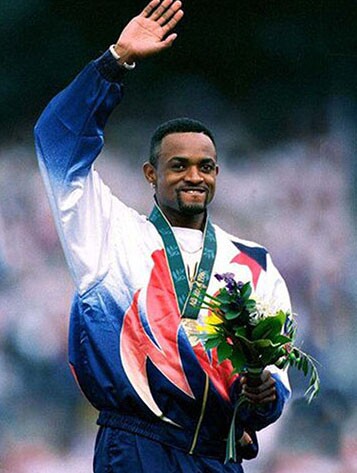
Kerry Lorenzo Harrison, who goes by Kenny, was born on February 13, 1965 in Milwaukee, Wisconsin, where he was a track star in high school, before going south to Kansas State University, where he won 3 NCAA titles, one in long jump and two in triple jump.
He won the 1991 World Championship in the triple jump, and was preparing to participate in the 1992 Olympics in Barcelona when he suffered a knee injury that required surgery. After rehabbing from surgery, he began competing in preparation for the 1996 Olympics, and he spent the three years leading up to the games ranked #2 in the world.
He was healthy when the 1996 Olympics came around, and was expected to compete with Jonathan Edwards of Great Britain, the world record holder who was ranked #1 in the world. In the preliminary round, he 17.58 meters on his first jump, which was 0.38 meters better than the second-best, by defending champion Mike Conley (father of the basketball player).
In the final round, where there were 12 jumpers, Harrison jumped 17.99 on his first jump, which would have been enough to win on its own, but on his third jump, he set a new Olympic record of 18.09 meters, while Edwards only managed a best jump of 17.88, giving Harrison the upset gold. At the time, it was the second-longest jump in history, and today, it still ranks #5. It was also the longest jump ever into a headwind until 2024, when Jordan Diaz of Spain jumped 18.18.
He competed for a couple more years, but decided to retire in 1998. His gold medal jump in 1996 is still the Olympic record 30 years later, and it's bigger because he beat the world record holder head to head to accomplish it, making him one of the greatest Olympians of all time, with only one event to his name.
Derrick Keith Brew was born on December 28, 1977 in Houston, Texas, and was raised and attended high school in the area, before going to college at LSU. He ran on the American 4x400m relay team in the 2001 and 2003 World Championships, both of which won gold, but had their medals taken away when some of his teammates were caught using steroids.
In the 2004 Olympics, his first event was the 400m. He won his heat in both the preliminary round and the semifinals, making him one of 3 Americans to advance to the final. In the final, the three Americans were in the lead and close together at the halfway point, but Brew dropped behind around the final turn, and came in behind his two teammates to take the bronze medal in an American podium sweep.
His other event was the 4x400m relay, where the Americans were overwhelming favorites due to having the top three 400m runners in the Olympics. Brew was picked to run the second leg in the prelim, and the Americans won by more than 2 seconds to advance to the final. In the final, he again ran the second leg, and he was given the baton with a lead of 0.93 seconds, which he expanded to 2.55 seconds by the midway point. The final 2 runners extended the lead even more, and they eventually won by 4.69 seconds, falling just short of the world record in the most dominant race in the history of the event.
He was again on the gold-winning relay team in the 2005 World Championships, but after failing to make the 2008 Olympic team, he retired from racing. Even though he only competed in 2 Olympic events, his part in the most dominant relay race of all time, along with his bronze medal a few days earlier, makes him one of the greatest Olympians of all time.
Armand Gustav Duplantis was born on November 10, 1999 in Lafayette, Louisiana, to an American father who was a pole vaulter, and a Swedish mother who was a heptathlete. He was raised in Louisiana, but spent his summers in Sweden with his grandparents, and holds dual citizenship. He first tried pole vaulting at age 4, and it was quickly apparent that he was special. He set his first age group world record at age 7, and still holds the records for all ages 7 through 12.
He began competing for Sweden in 2015, when the Swedish team agreed to bring his father on as a coach. He won the World Youth Championship that year, and the World Junior Championship in 2018, and began competing as an adult in 2019. In his first World Championship appearance that year, he came in second, something he hasn't done since in a major outdoor competition.
He set his first world record in February 2020, when he cleared 6.17m, (20'3"), which he broke again the next week by another centimeter. He was the favorite entering his first Olympics in Tokyo, and in the final, the field quickly dropped from seven at 5.8 meters, down to just three at 5.87 meters, then to two that cleared 5.92 and 5.97. He cleared 6.02 on his first try, while his opponent failed in three attempts, giving him the gold medal. He then raised the bar to 6.19m to try to break his world record, but failed to complete it, once knocking down the bar on his way down.
He won the next 2 World Championships, and broke his world record by a centimeter 6 more times, with 6.24m the new height to beat. In the 2024 Olympics, the only question was how high he would go. Only 7 vaulters were still alive after 5.9 meters, then 3 after 5.95. Neither of the others was able to clear 6 meters, which Mondo did easily, after which he cleared 6.1 meters on his first try as well, setting a new Olympic record. He then raised the bar to 6.25 meters, and finally cleared it on his third attempt to set a new world record again. He also became only the second pole vaulter ever to repeat as Olympic champion.
Since the Olympics, he has won another World Championship, and has broken his world record 6 more times by a centimeter each, and it currently sits at 6.31 meters. He believes that he can push the record to 6.4 meters eventually, and in 2028 he has the chance to have the first-ever three-peat in the event, but even if he doesn't, he has already established himself as one of the greatest Olympians of all time.
Athing Mu was born on June 8, 2002 in Trenton, New Jersey, to parents who had emigrated from South Sudan, and began running track at the age of 6. Upon graduating from high school in 2020, she attended Texas A&M, and also competed in the Olympic trials in early 2021, just days after she turned 19. Her time in the trials was the fastest in the world up to that point in the year, and she was made the favorite heading to Tokyo.
As the 800m started, Mu immediately sprinted to the front of the pack, and led the entire first lap at a steady pace, but as soon as the final lap started, she pulled away from the others, and by the finish line, she was 0.67 seconds ahead of anyone else, taking home an easy gold medal. She was the second-youngest winner of the event in history, and the youngest American woman to win track gold since 1964.
She also ran in the 4x400m relay, though she didn't usually run the 400m. She was assigned the anchor leg, but by the time she was given the baton, the race was practically over, as the Americans were 15 meters ahead of Poland, a gap of 1.5 seconds. Mu then ran the fastest leg of anyone, finishing her lap in 48.32 seconds, and the Americans won the race by nearly 4 seconds.
After Tokyo, Mu won the 800m World Championship in 2022, but only took bronze in the 2023 edition. In the 2024 Olympic trials, she tripped during her final race, causing her to miss out on going to Paris for the Olympics. She is still young, and actively competing, so she may be able to add to her medal count in 2028, but with what she has already done, she is one of the greatest Olympians of all time.
Raymond Clarence Ewry was born on October 14, 1873 in Lafayette, Indiana, and spent much of his childhood in a wheelchair due to polio. He went through a rigorous exercise routine to strengthen his legs, and by the time he went to college at Purdue in 1890, he was captain of the track team and played football. After graduating with a Masters in Mechanical Engineering, he moved to New York and joined the New York Athletic Club, competing in the standing jump events.
He first competed in the 1900 Paris Olympics, and all 3 of his events were held on the same day. In the standing high jump, there were only 3 competitors, but Ewry easily beat the others, jumping 1.655 meters, about 5 feet, 5 inches. There were only 4 participants in the standing long jump, and Ewry again dominated, jumping 3.3 meters, or 10 feet, 10 inches.
There were 10 jumpers in the standing triple jump event, and Ewry was the only one to jump more than 10 meters, ending up at 10.58 meters, nearly 2 feet ahead of anyone else. He walked away from Paris with gold medals in all 3 of his events.
He returned to defend his medals in 1904 in Saint Louis. In the standing long jump, which came first, he was again the best of the 4 participants, jumping over 3.4 meters on all 4 of his attempts, while no one else reached 3.3 meters on any jump. His final jump of 3.47 meters gave him the win by nearly 8 inches.
In the standing high jump, there were 5 athletes taking part, and Ewry again dominated, jumping 1.6 meters, a full 6 inches higher than the silver medalist. In the standing triple jump, he finished at 10.54 meters, just short of his distance from 1900, and again won the competition by more than a foot over anyone else.
In 1908, the standing triple jump had been discontinued, but he still competed in the other two events. In the standing long jump, there was a qualifying round for the first time, because the field had ballooned to 23, but Ewry led after both the qualifying and the final, finishing with a jump of 3.33 meters, 0.1 meters ahead of the silver medalist.
There were also 23 jumpers in the standing high jump, and this time Ewry was tied for first after qualifying with Kostas Tsiklitiras of Greece, both with jumps of 1.55 meters. The top 4 advanced to the final, where John Biller of the USA also jumped 1.55, but Ewry was able to eke past them both with a final jump of 1.57 meters to win his final gold medal.
He attempted to make the team again in 1912, but failed to qualify. Even though none of his events were contested again after World War I, he won every event he entered, often by large margins, which makes him one of the greatest Olympians of all time.
Ethan Katzberg was born on April 5, 2002 in Nanaimo, British Columbia, Canada, and started throwing the hammer when he was 14, after watching his sister compete in the event. He moved to Kamloops after high school to train with Dylan Armstrong, who had won a bronze medal in shot put in 2008. His first international competition was in 2001, and by 2003 he was the world champion, breaking the Canadian national record twice during that competition.
He was the favorite to win the gold medal in Paris in 2024, and he didn't disappoint. After the qualifying round, he was in first place, more than 2 meters ahead of anyone else. In the final, he started with a throw of 84.12, just short of the Olympic record of 84.8 meters. He only had one more valid throw in the final, which went 82.28, while no other competitor reached 80 meters, giving him a dominant gold medal by 4.15 meters.
Katzberg was the youngest hammer throw winner in history, the first Canadian thrower to win gold since 1904, and had the largest margin of victory in the event since 1912. He also repeated as world champion in 2025, and looks to have a very good career still in front of him. All taken together, he has already proven himself to be one of the greatest Olympians of all time.
Vilho Eino Ritola, known as Ville, was born on January 18, 1896 in Peraseinajoki, Finland, which at the time was part of the Russian Empire. He was the 14th of 20 children, and he joined 7 of them in emigrating to the United States in 1913 to find work as a carpenter. He didn't begin training as a runner until he was 23 years old.
In 1922, he won a couple of gold medals in the AAU Championship, and came in second in the Boston Marathon, after which he felt he was ready to try to make the Olympics, competing for his home country of Finland. Some other American Finns helped raise money to send him home to Finland to compete in the Olympic trials, where he set a world record in the 10000m, breaking the record previously held by fellow Finn Paavo Nurmi.
Ritola went to Paris to compete in 6 events. His first was the 10000m, where he was a heavy favorite, thanks partly to his new world record, and partly due to Nurmi choosing to sit out to conserve his energy for other events. He pulled away early, with only Edvin Wide of Sweden keeping pace, but after 4000m, Wide dropped back, and Ritola continued his pace, winning the race by 32 seconds, nearly half a lap, and breaking his own world record by 12 seconds, giving him a dominant gold medal in his first event.
His next event was the steeplechase, which he had never run before. He didn't have the technique down, but his speed and endurance were enough as he won the race by over 11 seconds, setting a new Olympic record, and coming up just 0.2 seconds short of the world record.
Up next was the 5000m, in which he would finally face Nurmi. Nurmi had just won the gold medal in the 1500m less than an hour earlier, so Ritola and Wide took off early, hoping that Nurmi would be too tired to catch them, but at the 2000m mark, Nurmi had caught up to the leaders, and by 3000m, Wide had dropped off the pace, leaving the two Finns to battle for gold. Nurmi passed Ritola at the 4000m mark, then held him off the rest of the way, winning the gold, and leaving Ritola with a silver by 0.2 seconds.
The cross country event was next, which covered nearly 10000m on one of the hottest days in Paris history. Nurmi and Ritola took off ahead of the pack again, but Ritola was unable to keep pace, and ended up losing by almost a minute and a half, though he still won silver by over a minute. More than half of the racers were unable to finish due to the heat.
The cross country team event scoring was based on placement of the top 3 runners from each country in the individual event, so Finland was a massive favorite due to having the top 2 finishers. Heikki Liimatainen was the third Finnish runner, and he was stumbling toward the finish, then stepped off the course thinking that he had finished, but he was still 30 meters short. After the crowd let him know that he hadn't finished, he returned to the course, and staggered for two minutes toward the line, finally crossing just in time to earn Finland the gold ahead of the USA.
The final event was the team 3000m race, in which the places of the top 3 finishers counted toward each country's score. Nurmi and Ritola again finished in first and second, but they didn't have to wait as long this time, as teammate Elias Katz came in fifth, earning the Finns an easy gold medal, the fourth for Ritola at his first Olympics. His 6 total medals are still the record for a track athlete at a single Olympics, and his 4 golds only trail Nurmi's 5 from the same Olympics.
He returned to the US after the Olympics and returned to work in construction, rarely training, but still competing in some meets. He decided to compete in the Olympics again in 1928, heading to Amsterdam, where he would go head to head with Nurmi in 3 events again.
The first event was the 10000m, where Ritola was the defending champ, but Nurmi was now the world record holder, and the two of them, along with Wide, left the field behind early again, with Ritola in front. Wide kept up with the Finns until 8000m, then fell behind, leaving the two favorites to fight for gold again. Nurmi stayed right behind Ritola until the final straightaway, when he passed his teammate and pulled away slightly to win by 0.6 seconds in Olympic record time, both more than 40 seconds ahead of Wide, the bronze medalist.
In the 5000m final, the same three runners pulled away from the pack again, with Ritola taking the lead around the halfway point. Wide fell behind with 600m left, while Ritola started to pull away from Nurmi, and ended up winning the race by 2 seconds, while Nurmi held on for the silver.
His final event was the steeplechase, where he was the defending champ. He qualified for the final, but hurt his ankle in the process, and while he still ran, he was unable to finish the race, the first time he had ever failed to win a medal in an Olympic event.
He retired soon after the 1928 Olympics, returning to the United States, where he spent the next 30 years working construction until he was old enough to retire. A few years later, he returned to Finland, where he passed away a decade later in Helsinki on April 24, 1982. He was overshadowed by his teammate Nurmi through his whole career, but he finally beat him head-to-head in his final Olympic win, and he was so much better than anyone else at the time, that he is obviously one of the greatest Olympians of all time.


.jpg/250px-Paavo_Nurmi_(Antwerp_1920).jpg?utm_source=en.wikipedia.org&utm_campaign=index&utm_content=thumbnail)