Showing posts with label 1924 Olympics. Show all posts

Friday, November 6, 2026

Top 150 Olympic Athletes: #12 - Lucien Gaudin


Lucien Gaudin

France

Fencing


Overall Ranks

#1 among French Olympians

#1 among Fencers


Olympic Results

1920

Team Foil - Silver

1924

Team Foil - Gold

Team Epee - Gold

1928

Individual Foil - Gold

Team Foil - Silver

Individual Epee - Gold

Total

Events - 6

Gold - 4

Silver - 2


Lucien Alphonse Paul Gaudin was born September 27, 1886 in Arras, France, and studied fencing under two of the masters who had competed in the 1900 Olympics, and began competing internationally in 1904, but not in time for that year's Olympics. He was selected to compete in the 1908 Olympics in London, but ended up not competing. 

He finally made his Olympic debut 12 years later in Antwerp, competing in the team foil event. He was a perfect 4-0 in his first round match against the Netherlands, which advanced France to the final pool. In that pool, he went 11-1, only losing a single bout against Italy, who would eventually win the gold medal, as they beat France 9-7 in their match, but Gaudin won a silver medal for his work.

He was expected to compete in the individual foil as well, but ended up sitting out, and the three medals ended up all being won by his French teammates. He returned to compete in 1924 in Paris, again starting with the team foil event. He was a perfect 12-0 in the early rounds, leading France back to the final pool. In the final pool, he was again perfect, going 10-0, but the ruling on his final point in a bout with Italy was somewhat controversial, and the Italian team walked out and forfeited the rest of the tournament, giving France an easy gold with their best opponent gone.

He again sat out the individual foil event, watching his teammates take gold and silver, instead preparing for the team epee event. He ended up only being used in the final pool, where he went 6-2 in his bouts, and helped France secure another team gold medal.

He was entered in 3 events in the 1928 Games in Amsterdam, and this time he competed in all 3, starting with the team foil again. He was again perfect in leading France to the final pool, winning all 12 of his bouts. In the final pool, he went 7-1, including 3-1 against Italy, but his teammates each went 1-3 in that match, so they lost to their rivals 10-6, and ended up with the silver medal again, despite Gaudin's best efforts.

That was the year when Gaudin would finally compete in the individual foil event for the first time. As usual, he was perfect all the way to the final, winning all 12 of his bouts, putting him in the 12-man final pool as one of the favorites. In that pool, he went 9-2, which resulted in a 3-way tie for first, so the three each fenced each other again to break the tie. He beat Erwin Casmir of Germany easily in his first bout, then faced Giulio Gaudini of Italy. He fell behind 4-2 in that match, but then took 3 straight points, and with it, the gold medal.

He also competed in the individual epee event that year, which was not his specialty, but he had contributed to the team gold 4 years earlier. He went 24-4 on his way to the final pool, coming in first in his pool in all 3 rounds. In the final pool, he went 8-1, with his only loss coming in a tie against Leon Tom of Belgium, as ties were counted as losses for both fencers that year. That record was enough to win him the gold medal, making him the second and most recent man in history to win both the foil and epee in the same Olympics.

He retired the next year to focus on running his film company, which had produced the official Olympic film for the 1924 Paris games. The company ended up going bankrupt in 1934, and in his despair, Gaudin committed suicide. It's been nearly 100 years since he last competed, but no one else has matched his performance in 1928, and he never finished worse than second place in any Olympic event in his career, making him one of the greatest Olympians of all time.


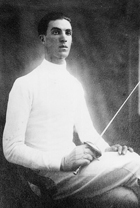
Saturday, October 3, 2026

Top 150 Olympic Athletes: #42 - Paavo Nurmi


Paavo Nurmi

Finland

Athletics


Overall Ranks

#10 among Track & Field Athletes

#7 among Male Track & Field Athletes

#2 among Finnish Olympians

#1 among Finnish Track & Field Athletes


Olympic Results

1920

5000m - Silver

10000m - Gold

Cross Country - Gold

Cross Country Team - Gold

1924

1500m - Gold

5000m - Gold

Team Race - Gold

Cross Country - Gold

Cross Country Team - Gold

1928

5000m - Silver

10000m - Gold

Steeplechase - Silver

Total

Events - 12

Gold - 9

Silver - 3


Paavo Johannes Nurmi was born on June 13, 1897 in Turku, Finland, into a poor family, where running was just a part of everyday life. He dropped out of school at age 12 to help support his family, and began training as a runner after hearing about the successes of Hannes Kolehmainen, a fellow Finn, at the 1912 Olympics. After a stint in the army during the Finnish civil war, he qualified to compete in the 1920 Olympics.

His first Olympic event was the 5000m, where he was one of 12 runners to qualify for the final. In the final race, he and Joseph Guillemot of France pulled away from the field after just two laps, and the two ran together for the rest of the race, until just 200m remained, at which point Guillemot had a finishing kick that left him 4.4 seconds ahead of Nurmi, who took the silver medal. It would be the only race in his career in which he lost to a runner from another country.

The 10000m was next, and since the world record holder had been killed in World War I, the two leaders from the 5000m were the favorites. Those two, along with James Wilson of Great Britain, led the way for most of the race, and when the pack nearly caught them with 5 laps to go, they picked up the pace and pulled away. Nurmi took the lead at the beginning of the final lap, and didn't allow the others a chance to pass him, and he won the race by 4.7 seconds to earn his first gold medal.

Next was the cross country race, which was supposed to be 10000m, but ended up closer to 8000m. Medals were awarded for the top 3 individuals, as well as the top 3 teams, which were scored based on the finishing order of their top 3 runners. Guillemot sprained his ankle halfway through the race, and Nurmi only had one real challenger, Eric Backman of Sweden, but he came through and won by 2.6 seconds to take another gold medal. Since the next two Finns finished 3rd and 6th, the team won gold solidly, as their placements added up to 10, far ahead of the Brits, with 21.

After the Olympics, Nurmi was able to afford to get electric lighting and running water for his family. He also began experimenting with his pace, running with a stopwatch for the rest of his career, in an attempt to make himself impossible to beat. Over the next 2 years, he set world records in the mile, the 1500m, 2000m, 3000m, 5000m, and 10000m. He is still the only athlete in history to hold world records in the mile, 5000m, and 10000m at the same time. He also graduated with an engineering degree in 1923.

He suffered a knee injury early in 1924, but was able to recover in time for the Olympic trials, where he qualified while setting new world records in the 1500m and 5000m just an hour apart. In the Olympics, which were contested on a 500m track, rather than today's familiar 400m version, he started with the 1500m. Ray Watson of the USA was able to keep pace with him through 2 laps, but fell back at the start of the last lap, and Nurmi coasted to the finish to conserve energy, still setting a new Olympic record in the process by 3 seconds.

42 minutes later, he competed in the 5000m. Ville Ritola (#89), and Edvin Wide of Sweden tried to tire him out by setting a fast pace early, so Nurmi abandoned his stopwatch and pushed to catch the leaders at the 2000m mark. Wide fell behind by 3000m, and Nurmi pulled ahead at 4000m, then held off his teammate for the last 2 laps and won the race by 0.2 seconds.

The cross country race was next, and the temperature that day was over 100 degrees, which caused most of the runners to drop out before the end of the race. Nurmi and Ritola took the lead early, but Ritola could not keep pace, and Nurmi won easily, by almost a minute and a half. He ended up getting the team gold as well, when his other teammate, Heikki Liimatainen, was able to cross the finish line after becoming disoriented near the finish, spending nearly two minutes stumbling toward the line before he finally made it.

His Olympics concluded the next day with the 3000m team race, which was run on the track with the same scoring system as the cross country team event. Nurmi and Ritola finished in the top 2 spots easily, and when their teammate, Elias Katz, finished in 5th, they won the gold medal in a runaway. This was Nurmi's fifth gold medal in Paris, which is still the most ever won by a track athlete in a single Olympics.

Nurmi spent 5 months touring the United States the next year, competing in 55 races in that time, which wore him down, and he slowed his training schedule over the next year. In 1926, he set a new 3000m world record in Sweden, but one of the Swedish runners spent the whole race interfering with his pace, and he vowed to never compete against him again, which came back to bite him later in his career.

He threatened not to compete in the 1928 Olympics, but he and the Finnish Olympic committee were finally able to make peace over his refusal to compete against the Swedish runners in recent years, and he made the team. He started his Olympics that year with the 10000m, his favorite race, and it started with himself, Ritola, and Wide running away from the field, then Wide dropping behind at 8000m. Ritola led the entire race up to 9000m, but then Nurmi pulled ahead of him and held him off down the stretch, winning by 0.6 seconds for his 9th career gold medal.

In the 5000m, the same three runners pulled away from the field again, and again, Wide fell behind late in the race, while the pair of Finns stayed together. This time, Ritola was the one who was able to pull away late, beating Nurmi for the only time in his career, by a margin of 2 seconds, while Nurmi was able to hold off a late charge from Wide to win the silver.

His final event was the steeplechase, which he hadn't run before, and in the heats, he fell on the first water jump, spraining his ankle and hip, but still finished fast enough to make the final. The day after the 5000m final, he ran in the steeplechase final, and after Ritola wore out early and dropped out, it was down to Nurmi and Toivo Loukola of Finland, but Loukola was able to leave Nurmi behind, and Nurmi had to settle for finishing with another silver.

He decided that he would compete in one final Olympics in 1932, planning to compete in just the 10000m and the marathon, but his plans were foiled when he was suspended by the IAAF for competing as a professional, which he hadn't. Finland's Olympic committee investigated and found that the allegations were untrue, and he went to Los Angeles to compete, but the ruling was upheld 3 days before the Olympics started, and he was forced to sit out. It turns out that the IAAF chairman was from Sweden, and that he had forced Germany to lie about making payments to Nurmi for a race in 1931, still holding a grudge from the 1926 incident.

Nurmi continued to run, refusing to turn pro, while he appealed the IAAF decision, but he lost his appeal in 1934, and his ban became permanent, even though it was based on lies. At that point, he retired from competition. He competed in 12 events over 3 Olympic Games, and never finished worse than 2nd place, winning 9 gold medals and 3 silvers in all. His record of 5 track gold medals in a single Olympics still stands, and he is obviously one of the greatest Olympians of all time.


Monday, August 17, 2026

Top 150 Olympic Athletes: #89 - Ville Ritola


Ville Ritola

Finland

Athletics


Overall Ranks

#27 among Track & Field Athletes

#21 among Male Track & Field Athletes

#3 among Finnish Olympians

#2 among Finnish Track & Field Athletes


Olympic Results

1924

5000m - Silver

10000m - Gold

Steeplechase - Gold

Team Race - Gold

Cross Country - Silver

Cross Country Team - Gold

1928

5000m - Gold

10000m - Silver

Total

Events - 9

Gold - 5

Silver - 3


Vilho Eino Ritola, known as Ville, was born on January 18, 1896 in Peraseinajoki, Finland, which at the time was part of the Russian Empire. He was the 14th of 20 children, and he joined 7 of them in emigrating to the United States in 1913 to find work as a carpenter. He didn't begin training as a runner until he was 23 years old.

In 1922, he won a couple of gold medals in the AAU Championship, and came in second in the Boston Marathon, after which he felt he was ready to try to make the Olympics, competing for his home country of Finland. Some other American Finns helped raise money to send him home to Finland to compete in the Olympic trials, where he set a world record in the 10000m, breaking the record previously held by fellow Finn Paavo Nurmi.

Ritola went to Paris to compete in 6 events. His first was the 10000m, where he was a heavy favorite, thanks partly to his new world record, and partly due to Nurmi choosing to sit out to conserve his energy for other events. He pulled away early, with only Edvin Wide of Sweden keeping pace, but after 4000m, Wide dropped back, and Ritola continued his pace, winning the race by 32 seconds, nearly half a lap, and breaking his own world record by 12 seconds, giving him a dominant gold medal in his first event.

His next event was the steeplechase, which he had never run before. He didn't have the technique down, but his speed and endurance were enough as he won the race by over 11 seconds, setting a new Olympic record, and coming up just 0.2 seconds short of the world record. 

Up next was the 5000m, in which he would finally face Nurmi. Nurmi had just won the gold medal in the 1500m less than an hour earlier, so Ritola and Wide took off early, hoping that Nurmi would be too tired to catch them, but at the 2000m mark, Nurmi had caught up to the leaders, and by 3000m, Wide had dropped off the pace, leaving the two Finns to battle for gold. Nurmi passed Ritola at the 4000m mark, then held him off the rest of the way, winning the gold, and leaving Ritola with a silver by 0.2 seconds.

The cross country event was next, which covered nearly 10000m on one of the hottest days in Paris history. Nurmi and Ritola took off ahead of the pack again, but Ritola was unable to keep pace, and ended up losing by almost a minute and a half, though he still won silver by over a minute. More than half of the racers were unable to finish due to the heat.

The cross country team event scoring was based on placement of the top 3 runners from each country in the individual event, so Finland was a massive favorite due to having the top 2 finishers. Heikki Liimatainen was the third Finnish runner, and he was stumbling toward the finish, then stepped off the course thinking that he had finished, but he was still 30 meters short. After the crowd let him know that he hadn't finished, he returned to the course, and staggered for two minutes toward the line, finally crossing just in time to earn Finland the gold ahead of the USA.

The final event was the team 3000m race, in which the places of the top 3 finishers counted toward each country's score. Nurmi and Ritola again finished in first and second, but they didn't have to wait as long this time, as teammate Elias Katz came in fifth, earning the Finns an easy gold medal, the fourth for Ritola at his first Olympics. His 6 total medals are still the record for a track athlete at a single Olympics, and his 4 golds only trail Nurmi's 5 from the same Olympics.

He returned to the US after the Olympics and returned to work in construction, rarely training, but still competing in some meets. He decided to compete in the Olympics again in 1928, heading to Amsterdam, where he would go head to head with Nurmi in 3 events again.

The first event was the 10000m, where Ritola was the defending champ, but Nurmi was now the world record holder, and the two of them, along with Wide, left the field behind early again, with Ritola in front. Wide kept up with the Finns until 8000m, then fell behind, leaving the two favorites to fight for gold again. Nurmi stayed right behind Ritola until the final straightaway, when he passed his teammate and pulled away slightly to win by 0.6 seconds in Olympic record time, both more than 40 seconds ahead of Wide, the bronze medalist.

In the 5000m final, the same three runners pulled away from the pack again, with Ritola taking the lead around the halfway point. Wide fell behind with 600m left, while Ritola started to pull away from Nurmi, and ended up winning the race by 2 seconds, while Nurmi held on for the silver.

His final event was the steeplechase, where he was the defending champ. He qualified for the final, but hurt his ankle in the process, and while he still ran, he was unable to finish the race, the first time he had ever failed to win a medal in an Olympic event.

He retired soon after the 1928 Olympics, returning to the United States, where he spent the next 30 years working construction until he was old enough to retire. A few years later, he returned to Finland, where he passed away a decade later in Helsinki on April 24, 1982. He was overshadowed by his teammate Nurmi through his whole career, but he finally beat him head-to-head in his final Olympic win, and he was so much better than anyone else at the time, that he is obviously one of the greatest Olympians of all time.


Friday, June 26, 2026

Top 150 Olympic Athletes: #141 - Giulio Gaudini


Giulio Gaudini

Italy

Fencing


Overall Rankings

#9 among Fencers

#8 among Italian Olympians

#8 among Male Fencers

#4 among Italians Fencers

#3 among Male Italian Fencers


Olympic Results

1928

Individual Foil - Bronze

Team Foil - Gold

1932

Individual Foil - Bronze

Team Foil - Silver

Individual Sabre - Silver

Team Sabre - Silver

1936

Individual Foil - Gold

Team Foil - Gold

Team Sabre - Silver

Total

Events - 11

Gold - 3

Silver - 4

Bronze - 2


Giulio Gaudini was born on September 28, 1904 in Rome, Italy. He began fencing at a young age, and immediately showed promise, so much so that he made Italy's very competitive Olympic fencing team when he was just 19 years old.

In his first Olympics, he was only entered in the team foil event. The team made it through pool play and the quarterfinals with no issue, reaching the final group of 4, but in their first match, against France, they disagreed with the final point that was awarded to the French and left the competition in protest, which gave the team a 4th place finish by default.

By 1928, he was one of the stars of the Italian team, and there would be no repeat of their 1924 result, as they won every match en route to a dominant gold medal. He then competed in the individual foil event for the first time, and advanced easily into the final group of 12, where he finished with a 9-2 record, which put him in a 3-way tie for first. The tie was broken by scoring margin, which earned Gaudini the bronze medal.

In 1932, he returned to compete in the foil events, but added the sabre events as well. The Italian team was favored to repeat their title in the team foil event, but after a 3-way tie in the final pool, Italy was awarded the silver medal based on having fewer overall touches than France. In the individual foil, he repeated his bronze medal performance from 4 years earlier.

Hungary was the defending champion in the team sabre and was the heavy favorite, and they did not disappoint, wiping out every opponent in the tournament. Gaudini and the Italians won silver, easily defeating Poland and the USA in the final pool, but falling 9-2 against Hungary. Hungary was expected to take all 3 individual sabre medals, but Gaudini surprised everyone by taking the silver after losing only 2 matches in the final pool, leaving him with 3 silvers and a bronze in 1932.

Gaudini qualified for the same 4 events in 1936, and this time Italy would return to form, going undefeated through the tournament and beating France 9-4 in the decisive match to take back the gold medal. In the individual foil, Gaudini came in first place in his pool in every round of the tournament, and won all 7 matches in the final pool to finally earn his first individual gold medal.

The team sabre event was a repeat of the 1932 event, except that Italy made their final match with Hungary a bit closer this time, losing 9-6 to earn a repeat silver. In the individual sabre, Gaudini reached the final pool, just as he always had, but finished 3-5 among that group and ended up in 6th place, the worst finish of his Olympic career.

The next two Olympic games were not held due to World War II, and before he could compete again, Gaudini passed away from cancer on January 6, 1948 in his hometown of Rome. He was undoubtedly one of the greatest fencers of his time, reaching the final pool in all 11 events in which he competed, and earning a total of 9 medals, 3 of which were gold, capped off with his first and only individual gold in 1936.