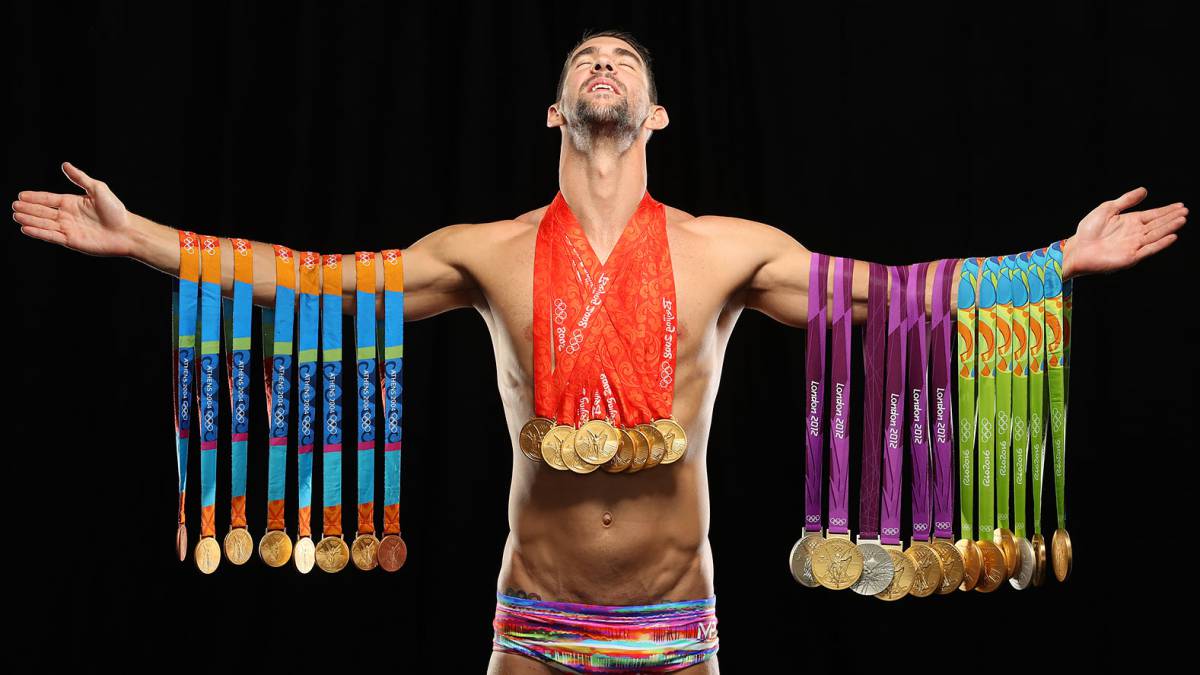
Michael Phelps
USA
Swimming
Overall Ranks
#1 among all Olympians
Olympic Results
2004
200m Freestyle - Bronze
4x100m Freestyle Relay - Bronze
4x200m Freestyle Relay - Gold
100m Butterfly - Gold
200m Butterfly - Gold
200m Individual Medley - Gold
400m Individual Medley - Gold
4x100m Medley Relay - Gold
2008
200m Freestyle - Gold
4x100m Freestyle Relay - Gold
4x200m Freestyle Relay - Gold
100m Butterfly - Gold
200m Butterfly - Gold
200m Individual Medley - Gold
400m Individual Medley - Gold
4x100m Medley Relay - Gold
2012
4x100m Freestyle Relay - Silver
4x200m Freestyle Relay - Gold
100m Butterfly - Gold
200m Butterfly - Silver
200m Individual Medley - Gold
4x100m Medley Relay - Gold
2016
4x100m Freestyle Relay - Gold
4x200m Freestyle Relay - Gold
100m Butterfly - Silver
200m Butterfly - Gold
200m Individual Medley - Gold
4x100m Medley Relay - Gold
Total
Events - 30
Gold - 23
Silver - 3
Bronze - 2
Michael Fred Phelps II was born on June 30, 1985 in Baltimore, Maryland, to a mother who was a middle school principal and a father who was a state trooper and former college football player. He learned to swim at age 7, and by the time he was 11, he had set many national records for his age group.
He was such a phenom that he qualified for the US Olympic team in 2000, when he was just 15 years old, the youngest swimmer to make the US team in 68 years. He swam well enough to make it to the final in the 200m butterfly, his only event, where he was in last place for most of the race, but had the fastest final lap of any swimmer to move up to 5th at the finish, just 0.33 seconds short of a medal. It would be the worst finish of his Olympic career.
The next year, at the World Championships, he set a new world record in the same event, becoming the youngest swimmer ever to set a world record, breaking Ian Thorpe's record by 13 months. The next year, he was part of a world record in the 4x100m medley relay, and set a new world record in the 400m individual medley. He set 7 world records in 2003, and by the time the 2004 Olympics came around, he was probably the top swimmer in the world, without having yet won an Olympic medal.
He qualified to compete in 8 events in Athens, and was aiming to break Mark Spitz's record of 7 gold medals in a single Olympics. He started out with the 400m IM, which was probably his strongest event, and he ran away with it early. He was 1.5 seconds ahead after the butterfly, and almost 3.5 seconds ahead after the backstroke. That narrowed to 2.3 seconds after the breaststroke, which was his weakest stroke, but he pulled away again on the freestyle, winning by 3.55 seconds and setting another world record in the event.
Next was the 4x100m freestyle relay, where the Americans always won. This time, the result would be different. Phelps swam the second leg, but the USA was in last place when he entered the pool. He was able to pull them up into 6th place, but they were still 2.3 seconds behind South Africa, who led. The next two swimmers continued to cut into the deficit, but it wasn't enough in the end, and they had to settle for a bronze medal, 1.45 seconds behind the winners.
Next was the 200m freestyle, which was not one of his usual events, but he entered it specifically to face Ian Thorpe. Pieter van den Hoogenband of the Netherlands was the defending champ, and he set off fast, ahead of world record pace through 150m, but with Thorpe right behind him. He faced badly down the stretch, and Thorpe got his revenge by winning, while Phelps nearly caught him as well, but ended up taking the bronze.
His next event was the 200m butterfly, where he held the world record, and he finally broke out of the doldrums, leading the race from start to finish, and setting a new Olympic record while winning his second gold medal in the second-fastest time in history. The same day, he swam the opening leg of the 4x200m relay, where Australia had upset the USA 4 years earlier. He gave the Americans a lead of just over a second after his swim, which slowly shrunk the rest of the way, but Klete Keller was able to hold off Thorpe on the anchor leg to win the race by 0.13 seconds, earning Phelps a third gold.
Next was the 200m IM, where he was also the world record holder. He again led the entire race, and nobody else was really even close, and he finished it off in world record time, while 3 others finished together about 1.6 seconds later, with Ryan Lochte ending up with the silver.
He then swam in the 100m butterfly, where he had lost to Ian Crocker at the Olympic trials, and was hoping for revenge. Crocker had a great start, and was 0.77 seconds ahead of Phelps at the turn, but Phelps swam an amazing last lap, catching Crocker at the wall and outtouching him by 0.04 seconds to win his 5th gold medal.
His final event was the 4x100m medley relay, where he swam the butterfly leg in the prelim, but gave up his spot in the final to Crocker, who helped the USA win gold in world record time. That win gave Phelps his 6th gold medal of the games, and his 8th medal overall, making him only the second man in history to win 8 medals at a single Olympics, after Aleksandr Dityatin of the USSR.
At the 2005 World Championships, Phelps decided to skip his two signature events, the 400m IM and the 200m butterfly, to experiment with a couple more freestyle events, and still managed to walk away with 5 gold medals and a silver. He went back to his usual set of events in 2007, and won 7 gold medals, 5 of them in world record time.
He went to Beijing in 2008 with the goal to beat Spitz's record of 7 gold medals in a single Olympics, which he had failed to do in Athens. He started again with the 400m IM, where Lochte was expected to challenge him, but Phelps had other ideas. Early on, Laszlo Cseh Jr of Hungary was keeping pace with him, and Lochte briefly had the lead at the 150m mark, but then Phelps pulled away from both of them, and ended up breaking his own world record from the previous month by more than a second, and beating Cseh by more than 2 seconds for the gold.
Next was the 4x100m freestyle relay, where America had been disappointing 4 years earlier. Phelps swam first, and was slightly behind the Australian swimmer after his leg, but the USA took the lead after the second leg. Unfortunately, France had a great third leg, and took the lead by 0.59 seconds, which required Jason Lezak to swim the leg of his life, which he did to make up the gap, and he ended up touching the wall first by 0.08 seconds to win the gold medal, and keep alive Phelps' drive for 8 golds, while also setting a world record.
Next was the 200m freestyle, where he held the world record, but had come in third in 2004, and hadn't won either of his prelim heats in Beijing. It turns out that he was just conserving his strength, as he left the field in the dust, winning in world record time, nearly 2 seconds ahead of his nearest competitor. He now had 3 golds in 3 events, and had gotten through 2 of his 3 toughest events.
Next was the 200m butterfly, where he had held the world record for 7 years, so he was expected to win easily. Moss Burmester of New Zealand led out early, but Phelps caught up by the midway point, then pulled away despite water leaking into his goggles, breaking another world record in the process while winning by more than half a second.
Next was the 4x200m relay, where there was no doubt that the Americans would win. Phelps led off with the second-fastest leg in history, giving them a lead of more than 2.5 seconds, and his teammates kept it up, finishing the race more than 5 seconds ahead of Russia, as well as more than 5 seconds under the previous world record, becoming the first team ever to break 7 minutes in that relay.
He then swam in the 200m IM, where Cseh and Lochte were expected to challenge him, but he didn't care about that, he just took the lead early, and kept it throughout the race, winning by 2.29 seconds and setting his 6th world record of the games while winning his 6th gold.
Next was his toughest event the 100m butterfly, the only one where he wasn't the current world record holder, and one that he barely won in 2004. At the turn, Phelps was in 7th place, and it seemed like his chance at 8 golds was over, but he turned on the burners on the last lap, and reached the wall simultaneously with Milorad Cavic of Serbia, but his final stroke allowed him to touch first, and he won the gold medal by 0.01 seconds, the closest finish possible. It was also an Olympic record, and was the only event where he did not set a world record that year.
He finished up with the 4x100m medley relay, swimming the butterfly leg, as usual. America started out in the lead after the backstroke, but had fallen to 3rd after the breaststroke, nearly half a second behind. Phelps was up next, and he got the lead back, putting them up by 0.25 seconds over Japan, but Japan faded, and Jason Lezak was able to hold off an Australian charge to win the gold medal by 0.7 seconds, while setting another world record.
After finally achieving his dream of 8 gold medals, Phelps scaled back a little going forward. At the 2009 World Championships, he only competed in 6 events, winning 5, and setting 4 world records. He won another 4 gold medals at the 2011 World Championships, but that was out of 7 events. He was starting to show his age somewhat, but was still among the best in the world.
He chose to swim in only 7 events at the 2012 Olympics, dropping the 200m freestyle from his program. He started off with the 400m IM, which he had previously said he would not race again, but he had changed his mind a year earlier, and was able to qualify for the final, but just barely. Lochte, who had beaten him in the Olympic trials, dominated the race, winning by more than 3.5 seconds, while Phelps was in medal position for most of the race, but ended up finishing in 4th, just 0.34 seconds short of a medal, the first time since he was a teenager that he hadn't won a medal.
Next was the 4x100m relay, where the USA had barely won in 2008. Phelps swam the second leg this time, and he helped them extend their lead to 0.76 seconds at the halfway point. They were still up by half a second going into the anchor, but Lochte was passed on the last lap, and the USA ended up with the silver medal.
His third event was the 200m butterfly, where he was attempting to become the first swimmer to win individual gold in the same event 3 times. He led for almost the entire race, but Chad le Clos of South Africa was able to chase him down on the final lap, and Phelps ended up finishing in second place by a margin of only 0.05 seconds. Even though it was a loss, he had won his 18th Olympic medal overall, tying him with Larisa Latynina for the most ever.
Next was the 4x200m relay, which America had dominated last time, and they were nearly as good this time. Phelps swam anchor, and was given a lead of nearly 4 seconds to work with, so he didn't push too hard, and still won the race by more than 3 seconds, while again breaking the 7 minute mark, though not the world record. At that point, Phelps broke the record for most total Olympic medals.
The 200m IM was Phelps' third attempt to become the first swimmer to win 3 straight in an individual event, and he was finally able to succeed. Lochte stayed with him for a little while, but was unable to match him after the first leg, and Phelps won the gold medal by 0.63 seconds over his teammate.
He was trying to do the same in the 100m butterfly, which he had won by a fingertip in 2008. This race was somewhat similar to the one in Beijing, with Phelps sitting in 7th at the turn, and Cavic in the lead, but Phelps caught up faster this time, and by the end, he had won by 0.23 seconds over le Clos, who had charged to the front with Phelps but was unable to overtake him.
He finished up again with the 4x100m medley relay, which the USA never lost. They were slightly behind Japan when Phelps jumped in, but he took back the lead, as usual, and they pulled away on the freestyle leg to win by almost 2 seconds, getting Phelps yet another gold medal, his 4th in London, and 18th overall.
He retired right after the London Olympics, but changed his mind 2 years later, and started training again. He did not compete in the 2015 World Championships after a DUI arrest, but still made the team for 2016 in Rio, competing in 6 events, the same ones as before, without the 400m IM.
He started out this time with the 4x100m relay, where France was favored. The USA was in a virtual tie with France after leg one, when Phelps started, and he gave the Americans a lead of more than a second after his swim, which ended up being enough, as the US finished the race more than half a second ahead of the favorites to win the gold medal.
Next was the 200m butterfly, where Phelps started out just behind Cseh in the final, but overtook his soon after that, and was able to withstand a late charge from Masato Sakai of Japan to win the gold medal. His gold medal total was now 20, more than double any other athlete's total at that time.
Next was the 4x200m relay, where Phelps swam the anchor leg for the USA. They had the lead the whole way, and it kept getting bigger as they went, so Phelps didn't have to do much on the final leg, coasting home as the USA won the gold medal by almost 2.5 seconds over Great Britain.
In the 200m IM, he was looking to become the first swimmer ever to four-peat, after becoming the first to win 3 in a row in London. He wasn't able to take the lead until just after the halfway point, but no one was able to come close to him once he did, and he ran away to win the gold medal by nearly 2 seconds.
He would try to repeat that feat the next day in the 100m butterfly, but that event had always been close. This time, it wasn't close, but not in Phelps' favor. Joseph Schooling of Singapore led the entire way and set a new Olympic record, winning Singapore's first-ever Olympic gold medal, while Phelps ended up in a 3-way tie with le Clos and Cseh for the silver medal, with all 3 touching the wall at the exact same moment.
His final event was the 4x100m medley relay, where he swam the butterfly leg, as usual. The Americans dominated the event, as they always had, leading from start to finish, and setting a new Olympic record in the process, beating Great Britain by more than a second to earn Phelps his 5th gold in Rio, and his 23rd of his career.
Phelps retired for good after the 2016 Olympics, moving to Arizona, where he is raising 4 sons and coaching swimming at Arizona State University. His 23 gold medals are more than double the total for any other Olympian ever, and his 28 total medals are 10 more than any other Olympian. He had the most total medals at 4 different Olympics, the only athlete ever to do that, and his 8 golds in a single Olympics is still the standard as well. He is the greatest Olympian of all time.


No comments:
Post a Comment