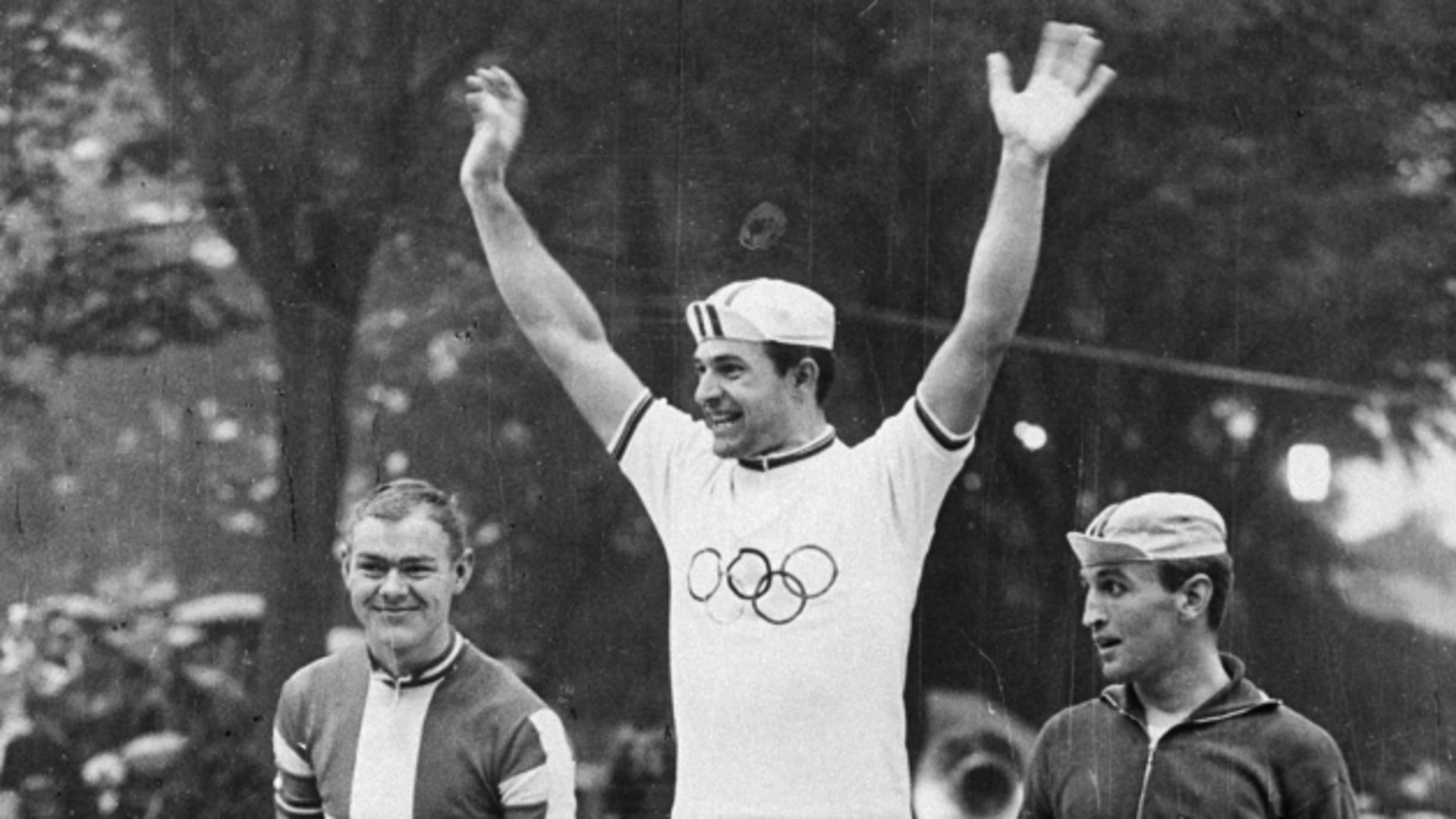
Mario Zanin was born on July 3, 1940 in Santa Lucia di Piave, Italy, and grew up playing soccer until he broke an ankle, at which point he switched to cycling. Prior to his appearance in the Olympics, he had won a couple of amateur races in Italy, including the national amateur road race in 1964.
He competed in the road race in 1964 in Tokyo, on an interesting course. It consisted of 8 laps of a 24 km course, which featured only one difficult climb, and due to that, and rainy weather on the day of the race, no one was ever able to separate from the pack for long. Each time a rider tried to break away, he was quickly pulled back into the pack, and by the end, there were 99 riders who finished within 0.2 seconds of each other. Zanin was one of two in the pack who was able to separate right before the finish, but only by a little over a bicycle length, and he was able to edge out Kjell Rodian of Denmark for the gold medal.
He turned pro soon after the Olympics, but his only professional victory was a single stage of the Vuelta a Espana, Spain's version of the Tour de France, before his retirement in 1968. Even though he only competed in a single event in his Olympic career, and it was an extremely close win, his ability to pull away from the pack when it mattered made him one of the greatest Olympians of all time.
*1 Gold medal stripped due to positive drug test by teammate
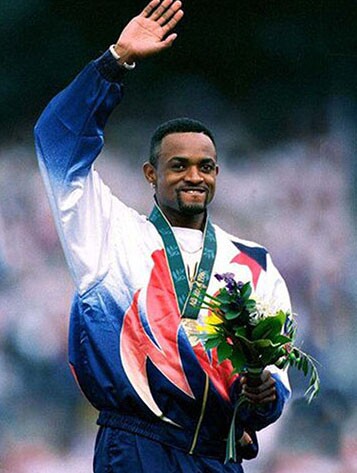
Angelo F Taylor Jr was born on December 29, 1978 in Albany, Georgia, and began running the hurdles in high school, then went to Georgia Tech, where he won the NCAA title in 1998 after finishing as runner-up the year before. He won a gold medal at the 1999 World Championships in the 4x400m relay, but the medal was later stripped when teammate Antonio Pettigrew was caught using PEDs.
Taylor qualified for his first Olympic team in 2000, running the best time in the world that year at the Olympic trials. He was a co-favorite entering the 400m hurdles, along with Llewellyn Herbert of South Africa, and after winning his prelim heat, he came in second to Herbert in their semifinal, but both qualified for the final. Taylor ran the final on the inside lane, and was in the middle of the pack halfway through, but sped up to get into second place by the 8th hurdle, then sprinted to the finish to beat Hadi Soua'an Al-Somaily of Saudi Arabia by .03 seconds in a photo finish for the gold.
He also ran the second leg in the first two rounds of the 4x400m relay that year, helping the American team qualify for the final, where they were big favorites, and they won the final by more than 2 seconds over Nigeria. That gold medal was later rescinded in 2008 when Pettigrew admitted to using PEDs at the time, and it has since been revealed that every runner on that team but Taylor and Michael Johnson was cheating at the time.
He also lost his 4x400m gold medal from the 2001 World Championships due to the same issue. He failed to qualify for the 2003 World Championships, but still made the 2004 Olympic team to defend his hurdle gold. He won his prelim heat, but came in 4th in his semifinal heat, and missed out on making the final by about half a second.
In 2007, he won a World Championship bronze in the regular 400m, along with another gold in the 4x400m relay, and this one he got to keep. He made the 2008 Olympic team, but his teammate, Kerron Clement, was considered the favorite in the 400m hurdles. Taylor had the fastest time in the semifinal round, and didn't give anyone else a chance in the final, pulling away early, and by the time Clement made his move, it was too late, and Taylor had won by 0.73 seconds.
He also ran in the 4x400m relay, where the USA was expected to win big, as they had swept the medals in both the 400m and the 400m hurdle events. Taylor ran the anchor leg in the prelim, but had such a huge lead that he just coasted to the finish. In the final, he ran the second leg, and was given a full second lead, which he held, and the Americans ended up winning by more than 2.5 seconds, giving him a relay gold that was not taken away.
He won a couple more relay golds at the World Championships before heading to his 4th Olympics in 2012, where he was team captain. In the 400m hurdles, he won his prelim and barely lost in his semi, but still made the final. In the final, he led through the 7th hurdle, but he switched legs over the next hurdle, and it threw off his rhythm, and he ended up finishing in 5th.
In the 4x400m relay, the Americans were not the favorites for the first time in memory, due to having a couple of their best runners unavailable due to injury. Taylor was asked to run the anchor leg in the final, and after Tony McQuay ran an amazing leg to pull the US into the lead by a half second, Taylor took the baton. He ran a good leg, but Ramon Miller of the Bahamas was faster, and passed him on the homestretch, leaving the US to take home the silver medal.
He retired after the Olympics and became a youth track coach, which was unfortunately illegal, because he had been convicted in 2006 of molesting multiple 15-year-old girls. When the US Center for SafeSport finally noticed, he was given a lifetime ban from participating in any capacity with events involving minors. Even though he is not a good person, he was a great athlete, winning 4 gold medals, two of them individually, and was one of the greatest Olympians of all time.
Diana Lorena Taurasi was born on June 11, 1982 in Glendale, California, to parents who had emigrated from Argentina. She was named the National Player of the Year in high school, then attended UConn, where she won 3 consecutive national championships, and won 2 straight NCAA Player of the Year awards as well as 2 awards for Most Outstanding Player in the NCAA Tournament.
She was the #1 overall draft pick by the Phoenix Mercury in 2004, and was also named to the USA Olympic team. She was a starter on that team, which won its 8 games by an average of 25 points each, with only Russia getting close, losing by 4 in the semifinal. They cruised to the gold medal, and then she made her WNBA debut, and won Rookie of the Year.
She led the WNBA in scoring in 2006, then won a championship in 2007. She was again a starter on the 2008 Olympic team, where she started every game and was 3rd on the team in scoring, and the team was even more dominant than before, winning by an average of 38 points per game, with their closest win again coming against Russia, this time by 15 points in the semifinal.
Taurasi led the WNBA in scoring in each of the next 4 seasons, and in 2009 was the regular season and Finals MVP as she won her second championship. In 2012, she was the leading scorer for the American Olympic team, which won its 8 games by an average of 35 points per game, with a 13-point win over Australia in the semifinal the closest they came to a loss.
In 2014 Taurasi won her third WNBA championship, leading the league in assists that year, and winning her second Finals MVP award. In 2016, she again led the American Olympic team in scoring, with 15.6 per game, the highest of her Olympic career, and the team again dominated everybody, winning by 37 points per game, with France coming within 19 in the semifinal as the closest result.
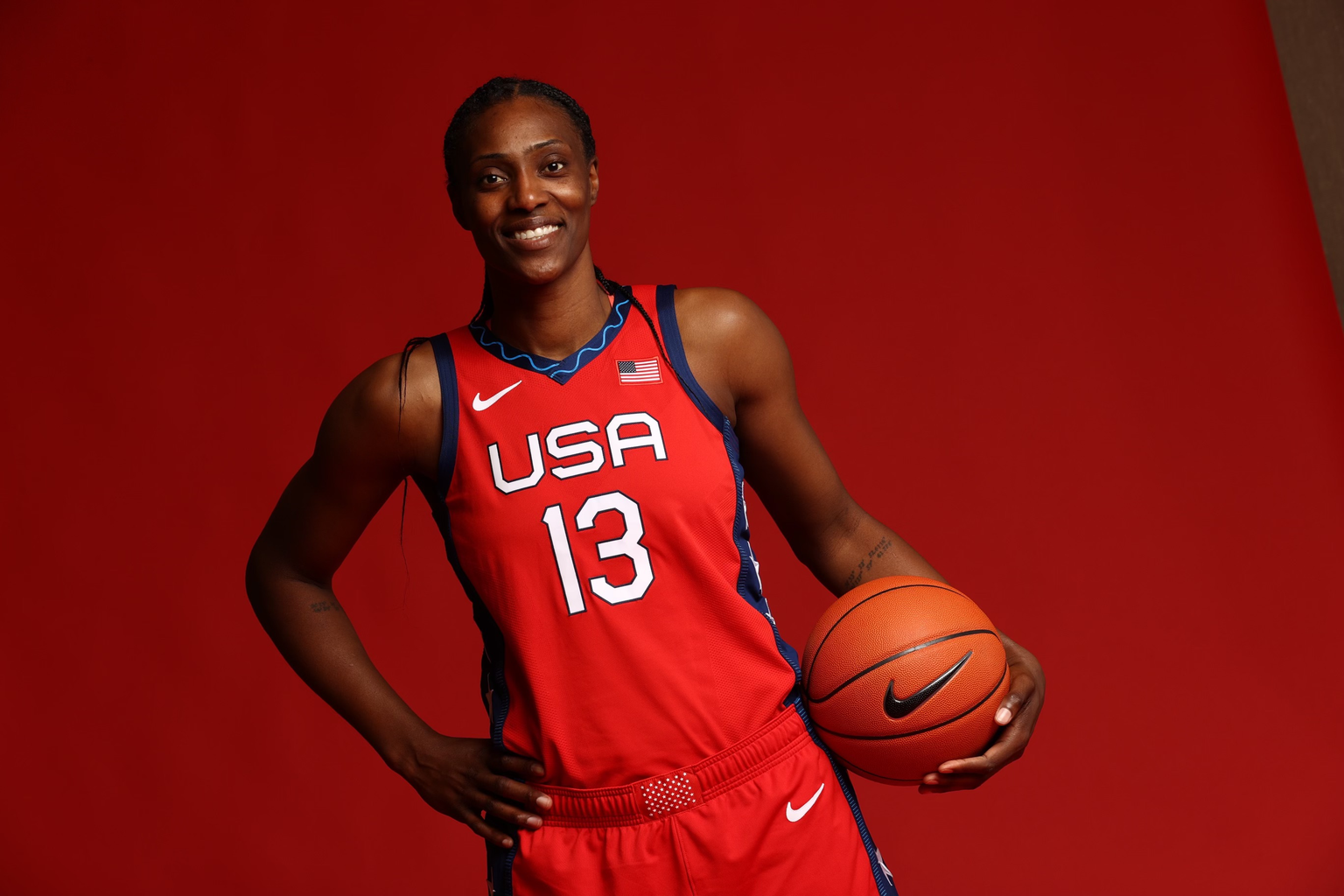
She competed in the Olympics again in 2021, though she took on a lesser role, but it didn't really matter. The Americans won their games by an average of 16 points, with only one opponent coming within single digits, and she and Sue Bird together became the first to win 5 gold medals in the same team event.
She played in one final Olympics in 2024, though she hardly saw the court, and only scored 5 total points throughout the tournament, but they didn't really need her on the court as much as they needed her veteran presence. They again won their games by an average of 16 points, though they nearly lost in the final, beating France by a single point. With that victory, Taurasi became the first Olympian ever to win 6 gold medals in a single team event.
She retired after the 2024 season, and is the WNBA's all-time scoring leader, a three-time champion in both the pros and in college, a two-time Championship MVP in both the pros and college, two-time college player of the year, one-time WNBA MVP, and the only 6-time Olympic basketball champion. There is no doubt that she is one of the greatest Olympians of all time.
Maria Valentina Vezzali was born on February 14, 1974 in Jesi, Italy, and began her fencing training with her father when she was a young girl, and quickly proved to be talented at it. She competed in her first world championship at age 19, finishing 6th, which would be the worst finish in any event in her entire career.
She finished 2nd in the World Championships in 1994, and 3rd in 1995, so she was one of the main medal contenders heading to Atlanta in 1996 for her first Olympics. The individual foil event was contested as a single-elimination tournament, with each bout going to 15 touches. As the #1 seed, Vezzali had a bye in the first round, then had a couple of close early matches before winning 15-10 in the quarterfinal and 15-7 in the semifinal. In the final, she faced Laura Badea of Romania, the defending world champion, and she ended up falling 15-10, leaving her with a silver medal.
The team event was also single-elimination, and Italy was the #1 seed, as they had two of the top 3 in the individual event. They destroyed China 45-24 in the quarterfinal, then had a close call against Hungary before beating Romania in the final 45-33, avenging their losses to Badea in the individual event and taking home the gold.
In 1999, she finally won her first World Championship gold in individual foil, after getting other medals in the previous three, and she was the favorite in Sydney in 2000, again starting as the #1 seed. This time, she made easy work of the entire competition, never allowing an opponent to score more than 8 touches, and winning the final 15-5 to take home a dominant gold medal, her first individual Olympic gold.
In the team event, Italy was again the top seed, thanks to again having two medalists on the team. They won all three of their matches without much trouble, scoring at least 6 points more than each opponent, and they successfully defended their gold medal from Atlanta.
She won the next two World Championships, running her total to 3 in a row, and was again the favorite in Athens. The team events are held on a rotating basis, so there was no team event that year, so she made the most of her time in the individual. She made it back to the final again without allowing an opponent to score more than 8, but her final match was closer, facing teammate and 2-time bronze medalist Giovanna Trillini. The score went back and forth, but Vezzali pulled away at the end to win 15-11 for a repeat gold.
She won 2 more World Championships before the Olympics headed to Beijing in 2008, and she was the #1 seed for the 4th straight time in the individual foil. She once again dominated all the way to the final, where she faced Nam Hyeon-Hui of South Korea. The bout was a defensive struggle, and was tied at 5 with just a few seconds left when Vezzali scored the winning touch to take her third straight gold medal, becoming the first athlete ever to win the event three times in a row.
The Italians were again heavy favorites in the team event, with 3 of the top 4 individuals, and they beat the Chinese hosts easily to reach the semifinal, but they were surprised by the Russians in the semifinal, losing a low-scoring battle 22-21, with Vezzali scoring 13 of her team's points. They rebounded to beat Hungary 32-23 in the bronze medal match, but it was still a disappointment for the favorites.
In the 2009 World Championships, she failed to medal for the first time since 1993, when she was a rookie. She bounced back to win again in 2011, but she was starting to show a little weakness. In London in 2012, she was the #2 seed, behind Nam, but it didn't matter much in the early rounds, as she easily reached the semifinals again. In the semifinal, however, she was upset by Arianna Errigo, also from Italy, losing 15-12, and was forced to face Nam again, this time for bronze rather than gold. She would take care of business, winning another close match 13-12, giving her a fifth straight medal in the individual foil event.
Italy won all 3 medals in the individual event, so they were heavy favorites in the team foil. They destroyed the host Brits 42-14, then did the same to the French, 45-22, to advance to the final. They faced Russia in the final, and they got their revenge, beating them 45-31, giving Vezzali a third gold medal in the team event, and a 6th overall.
She was elected to the Italian Parliament in 2013, but continued to compete, winning several medals in the World Championships, but after she failed to make the Olympic team in 2016, she retired from competition. She competed in 9 Olympic events over 5 Games, and won medals in every single one, six of them gold, and she is one of only 5 athletes in history to win a medal in the same individual event at 5 straight Olympics, making her easily one of the greatest Olympians of all time.
Kerry Lorenzo Harrison, who goes by Kenny, was born on February 13, 1965 in Milwaukee, Wisconsin, where he was a track star in high school, before going south to Kansas State University, where he won 3 NCAA titles, one in long jump and two in triple jump.
He won the 1991 World Championship in the triple jump, and was preparing to participate in the 1992 Olympics in Barcelona when he suffered a knee injury that required surgery. After rehabbing from surgery, he began competing in preparation for the 1996 Olympics, and he spent the three years leading up to the games ranked #2 in the world.
He was healthy when the 1996 Olympics came around, and was expected to compete with Jonathan Edwards of Great Britain, the world record holder who was ranked #1 in the world. In the preliminary round, he 17.58 meters on his first jump, which was 0.38 meters better than the second-best, by defending champion Mike Conley (father of the basketball player).
In the final round, where there were 12 jumpers, Harrison jumped 17.99 on his first jump, which would have been enough to win on its own, but on his third jump, he set a new Olympic record of 18.09 meters, while Edwards only managed a best jump of 17.88, giving Harrison the upset gold. At the time, it was the second-longest jump in history, and today, it still ranks #5. It was also the longest jump ever into a headwind until 2024, when Jordan Diaz of Spain jumped 18.18.
He competed for a couple more years, but decided to retire in 1998. His gold medal jump in 1996 is still the Olympic record 30 years later, and it's bigger because he beat the world record holder head to head to accomplish it, making him one of the greatest Olympians of all time, with only one event to his name.
Derrick Keith Brew was born on December 28, 1977 in Houston, Texas, and was raised and attended high school in the area, before going to college at LSU. He ran on the American 4x400m relay team in the 2001 and 2003 World Championships, both of which won gold, but had their medals taken away when some of his teammates were caught using steroids.
In the 2004 Olympics, his first event was the 400m. He won his heat in both the preliminary round and the semifinals, making him one of 3 Americans to advance to the final. In the final, the three Americans were in the lead and close together at the halfway point, but Brew dropped behind around the final turn, and came in behind his two teammates to take the bronze medal in an American podium sweep.
His other event was the 4x400m relay, where the Americans were overwhelming favorites due to having the top three 400m runners in the Olympics. Brew was picked to run the second leg in the prelim, and the Americans won by more than 2 seconds to advance to the final. In the final, he again ran the second leg, and he was given the baton with a lead of 0.93 seconds, which he expanded to 2.55 seconds by the midway point. The final 2 runners extended the lead even more, and they eventually won by 4.69 seconds, falling just short of the world record in the most dominant race in the history of the event.
He was again on the gold-winning relay team in the 2005 World Championships, but after failing to make the 2008 Olympic team, he retired from racing. Even though he only competed in 2 Olympic events, his part in the most dominant relay race of all time, along with his bronze medal a few days earlier, makes him one of the greatest Olympians of all time.
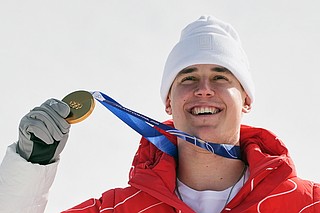
Franjo von Allmen was born on July 24, 2001 in Boltigen, Switzerland, and began skiing at age 2. He was a carpenter's apprentice as a young man, but after his father died in 2019, he was afraid that he would have to put skiing aside to take care of his family. A crowdfunding campaign was put together that made enough money for him to continue skiing, and he made the 2026 Olympic team as a result.
His first Olympic event was the downhill, where he was ranked #2 in the world prior to the event. He was one of the first to run, and had the best time after his run, then he had to sit and watch as 30 other skiers took aim at his time, failing each time. Giovanni Franzoni of Italy came closest, finishing 0.2 seconds behind, but von Allmen had won his first gold medal.
The next event was the team combined, which was being held for the first time ever. It involves a pair of skiers, one running the downhill course, and the other running the slalom course, and the winner is determined by combined time of the two racers. Von Allmen ran the downhill first, and was in 4th place after his run, with Franzoni sitting in first, but his teammate, Tanguy Nef, had the fastest run on the slalom, and the other leaders' teammates all faltered, giving the Swiss the win by almost exactly a full second.
His final event was the Super G, and he was the seventh skier to race. He was able to edge out the leader, Ryan Cochran-Siegle, by 0.13 seconds, and while a few other skiers got within a second of his time, no one was able to match his time, and von Allmen walked away with his third gold medal of the games. He was the third man in history to win 3 alpine skiing golds in one Olympics, and was the first to ever win the downhill and Super G in the same games.
Von Allmen's career is just getting started, but what a great start it has been. He won gold in every Olympic event he has entered, even though he was never the favorite, which has helped make him one of the greatest Olympians of all time already.
Armand Gustav Duplantis was born on November 10, 1999 in Lafayette, Louisiana, to an American father who was a pole vaulter, and a Swedish mother who was a heptathlete. He was raised in Louisiana, but spent his summers in Sweden with his grandparents, and holds dual citizenship. He first tried pole vaulting at age 4, and it was quickly apparent that he was special. He set his first age group world record at age 7, and still holds the records for all ages 7 through 12.
He began competing for Sweden in 2015, when the Swedish team agreed to bring his father on as a coach. He won the World Youth Championship that year, and the World Junior Championship in 2018, and began competing as an adult in 2019. In his first World Championship appearance that year, he came in second, something he hasn't done since in a major outdoor competition.
He set his first world record in February 2020, when he cleared 6.17m, (20'3"), which he broke again the next week by another centimeter. He was the favorite entering his first Olympics in Tokyo, and in the final, the field quickly dropped from seven at 5.8 meters, down to just three at 5.87 meters, then to two that cleared 5.92 and 5.97. He cleared 6.02 on his first try, while his opponent failed in three attempts, giving him the gold medal. He then raised the bar to 6.19m to try to break his world record, but failed to complete it, once knocking down the bar on his way down.
He won the next 2 World Championships, and broke his world record by a centimeter 6 more times, with 6.24m the new height to beat. In the 2024 Olympics, the only question was how high he would go. Only 7 vaulters were still alive after 5.9 meters, then 3 after 5.95. Neither of the others was able to clear 6 meters, which Mondo did easily, after which he cleared 6.1 meters on his first try as well, setting a new Olympic record. He then raised the bar to 6.25 meters, and finally cleared it on his third attempt to set a new world record again. He also became only the second pole vaulter ever to repeat as Olympic champion.
Since the Olympics, he has won another World Championship, and has broken his world record 6 more times by a centimeter each, and it currently sits at 6.31 meters. He believes that he can push the record to 6.4 meters eventually, and in 2028 he has the chance to have the first-ever three-peat in the event, but even if he doesn't, he has already established himself as one of the greatest Olympians of all time.
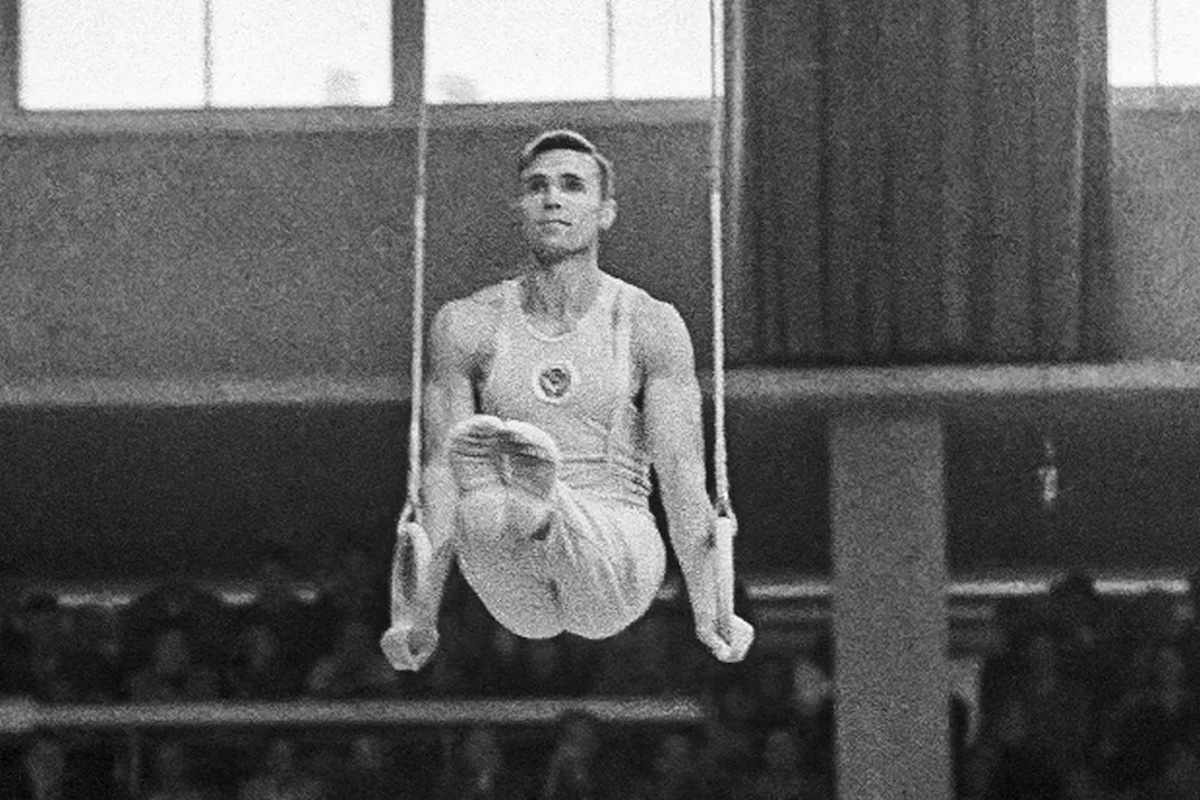
Viktor Ivanovich Chukarin was born on November 9, 1921 in Krasnoarmeyskoye, USSR, which is now part of Ukraine. He began training in gymnastics as a young child, then joined the Soviet army during World War II, and ended up spending nearly 4 years as a Prisoner of War, finally being released when the war ended.
He was only 88 pounds when he returned from war, but he began training again, and by 1949, he was the Soviet national champion, a feat he repeated in both 1950 and 1951. When the Soviets appeared in the Olympics for the first time in 1952, he was the top member of the national team, and it showed in Helsinki, even though he was already 30 years old.
All gymnastics events were held simultaneously at the time, with the scores in the individual events added together for the all-around score, and the all-arounds scores added together for the team score. The only event in which he didn't contend for a medal was the floor exercise, where he finished 29th. He won gold in the vault, where he was only 4th in the compulsory portion, but had the top score by far in the optional section, which gave him the best overall score by 0.05.
In the parallel bars, he came in second to Hans Eugster of Switzerland, who was also the defending world champion in the event, but he only lost by 0.05 points, so it was a close silver. In the horizontal bar, he had the #2 score in the optional portion, but was far enough behind in the compulsory that he ended up in 5th place overall, falling short of a medal.
In the rings, he had a very good score of 19.55, which earned him silver, but he wasn't close to the gold medal score of 19.75 posted by his teammate, Hrant Shahinyan. In the pommel horse, he was #3 in the compulsory, but had the top score by far in the optional again, which earned him another individual gold medal, his second of the events.
When the scores from all of the individual events were tallied, Chukarin had run away with the individual all-around gold medal, 0.75 points ahead of Shahinyan, who took the silver. The Soviets had 7 of the top 11 scorers in the individual all-around, and the top 5 scores on each apparatus were counted in the team event, so the Soviets won gold easily, 6.85 points ahead of Switzerland. Chukarin ended his first Olympics with 6 medals, 4 of them gold.
After winning the all-around World Championship in 1954, Chukarin led the Soviets into the 1956 Olympics in Melbourne as well, just after his 35th birthday. The format was the same as it had been 4 years earlier, but this time, Chukarin finished in the top 7 of all six individual events, making up for his weak performance in the floor exercise in Helsinki by taking home the silver this time.
His vault and rings scores were both lower than usual, and he finished in 7th place in each event, but he was stronger than usual in the parallel bars, where he managed to win the gold in a close competition, just ahead of 3 Japanese gymnasts. He came up just short of a medal in the horizontal bar, with a 4th place finish, but he managed to slip in and grab a bronze in the pommel horse to get his third individual medal of 1956, one of each color.
Because his event scores were all so good, he managed to repeat as the individual all-around champion, a very difficult feat to accomplish, and this time Takashi Ono of Japan made it close, losing by 0.05 points to the Soviet. Japan had also closed the gap in the team event, but the USSR still managed to win gold, beating Japan by 1.85 points.
He retired soon after the 1956 Olympics, becoming a gymnastics coach for several years, and he passed away in 1984 in Lviv, USSR, which is also part of Ukraine today. Even though he didn't appear in the Olympics until he was 30 years old, he still managed to win the individual all-around twice, with 3 other individual golds, and 11 medals overall, so the late start didn't prevent him from becoming one of the greatest Olympians of all time.
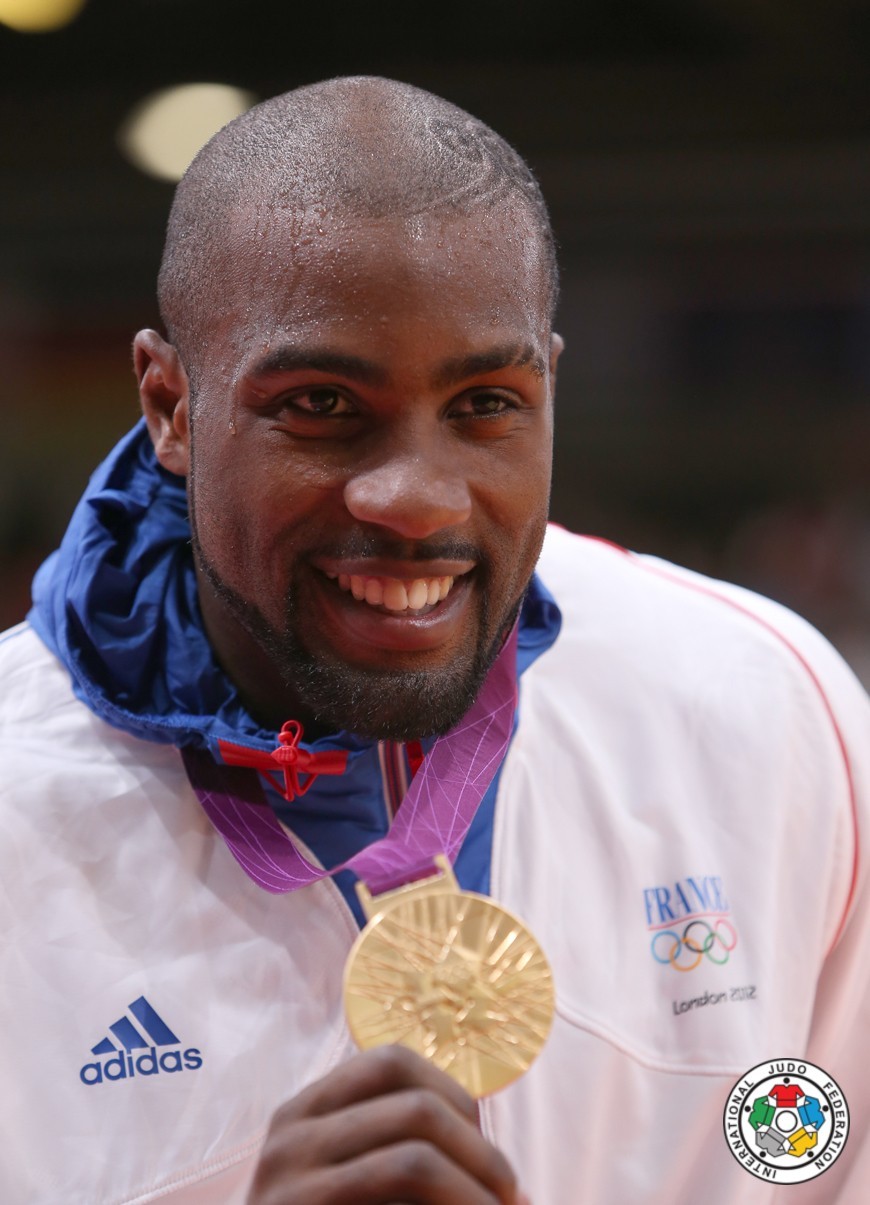
Teddy Pierre-Marie Riner was born on April 7, 1989 in Pointe-a-Pitre, Guadeloupe, a Caribbean island that is a territory of France, and moved with his family to Paris while he was still a toddler. He grew up playing multiple sports, but preferred judo because it was all up to him. In 2007, the day after he turned 18, he won the European judo championship, then won the World Championship later that year, the youngest ever to do so, and he repeated as champion in 2008.
He competed in the heavyweight division in the 2008 Olympics in Beijing, where he was expected to win. He won his first two bouts to advance to the semifinal round, but lost in sudden death to Abdullo Tangriyev of Uzbekistan. This put him into the repechage pool, where he won all 3 of his bouts easily, which earned him a bronze medal.
After the Olympic disappointment, he went back and won the World Championship 3 times in a row, and went into 2012 in London as a huge favorite. He competed in 5 bouts, with all 5 either ending in ippon (the highest score possible), or waza-ari (the second-highest score), and finally had his Olympic gold medal to go with all of his World Championships.
After the Olympic win, he went and won 3 more World Championships in a row, stretching his streak to 8 in a row, so he was obviously the huge favorite to take gold in Rio in 2016. As the top seed, he got a first-round bye, then won 3 straight bouts by ippon or waza-ari, which put him in the final, against Hisayoshi Harasawa of Japan, who had won 3 straight by ippon. The final ended in a tie, which was broken by total penalties, with Riner winning 1-2, giving him a repeat gold medal.
Between 2010 and 2020, Riner had a streak of nearly 10 years without losing a single bout in any competition, which was broken in the Paris Grand Slam that year. The next year, in Tokyo, he was still a favorite, but was upset in the quarterfinal round by Tamerlan Bashayev of Russia, requiring him to win a repechage bout to make it to a bronze medal bout. He won the repechage and bronze medal bouts by ippon, which earned him another bronze medal, 13 years after his first.
A mixed team event was also introduced in the 2020 Olympics, where each team had up to 12 judoka competing, which 6 taking the mat in each round, and the round ending when a country reached 4 wins. Riner won by ippon in his first bout, with France winning 4-3 over Israel after a tiebreaker bout, then wasn't needed in a 4-0 win over the Netherlands in the semifinal, before winning by waza-ari in the final round, as France beat host Japan 4-1, giving him his third Olympic gold medal.
He won another World Championship in 2023, and hoped to win another Olympic gold at home in Paris in 2024. He dominated his way to the gold medal, winning all four of his bouts by ippon, becoming the second judoka in history to win 3 individual gold medals.
In the mixed team event, Riner wasn't needed in France's 4-0 sweep of Israel in the first round, then he had the decisive ippon in their quarterfinal 4-1 with over South Korea. They also dominated Italy 4-1 in the semifinal, with another ippon from Riner, leading to a final rematch with Japan, this time with the home team switched. In the final, Riner won by ippon to give France its first win, then after France tied the match at 3-3, the heavyweights were randomly selected to battle for the gold in the tiebreaker, where Riner completed another ippon to give his team the repeat gold medal, his fifth overall.
Riner had elbow surgery shortly after the 2024 Olympics, but has not retired and plans to compete again in 2028, hoping to add to his medal collection. He has competed in 7 Olympic events so far, and has won his final bout every time, leading to a record of 5 golds and 2 bronzes so far. He has already established himself as one of the greatest Olympians of all time, but he may still improve his standing in the future.
Athing Mu was born on June 8, 2002 in Trenton, New Jersey, to parents who had emigrated from South Sudan, and began running track at the age of 6. Upon graduating from high school in 2020, she attended Texas A&M, and also competed in the Olympic trials in early 2021, just days after she turned 19. Her time in the trials was the fastest in the world up to that point in the year, and she was made the favorite heading to Tokyo.
As the 800m started, Mu immediately sprinted to the front of the pack, and led the entire first lap at a steady pace, but as soon as the final lap started, she pulled away from the others, and by the finish line, she was 0.67 seconds ahead of anyone else, taking home an easy gold medal. She was the second-youngest winner of the event in history, and the youngest American woman to win track gold since 1964.
She also ran in the 4x400m relay, though she didn't usually run the 400m. She was assigned the anchor leg, but by the time she was given the baton, the race was practically over, as the Americans were 15 meters ahead of Poland, a gap of 1.5 seconds. Mu then ran the fastest leg of anyone, finishing her lap in 48.32 seconds, and the Americans won the race by nearly 4 seconds.
After Tokyo, Mu won the 800m World Championship in 2022, but only took bronze in the 2023 edition. In the 2024 Olympic trials, she tripped during her final race, causing her to miss out on going to Paris for the Olympics. She is still young, and actively competing, so she may be able to add to her medal count in 2028, but with what she has already done, she is one of the greatest Olympians of all time.
Raymond Clarence Ewry was born on October 14, 1873 in Lafayette, Indiana, and spent much of his childhood in a wheelchair due to polio. He went through a rigorous exercise routine to strengthen his legs, and by the time he went to college at Purdue in 1890, he was captain of the track team and played football. After graduating with a Masters in Mechanical Engineering, he moved to New York and joined the New York Athletic Club, competing in the standing jump events.
He first competed in the 1900 Paris Olympics, and all 3 of his events were held on the same day. In the standing high jump, there were only 3 competitors, but Ewry easily beat the others, jumping 1.655 meters, about 5 feet, 5 inches. There were only 4 participants in the standing long jump, and Ewry again dominated, jumping 3.3 meters, or 10 feet, 10 inches.
There were 10 jumpers in the standing triple jump event, and Ewry was the only one to jump more than 10 meters, ending up at 10.58 meters, nearly 2 feet ahead of anyone else. He walked away from Paris with gold medals in all 3 of his events.
He returned to defend his medals in 1904 in Saint Louis. In the standing long jump, which came first, he was again the best of the 4 participants, jumping over 3.4 meters on all 4 of his attempts, while no one else reached 3.3 meters on any jump. His final jump of 3.47 meters gave him the win by nearly 8 inches.
In the standing high jump, there were 5 athletes taking part, and Ewry again dominated, jumping 1.6 meters, a full 6 inches higher than the silver medalist. In the standing triple jump, he finished at 10.54 meters, just short of his distance from 1900, and again won the competition by more than a foot over anyone else.
In 1908, the standing triple jump had been discontinued, but he still competed in the other two events. In the standing long jump, there was a qualifying round for the first time, because the field had ballooned to 23, but Ewry led after both the qualifying and the final, finishing with a jump of 3.33 meters, 0.1 meters ahead of the silver medalist.
There were also 23 jumpers in the standing high jump, and this time Ewry was tied for first after qualifying with Kostas Tsiklitiras of Greece, both with jumps of 1.55 meters. The top 4 advanced to the final, where John Biller of the USA also jumped 1.55, but Ewry was able to eke past them both with a final jump of 1.57 meters to win his final gold medal.
He attempted to make the team again in 1912, but failed to qualify. Even though none of his events were contested again after World War I, he won every event he entered, often by large margins, which makes him one of the greatest Olympians of all time.
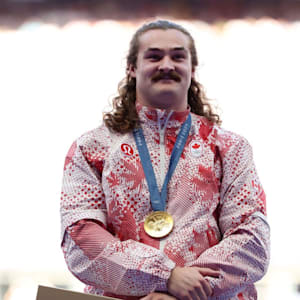
Ethan Katzberg was born on April 5, 2002 in Nanaimo, British Columbia, Canada, and started throwing the hammer when he was 14, after watching his sister compete in the event. He moved to Kamloops after high school to train with Dylan Armstrong, who had won a bronze medal in shot put in 2008. His first international competition was in 2001, and by 2003 he was the world champion, breaking the Canadian national record twice during that competition.
He was the favorite to win the gold medal in Paris in 2024, and he didn't disappoint. After the qualifying round, he was in first place, more than 2 meters ahead of anyone else. In the final, he started with a throw of 84.12, just short of the Olympic record of 84.8 meters. He only had one more valid throw in the final, which went 82.28, while no other competitor reached 80 meters, giving him a dominant gold medal by 4.15 meters.
Katzberg was the youngest hammer throw winner in history, the first Canadian thrower to win gold since 1904, and had the largest margin of victory in the event since 1912. He also repeated as world champion in 2025, and looks to have a very good career still in front of him. All taken together, he has already proven himself to be one of the greatest Olympians of all time.
Mikhail Yakovlevich Voronin was born on March 26, 1945 in Moscow, USSR, and trained at the main Soviet gymnastics school in Moscow while growing up. He made the national team in 1966, and at that year's world championship, he won the rings and the individual all-around, plus 3 silvers, making him one of the top medal competitors heading to Mexico City in 1968.
Voronin was the favorite to win the individual all-around, thanks to his recent world championship, and he was definitely the best on the Soviet team, but he was edged out for the gold medal by Sawao Kato of Japan, who took gold by 0.05 points. The day before, Voronin's wife, Zinaida, had also won silver in the individual all-around.
The top 8 in the individual all-around were all from either Japan or the USSR, but since 5 of them were from Japan, the Japanese won by 4.8 points to continue their streak of team golds. The Soviets finished nearly 14 points ahead of the East Germans for silver, so there was never any doubt that they would get a medal, just a question as to the color.
Voronin qualifed for all 6 event finals, but decided to sit out of the floor exercise final, where he was 4th after qualifying. In the vault, he was tied for #2 with Yukio Endo of Japan going into the final, behind Kato, but Kato faltered on his final vault, and Voronin had the best vault of the round, which moved him up to gold.
He was also #2 in the parallel bars heading into the final, behind Akinori Nakayama of Japan by 0.1 points. The two scored identical 9.7s in the final performance, so they kept their standing, with Voronin taking another silver. He and Nakayama were tied after qualifying in the horizontal bar, and they again posted identical scores in the final, leading to the pair sharing the gold medal.
In the rings, Voronin had qualified third, but after Kato had another poor final performance, Voronin was able to move up and take his 4th silver medal in Mexico City. On the pommel horse, he was #2 after qualifying, but was outperformed by Olli Laiho of Finland in the final and fell to third, content to take home a bronze.
After the 1970 World Championship, where he only earned two individual bronze medals, he remained on the national team for the 1972 Olympics in Munich. This time the team competition was first, and the result was just like 4 years earlier, except that the Japanese won by 7.2 points this time, while the Soviets were still 14 points ahead of the East Germans for silver.
The top 36 in the team event were advanced to the individual all-around final, with Voronin in 7th at that point. Unfortunately, he struggled in the final performances, coming in among the bottom 7 in 3 events, and fell to 12th overall by the end of the event.
He qualified for only 2 event finals, the rings and the pommel horse. In the rings, he qualified in second, but with a large gap both behind and in front of him, he was unlikely to move, and he didn't, finishing with a silver medal in rings for the second straight time. He had the same gaps around him in the pommel horse, except that he started in 5th, which is also where he ended up.
He retired from competition after the 1972 Olympics, moving on to become a gymnastics coach. He was a good performer in his second Olympics, but his 7 overall medals in 1968 was tied for the record for a single games at the time, since broken by Aleksandr Dityatin and Michael Phelps, and finishing in the top four in all 8 events alone is enough to make him one of the greatest Olympians of all time.
Vilho Eino Ritola, known as Ville, was born on January 18, 1896 in Peraseinajoki, Finland, which at the time was part of the Russian Empire. He was the 14th of 20 children, and he joined 7 of them in emigrating to the United States in 1913 to find work as a carpenter. He didn't begin training as a runner until he was 23 years old.
In 1922, he won a couple of gold medals in the AAU Championship, and came in second in the Boston Marathon, after which he felt he was ready to try to make the Olympics, competing for his home country of Finland. Some other American Finns helped raise money to send him home to Finland to compete in the Olympic trials, where he set a world record in the 10000m, breaking the record previously held by fellow Finn Paavo Nurmi.
Ritola went to Paris to compete in 6 events. His first was the 10000m, where he was a heavy favorite, thanks partly to his new world record, and partly due to Nurmi choosing to sit out to conserve his energy for other events. He pulled away early, with only Edvin Wide of Sweden keeping pace, but after 4000m, Wide dropped back, and Ritola continued his pace, winning the race by 32 seconds, nearly half a lap, and breaking his own world record by 12 seconds, giving him a dominant gold medal in his first event.
His next event was the steeplechase, which he had never run before. He didn't have the technique down, but his speed and endurance were enough as he won the race by over 11 seconds, setting a new Olympic record, and coming up just 0.2 seconds short of the world record.
Up next was the 5000m, in which he would finally face Nurmi. Nurmi had just won the gold medal in the 1500m less than an hour earlier, so Ritola and Wide took off early, hoping that Nurmi would be too tired to catch them, but at the 2000m mark, Nurmi had caught up to the leaders, and by 3000m, Wide had dropped off the pace, leaving the two Finns to battle for gold. Nurmi passed Ritola at the 4000m mark, then held him off the rest of the way, winning the gold, and leaving Ritola with a silver by 0.2 seconds.
The cross country event was next, which covered nearly 10000m on one of the hottest days in Paris history. Nurmi and Ritola took off ahead of the pack again, but Ritola was unable to keep pace, and ended up losing by almost a minute and a half, though he still won silver by over a minute. More than half of the racers were unable to finish due to the heat.
The cross country team event scoring was based on placement of the top 3 runners from each country in the individual event, so Finland was a massive favorite due to having the top 2 finishers. Heikki Liimatainen was the third Finnish runner, and he was stumbling toward the finish, then stepped off the course thinking that he had finished, but he was still 30 meters short. After the crowd let him know that he hadn't finished, he returned to the course, and staggered for two minutes toward the line, finally crossing just in time to earn Finland the gold ahead of the USA.
The final event was the team 3000m race, in which the places of the top 3 finishers counted toward each country's score. Nurmi and Ritola again finished in first and second, but they didn't have to wait as long this time, as teammate Elias Katz came in fifth, earning the Finns an easy gold medal, the fourth for Ritola at his first Olympics. His 6 total medals are still the record for a track athlete at a single Olympics, and his 4 golds only trail Nurmi's 5 from the same Olympics.
He returned to the US after the Olympics and returned to work in construction, rarely training, but still competing in some meets. He decided to compete in the Olympics again in 1928, heading to Amsterdam, where he would go head to head with Nurmi in 3 events again.
The first event was the 10000m, where Ritola was the defending champ, but Nurmi was now the world record holder, and the two of them, along with Wide, left the field behind early again, with Ritola in front. Wide kept up with the Finns until 8000m, then fell behind, leaving the two favorites to fight for gold again. Nurmi stayed right behind Ritola until the final straightaway, when he passed his teammate and pulled away slightly to win by 0.6 seconds in Olympic record time, both more than 40 seconds ahead of Wide, the bronze medalist.
In the 5000m final, the same three runners pulled away from the pack again, with Ritola taking the lead around the halfway point. Wide fell behind with 600m left, while Ritola started to pull away from Nurmi, and ended up winning the race by 2 seconds, while Nurmi held on for the silver.
His final event was the steeplechase, where he was the defending champ. He qualified for the final, but hurt his ankle in the process, and while he still ran, he was unable to finish the race, the first time he had ever failed to win a medal in an Olympic event.
He retired soon after the 1928 Olympics, returning to the United States, where he spent the next 30 years working construction until he was old enough to retire. A few years later, he returned to Finland, where he passed away a decade later in Helsinki on April 24, 1982. He was overshadowed by his teammate Nurmi through his whole career, but he finally beat him head-to-head in his final Olympic win, and he was so much better than anyone else at the time, that he is obviously one of the greatest Olympians of all time.
Yury Yevlampiyevich Titov was born on November 27, 1935 on Omsk, USSR, and took up grymnastics at age 14. By the time he was 19 years old, he had been named to the Soviet national team, and his first major international competition was the 1956 Olympics in Melbourne.
That year, all of the gymnastic events were held at once, with each gymnast's score counting toward the individual event, the all-around, and the team event at the same time. Titov's best individual event was the horizontal bar, where he scored a 19.4, good enough for the silver medal, but 0.2 points behind Takashi Ono of Japan, who won the gold.
He won another individual medal in the vault, this one a bronze. He was only 0.1 points behind the gold medalists, so his overall score was still very good. He came in 5th place in two of the other individual events, and finished in the top 10 in all 6, which helped him earn the bronze medal in the individual all-around, though he was more than 0.4 points behind the other medalists, Ono and Viktor Chukarin, his Soviet teammate.
The team event was close. The USSR had won gold in 1952, and Chukarin had won his second straight all-around gold, and with Titov as a strong second scorer on the team, the Soviets were able to defeat the Japanese team by 1.85 points, earning a gold medal for the team. This would be the last time Japan lost the team event until 1980, when they didn't compete.
In 1960, the format had been updated so that the individual events had a final round after the team and all-around events had been completed. In the individual all-around, Titov finished third again, earning a repeat bronze, with Ono again taking the silver, and a new Soviet teammate, Boris Shakhlin, taking the gold.
In the team event, the 6 Japanese gymnasts all finished among the top 9 overall, making them very hard to beat. With Shakhlin and Titov's impressive individual scores, they were able to make it close, but the Soviets still lost by 2.5 points, but were 13.65 points ahead of Italy, who won bronze.
Titov qualified for all 6 event finals, but only managed to medal in one, the floor exercise. In that event, he qualified in second, and managed to hold on to it after the final performance, though the third place finisher closed the gap a little, but he still managed to take silver. He had qualified third in both the rings and the pommel horse, but poor final performances dropped him out of the medals in each, but it was still very impressive that he qualified for all 6 finals.
The format remained the same in 1964, when Titov returned for his third Olympics. By that time, he had been surpassed by several of his teammates, and finished 13th overall in the individual all-around, fifth among the Soviets, and a full point short of the medals. In the team event, there were still just two teams competing for gold, but the Soviets lost to Japan again by an identical 2.5 point margin to repeat as silver medalists.
Titov qualified for only one event final that year, the horizontal bar, where he had earned his first medal back in 1956. He qualified #2 behind Shakhlin, then scored a 9.8 in his final performance, which allowed him to hold onto his spot and earn another silver medal. He remained on the national team for two more years, then retired after the 1966 World Championships, with 9 Olympic medals to his name.
After competing in the Olympics 3 different times, Titov ended his career with only 1 gold medal, which came in the team event in 1956, but he won 5 silvers and 3 bronzes as well, and was in the top six 7 other times. While he was never the best in the world, or even in his own country, he was near the top so often and for so long, that he has earned a spot as one of the greatest Olympians of all time.
Aleksandr Nikolayevich Dityatin was born on August 7, 1957 in Saint Petersburg, USSR (then known as Leningrad). He trained in gymnastics from a young age, and when he was 15, he received a special exception to be allowed to compete with adults in the senior division of the national championships.
He was selected to the national team when he was just 18, competing in his first Olympics in Montreal that year. The team competition came first, and the Japanese had won 4 straight golds at that point, and were favored to win again. The Soviets, however, didn't listen, and beat Japan in both the floor exercise and the rings, but ended up losing overall by 0.4 points, earning them a silver medal.
The top 36 competitors from the team event advanced to the individual all-around final, with a max of 3 per nation, and Dityatin was the third Soviet to qualify, in sixth place overall. In that event, he tied for the best score on the rings, and was second place in floor exercise overall, and had top 5 scores in three of the other events, but he came in 20th in the horizontal bar, which dropped his score enough that he ended up in 4th place, just outside the medals.
He qualified for two event finals, the rings and the pommel horse. The rings were his best event, and he was third after qualifying, but after his teammate, Vladimir Markelov, dropped out, he was able to move up to 2nd after posting the best score in his final performance, giving him a silver medal. In the pommel horse, he was the 6th and final qualifier, and he didn't improve his standing in the final. He still walked away with 2 silver medals at his first Olympics.
In 1980, he was again on the Soviet team, this time competing at home in Moscow. The Japanese team had joined the American boycott, so the home team was a big favorite in the team event, and they left no doubt, as they posted the highest score in each of the 6 parts of the competition, winning the gold medal by 8.45 points over East Germany.
In the individual all-around, Dityatin was the #1 qualifier, just ahead of his teammate, Nikolay Andrianov, who was the defending champion. Dityatin beat or tied his teammate in all 6 disciplines, and with no other major challengers, the gold medal went to Dityatin by 0.425 points, a pretty decent margin for an individual event.
He qualified for all 6 of the individual event finals. He was the #4 qualifier for the floor exercise, but after earning a 9.9 in his final performance, he moved up to third and took the bronze medal. He had tied for #2 in qualifying for the vault, but after a 9.925 in the final, tied for best score in that round, he earned the silver medal alone.
He was #3 in qualifying for the parallel bars, but after a poor performance from Stoyan Delchev of Bulgaria, the leader, plus a 9.9 score from Dityatin, he moved up to take another silver. In the horizontal bar, he was again behind Delchev in qualifying, and was unable to pass him in the final, instead settling for another silver medal.
He was the top qualifier in the rings, where he had won the silver in 1976, and this time he scored an impressive 9.5 in the final to put it out of reach for everyone else, giving him his first individual event gold by 0.15 points over his nearest competitor. In the pommel horse, he scored a 9.9 in all three rounds, but it wasn't enough to overcome Zoltan Magyar of Hungary, who finished with a perfect 10 and left the silver to Dityatin.
In all, Dityatin had earned 8 medals in Moscow, the first Olympian ever to win 8 in a single Olympics, a feat that has only been matched by Michael Phelps twice. Soon after the 1980 Olympics, he was severely injured in training, and was forced to retire as a result, spending the next decade plus as a coach. Though he was the first to win 8 medals at one Olympics, only 3 were gold, but it was still an impressive achievement, and made him one of the greatest Olympians of all time.
Sylvia Shaqueria Fowles was born on October 6, 1985 in Miami, Florida, which is also where she grew up, and led her high school teams to 3 state championships and was MVP of the high school All-American game. She then attended college at LSU, where she led the Tigers to the Final Four in each of her 4 seasons.
She was the #2 draft pick in the 2008 WNBA Draft by the Chicago Sky, and made her Olympic debut that same year. She shot 64.3% from the field for the tournament, and led the USA in scoring with 13.4 points per game, as the Americans swept their way to an easy gold medal, with a 27-point win over Australia in the gold medal game.
In 2012, she was again chosen for the USA team, and played a slightly smaller role, but still averaged 6.0 points per game while shooting 61.1% from the field as the USA again went through the tourney without a loss, and beat France by 36 in the final game. She shot 69.0% in the 2016 Olympics, and the USA won another gold medal with a 29-point win over Spain.
She was selected for her 4th Olympic team in 2020, and again had an enormous shooting percentage of 63.2% for the tournament. This time, the games were a little closer, and the Americans only managed to beat the host Japanese team by 15 in the gold medal game, but Fowles had earned her 4th gold medal.
She retired after the 2022 WNBA season as the league's all-time leader in field goal percentage, at 59.9%, and rebounds per game, at 9.8. She led the league in blocks twice, rebounding twice, and field goal percentage 7 times, and won 2 championships, in 2015 and 2017. Four gold medals in separate Olympics is a rare feat, and Fowles was a large part of those teams, which makes her one of the greatest Olympians of all time.
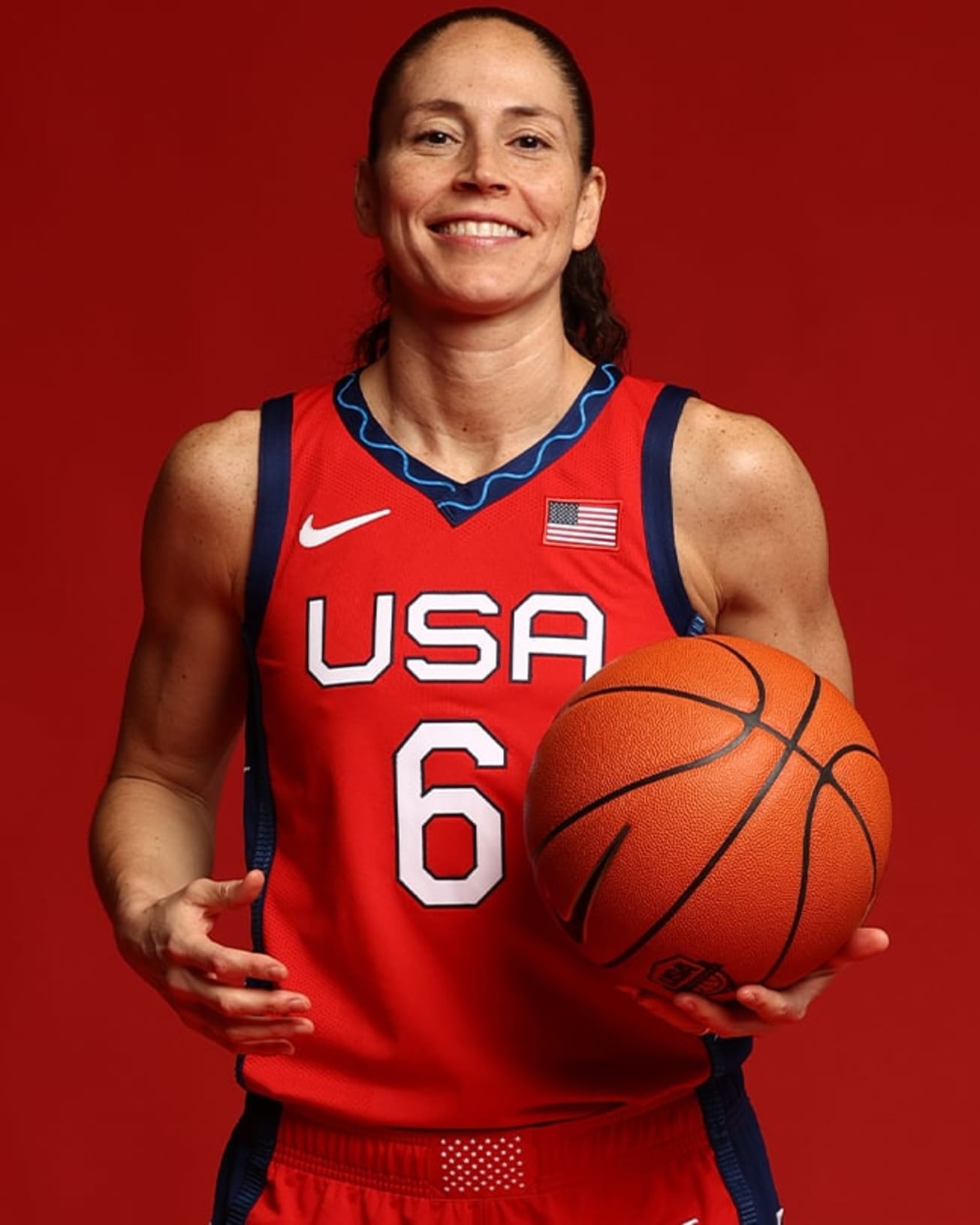
Suzanne Brigit Bird was born on Oct 16, 1980 in Syosset, New York, and began playing AAU basketball in sixth grade. By the time she reached high school, she was a big star, and in her senior season, she led her team to an undefeated season and a state and national championship.
She attended the University of Connecticut, and after missing most of her freshman season to a torn ACL, she led the Huskies to a 36-1 record as a sophomore and a national championship. After a disappointing junior season where they lost 3 games and didn't win a title, her senior season was perfect, with a 39-0 record and another national title. She was drafted by the Seattle Storm with the #1 pick in the 2002 WNBA Draft.
For her entire time as a pro, which covered 20 seasons, she was also a member of the US national team, starting with the 2002 World Championships, and stretching clear until the Tokyo Olympics in 2021. She wasn't one of the big stars on the 2004 Olympic team, averaging only about 3 points per game, but she came out of that year with both a gold medal and a WNBA championship.
By 2008, she had become the national team's starting point guard, and in the 2008 Olympic tournament, she led the team with 14 steals in 8 games, and they team went undefeated again en route to the gold medal. In 2012, she raised her scoring average to 6.1 per game and her assists to 4.5 while helping guide the US to its fifth straight gold medal, and her third.
She led the USA team in assists in each of the next two Olympics as well, tying the old record with 4 Olympic gold basketball medals in 2016, then breaking it in 2020, along with Diana Taurasi, when the pair won their fifth. Though she was never a big scorer, especially in the Olympics, her mastery at distributing the ball made her a very important piece of all of those gold medals.
In her professional career, she won 4 WNBA titles, 5 Euro League titles, and 5 Russian league championships. Add in her high school championship and 2 NCAA championships to her 5 Olympic gold medals, and you have one of the greatest champions ever in any sport, and one of the greatest Olympians of all time.
Christian Taylor born on June 18, 1990 in Fayetteville, Georgia, and learned how to triple jump in elementary school. In high school, he set Georgia state records in the long jump, triple jump, and 400m. He then attended the University of Florida, and while there, won his first World Championship in the triple jump in 2011.
He and Will Claye took turns winning each meet through 2011 and 2012, with Taylor winning in the 2012 Olympic Trials, and they were co-favorites heading into the London Olympics. Taylor led the qualifying round with a jump of 17.21 meters, but in the 12-man final, he fouled on his first two jumps, giving him one more chance to get into the top 8 or be eliminated. He jumped 17.15, which earned him 3 more jumps, and on his very next jump he got 17.81, which ended up winning him the gold medal, leaving Claye to take the silver.
The following year he moved to England to train, and in 2015 he won the World Championship again, this time with a jump of 18.21, the second-longest in history. He was the favorite to win gold again in Rio, and he again led after qualifying. In the final, he hit 17.86 with his first jump, which was longer than any of the others had ever jumped, and it ended up winning him the gold. He also jumped 17.77 twice in the final round, which gave him the three longest jumps of the competition.
He repeated as World Champion in both 2017 and 2019, but an Achilles injury prevented him from competing in the Tokyo Olympics. When he returned in 2022 for the World Championships, he only managed to finish in 18th place, and in 2024 he officially retired. He owns the American record, 3 of the 10 best jumps in history, and two Olympic gold medals, making him one of the greatest Olympians of all time.