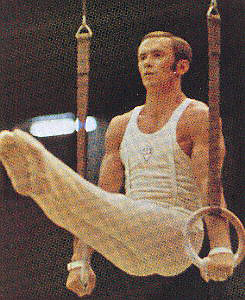
Mikhail Voronin
USSR
Artistic Gymnastics
Overall Ranks
#17 among Gymnasts
#11 among Male Gymnasts
#8 among Soviet Olympians
#4 among Soviet Male Gymnasts
Olympic Results
1968
Individual All-Around - Silver
Team - Silver
Vault - Gold
Parallel Bars - Silver
Horizontal Bar - Gold
Rings - Silver
Pommel Horse - Bronze
1972
Team - Silver
Rings - Silver
Total
Events - 16
Gold - 2
Silver - 6
Bronze - 1
Mikhail Yakovlevich Voronin was born on March 26, 1945 in Moscow, USSR, and trained at the main Soviet gymnastics school in Moscow while growing up. He made the national team in 1966, and at that year's world championship, he won the rings and the individual all-around, plus 3 silvers, making him one of the top medal competitors heading to Mexico City in 1968.
Voronin was the favorite to win the individual all-around, thanks to his recent world championship, and he was definitely the best on the Soviet team, but he was edged out for the gold medal by Sawao Kato of Japan, who took gold by 0.05 points. The day before, Voronin's wife, Zinaida, had also won silver in the individual all-around.
The top 8 in the individual all-around were all from either Japan or the USSR, but since 5 of them were from Japan, the Japanese won by 4.8 points to continue their streak of team golds. The Soviets finished nearly 14 points ahead of the East Germans for silver, so there was never any doubt that they would get a medal, just a question as to the color.
Voronin qualifed for all 6 event finals, but decided to sit out of the floor exercise final, where he was 4th after qualifying. In the vault, he was tied for #2 with Yukio Endo of Japan going into the final, behind Kato, but Kato faltered on his final vault, and Voronin had the best vault of the round, which moved him up to gold.
He was also #2 in the parallel bars heading into the final, behind Akinori Nakayama of Japan by 0.1 points. The two scored identical 9.7s in the final performance, so they kept their standing, with Voronin taking another silver. He and Nakayama were tied after qualifying in the horizontal bar, and they again posted identical scores in the final, leading to the pair sharing the gold medal.
In the rings, Voronin had qualified third, but after Kato had another poor final performance, Voronin was able to move up and take his 4th silver medal in Mexico City. On the pommel horse, he was #2 after qualifying, but was outperformed by Olli Laiho of Finland in the final and fell to third, content to take home a bronze.
After the 1970 World Championship, where he only earned two individual bronze medals, he remained on the national team for the 1972 Olympics in Munich. This time the team competition was first, and the result was just like 4 years earlier, except that the Japanese won by 7.2 points this time, while the Soviets were still 14 points ahead of the East Germans for silver.
The top 36 in the team event were advanced to the individual all-around final, with Voronin in 7th at that point. Unfortunately, he struggled in the final performances, coming in among the bottom 7 in 3 events, and fell to 12th overall by the end of the event.
He qualified for only 2 event finals, the rings and the pommel horse. In the rings, he qualified in second, but with a large gap both behind and in front of him, he was unlikely to move, and he didn't, finishing with a silver medal in rings for the second straight time. He had the same gaps around him in the pommel horse, except that he started in 5th, which is also where he ended up.
He retired from competition after the 1972 Olympics, moving on to become a gymnastics coach. He was a good performer in his second Olympics, but his 7 overall medals in 1968 was tied for the record for a single games at the time, since broken by Aleksandr Dityatin and Michael Phelps, and finishing in the top four in all 8 events alone is enough to make him one of the greatest Olympians of all time.


No comments:
Post a Comment