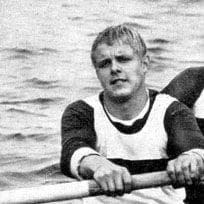
Siegfried Brietzke
East Germany
Rowing
Overall Ranks
#3 among East German Olympians
#1 among Rowers
Olympic Results
1972
Coxless Pairs - Gold
1976
Coxless Fours - Gold
1980
Coxless Fours - Gold
Total
Events - 3
Gold - 3
Siegfried Brietzke was born on June 12, 1952 in Rostock, East Germany. He started rowing when he was 15 years old after seeing a TV commercial that was recruiting tall boys to become competitive rowers. Within 3 years, he had taken gold in the coxless pairs at the World Junior Rowing Championships with Wolfgang Mager, his longtime rowing partner.
The pair qualified for the 1972 Olympics in Munich, and were considered to be one of the favorites, since another East German pair had won the event in the previous Olympics. They won their heat by more than 5.5 seconds, which advanced them to the semifinals, where they again posted the best time to advance to the final race. They were in 6th place halfway through the final, more than 6 seconds behind the leaders, but then they turned on the jets, outpacing all of the other boats by at least 9 seconds down the backstretch, giving them a victory by nearly 4 seconds.
After coming in 4th place at the 1973 European championships, the pair switched events to the coxless fours, adding Stefan Semmler and Andreas Decker to the team. They went on to win the World Championship in 1974 and 1975, making them big favorites to win gold in Montreal in 1976. They followed through with ease, setting Olympic records in all 3 of their races, and winning in the final over a surprising team from Norway by almost 4 seconds.
Before the next Olympics, the same team won two more World Championships, but had been upset by the USSR team in 1978, so it was bad news when Brietzke's longtime partner Mager injured his hand just before the Olympics and had to be replaced by Jurgen Thiele as the headed to Moscow. Both the East Germans and the Soviets won their heats by more than 13 seconds, setting up a showdown for the gold, but it wasn't really a contest, as the East German team led by at least 2 seconds the entire way, winning Brietzke his third straight gold medal.
Brietzke stopped rowing competitively after Moscow, and since East Germany boycotted 1984 anyway, he wouldn't have been able to compete again anyway, so his Olympic career ended with 3 gold medals in 3 attempts, and none of them was particularly close. The fact that he never lost and was never challenged makes him one of the greatest Olympians of all time.


No comments:
Post a Comment