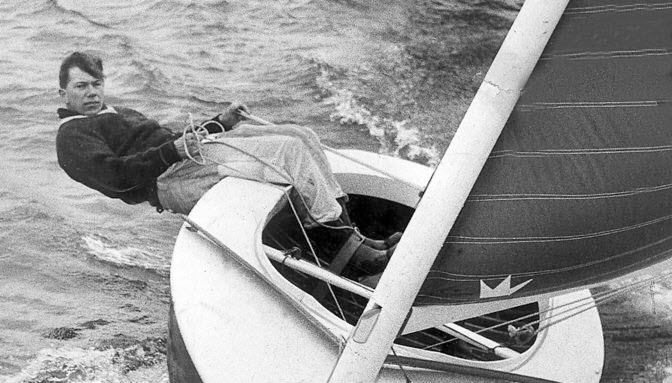
Paul Elvstrom
Denmark
Sailing
Overall Ranks
#1 among Sailers
#1 among Danish Olympians
Olympic Results
1948
One-Person Heavyweight Dinghy - Gold
1952
One-Person Heavyweight Dinghy - Gold
1956
One-Person Heavyweight Dinghy - Gold
1960
One-Person Heavyweight Dinghy - Gold
Total
Events - 8
Gold - 4
Paul Bert Elvstrom was born on February 25, 1928 in Hellerup, Denmark. His father was a sea captain who died when Paul was young. He lived right along the strait between Denmark and Sweden, and became obsessed with sailing from a very young age. A neighbor who recognized his talent and interest gave him his first boat.
His first Olympic appearance came in 1948, when he was just 20 years old. He competed in the one-person heavyweight dinghy, which used a boat called the Firefly that year, which was usually manned by two sailors. All competitors sailed in 7 races, with scores given after each race based on order of finish, and each sailor's worst race not counted.
Elvstrom got his worst race out of the way early, as he failed to finish the first race, resulting in no points scored. He improved over the next several races, and was in 8th place after the fifth race, but after winning the final two races, he pulled into the lead and walked away with a gold medal.
After the 1948 Olympics, 4th-place finisher Rickard Sarby of Sweden designed a new ship which he called the Finn, which was designed for a single sailor, and became the model used in the event starting in 1952. Elvstrom returned to defend his gold medal, and had an easy time of it, winning 3 of the first 4 races outright, which gave him a big enough lead that he could have skipped the final 3 races and still won the gold. Instead, he finished 3rd, 4th, and 1st in those three races and ended up with the largest win ever in the event.
He was expected to win again in 1956, and he started out well, winning the first race, but he struggled in the next two races, finishing in the middle of the pack in each, which left him in second place nearly halfway through. After that point, he figured it out, winning 4 straight races to run away with the gold medal yet again.
He returned in 1960 looking to make history. No Olympian had ever won the same individual event 4 straight times, and he was favored to be the first. He won 3 of the first 6 races, and finished in the top 5 in the others, leaving him with a large enough lead that he didn't need to compete in the final race, so he sat out and took the easy gold.
He skipped the 1964 Olympics, then made his return in 1968, but in a different event, the two-person keelboat, sailing with partner Poul Mik-Meyer. The pair remained in contention for a medal throughout the competition, and was in third place entering the final race, but they already couldn't reach gold at that point. Unfortunately, they finished 5th in that race, which put them in 4th place overall, leaving them just short of a medal.
In 1968, he competed in the three-person keelboat, which was shortened to 6 races due to the hostage situation in the Olympic village, but his team finished around the middle in the first two races, leaving them far behind the pack. They won the third race, which put them in 5th overall, but they dropped to 12th after race four, and after they bumped another boat in race five, resulting in a disqualification, and they refused to finish the event in protest.
He skipped the next two Olympic games, but returned in 1984 to compete in Los Angeles in the Multihull event, partnering with his daughter, Trine. They kept themselves in third place through the first four races, but then fell to 4th place after finishing #14 in race five, and remained there for the rest of the event, falling just short of a medal again.
The father-daughter pair returned for one final attempt at a medal in 1988, but they only finished in the top 5 in one race, and were never in medal contention. His Olympic career spanned 40 years, and he competed in 8 different games, and while he was in contention for medals late in his career, winning 4 straight gold medals in the same event made his one of the greatest Olympians of all time.


No comments:
Post a Comment