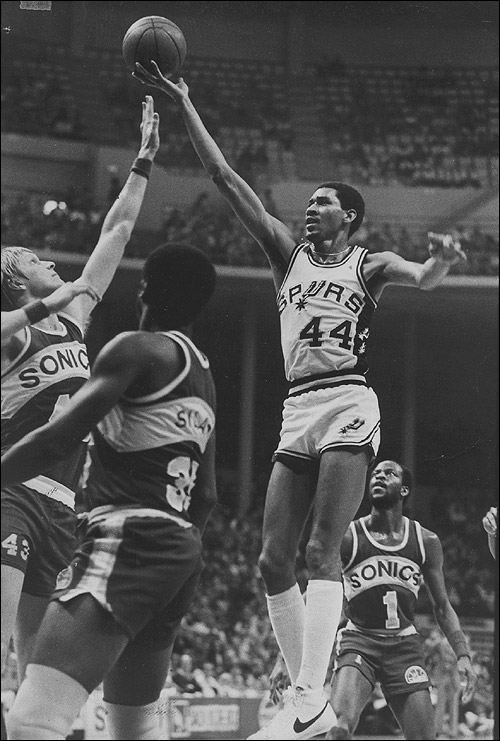
Showing posts with label George Gervin. Show all posts

Wednesday, September 8, 2021

Top 100 NBA Players: #53 - George Gervin


George Gervin

Teams

Virginia Squires (ABA) - 1973-74

San Antonio Spurs (ABA/NBA) - 1974-85

Chicago Bulls - 1985-86


Playoffs

Appearances - 13 (1973,1974,1975,1976,1977,1978,1979,1980,1981,1982,1983,1985,1986)

Conference Finals - 3 (1979,1982,1983)

NBA Finals - 0

Championships - 0


Awards and Honors

All-NBA First Team - 5 (1978,1979,1980,1981,1982)

All-NBA/ABA Second Team - 4 (1974,1975,1976,1977,1981,1983)

Hall of Fame - 1996

*(actual in bold, deserved in italics)


All-Time Ranks

Points Per Game - #11

Total Points - #17

Total Steals - #78

Total Blocks - #91

Free Throw Percentage - #94


League Leads

Total Points (#1-1978,1979,1980,1982, #3-1981,1983, #5-1974,1975)

Points Per Game (#1-1978,1979,1980,1982, #3-1981, #4-1974,1983)

Free Throw Percentage (#4-1976,1982,1983, #5-1986)

Field Goal Percentage (#4-1977)


George Gervin averaged 29.5 points and 15.3 rebounds as a sophomore at Eastern Michigan, but his college career ended early after he punched an opponent during a tournament game, earning him a year-long suspension and dismissal from the team. He signed with a CBA team, where he was noticed by the Virginia Squires of the ABA, who signed him midway through the 1972-73 season, thus beginning his pro career.

Gervin played well for Virginia, but the team was in financial trouble, and soon after they sold Julius Erving, they sold Gervin as well, sending him to the San Antonio Spurs after only a year with the Squires. At the end of that season, he had become eligible to join the NBA, and was drafted in the 3rd round by the Phoenix Suns, but he decided to stick with the Spurs in the ABA.

Gervin averaged over 20 points per game in each of his 2.5 years with the Spurs in the ABA days, and was named to the All-ABA Second Team twice, but the Spurs never won a playoff series in the ABA with Gervin on the team. However, the Spurs' high-paced style of play with Gervin won them a lot of fans, and helped make them one of the teams that was allowed to join the NBA in the 1976 merger.

In his second season with the Spurs in the NBA, Gervin led the league in scoring, winning it on the final day of the season. David Thompson had scored 73 points in his final game, meaning that Gervin needed 63 to win the title, which he did midway through the 3rd quarter of the final game before sitting out the final quarter and a half with the title in hand. That was the first of 5 straight seasons where Gervin was named to the All-NBA First Team.

He repeated as scoring champ the next year, averaging 29.6 per game, then led the Spurs to the Conference Finals, where they took a 3-1 lead on the Washington Bullets before losing 3 games in a row to fall just short of the NBA Finals. It was the closest Gervin would ever get to the ultimate series.

He won his 3rd straight scoring title the next year, with a career high of 33.1 points, and matched the average in the playoffs, but the Spurs fell in the first round. He led the league in scoring for a 4th time in 1982, putting up 32.3 per game, and led them to another Conference Finals, but this time they were swept by the Lakers.

The team traded for Artis Gilmore after that season to take a bit of the scoring load off Gervin, but he still scored 26.2 per game, and they made a repeat trip to the Conference Finals, with a similar result, losing to the Lakers in 6 games this time. He played two more years with the Spurs, but age was starting to catch up with him, and after the 1985 season, the new coach wanted to move him to the bench, which he didn't want, so he was traded to the Chicago Bulls.

He was expected to back up Michael Jordan in Chicago, but after Jordan went down with an injury, Gervin ended up starting almost the whole season, averaging 16.2 points per game and helping get the Bulls to the playoffs. Jordan returned in time for the playoffs, and Gervin's playing time was decimated, playing only 11 minutes in the first two playoff games and not playing at all in the third, finishing the series without a point. After that season, he left the NBA for good, playing in Europe for several years before the retired for good.

Gervin was a great scorer throughout his career, scoring at least 20 points per game in all 12 of his seasons with San Antonio and taking home 4 scoring titles. His career average of 25.1 per game is 11th in history, and he is #9 in history when only counting his NBA years. His biggest downfall was his lack of postseason success. He only reached the Conference Finals 3 times and never reached the Finals, making him the second-best player ever to never reach the Finals, but he obviously belongs on the list of the greatest players ever.


Friday, September 23, 2016

Top 100 NBA Players: #4 - Kareem Abdul-Jabbar


Kareem Abdul-Jabbar

Kareem Abdul-Jabbar dominated the 1970's in a way no decade has been dominated before or since, then adjusted to his role as sidekick to another superstar better than any other player in history, which allowed him to finish his career with 6 championships and 10 NBA Finals appearances.

There was no doubt that Kareem (then Lew Alcindor) would be the top pick in the 1969 NBA Draft, after he led UCLA to an 88-2 record in 3 seasons and 3 straight NCAA championships, where he was named the Most Outstanding Player each time. He easily won the Rookie of the Year trophy, and should have been given the MVP as well, but it was awarded to Willis Reed, who led the New York Knicks to the league's best record and their first championship that season. Here are how their numbers stacked up that year:

Alcindor - 28.8 pts, 14.5 reb, 4.1 ast, .518 FG%, .653 FT%
Reed - 21.7 pts, 13.9 reb, 2.0 ast, .507 FG%, .756 FT%

Although Reed may have led his team to a few more wins (Milwaukee had the second-best record), it's very easy to see that Kareem had the bigger impact, leading a team in its second year of existence to the league's second-best record and a trip to the Conference Finals. In fact, from 1969-1980, a span of 11 seasons, Kareem was the best player 8 times, with the only exceptions coming in two seasons in which he missed time with a broken hand and one season in which George Gervin was on top of his game. He holds the record for most MVP's won, with 6, but I believe he should have been awarded 8.

Even with how great he was for so long, he was only able to make it to 3 NBA Finals during his time as team leader, winning twice. There were even two seasons right during his peak seasons in which his teams missed the playoffs completely, which no other top 10 player can say. That all changed in 1981, when Magic Johnson became the center of the Lakers' offense and Kareem became their #2 star.

In the final 8 seasons of Kareem's career in Los Angeles, the Lakers made it to the Finals 7 times, and Kareem was a major contributor for most of those teams, although by the time he retired he was not near the player he had once been, posting just 10 points per game along with fewer than 5 rebounds.

Kareem is the NBA's all-time leader in All-Star appearances, MVP awards, points scored, and minutes played, and he is also one of only 3 players in history to win the scoring title, MVP, and Finals MVP in the same season, along with Michael Jordan and Shaquille O'Neal. That season was 1971, just his second season as a pro, when he averaged 31.7 points and 16.0 rebounds, took 133 out of 153 MVP votes, then led Milwaukee to the title by winning 12 of 14 in the playoffs and sweeping the Baltimore Bullets in the Finals. He was the first to do it, and it wouldn't happen again for 20 years, when Jordan won his first title.

Saturday, September 3, 2016

Top 100 NBA Players: #27 - Moses Malone


Moses Malone

Moses Malone is the greatest offensive rebounder in the history of the NBA, and was a trailblazer for many of today's players, becoming the first player to successfully jump directly from high school to the pros. He also had an incredibly long career, playing 19 NBA seasons and 21 professional seasons overall.

As I stated above, Malone was easily the best offensive rebounder to ever set foot on a basketball court. He has the three highest single season totals of all time, and is also the owner of 6 of the top 10 offensive rebounding seasons. He led the league in offensive rebounds in each of his first 7 seasons, and in total rebounding six times in his career. In 1978-79, he averaged 7.2 offensive rebounds per game, and 17.6 overall. He was truly a monster on the boards.

Malone was among the top 5 players in the league for five straight seasons early in his career, from 1978-1983. During that stretch, he was awarded the MVP three times, but he may not have been the best player during those seasons. I'm going to break down the best players from four of those seasons and show my pick for each season's MVP

Gervin (1979) - 29.6 pts, 5.0 reb, 2.7 ast, 1.7 stl, 1.1 blk, .541 FG%, .826 FT%, .585 Win%
Malone (1979) - 24.8 pts, 17.6 reb, 1.8 ast, 1.0 stl, 1.5 blk, .540 FG%, .739 FT%, .573 Win%

Gervin led the league in scoring, while Malone led the league in rebounding. Gervin was the better shooter, despite being the smaller player, and his team finished ahead of Malone's in the overall standings. They also advanced farther in the playoffs than the Rockets, all of which make a strong case for Gervin deserving that season's MVP.

Erving (1981) - 24.6 pts, 8.0 reb, 4.4 ast, 2.1 stl, 1.8 blk, .521 FG%, .787 FT%, .756 Win%
Malone (1981) - 27.8 pts, 14.8 reb, 1.8 ast, 1.0 stl, 1.9 blk, .522 FG%, .757 FT%, .488 Win%

Statistically, Malone was a much better player, but Erving had the advantage of playing for the team with the best record, which is probably why he won the MVP, but in retrospect, the 76ers fell in the Eastern Conference Finals, while Malone led the Rockets all the way to the NBA Finals, where they fell to Boston in 6 games. This one's not completely clear-cut, but I believe Malone was the better player that season.

Johnson (1982) - 18.6 pts, 9.6 reb, 9.5 ast, 2.7 stl, 0.4 blk, .537 FG%, .760 FT%, .695 Win%
Malone (1982) - 31.1 pts, 14.7 reb, 1.8 ast, 0.9 stl, 1.5 blk, .519 FG%, .762 FT%, .561 Win%

Malone had an amazing season, leading the league in rebounding again while averaging over 30 points for the only time in his career, but Magic came closer to a triple-double average than anybody since Oscar Robertson and led Los Angeles to the best record in the West and eventually an NBA Championship, while Houston lost in the first round. This should have been Johnson's first MVP.

Johnson (1983) - 16.8 pts, 8.6 reb, 10.5 ast, 2.2 stl, 0.6 blk, .548 FG%, .800 FT%, .707 Win%
Malone (1983) - 24.5 pts, 15.3 reb, 1.3 ast, 1.1 stl, 2.0 blk, .501 FG%, .761 FT%, .793 Win%

Johnson nearly matched everything he had done the year before, even upping the Lakers' winning percentage and shooting much better than big man Malone, while Moses saw a huge dip in his scoring numbers, which he made up for by winning more games with his new team, the 76ers. The two teams met in the Finals, with Malone's Rockets winning in 4 games, but I still think Magic was slightly better overall, because he could pass the ball and take it away from the other team.

It was during that championship run of 1983 when Moses famously predicted that Philly would sweep through the playoffs in "fo, fo, fo," which they came within one game of accomplishing, losing just once in the second round. Moses ran away with the Finals MVP award and took home his only championship during that season.

Most experts have Malone ranked a bit higher all-time, but there are several reasons to rank him a bit lower. The first is that he really didn't have that much playoff success. He had the one magical and dominant season in 1983, and he took his team to the Finals in 1981, but other than that, he only saw the Conference Finals two other times in 19 seasons. That equals 15 seasons of losing in the first round or missing the playoffs altogether.

Another problem with Malone is that he was traded often during the prime of his career. Usually when one of the best players in the league is traded, it's because there is some sort of problem with the player, and Malone was traded not just once, but 5 times during the best years of his career. In fact, more than half of my top 20 players played for only one team during their prime years. One mark of a truly great player is that he is untradeable.

Moses was also not a great shooter, especially for a big man. His career average was under 50%, which is unacceptable for a center, and he only shot over 50% five times in his 19 seasons. His longevity, durability, and dominance in one category for a long period of time certainly help him out here, but he is not one of history's top 25.

Saturday, August 27, 2016

Top 100 NBA Players: #36 - George Gervin


George Gervin

George Gervin was an amazing scorer and a big star for a number of years, but more than anyone else who reached this high on the list, he was not a winner. He was known for being somewhat selfish, but it doesn't diminish how great he was offensively.

Gervin was a four time scoring leader, and is one of 7 players all-time to win three straight scoring titles. In 1980 he averaged 33.1 points per game, and he eclipsed 30 points again 2 years later, when he again led the league with 32.3 nightly. He was twice the MVP runner-up, in 1978 and 1979, but he probably should have won in 1979, when it was given to Moses Malone. Here are how their numbers stacked up that season:

Malone - 24.8 pts, 17.6 reb, 1.8 ast, 1.5 blk, .540 FG%, .739 FT%
Gervin - 29.6 pts, 5.0 reb, 2.7 ast, 1.1 blk, .541 FG%, .826 FT%

Moses led the league in rebounding that year, and Gervin in scoring, so both were obvious candidates. In the other four categories, Gervin was obviously the better player, especially if you know that Gervin was a shooting guard and Malone was a center, because Gervin shot a higher percentage than the MVP that year, and blocked nearly as many shots.

Gervin was the best player on his team for nearly his entire career, but he never saw much playoff success in that role. His best finish was losing in the Conference Finals three times, making him the best player to never play in the NBA Finals, joining Dominique Wilkins, Steve Nash, Alex English, and Vince Carter on that dubious list.

For six straight seasons, Gervin was one of the top 3 players in the NBA, but because of his playoff failings he is usually not considered to be on the same level as those who were his peers during those years, including Moses Malone, Magic Johnson, and Kareem Abdul-Jabbar. His averages over that time were spectacular, and they are listed below:

Gervin (1977-1983) - 29.2 pts, 5.0 reb, 3.0 ast, 1.3 stl, .514 FG%, .834 FT%

Gervin had the disadvantage of never having a true star for a teammate. As the only star in San Antonio for a long time, he did get them to the playoffs in every season of his career, even though he couldn't get them through to the Finals. His career was still very impressive, even though it only lasted for 10 NBA seasons.

Sunday, July 31, 2016

Top 100 NBA Players: #65 - Carmelo Anthony


Carmelo Anthony

Carmelo Anthony has been a star in the NBA since day one, and after 13 seasons, it's only right that he get some recognition as one of the best players in NBA history. He has scored at least 20 points per game in each of the first thirteen seasons of his career, making him one of just 6 players to accomplish that feat, with the others being Kareem, Hakeem, LeBron, Shaq, and Jordan.

During that time, he hasn't just been reaching the 20-point plateau, he's been well above it quite often, reaching 25 points per game 7 times in his career, and he's ended nine seasons ranked among the top 8 scorers in the league, including one season in which he was the league's top scorer. He's also spent nearly his entire career as the best player on his team, only playing second fiddle during Iverson's full season in Denver and for the last half of his first season with Amare.

Not only has Carmelo scored a lot in his career, he took his team to the playoffs in each of his first ten seasons in the league, although he has only seen his team pass through the first round twice, in 2009, when he led the Nuggets to the Western Conference Finals, and 2013, when they lost in the second round.

Carmelo also used to own an NBA record that is quite impressive. In 2008, he scored 33 points in one quarter against Minnesota, tying George Gervin's record that had stood untouched for just over 30 years. That equates to nearly 3 points per minute during that quarter, and his total for the quarter was more than his season average for points per game.

Sadly, Carmelo only seems to have two things going for him: he is a great scorer, and he has done it for a long time. He has never been known to have an all-around game, as he is fairly average at shooting and rebounding, and he has had very little success in the playoffs, with only 3 series wins in 13 tries, without a single appearance in the NBA Finals. He's still only 32 years old and seems to still be on top of his game, so maybe something will change and he can still climb higher on this list.

Friday, June 8, 2012

Top 100 NBA Players: #3


Kareem Abdul-Jabbar

(Kalb: #5, Simmons: #3, BBR: #5)

Kareem Abdul-Jabbar dominated the 1970's in a way no decade has been dominated before or since, then adjusted to his role as sidekick to another superstar better than any other player in history, which allowed him to finish his career with 6 championships and 10 NBA Finals appearances.

There was no doubt that Kareem (then Lew Alcindor) would be the top pick in the 1969 NBA Draft, after he led UCLA to an 88-2 record in 3 seasons and 3 straight NCAA championships, where he was named the Most Outstanding Player each time. He easily won the Rookie of the Year trophy, and should have been given the MVP as well, but it was awarded to Willis Reed, who led the New York Knicks to the league's best record and their first championship that season. Here are how their numbers stacked up that year:

Alcindor - 28.8 pts, 14.5 reb, 4.1 ast, .518 FG%, .653 FT%
Reed - 21.7 pts, 13.9 reb, 2.0 ast, .507 FG%, .756 FT%

Although Reed may have led his team to a few more wins (Milwaukee had the second-best record), it's very easy to see that Kareem had the bigger impact, leading a team in its second year of existence to the league's second-best record and a trip to the Conference Finals. In fact, from 1969-1980, a span of 11 seasons, Kareem was the best player 8 times, with the only exceptions coming in two seasons in which he missed time with a broken hand and one season in which George Gervin was on top of his game. He holds the record for most MVP's won, with 6, but I believe he should have been awarded 8.

Even with how great he was for so long, he was only able to make it to 3 NBA Finals during his time as team leader, winning twice. There were even two seasons right during his peak seasons in which his teams missed the playoffs completely, which no other top 10 player can say. That all changed in 1981, when Magic Johnson became the center of the Lakers' offense and Kareem became their #2 star.

In the final 8 seasons of Kareem's career in Los Angeles, the Lakers made it to the Finals 7 times, and Kareem was a major contributor for most of those teams, although by the time he retired he was not near the player he had once been, posting just 10 points per game along with fewer than 5 rebounds.

Kareem is the NBA's all-time leader in All-Star appearances, MVP awards, points scored, and minutes played, and he is also one of only 3 players in history to win the scoring title, MVP, and Finals MVP in the same season, along with Michael Jordan and Shaquille O'Neal. That season was 1971, just his second season as a pro, when he averaged 31.7 points and 16.0 rebounds, took 133 out of 153 MVP votes, then led Milwaukee to the title by winning 12 of 14 in the playoffs and sweeping the Baltimore Bullets in the Finals. He was the first to do it, and it wouldn't happen again for 20 years, when Jordan won his first title.


In terms of longevity, Kareem and Karl Malone are basically even. When you look at playoff success, the edge goes to Abdul-Jabbar, who won a couple of titles as the star player and several more playing with Magic as the star. When looking at regular season dominance, there is no doubt that Kareem was better, as he was the best player 8 times, while Malone spent nearly as long as the league's #2 player. Overall, it's easy to see that Kareem was the better player, and deserves the #3 spot among the all-time greats.

Saturday, December 31, 2011

Top 100 NBA Players: #22


David Robinson

(Kalb: #20, Simmons: #28, BBR: #7)

David Robinson was one of the most impressive physical specimens to ever take the court to play basketball, and at one point he was widely considered to be the successor to Michael Jordan as the superstar of the NBA. According to Bill Simmons, "if we ever start cloning basketball players someday, Jordan, LeBron and Robinson will be one-two-three in some order."

Robinson was so highly though of early in his career that when the time came to pick the players for the first Dream Team to compete in the 1992 Olympics, Robinson was the committee's unanimous #4 choice, behind only Jordan, Bird, and Magic. At that point, Robinson had completed only 3 season in the NBA, during which time he had been named the unanimous Rookie of the Year, Defensive Player of the Year, and two-time All-NBA First Team and All-Defensive First Team center.

Robinson's peak corresponded with Michael Jordan's first retirement, which made many believe that he would become a completely dominant force and start to make a collection of MVP's and NBA titles, but Hakeem Olajuwon took advantage of Jordan leaving and finally earned two titles of his own before MJ returned. From 1994-96, Robinson was easily one of the top 3 players in the league, but was never the unquestioned superstar. Here are his stats compared with other top players from those seasons:

Robinson (1994) - 29.8 pts, 10.7 reb, 4.8 ast, 1.7 stl, 3.3 blk, .507 FG%, .749 FT%
Olajuwon (1994) - 27.3 pts, 11.9 reb, 3.6 ast, 1.6 stl, 3.7 blk, .528 FG%, .716 FT%

Robinson (1995) - 27.6 pts, 10.8 reb, 2.9 ast, 1.7 stl, 3.2 blk, .530 FG%, .774 FT%
O'Neal (1995) - 29.3 pts, 11.4 reb, 2.7 ast, 0.9 stl, 2.4 blk, .583 FG%, .533 FT%

Robinson (1996) - 25.0 pts, 12.2 reb, 3.0 ast, 1.4 stl, 3.3 blk, .516 FG%, .761 FT%
Jordan (1996) - 30.4 pts, 6.6 reb, 4.3 ast, 2.2 stl, 0.5 blk, .495 FG%, .834 FT%

None of those seasons had a clear top player, but in each case I would place Robinson one step below his nearest competition due to their higher level of playoff success in those seasons. His peak came to abrupt end the next season, when back and foot injuries limited him to only 6 games and caused the Spurs to miss the playoffs for the first time since his arrival.

In a way that season was also a blessing in disguise, as their horrible record earned them the top pick in the NBA Draft, which gave them Tim Duncan, the perfect complement to Robinson on the inside. That combination gave the Spurs their first two championships, the first with Duncan narrowly edging Robinson for the Finals MVP, and the second coming by a much wider margin.

One of the signature moments of Robinson's career came on the closing day of the 1994 season, when he and Shaq were in a tight race for the scoring title in the first season someone besides Michael Jordan was sitting at the top in 8 years. Shaw had put up 32 points earlier in the day, so Robinson knew exactly what he needed to do, and he had the perfect opponent, the Los Angeles Clippers. He scored 71 points that day, destroying Gervin's old team record of 63 and taking the scoring title on the very last day.


Robinson was never the league superstar like Mikan was, but Robinson maintained a high level of play for a little longer, then settled in as a very good player for several years and won a couple championships, while Mikan retired as soon as he was no longer the big star. The fact that he was able to excel in both roles, and how good he was right from the start, gave him this spot just ahead of the first dominant big man.

Friday, October 7, 2011

Top 100 NBA Players: #26


Moses Malone

(Kalb: #14, Simmons: #12, BBR: #15)

Moses Malone is the greatest offensive rebounder in the history of the NBA, and was a trailblazer for many of today's players, becoming the first player to successfully jump directly from high school to the pros. He also had an incredibly long career, playing 19 NBA seasons and 21 professional seasons overall.

As I stated above, Malone was easily the best offensive rebounder to ever set foot on a basketball court. He has the three highest single season totals of all time, and is also the owner of 6 of the top 10 offensive rebounding seasons. He led the league in offensive rebounds in each of his first 7 seasons, and in total rebounding six times in his career. In 1978-79, he averaged 7.2 offensive rebounds per game, and 17.6 overall. He was truly a monster on the boards.

Malone was among the top 5 players in the league for five straight seasons early in his career, from 1978-1983. During that stretch, he was awarded the MVP award three times, but he may not have been the best player during those seasons. I'm going to break down the best players from four of those seasons and show my pick for each season's MVP

Gervin (1979) - 29.6 pts, 5.0 reb, 2.7 ast, 1.7 stl, 1.1 blk, .541 FG%, .826 FT%, .585 Win%
Malone (1979) - 24.8 pts, 17.6 reb, 1.8 ast, 1.0 stl, 1.5 blk, .540 FG%, .739 FT%, .573 Win%

Gervin led the league in scoring, while Malone led the league in rebounding. Gervin was the better shooter, despite being the smaller player, and his team finished ahead of Malone's in the overall standings. They also advanced farther in the playoffs than the Rockets, all of which make a strong case for Gervin deserving that season's MVP.

Erving (1981) - 24.6 pts, 8.0 reb, 4.4 ast, 2.1 stl, 1.8 blk, .521 FG%, .787 FT%, .756 Win%
Malone (1981) - 27.8 pts, 14.8 reb, 1.8 ast, 1.0 stl, 1.9 blk, .522 FG%, .757 FT%, .488 Win%

Statistically, Malone was a much better player, but Erving had the advantage of playing for the team with the best record, which is probably why he won the MVP, but in retrospect, the 76ers fell in the Eastern Conference Finals, while Malone led the Rockets all the way to the NBA Finals, where they fell to Boston in 6 games. This one's not completely clear-cut, but I believe Malone was the better player that season.

Johnson (1982) - 18.6 pts, 9.6 reb, 9.5 ast, 2.7 stl, 0.4 blk, .537 FG%, .760 FT%, .695 Win%
Malone (1982) - 31.1 pts, 14.7 reb, 1.8 ast, 0.9 stl, 1.5 blk, .519 FG%, .762 FT%, .561 Win%

Malone had an amazing season, leading the league in rebounding again while averaging over 30 points for the only time in his career, but Magic came closer to a triple-double average than anybody since Oscar Robertson and led Los Angeles to the best record in the West and eventually an NBA Championship, while Houston lost in the first round. This should have been Johnson's first MVP.

Johnson (1983) - 16.8 pts, 8.6 reb, 10.5 ast, 2.2 stl, 0.6 blk, .548 FG%, .800 FT%, .707 Win%
Malone (1983) - 24.5 pts, 15.3 reb, 1.3 ast, 1.1 stl, 2.0 blk, .501 FG%, .761 FT%, .793 Win%

Johnson nearly matched everything he had done the year before, even upping the Lakers' winning percentage and shooting much better than big man Malone, while Moses saw a huge dip in his scoring numbers, which he made up for by winning more games with his new team, the 76ers. The two teams met in the Finals, with Malone's Rockets winning in 4 games, but I still think Magic was slightly better overall, because he could pass the ball and take it away from the other team.

It was during that championship run of 1983 when Moses famously predicted that Philly would sweep through the playoffs in "fo, fo, fo," which they came within one game of accomplishing, losing just once in the second round. Moses ran away with the Finals MVP award and took home his only championship during that season.

You may have noticed that most experts have Malone ranked a bit higher all-time, but there are several reasons to rank him a bit lower. The first is that he really didn't have that much playoff success. He had the one magical and dominant season in 1983, and he took his team to the Finals in 1981, but other than that, he only saw the Conference Finals two other times in 19 seasons. That equals 15 seasons of losing in the first round or missing the playoffs altogether.

Another problem with Malone is that he was traded often during the prime of his career. Usually when one of the best players in the league is traded, it's because there is some sort of problem with the player, and Malone was traded not just once, but 5 times during the best years of his career. In fact, more than half of my top 20 players played for only one team during their prime years. One mark of a truly great player is that he is untradeable.

Moses was also not a great shooter, especially for a big man. His career average was under 50%, which is unacceptable for a center, and he only shot over 50% five times in his 19 seasons. His longevity, durability, and dominance in one category for a long period of time certainly help him out here, but he is not one of history's top 25.


Malone and Wade each have one championship, one Finals MVP, and two Finals appearances in their careers. Malone had a lot fewer injury problems than Wade has had, but Wade was a better all-around player than Malone, who was more of an inside-only star. The thing that keeps Malone ahead was that he was a star player of 14 years, which is longer than Wade has been in the league so far. I'm not sure how much longer he can hold him off, though.

Monday, September 5, 2011

Top 100 NBA Players: #33


Paul Pierce

(Simmons: #54, BBR: #43)

Paul Pierce is best known today as a member of Boston's "Big Three," the three superstars that were brought together in 2007 and brought a championship to Boston in 2008, and he's also known as the one chosen from among those three to win the Finals MVP Award that season, which leads many to believe that before the arrival of Garnett and Allen that Pierce and the Celtics couldn't win, but that isn't exactly true.

Pierce hit his peak as a player from 2001-2003, back when Antoine Walker was also playing in Boston, and the Celtics were actually a pretty good team. They won playoff series in both of those seasons, and even reached the Eastern Conference Finals in 2002, with Pierce as the team leader. Here are his combined stats from those two seasons:

Pierce - 26.0 pts, 7.1 reb, 3.8 ast, 1.8 stl, 0.9 blk, .429 FG%, .360 3P%, .805 FT%

Other than the field goal percentage, which was pretty low even for a guard, Pierce was great all-around. He has managed to improve his shooting over the course of the past 8 seasons, and he has kept most of the other numbers relatively close to that level.

He remained one of the better players in the league for the next few seasons, but the Celtics started to slide, so they picked up a couple of stars to help share the load, and the result was their first title in two decades. Pierce was named the MVP of the Finals, but Kevin Garnett should have won it, as the numbers from that year's playoffs show:

Garnett - 20.4 pts, 10.5 reb, 3.3 ast, 1.3 stl, 1.1 blk, .495 FG%, .810 FT%
Pierce - 19.7 pts, 5.0 reb, 4.6 ast, 1.1 stl, 0.3 blk, .441 FG%, .802 FT%

A quick glance at those numbers shows that Garnett was by far the better player, performing better in every key category but one, assists, and that one was pretty close. I believe the reason Pierce won was his "comeback" from a "major injury" in game 1, which exhibited worse acting than a lot of reality shows. He couldn't even get up and walk off the court, but just minutes later he was back and scored 15 points in the third quarter to lead them to victory.

In 2010 Boston made another trip to the Finals, and people once again talked as if Pierce was the star of that team and the driving force behind it, but I showed earlier in my article about Rajon Rondo (#84) that the star power of the team had shifted to the point guard position. That's not to say the Pierce wasn't important on those Finals teams, because any team needs at least two stars to get to the Finals in today's league, and Pierce was one of them on both of those teams.


Pierce has a couple of real advantages over Gervin, the first being his ability to win in the playoffs, which Gervin didn't have, and the other being his longevity, which escaped the Spurs superstar, who left the NBA in his early 30's. Pierce was never the best player in the league, but he did make the top 5 in his fourth season, and he's remained a star in all but one of his seasons since, even playing at an All-Star level this season, at an age when Gervin was already gone.

Thursday, September 1, 2011

Top 100 NBA Players: #34


George Gervin

(Kalb: #26, Simmons: #34, BBR: #41)

George Gervin was an amazing scorer and a big star for a number of years, but more than anyone else who reached this high on the list, he was not a winner. He was known for being somewhat selfish, but it doesn't diminish how great he was offensively.

Gervin was a four time scoring leader, and is one of 6 players all-time to win three straight scoring titles. In 1980 he averaged 33.1 points per game, and he eclipsed 30 points again 2 years later, when he again led the league with 32.3 nightly. He was twice the MVP runner-up, in 1978 and 1979, but he probably should have won in 1979, when it was given to Moses Malone. Here are how their numbers stacked up that season:

Malone - 24.8 pts, 17.6 reb, 1.8 ast, 1.5 blk, .540 FG%, .739 FT%
Gervin - 29.6 pts, 5.0 reb, 2.7 ast, 1.1 blk, .541 FG%, .826 FT%

Moses led the league in rebounding that year, and Gervin in scoring, so both were obvious choices. In the other four categories, Gervin was obviously the better player, especially if you know that Gervin was a shooting guard and Malone was a center, because Gervin shot a higher percentage than the MVP that year, and blocked nearly as many shots.

Gervin was the best player on his team for nearly his entire career, but he never saw much playoff success in that role. His best finish was losing in the Conference Finals three times, making him the best player to never play in the NBA Finals, joining Dominique Wilkins, Steve Nash, Alex English, Vince Carter, and Tracy McGrady on that dubious list.

For six straight seasons, Gervin was one of the top 3 players in the NBA, but because of his playoff failings he is usually not considered to be on the same level as those who were at his level during those years, including Moses Malone, Magic Johnson, and Kareem Abdul-Jabbar. His averages over that time were spectacular, and they are listed below:

Gervin (1977-1983) - 29.2 pts, 5.0 reb, 3.0 ast, 1.3 stl, .514 FG%, .834 FT%

Gervin had the disadvantage of never having a true star for a teammate. As the only star in San Antonio for a long time, he did get them to the playoffs in every season of his career, even though he couldn't get them through to the Finals. His career was still very impressive, even though it only lasted for 10 NBA seasons.


Payton may have been the better defensive player by far, but Gervin's offensive prowess was so great that there is no doubt he was better than Payton. Gervin's first 7 NBA seasons were all at least as good as Payton's best season, so even though Payton lasted much longer, Gervin got much higher. While Gervin was not a great playoff player, Payton's overall playoff success wasn't much better, so Gervin is definitely higher up on the list.

Friday, July 29, 2011

Top 100 NBA Players: #66


Carmelo Anthony

(BBR: #53)

Carmelo Anthony has been a star in the NBA since day one, and with eight seasons under his belt, it's only right that he get some recognition as one of the best players in NBA history. He has scored at least 20 points per game in all eight seasons of his career, making him one of just 14 players to accomplish that in his career.

For the past six seasons, he hasn't just been reaching the 20-point plateau, he's been well above it, and he's ended each of those seasons ranked among the top 8 scorers in the league. He's also spent nearly his entire career as the best player on his team, only playing second fiddle during Iverson's full season in Denver and for the last half of this season to Amare, although that may change in the coming season.

Not only has Carmelo scored a lot in his career, he has taken his team to the playoffs in each and every season he has been in the league, although he has only seen his team pass through the first round once, in 2009, when he led the Nuggets to the Western Conference Finals.

Carmelo has missed at least five games in six of his eight seasons, for reasons ranging from deaths in the family to suspensions to minor injuries, but he has never spent more than 17 games in street clothes in a single season. His best season was not the one where he scored the most, but the one where he played the most games during his peak years, which came clear back in 2006. He bested that years scoring average twice since then, but both times did it while missing more than 10 games.

Carmelo also owns an NBA record that is quite impressive. In 2008, he scored 33 points in one quarter against Minnesota, tying George Gervin's record that had stood untouched for just over 30 years. That equates to nearly 3 points per minute during that quarter, and his total for the quarter was more than his season average for points per game.


Moncrief may have been a much better player than Anthony at his peak, but his peak lasted only six years, and Anthony has been a star player for all eight years of his career so far, and it's not even certain that he has reached his peak yet. The two are exactly even in playoff success, with each leading just one trip to the Conference Finals. I still get the feeling that Anthony can do more than he has so far, but maybe he's that rare player who found his peak early and was able to maintain it for a long time.