Showing posts with label Alex English. Show all posts

Tuesday, August 24, 2021

Top 100 NBA Players: #68 - Alex English


Alex English

Teams

Milwaukee Bucks - 1976-78

Indiana Pacers - 1978-80

Denver Nuggets - 1980-90

Dallas Mavericks - 1990-91


Playoffs

Appearances - 10 (1978,1982,1983,1984,1985,1986,1987,1988,1989,1990)

Conference Finals - 1 (1985)

NBA Finals - 0

Championships - 0


Awards and Honors

All-NBA First Team - 0 (1983)

All-NBA Second Team - 3 (1982,1983,1984,1985,1986,1987)

Hall of Fame - 1997

*(actual in bold, deserved in italics)


All-Time Ranks

Total Points - #23

Points Per Game - #41

Total Assists - #99


League Leads

Total Points (#1-1983,1986, #2-1987, #3-1985, #4-1982,1984, #5-1989)

Points Per Game (#1-1983, #3-1986,1987, #4-1982,1984, #5-1985)

Field Goal Percentage (#5-1978)


Alex English was a solid player for 4 years at South Carolina, capped off by a senior season where he averaged 22.6 points and 10.3 rebounds, and he was drafted in the second round of the NBA Draft by the Milwaukee Bucks, where he would spend the first two seasons of his career in obscurity, putting up less than 10 points per game in each season.

After those 2 years, he was allowed to leave as a free agent, and he signed on with the Indiana Pacers, where he became a starter and averaged 16 points per game, but after a year and a half, the team traded him to the Denver Nuggets for George McGinnis, who had been a huge star in Indiana during their ABA days.

English became a star very quickly in Denver, averaging 21.3 points per game during the tail end of the 1980 season after he was traded, and he scored at least 20 points per game for the rest of the decade with the Nuggets. He increased his scoring in each of his first 7 seasons, culminating in a scoring title in 1983, when he finished with 28.4 points, just ahead of his teammate, Kiki Vandeweghe, who came in #2 in the league.

After Vandeweghe left the team in 1984, English took on an even bigger role, and it resulted in the deepest playoff run of his career in 1985. He averaged over 30 points per game in the playoffs as the Nuggets beat the Spurs and the Jazz, but after English broke his shooting thumb in Game 4 of the Western Conference Finals against the Lakers, the Nuggets season was over.

He set his career high in scoring the next year, averaging 29.8 points per game, which put him at #3 behind Dominique Wilkins and Adrian Dantley for the season, but the Nuggets' season ended in the second round. He continued to score big for the Nuggets for the rest of the decade, but they were never able to get past the second round again.

After he averaged only 17.9 points in 1989-90, English was allowed to leave as a free agent. He signed with the Dallas Mavericks, where he scored only 9.7 per game in one season with the team, and he was unable to find a team to take him after that, so his NBA career ended.

English scored more points than any other player in the 1980s, and was the first player ever to score over 2000 points 8 times in a row. Just like the two players before him in this countdown, he won a single scoring title, but never reached the NBA Finals, though English reached the second round 5 times, which was better than the other two, which allows him to sit just ahead of them in this countdown of the greatest players of all time.


Saturday, August 27, 2016

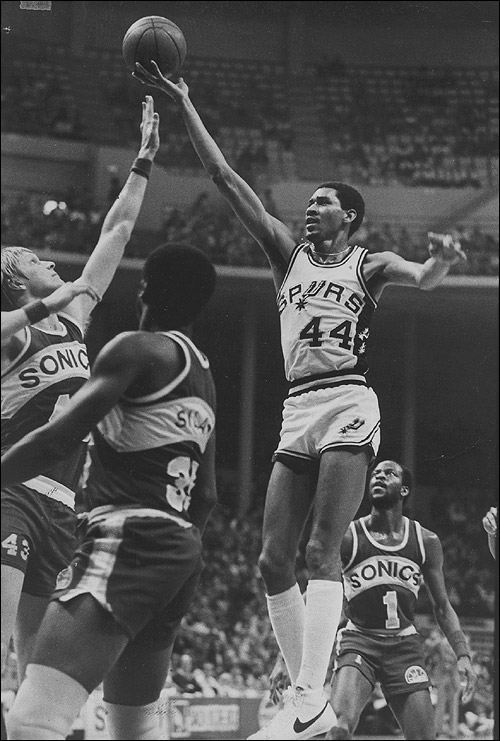
Top 100 NBA Players: #36 - George Gervin


George Gervin

George Gervin was an amazing scorer and a big star for a number of years, but more than anyone else who reached this high on the list, he was not a winner. He was known for being somewhat selfish, but it doesn't diminish how great he was offensively.

Gervin was a four time scoring leader, and is one of 7 players all-time to win three straight scoring titles. In 1980 he averaged 33.1 points per game, and he eclipsed 30 points again 2 years later, when he again led the league with 32.3 nightly. He was twice the MVP runner-up, in 1978 and 1979, but he probably should have won in 1979, when it was given to Moses Malone. Here are how their numbers stacked up that season:

Malone - 24.8 pts, 17.6 reb, 1.8 ast, 1.5 blk, .540 FG%, .739 FT%
Gervin - 29.6 pts, 5.0 reb, 2.7 ast, 1.1 blk, .541 FG%, .826 FT%

Moses led the league in rebounding that year, and Gervin in scoring, so both were obvious candidates. In the other four categories, Gervin was obviously the better player, especially if you know that Gervin was a shooting guard and Malone was a center, because Gervin shot a higher percentage than the MVP that year, and blocked nearly as many shots.

Gervin was the best player on his team for nearly his entire career, but he never saw much playoff success in that role. His best finish was losing in the Conference Finals three times, making him the best player to never play in the NBA Finals, joining Dominique Wilkins, Steve Nash, Alex English, and Vince Carter on that dubious list.

For six straight seasons, Gervin was one of the top 3 players in the NBA, but because of his playoff failings he is usually not considered to be on the same level as those who were his peers during those years, including Moses Malone, Magic Johnson, and Kareem Abdul-Jabbar. His averages over that time were spectacular, and they are listed below:

Gervin (1977-1983) - 29.2 pts, 5.0 reb, 3.0 ast, 1.3 stl, .514 FG%, .834 FT%

Gervin had the disadvantage of never having a true star for a teammate. As the only star in San Antonio for a long time, he did get them to the playoffs in every season of his career, even though he couldn't get them through to the Finals. His career was still very impressive, even though it only lasted for 10 NBA seasons.

Saturday, August 20, 2016

Top 100 NBA Players: #44 - Alex English


Alex English

Alex English has been largely forgotten today, mostly due to his lack of postseason success, but longtime Nuggets fans remember what a great player he was, and he has a place in history that cannot be forgotten.

If you were to ask somebody who the leading scorer of the 1980's was, many would answer with Michael Jordan or Larry Bird rather than Alex English, but he happens to be the correct answer. He scored 19700 points from 1980 to 1989, averaging at least 23 points per game in every season and leading the league in 1983. His scoring average for the decade was 26.9, an amazing accomplishment that few have ever come close to.

He was more than just a great scorer, however. He averaged 5.7 rebounds per game over that same time period, with a peak of 8.0 in 1981. He also averaged 4.6 assists, and always hovered around that range throughout his career. He shot .511 for the decade from the field and .841 from the free throw line. He was an all-around star.

He also led the Nuggets to nine straight playoff berths, and although he never saw the NBA Finals in his career, he did take Denver to the Western Conference Finals once, averaging over 30 points per game during the 1985 playoffs. While most of the other players who have a good ranking on this list have seen quite a bit of playoff success, English did so much during the regular seasons that he can't be overlooked.

Thursday, September 1, 2011

Top 100 NBA Players: #34


George Gervin

(Kalb: #26, Simmons: #34, BBR: #41)

George Gervin was an amazing scorer and a big star for a number of years, but more than anyone else who reached this high on the list, he was not a winner. He was known for being somewhat selfish, but it doesn't diminish how great he was offensively.

Gervin was a four time scoring leader, and is one of 6 players all-time to win three straight scoring titles. In 1980 he averaged 33.1 points per game, and he eclipsed 30 points again 2 years later, when he again led the league with 32.3 nightly. He was twice the MVP runner-up, in 1978 and 1979, but he probably should have won in 1979, when it was given to Moses Malone. Here are how their numbers stacked up that season:

Malone - 24.8 pts, 17.6 reb, 1.8 ast, 1.5 blk, .540 FG%, .739 FT%
Gervin - 29.6 pts, 5.0 reb, 2.7 ast, 1.1 blk, .541 FG%, .826 FT%

Moses led the league in rebounding that year, and Gervin in scoring, so both were obvious choices. In the other four categories, Gervin was obviously the better player, especially if you know that Gervin was a shooting guard and Malone was a center, because Gervin shot a higher percentage than the MVP that year, and blocked nearly as many shots.

Gervin was the best player on his team for nearly his entire career, but he never saw much playoff success in that role. His best finish was losing in the Conference Finals three times, making him the best player to never play in the NBA Finals, joining Dominique Wilkins, Steve Nash, Alex English, Vince Carter, and Tracy McGrady on that dubious list.

For six straight seasons, Gervin was one of the top 3 players in the NBA, but because of his playoff failings he is usually not considered to be on the same level as those who were at his level during those years, including Moses Malone, Magic Johnson, and Kareem Abdul-Jabbar. His averages over that time were spectacular, and they are listed below:

Gervin (1977-1983) - 29.2 pts, 5.0 reb, 3.0 ast, 1.3 stl, .514 FG%, .834 FT%

Gervin had the disadvantage of never having a true star for a teammate. As the only star in San Antonio for a long time, he did get them to the playoffs in every season of his career, even though he couldn't get them through to the Finals. His career was still very impressive, even though it only lasted for 10 NBA seasons.


Payton may have been the better defensive player by far, but Gervin's offensive prowess was so great that there is no doubt he was better than Payton. Gervin's first 7 NBA seasons were all at least as good as Payton's best season, so even though Payton lasted much longer, Gervin got much higher. While Gervin was not a great playoff player, Payton's overall playoff success wasn't much better, so Gervin is definitely higher up on the list.

Friday, August 26, 2011

Top 100 NBA Players: #40


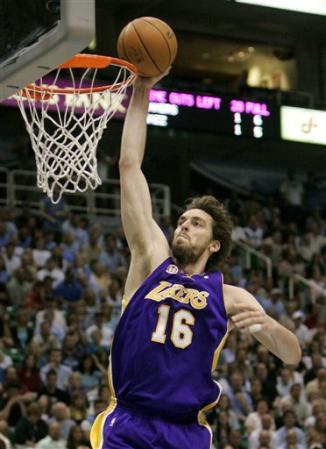
Pau Gasol

(BBR: #85)

You may not think that Pau Gasol deserves to be ranked among the all-time greats, or especially in the top 40, but there was a time that many would have said that about Scottie Pippen as well. The truth is that Pau Gasol brought about a huge change in Los Angeles after he was traded and helped the team regain its winning ways.

When Pau arrived in Los Angeles, Kobe Bryant was already an established superstar, but the Lakers weren't winning with him as their only star. Here are their playoff results in the three years Pre-Pau and Post-Trade:

Pre-Pau - missed playoffs once, lost in first round twice
Post-Trade - Lost in Finals once, won two championships

The difference between the pre- and post-trade results in each season was exactly three playoff series. The only real difference between these teams was the addition of Pau Gasol. Can you really say that he's not a great player? It's obvious to me that Gasol was the catalyst the team needed to advance.

Gasol has been a star player since the day he arrived in America. He has averaged at least 17.6 points in all 10 seasons he's been a pro, and has steadily become a better rebounder, averaging over 10 per game for the past two seasons. In each of the Lakers' title seasons he was one of the six best players in the league, although many overlooked him because he was only the second-best on his team.


English was slightly better than Pau in his prime, but it took him a few years to get going, while Gasol was a star from day one. English's playoff success was nearly nonexistent, while Gasol has been to the promised land three times and brought back two trophies as proof. Their peaks are now nearly the same length, so Gasol's playoff success is enough to push him past English and squeak him into the top 40.

Thursday, August 25, 2011

Top 100 NBA Players: #41


Alex English

(Simmons: #65, BBR: #70)

Alex English has been largely forgotten today, mostly due to his lack of postseason success, but longtime Nuggets fans remember what a great player he was, and he has a place in history that cannot be forgotten.

If you were to ask somebody who the leading scorer of the 1980's was, many would answer with Michael Jordan or Larry Bird, but almost nobody would guess Alex English, but he happens to be the correct answer. He scored 19700 points from 1980 to 1989, averaging at least 23 points per game in every season and leading the league in 1983. His scoring average for the decade was 26.9, an amazing accomplishment that few have ever come close to.

He was more than just a great scorer, however. He averaged 5.7 rebounds per game over that same time period, with a peak of 8.0 in 1981. He also averaged 4.6 assists, and always hovered around that range throughout his career. He shot .511 for the decade from the field and .841 from the free throw line. He was an all-around star.

He also led the Nuggets to nine straight playoff berths, and although he never saw the NBA Finals in his career, he did take Denver to the Western Conference Finals once, averaging over 30 points per game during the 1985 playoffs. While most of the other players who have a good ranking on this list have seen quite a bit of playoff success, English did so much during the regular seasons that he can't be overlooked.


English and Allen each spent a great deal of their careers averaging over 20 points per game, but English did it for a little longer and did it in bigger quantities than Allen. Both led underdog teams to the Conference Finals in their prime years, but Allen had the good fortune of landing on a contending team late in his career and winning a title. What it really comes down to is that English's accomplishment of most points in the 1980's was just a little more impressive than Allen's all-time three-point record.

Saturday, July 2, 2011

Top 100 NBA Players: #94


Fat Lever

(BBR: #188)

Unless you are a die-hard Denver Nuggets fan, you are probably scratching your head right now, but Fat Lever is one of the most underrated players in NBA history. He was Jason Kidd before Kidd was. Some of his statistical achievements have never been matched. Yet most fans don't even know who he is, and he didn't even get the recognition he deserved while he was playing, as evidenced by the fact that he was part of two All-Star teams and one All-NBA team.

Let's start by looking at one of his best seasons, 1988-1989. His stat line that year is one for the ages.

Fat Lever - 19.8 pts, 9.3 reb, 7.9 ast

There are only two other players in NBA history who have matched those totals in any single season, and you may have heard of them. The first was Oscar Robertson, who did it 4 straight seasons from 1961-1964, and the other was Wilt Chamberlain, who accomplished it in 1968. Two all-time greats from the 1960's and Fat Lever, that's it. No LeBron James, no Michael Jordan, no Magic Johnson or Larry Bird. Just Fat Lever has his those numbers in the past 40 years.

If you're thinking that he had a one-hit wonder season that year, you're wrong. That was just part of one of the best 4-year runs in NBA history, which lasted from 1986-87 through 1989-1990. During that stretch his averages look like this:

Fat Lever - 19.1 pts, 8.9 reb, 7.6 ast, 2.5 stl

How many players have reached those totals in a season? Just one. That's right, Fat Lever is the only one who has ever put up those numbers at any point in his career, and those were his 4-season averages. Remember the reference to Jason Kidd earlier? Lever, also a point guard, had the potential to be an even bigger star than Kidd, because he was a better shooter than Kidd ever has been. Lever, with 46 triple-doubles in a Nuggets uniform, is by far their all-time leader, with Dikembe Mutombo coming in a not-so-close second with 8. In fact, only 29 triple-doubles have been recorded in Denver history that weren't credited to Fat Lever.

So why does nobody know who he is? Part of it is probably because he played alongside Alex English, one of the league's best scorers, for his entire career in Denver. Part of it is that his career basically ended right at its peak. After the 1990 season, he was traded to the Dallas Mavericks, where he missed most of his first 3 seasons due to knee injuries before returning for one final season in which he was not the same player as before. He was let go by Dallas in 1994, at which point they drafted the next best thing, Jason Kidd. It also doesn't help that he only played in the Western Conference Finals once in his entire career, and it was a couple of years before he hit his peak.


The things that kept Hornacek close to Lever were his level of playoff success and his longevity, but there is no denying that Lever was the better player. Those four years he posted in the late 1980's were all better than anything Hornacek ever did, and he had six seasons that were better than Horny's second-best overall season. I've even heard a rumor that Lever is the only player ever to record 30 points, 15 rebounds, and 20 assists in a single game. I haven't been able to verify this myself, because old boxscores are hard to find, but I wouldn't doubt that it's true. It's just too bad that it couldn't have lasted longer.