Showing posts with label Ray Allen. Show all posts

Wednesday, August 11, 2021

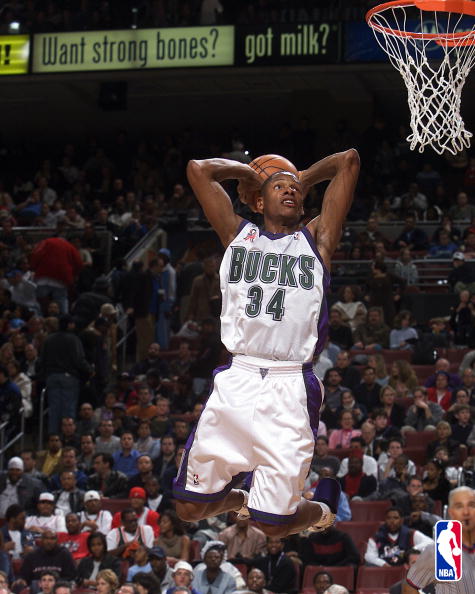
Top 100 NBA Players: #81 - Ray Allen


Ray Allen

Teams

Milwaukee Bucks - 1996-03

Seattle SuperSonics - 2003-07

Boston Celtics - 2007-12

Miami Heat - 2012-14


Playoffs

Appearances - 11 (1999,2000,2001,2005,2008,2009,2010,2011,2012,2013,2014)

Conference Finals - 6 (2001,2008,2010,2012,2013,2014)

NBA Finals - 4 (2008,2010,2013,2014)

Championships - 2 (2008,2013)


Awards and Honors

All-NBA Second Team - 1 (2001,2005)

All-NBA Third Team - 1 (2001,2005)

Hall of Fame - 2018

*(actual in bold, deserved in italics)


All-Time Ranks

Three-Pointers Made - #1

Free Throw Percentage - #6

Total Points - #29

Three-Point Percentage - #48

Total Steals - #54

Total Assists - #98


League Leads

Free Throw Percentage (#2-2003,2009, #3-1998,2006,2010, #4-1999,2004,2007,2008, #5-2000,2013)

Three Pointers Made (#1-2002,2003,2006, #2-2000,2001,2009, #4-2005, #5-2008,2011)

Three Point Percentage (#2-2011, #4-2012)


Ray Allen was a great shooter and scorer at the University of Connecticut, and after being drafted #5 overall in 1996, he became a very good scorer in the NBA, and one of only a handful of players in the conversation for the best shooter of all time.

He was drafted by Minnesota, but immediately traded to Milwaukee for Stephon Marbury, who was drafted right before him. He was named to the All-Rookie Second Team, then quickly improved to become an All-Star within just a few years. In his 4th season, he averaged 22.1 points per game, the first of 8 consecutive seasons where he scored at least 21 per game, and he made his first of 10 All-Star appearances in a 12-year period.

In 2001, he, along with Glenn Robinson and Sam Cassell, led the Bucks to the Eastern Conference Finals, his deepest playoff run to that point, but they fell to Allen Iverson and the 76ers in 7 games, even with Allen scoring 27.1 points per game, including 41 in a big Game 6 win.

The Bucks were not able to replicate that success the next year, and early in 2003 Allen was traded to the Seattle SuperSonics in a deal involving Gary Payton. His 4 full seasons in Seattle were the 4 highest-scoring of his career, but they would only make one playoff appearance, losing in the second round in 2005. After averaging a career-high 26.4 points per game in 2007, but missing the end of the season after double ankle surgery, Allen was traded to the Boston Celtics.

It was in Boston that Allen began to gain his reputation as a clutch playoff performer. In his first season with the Celtics, his scoring average dropped by 9 points per game due to having superstars Paul Pierce and Kevin Garnett as teammates, but Allen stepped up in important moments, like Game 6 of the NBA Finals, when he set a Finals record with 7 three-pointers as they finished the series and he won his first championship.

As great as Allen was as a three-point shooter, he was even better from the free throw line. Although he never led the league in free throw shooting, he was in the top five 11 different times, and currently ranks as the 6th-best free throw shooter of all time. In 2008-09, he hit 72 straight free throws, breaking the Celtics franchise record that was previously held by Larry Bird.

In 2010, Allen would break his own record for most 3-pointers in a Finals game when he hit 8 of them in Game 2, but the Celtics fell to the Lakers in 7 games. In 2011, he passed Reggie Miller to become the all-time leader in three-pointers made, a distinction he still holds, and in 2013 he passed Miller to take over first place in playoff three-pointers, though he has since fallen to third behind Stephen Curry and LeBron James.

Allen finished out his career with 2 seasons in Miami, where he won another championship in 2013 after hitting one of the greatest 3-pointers in playoff history to tie game 6 in the closing seconds, and making a 4th Finals appearance in his final season, this time losing to the Spurs in 5 games. Allen considered returning to the league several time over the next few seasons, but eventually made his retirement official in 2016.

Allen never had a ton of rebounds or assists in his career, never reaching 6 rebounds or 5 assists per game in any season of his career. He was primarily a shooter and a scorer, but he was great at what he did. He is among the all-time leaders in both three-point and free throw percentage, with career averages of .400 and .894, which are both amazing numbers, and made important contributions to 2 title teams late in his career, which makes him one of the greatest players of all time.


Monday, August 29, 2016

Top 100 NBA Players: #33 - Paul Pierce


Paul Pierce

Paul Pierce is best known today as a member of Boston's "Big Three," the three superstars that were brought together in 2007 and brought a championship to Boston in 2008, and he's also known as the one chosen from among those three to win the Finals MVP Award that season, which leads many to believe that before the arrival of Garnett and Allen that Pierce and the Celtics couldn't win, but that isn't exactly true.

Pierce hit his peak as a player from 2001-2003, back when Antoine Walker was also playing in Boston, and the Celtics were actually a pretty good team. They won playoff series in both of those seasons, and even reached the Eastern Conference Finals in 2002, with Pierce as the team leader. Here are his combined stats from those two seasons:

Pierce - 26.0 pts, 7.1 reb, 3.8 ast, 1.8 stl, 0.9 blk, .429 FG%, .360 3P%, .805 FT%

Other than the field goal percentage, which was pretty low even for a guard, Pierce was great all-around. He did manage to improve his shooting over the course of the next 11 seasons, and he kept most of the other numbers relatively close to that level for as long as he stayed in Boston.

He remained one of the better players in the league for the next few seasons, but the Celtics started to slide, so they picked up a couple of stars to help share the load, and the result was their first title in two decades. Pierce was named the MVP of the Finals, but Kevin Garnett should have won it, as the numbers from that year's playoffs show:

Garnett - 20.4 pts, 10.5 reb, 3.3 ast, 1.3 stl, 1.1 blk, .495 FG%, .810 FT%
Pierce - 19.7 pts, 5.0 reb, 4.6 ast, 1.1 stl, 0.3 blk, .441 FG%, .802 FT%

A quick glance at those numbers shows that Garnett was by far the better player, performing better in every key category but one, assists, and that one was pretty close. I believe the reason Pierce won was his "comeback" from a "major injury" in game 1, which exhibited worse acting than a lot of reality shows. He couldn't even get up and walk off the court, but just minutes later he was back and scored 15 points in the third quarter to lead them to victory.

In 2010 Boston made another trip to the Finals, and people once again talked as if Pierce was the star of that team and the driving force behind it, but I showed earlier in my article about Rajon Rondo (#58) that the star power of the team had shifted to the point guard position. That's not to say the Pierce wasn't important on those Finals teams, because any team needs at least two stars to get to the Finals in today's league, and Pierce was one of them on both of those teams.

Friday, August 12, 2016

Top 100 NBA Players: #53 - Ray Allen


Ray Allen

Today Ray Allen is best remembered as a 3-point marksman who spent the end of his career chasing rings, but it's easy to forget that before he was traded to Boston he had already established himself as one of the best players in the league. In 2001, he was already the star of the Milwaukee Bucks, despite having veteran stars Sam Cassell and Glenn Robinson on the roster. Here are his stats from that season:

Allen - 22.0 pts, 5.2 reb, 4.6 ast, 1.5 stl, .480 FG%, .433 3P%, .888 FT%

That season he also led the Bucks to the Eastern Conference Finals, where they fell to Allen Iverson and the 76ers, but there's no way they would have made it that far without Allen, who improved in almost every category in the playoffs, averaging 25.1 points, 4.1 rebounds, 6.0 assists, and shot nearly 48% from long range and 92% from the free throw line.

Ray Allen scored at least 20 points per game for 8 straight seasons in the prime of his career, peaking out at 26.4 in 2007, his final season with Seattle. Allen is also known as one of the best free throw shooters of all time, ranking 7th all-time currently with a 89.4% mark.

Allen also holds a record that looked untouchable for a while, the all-time lead in three-pointers made. When Reggie Miller retired in 2005, he had 2560 career 3-pointers, while Allen had totaled only 1486 to that point, leaving him more than 1000 behind. What did Allen do the next season? He set a new NBA record for three-pointers made in a season with 269 and led the league for the 3rd time in his career, cutting into Miller's huge lead and making it seem like it would only be a matter of time until he broke the record, which he did in February of 2011.

Allen finally saw the NBA Finals in 2008, when he helped the Celtics win their first championship in two decades. He was not the star of the team, but he was the third-best player while playing better than most teams' #2 guys. He also made a return trip to the Finals two years later, although his role had diminished a little bit more. He did get another championship ring in 2013 in Miami, although he had just a minor role in that title.

Though he is more remembered for 3-point shooting today, Allen was a superstar and very solid all-around player for years before accepting a reduced role in order to win. Although his 3-point record may eventually fall to Stephen Curry, he should still have it for at least the next 4 seasons, since Curry is almost 1400 three-pointers behind today.

Saturday, August 6, 2016

Top 100 NBA Players: #58 - Rajon Rondo


Rajon Rondo

Rondo is one of the youngest player to appear on this list so far, and you may wonder if he has done enough in his short career to merit his placement among the all-time greats, especially with his performance over the past few seasons. He may not have a huge list of career accomplishments, but what he did in Boston was pretty impressive.

First of all, he has already won a championship as a starting point guard in 2008. During that season he may have been overshadowed by the "Big Three" of Kevin Garnett, Paul Pierce, and Ray Allen, but he wasn't far behind them in playoff production. He had more steals and assists than any other player to appear in the playoffs that year, and it quickly became clear that the Celtics were more than just 3 players.

The following season, despite only making it to the second round, he once again had the most playoff assists of any player. That season he was the best player on the Celtics in the postseason, boosting his averages to 16.9 points, 9.7 rebounds, 9.8 assists, and 2.5 steals. In 2010, he was the best playoff player for the Celtics once again, and he led them all the way back to the NBA Finals. Look at the playoff numbers for the four Celtics stars that year.

Rondo - 15.8 pts, 5.6 reb, 9.3 ast, 1.9 stl
Garnett - 15.0 pts, 7.4 reb, 2.5 ast, 1.1 stl
Pierce - 18.8 pts, 6.0 reb, 3.4 ast, 1.0 stl
Allen - 16.1 pts, 3.3 reb, 2.6 ast, 0.9 stl

Rondo was scoring and rebounding just as much as his bigger teammates, had more steals than any of them, and had more assists than all three of them combined. During the regular season he was named to the All-Defensive First Team and should have been named to the All-NBA Second Team. 

Two years later he led the Celtics back to the Eastern Conference Finals one more time, despite Garnett and Pierce continuing to get more accolades. They went clear to game 7 that year in the conference finals, but LeBron James and the Heat kept them from making another Finals appearance. If you doubt that Rondo was the best player on the team that postseason, here are the stats from that year's playoffs:

Rondo - 17.3 pts, 6.7 reb, 11.9 ast, 2.4 stl
Garnett - 19.2 pts, 10.3 reb, 1.5 ast, 1.2 stl
Pierce - 18.9 pts, 6.1 reb, 3.1 ast, 1.5 stl

As you can see, Rondo was a major reason that the Celtics were able to be so good for those 5 seasons, even performing better than the so-called Big 3 for most of that time. Even though he hasn't been the same player since the Celtics broke up the team, he did lead the league in assists again this past season, and maybe a fresh start in Chicago will help get his career back on track.

Monday, September 5, 2011

Top 100 NBA Players: #33


Paul Pierce

(Simmons: #54, BBR: #43)

Paul Pierce is best known today as a member of Boston's "Big Three," the three superstars that were brought together in 2007 and brought a championship to Boston in 2008, and he's also known as the one chosen from among those three to win the Finals MVP Award that season, which leads many to believe that before the arrival of Garnett and Allen that Pierce and the Celtics couldn't win, but that isn't exactly true.

Pierce hit his peak as a player from 2001-2003, back when Antoine Walker was also playing in Boston, and the Celtics were actually a pretty good team. They won playoff series in both of those seasons, and even reached the Eastern Conference Finals in 2002, with Pierce as the team leader. Here are his combined stats from those two seasons:

Pierce - 26.0 pts, 7.1 reb, 3.8 ast, 1.8 stl, 0.9 blk, .429 FG%, .360 3P%, .805 FT%

Other than the field goal percentage, which was pretty low even for a guard, Pierce was great all-around. He has managed to improve his shooting over the course of the past 8 seasons, and he has kept most of the other numbers relatively close to that level.

He remained one of the better players in the league for the next few seasons, but the Celtics started to slide, so they picked up a couple of stars to help share the load, and the result was their first title in two decades. Pierce was named the MVP of the Finals, but Kevin Garnett should have won it, as the numbers from that year's playoffs show:

Garnett - 20.4 pts, 10.5 reb, 3.3 ast, 1.3 stl, 1.1 blk, .495 FG%, .810 FT%
Pierce - 19.7 pts, 5.0 reb, 4.6 ast, 1.1 stl, 0.3 blk, .441 FG%, .802 FT%

A quick glance at those numbers shows that Garnett was by far the better player, performing better in every key category but one, assists, and that one was pretty close. I believe the reason Pierce won was his "comeback" from a "major injury" in game 1, which exhibited worse acting than a lot of reality shows. He couldn't even get up and walk off the court, but just minutes later he was back and scored 15 points in the third quarter to lead them to victory.

In 2010 Boston made another trip to the Finals, and people once again talked as if Pierce was the star of that team and the driving force behind it, but I showed earlier in my article about Rajon Rondo (#84) that the star power of the team had shifted to the point guard position. That's not to say the Pierce wasn't important on those Finals teams, because any team needs at least two stars to get to the Finals in today's league, and Pierce was one of them on both of those teams.


Pierce has a couple of real advantages over Gervin, the first being his ability to win in the playoffs, which Gervin didn't have, and the other being his longevity, which escaped the Spurs superstar, who left the NBA in his early 30's. Pierce was never the best player in the league, but he did make the top 5 in his fourth season, and he's remained a star in all but one of his seasons since, even playing at an All-Star level this season, at an age when Gervin was already gone.

Thursday, August 25, 2011

Top 100 NBA Players: #41


Alex English

(Simmons: #65, BBR: #70)

Alex English has been largely forgotten today, mostly due to his lack of postseason success, but longtime Nuggets fans remember what a great player he was, and he has a place in history that cannot be forgotten.

If you were to ask somebody who the leading scorer of the 1980's was, many would answer with Michael Jordan or Larry Bird, but almost nobody would guess Alex English, but he happens to be the correct answer. He scored 19700 points from 1980 to 1989, averaging at least 23 points per game in every season and leading the league in 1983. His scoring average for the decade was 26.9, an amazing accomplishment that few have ever come close to.

He was more than just a great scorer, however. He averaged 5.7 rebounds per game over that same time period, with a peak of 8.0 in 1981. He also averaged 4.6 assists, and always hovered around that range throughout his career. He shot .511 for the decade from the field and .841 from the free throw line. He was an all-around star.

He also led the Nuggets to nine straight playoff berths, and although he never saw the NBA Finals in his career, he did take Denver to the Western Conference Finals once, averaging over 30 points per game during the 1985 playoffs. While most of the other players who have a good ranking on this list have seen quite a bit of playoff success, English did so much during the regular seasons that he can't be overlooked.


English and Allen each spent a great deal of their careers averaging over 20 points per game, but English did it for a little longer and did it in bigger quantities than Allen. Both led underdog teams to the Conference Finals in their prime years, but Allen had the good fortune of landing on a contending team late in his career and winning a title. What it really comes down to is that English's accomplishment of most points in the 1980's was just a little more impressive than Allen's all-time three-point record.

Wednesday, August 24, 2011

Top 100 NBA Players: #42


Ray Allen

(Simmons: #63, BBR: #56)

Right not you're probably thinking, "Are you seriously putting Ray Allen ahead of Isiah Thomas?" Yes, I am. It may not seem like a logical choice at first glance, but Allen spent a number of years as a superstar before moving into his current role as a shooter in Boston.

First let's look at the top season for each player. Isiah Thomas reached his peak in his 4th season (1985), while Allen took 5 years to reach the top. Thomas was a point guard and Allen a shooting guard, so Thomas obviously had the edge in assists, but look at all the other stats:

Thomas - 21.2 pts, 4.5 reb, 13.9 ast, 2.3 stl, .458 FG%, .257 3P%, .809 FT%
Allen - 22.0 pts, 5.2 reb, 4.6 ast, 1.5 stl, .480 FG%, .433 3P%, .888 FT%

Thomas had a big edge in assists and a slight edge in steals, but Allen had a huge edge in all of the shooting percentages and a slight lead in scoring and rebounding. I still think that Thomas' season was a little better, but it's hard to say that Allen doesn't belong in the same league as Thomas when you compare their peaks.

Ray Allen scored at least 20 points per game for 8 straight seasons in the prime of his career, peaking out at 26.4 in 2007, his final season with Seattle. Thomas scored over 20 for just 5 straight seasons, never reaching that mark after the age of 25. Allen is also known as one of the best free throw shooters of all time, and it's interesting to note that his worst season from the line (.823 when he was a rookie) was still better than Thomas' best (.818 in 1989).

Allen also holds a record that looked untouchable for a while, the all-time lead in three-pointers made. When Reggie Miller retired in 2005, he had 2560 career 3-pointers, while Allen had totaled only 1486 to that point, leaving him more than 1000 behind. What did Allen do the next season? He set a new NBA record for three-pointers made in a season and led the league for the 3rd time in his career, cutting into Miller's huge lead and making it seem like it would only be a matter of time until he broke the record, which he did in February of this year.

In 2001, Ray Allen had established himself as the star of the Milwaukee Bucks, despite having veteran stars Sam Cassell and Glenn Robinson on the roster, and he led the Bucks to the Eastern Conference Finals, where they fell to Allen Iverson and the 76ers, but there's no way they would have made it that far without Allen, who improved in almost every category in the playoffs, averaging 25.1 points, 4.1 rebounds, 6.0 assists, and shot nearly 48% from long range and 92% from the free throw line.

Allen finally saw the NBA Finals in 2008, when he helped the Celtics win their first championship in two decades. He was not the star of the team, but he was the third-best player while playing better than most teams' #2 guys. He also made a return trip to the Finals two years later, although his role had diminished a little bit more.


Isiah Thomas had more playoff success than Ray Allen, and a bigger role in that success, but his career ended much earlier than Allen's. Thomas was only relevant for 8 seasons, while Allen has kept himself playing at a star level for 13 full seasons, playing just as well at age 35 as he did at age 26. Taking the career lead in three-pointers and winning a title just cemented his legacy and moved him ahead of Thomas.