Showing posts with label Isiah Thomas. Show all posts

Sunday, September 26, 2021

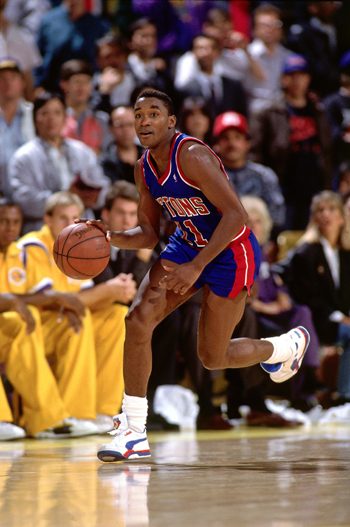
Top 100 NBA Players: #35 - Isiah Thomas


Isiah Thomas

Teams

Detroit Pistons - 1981-94


Playoffs

Appearances - 9 (1984,1985,1986,1987,1988,1989,1990,1991,1992)

Conference Finals - 5 (1987,1988,1989,1990,1991)

NBA Finals - 3 (1988,1989,1990)

Championships - 2 (1989,1990)


Awards and Honors

Rookie of the Year - 1982

Finals MVP - 1 (1989,1990)

All-NBA First Team - 3 (1984,1985,1986,1987)

All-NBA Second Team - 2 (1983,1987,1988)

All-NBA Third Team - 0 (1983,1989,1990)

Hall of Fame - 2000

*(actual in bold, deserved in italics)


All-Time Ranks

Assists Per Game - #5

Total Assists - #9

Total Steals - #18

Steals Per Game - #24

Total Points - #69

Points Per Game - #89


League Leads

Total Assists (#1-1984,1985, #2-1986, #4-1987, #5-1983,1990)

Assists Per Game (#1-1985, #2-1984,1986, #3-1987)

Total Steals (#2-1983,1984, #5-1985)

Steals Per Game (#2-1984, #4-1983)

Three-Point Percentage (#2-1983)

Three Pointers Made (#4-1983)


After leading Indiana to a national championship and winning the Tournament's Most Outstanding Player award as a sophomore while averaging 16.0 points and 5.8 assists per game, Isiah Thomas was drafted by the Detroit Pistons with the #2 overall pick in the draft.

Thomas averaged 17.0 points, 7.8 assists, and 2.1 steals as a rookie and was named to the All-Rookie First Team, but somehow didn't receive a single vote for Rookie of the Year, which went to Buck Williams, who averaged 15.5 points and 12.3 rebounds. He was selected as a starter in the All-Star Game, a rarity for a rookie.

Thomas had his highest-scoring season in year 2, when he put in 22.9 points per game to go with his 7.8 assists and 2.5 steals per game. Detroit still wasn't good enough to make the playoffs, but that would change the next year, and they would make it to the postseason in each of the next 9 seasons.

The next year Thomas made the All-NBA First Team and led the league in total assists, though his average came in second, and led the Pistons to the playoffs. In the deciding Game 5 of the first round, he scored 16 points in the final 94 seconds of regulation to force the game into overtime, but they ended up falling short in the extra period.

In 1984-85 Thomas had his best individual season by far. He led the league in assists with 13.9 per game, while also scoring 21.2 points and grabbing 2.3 steals per game. The Pistons were able to make it one step farther in the playoffs, falling to the Celtics in the second round.

Thomas averaged at least 20 points and 10 assists in each of the next two seasons as well, making it 4 in a row, and he helped the Pistons reach the Conference Finals, the farthest the Pistons had made it in the playoffs since arriving in Detroit. They fell to the Celtics again, but they were making progress.

Thomas' personal statistics dipped just slightly over the next several seasons, but those were the most successful seasons of his career. In 1988 he led the Pistons to the NBA Finals, where they faced the Lakers, and after taking a 3-2 lead, Thomas sprained his ankle in Game 6, but still managed to score 25 points in the third quarter alone, setting the Finals record for a quarter. Unfortunately, the Lakers won that game and the next to take the series in 7 games.

The following season, Detroit had the best record in the NBA, and after knocking off Michael Jordan and the Chicago Bulls in the Conference Finals, they got a rematch with LA in the Finals, but this time they swept the defending champs. Thomas averaged 21.3 points and 7.3 assists in the Finals, but the Finals MVP went to Joe Dumars, who averaged 27.3 points in the Finals.

The next season was more of the same, with Detroit taking the #1 seed, then knocking off Jordan and the Bulls in the Conference Finals again, before coming home with another championship, this time over Clyde Drexler and the Trail Blazers, with Thomas winning the Finals MVP with averages of 27.6 points, 7.0 assists, and 5.2 rebounds.

Thomas missed 33 games the next season with a wrist injury, but the Pistons were still a strong team, and they reached the Conference Finals for the 5th year in a row, but this time they weren't as strong as Chicago, who swept the 2-time defending champs to end their quest for a threepeat.

Thomas and the Pistons started to slowly decline from that point, not winning another playoff series in his career, and after he tore his Achilles tendon late in the 1994 season, he decided that the time had come to retire after 13 seasons.

Thomas had a quick rise to the top tier of players in the league, and had 4 straight seasons of finishing in the top 3 in assists, including one outright assists title. His team got better as he took a slight step back statistically over the next several years, but he was still the best player on the Pistons through both of their title runs and their other 3 deep playoff runs during that time, and he belongs here near the top of the list of the best players in history.


Wednesday, August 17, 2016

Top 100 NBA Players: #47 - Isiah Thomas


Isiah Thomas

Isiah Thomas' name today is often synonymous with failure, due to his disastrous stints as coach and GM with multiple teams over the past several years and sexual harassment allegations, but in his playing days, he was one of the top players out there, and a great playoff performer.

Isiah was a great player right from the beginning of his career. He averaged 17 points as a rookie, then scored a career high 22.9 points per game the next season. Even with a small dip in scoring average over the next few seasons, he continued to improve, reaching his peak at age 23, when he put up the following stat line:

Thomas - 21.2 pts, 4.5 reb, 13.9 ast, 2.3 stl, .458 FG%, .809 FT%

His assist average that season led the entire league, and was the second of four straight seasons in which he averaged over 10 per game and finished in the top 3 overall. He averaged over 20 points per game for five straight seasons, and also averaged over 2 steals per game for 5 straight years.

What made Isiah great was that he was willing to sacrifice those big numbers in order to help the Pistons become winners. Starting in 1986-87, Detroit made it to four straight Eastern Conference Finals, which included three straight NBA Finals. Detroit was the winner of two straight championships, and Thomas was the star on both of those teams, but he was passed over for the Finals MVP in 1989 in favor of Joe Dumars, who was a little more fan-friendly. Here are the stats for the team's two starting guards:

Thomas - 18.2 pts, 4.3 reb, 8.3 ast, 1.6 stl, .412 FG%, .740 FT%
Dumars - 17.6 pts, 2.6 reb, 5.6 ast, 0.7 stl, .455 FG%, .861 FT%

The only way that Dumars was superior was in his shooting percentages, which shouldn't be enough to justify him taking the Finals MVP away from Thomas. Thomas was also the best player on the Pistons team that lost to Los Angeles in 1988, which means he was the best player on three straight Finals teams. There aren't a lot of players who can say that.

Thomas earns points both for being a star player early in his career and a winner later in his career, which allows him to rank pretty high on the all-time list, but his best years did not coincide with the years his team was winning, although he was still very good when the Pistons became champs. There are so many great players who had higher peaks, longer peaks, or more time as a winner, but Thomas had a bit of everything in his career.

Monday, July 4, 2016

Top 100 NBA Players: #94 - Kevin Johnson


Kevin Johnson

Kevin Johnson may be remembered most for the injury-plagued seasons that filled the latter half of his career, but many may have forgotten that, once upon a time, he was one of the greatest point guards to ever take the court. Don't believe me? Let's look at a few of the things KJ did that few others have ever done.

Kevin Johnson is one of only three players ever to average over 20 points and 10 assists in three straight seasons. The other two players are guys you've probably heard of: Oscar Robertson and Isiah Thomas. He is one of only two players to average over 20 points and 12 assists while shooting over 50% from the field in a season. The other is Magic Johnson (no relation).

There are all sorts of variations of these stats that you can come up with that only those four players had ever accomplished, and the only players in the past 20 years to come close to those numbers are Chris Paul and Russell Westbrook. During just his second season in the NBA, he was named the league's Most Improved Player and made the All-NBA Second Team because of these numbers:

Johnson - 20.4 pts, 4.2 reb, 12.2 ast, 1.7 stl, .505 FG%, .882 FT%

You have to remember that KJ was not a big man, only 6-1 and 190 pounds, but he was still grabbing 4 rebounds and shooting over 50% from the field. But if KJ was so great, why is he ranked this low? The problem started in the 1992-93 season, when he missed 33 games with various injuries, mostly to his hamstrings. From then on, he never played more than 70 games in a season, and he only reached the 20-ppg plateau two more times.

Johnson saw his teams make it at least to the Conference Finals three times during his career, including two trips to the Western Conference Finals in his second and third seasons, when he was either the best or second-best Sun. In 1993 the Suns made it to the NBA Finals, and he was probably the #3 player on that team, behind Dan Majerle and Charles Barkley. He did set a Finals record during game 3, when he played 62 minutes (out of 63 possible) in the triple overtime victory over Chicago.

What KJ accomplished early in his career was truly historic, and that alone would be enough for me to put him in this top 100, but it's sad that it didn't continue for longer. If he had just had the durability of Steve Nash, we might be talking about him as one of the top 3 point guards of all time, but instead he has to settle for a spot closer to the bottom of the top 100.

Wednesday, August 24, 2011

Top 100 NBA Players: #42


Ray Allen

(Simmons: #63, BBR: #56)

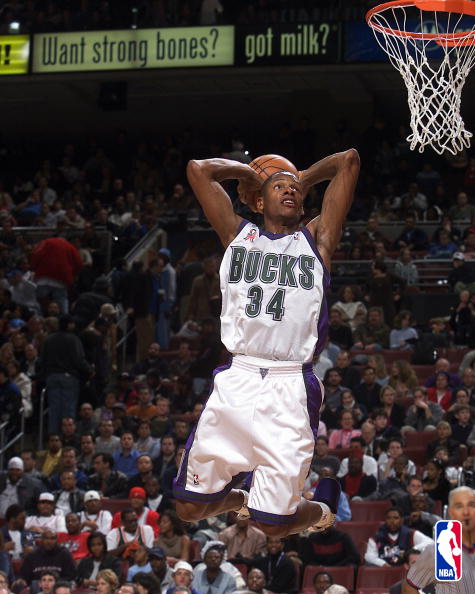
Right not you're probably thinking, "Are you seriously putting Ray Allen ahead of Isiah Thomas?" Yes, I am. It may not seem like a logical choice at first glance, but Allen spent a number of years as a superstar before moving into his current role as a shooter in Boston.

First let's look at the top season for each player. Isiah Thomas reached his peak in his 4th season (1985), while Allen took 5 years to reach the top. Thomas was a point guard and Allen a shooting guard, so Thomas obviously had the edge in assists, but look at all the other stats:

Thomas - 21.2 pts, 4.5 reb, 13.9 ast, 2.3 stl, .458 FG%, .257 3P%, .809 FT%
Allen - 22.0 pts, 5.2 reb, 4.6 ast, 1.5 stl, .480 FG%, .433 3P%, .888 FT%

Thomas had a big edge in assists and a slight edge in steals, but Allen had a huge edge in all of the shooting percentages and a slight lead in scoring and rebounding. I still think that Thomas' season was a little better, but it's hard to say that Allen doesn't belong in the same league as Thomas when you compare their peaks.

Ray Allen scored at least 20 points per game for 8 straight seasons in the prime of his career, peaking out at 26.4 in 2007, his final season with Seattle. Thomas scored over 20 for just 5 straight seasons, never reaching that mark after the age of 25. Allen is also known as one of the best free throw shooters of all time, and it's interesting to note that his worst season from the line (.823 when he was a rookie) was still better than Thomas' best (.818 in 1989).

Allen also holds a record that looked untouchable for a while, the all-time lead in three-pointers made. When Reggie Miller retired in 2005, he had 2560 career 3-pointers, while Allen had totaled only 1486 to that point, leaving him more than 1000 behind. What did Allen do the next season? He set a new NBA record for three-pointers made in a season and led the league for the 3rd time in his career, cutting into Miller's huge lead and making it seem like it would only be a matter of time until he broke the record, which he did in February of this year.

In 2001, Ray Allen had established himself as the star of the Milwaukee Bucks, despite having veteran stars Sam Cassell and Glenn Robinson on the roster, and he led the Bucks to the Eastern Conference Finals, where they fell to Allen Iverson and the 76ers, but there's no way they would have made it that far without Allen, who improved in almost every category in the playoffs, averaging 25.1 points, 4.1 rebounds, 6.0 assists, and shot nearly 48% from long range and 92% from the free throw line.

Allen finally saw the NBA Finals in 2008, when he helped the Celtics win their first championship in two decades. He was not the star of the team, but he was the third-best player while playing better than most teams' #2 guys. He also made a return trip to the Finals two years later, although his role had diminished a little bit more.


Isiah Thomas had more playoff success than Ray Allen, and a bigger role in that success, but his career ended much earlier than Allen's. Thomas was only relevant for 8 seasons, while Allen has kept himself playing at a star level for 13 full seasons, playing just as well at age 35 as he did at age 26. Taking the career lead in three-pointers and winning a title just cemented his legacy and moved him ahead of Thomas.

Monday, August 22, 2011

Top 100 NBA Players: #43


Isiah Thomas

(Kalb: #25, Simmons: #23, BBR: #26)

Isiah Thomas' name today is often synonymous with failure, due to his disastrous stints as coach and GM with multiple teams over the past several years, but in his playing days, he was one of the top players out there, and a great playoff performer.

Isiah was a great player right from the beginning of his career. He averaged 17 points as a rookie, then scored a career high 22.9 points per game the next season. Even with a small dip in scoring average over the next few seasons, he continued to improve, reaching his peak at age 23, when he put up the following stat line:

Thomas - 21.2 pts, 4.5 reb, 13.9 ast, 2.3 stl, .458 FG%, .809 FT%

His assist average that season led the entire league, and was the second of four straight seasons in which he averaged over 10 per game and finished in the top 3 overall. He averaged over 20 points per game for five straight seasons, and also averaged over 2 steals per game for 5 straight years.

What made Isiah great was that he was willing to sacrifice those big numbers in order to help the Pistons become winners. Starting in 1986-87, Detroit made it to four straight Eastern Conference Finals, which included three straight NBA Finals. Detroit was the winner of two straight championships, and Thomas was the star on both of those teams, but he was passed over for the Finals MVP in 1989 in favor of Joe Dumars, who was a little more fan-friendly. Here are the stats for the team's two starting guards:

Thomas - 18.2 pts, 4.3 reb, 8.3 ast, 1.6 stl, .412 FG%, .740 FT%
Dumars - 17.6 pts, 2.6 reb, 5.6 ast, 0.7 stl, .455 FG%, .861 FT%

The only way that Dumars was superior was in his shooting percentages, which shouldn't be enough to justify him taking the Finals MVP away from Thomas. Thomas was also the best player on the Pistons team that lost to Los Angeles in 1988, which means he was the best player on three straight Finals teams. There aren't a lot of players who can say that.

Thomas earns points both for being a star player early in his career and a winner later in his career, which allows him to rank pretty high on the all-time list, but his best years did not coincide with the years his team was winning, although he was still very good when the Pistons became champs. There are so many great players who had higher peaks, longer peaks, or more time as a winner, but Thomas had a bit of everything in his career.


Thomas and Schayes were the top players on exactly three NBA Finalists each, with Thomas getting a slight edge due to his team winning the title twice. Thomas reached a higher peak than Schayes early in his career, but also faded much more quickly, which balances out. The edge goes to Isiah because of his playoff heroics and his great early years, which make him much more memorable than Schayes.

Monday, July 25, 2011

Top 100 NBA Players: #70


Kevin Johnson

(Simmons: #93, BBR: #90)

Kevin Johnson may be remembered most for the injury-plagued seasons that filled the latter half of his career, but many may have forgotten that, once upon a time, he was one of the greatest point guards to ever take the court. Don't believe me? Let's look at a few of the things KJ did that few others have ever done.

Kevin Johnson is one of only three players ever to average over 20 points and 10 assists in three straight seasons. The other two players are guys you've probably heard of: Oscar Robertson and Isiah Thomas. He is one of only two players to average over 20 points and 12 assists while shooting over 50% from the field in a season. The other is Magic Johnson (no relation).

There are all sorts of variations of these stats that you can come up with that only those four players had ever accomplished, and the only player in the past 20 years to come close to those numbers is Chris Paul. During just his second season in the NBA, he was named the league's Most Improved Player and made the All-NBA Second Team because of these numbers:

Johnson - 20.4 pts, 4.2 reb, 12.2 ast, 1.7 stl, .505 FG%, .882 FT%

You have to remember that KJ was not a big man, only 6-1 and 190 pounds, but he was still grabbing 4 rebounds and shooting over 50% from the field. But if KJ was so great, why is he ranked this low? The problem started in the 1992-93 season, when he missed 33 games with various injuries, mostly to his hamstrings. From then on, he never played more than 70 games in a season, and he only reached the 20-ppg plateau two more times.

Johnson saw his teams make it at least to the Conference Finals three times during his career, including two trips to the Western Conference Finals in his second and third seasons, when he was either the best or second-best Sun. In 1993 the Suns made it to the NBA Finals, and he was probably the #3 player on that team, behind Dan Majerle and Charles Barkley. He did set a Finals record during game 3, when he played 62 minutes (out of 63 possible) in the triple overtime victory over Chicago.

What KJ accomplished early in his career was truly historic, and that alone would be enough for me to put him in this top 100, but it's sad that it didn't continue for longer. If he had just had the durability of Steve Nash, we might be talking about him as one of the top 3 point guards of all time, but instead he has to settle for a spot closer to the bottom of the top 100.


Johnson had almost exactly the same playoff career as Latrell Sprewell, but he had a couple of seasons early in his career that Sprewell could only have dreamed of. KJ's career ended a little bit sooner, but what he did early on was enough to put him ahead of Latrell.