Showing posts with label Dolph Schayes. Show all posts

Thursday, September 16, 2021

Top 100 NBA Players: #45 - Dolph Schayes


Dolph Schayes

Teams

Syracuse Nationals/Philadelphia 76ers - 1949-64


Playoffs

Appearances - 14 (1950,1951,1952,1953,1954,1955,1956,1957,1958,1959,1960,1961,1962,1963)

Conference Finals - 9 (1950,1951,1952,1954,1955,1956,1957,1959,1961)

NBA Finals - 3 (1950,1954,1955)

Championships - 1 (1955)


Awards and Honors

All-NBA First Team - 6 (1950,1951,1952,1953,1954,1955,1957,1958)

All-NBA Second Team - 6 (1950,1951,1952,1956,1959,1960,1961)

Finals MVP - 0 (1955)

Hall of Fame - 1973


All-Time Ranks

Rebounds Per Game - #18

Total Rebounds - #30

Free Throw Percentage - #68

Total Points - #73


League Leads

Total Rebounds (#1-1951, #3-1953,1957, #4-1955,1956,1958, #5-1952,1954,1959,1960)

Free Throw Percentage (#1-1958,1960,1962, #2-1954,1956,1957,1959,1961, #3-1953,1955)

Rebounds Per Game (#1-1951, #4-1953,1955,1957,1958, #5-1952,1954,1956,1959)

Points Per Game (#2-1958, #4-1957, #5-1950,1953,1956)

Total Points (#2-1958, #3-1957, #5-1953,1956)

Assists Per Game (#5-1950)


Dolph Schayes started college at age 16, attending NYU, and during his freshman season led the team to the championship game. He graduated when he was 20 with a degree in aeronautical engineering, and was drafted by the New York Knicks of the BAA and the Tri-Cities Blackhawks of the NBL, who traded him to the Syracuse Nationals, where he decided to sign.

During his rookie season in the NBL, Schayes was named the Rookie of the Year, and the NBL and BAA merged after the season to become the NBA. In the first season of the official NBA, Schayes, a power forward, finished #5 in the league in assists and led the Nationals to the Finals, knocking off the Knicks in the Conference Finals before falling to the Minneapolis Lakers in the Finals.

In his second NBA season, the first season in which rebounds were recorded, Schayes led the league with 16.4 per game. The team barely made the playoffs, but pulled off an upset over the top-seeded Warriors to advance to the Conference Finals again, where they fell to the Knicks in a rematch.

Despite his numbers dipping the next year, Schayes made his first All-NBA First Team the next year after leading the Nationals to the best record in the East. They faced the Knicks in the Eastern Finals for the third year in a row, this time losing to their cross-state rivals again.

In 1954, Schayes was finally able to lead the Nationals back to the Finals, where they met the Lakers once again. The teams alternated wins throughout the series, but Schayes struggled, averaging only 9.3 points per game, and they lost the Finals in 7 games.

They finally broke through the next year. Schayes averaged 18.5 points per game, his best up to that point in his career, along with 12.3 rebounds, and led the Nationals back to the NBA Finals, where they knocked off the Fort Wayne Pistons behind 19 points per game from Schayes. The Finals MVP award did not exist at the time, but if it did, Schayes would have been the easy winner.

The Nationals made the playoffs as the result of a tiebreaker the next year, but still advanced to the Eastern Finals, but this time the Philadelphia Warriors prevented them from reaching their 3rd straight Finals. In 1957-58, he scored a career-high 24.9 per game, grabbed 14.2 rebounds, and led the league in free throw shooting with a .904 average. He would lead the league in free throw shooting 2 more times, in 1960 and 1962, pretty impressive for a power forward.

Schayes was the league's original iron man, playing in 706 straight games between 1952 and 1961 without sitting out. He was the first player in league history to reach 15000 points, but had fallen behind Bob Pettit by the time he retired. After the 1963 season, the team moved to Philadelphia and became the 76ers, and Schayes was named player-coach, though he hardly used himself as a player and retired after that season. He coached the team for 3 more years and won a Coach of the Year award before being fired for failing to reach the Finals.

Schayes was one of the league's first dominant big men, though he was often overshadowed by George Mikan, who played at the same time and won 5 championships, but Schayes was able to lead his team to the Finals 3 times and was the best player on a championship team as well. He was a league rebounding and free throw percentage leader, and never missed the playoffs in his career, though he did not play in the playoffs in his final season. Even though it's been more than 50 years since he retired, Schayes is still one of the greatest to ever play the game.


Monday, September 12, 2016

Top 100 NBA Players: #16 - George Mikan


George Mikan

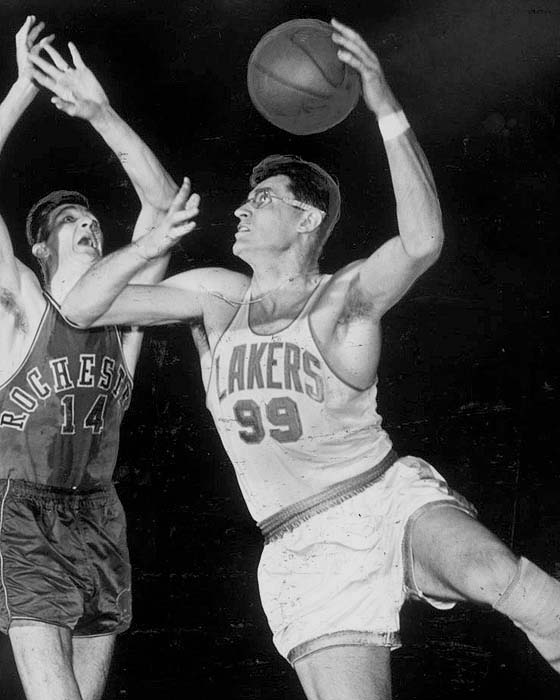
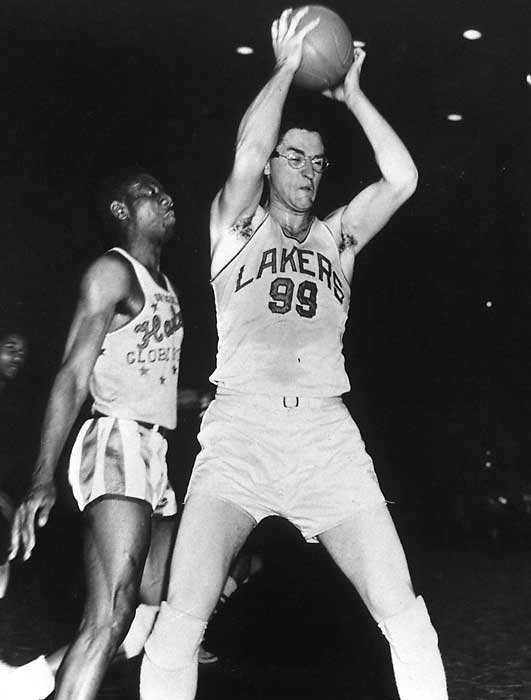
George Mikan is probably the most difficult player to place within any countdown of the greatest players of all time, but any list that doesn't contain him is absolutely flawed. Mikan dominated the league in an era where the game was played very differently, and he is the reason for many rule changes that we recognize today as integral parts of the game.

In Mikan's first three seasons, he led the NBA in scoring, scoring over 27 points per game over 3 straight seasons, while only a couple of other players were even reaching the 20-point plateau. The MVP award did not exist in his day, but if it did, his name would have been permanently etched on it. Here are his stats from his first three seasons compared to those of the second-best players in each of those seasons:

Mikan (1949) - 28.3 pts, 3.6 ast, .416 FG%, .772 FT%
Fulks (1949) - 26.0 pts, 1.2 ast, .313 FG%, .787 FT%

Mikan (1950) - 27.4 pts, 2.9 ast, .407 FG%, .779 FT%
Groza (1950) - 23.4 pts, 2.5 ast, .478 FG%, .729 FT%

Mikan (1951) - 28.4 pts, 14.1 reb, 3.1 ast, .428 FG%, .803 FT%
Schayes (1951) - 17.0 pts, 16.4 reb, 3.8 ast, .357 FG%, .752 FT%

Fulks shot free throws better than Mikan, Groza shot field goals better, and Schayes was better on the boards, but Mikan was the top player in the NBA in all of those seasons with no doubt. He would have won all 3 MVP awards easily, and would have won championships in all three seasons if he hadn't broken his leg during the playoffs. Instead of sitting out with such a major injury, he had the team doctor tape it up with a plate on each side and played through it, getting his team to the conference finals anyway. There also was no Finals MVP award yet at that point, but he would have won two in those first two seasons.

After the 1951 season, the league made a rule change to prevent Mikan from being so dominant, and that rule change was widening the three-second lane from 6 feet to twelve feet, which is much closer to what we recognize today. Mikan's scoring average and shooting percentage dropped significantly due to this change, so he focused more on rebounding, and in the next two seasons he led the league in that category instead. Here are his stats over the next two seasons, both of which would have been MVP seasons for him as well:

Mikan (1952) - 23.8 pts, 13.5 reb, 3.0 ast, .385 FG%, .780 FT%
Cousy (1952) - 21.7 pts, 6.4 reb, 6.7 ast, .369 FG%, .808 FT%

Mikan (1953) - 20.6 pts, 14.4 reb, 2.9 ast, .399 FG%, .780 FT%
Cousy (1953) - 19.8 pts, 6.3 reb, 7.7 ast, .352 FG%, .816 FT%

Mikan was still the best player in the league, but the #2 player was no longer a center or power forward, he was a point guard. The rule change had made it possible for a player to dominate the game from any position, making Mikan's grip on the best player title less sure. He did lead the Lakers to two more championships in those seasons, and would have added two more Finals MVP's to his collection.

1954 was the season in which Cousy finally displaced Mikan as the league's premier player, and Mikan knew that the end was near. Even though he wasn't the best player anymore, he still led the Lakers to one more title, giving him 5 in six seasons. He retired after the playoffs, possibly because of the aforementioned reason, or possibly to spend more time with his family, which is the reason he gave. Most likely, it was because of another rule that was implemented that summer: the 24-second shot clock. That rule prevented the Lakers from standing around waiting for Mikan to get into position before tossing him the ball for an easy inside shot. His lack of speed would have been his downfall, and he proved it by attempting a comeback a year later, averaging only 10 points and 8 rebounds during half a season of action.

Though Mikan's career was extremely short (only 7 seasons) he was the dominant player of his era, and if the awards had been thought of earlier, Mikan's trophy case would include 5 Regular Season and 5 Finals MVP awards. Also, he is the one we can thank for many of the rules today that keep the game interesting and competitive, so there is no way that he can be left out of the top section of these rankings.

Tuesday, August 16, 2016

Top 100 NBA Players: #48 - Dolph Schayes


Dolph Schayes

Dolph Schayes was one of the biggest stars of the early NBA, and the only one who was able to see success both before and after the adoption of the shot clock. Today he is probably better known as the father of Danny Schayes, but he should be remembered as a great player and possibly the greatest Jewish player ever.

In the first four seasons of the NBA's existence, rebounds were not counted, but in the first season they were counted, Schayes was the league leader, grabbing 16.4 per game, to go along with 17 points in each contest. For some reason, he was only voted to the All-NBA Second Team, despite the fact that he was easily the best forward in the league.

He spent the next nine seasons among the league's top 5 rebounders, and he also finished among the top 10 scorers in each of those seasons. He twice led the league in minutes played, and three times in free throw percentage, topping the 90% mark twice, which is still an amazing accomplishment. He missed only three games in his first 12 seasons, earning a reputation as a tough player. Even more amazing is that he played one entire season with a broken wrist on his shooting hand, which forced him to learn to shoot left-handed, a skill that helped him immensely throughout the remainder of his career.

In his first 10 seasons, with the exception of the season he had a broken wrist, he was one of the top 6 players in the league, but was never the top player. He was the top player for the Syracuse Nationals for each of his first 12 seasons, and in most of those seasons he led them at least to the Conference Finals, or Division Finals as they were called back then.

His teams played in the NBA Finals three times, winning the title in 1955, the first season with a shot clock. He was by far the best player on that team, as evidenced by the statistical differences between him and his best teammate, Paul Seymour, which can be seen below.

Schayes - 19.0 pts, 12.8 reb, 3.6 ast, .359 FG%, .840 FT%
Seymour - 12.5 pts, 3.9 reb, 6.8 ast, .309 FG%, .900 FT%

He was also the best player on the Finals losers in both 1950 and 1954, the first of which was his rookie season. Six times his teams lost one step short of the Finals, but they always made the playoffs. In fact, the only time he missed the playoffs was his final season, after the team had moved to Philadelphia and become the 76ers, and Schayes was 35 years old, which was ancient for those days.

Overall, Schayes has to be regarded as a great player, one who was always one of the top players in the league, with only one real weakness, which was his shooting percentage, which, at .380, was even low for those days. He was a good all-around player and a winner, and was a star for a long period of time, meeting all of my criteria for inclusion on this list.

Tuesday, July 5, 2016

Top 100 NBA Players: #93 - Hal Greer


Hal Greer

Hal Greer was a great player during the entire decade of the 60's, but he was never quite as successful being the alpha dog as he was being the second banana. The best years his team enjoyed during his tenure were the years where either Dolph Schayes or Wilt Chamberlain had taken over as the star of the team. The presence of another star didn't diminish Greer's stats, it just added to his playoff success.

From 1960 to 1970, Greer's scoring average was always between 19.5 and 24.1, his rebound average between 4.7 and 7.4, and his assist average between 3.4 and 5.1, and he was named to 10 consecutive All-Star teams. He was known as a player you could always count on to be there and to do his job, but he never fully stood out as a superstar, just a very good All-Star.

Greer's most productive years came alongside Wilt Chamberlain with the Philadelphia 76ers, where they made it at least to the Eastern Conference Finals 3 times in 4 years, winning the championship in 1967, which broke Boston's 8-season championship streak. It's obvious that Wilt was the star of those teams, but Greer was his #2, the guy with the outside shot who could hit his free throws.

Greer's best playoff run came during that championship season, when he averaged 27.7 points to lead the team, while Wilt averaged 21.7 points, 29.1 rebounds, and 9.0 assists. His next two best playoff scoring averages came during the two years that they lost in the Eastern Conference Finals, which shows that the team made it farther in the playoffs when Greer was on top of his game.

Just like most of the players in this region of the list, Greer only owns one championship ring, and he was never the star of a team that made a deep playoff run, but without his contributions Wilt would have never won a title in his hometown, so he has to be included among the list of the best players of all time.

Sunday, December 11, 2011

Top 100 NBA Players: #23


George Mikan

(Kalb: #19, Simmons: #36, BBR: #59)

George Mikan is probably the most difficult player to place within any countdown of the greatest players of all time, but any list that doesn't contain him is absolutely flawed. Mikan dominated the league in an era where the game was played very differently, and he is the reason for many rule changes that we recognize today as integral parts of the game.

In Mikan's first three seasons, he led the NBA in scoring, scoring over 27 points per game over 3 straight seasons, while only a couple of other players were even reaching the 20-point plateau. The MVP award did not exist in his day, but if it did, his name would have been permanently etched on it. Here are his stats from his first three seasons compared to those of the second-best players in each of those seasons:

Mikan (1949) - 28.3 pts, 3.6 ast, .416 FG%, .772 FT%
Fulks (1949) - 26.0 pts, 1.2 ast, .313 FG%, .787 FT%

Mikan (1950) - 27.4 pts, 2.9 ast, .407 FG%, .779 FT%
Groza (1950) - 23.4 pts, 2.5 ast, .478 FG%, .729 FT%

Mikan (1951) - 28.4 pts, 14.1 reb, 3.1 ast, .428 FG%, .803 FT%
Schayes (1951) - 17.0 pts, 16.4 reb, 3.8 ast, .357 FG%, .752 FT%

Fulks shot free throws better than Mikan, Groza shot field goals better, and Schayes was better on the boards, but Mikan was the top player in the NBA in all of those seasons with no doubt. He would have won all 3 MVP awards easily, and would have won championships in all three seasons if he hadn't broken his leg during the playoffs. Instead of sitting out with such a major injury, he had the team doctor tape it up with a plate on each side and played through it, getting his team to the conference finals anyway. There also was no Finals MVP award yet at that point, but he would have won two in those first two seasons.

After the 1951 season, the league made a rule change to prevent Mikan from being so dominant, and that rule change was widening the three-second lane from 6 feet to twelve feet, which is much closer to what we recognize today. Mikan's scoring average and shooting percentage dropped significantly due to this change, so he focused more on rebounding, and in the next two seasons he led the league in that category instead. Here are his stats over the next two seasons, both of which would have been MVP seasons for him as well:

Mikan (1952) - 23.8 pts, 13.5 reb, 3.0 ast, .385 FG%, .780 FT%
Cousy (1952) - 21.7 pts, 6.4 reb, 6.7 ast, .369 FG%, .808 FT%

Mikan (1953) - 20.6 pts, 14.4 reb, 2.9 ast, .399 FG%, .780 FT%
Cousy (1953) - 19.8 pts, 6.3 reb, 7.7 ast, .352 FG%, .816 FT%

Mikan was still the best player in the league, but the #2 player was no longer a center or power forward, he was a point guard. The rule change had made it possible for a player to dominate the game from any position, making Mikan's grip on the best player title less sure. He did lead the Lakers to two more championships in those seasons, and would have added two more Finals MVP's to his collection.

1954 was the season in which Cousy finally displaced Mikan as the league's premier player, and Mikan knew that the end was near. Even though he wasn't the best player anymore, he still led the Lakers to one more title, giving him 5 in six seasons. He retired after the playoffs, possibly because of the aforementioned reason, or possibly to spend more time with his family, which is the reason he gave. Most likely, it was because of another rule that was implemented that summer: the 24-second shot clock. That rule prevented the Lakers from standing around waiting for Mikan to get into position before tossing him the ball for an easy inside shot. His lack of speed would have been his downfall, and he proved it by attempting a comeback a year later, averaging only 10 points and 8 rebounds during half a season of action.

Though Mikan's career was extremely short (only 7 seasons) he was the dominant player of his era, and if the awards had been thought of earlier, Mikan's trophy case would include 5 Regular Season and 5 Finals MVP awards. Also, he is the one we can thank for many of the rules today that keep the game interesting and competitive, so there is no way that he can be left out of the top section of these rankings.


It's tough to compare Mikan to Havlicek, because the times were different and their careers were very different. Both were Finals MVP's, with Mikan deserving two more than Hondo, but Mikan was the best player in the league for 5 years, and Havlicek was never able to say that. Longevity helps Havlicek out a bit, but it's not enough to make up for how great Mikan was in those six seasons.

Monday, August 22, 2011

Top 100 NBA Players: #43


Isiah Thomas

(Kalb: #25, Simmons: #23, BBR: #26)

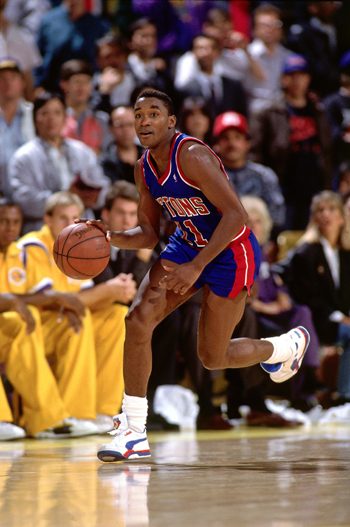
Isiah Thomas' name today is often synonymous with failure, due to his disastrous stints as coach and GM with multiple teams over the past several years, but in his playing days, he was one of the top players out there, and a great playoff performer.

Isiah was a great player right from the beginning of his career. He averaged 17 points as a rookie, then scored a career high 22.9 points per game the next season. Even with a small dip in scoring average over the next few seasons, he continued to improve, reaching his peak at age 23, when he put up the following stat line:

Thomas - 21.2 pts, 4.5 reb, 13.9 ast, 2.3 stl, .458 FG%, .809 FT%

His assist average that season led the entire league, and was the second of four straight seasons in which he averaged over 10 per game and finished in the top 3 overall. He averaged over 20 points per game for five straight seasons, and also averaged over 2 steals per game for 5 straight years.

What made Isiah great was that he was willing to sacrifice those big numbers in order to help the Pistons become winners. Starting in 1986-87, Detroit made it to four straight Eastern Conference Finals, which included three straight NBA Finals. Detroit was the winner of two straight championships, and Thomas was the star on both of those teams, but he was passed over for the Finals MVP in 1989 in favor of Joe Dumars, who was a little more fan-friendly. Here are the stats for the team's two starting guards:

Thomas - 18.2 pts, 4.3 reb, 8.3 ast, 1.6 stl, .412 FG%, .740 FT%
Dumars - 17.6 pts, 2.6 reb, 5.6 ast, 0.7 stl, .455 FG%, .861 FT%

The only way that Dumars was superior was in his shooting percentages, which shouldn't be enough to justify him taking the Finals MVP away from Thomas. Thomas was also the best player on the Pistons team that lost to Los Angeles in 1988, which means he was the best player on three straight Finals teams. There aren't a lot of players who can say that.

Thomas earns points both for being a star player early in his career and a winner later in his career, which allows him to rank pretty high on the all-time list, but his best years did not coincide with the years his team was winning, although he was still very good when the Pistons became champs. There are so many great players who had higher peaks, longer peaks, or more time as a winner, but Thomas had a bit of everything in his career.


Thomas and Schayes were the top players on exactly three NBA Finalists each, with Thomas getting a slight edge due to his team winning the title twice. Thomas reached a higher peak than Schayes early in his career, but also faded much more quickly, which balances out. The edge goes to Isiah because of his playoff heroics and his great early years, which make him much more memorable than Schayes.

Sunday, August 21, 2011

Top 100 NBA Players: #44


Dolph Schayes

(Kalb: #23, Simmons: #50, BBR: #71)

Dolph Schayes was one of the biggest stars of the early NBA, and the only one who was able to see success both before and after the adoption of the shot clock. Today he is probably better known as the father of Danny Schayes, but he should be remembered as a great player and possibly the greatest Jewish player ever.

In the first four seasons of the NBA's existence, rebounds were not counted, but in the first season they were counted, Schayes was the league leader, grabbing 16.4 per game, to go along with 17 points in each contest. For some reason, he was only voted to the All-NBA Second Team, despite the fact that he was easily the best forward in the league.

He spent the next nine seasons among the league's top 5 rebounders, and he also finished among the top 10 scorers in each of those seasons. He twice led the league in minutes played, and three times in free throw percentage, topping the 90% mark twice, which is still an amazing accomplishment. He missed only three games in his first 12 seasons, earning a reputation as a tough player. Even more amazing is that he played one entire season with a broken wrist on his shooting hand, which forced him to learn to shoot left-handed, a skill that helped him immensely throughout the remainder of his career.

In his first 10 seasons, with the exception of the season he had a broken wrist, he was one of the top 6 players in the league, but was never the top player. He was the top player for the Syracuse Nationals for each of his first 12 seasons, and in most of those seasons he led them at least to the Conference Finals, or Division Finals as they were called back then.

His teams played in the NBA Finals three times, winning the title in 1955, the first season with a shot clock. He was by far the best player on that team, as evidenced by the statistical differences between him and his best teammate, Paul Seymour, which can be seen below.

Schayes - 19.0 pts, 12.8 reb, 3.6 ast, .359 FG%, .840 FT%
Seymour - 12.5 pts, 3.9 reb, 6.8 ast, .309 FG%, .900 FT%

He was also the best player on the Finals losers in both 1950 and 1954, the first of which was his rookie season. Six times his teams lost one step short of the Finals, but they always made the playoffs. In fact, the only time he missed the playoffs was his final season, after the team had moved to Philadelphia and become the 76ers, and Schayes was 35 years old, which was ancient for those days.

Overall, Schayes has to be regarded as a great player, one who was always one of the top players in the league, with only one real weakness, which was his shooting percentage, which, at .380, was even low for those days. He was a good all-around player and a winner, and was a star for a long period of time, meeting all of my criteria for inclusion on this list.


Schayes and Johnson were both perennial winners and owners of NBA championships, but they played totally different positions in totally different eras. Their level of play was very similar for about the same length of time, and both were able to continue improve their games even though they were stars from their early years. Schayes wins the battle here because he was the star player for his entire career, while Johnson was usually the sidekick.

Tuesday, July 19, 2011

Top 100 NBA Players: #76


Hal Greer

(Simmons: #46, BBR: #69)

Hal Greer was a great player during the entire decade of the 60's, but he was never quite as successful being the alpha dog as he was being the second banana. The best years his team enjoyed during his tenure were the years where either Dolph Schayes or Wilt Chamberlain had taken over as the star of the team. The presence of another star didn't diminish Greer's stats, it just added to his playoff success.

From 1960 to 1970, Greer's scoring average was always between 19.5 and 24.1, his rebound average between 4.7 and 7.4, and his assist average between 3.4 and 5.1. He was known as a player you could always count on to be there and to do his job, but he never fully stood out as a superstar, he was always just a very good All-Star.

Greer's most productive years came alongside Wilt Chamberlain with the Philadelphia 76ers, where they made it at least to the Eastern Conference Finals 3 times in 4 years, winning the championship in 1967, which broke Boston's 8-season championship streak. It's obvious that Wilt was the star of those teams, but Greer was his #2, the guy with the outside shot who could hit his free throws.

Greer's best playoff run came during that championship season, when he averaged 27.7 points to lead the team, while Wilt averaged 21.7 points, 29.1 rebounds, and 9.0 assists. His next two best playoff scoring averages came during the two years that they lost in the Eastern Conference Finals, which shows that the team made it farther in the playoffs when Greer was on top of his game.


You can see from the chart that White had a slightly higher career plateau than Greer, but Greer maintained his longer. White has one more title than Greer, but Greer was the undisputed #2 player on his title team, while White was probably just third best. Greer sets himself apart because of the length of time that he was able to maintain such a high level of play.