Showing posts with label Dennis Johnson. Show all posts

Friday, August 19, 2016

Top 100 NBA Players: #45 - Dennis Johnson


Dennis Johnson

Dennis Johnson is one of the most underrated guards of all time, as evidenced by the fact that he wasn't even elected to the Hall of Fame until after his death, which was a full 17 seasons after he retired. Not only did he win three championships, but he was an integral part of each of those teams.

He started his career with the Seattle SuperSonics, where in just his second season he helped take the extreme underdogs all the way to the NBA Finals. His averages went from 12.7 points and 3.6 rebounds in the regular season to 16.1 points and 4.6 rebounds in the playoffs, but in the last game of the NBA Finals, he choked, going 0-14 as the Sonics lost to the Bullets.

The next season, he came back at the same level at which he finished the previous season, matching the averages above and taking Seattle back to the Finals, and because he performed well throughout the playoffs and redeemed his previous failing, he was awarded the Finals MVP. In my profile of Gus Williams (#55) I showed why I thought the award should have gone to him instead, but there is no arguing that Johnson was one of the two stars on the title team, and that was in just his third season.

Johnson was even better the next season, averaging 19 points, 5.1 rebounds, and 4.1 assists per game while being named to the All-Defensive Team for the second of what would become nine straight seasons. Unfortunately, the Sonics lost in the Western Conference Finals that year to the Lakers, who featured Kareem Abdul-Jabbar and a rookie named Magic Johnson.

He was traded to the Phoenix Suns after that season in exchange for Paul Westphal, and while he continued to put up big numbers, he was not able to replicate the playoff success he enjoyed in Seattle. While he was a Sun, he made his only appearance on the All-NBA First Team and enjoyed his most impressive personal seasons.

After three season in Phoenix, he made his way to Boston via another trade, and was able to use his experience to help the Celtics make it to four straight NBA Finals, two of which earned him additional championship rings. While Kevin McHale and Robert Parish tend to be more recognized as stars during that period for Boston, more often than not it was Dennis Johnson playing second fiddle to Larry Bird on those great teams.

Above it all, Dennis Johnson was a winner, making the playoffs in every season after his rookie year ended. He made it at least to the Conference Finals 8 times in his career, and played in 6 NBA Finals. He was twice the second-best player on a champion, and he was always in the top 4 on those 8 teams that made deep playoff runs. Even though he never averaged 20 points per game for a full season, he was a huge asset if you wanted a winner.

Wednesday, August 10, 2016

Top 100 NBA Players: #55 - Gus Williams


Gus Williams

Gus Williams played like a superstar for several years in Seattle, yet then and now he is underappreciated for what he accomplished. Most fans today haven't even heard of him, and the professionals who have ranked the all-time greats like I'm doing also ignored him completely, but there are some good reasons to put him on this list.

Williams was the best player on the 1979 NBA Champion Seattle SuperSonics, but even then he was overlooked for a more recognizable teammate, Dennis Johnson, when it came to the voting for Finals MVP. The truth is that Johnson was awarded the MVP because of the way he had bounced back after going 0 for 14 in the deciding game of the Finals the previous season, but Williams was still the better overall player. Here are their stats from the playoffs:

Johnson - 20.9 pts, 6.1 reb, 4.1 ast, 1.6 stl, .450 FG%, .771 FT%
Williams - 26.6 pts, 4.1 reb, 3.7 ast, 2.0 stl, .476 FG%, .709 FT%

There was some pretty good balance between the two guards among these five categories during that postseason, but Williams outscored Johnson by more than 5 points per game, and in my opinion was the real reason that Seattle won the series and the championship.

Williams had been the second-best player on the Sonics during their run to the Finals the previous season, and he was once again the best player for Seattle as they advanced to the Western Conference Finals in 1980. That's 3 straight seasons of making at least the Conference Finals as the star of the team or his top sidekick. He was obviously feeling unappreciated at this point, so he sat out the following season in a contract dispute, a season that most likely would have been his best, judging by his career trajectory.

When he returned after a one-season hiatus, he picked up right where he left off statistically, actually improving in many categories, but he was never able to see the same playoff success as he had before. He never made it past the second round again in his career, but he was still enough of a star to be worthy of some recognition. Here are his stats for the 3 years before and after the holdout season.

Williams (1977-1980) - 19.8 pts, 3.3 reb, 4.2 ast, 2.3 stl
Williams (1981-1984) - 20.7 pts, 2.7 reb, 7.8 ast, 2.3 stl

He may not have received the recognition he deserved back when he was starring for Seattle or today, but he hasn't been forgotten here, and there is no way I can leave a player this talented off of my top 100.

Sunday, August 21, 2011

Top 100 NBA Players: #44


Dolph Schayes

(Kalb: #23, Simmons: #50, BBR: #71)

Dolph Schayes was one of the biggest stars of the early NBA, and the only one who was able to see success both before and after the adoption of the shot clock. Today he is probably better known as the father of Danny Schayes, but he should be remembered as a great player and possibly the greatest Jewish player ever.

In the first four seasons of the NBA's existence, rebounds were not counted, but in the first season they were counted, Schayes was the league leader, grabbing 16.4 per game, to go along with 17 points in each contest. For some reason, he was only voted to the All-NBA Second Team, despite the fact that he was easily the best forward in the league.

He spent the next nine seasons among the league's top 5 rebounders, and he also finished among the top 10 scorers in each of those seasons. He twice led the league in minutes played, and three times in free throw percentage, topping the 90% mark twice, which is still an amazing accomplishment. He missed only three games in his first 12 seasons, earning a reputation as a tough player. Even more amazing is that he played one entire season with a broken wrist on his shooting hand, which forced him to learn to shoot left-handed, a skill that helped him immensely throughout the remainder of his career.

In his first 10 seasons, with the exception of the season he had a broken wrist, he was one of the top 6 players in the league, but was never the top player. He was the top player for the Syracuse Nationals for each of his first 12 seasons, and in most of those seasons he led them at least to the Conference Finals, or Division Finals as they were called back then.

His teams played in the NBA Finals three times, winning the title in 1955, the first season with a shot clock. He was by far the best player on that team, as evidenced by the statistical differences between him and his best teammate, Paul Seymour, which can be seen below.

Schayes - 19.0 pts, 12.8 reb, 3.6 ast, .359 FG%, .840 FT%
Seymour - 12.5 pts, 3.9 reb, 6.8 ast, .309 FG%, .900 FT%

He was also the best player on the Finals losers in both 1950 and 1954, the first of which was his rookie season. Six times his teams lost one step short of the Finals, but they always made the playoffs. In fact, the only time he missed the playoffs was his final season, after the team had moved to Philadelphia and become the 76ers, and Schayes was 35 years old, which was ancient for those days.

Overall, Schayes has to be regarded as a great player, one who was always one of the top players in the league, with only one real weakness, which was his shooting percentage, which, at .380, was even low for those days. He was a good all-around player and a winner, and was a star for a long period of time, meeting all of my criteria for inclusion on this list.


Schayes and Johnson were both perennial winners and owners of NBA championships, but they played totally different positions in totally different eras. Their level of play was very similar for about the same length of time, and both were able to continue improve their games even though they were stars from their early years. Schayes wins the battle here because he was the star player for his entire career, while Johnson was usually the sidekick.

Saturday, August 20, 2011

Top 100 NBA Players: #45


Dennis Johnson

(Simmons: #52, BBR: #99)

Dennis Johnson is one of the most underrated guards of all time, as evidenced by the fact that he wasn't even elected to the Hall of Fame until after his death, which was a full 17 seasons after he retired. Not only did he win three championships, but he was an integral part of each of those teams.

He started his career with the Seattle Supersonics, where in just his second season he helped take the extreme underdogs all the way to the NBA Finals. His averages went from 12.7 points and 3.6 rebounds in the regular season to 16.1 points and 4.6 rebounds in the playoffs, but in the last game of the NBA Finals, he choked, going 0-14 as the Sonics lost to the Bullets.

The next season, he came back in playoff form, matching the averages above and taking Seattle back to the Finals, and because he performed well throughout the playoffs and redeemed his previous failing, he was awarded the Finals MVP Award. In my profile of Gus Williams (#57) I showed why I thought the award should have gone to him instead, but there is no arguing that Johnson was one of the two stars on the title team, and that was in just his third season.

Johnson was even better the next season, averaging 19 points, 5.1 rebounds, and 4.1 assists per game while being named to the All-Defensive Team for the second of what would become nine straight seasons. Unfortunately, the Sonics lost in the Western Conference Finals that year to the Lakers, who featured Kareem Abdul-Jabbar and a rookie named Magic Johnson.

He was traded to the Phoenix Suns after that season in exchange for Paul Westphal, and while he continued to put up big numbers, he was not able to replicate the playoff success he enjoyed in Seattle. While he was a Sun, he made his only appearance on the All-NBA First Team and enjoyed his most impressive personal seasons.

After three season in Phoenix, he made his way to Boston via another trade, and was able to use his experience to help the Celtics make it to four straight NBA Finals, two of which earned him additional championship rings. While Kevin McHale and Robert Parish tend to be more recognized as stars during that period for Boston, more often than not it was Dennis Johnson playing second fiddle to Larry Bird on those great teams.

Above it all, Dennis Johnson was a winner, making the playoffs in every season after his rookie year ended. He made it at least to the Conference Finals 8 times in his career, and played in 6 NBA Finals. He was twice the second-best player on a champion, and he was always in the top 4 on those 8 teams that made deep playoff runs. Even though he never averaged 20 points per game for a full season, he was a huge asset if you wanted a winner.


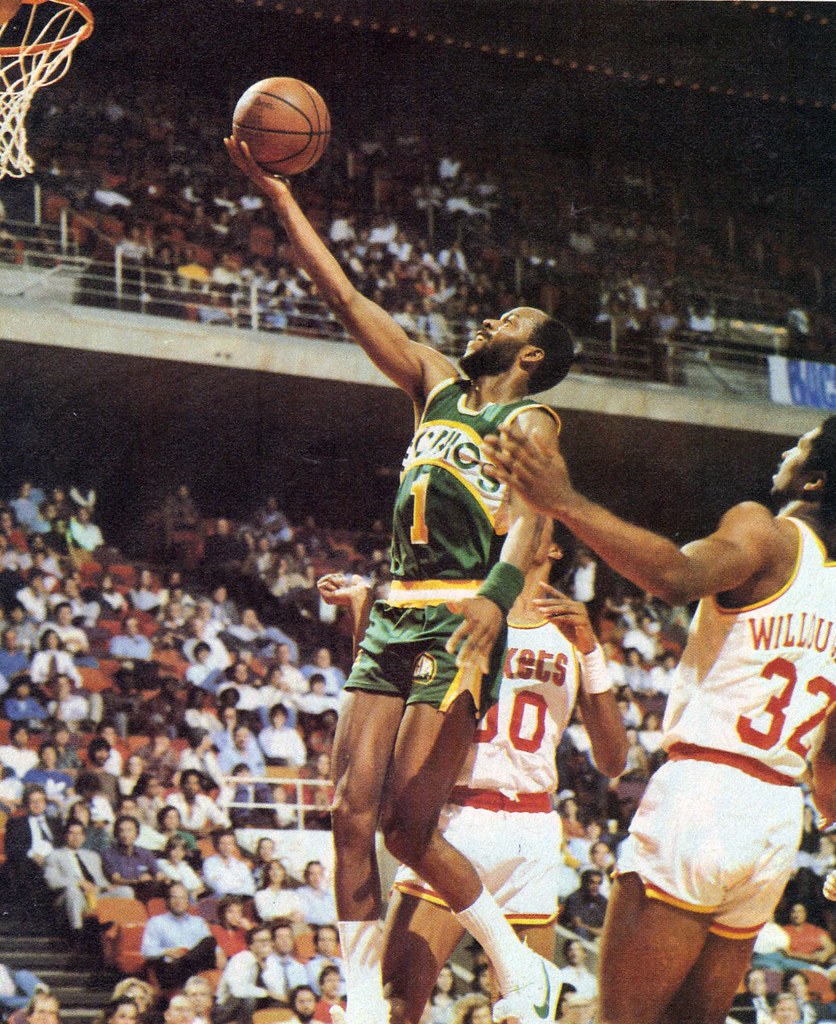
Johnson and McHale played together on the great Celtic teams of the 1980's, and they took turns being the #2 and #3 guy on those teams. McHale was a slightly better player overall, but Johnson gets the edge over McHale because he had already built a nice playoff resume before he even came to Boston.

Sunday, August 7, 2011

Top 100 NBA Players: #57

Gus Williams

(BBR: #170)

Gus Williams played like a superstar for several years in Seattle, yet then and now he is underappreciated for what he accomplished. Most fans today haven't even heard of him, and the professionals who have ranked the all-time greats like I'm doing also ignored him completely, but there are some good reasons to put him on this list.

Williams was the best player on the 1979 NBA Champion Seattle SuperSonics, but even then he was overlooked for a more recognizable teammate, Dennis Johnson, when it came to the voting for Finals MVP. The truth is that Johnson was awarded the MVP because of the way he had bounced back after going 0 for 14 in the deciding game of the Finals the previous season, but Williams was still the better overall player. Here are their stats from the playoffs:

Johnson - 20.9 pts, 6.1 reb, 4.1 ast, 1.6 stl, .450 FG%, .771 FT%
Williams - 26.6 pts, 4.1 reb, 3.7 ast, 2.0 stl, .476 FG%, .709 FT%

There was some pretty good balance between the two guards among these five categories during that postseason, but Williams outscored Johnson by more than 5 points per game, and in my opinion was the real reason that Seattle won the series and the championship.

Williams had been the second-best player on the Sonics during their run to the Finals the previous season, and he was once again the best player for Seattle as they advanced to the Western Conference Finals in 1980. That's 3 straight seasons of making at least the Conference Finals as the star of the team or his top sidekick. He was obviously feeling unappreciated at this point, so he sat out the following season in a contract dispute, a season that most likely would have been his best, judging by his career trajectory, which you can see in the chart below.

When he returned after a one-season hiatus, he picked up right where he left off statistically, actually improving in many categories, but he was never able to see the same playoff success as he had before. He never made it past the second round again in his career, but he was still enough of a star to be worthy of some recognition. Here are his stats for the 3 years before and after the holdout season.

Williams (1977-1980) - 19.8 pts, 3.3 reb, 4.2 ast, 2.3 stl
Williams (1981-1984) - 20.7 pts, 2.7 reb, 7.8 ast, 2.3 stl

He may not have received the recognition he deserved back when he was starring for Seattle or today, but he hasn't been forgotten here, and there is no way I can leave a player this talented off of my top 100.


Williams and Stoudemire both took an entire season off after their peak seasons, Stoudemire for knee surgery and Williams for a contract dispute. Their regular season success is pretty similar, with Williams holding a slight edge because we've been able to see his entire career already, and the slight edge in playoff success due to leading Seattle to the title puts him above Stoudemire any way you look at it.