Showing posts with label Robert Parish. Show all posts

Sunday, September 19, 2021

Top 100 NBA Players: #42 - Robert Parish


Robert Parish

Teams

Golden State Warriors - 1976-80

Boston Celtics - 1980-94

Charlotte Hornets - 1994-96

Chicago Bulls - 1996-97


Playoffs

Appearances - 16 (1977,1981,1982,1983,1984,1985,1986,1987,1988,1989,1990,1991,1992,1993,1995,1997)

Conference Finals - 7 (1981,1982,1984,1985,1986,1987,1988)

NBA Finals - 5 (1981,1984,1985,1986,1987)

Championships - 4 (1981,1984,1986,1997)


Awards and Honors

All-NBA First Team - 0 (1981)

All-NBA Second Team - 1 (1982,1983)

All-NBA Third Team - 1 (1979,1984,1989)

Hall of Fame - 2003

*(actual in bold, deserved in italics)


All-Time Ranks

Total Rebounds - #9

Total Blocks - #11

Total Points - #33

Field Goal Percentage - #40

Blocks Per Game - #71

Total Steals - #91

Rebounds Per Game - #98


League Leads

Field Goal Percentage (#2-1988,1991, #3-1989,1990)

Total Blocks (#3-1981, #4-1979, #5-1982)

Blocks Per Game (#4-1979,1981, #5-1982)

Total Rebounds (#2-1989)

Rebounds Per Game (#3-1989)


Robert Parish averaged 23.0 points and 18.7 rebounds as a freshman at Centenary, leading to him being drafted by the Utah Stars of the ABA, but he decided to stay in school. After his junior year, he was drafted again, this time by the San Antonio Spurs, but again he decided to finish college. He averaged 24.8 points and 18.0 rebounds as a senior, then was drafted by the Golden State Warriors at #8 overall.

The Warriors were only one season removed from winning a championship when he arrived, and they made the playoffs that year, reaching the second round. Parish averaged 9.1 points and 7.1 rebounds, but he improved quickly over the next couple of years while the Warriors went in the opposite direction, missing the playoffs in each of the next three seasons.

After averaging over 17 points and 10 rebounds in his last 2 seasons in Golden State, Parish was traded to the Boston Celtics on draft day, along with the draft pick that became Kevin McHale, for two other first round picks. His first season in Boston was the best of his career, with averages of 18.9 points, 9.5 rebounds, and 2.6 blocks, and he, along with Larry Bird, led the Celtics to a championship.

He averaged a career high of 19.9 points the next year, along with 10.8 rebounds, and was named to the All-NBA Second Team for the only time in his career, but the Celtics fell short in the playoffs, getting beaten by the 76ers in the Conference Finals in 7 games. 

The Celtics made it back to the Finals in 1984 after Parish averaged 19.0 points and 10.7 rebounds in the regular season, and Parish was still the team's second-best player as they won their second title of the decade, but he averaged only 15.4 points in the Finals.

Parish was known for being very consistent, and his averages in each of the next 3 years were very similar to what they had been for the past several years, and Boston reached the NBA Finals in all 3 years as well. By this point, Kevin McHale had overtaken him as the second-best Celtic, but Parish still played an important role in a third championship in 1986.

Larry Bird missed most of the 1988-89 season due to injury, and Parish stepped up in his absence, averaging 18.6 points and 12.5 rebounds, which was a career-high at age 35, but it wasn't enough to help the Celtics reach a fifth straight Finals, and they were swept in the first round instead.

Parish played 5 more seasons in Boston, but the team and Parish were declining. Bird and McHale both retired due to injuries, and Parish finally left the team as a free agent in 1994, signing with the Hornets at age 41. He backed up Alonzo Mourning for 2 seasons, then joined the Chicago Bulls for the 1996-97 season, where he averaged 3.7 points per game in the regular season, then played in only 2 playoff games as the Bulls won the championship again, earning Parish a 4th ring, and the title of oldest NBA champion ever, after which he retired.

Parish played 21 total seasons in the NBA, second only to Vince Carter, and played more games than any other player ever. He was a big part of three Celtics titles in the 1980s, and is #9 on the all-time rebounding list and #11 in all-time blocks, because he was content to do the dirty work and he did it well for a long time. He was never flashy, so he is often overlooked, but he is definitely one of the greatest to ever play the game.


Friday, August 19, 2016

Top 100 NBA Players: #45 - Dennis Johnson


Dennis Johnson

Dennis Johnson is one of the most underrated guards of all time, as evidenced by the fact that he wasn't even elected to the Hall of Fame until after his death, which was a full 17 seasons after he retired. Not only did he win three championships, but he was an integral part of each of those teams.

He started his career with the Seattle SuperSonics, where in just his second season he helped take the extreme underdogs all the way to the NBA Finals. His averages went from 12.7 points and 3.6 rebounds in the regular season to 16.1 points and 4.6 rebounds in the playoffs, but in the last game of the NBA Finals, he choked, going 0-14 as the Sonics lost to the Bullets.

The next season, he came back at the same level at which he finished the previous season, matching the averages above and taking Seattle back to the Finals, and because he performed well throughout the playoffs and redeemed his previous failing, he was awarded the Finals MVP. In my profile of Gus Williams (#55) I showed why I thought the award should have gone to him instead, but there is no arguing that Johnson was one of the two stars on the title team, and that was in just his third season.

Johnson was even better the next season, averaging 19 points, 5.1 rebounds, and 4.1 assists per game while being named to the All-Defensive Team for the second of what would become nine straight seasons. Unfortunately, the Sonics lost in the Western Conference Finals that year to the Lakers, who featured Kareem Abdul-Jabbar and a rookie named Magic Johnson.

He was traded to the Phoenix Suns after that season in exchange for Paul Westphal, and while he continued to put up big numbers, he was not able to replicate the playoff success he enjoyed in Seattle. While he was a Sun, he made his only appearance on the All-NBA First Team and enjoyed his most impressive personal seasons.

After three season in Phoenix, he made his way to Boston via another trade, and was able to use his experience to help the Celtics make it to four straight NBA Finals, two of which earned him additional championship rings. While Kevin McHale and Robert Parish tend to be more recognized as stars during that period for Boston, more often than not it was Dennis Johnson playing second fiddle to Larry Bird on those great teams.

Above it all, Dennis Johnson was a winner, making the playoffs in every season after his rookie year ended. He made it at least to the Conference Finals 8 times in his career, and played in 6 NBA Finals. He was twice the second-best player on a champion, and he was always in the top 4 on those 8 teams that made deep playoff runs. Even though he never averaged 20 points per game for a full season, he was a huge asset if you wanted a winner.

Saturday, July 30, 2016

Top 100 NBA Players: #67 - Robert Parish


Robert Parish

Robert Parish was a member of 4 championship teams and played in the Finals 7 times in his career, but it's safe to say that without Larry Bird and Michael Jordan, those numbers would both be much smaller. Even though he wasn't the driving force behind those titles, he still has a place in the brotherhood of all-time greats.

Parish began his career in Golden State, playing for teams that consistently missed the playoffs, but his luck changed in 1980, when he was traded to Boston with a draft pick that became Kevin McHale for a #1 pick, which turned into Joe Barry Carroll. That trade set the Celtics' frontcourt for a decade and built a dynasty.

Parish was incredibly consistent in the 1980's, averaging over 16 points and 9 rebounds per game for 9 straight seasons, while shooting over 53% for 13 straight seasons, stretching that streak clear through 1993. While he was definitely a good player, he was just a piece in Boston, ranking as their 3rd-best player on two title teams, and lower than that for the rest of his time there.

Perhaps the most amazing thing about Parish was his durability. He played 21 seasons, and in the first 20 he never missed more than 10 games. That durability enabled him to pass Kareem Abdul-Jabbar as the player to appear in the most games in NBA history in 1996, his 20th season, during which he started 34 games for the Charlotte Hornets. While it's not the most desirable category to hold the record in, it's still an impressive achievement.

Saturday, August 20, 2011

Top 100 NBA Players: #45


Dennis Johnson

(Simmons: #52, BBR: #99)

Dennis Johnson is one of the most underrated guards of all time, as evidenced by the fact that he wasn't even elected to the Hall of Fame until after his death, which was a full 17 seasons after he retired. Not only did he win three championships, but he was an integral part of each of those teams.

He started his career with the Seattle Supersonics, where in just his second season he helped take the extreme underdogs all the way to the NBA Finals. His averages went from 12.7 points and 3.6 rebounds in the regular season to 16.1 points and 4.6 rebounds in the playoffs, but in the last game of the NBA Finals, he choked, going 0-14 as the Sonics lost to the Bullets.

The next season, he came back in playoff form, matching the averages above and taking Seattle back to the Finals, and because he performed well throughout the playoffs and redeemed his previous failing, he was awarded the Finals MVP Award. In my profile of Gus Williams (#57) I showed why I thought the award should have gone to him instead, but there is no arguing that Johnson was one of the two stars on the title team, and that was in just his third season.

Johnson was even better the next season, averaging 19 points, 5.1 rebounds, and 4.1 assists per game while being named to the All-Defensive Team for the second of what would become nine straight seasons. Unfortunately, the Sonics lost in the Western Conference Finals that year to the Lakers, who featured Kareem Abdul-Jabbar and a rookie named Magic Johnson.

He was traded to the Phoenix Suns after that season in exchange for Paul Westphal, and while he continued to put up big numbers, he was not able to replicate the playoff success he enjoyed in Seattle. While he was a Sun, he made his only appearance on the All-NBA First Team and enjoyed his most impressive personal seasons.

After three season in Phoenix, he made his way to Boston via another trade, and was able to use his experience to help the Celtics make it to four straight NBA Finals, two of which earned him additional championship rings. While Kevin McHale and Robert Parish tend to be more recognized as stars during that period for Boston, more often than not it was Dennis Johnson playing second fiddle to Larry Bird on those great teams.

Above it all, Dennis Johnson was a winner, making the playoffs in every season after his rookie year ended. He made it at least to the Conference Finals 8 times in his career, and played in 6 NBA Finals. He was twice the second-best player on a champion, and he was always in the top 4 on those 8 teams that made deep playoff runs. Even though he never averaged 20 points per game for a full season, he was a huge asset if you wanted a winner.


Johnson and McHale played together on the great Celtic teams of the 1980's, and they took turns being the #2 and #3 guy on those teams. McHale was a slightly better player overall, but Johnson gets the edge over McHale because he had already built a nice playoff resume before he even came to Boston.

Thursday, August 4, 2011

Top 100 NBA Players: #60


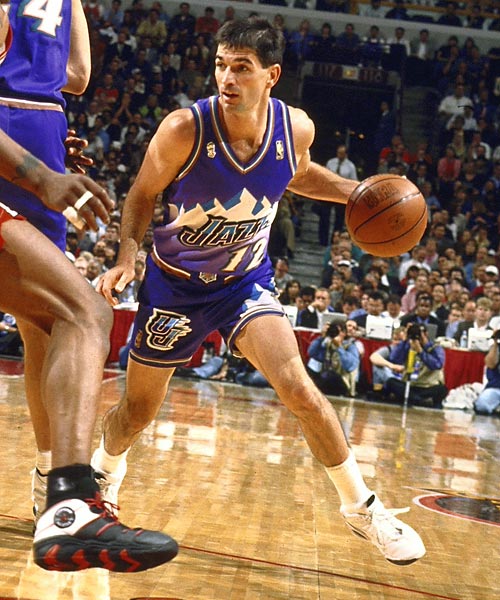
John Stockton

(Kalb: #27, Simmons: #25, BBR: #14)

I realize that many may call it blasphemy to put Stockton this low in the all-time rankings, especially with all of the individual achievements in his career, and it hurts me to put him here too, because I have the utmost respect for him as a player and as a human being, but the fact is that he wasn't as good as many have made him out to be.

A few people will try to claim that his assist record should be discounted because assists were easier to get in his era than they were earlier days of the league, and will often compare his numbers to those of Bob Cousy to make their point, but the truth is that the average number of assists per game changed very little from 1951 through today. Assists did reach their peak in the mid-1980's, but the difference wasn't that huge. In 1956, when Cousy led the league with 8.9 assists per game, the average team got 24.3 per game, and when Stockton led the league with 14.2 assists per game in 1991, the team average leaguewide was 24.7. The only time in which assists were truly hard to get was the first four seasons of the NBA, in which the average for a team was still in the single digits.

The obvious question here is, "What caused the difference between Cousy and Stockton if assists were just as easy to get back then?" The real difference is specialization. Before the 1980's, most teams did not differentiate a point guard from a shooting guard. Whichever one got the ball took it up the court, and was more likely to record an assist. That is a small part of the reason that Stockton is ranked this low, but only a part.

Let's look for a moment at Stockton's other major achievement, which is his all-time record for steals. This one is especially misleading, because steals, unlike assists, have only been recorded for the past 38 years, meaning that there is no way to know whether he really has the most overall steals. If Jordan hadn't retired for five seasons in the prime of his career, he could easily have passed Stockton here. This record was also helped by the fact that he has played in the third-most games all-time. He was a good defensive player and led the league in steals twice, but this record doesn't help his all-time standing quite as much.

Another thing holding Stockton back was the lack of postseason success. He played in two NBA Finals late in his career, and he was still the #2 player on the Jazz, just as he had been for over a decade, but that seems to eclipse his previous playoff failings in the eyes of many. The truth is that in his 19 seasons, the Jazz made the playoffs every single season, but lost in the first round 9 times, and in the second round 5 more times. That leaves 3 Western Conference Finals seasons and the two trips to the Finals, where they lost to Michael Jordan and the Bulls. In 1996, he was not as good as Jeff Hornacek, which I detailed in my article on his back at #95, and he was still Malone's sidekick on those other teams. How can someone be considered one of the greatest of all time if he was never the best player on his own team?

To recap, I want to emphasize that I love John Stockton. I loved the way he played, and especially the way he showed up every night. In 17 different seasons he never missed a single game. He played his entire career with one team, showing great loyalty to the Utah team that took a chance on the small-school boy. The Jazz made the playoffs every single season that he was on the roster. I just can't overlook the fact that he wasn't ever a superstar. He only ranked among the top 15 players in the league once, and was never his team's best player. He rarely saw playoff success, and the majority of it came after he had started to decline as a player. He was very good at the things he was supposed to do, and not so great at the things he wasn't expected to do. Overall, he exceeded a lot of expectations, but he is not one of the top 50 players of all time. Sorry.


Stockton and Parish had two of the longest careers of anybody in NBA history, and both were able to maintain a relatively even level of play for a long period of time. Parish had more playoff success, but Stockton was a bigger reason for his team's overall success. What this one really came down to was that Stockton became a relevant player a year earlier in his career than Parish did, and started his decline at the same point.

Wednesday, August 3, 2011

Top 100 NBA Players: #61


Robert Parish

(Simmons: #59, BBR: #54)

Robert Parish was a member of 4 championship teams and played in the Finals 7 times in his career, but it's safe to say that without Larry Bird and Michael Jordan, those numbers would both be much smaller. Even though he wasn't the driving force behind those titles, he still has a place in the brotherhood of all-time greats.

Parish began his career in Golden State, playing for teams that consistently missed the playoffs, but his luck changed in 1980, when he was traded to Boston with a draft pick that became Kevin McHale for a #1 pick, which turned into Joe Barry Carroll. That trade set the Celtics' frontcourt for a decade and built a dynasty.

Parish was incredibly consistent in the 1980's, averaging over 16 points and 9 rebounds per game for 9 straight seasons, while shooting over 53% for 13 straight seasons, stretching that streak clear through 1993. While he was definitely a good player, he was just a piece in Boston, ranking as their 3rd-best player on two title teams, and lower than that for the rest of his time there.

Perhaps the most amazing thing about Parish was his durability. He played 21 seasons, and in the first 20 he never missed more than 10 games. That durability enabled him to pass Kareem Abdul-Jabbar as the player to appear in the most games in NBA history in 1996, his 20th season, during which he started 34 games for the Charlotte Hornets. While it's not the most desirable category to hold the record in, it's still an impressive achievement.


Parish may not have had the memorable highlights of Shawn Kemp, and he wasn't the team leader that Kemp was, but he was able to maintain a peak very close to the same level as Kemp's for a lot longer, and he had a lot more playoff success, even if it came riding the coattails of more talented teammates. The only thing that is keeping these two close together in the rankings is the fact that Parish could not have taken a team to the Finals by himself.