Showing posts with label John Stockton. Show all posts

Tuesday, October 19, 2021

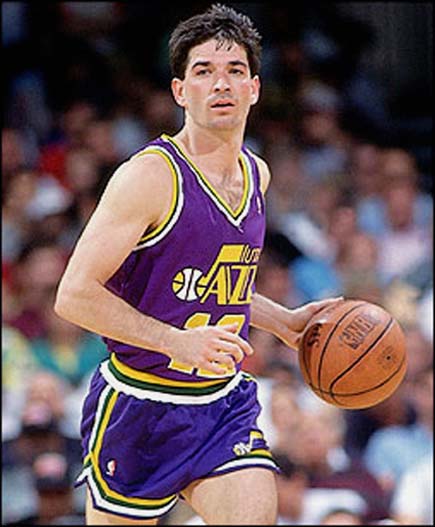
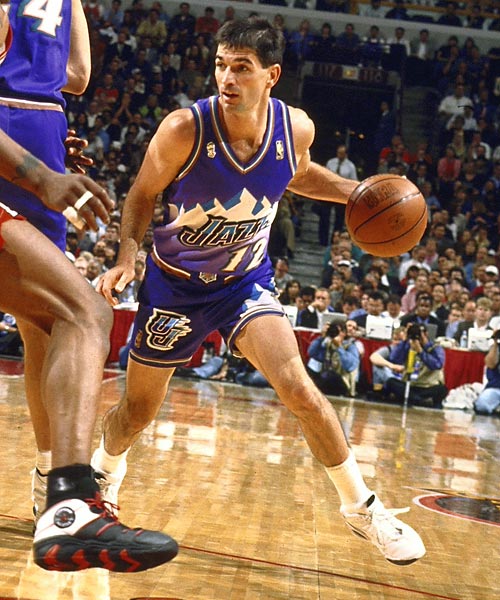
Top 100 NBA Players: #12 - John Stockton


John Stockton

Teams

Utah Jazz - 1984-03


Playoffs

Appearances - 19 (1985,1986,1987,1988,1989,1990,1991,1992,1993,1994,1995,1996,1997,1998,1999,2000,2001,2002,2003)

Conference Finals - 5 (1992,1994,1996,1997,1998)

NBA Finals - 2 (1997,1998)

Championships - 0


Awards and Honors

All-NBA First Team - 2 (1988,1989,1991,1992,1994,1995,1996,1997)

All-NBA Second Team - 6 (1988,1989,1990,1992,1993,1996)

All-NBA Third Team - 3 (1991,1997,1999,2000,2001,2002)

Hall of Fame - 2009

*(actual in bold, deserved in italics)


All-Time Ranks

Total Assists - #1

Total Steals - #1

Assists Per Game - #2

Steals Per Game - #8

Total Points - #53

Field Goal Percentage - #86


League Leads

Total Assists (#1-1988,1989,1990,1991,1992,1993,1994,1995,1996, #2-1997,2001, #4-2000, #5-2002,2003)

Assists Per Game (#1-1988,1989,1990,1991,1992,1993,1994,1995,1996, #2-1997,2001, #5-1998,2002,2003)

Total Steals (#1-1989,1992, #2-1991, #3-1988,1990,1993, #4-1994,1995)

Steals Per Game (#1-1989,1992, #2-1990,1991, #3-1988,1993, #4-1994,1995)

Field Goal Percentage (#4-1988, #5-2002)

Three-Point Percentage (#2-2001, #5-1995)


As a senior at Gonzaga, John Stockton averaged 20.9 points, 7.2 assists, and 3.9 steals per game, which led the Utah Jazz to select him with the #16 overall pick in the NBA Draft.

Stockton came off the bench in his first 3 seasons, raising all of his statistical averages each year, up to 7.9 points, 8.2 assists, and 2.2 steals per game in 1987. He was named the starting point guard the next season, and he immediately shot to the top of the league, leading all players in assists with 13.8 per game, the second-highest average of all time at that point, while scoring 14.7 points per game and recording 3.0 steals per game, #3 in the league. 

The Jazz made the playoffs in all 19 seasons with Stockton, and this year was no exception, with Utah making it to the second round, where they lost to the Lakers in 7 games, with Stockton averaging 19.3 points, 16.4 assists, and 4.0 steals per game in the series, but they couldn't beat the defending champs, and they wouldn't make a deep playoff run for several more years.

In his second year as a starter, he led the league in both assists and steals, with 13.6 and 3.2 per game respectively, along with 17.1 points per game. Despite that, he still wasn't named to the All-NBA First Team, instead being relegated to the Second Team for the second year in a row.

The next year, he set the all-time record for most assists per game in a season, dishing out 14.5 per game, along with a career high 17.2 points per game and 2.7 steals. He missed 4 games that season, the first time in his career that he sat out a single game.

The next year, he set the all-time record for most total assists in a season, getting 1164 for an average of 14.2 per game, giving him his 4th straight assist title. He also matched his career high with 17.2 points per game that season while taking 2.9 steals per game as well.

Stockton had his best overall season the next year. His averages were slightly down, to 15.8 points, 13.7 assists, and 3.0 steals per game, the latter two of which led the league. He also helped lead the Jazz to the Conference Finals for the first time in their history, but the Portland Trail Blazers stopped their run there, ending their season.

Stockton led the league in assists in each of the next 4 seasons as well, making it 9 years in a row by 1996, breaking Bob Cousy's record of 8 straight seasons leading the league. The team also made their 3rd Conference Final that year, but Seattle beat the Jazz this time, marking the 12th straight year that Stockton had failed to reach the Finals.

That ended the next year, when Stockton lost the assist title for the first time in a decade, averaging only 10.5 per game, but the Jazz finally broke through in the playoffs, beating the Rockets in the Conference Finals after Stockton hit a buzzer-beater over Charles Barkley to win the series. They met the Bulls in the Finals, but were unable to unseat the defending champs, losing in 6 games.

Stockton missed the first 18 games of the next season with a knee injury, only the second time in his career that he had missed any time, and when he came back, the team cut down his playing time a little in order to preserve him, keeping him around 30 minutes per game for the remainder of his career instead of the 35-36 he had usually played before. The Jazz returned to the Finals that year, but lost again in 6 games in a rematch with Chicago.

Stockton played 5 more years with the Jazz, averaging at least 10 points and 7 assists per game each season, and continued as their starting point guard past the age of 40. He finally retired in 2003, after playing 19 seasons, all with Utah, missing only 22 games in his career, and never missing the playoffs.

Stockton is the all-time leader in both steals and assists in NBA history, with Jason Kidd behind him in both categories. He has 581 more steals than Kidd, and is 933 ahead of Chris Paul, the active leader in the category, so he is in no danger of losing his lead. The same applies even more to the assist lead, where he is 3715 ahead of Kidd and 5531 ahead of Paul, who is the active leader.

In addition to those all-time leads, Stockton has the second-highest assist average in history, behind only Magic Johnson, and holds the records for most assists in a season, assist average in a season, and most seasons leading the league. He's also in the top 10 in steals per game for his career, so even though he was never able to win a championship, he's obviously one of the greatest to ever play the game.


Saturday, September 3, 2016

Top 100 NBA Players: #28 - Bob Cousy


Bob Cousy

Bob Cousy was one of the greatest guards in the early days of the NBA, a man who held the record for most consecutive seasons leading the league in assists for over 30 years, and a proven winner who needs to use both hands in order to wear all of his championship rings.

Many people try to say that Cousy would have had more assists in today's NBA, where assists are supposedly easier to come by, but I showed in my profile on John Stockton (#83) that this was not true. The average assists per team per game has been largely unchanged over the past 60 years, with the only dry period for assists coming in the league's first 5 seasons. The fact is that the average in 1953, Cousy's first season leading the league in assists, was 21.1 per game, while today that average has skyrocketed to 21.5.

The real reason that Cousy did not get more assists during all those seasons he was leading the league is that there was no position called point guard back then, just guards. Because of this, there was no designated ballhandler on any certain team, which makes it even more impressive that Cousy led the league for 8 straight seasons.

Another thing that makes Cousy one of the greats is that he was the best player in the entire league for two seasons early in his career. In 1954 and 1955, before the MVP award had been created, Cousy was arguably the league's elite star, with Neil Johnston as his nearest competitor. Here are their stats from those two seasons:

Cousy (1954) - 19.2 pts, 5.5 reb, 7.2 ast, .385 FG%, .787 FT%, 42-30 record
Johnston (1954) - 24.4 pts, 11.1 reb, 2.8 ast, .449 FG%, .747 FT%, 29-43 record

Cousy (1955) - 21.2 pts, 6.0 reb, 7.8 ast, .397 FG%, .807 FT%, 36-36 record
Johnston (1955) - 22.7 pts, 15.1 reb, 3.0 ast, .440 FG%, .766 FT%, 33-39 record

Both players were great scorers for the time (ranked #1 and #2 in both seasons), and both were great at their areas of specialty (assists for Cousy and rebounds for Johnston), but Cousy was also a very good rebounder, while Johnston was not known for passing the ball much. Cousy's teams were also much better then Johnston's and made the playoffs both years, something Johnston's Warriors teams didn't.

Some people will say that Cousy won all those championships because of Bill Russell, but the truth is that without Cousy, they may not have won the first four of those titles. In fact, during Russell's rookie season of 1956-57, Cousy was still the best player on the Celtics' title team, and he was still the best player the next year when they lost in the Finals. That's when Russell took over as the star, but Cousy was still #2 in Boston for three more seasons, and was still an important player on the next two title teams, retiring after winning his sixth title. Before Russell even arrived, Cousy had led Boston to three straight Eastern Conference Finals, so there is no doubt that he was a winner, but the combination of Russell and Cousy was what made them unstoppable.

Tuesday, August 9, 2016

John Stockton and other outliers

There has been a lot of discussion over the past month of my placement of John Stockton at #83 in my all-time rankings of the top players in NBA history, so I felt like I should use this post to explain a little bit about my formulas and how they work.

First of all, the results of my analysis does not always represent my personal opinion. I have several different formulas that I have created for rankings teams or players from several sports or leagues, and I have never looked at the results of any of them and felt they were perfect. I am always watching for teams or players that feel out of place, AKA outliers, and I use those to determine either errors or weaknesses in my method.

For example, in last season's college football rankings, Georgia Tech always seemed to be ranked higher than seemed correct, and losses in several games in which I picked them to win only confirmed that feeling. As a result, I have analyzed their results from last season and have pinpointed a possible cause for that aberration, and I am making an adjustment to this year's version of my rankings to try to correct it.

This has been a recurring theme throughout the time that I have done statistical rankings. Over the years I have added new components to my formula nearly every year to try to make the resulting predictions more accurate, and my correct pick percentage has risen almost every year as a result. The most recent adjustment to that formula was a method for integrating a momentum factor into the equation, and it worked pretty well.

In player rankings it is a little more complicated. There is no way to easily measure whether rankings one player over another is correct, because there are no individual matchups that show a definite winner. But just like in team rankings, when a player seems to be ranked too high or too low, I pay special attention to that player and try to find a way to correct the perceived problem.

There are a few players in the current version of my rankings that fit this criteria, with John Stockton as the biggest example and Bill Russell as another. Five years ago I released the previous version of these rankings, and there were even more examples of players I felt were not ranked correctly then. While improvements have been made in this system over the past 5 years, it is still not perfect, and that is part of the fun for me. It gives me a chance to continue thinking about ways to improve the system.

Now let me get back to John Stockton, the biggest outlier of all. He has always been one of the most difficult players to rank, no matter how many changes I have made to my formula over the years. Since finishing this most recent version of my rankings (which took dozens of hours to complete), I have spent a lot of time reviewing the data to ensure its accuracy, and I have found that he is ranked accurately according to this version of the formula.

But that leaves a problem. Does anyone really believe that John Stockton is only the 83rd greatest player of all time? I don't believe that, and you probably don't either. As I have pondered his unique career, I have tried to find an adjustment that can be made that would more place him in a ranking position that seems more accurate. I have come up with a couple of ideas, but neither would be guaranteed to fix the issue and both would take many more months of work to implement. I will continue to study these possibilities and run some tests, and maybe by the next time I am ready to release a version of these rankings they will look a little different.

In conclusion, I am aware that John Stockton's rankings is probably unfair, and I agree that he should be ranked ahead of several of the players that I have highlighted ahead of him on this list. Rather than focusing on the injustice of his ranking and comparing each player ahead to John Stockton, let's instead focus on celebrating the greatness of the players on the list and learning a little more about them.

Tuesday, August 2, 2016

Top 100 NBA Players: #63 - Chris Paul


Chris Paul

Chris Paul may seem like a strange choice to put above all-time assist leader John Stockton and 2-time MVP Steve Nash in these rankings, especially since he has had even less playoff success than either of those better-known stars.

The first thing that really helps Chris Paul is that he has been the star of his team for nearly every season of his career, while Nash was only the best on his team during the season Amare missed due to a major knee injury, and Stockton was never the best player on his team. Being the best player on his team means that Paul had more to do with his team's successes, which nearly balances out the fact that he hasn't reached the Conference Finals yet.

Chris Paul is also a better scorer than either of those other point guards, with a career average of 18.8 per game, higher than Stockton ever averaged in any season and tied with Nash's career high. His career rebounding average of 4.4 is higher than either of the others ever reached in a single season as well, meaning that Paul contributes in more categories more consistently than the stars.

All 3 of these guards have been league leaders in assists multiple times, with Stockton the all-time standard with 9 straight seasons leading the league, while Nash had 5 seasons and Paul has already accumulated 4. Nash was never known for his defense, but Stockton holds the all-time total steals record, and Paul is the most likely to break it, with 6 seasons leading the league to Stockton's two.

The biggest thing that has pushed Chris Paul ahead in the rankings are his 3 seasons in which he led the league in both assists and steals in the same season. The first two came when he was playing in New Orleans, and both times he also averaged over 21 points per game as well, and the other came with the Clippers, with an average of 19 points per game. He was the best player on his team in all 3 of those seasons, and twice he led his team into the second round of the playoffs in those seasons.

In the first season Stockton led the league in steals and assists, he averaged 17 points per game on a team led by Karl Malone and saw his team swept in the first round. The second time his scoring dipped to 15.8, but he and Malone did get the Jazz to the Conference Finals, though Malone had more to do with it than Stockton.

Overall, the reason that Paul has reached a little higher in the rankings is that he has had several seasons where he ranked as one of the premier stars in the league, one that could be considered a potential MVP, while Stockton never really reached that level. He hasn't gone deep into the playoffs yet, but he still has plenty of time and a solid team around him, so maybe someday he will be good enough to reach the top 50.

Sunday, July 24, 2016

Top 100 NBA Players: #73 - Steve Nash


Steve Nash

Steve Nash is one of my favorite players of all time, so it hurts a little bit to have to put him clear down here on the all-time list, but he has been slightly overrated by the fact that he won two MVP awards that he probably shouldn't have. But just because I don't quite feel he was MVP-worthy does not mean that he his shown some major feats of greatness during his career.

Steve Nash is the holder of several impressive records. One of the biggest is that he has the highest free throw percentage in the history of the NBA. Only three players can claim an overall free throw percentage over 90% for their career, and Nash is one of them. In 2010, he broke John Stockton's record as the oldest player to lead the league in assists, and he broke it by 3 years. The following year, he did it again, setting the bar even higher by winning the assist title at age 37. There has never been a point guard who played that well that late in his career, and that includes Jason Kidd and Stockton.

He is also one of the few players in history to achieve a 50-40-90 season, shooting 50% from the field, 40% from long range, and 90% from the free throw line. Only seven players have ever achieved this: Larry Bird, Dirk Nowitzki, Reggie Miller, Mark Price, Kevin Durant, Stephen Curry, and Nash. But Nash hasn't just joined that club, he is the captain of it. Nash has achieved it 4 times, including three straight seasons from 2007-2010, while the other 6 have done it only seven times combined. Nash barely missed out on making it five straight years with the 2006-07 season, when he finished the season shooting .899 from the free throw line. He was arguably the best in-game shooter in the history of the NBA when he retired, although Stephen Curry looks like he will probably take that title from him.

Steve Nash is one of only two MVP's in history to never make an appearance in the NBA Finals (the other is 2011 winner Derrick Rose). Even with that fact, he didn't have a complete lack of playoff success. He was a top 3 player on 4 Western Conference Finalists, but he was never able to get over that hump. In addition to his eight seasons in the top 3 in assists in the league, which includes 5 times as #1, he also led all playoff players in assists average 4 times, with an average of 13.3 per game in 2007 as his best performance.

I said earlier that I didn't believe Nash should have won those two MVP awards. It hurts more than you can imagine for me to write that, but it's true. In 2005, when he won his first award, Nash was credited with the Suns' success because he was the new guy in town, but Amare was very impressive that year, and probably should have won the award himself. Here are their stats from that season:

Stoudemire - 26.0 pts, 8.9 reb, 1.6 ast, 1.6 blk, .559 FG%, .733 FT%
Nash - 15.5 pts, 3.3 reb, 11.5 ast, .502 FG%, .431 3P%, .887 FT%

Each was impressive in his own right, but because Amare showed so much improvement that year, people assumed it was because of Nash. Having a great point guard to get you the ball has to help, but it also can't hurt that Amare was 22 years old and still growing as a player. The next year, Amare went down with a knee injury, and the Suns weren't expected to go anywhere, but Nash led them to a respectable record and a return trip to the Conference Finals, so he was able to repeat as MVP, but Dirk led the Mavericks to a better record with better numbers, which are listed below:

Nowitzki - 26.6 pts, 9.0 reb, 2.8 ast, .480 FG%, .406 3P%, .901 FT%
Nash - 18.8 pts, 4.2 reb, 10.5 ast, .512 FG%, .439 3P%, .921 FT%

Nash's resume was definitely stronger statistically in 2006, but his team was not one of the top 3 record-wise in the league, which makes him the only MVP in the past 30 years who can say that. As great as he was, the lack of championships drags him down, as does the fact that his MVP's may not have been deserved.

Friday, July 15, 2016

Top 100 NBA Players: #83 - John Stockton


John Stockton

I realize that many may call it blasphemy to put Stockton this low in the all-time rankings, especially with all of the individual achievements in his career, and it hurts me to put him here too, because I have the utmost respect for him as a player and as a human being, but the fact is that he wasn't as good as many have made him out to be.

A few people will try to claim that his assist record should be discounted because assists were easier to get in his era than they were earlier days of the league, and will often compare his numbers to those of Bob Cousy to make their point, but the truth is that the average number of assists per game changed very little from 1951 through today. Assists did reach their peak in the mid-1980's, but the difference wasn't that huge. In 1956, when Cousy led the league with 8.9 assists per game, the average team got 24.3 per game, and when Stockton led the league with 14.2 assists per game in 1991, the team average league-wide was 24.7. The only time in which assists were truly hard to get was the first four seasons of the NBA, in which the average for a team was still in the single digits.

The obvious question here is, "What caused the difference between Cousy and Stockton if assists were just as easy to get back then?" The real difference is specialization. Before the 1980's, most teams did not differentiate a point guard from a shooting guard. Whichever one got the ball took it up the court, and was more likely to record an assist. That is a small part of the reason that Stockton is ranked this low, but only a part.

Let's look for a moment at Stockton's other major achievement, which is his all-time record for steals. This one is especially misleading, because steals, unlike assists, have only been recorded for the past 43 years, meaning that there is no way to know whether he really has the most overall steals. If Jordan hadn't retired for five seasons in the prime of his career, he could easily have passed Stockton here. This record was also helped by the fact that he has played in the third-most games all-time, and is the only guard near the top of that list. He was a good defensive player and led the league in steals twice, but this record doesn't help his all-time standing quite as much.

Another thing holding Stockton back was the lack of postseason success. He played in two NBA Finals late in his career, and he was still the #2 player on the Jazz, just as he had been for over a decade, but that seems to eclipse his previous playoff failings in the eyes of many. The truth is that in his 19 seasons, the Jazz made the playoffs every single season, but lost in the first round 9 times, and in the second round 5 more times. That leaves 3 Western Conference Finals seasons and the two trips to the Finals, where they lost to Michael Jordan and the Bulls. How can someone be considered one of the greatest of all time if he was never the best player on his own team?

To recap, I want to emphasize that I love John Stockton. I loved the way he played, and especially the way he showed up every night. In 17 different seasons he never missed a single game. He played his entire career with one team, showing great loyalty to the Utah team that took a chance on the small-school boy. The Jazz made the playoffs every single season that he was on the roster. I just can't overlook the fact that he wasn't ever a superstar. He only ranked among the top 15 players in the league once, and was never his team's best player. He rarely saw playoff success, and the majority of it came after he had started to decline as a player. He was very good at the things he was supposed to do, and not so great at the things he wasn't expected to do. Overall, he exceeded a lot of expectations, but he is not one of the top 75 players of all time. Sorry.

Tuesday, August 30, 2011

Top 100 NBA Players: #36


Bob Cousy

(Kalb: #10, Simmons: #21, BBR: #42)

Bob Cousy was one of the greatest guards in the early days of the NBA, a man who held the record for most consecutive seasons leading the league in assists for over 30 years, and a proven winner who needs to use both hands in order to wear all of his championship rings.

Many people try to say that Cousy would have had more assists in today's NBA, where assists are supposedly easier to come by, but I showed in my profile on John Stockton (#60) that this was not true. The average assists per team per game has been largely unchanged over the past 60 years, with the only dry period for assists coming in the league's first 5 seasons. The fact is that the average in 1953, Cousy's first season leading the league in assists, was 21.1 per game, while today that average has skyrocketed to 21.5.

The real reason that Cousy did not get more assists during all those seasons he was leading the league is that there was no position called point guard back then, just guards. Because of this, there was no designated ballhandler on any certain team, which makes it even more impressive that Cousy led the league for 8 straight seasons.

Another thing that makes Cousy one of the greats is that he was the best player in the entire league for two seasons early in his career. In 1954 and 1955, before the MVP award had been created, Cousy was arguably the league's elite star, with Neil Johnston as his nearest competitor. Here are their stats from those two seasons:

Cousy (1954) - 19.2 pts, 5.5 reb, 7.2 ast, .385 FG%, .787 FT%, 42-30 record
Johnston (1954) - 24.4 pts, 11.1 reb, 2.8 ast, .449 FG%, .747 FT%, 29-43 record

Cousy (1955) - 21.2 pts, 6.0 reb, 7.8 ast, .397 FG%, .807 FT%, 36-36 record
Johnston (1955) - 22.7 pts, 15.1 reb, 3.0 ast, .440 FG%, .766 FT%, 33-39 record

Both players were great scorers for the time (ranked #1 and #2 in both seasons), and both were great at their areas of specialty (assists for Cousy and rebounds for Johnston), but Cousy was also a very good rebounder, while Johnston was not known for passing the ball much. Cousy's teams were also much better then Johnston's and made the playoffs both years, something Johnston's Warriors teams didn't.

Some people will say that Cousy won all those championships because of Bill Russell, but the truth is that without Cousy, they may not have won the first four of those titles. In fact, during Russell's rookie season of 1956-57, Cousy was still the best player on the Celtics' title team, and he was still the best player the next year when they lost in the Finals. That's when Russell took over as the star, but Cousy was still #2 in Boston for three more seasons, and was still an important player on the next two title teams, retiring after winning his sixth title. Before Russell even arrived, Cousy had led Boston to three straight Eastern Conference Finals, so there is no doubt that he was a winner, but the combination of Russell and Cousy was what made them unstoppable.


Cousy and Worthy were actually quite similar, both being known as the sidekick on great championship dynasties. Both played in at least 6 NBA Finals, with Cousy winning twice as many titles as Worthy (6 to 3). Cousy had the distinction of being the best player in the NBA for a couple years, while Worthy never approached that level. All in all, it seems quite obvious that Cousy has to be ranked higher on this list.

Wednesday, August 10, 2011

Top 100 NBA Players: #54


Steve Nash

(Simmons: #38, BBR: #31)

Steve Nash is one of my favorite players of all time, so it hurts a little bit to have to put him clear down here on the all-time list, but he has been slightly overrated by the fact that he won two MVP awards that he probably shouldn't have. But just because I don't quite feel he was MVP-worthy does not mean that he his shown some major feats of greatness during his career.

Steve Nash is the holder of several impressive records. One of the biggest is that he has the highest free throw percentage in the history of the NBA. Only two players can claim an overall free throw percentage over 90% for their career, and Nash is one of them. In 2010, he broke John Stockton's record as the oldest player to lead the league in assists, and he broke it by 3 years. The following year, he did it again, setting the bar even higher by winning the assist title at age 37. There has never been a point guard who played this well this late in his career, and that includes Jason Kidd and Stockton.

He is also one of only five players in history to achieve a 50-40-90 season, shooting 50% from the field, 40% from long range, and 90% from the free throw line. Only five players have ever achieved this: Larry Bird, Dirk Nowitzki, Reggie Miller, Mark Price, and Nash. But Nash hasn't just joined that club, he is the captain of it. Nash has achieved it 4 times, including three straight seasons from 2007-2010, while the other 4 have done it only five times combined. Nash barely missed out on making it five straight years in the 2006-07 season, when he finished the season shooting .899 from the free throw line. He is, without a doubt, the best in-game shooter in the history of the NBA.

Steve Nash is one of only two MVP's in history to never make an appearance in the NBA Finals (the other is 2011 winner Derrick Rose). Even with that fact, he hasn't had a complete lack of playoff success. He has been a top 3 player on 4 Western Conference Finalists, but he has never been able to get over that hump. In addition to his eight seasons in the top 3 in assists in the league, which includes 5 times as #1, he has also led all playoff players in assists average 4 times, with an average of 13.3 per game in 2007 as his best performance.

I said earlier that I didn't believe Nash should have won those two MVP awards. It hurts more than you can imagine for me to write that, but it's true. In 2005, when he won his first award, Nash was credited with the Suns' success because he was the new guy in town, but Amare was very impressive that year, and probably should have won the award himself. Here are their stats from that season:

Stoudemire - 26.0 pts, 8.9 reb, 1.6 ast, 1.6 blk, .559 FG%, .733 FT%
Nash - 15.5 pts, 3.3 reb, 11.5 ast, .502 FG%, .431 3P%, .887 FT%

Each was impressive in his own right, but because Amare showed so much improvement that year, people assumed it was because of Nash. Having a great point guard to get you the ball has to help, but it also can't hurt that Amare was 22 years old and still growing as a player. The next year, Amare went down with a knee injury, and the Suns weren't expected to go anywhere, but Nash led them to a respectable record and a return trip to the Conference Finals, so he was able to repeat as MVP, but Dirk led the Mavericks to a better record with better numbers, which are listed below:

Nowitzki - 26.6 pts, 9.0 reb, 2.8 ast, .480 FG%, .406 3P%, .901 FT%
Nash - 18.8 pts, 4.2 reb, 10.5 ast, .512 FG%, .439 3P%, .921 FT%

Nash's resume was definitely stronger statistically in 2006, but his team was not one of the top 3 record-wise in the league, which makes him the only MVP in the past 25 years who can say that. There's no doubt that he's a star player, and he may not be done yet. He could still make a run at the top 50 of all time, but it might take a championship to do it.


The interesting thing about Nash is how he started rising to his peak at the point in his career where most players start to drop from relevance. His peak is higher and has lasted longer than Hamilton's, but Hamilton's playoff success kept him somewhat close to Nash overall. Nash, even though he's several years older than Hamilton, still has a chance to add to his career accomplishments, while Rip seems to be on the downside of his career.

Friday, August 5, 2011

Top 100 NBA Players: #59


Adrian Dantley

(Simmons: #66, BBR: #89)

Adrian Dantley was one of the top scorers of the 1980's, leading the league in scoring twice and reaching the 30-point plateau four straight times, but he rarely saw the playoffs, and saw even less success when he did get there.

Even with all of Dantley's scoring exploits, he was only voted to the All-NBA team twice in his career, both times making the Second Team while leading all players in scoring. One reason held him back from All-NBA accolades was that he was pouring in the points while playing for losing teams. Even though he wasn't able to produce winning teams during his prime, he did put up some very impressive numbers while he was with Utah.

Dantley (Utah) - 461 games, 29.6 pts, 6.2 reb, 3.7 ast, 1.1 stl, .562 FG%
Dantley (Other) - 494 games, 19.3 pts, 5.3 reb, 2.3 ast, 0.9 stl, .511 FG%

Dantley was not a big man, only 6-5 and 208 pounds, but he spent the majority of his time in the lane, playing physically and making trips to the free throw line constantly. In fact, he led the league in free throws made five times and attempts three times. When he retired, he also had the highest field goal percentage of any player who did not play center.

Despite his amazing scoring, Dantley was traded five times during his career, always for less talented or washed-up players. Generally that would indicate that there are other problems going on off the court, much like the way Zach Randolph has been passed around throughout his short career. There's no way you can discount the big numbers, but he wasn't a winner, was traded over and over, and didn't maintain his high level of play as long as he should have.


Dantley was an immediate star in the league, winning the Rookie of the Year award while scoring over 20 points per game, while Stockton took a few years to catch on. Dantley's three best years were so far above anything Stockton ever did that he would have had to see it in person to believe it (he actually did, watching Dantley's best season from the Jazz bench as a rookie). Stockton may have lasted a couple more years as an effective player and had slightly more playoff success at his peak, but Dantley was so much better at his peak that he has to go ahead of him here.

Thursday, August 4, 2011

Top 100 NBA Players: #60


John Stockton

(Kalb: #27, Simmons: #25, BBR: #14)

I realize that many may call it blasphemy to put Stockton this low in the all-time rankings, especially with all of the individual achievements in his career, and it hurts me to put him here too, because I have the utmost respect for him as a player and as a human being, but the fact is that he wasn't as good as many have made him out to be.

A few people will try to claim that his assist record should be discounted because assists were easier to get in his era than they were earlier days of the league, and will often compare his numbers to those of Bob Cousy to make their point, but the truth is that the average number of assists per game changed very little from 1951 through today. Assists did reach their peak in the mid-1980's, but the difference wasn't that huge. In 1956, when Cousy led the league with 8.9 assists per game, the average team got 24.3 per game, and when Stockton led the league with 14.2 assists per game in 1991, the team average leaguewide was 24.7. The only time in which assists were truly hard to get was the first four seasons of the NBA, in which the average for a team was still in the single digits.

The obvious question here is, "What caused the difference between Cousy and Stockton if assists were just as easy to get back then?" The real difference is specialization. Before the 1980's, most teams did not differentiate a point guard from a shooting guard. Whichever one got the ball took it up the court, and was more likely to record an assist. That is a small part of the reason that Stockton is ranked this low, but only a part.

Let's look for a moment at Stockton's other major achievement, which is his all-time record for steals. This one is especially misleading, because steals, unlike assists, have only been recorded for the past 38 years, meaning that there is no way to know whether he really has the most overall steals. If Jordan hadn't retired for five seasons in the prime of his career, he could easily have passed Stockton here. This record was also helped by the fact that he has played in the third-most games all-time. He was a good defensive player and led the league in steals twice, but this record doesn't help his all-time standing quite as much.

Another thing holding Stockton back was the lack of postseason success. He played in two NBA Finals late in his career, and he was still the #2 player on the Jazz, just as he had been for over a decade, but that seems to eclipse his previous playoff failings in the eyes of many. The truth is that in his 19 seasons, the Jazz made the playoffs every single season, but lost in the first round 9 times, and in the second round 5 more times. That leaves 3 Western Conference Finals seasons and the two trips to the Finals, where they lost to Michael Jordan and the Bulls. In 1996, he was not as good as Jeff Hornacek, which I detailed in my article on his back at #95, and he was still Malone's sidekick on those other teams. How can someone be considered one of the greatest of all time if he was never the best player on his own team?

To recap, I want to emphasize that I love John Stockton. I loved the way he played, and especially the way he showed up every night. In 17 different seasons he never missed a single game. He played his entire career with one team, showing great loyalty to the Utah team that took a chance on the small-school boy. The Jazz made the playoffs every single season that he was on the roster. I just can't overlook the fact that he wasn't ever a superstar. He only ranked among the top 15 players in the league once, and was never his team's best player. He rarely saw playoff success, and the majority of it came after he had started to decline as a player. He was very good at the things he was supposed to do, and not so great at the things he wasn't expected to do. Overall, he exceeded a lot of expectations, but he is not one of the top 50 players of all time. Sorry.


Stockton and Parish had two of the longest careers of anybody in NBA history, and both were able to maintain a relatively even level of play for a long period of time. Parish had more playoff success, but Stockton was a bigger reason for his team's overall success. What this one really came down to was that Stockton became a relevant player a year earlier in his career than Parish did, and started his decline at the same point.

Friday, July 1, 2011

Top 100 NBA Players: #95


Jeff Hornacek

(BBR: #134)

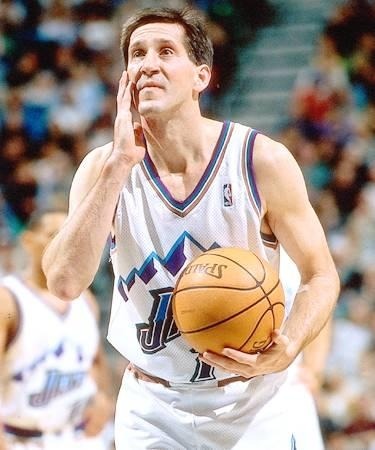
Many people are going to be surprised by this pick, not only that he made the list at all, but that I've placed him ahead of a man who was a bona fide star, while Jeff Hornacek is most remembered for being the 3-point shooter that played alongside Karl Malone and John Stockton for years in Utah. But there is more to Hornacek than that. And he was a better player than you may remember.

In his 14-year career, Jeff started for 6 Western Conference Finalists and 2 NBA Finalists, mostly with the Utah Jazz but also with the Phoenix Suns early in his career. And while he is often remembered as being in Malone and Stockton's shadow, it wasn't always that way. In 1996, when Utah made its first of 3 straight trips to the Western Conference Finals, it was Hornacek, and not Stockton, that was the #2 player for the Jazz. Consider their postseason stats:

Hornacek - 17.5 pts, 3.6 reb, 3.3 ast, .502 FG%, .586 3P%, .890 FT%
Stockton - 11.1 pts, 3.2 reb, 10.8 ast, .446 FG%, .289 3P%, .814 FT%

No argument can be made to say that Hornacek was not the better player in that postseason. Perhaps that explains why the Jazz failed to make the NBA Finals that season, but it was the single best postseason of Hornacek's career. Stockton brought the assists as always, but he was far from his usual dominant numbers that year.

You may also remember that Hornacek was the centerpiece of the trade that brought Charles Barkley to Phoenix from Philadelphia. Many thought that the trade was very one-sided, but Hornacek, the Suns' best player at the time, was just as valuable as Barkley in the season prior to the trade. Here are their numbers from 1992:

Hornacek - 20.1 pts, 5.0 reb, 5.1 ast, .512 FG%, .439 3P%, .886 FT%
Barkley - 23.1 pts, 11.1 reb, 4.1 ast, .552 FG%, .234 3P%, .695 FT%

Barkley was naturally the better rebounder, and Hornacek was a much better shooter from long distance and the free throw line. Both had excellent percentages from the field for their respective positions, and both scored at least 20 points per game. The reason that the trade is viewed as a win for the Suns is that they enjoyed a 9-game improvement while the Sixers suffered a 9-game decline. Part of this may be due to the fact that Barkley was allowed to play his natural position and was the unquestioned team leader, while Hornacek was forced to play point guard so that Hersey Hawkins could remain at shooting guard.

But was Hornacek better than Walter Davis? Let's take a look at their career values in the graph below.


Davis may have been the more talented player, but he failed to even approach his full potential. Hornacek, on the other hand, may have played at the highest level he possibly could have throughout his career, and the results show a very steady and strong career. Davis' peaks were higher, but they were too few and far between, but you could count on Hornacek to be there year after year, giving everything he had to push his teams into the playoffs. And that is why he makes this list at #95, one of the forgotten best players of all time.