Showing posts with label Kareem Abdul-Jabbar. Show all posts

Friday, December 3, 2021

Top 25 NBA 10-Year Runs

This is a list of the top 25 decades registered by players in NBA history, using the same method used to determine my all-time top 100 players. Only the top decade for each player is ranked, but any other qualifying 10-year periods are included where they would have been ranked if included (* indicates awards that didn't exist at the time, award is assumed):

1. LeBron James - SF/PF/PG - MIA/CLE/LAL - 2010-20

26.5 Pts, 7.7 Reb, 7.7 Ast, 1.5 Stl, 0.7 Blk, .528 FG%, .355 3P%, .727 FT%

Assist Leader

4x Champion, 5x Finals loss

4x Finals MVP, 2x MVP, 9x All-NBA First Team, All-NBA Third Team, 3x All-Defensive First Team, All-Defensive Second Team, 9x Top 4 in MVP voting


1a. LeBron James - SF/PF - CLE/MIA/CLE - 2008-18

1b. LeBron James - SF/PF/PG - MIA/CLE/LAL - 2011-21

1c. LeBron James - SF/PF - CLE/MIA/CLE - 2007-17

1d. LeBron James - SF/PF - CLE/MIA/CLE - 2009-19

1e. LeBron James - SF/PF - CLE/MIA/CLE - 2006-16


2. Michael Jordan - SG - CHI - 1987-98

31.4 Pts, 6.4 Reb, 5.5 Ast, 2.5 Stl, 0.8 Blk, .509 FG%, .346 3P%, .834 FT%

9x Scoring leader, 3x Steals leader

6x Champion, 2x Conference Finals loss, 2x Second Round loss

6x Finals MVP, 5x MVP, Defensive Player of the Year, 9x All-NBA First Team, 9x All-Defensive First Team, 9x Top 3 in MVP voting


2a. Michael Jordan - SG/SF - CHI/WAS - 1988-02

2b. Michael Jordan - SG - CHI - 1986-97


3. Wilt Chamberlain - C - PHW/SFW/PHI/LAL - 1959-69

34.4 Pts, 24.3 Reb, 4.5 Ast, .530 FG%, .514 FT%

7x Scoring leader, 8x Rebounding leader, 7x Field Goal Percentage leader, Assist leader

Champion, 2x Finals loss, 5x Conference Finals loss, Second Round loss

*Finals MVP, 4x MVP, Rookie of the Year, 7x All-NBA First Team, 2x All-NBA Second Team, 8x Top 5 in MVP voting


4. Magic Johnson - PG - LAL - 1981-91

19.8 Pts, 7.2 Reb, 11.9 Ast, 1.8 Stl, 0.4 Blk, .520 FG%, .303 3P%, .855 FT%

4x Assist leader, Steals leader, Free Throw Percentage Leader

4x Champion, 4x Finals loss, Conference Finals loss, Second Round loss

2x Finals MVP, 3x MVP, 9x All-NBA First Team, All-NBA Second Team, 9x Top 3 in MVP voting


4a. LeBron James - SF/PF - CLE/MIA/CLE - 2005-15

4b. Michael Jordan - SG/SF - CHI/WAS - 1989-03

4c. Wilt Chamberlain - C - PHW/SFW/PHI/LAL - 1960-70

4d. Magic Johnson - PG - LAL - 1979-89


5. Shaquille O'Neal - C - ORL/LAL - 1994-04

27.3 Pts, 11.7 Reb, 3.0 Ast, 0.7 Stl, 2.4 Blk, .576 FG%, .063 3P%, .530 FT%

2x Scoring leader, 6x Field Goal Percentage leader

3x Champion, 2x Finals loss, 2x Conference Finals loss, 3x Second Round loss

3x Finals MVP, MVP, 6x All-NBA First Team, 2x All-NBA Second Team, 2x All-NBA Third Team, 3x All-Defensive Second Team, 6x Top 5 in MVP voting


5a. Magic Johnson - PG - LAL - 1980-90

5b. Michael Jordan - SG - CHI - 1985-96

5c. Wilt Chamberlain - C - PHW/SFW/PHI/LAL - 1961-71

5d. Magic Johnson - PG/PF - LAL - 1982-96

5e. LeBron James - SF/PF - CLE/MIA - 2004-14

5f. Shaquille O'Neal - C - ORL/LAL - 1993-03

5g. Shaquille O'Neal - C - LAL/MIA - 1996-06


6. Bill Russell - C - BOS - 1958-68

15.8 Pts, 23.4 Reb, 4.5 Ast, .442 FG%, .577 FT%

3x Rebounding leader

9x Champion, Conference Finals loss

*7x Finals MVP, 4x MVP, 3x All-NBA First Team, 7x All-NBA Second Team, 9x Top 4 in MVP voting


6a. Shaquille O'Neal - C - ORL/LAL/MIA - 1995-05

6b. Bill Russell - C - BOS - 1959-69

6c. Bill Russell - C - BOS - 1956-66

6d. Shaquille O'Neal - C - ORL/LAL - 1992-02

6e. Bill Russell - C - BOS - 1957-67

6f. Shaquille O'Neal - C - LAL/MIA - 1997-07

6g. Wilt Chamberlain - C - PHW/SFW/PHI/LAL - 1962-72

6h. Michael Jordan - SG - CHI - 1984-95

6i. LeBron James - SF/PF/SG - CLE/MIA - 2003-13

6j. Wilt Chamberlain - C - SFW/PHI/LAL - 1963-73

6k. Shaquille O'Neal - C - LAL/MIA/PHX - 1998-08


7. Kareem Abdul-Jabbar - C - MIL/LAL - 1970-80

28.2 Pts, 14.4 Reb, 4.5 Ast, 1.2 Stl, 3.5 Blk, .559 FG%, .719 FT%

2x Scoring Leader, 4x Block leader, Rebounding leader, Field Goal Percentage leader

2x Champion, Finals loss, 2x Conference Finals loss, 2x Second Round loss, First Round loss

Finals MVP, 6x MVP, 7x All-NBA First Team, 2x All-NBA Second Team, 4x All-Defensive First Team, 4x All-Defensive Second Team, 10x Top 5 in MVP voting


8. Tim Duncan - PF/C - SAS - 1998-08

21.7 Pts, 11.8 Reb, 3.2 Ast, 0.8 Stl, 2.4 Blk, .503 FG%, .207 3P%, .686 FT%

4x Champion, 2x Conference Finals loss, 3x Second Round loss

3x Finals MVP, 2x MVP, 8x All-NBA First Team, 2x All-NBA Second Team, 8x All-Defensive First Team, 2x All-Defensive Second Team, 8x Top 5 in MVP voting


8a. Tim Duncan - PF/C - SAS - 1997-07

8b. Shaquille O'Neal - C - LAL/MIA/PHX - 1999-09


9. Kobe Bryant - SG - LAL - 2000-10

28.5 Pts, 5.8 Reb, 5.2 Ast, 1.7 Stl, 0.5 Blk, .456 FG%, .342 3P%, .843 FT%

2x Scoring leader

5x Champion, 2x Finals loss, Second Round loss, 2x First Round loss

2x Finals MVP, MVP, 8x All-NBA First Team, All-NBA Second Team, All-NBA Third Team, 7x All-Defensive First Team, 2x All-Defensive Second Team, 8x Top 5 in MVP voting


10. Jerry West - PG/SG - LAL - 1963-73

28.0 Pts, 5.3 Reb, 7.2 Ast, .484 FG%, .833 FT%

Scoring leader, Assist leader

Champion, 6x Finals loss, 2x Second Round loss

Finals MVP, 8x All-NBA First Team, 2x All-NBA Second Team, 4x All-Defensive First Team, All-Defensive Second Team, 6x Top 5 in MVP voting


11. Bob Cousy - PG - BOS - 1953-63

18.3 Pts, 4.8 Reb, 7.9 Ast, .380 FG%, .805 FT%

7x Assist leader

6x Champion, Finals loss, 2x Conference Finals loss, Second Round loss

*2x Finals MVP, MVP, *2x MVP, 8x All-NBA First Team, 2x All-NBA Second Team, 4x Top 4 in MVP voting


11a. Tim Duncan - PF/C - SAS - 2000-10

11b. Jerry West - PG/SG - LAL - 1962-72


12. Julius Erving - SF - VIR/NYN/PHI - 1971-81

26.1 Pts, 9.9 Reb, 4.5 Ast, 2.1 Stl, 1.7 Blk, .505 FG%, .309 3P%, .781 FT%

3x Scoring leader

2x Champion, 2x Finals loss, 3x Conference Finals loss, 3x Second Round loss

2x Finals MVP, 4x MVP, 7x All-ABA/NBA First Team, 2x All-ABA/NBA Second Team, All-Defensive First Team, 7x Top 5 in MVP voting


12a. Kareem Abdul-Jabbar - C - MIL/LAL - 1973-83

12b. Tim Duncan - PF/C - SAS - 1999-09

12c. Kareem Abdul-Jabbar - C - MIL/LAL - 1969-79

12d. Kareem Abdul-Jabbar - C - MIL/LAL - 1971-81


13. Hakeem Olajuwon - C - HOU - 1985-95

24.4 Pts, 12.4 Reb, 2.7 Ast, 2.0 Stl, 3.7 Blk, .515 FG%, .178 3P%, .720 FT%

2x Rebounding leader, 3x Blocks leader

2x Champion, Finals loss, 2x Second Round loss, 4x First Round loss

2x Finals MVP, MVP, 2x Defensive Player of the Year, 5x All-NBA First Team, 2x All-NBA Second Team, 2x All-NBA Third Team, 5x All-Defensive First Team, All-Defensive Second Team, 5x Top 5 in MVP voting


13a. Jerry West - PG/SG - LAL - 1964-74

13b. Bob Cousy - PG - BOS - 1952-62

13c. Kareem Abdul-Jabbar - C - MIL/LAL - 1972-82

13d. Kobe Bryant - SG - LAL - 2001-11

13e. Kareem Abdul-Jabbar - C - LAL - 1975-85


14. Kevin Durant - SF/PF - OKC/GSW/BKN - 2010-21

27.6 Pts, 7.4 Reb, 4.7 Ast, 1.1 Stl, 1.2 Blk, .506 FG%, .389 3P%, .883 FT%

3x Scoring leader, Free Throw Percentage leader

2x Champion, 2x Finals loss, 3x Conference Finals loss, 2x Second Round loss

2x Finals MVP, MVP, 5x All-NBA First Team, 3x All-NBA Second Team, 5x Top 5 in MVP voting


14a. Kobe Bryant - SG - LAL - 1999-09

14b. Kareem Abdul-Jabbar - C - LAL - 1976-86


15. Larry Bird - SF/PF - BOS - 1980-90

25.3 Pts, 10.1 Reb, 6.5 Ast, 1.8 Stl, 0.9 Blk, .502 FG%, .367 3P%, .888 FT%

4x Free Throw Percentage leader

3x Champion, 2x Finals loss, 2x Conference Finals loss, Second Round loss, First Round loss

2x Finals MVP, 3x MVP, 8x All-NBA First Team, All-NBA Second Team, 3x All-Defensive Second Team, 8x Top 3 in MVP voting


15a. Julius Erving - SF - VIR/NYN/PHI - 1972-82

15b. Kevin Durant - SF/PF - OKC/GSW - 2009-19

15c. Kobe Bryant - SG - LAL - 2002-12

15d. Tim Duncan - PF/C - SAS - 2001-11

15e. Jerry West - PG/SG - LAL - 1961-71

15f. Larry Bird - SF/PF - BOS - 1979-89

15g. Hakeem Olajuwon - C - HOU - 1987-97

15h. Julius Erving - SF - NYN/PHI - 1973-83

15i. Hakeem Olajuwon - C - HOU - 1986-96

15j. Jerry West - PG/SG - LAL - 1960-70

15k. Bob Cousy - PG - BOS - 1951-61

15l. Kareem Abdul-Jabbar - C - MIL/LAL - 1974-84


16. Russell Westbrook - PG - OKC/HOU - 2010-20

25.0 Pts, 7.6 Reb, 8.7 Ast, 1.8 Stl, 0.3 Blk, .442 FG%, .309 3P%, .799 FT%

2x Scoring leader, 2x Assist leader

Finals loss, 3x Conference Finals loss, Second Round loss, 4x First Round loss

MVP, 2x All-NBA First Team, 5x All-NBA Second Team, 2x All-NBA Third Team, 4x Top 5 in MVP voting


16a. Tim Duncan - PF/C - SAS - 2002-12

16b. Russell Westbrook - PG - OKC - 2009-19


17. Stephen Curry - PG - GSW - 2011-21

25.8 Pts, 4.7 Reb, 6.7 Ast, 1.7 Stl, 0.2 Blk, .478 FG%, .432 3P%, .906 FT%

2x Scoring leader, Steals leader, 3x Free Throw Percentage leader

3x Champion, 2x Finals loss, Second Round loss, First Round loss

2x MVP, 4x All-NBA First Team, 2x All-NBA Second Team, All-NBA Third Team, 4x Top 5 in MVP voting


18. James Harden - SG/PG - OKC/HOU/BKN - 2011-21

28.2 Pts, 6.0 Reb, 7.5 Ast, 1.7 Stl, 0.6 Blk, .447 FG%, .364 3P%, .861 FT%

3x Scoring leader, Assist leader

Finals loss, 2x Conference Finals loss, 4x Second Round loss, 3x First Round loss

MVP, Sixth Man of the Year, 6x All-NBA First Team, All-NBA Third Team, 6X Top 5 in MVP voting


18a. Kobe Bryant - SG - LAL - 2003-13

18b. Hakeem Olajuwon - C - HOU - 1988-98

18c. Stephen Curry - PG - GSW - 2009-19

18d. Russell Westbrook - PG - OKC/HOU/WAS - 2011-21


19. George Mikan - C - MNL - 1948-56

23.1 Pts, 13.4 Reb, 2.8 Ast, .404 FG%, .782 FT%

3x Scoring leader, 2x Rebounding leader

5x Champion, Conference Finals loss, Second Round loss

*5x Finals MVP, *5x MVP, 6x All-NBA First Team


19a. Kareem Abdul-Jabbar - C - LAL - 1977-87

19b. Kevin Durant - SF/PF - OKC/GSW - 2008-18

19c. Stephen Curry - PG - GSW - 2010-20

19d. Bob Cousy - PG - BOS - 1950-60

19e. Hakeem Olajuwon - C - HOU - 1989-99

19f. Larry Bird - SF/PF - BOS - 1981-91

19g. Russell Westbrook - PG - OKC - 2008-18


20. Oscar Robertson - PG - CIN/MIL - 1961-71

28.1 Pts, 8.0 Reb, 10.1 Ast, .491 FG%, .839 FT%

Scoring leader, 6x Assist leader, 2x Free Throw Percentage leader

Champion, 2x Conference Finals loss, 4x Second Round loss

MVP, 8x All-NBA First Team, 2x All-NBA Second Team, 8x Top 5 in MVP voting


20a. Kareem Abdul-Jabbar - C - LAL - 1978-88

20b. James Harden - SG/PG - OKC/HOU/BKN - 2010-20

20c. Shaquille O'Neal - C - LAL/MIA/PHX/CLE - 2000-10


21. John Stockton - PG - UTA - 1987-97

15.6 Pts, 2.9 Reb, 12.8 Ast, 2.6 Stl, 0.2 Blk, .524 FG%, .392 3P%, .829 FT%

9x Assist leader, 2x Steals leader

Finals loss, 3x Conference Finals loss, 2x Second Round loss, 4x First Round loss

2x All-NBA First Team, 6x All-NBA Second Team, 2x All-NBA Third Team


22. Steve Nash - PG - DAL/PHX - 2001-11

16.9 Pts, 3.3 Reb, 10.0 Ast, 0.8 Stl, 0.1 Blk, .497 FG%, .436 3P%, .910 FT%

5x Assist leader, 2x Free Throw Percentage leader

4x Conference Finals loss, 2x Second Round loss, 2x First Round loss

2x MVP, 3x All-NBA First Team, 2x All-NBA Second Team, 2x All-NBA Third Team, 3x Top 2 in MVP voting


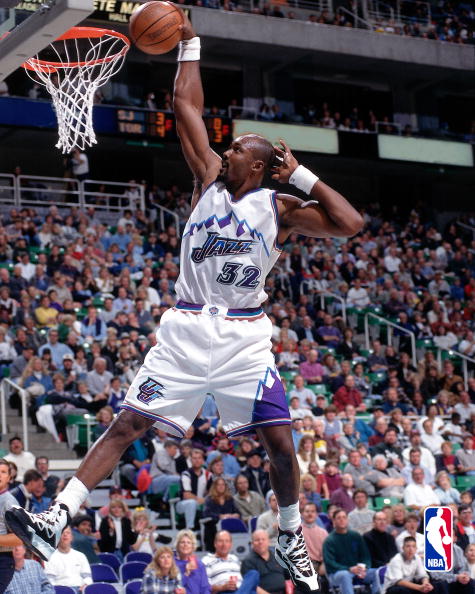
23. Karl Malone - PF - UTA - 1990-00

26.7 Pts, 10.6 Reb, 3.8 Ast, 1.4 Stl, 0.9 Blk, .526 FG%, .260 3P%, .755 FT%

2x Finals loss, 3x Conference Finals loss, 3x Second Round loss, 2x First Round loss

2x MVP, 9x All-NBA First Team, All-NBA Second Team, 3x All-Defensive First Team, 7x Top 5 in MVP voting


23a. Steve Nash - PG - DAL/PHX - 2000-10

23b. Hakeem Olajuwon - C - HOU - 1984-94

23c. Karl Malone - PF - UTA - 1989-99


24. Dwyane Wade - SG - MIA - 2004-14

25.1 Pts, 5.1 Reb, 6.1 Ast, 1.8 Stl, 1.0 Blk, .494 FG%, .288 3P%, .766 FT%

Scoring leader

3x Champion, 2x Finals loss, Conference Finals loss, 3x First Round loss

Finals MVP, 2x All-NBA First Team, 3x All-NBA Second Team, 3x All-NBA Third Team, 3x All-Defensive Second Team, 2x Top 5 in MVP voting


24a. Kobe Bryant - SG - LAL - 1998-08

24b. Larry Bird - SF - BOS - 1982-92

24c. Steve Nash - PG - DAL/PHX - 2002-12

24d. Kobe Bryant - SG - LAL - 2004-14

24e. Julius Erving - SF - NYN/PHI - 1974-84

24f. John Stockton - PG - UTA - 1988-98

24g. Oscar Robertson - PG - CIN - 1960-70

24h. Dwyane Wade - SG/PG - MIA - 2003-13

24i. Oscar Robertson - PG - CIN/MIL - 1962-72

24j. Karl Malone - PF - UTA - 1991-01

24k. Karl Malone - PF - UTA - 1988-98

24l. Hakeem Olajuwon - C - HOU - 1990-00

24m. Tim Duncan - PF/C - SAS - 2004-14

24n. John Stockton - PG - UTA - 1989-99

24o. Kobe Bryant - SG - LAL - 2005-15

24p. Tim Duncan - PF/C - SAS - 2003-13

24q. John Stockton - PG - UTA - 1990-00

24r. Kareem Abdul-Jabbar - C - LAL - 1979-89

24s. Julius Erving - SF - NYN/PHI - 1975-85

24t. Hakeem Olajuwon - C - HOU - 1991-01

24u. John Stockton - PG - UTA - 1986-96


25. Elgin Baylor - SF - MNL/LAL - 1958-68

28.1 Pts, 14.2 Reb, 4.2 Ast, .426 FG%, .783 FT%

5x Finals loss, 3x Conference Finals loss, 2x Second Round loss

Rookie of the Year, 9x All-NBA First Team, 6x Top 5 in MVP voting

Friday, November 19, 2021

Top 25 NBA Seasons of All Time - Playoffs Included

This is a list of the top full seasons in all of NBA history using the same method I used to rank my top 100 players of all time, with one season ranked per player, and other qualifying seasons by a player already ranked inserted in between in the spot they would have ranked. Regular season stats marked RS, Playoff stats marked PS, * means award did not exist at the time, presumed winner:

1. LeBron James - SF - CLE - 2015-16

RS: 25.3 Pts (#5), 7.4 Reb, 6.8 Ast (#9), 1.4 Stl, 0.6 Blk, .520 FG% (#14), .309 3P%, .731 FT%

PS: 26.3 Pts (#5), 9.5 Reb (#8), 7.6 Ast (#3), 2.3 Stl (#5), 1.3 Blk (#11), .525 FG% (#17), .340 3P%, .661 FT%

Finals MVP, All-NBA First Team, #3 in MVP voting


1b. LeBron James - PG - LAL - 2019-20


2. Wilt Chamberlain - C - PHI - 1966-67

RS: 24.1 Pts (#5), 24.2 Reb (#1), 7.8 Ast (#3), .683 FG% (#1), .441 FT%

PS: 21.7 Pts (#7), 29.1 Reb (#1), 9.0 Ast (#2), .579 FG% (#2), .390 FT%

MVP, Finals MVP*, All-NBA First Team


3. Shaquille O'Neal - C - LAL - 1999-00

RS: 29.7 Pts (#1), 13.6 Reb (#2), 3.8 Ast, 0.5 Stl, 3.0 Blk (#3), .574 FG% (#1), .524 FT%

PS: 30.7 Pts (#1), 15.4 Reb (#1), 3.1 Ast, 0.6 Stl, 2.4 Blk (#6), .566 FG% (#2), .456 FT%

MVP, Finals MVP, All-NBA First Team, All-Defensive Second Team


4. Julius Erving - SF - NYN - 1975-76

RS: 29.3 Pts (#1), 11.0 Reb (#5), 5.0 Ast (#7), 2.5 Stl (#3), 1.9 Blk (#7), .507 FG% (#10), .330 3P% (#6), .801 FT%

PS: 34.7 Pts (#1), 12.6 Reb (#2), 4.9 Ast (#6), 1.9 Stl (#3), 2.0 Blk (#3), .533 FG% (#6), .222 3P%, .804 FT% (#14)

MVP, Finals MVP, All-ABA First Team, All-Defensive First Team


5. Michael Jordan - SG - CHI - 1990-91

RS: 31.5 Pts (#1), 6.0 Reb, 5.5 Ast, 2.7 Stl (#3), 1.0 Blk, .539 FG% (#12), .312 3P%, .851 FT%

PS: 31.1 Pts (#1), 6.4 Reb, 8.4 Ast (#7), 2.4 Stl (#5), 1.4 Blk (#7), .524 FG%, .385 3P% (#11), .845 FT%

MVP, Finals MVP, All-NBA First Team, All-Defensive First Team


6. Magic Johnson - PG - LAL - 1986-87

RS: 23.9 Pts (#10), 6.3 Reb, 12.2 Ast (#1), 1.7 Stl (#16), 0.5 Blk, .522 FG%, .205 3P%, .848 FT% (#20)

PS: 21.8 Pts (#12), 7.7 Reb (#18), 12.2 Ast (#1), 1.7 Stl (#9), 0.4 Blk, .539 FG% (#20), .200 3P%, .831 FT%

MVP, Finals MVP, All-NBA First Team


6a. Shaquille O'Neal - C - LAL - 2000-01

6b. LeBron James - SF - MIA - 2011-12


7. Kareem Abdul-Jabbar - C - LAL - 1979-80

RS: 24.8 Pts (#6), 10.8 Reb (#8), 4.5 Ast, 1.0 Stl, 3.4 Blk (#1), .604 FG% (#2), .765 FT%

PS: 31.9 Pts (#2), 12.1 Pts (#2), 3.1 Ast, 1.1 Stl (#20), 3.9 Blk (#1), .572 FG% (#3), .790 FT%

MVP, All-NBA First Team, All-Defensive First Team, Won Finals


8. Giannis Antetokounmpo - PF - MIL - 2020-21

RS: 28.1 Pts (#5), 11.0 Reb (#8), 5.9 Ast, 1.2 Stl, 1.2 Blk (#16), .569 FG% (#13), .303 3P%, .685 FT%

PS: 30.2 Pts (#7), 12.8 Reb (#1), 5.1 Ast (#17), 1.0 Stl (#19), 1.2 Blk (#6), .569 FG% (#11), .186 3P%, .587 FT%

Finals MVP, All-NBA First Team, All-Defensive First Team, #4 in MVP voting


9. Tim Duncan - PF - SAS - 2002-03

RS: 23.3 Pts (#7), 12.9 Reb (#3), 3.9 Ast, 0.7 Stl, 2.9 Blk (#3), .513 FG% (#7), .710 FT%

PS: 24.7 Pts (#8), 15.4 Reb (#4), 5.3 Ast (#12), 0.6 Stl, 3.3 Blk (#1), .529 FG% (#10), .677 FT%

MVP, Finals MVP, All-NBA First Team, All-Defensive First Team


10. Hakeem Olajuwon - C - HOU - 1994-95

RS: 27.8 Pts (#2), 10.8 Reb (#8), 3.5 Ast, 1.8 Stl (#9), 3.4 Blk (#2), .517 FG%, .756 FT%

PS: 33.0 Pts (#1), 10.3 Reb (#9), 4.5 Ast (#17), 1.2 Stl (#15), 2.8 Blk (#3), .531 FG% (#12), .681 FT%

Finals MVP, All-NBA Third Team, #5 in MVP voting


10b. Michael Jordan - SG - CHI - 1992-93


11. George Mikan - C - MNL - 1948-49

RS: 28.3 Pts (#1), 3.6 Ast (#8), .416 FG% (#2), .772 FT% (#14)

PS: 30.3 Pts (#1), 2.1 Ast, .454 FG% (#2), .802 FT% (#8)

MVP*, Finals MVP*, All-BAA First Team


11a. Hakeem Olajuwon - C - HOU - 1993-94

11b. Michael Jordan - SG - CHI - 1991-92

11c. LeBron James - PF - CLE - 2017-18

11d. Wilt Chamberlain - C - SFW - 1963-64

11e. Magic Johnson - PG - LAL - 1984-85

11f. Wilt Chamberlain - C - PHW - 1961-62

11g. LeBron James - SF - MIA - 2012-13


12. Stephen Curry - PG - GSW - 2016-17

RS: 25.3 Pts (#10), 4.5 Reb, 6.6 Ast (#12), 1.8 Stl (#7), 0.2 Blk, .468 FG%, .411 3P% (#15), .898 FT% (#6)

PS: 28.1 Pts (#5), 6.2 Reb, 6.7 Ast (#9), 2.0 Stl (#4), 0.2 Blk, .484 FG%, .419 3P%, .904 FT% (#14)

All-NBA Second Team, #6 in MVP voting, Won Finals


12a. Stephen Curry - PG - GSW - 2014-15

12b. George Mikan - C - MNL - 1949-50


13. Dwyane Wade - SG - MIA - 2005-06

RS: 27.2 Pts (#5), 5.7 Reb, 6.7 Ast (#11), 1.9 Stl (#6), 0.8 Blk, .495 FG%, .783 FT%

PS: 28.4 Pts (#4), 5.9 Reb, 5.7 Ast (#9), 2.2 Stl (#1), 1.1 Blk (#12), .497 FG%, .808 FT%

Finals MVP, All-NBA Second Team, #6 in MVP voting


13a. Shaquille O'Neal - C - LAL - 2001-02


14. Kobe Bryant - SG - LAL - 2008-09

RS: 26.8 Pts (#3), 5.2 Reb, 4.9 Ast, 1.5 Stl (#12), 0.5 Blk, .467 FG%, .351 3P%, .856 FT%

PS: 30.2 Pts (#2), 5.3 Reb, 5.5 Ast (#11), 1.7 Stl (#7), 0.9 Blk (#14), .457 FG%, .349 3P%, .883 FT% (#16)

Finals MVP, All-NBA First Team, All-Defensive First Team, #2 in MVP voting


14a. Michael Jordan - SG - CHI - 1996-97


15. George McGinnis - PF - IND - 1974-75

RS: 29.8 Pts (#1), 14.3 Reb (#5), 6.3 Ast (#3), 2.6 Stl (#2), 0.7 Blk, .451 FG%, .354 3P% (#4), .724 FT%

PS: 32.3 Pts (#2), 15.9 Reb (#4), 8.2 Ast (#2), 2.0 Stl (#5), 0.6 Blk (#13), .468 FG%, .315 3P% (#6), .688 FT%

MVP, All-ABA First Team, Won Finals


15a. Magic Johnson - PG - LAL - 1987-88

15b. LeBron James - SF - CLE - 2016-17


16. Moses Malone - C - PHI - 1982-83

RS: 24.5 Pts (#5), 15.3 Reb (#1), 1.3 Ast, 1.1 Stl, 2.0 Blk (#10), .501 FG%, .761 FT%

PS: 26.0 Pts (#3), 15.8 Reb (#1), 1.5 Ast, 1.5 Stl (#10), 1.9 Blk (#5), .536 FG% (#14), .717 FT%

MVP, Finals MVP, All-NBA First Team, All-Defensive First Team


17. Larry Bird - SF - BOS - 1983-84

RS: 24.2 Pts (#7), 10.1 Reb (#10), 6.6 Ast (#13), 1.8 Stl (#11), 0.9 Blk, .492 FG%, .247 3P%, .888 FT% (#1)

PS: 27.5 Pts (#4), 11.0 Reb (#5), 5.9 Ast (#12), 2.3 Stl (#6), 1.2 Blk (#14), .524 FG%, .412 3P% (#2), .879 FT% (#19)

MVP, Finals MVP, All-NBA First Team, All-Defensive Second Team


17a. Kareem Abdul-Jabbar - C - MIL - 1970-71


18. Bill Russell - C - BOS - 1964-65

RS: 14.1 Pts, 24.1 Reb (#1), 5.3 Ast (#5), .438 FG%, .573 FT%

PS: 16.5 Pts (#12), 25.2 Reb (#2), 6.3 Ast (#2), .527 FG% (#3), .526 FT%

MVP, Finals MVP*, All-NBA First Team


19. Bob Cousy - PG - BOS - 1958-59

RS: 20.0 Pts (#9), 5.5 Reb, 8.6 Ast (#1), .384 FG%, .855 FT% (#4)

PS: 19.5 Pts (#9), 6.9 Reb (#14), 10.8 Ast (#1), .326 FG%, .745 FT%

Finals MVP*, All-NBA First Team, #4 in MVP voting


20. Rick Barry - SF - GSW - 1974-75

RS: 30.6 Pts (#2), 5.7 Reb, 6.2 Ast (#6), 2.9 Stl (#1), 0.4 Blk, .464 FG%, .904 FT% (#1)

PS: 28.2 Pts (#2), 5.5 Reb (#20), 6.1 Ast (#5), 2.9 Stl (#3), 0.9 Blk (#11), .444 FG%, .918 FT% (#3)

Finals MVP, All-NBA First Team, #4 in MVP voting


20a. Michael Jordan - SG - CHI - 1995-96

20b. Michael Jordan - SG - CHI - 1997-98

20c. Kareem Abdul-Jabbar - C - MIL - 1973-74

20d. Larry Bird - SF - BOS - 1985-86

20e. LeBron James - SF - CLE - 2008-09


21. Russell Westbrook - PG - OKC - 2015-16

RS: 23.5 Pts (#8), 7.8 Reb, 10.4 Ast (#2), 2.0 Stl (#5), 0.3 Blk, .454 FG%, .296 3P%, .812 FT%

PS: 26.0 Pts (#6), 6.9 Reb (#17), 11.0 Ast (#1), 2.6 Stl (#1), 0.1 Blk, .405 FG%, .324 3P%, .829 FT%

All-NBA First Team, #4 in MVP voting, lost in Conference Finals


22. Kevin Durant - SF - GSW - 2017-18

RS: 26.4 Pts (#6), 6.8 Reb, 5.4 Ast, 0.7 Stl, 1.8 Blk (#5), .516 FG% (#20), .419 3P% (#18), .889 FT% (#8)

PS: 29.0 Pts (#4), 7.8 Reb (#16), 4.7 Ast (#18), 0.7 Stl, 1.2 Blk (#11), .487 FG%, .341 3P%, .901 FT% (#7)

Finals MVP, All-NBA First Team, #7 in MVP voting


22a. Julius Erving - SF - NYN - 1973-74


23. Jerry West - PG - LAL - 1971-72

RS: 25.8 Pts (#7), 4.2 Reb, 9.7 Ast (#1), .477 FG%, .814 FT% (#13)

PS: 22.9 Pts (#10), 4.9 Reb, 8.9 Ast (#1), .376 FG%, .830 FT% (#20)

All-NBA First Team, All-Defensive First Team, #2 in MVP voting, Won Finals


24. Connie Hawkins - C - PTP - 1967-68

RS: 26.8 Pts (#1), 13.5 Reb (#2), 4.6 Ast (#3), .519 FG% (#2), .764 FT%

PS: 29.9 Pts (#1), 12.3 Reb (#5), 4.6 Ast (#3), .594 FG% (#1), .729 FT%

MVP, Finals MVP, All-ABA First Team


24a. Tim Duncan - C - SAS - 2006-07

24b. Tim Duncan - C - SAS - 2004-05


25. Arnie Risen - C - ROC - 1950-51

RS: 16.3 Pts (#9), 12.0 Reb (#4), 2.4 Ast, .401 FG% (#11), .734 FT%

PD: 19.5 Pts (#3), 14.0 Reb (#2), 2.4 Ast (#13), .389 FG% (#16), .644 FT%

Finals MVP*

Friday, October 29, 2021

Top 100 NBA Players: #2 - Kareem Abdul-Jabbar


Kareem Abdul-Jabbar

Teams

Milwaukee Bucks - 1969-75

Los Angeles Lakers - 1975-89


Playoffs

Appearances - 18 (1971,1972,1973,1974,1977,1978,1979,1980,1981,1982,1983,1984,1985,1986,1987,1988,1989)

Conference Finals - 14 (1970,1971,1972,1974,1977,1980,1982,1983,1984,1985,1986,1987,1988,1989)

NBA Finals - 10 (1971,1974,1980,1982,1983,1984,1985,1987,1988,1989)

Championships - 6 (1971,1980,1982,1985,1987,1988)


Awards and Honors

Rookie of the Year - 1970

MVP - 6 (1971,1972,1974,1976,1977,1979,1980)

Finals MVP - 2 (1971,1980,1985)

All-NBA First Team - 10 (1970,1971,1972,1973,1974,1975,1976,1977,1978,1979,1980,1981,1984,1986)

All-NBA Second Team - 5 (1970,1978,1979,1982,1983,1984,1985)

Hall of Fame - 1995

*(actual in bold, deserved in italics)


All-Time Ranks

Total Points - #1

Total Blocks - #3

Total Rebounds - #4

Blocks Per Game - #8

Points Per Game - #17

Field Goal Percentage - #21

Rebounds Per Game - #31

Total Assists - #45


League Leads

Field Goal Percentage (#1-1977, #2-1971,1972,1974,1979,1980, #3-1973, #4-1975,1978,1982,1983,1985, #5-1976,1981,1987)

Total Points (#1-1970,1971,1972, #2-1973,1974,1976,1977, #4-1975,1981, #5-1980)

Points Per Game (#1-1971,1972, #2-1970,1973,1976, #3-1974,1975,1977, #4-1978,1981)

Total Blocks (#1-1976,1977,1979,1980, #2-1974,1975,1981, #4-1978,1982)

Rebounds Per Game (#1-1976, #2-1977, #3-1970,1972,1979, #4-1971,1973,1974, #5-1975)

Blocks Per Game (#1-1975,1976,1979,1980, #2-1974,1977,1978, #3-1981,1982)

Total Rebounds (#1-1976,1977, #2-1972, #3-1970,1971,1974, #4-1979, #5-1973)


After being named the National Player of the Year 3 times, winning 3 straight national championships, and 3 straight Most Oustanding Player of the NCAA Tournament awards at UCLA, Kareem Abdul-Jabbar (then known as Lew Alcindor) was the #1 overall pick in the NBA Draft by the Milwaukee Bucks.

As a rookie, Alcindor finished #2 in the league in scoring, with 28.8 per game, and third in rebounding with 14.5, and was easily named the Rookie of the Year. He led the Bucks from the worst record in the East the year before to the #2 seed, and he had 46 points and 25 rebounds in the deciding game of the first round, before the team's season ended in the second round.

The team traded for Oscar Robertson before the next season, and finished the season with the league's best record, with Alcindor averaging a league-leading 31.7 points per game along with 16.0 rebounds and winning his first MVP award. They lost only 2 games on their way to the NBA Finals, where they swept the Bullets, winning the championship and earning Alcindor the Finals MVP as well.

After the championship season, he announced that he wanted to be known by his Muslim name, Kareem Abdul-Jabbar, which he had used privately for several years. He had another dominant season, averaging 34.8 points and 16.6 rebounds, his second straight year leading the league in scoring, but the Bucks lost to the record-setting Lakers team in the Conference Finals, ending their bid for a repeat title.

After a slightly down year in 1973 (30.2 points, 16.1 rebounds, and 5.0 assists per game) that ended in a first-round playoff loss, he won his 3rd MVP in 4 years in 1974, and led the Bucks back to the NBA Finals for the second time in their history. They played the Boston Celtics in that series, and Abdul-Jabbar averaged 32.6 points, but they lost in 7 games.

Abdul-Jabbar privately requested a trade after that season after the retirement of Oscar Robertson, but nothing came of it at the time. He played one more season with the Bucks, averaging 30.0 points, 14.0 rebounds, and leading the league in blocks with 3.3 per game in the second season the stat was recorded. Despite his individual success, the team missed the playoffs, the first time in his life that he did not reach the postseason.

He was traded to the Los Angeles Lakers during the offseason, and he had his best individual season, averaging 27.7 points, 5.0 assists, and league-leading 16.9 rebounds and 4.1 blocks, both career highs as well. He was named the MVP for the 4th time due to his great play, but despite his dominance, the Lakers missed the playoffs.

His individual numbers dropped a bit the next year, but he was able to lead the Lakers to the best record in the league, winning his 5th MVP along the way. They reached the Conference Finals, where they met Bill Walton and the Trail Blazers, and they ended up being swept by Portland.

He broke his hand punching an opponent in the first game of the next season, which caused him to miss 20 games, the only major injury of his career, and that was the only season in which he was not named an All-Star. The next year he led the league in blocks for the third time, but they lost in the second round, which was the second and last time in his career that he would have consecutive seasons without reaching the Conference Finals.

Magic Johnson was drafted by the team in 1979, and Kareem went on to win his record 6th MVP that year, with averages of 24.8 points, 10.8 rebounds, 4.5 assists, and 3.4 blocks, which led the league again. The Lakers went all the way to the Finals, winning the championship over Philadelphia in 6 games, with Kareem sitting out the final game due to injury.

Kareem was still the Lakers' best player for one more season, while Magic Johnson missed the majority of the season due to injury. He averaged 26.2 points and 10.3 rebounds, the 12th straight season that he averaged at least 23 points and 10 rebounds. He averaged at least 20 points per game for 5 more seasons, making it 17 in a row to start his career, a feat that has been surpassed by only LeBron James.

He went on to win 4 more championships with the Lakers, 3 as the sidekick to Magic Johnson, and even won another Finals MVP in 1985, 14 years after his first. By the time he won his 6th and final championship in 1988, he was no longer playing at a star level, but he returned for one final season, retiring in 1989 at the age of 42.

Kareem has been the NBA's all-time scoring leader since he passed Wilt Chamberlain's record in 1984, and he is also currently #4 in rebounds and #3 in blocks, despite the stat not being tracked during his first 4 seasons. He reached the Conference Finals 14 times in his career, more than any other player ever, and played in 10 NBA Finals more than anyone but Bill Russell and Sam Jones. He won 6 championships, and was either the best or second-best player on 5 of those teams, and won 6 MVPs, the most of any player ever. No matter how you look at his career, he was one of the greatest players of all time.


Sunday, September 25, 2016

Top 100 NBA Players: #1 - Michael Jordan


Michael Jordan

Ask 100 people who the greatest player of all time is, and the top response will most likely be Michael Jordan, but it would be far from a landslide. Many others would get a significant number of votes, from Wilt Chamberlain, Bill Russell, and Oscar Robertson to Shaquille O'Neal, Kobe Bryant, and even LeBron James.  So what makes Michael Jordan the best player of all time?

There are five factors that I feel qualify a player to be considered one of the greatest of all time. Those are offensive and defensive prowess, regular season and playoff dominance, and longevity. By using these 5 factors, I'll show that Michael Jordan is the greatest player of all time.

First, offensive prowess. The purpose of offense is to score points, and there has never been a greater scorer than Michael Jordan. Wilt Chamberlain may own the record for points in a game and points per game for a full season, but Michael Jordan owns the record for most points per game over a full career. The five players with the highest career scoring averages are, in order:

Michael Jordan
Wilt Chamberlain
Kevin Durant
Elgin Baylor
LeBron James

Next, defensive prowess. This one is a little tougher to define, especially since the All-Defensive Team has only existed since 1969, Bill Russell's final season. Three players have appeared on the All-Defensive First Team nine times in their career, and if you add in Bill Russell and Wilt Chamberlain, both of whom were said to have blocked at least 8 shots in a game quite regularly, this is the list you come up with:

Michael Jordan
Kobe Bryant
Kevin Garnett
Bill Russell
Wilt Chamberlain

Then let's consider regular season dominance. Michael Jordan was the best player in the league for his final 9 seasons with the Chicago Bulls, and would have made it at least 11 if he hadn't kept retiring prematurely. He was the best player in 1988, and he was the best player in 1998, a feat only Kareem can match with his 1970 and 1980 seasons. The list of players who spent the longest time as the league's top star is as follows:

Wilt Chamberlain
Michael Jordan
Kareem Abdul-Jabbar
LeBron James
Larry Bird

Perhaps the most important category is playoff dominance. The whole point of playing the game is to win championships, and Jordan was the best player on more champions than anybody but Bill Russell. He made 6 trips to the NBA Finals in his career, and won all 6 times. The record for highest scoring average in a Finals series is 41.0, and it's no surprise that Jordan holds that record for his performance against the Phoenix Suns in 1993. Here is the list of the players who have led their teams to the most championships:

Bill Russell
Michael Jordan
Magic Johnson
Tim Duncan
Shaquille O'Neal
Larry Bird
LeBron James

Finally, let's look at longevity. When looking at this category, I'm looking at more than just playing for a long time. You must also play at a high level for a long period of time, and Michael Jordan fits that bill as well. In his first game after turning 40, he obliterated the old record for points by a player of that age. Kareem had held the record of 27, but Jordan poured in 43 that night, and scored at least 30 points 9 other times after his 40th birthday, meaning he owns the 10 highest-scoring games for a 40-year old player. Here are the 5 players who had the most productive seasons after the age of 35:

Karl Malone
Elgin Baylor
Kareem Abdul-Jabbar
Michael Jordan
Jerry West

There's only one player that appears on all 5 of these lists, and you've probably already guessed who that is. It's also worth noting that only two other players appear even 3 times on these lists, and those are Wilt Chamberlain and LeBron James, the two players I ranked just behind Jordan. Michael Jordan is the only player in history who has been dominant in every important facet of the game, which is what makes him the greatest of all time.

With that in mind, are there any current players that have a chance at displacing Jordan at the top? In my opinion, there are several that have a chance. The obvious one is LeBron James, who has already cracked three of these lists, and has already made the All-Defensive First Team six times, and has a head start on the longevity since he started so young. Another is Kevin Durant, who is a great offensive player and is improving on defense, and also entered the league very young, which could help his longevity. Russell Westbrook and Stephen Curry are also young and showing some promise, but do they have what it takes to be considered the greatest? It will be fun to watch and find out.

Saturday, September 24, 2016

Top 100 NBA Players: #2 - LeBron James


LeBron James

LeBron James is one of the youngest players on this entire list, yet he has somehow risen to #2 already, and #1 is an eventual possibility for him, whether you are a fan of his or not. Many try to say that LeBron is not that great, that he'll never be as great as Michael Jordan, but there are problems with that reasoning.

People say that Jordan was greater because he won 6 titles in 6 tries, and LeBron has 3 in 7 tries. The problem is that we are comparing 1990's Jordan with 2010's LeBron, when we should be comparing 2000's LeBron with 1980's Jordan. At the end of 2011, his first season in Miami, LeBron James was 26 years old. Here is a comparison of the career accomplishments and statistics of Jordan and LeBron at age 26:

Jordan - 6 playoffs, 2 conference finals, 0 NBA Finals, 1 MVP, 3 years as best player in the league
James - 6 playoffs, 3 conference finals, 2 NBA Finals, 2 MVP, 6 years as best player in the league

Jordan - 32.8 pts, 6.3 reb, 6.0 ast, 2.8 stl, 1.1 blk, .516 FG%, .282 3P%, .848 FT%
James - 27.7 pts, 7.1 reb, 7.0 ast, 1.7 stl, 0.8 blk, .479 FG%, .329 3P%, .744 FT%

When looking at them statistically, LeBron had more triple-double potential, but Jordan was still a little better overall. When looking at their accomplishments at age 26, LeBron is the clear-cut winner, matching or beating Jordan in every category. The fact is that back in the 1980's, people were saying the same things about Jordan that they used to say about LeBron, that he's great but he'll never lead his team to a title, that he doesn't know how to involve his teammates enough, etc. At age 27, Michael Jordan won his first of six NBA Championships, and LeBron did the same 21 years later.

Now let's take a look at Jordan and LeBron at age 31 (James' current age):

Jordan - 10 playoffs, 5 conference finals, 3 NBA Finals, 3 championships, 3 MVP's, 6 seasons as best player in the league
James - 11 playoffs, 8 conference finals, 7 NBA Finals, 3 championships, 4 MVP's, 8 seasons as best player in the league

Jordan - 32.2 pts, 6.3 reb, 5.9 ast, 2.7 stl, 1.0 blk, .514 FG%, .845 FT%
James - 27.2 pts, 7.2 reb, 6.9 ast, 1.7 stl, 0.8 blk, .498 FG%, .744 FT%

Statistically, both showed a small regression between 26 and 31, but it was very slight in both cases. LeBron did improve his shooting percentage by nearly 2 points, so the argument can be made that he slipped less. In terms of accomplishments, LeBron is still ahead of Jordan's pace in every category, although Jordan's year of retirement affected a couple of the numbers.

The fact is, you can't claim that LeBron will never be as great as Jordan based only on the fact that he has lost in the NBA Finals 4 times. In his 13 seasons on the Bulls, Jordan reached the Finals 6 times, and LeBron has done it 7 times in the same number of seasons. Twice, LeBron was able to drag a team to the Finals without a single healthy All-Star caliber player beside him, while Jordan had Pippen as support through all of his title seasons.

LeBron is the holder of many "youngest" records, including youngest #1 pick, youngest Rookie of the Year, youngest to record a triple-double, any many others. He is also one of 4 players in history to lead his team in all 5 of the major statistical categories for a full season, along with Dave Cowens, Scottie Pippen, and Kevin Garnett. In 2005, at the age of 20, LeBron was already the best player in the NBA, becoming only the third player to be the best within his first two seasons, and the other two happen to be Kareem and Wilt, who fell right behind him in these rankings.

Could LeBron James end up as the best player in the history of the NBA? Definitely. Will he? That depends on a lot of factors. If he is able to win championships in the next two seasons while maintaining his current level of play, it could be enough to surpass MJ. If he fails to win but continues his Finals streak, it would probably take 3. A lot depends on him maintaining his health, which has been steady throughout his career, and maintaining his drive to win, which can become tough after multiple titles. However it turns out, we are currently witnessing the prime years of one of the greatest players ever to wear an NBA uniform.

Friday, September 23, 2016

Top 100 NBA Players: #4 - Kareem Abdul-Jabbar


Kareem Abdul-Jabbar

Kareem Abdul-Jabbar dominated the 1970's in a way no decade has been dominated before or since, then adjusted to his role as sidekick to another superstar better than any other player in history, which allowed him to finish his career with 6 championships and 10 NBA Finals appearances.

There was no doubt that Kareem (then Lew Alcindor) would be the top pick in the 1969 NBA Draft, after he led UCLA to an 88-2 record in 3 seasons and 3 straight NCAA championships, where he was named the Most Outstanding Player each time. He easily won the Rookie of the Year trophy, and should have been given the MVP as well, but it was awarded to Willis Reed, who led the New York Knicks to the league's best record and their first championship that season. Here are how their numbers stacked up that year:

Alcindor - 28.8 pts, 14.5 reb, 4.1 ast, .518 FG%, .653 FT%
Reed - 21.7 pts, 13.9 reb, 2.0 ast, .507 FG%, .756 FT%

Although Reed may have led his team to a few more wins (Milwaukee had the second-best record), it's very easy to see that Kareem had the bigger impact, leading a team in its second year of existence to the league's second-best record and a trip to the Conference Finals. In fact, from 1969-1980, a span of 11 seasons, Kareem was the best player 8 times, with the only exceptions coming in two seasons in which he missed time with a broken hand and one season in which George Gervin was on top of his game. He holds the record for most MVP's won, with 6, but I believe he should have been awarded 8.

Even with how great he was for so long, he was only able to make it to 3 NBA Finals during his time as team leader, winning twice. There were even two seasons right during his peak seasons in which his teams missed the playoffs completely, which no other top 10 player can say. That all changed in 1981, when Magic Johnson became the center of the Lakers' offense and Kareem became their #2 star.

In the final 8 seasons of Kareem's career in Los Angeles, the Lakers made it to the Finals 7 times, and Kareem was a major contributor for most of those teams, although by the time he retired he was not near the player he had once been, posting just 10 points per game along with fewer than 5 rebounds.

Kareem is the NBA's all-time leader in All-Star appearances, MVP awards, points scored, and minutes played, and he is also one of only 3 players in history to win the scoring title, MVP, and Finals MVP in the same season, along with Michael Jordan and Shaquille O'Neal. That season was 1971, just his second season as a pro, when he averaged 31.7 points and 16.0 rebounds, took 133 out of 153 MVP votes, then led Milwaukee to the title by winning 12 of 14 in the playoffs and sweeping the Baltimore Bullets in the Finals. He was the first to do it, and it wouldn't happen again for 20 years, when Jordan won his first title.

Monday, September 19, 2016

Top 100 NBA Players: #8 - Karl Malone


Karl Malone

How can a player who never won a championship be ranked at #8, ahead of many of the greatest champions of all time? By being consistently among the best players in the league for a longer period than any other player in history, with the possible exception of Kareem Abdul-Jabbar.

Karl Malone was never the best player in the NBA for any single season, but he spent a longer period of time as the second-best player in the league than anyone else, and he led his team to the playoffs in each of his 19 seasons, making 3 appearances in the Finals and 3 more in the Conference Finals.

Malone was awarded two MVP awards during his career, but neither one was deserved. He won the first because voters were tired of picking one superstar, and he won the other because they weren't ready to recognize a new superstar yet. The first came in 1997, when he somehow beat out Michael Jordan to win the league's top individual award, but the numbers tell a different story:

Malone - 27.4 pts, 9.9 reb, 4.5 ast, 1.4 stl, .550 FG%, .755 FT%
Jordan - 29.6 pts, 5.9 reb, 4.3 ast, 1.7 stl, .486 FG%, .833 FT%

The two players each beat the other in 3 of these categories, which puts them pretty close to each other, but the Bulls won 5 more games than the Jazz that season, picking up 69 wins in all, tying the second-best record of all time, behind only their 72-10 record from the previous season, when Jordan took 109 out of 113 first-place votes for MVP.

Two years later, Malone was awarded his second MVP, but I feel that the voters weren't ready to hand the award to second-year player Tim Duncan, who had been nearly as good offensively and much better defensively than Malone, even with both teams finishing with identical records. I broke down the statistics on this one when I introduced Tim Duncan back at #10, if you want to look at it in more detail.

All of this would seem to drag Malone down a couple of spots, but there are also several very impressive aspects of Malone's career. Consider that he is one of only 2 players ever to average over 20 points per game for 17 straight seasons, along with Kareem, and he is also #2 all time in points scored, to Kareem as well. He never led the league in any major statistical category, but he was always among the league leaders in points and rebounds.

The fact that he played 19 seasons is pretty impressive in itself, and the fact that he made the playoffs in each of those seasons is more impressive still, but when you consider that he was not just playing, but playing at an All-Star level clear up to the end, that is something that sets him apart. He is the oldest player ever to record a triple-double, doing it at age 40 during his final season, and is also the oldest player ever to score 50 points, doing it at age 36 in a playoff game. He is also the oldest player ever to start for an NBA Finals team, holding the power forward position for the Los Angeles Lakers in his final season, the only time in his career he wasn't the best player on his team.

Malone's run as the league's #2 man almost as impressive. He first cracked the league's top 5 in 1988, when he was just 24 years old, and remained there until he was 36 years old in the year 2000, a run of 13 consecutive seasons. He was definitely the second-best player in the league for each of Michael Jordan's final three seasons with the Bulls, and seemed poised to take over as the top player when Tim Duncan strode in and dominated the 1999 season. Then, when Duncan was hurt near the end of the 2000 season, it seemed once again that an opening had been created for Malone, but Shaq stepped in to fill the void instead, and Malone lost his final chance to be the league's alpha dog.

In addition to him playing at a high level for so many years, he also rarely missed a game. Until his final season, he never missed more than 2 games in a single season, and nearly half the games he missed up to that point were due to suspensions. He was given the nickname "the Mailman" because he always delivered, and even though he may have missed a couple of deliveries in the Finals, can you really fault him for not being able to beat Michael Jordan at his peak? Malone played at a higher level for a longer period of time than any other player in the history of the NBA, and that's why he's the #8 player of all time.

Sunday, September 11, 2016

Top 100 NBA Players: #17 - Kevin Garnett


Kevin Garnett

Kevin Garnett is one of four active players to appear among the top 20 players of all time, and even though he is built like a praying mantis, he was a force in professional basketball for 18 seasons, and he is still playing into his 22nd season, making him by far the most experienced player remaining in the league.

Garnett was a major trail blazer for the current generation of NBA stars, jumping straight to the league from high school, the first player in 20 years to do so, but his success caused many to follow in his footsteps, from future stars like Kobe, LeBron, and Amare to busts like Korleone Young, DeSagana Diop, and Kwame Brown. Three of the four active players among my top 20 did not attend college, and who knows if that would have happened without Garnett taking a risk in 1995.

Garnett was drafted by the Minnesota Timberwolves, and it is because of him that the franchise even has any history to celebrate. They made the playoffs for the first time in Garnett's second year, which started a string of 8 consecutive playoff appearances, since which they have not returned to the postseason. Garnett was the team's best player every time they made the playoffs, and during that run he missed a total of 11 games, an incredible feat for a player who looks so fragile.

The eighth year of that run was a magical one for Garnett and the Timberwolves. It was the only time in franchise history that the Wolves won a playoff series, and they actually won two of them, advancing clear to the Western Conference Finals, where the Lakers dispatched them on their way to a three-peat. Garnett was named the MVP that season, and there is absolutely no doubt in my mind that he deserved it. In my opinion, the only more dominant season in the last 20 years was Shaq's 2000 campaign. Here is a comparison of Garnett and Kobe Bryant, his nearest competitor, from that season:

Garnett - 24.2 pts, 13.9 reb, 5.0 ast, 1.5 stl, 2.2 blk, .499 FG%, .791 FT%
Bryant - 24.0 pts, 5.5 reb, 5.1 ast, 1.7 stl, 0.4 blk, .438 FG%, .852 FT%

I don't think I even need to do any explanation as to why Garnett was the MVP, because the numbers do the talking. In NBA history, there have only been six times that a player has matched Garnett's scoring, rebounding, and assists numbers from that season in any single year. It was done by Wilt three times, Kareem twice, and Elgin Baylor once. The most recent of those seasons was Kareem in 1976, and it hasn't been done by anyone but Garnett since.

After that season the Timberwolves sank back into mediocrity, with Garnett toiling away as a superstar on a bad team, until the summer of 2007, when he was rescued by the Boston Celtics, who had decided they wanted to pursue a championship, since it had been over a decade since they had really tried, and with Garnett leading the way, Boston won their first title in over two decades. Paul Pierce was named the Finals MVP, but I think the award should have gone to Garnett, and here are the stats from the playoffs to back up my point:

Garnett - 20.4 pts, 10.5 reb, 3.3 ast, 1.3 stl, 1.1 blk, .495 FG%, .810 FT%
Pierce - 19.7 pts, 5.0 reb, 4.6 ast, 1.1 stl, 0.3 blk, .441 FG%, .802 FT%

Okay, now I'm no expert (well, maybe I am), but when one player is better in 6 of 7 statistical categories, and the other is reasonably close, that player is better, especially since being teammates eliminates the pace factor from the argument. Garnett was the MVP of the 2008 Finals, but Celtics fans helped select Pierce because he stuck with the team through the tough times.

Two years later, Boston returned to the NBA Finals, but this time Garnett was no longer the star, his body having finally worn down after playing over 1100 games in the NBA, but he was still one of the team's leaders, and he earned that second trip to the Finals, something very few superstars have gone without. In his career, Garnett won a championship, an MVP, and a Defensive Player of the Year award. He's a great all-around player, and he finally got to prove he was a winner while he was still a relevant superstar.

Saturday, September 10, 2016

Top 100 NBA Players: #18 - Oscar Robertson


Oscar Robertson

I know what you're thinking. How can Oscar Robertson be ranked below the top 10? He's the only person in NBA history to average a triple-double for an entire season, and he nearly did it four other times. Let me explain the factors that dropped the Big O from his usual spot in the top 10 of any other overall ranking you've probably ever seen.

First of all, let's consider his triple-double season. While I don't want to take anything away from him for such an amazing accomplishment, the fact is that his performance was a little inflated. The 1960's in general were an era of over-the-top stats, and 1962 in particular was the worst. That season, besides Oscar's huge numbers, we also saw Walt Bellamy win the Rookie of the Year with 31.6 points and 19.0 rebounds per game, and some guy named Wilt averaged over 50 points and 25 rebounds per game. It wasn't just a collision of great players that caused this unmatched season, it was a much higher pace of play which jacked up all of the statistics.

When you compare 1962 with 2012, you'll notice some major differences. The scoring average 50 years ago was 25% higher than it is today, the rebounding average was 69% higher, and the assist average was 16% higher, even in an era where they weren't given out as freely. The top 4 scoring seasons in history were Oscar's four best years, and the top 13 single season rebounding averages were all recorded by players in the 1960's. If you were to take Oscar's stats from that season and make them correspond to today's pace, here's the difference you would see:

Robertson 1962 (actual) - 30.8 pts, 12.5 reb, 11.4 ast
Robertson 1962 (adjusted) - 24.6 pts, 7.4 reb, 9.8 ast

Like I said, I am not saying that Oscar was not an incredible player, because even those numbers would put him among the top 3 players in the league today. Not only that, but I also believe that his skills would translate well to today's game, so he likely would be a potential MVP today if he weren't over 70 years old.

Now that his amazing stats have been somewhat put into perspective, let's look at another major determiner of greatness - winning when it matters. While Robertson was at his peak in Cincinnati, he led them as far as the Conference Finals twice, and failed to make the playoffs in 4 other seasons. When he finally did win a championship, with Milwaukee in 1971, it was with Kareem leading the way and Oscar setting him up. He did make a return trip to the Finals in his final season, 1974, where they lost to the Celtics in 7 games.

One final note about Robertson. He played in an era that was very different from today. There were numerous times during his college and pro career when he wasn't allowed to stay in the same hotels or eat at the same restaurants as teammates because of the color of his skin. The fact that he excelled amidst the turmoil of segregation is another testament to his greatness.

Friday, September 2, 2016

Top 100 NBA Players: #29 - Julius Erving


Julius Erving

When Julius Erving finally made his NBA debut in 1976, he was already an established superstar, having spent five seasons in the ABA and winning the final 3 MVP awards that league gave out. If I was doing a ranking of the top professional basketball players of all time, and not just NBA players, Erving would definitely jump up much closer to the top 10, but when you consider only the NBA portion of his career, it's still quite impressive.

Erving started out his time in the NBA as the second-best player in the entire league, with only Kareem playing at a higher level than the 76ers' new star. Each led his team to the top seed in his conference entering the playoffs, but Erving went a step beyond Kareem there, advancing to the NBA Finals in his "rookie" season, where they lost to Bill Walton and the Trail Blazers in Walton's only healthy season.

The next season Philadelphia once again took the top seed in the East, but they lost in the Eastern Conference Finals to the eventual champion Washington Bullets. Two years later, it was Philadelphia pulling off the conference final upset, taking down Larry Bird and the Celtics 4 games to 1, setting up a huge Finals showdown with the Los Angeles Lakers, who were led by another young star named Magic Johnson, who eventually led them to the championship and left Erving ringless still.

In 1981, Erving won his first and only NBA MVP award, although I feel that it should have gone to Moses Malone, while I will explain in more detail in a later profile. Malone ended up taking the Rockets all the way to the Finals, where they lost to Boston, while Erving lost to those same Celtics one round earlier. Even at age 30, there was no denying that Dr. J was still one of the league's premier players.

In 1982, Erving led the 76ers to the Finals for the third time in his NBA career, but they once again were no match for Magic Johnson and the Lakers. One of the reasons that Erving is not rated higher is that he was never quite good enough to lead a team all the way to the championship without more help, and that help came the next season in the form of Moses Malone.

With Malone as a teammate rather than an opponent, Erving and the 76ers returned to the NBA Finals, this time sweeping the Lakers and posting a total record of 12-1 during their dominant playoff run. Erving was finally an NBA Champion, but he wasn't the star of the show anymore. That was Moses, who won both the regular season and Finals MVP awards in the only championship season for either player.

Erving hung on for a few more seasons, but he was obviously on the downside of his career, and he was never one of the top 10 players again. In 11 NBA seasons, Erving never missed the playoffs, and he led his team to the NBA Finals 3 times and the conference finals twice before he was replaced by Malone. With Malone leading the way, he won a championship, and saw the conference finals one more time, but at that point he had also been surpassed by a young Charles Barkley. Overall, he was one of the league's most dynamic and exciting stars, and he saw quite a bit of success despite the fact that he never led a title run himself.

Saturday, August 27, 2016

Top 100 NBA Players: #36 - George Gervin


George Gervin

George Gervin was an amazing scorer and a big star for a number of years, but more than anyone else who reached this high on the list, he was not a winner. He was known for being somewhat selfish, but it doesn't diminish how great he was offensively.

Gervin was a four time scoring leader, and is one of 7 players all-time to win three straight scoring titles. In 1980 he averaged 33.1 points per game, and he eclipsed 30 points again 2 years later, when he again led the league with 32.3 nightly. He was twice the MVP runner-up, in 1978 and 1979, but he probably should have won in 1979, when it was given to Moses Malone. Here are how their numbers stacked up that season:

Malone - 24.8 pts, 17.6 reb, 1.8 ast, 1.5 blk, .540 FG%, .739 FT%
Gervin - 29.6 pts, 5.0 reb, 2.7 ast, 1.1 blk, .541 FG%, .826 FT%

Moses led the league in rebounding that year, and Gervin in scoring, so both were obvious candidates. In the other four categories, Gervin was obviously the better player, especially if you know that Gervin was a shooting guard and Malone was a center, because Gervin shot a higher percentage than the MVP that year, and blocked nearly as many shots.

Gervin was the best player on his team for nearly his entire career, but he never saw much playoff success in that role. His best finish was losing in the Conference Finals three times, making him the best player to never play in the NBA Finals, joining Dominique Wilkins, Steve Nash, Alex English, and Vince Carter on that dubious list.

For six straight seasons, Gervin was one of the top 3 players in the NBA, but because of his playoff failings he is usually not considered to be on the same level as those who were his peers during those years, including Moses Malone, Magic Johnson, and Kareem Abdul-Jabbar. His averages over that time were spectacular, and they are listed below:

Gervin (1977-1983) - 29.2 pts, 5.0 reb, 3.0 ast, 1.3 stl, .514 FG%, .834 FT%

Gervin had the disadvantage of never having a true star for a teammate. As the only star in San Antonio for a long time, he did get them to the playoffs in every season of his career, even though he couldn't get them through to the Finals. His career was still very impressive, even though it only lasted for 10 NBA seasons.