Showing posts with label Vince Carter. Show all posts

Saturday, July 31, 2021

Top 100 NBA Players: #92 - Vince Carter


Vince Carter

Teams

Toronto Raptors - 1998-04

New Jersey Nets - 2004-09

Orlando Magic - 2009-10

Phoenix Suns - 2010-11

Dallas Mavericks - 2011-14

Memphis Grizzlies - 2014-17

Sacramento Kings - 2017-18

Atlanta Hawks - 2018-20


Playoffs

Appearances - 11 (2000,2001,2005,2006,2007,2010,2012,2014,2015,2016,2017)

Conference Finals - 1 (2010)

NBA Finals - 0

Championships - 0


Awards and Honors

Rookie of the Year - 1999

All-NBA Second Team - 1 (2001)

All-NBA Third Team - 1 (2000)

*(actual in bold, deserved in italics)


All-Time Ranks

Three Pointers Made - #6

Total Points - #22

Total Steals - #45

Total Assists - #78


League Leads

Total Points (#2-2000, #4-2007, #5-2001)

Points Per Game (#4-2000, #5-2001)


After leading North Carolina to the Final Four twice in a row, Vince Carter and his teammate Antawn Jamison entered the NBA Draft, where they were selected by Golden State and Toronto before being traded for each other, with Carter landing in Toronto, where he joined his cousin, Tracy McGrady, who had been picked by the Raptors the year before.

The start of Carter's NBA career was a whirlwind, as he averaged 18.3 points per game on his way to the Rookie of the Year award, then followed that up by averaging 25.7 per game in his second season, good for #4 in the league. He made the All-NBA Third Team that year and won one of the most memorable Slam Dunk contests in history as well, then joined the Olympic team and won a gold medal after the season, throwing down the greatest Olympic dunk of all time in the process.

He continued his rise in 2001, scoring a career-high 27.6 points per game, making the All-NBA Second Team, and leading the Raptors to their first-ever playoff series victory. He signed a big contract extension after the season, but knee and hamstring problems caused him to miss large chunks of the next 2 seasons, resulting in early playoff exits or missing the postseason altogether.

The Raptors decided to start rebuilding in 2004, and Carter didn't trust team management to make the right moves to get the team back to the playoffs. He was traded to New Jersey early in that season, where he had many of his best years. He missed only 11 games during 4 full seasons with the Nets, and made 3 straight playoff appearances, including his personal-best 2006 playoff run, when he averaged 29.6 points, 7.0 rebounds, and 5.3 assists before losing in the second round.

After 4 and a half seasons with the Nets, Carter was traded to the Orlando Magic, who had just lost in the NBA Finals and were hoping Carter would be the piece to push them over the top. At that point, Carter had averaged over 20 points per game in 10 straight seasons, but he would never reach that level again. The Magic, led by Dwight Howard, reached the Conference Finals that season, but it would be the deepest playoff run of Carter's career.

Carter's time as a superstar was over, but he still had a lot of basketball to play. He was a starter for the Phoenix Suns and Dallas Mavericks over the next couple of years, then took a bench role for most of the remainder of his career. For a couple of years with the Mavericks he was the first man off the bench, and then he spent time with Memphis, Sacramento, and Atlanta, where he served in more of a mentor role to younger players.

Carter holds the NBA record for seasons played with 22, and is the only player to appear in a game in 4 different decades. During his final season, he had 4 teammates who were not even born when Carter was drafted, and he finished his career with the third most games played of all time. He is also #6 in 3-pointers made and #22 in points scored. 

Carter is one of the few players who was able to make a smooth transition from being a star player to sidekick to role player, which allowed him to have such a lengthy career. He may be best remembered for his thunderous dunks during his time with Toronto, but he became an even better player with New Jersey when he became more of an all-around player, and there is no doubt that he deserves to be mentioned among the greatest players of all time.


Saturday, September 10, 2016

Top 100 NBA Players: #19 - Clyde Drexler


Clyde Drexler

Clyde Drexler is considered by most experts to be a second-tier star, not an all-time superstar, but these are misconceptions due to the fact that he was never able to measure up to Michael Jordan when they faced each other in the 1992 NBA Finals, but is there anybody who could?

Drexler was a great all-around player, averaging over 20 points, 5 rebounds, and 5 assists in 6 straight seasons during his prime, and during that same period he led the Trail Blazers to some of the best seasons in their history. In 1990, he led the Blazers from the third seed in the West to the NBA Finals, where they fell to the Detroit Pistons in 5 games. The next season Portland had the best regular season record, but lost in the Western Conference Finals to the Los Angeles Lakers.

In 1992, he again led the Blazers to the Finals, but they once again lost, this time to the Chicago Bulls. Many people remember Drexler for losing in those years, but he averaged over 21 points, 7 rebounds, and 7 assists per game during all three of those playoff campaigns and was by far the best player on his team, while the teams he lost to had great supporting stars.

Drexler suffered injuries during the next season, which caused people to forget about him as other teams began to dominate in the West, and when he became healthy again, Portland was no longer a championship contender, so he requested a trade and was sent to his hometown of Houston to be reunited with college teammate Hakeem Olajuwon. That season, the two superstars led the Rockets from the sixth seed in the West to their second straight NBA title, which finally earned Drexler his ring.

Many people try to discount Clyde's NBA championship by saying that he was no longer a star player when he won his title, and while he was no longer in his prime, he was definitely still a player capable of dominating. If you look at his stats in 1992, his best season, and 1995, when he won his title, you'll see that the dropoff isn't that big:

Drexler (1992) - 25.0 pts, 6.6 reb, 6.7 ast, 1.8 stl, .470 FG%, .337 3P%, .794 FT%
Drexler (1995) - 21.8 pts, 6.3 reb, 4.8 ast, 1.8 stl, .461 FG%, .360 3P%, .824 FT%

Drexler also played much bigger than his position. He is the all-time leader for offensive rebounds among guards, and is fourth all-time in overall rebounds and fifth in blocked shots for guards. The only guards with more rebounds are Jason Kidd, Oscar Robertson, and Kobe Bryant, and the only guards with more blocks are Ron Harper, Michael Jordan, Dwyane Wade, and Vince Carter. He is also one of five players in history to reach 20,000 points, 6,000 rebounds, and 6,000 assists during his career, joining John Havlicek, Oscar Robertson, Kobe Bryant, and LeBron James.

Saturday, August 27, 2016

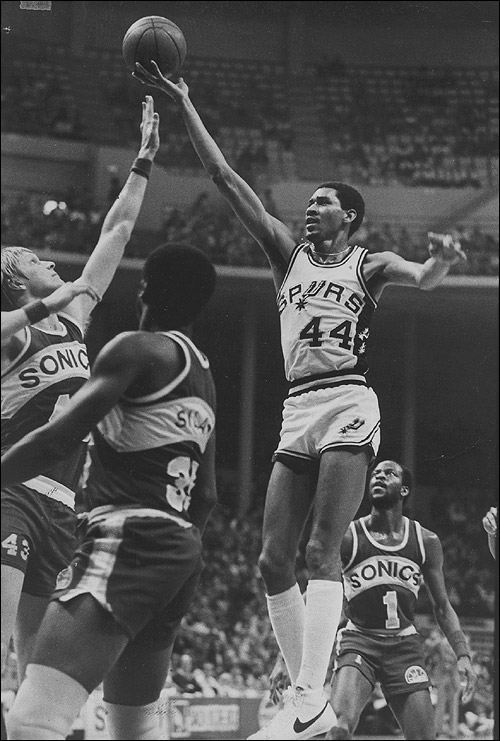
Top 100 NBA Players: #36 - George Gervin


George Gervin

George Gervin was an amazing scorer and a big star for a number of years, but more than anyone else who reached this high on the list, he was not a winner. He was known for being somewhat selfish, but it doesn't diminish how great he was offensively.

Gervin was a four time scoring leader, and is one of 7 players all-time to win three straight scoring titles. In 1980 he averaged 33.1 points per game, and he eclipsed 30 points again 2 years later, when he again led the league with 32.3 nightly. He was twice the MVP runner-up, in 1978 and 1979, but he probably should have won in 1979, when it was given to Moses Malone. Here are how their numbers stacked up that season:

Malone - 24.8 pts, 17.6 reb, 1.8 ast, 1.5 blk, .540 FG%, .739 FT%
Gervin - 29.6 pts, 5.0 reb, 2.7 ast, 1.1 blk, .541 FG%, .826 FT%

Moses led the league in rebounding that year, and Gervin in scoring, so both were obvious candidates. In the other four categories, Gervin was obviously the better player, especially if you know that Gervin was a shooting guard and Malone was a center, because Gervin shot a higher percentage than the MVP that year, and blocked nearly as many shots.

Gervin was the best player on his team for nearly his entire career, but he never saw much playoff success in that role. His best finish was losing in the Conference Finals three times, making him the best player to never play in the NBA Finals, joining Dominique Wilkins, Steve Nash, Alex English, and Vince Carter on that dubious list.

For six straight seasons, Gervin was one of the top 3 players in the NBA, but because of his playoff failings he is usually not considered to be on the same level as those who were his peers during those years, including Moses Malone, Magic Johnson, and Kareem Abdul-Jabbar. His averages over that time were spectacular, and they are listed below:

Gervin (1977-1983) - 29.2 pts, 5.0 reb, 3.0 ast, 1.3 stl, .514 FG%, .834 FT%

Gervin had the disadvantage of never having a true star for a teammate. As the only star in San Antonio for a long time, he did get them to the playoffs in every season of his career, even though he couldn't get them through to the Finals. His career was still very impressive, even though it only lasted for 10 NBA seasons.

Sunday, August 14, 2016

Top 100 NBA Players: #50 - Vince Carter


Vince Carter

In Bill Simmons' The Book of Basketball, he uses his entire section on Vince Carter to complain about how Vince Carter would have been a better player if he had just cared more, and he has a point, which I will show you later, but when he was healthy and motivated, he showed the potential to be one of the best players of all time.

Vince Carter averaged over 20 points per game for 10 consecutive seasons, and he also averaged over 4 rebounds and 3 assists for that entire time as well. In his best season, 2000-2001, he averaged 27.6 points per game, fifth in the league, while averaging 5.5 rebounds and 3.9 assists as well. That year he also took Toronto to their first playoff series win, playing just as well in the playoffs as the regular season. That season, the only player in the league who was definitely better than Vince was Shaq, who had hit his prime.

Unfortunately, Carter was slowed by injuries over the next two seasons, and Toronto's momentum slowed, causing Vince to decide he didn't want to try anymore. He finally gave up in the beginning of the 2004-05 season, showing so little effort that it came as no surprise when he admitted after a trade to New Jersey that he hadn't been trying in Toronto. Here are his pre- and post-trade stats for that season:

Carter (TOR) - 15.9 pts, 3.3 reb, 3.1 ast, .411 FG%, .322 3P%, .694 FT%
Carter (NJN) - 27.5 pts, 5.9 reb, 4.7 ast, .462 FG%, .425 3P%, .817 FT%

The fact that he tanked that badly was so shameful that if I wasn't basing this top 100 on statistics and winning, I would have moved him down several spots. He is one of the most selfish players of all time, which is the reason he has seen so little playoff success. When he reached New Jersey, they immediately stopped competing for championships. The same thing happened in Orlando and Phoenix. Coincidence? Probably not.

There is no doubt that Vince Carter is a great player. His career scoring average is still over 18 per game. He has a highlight reel full of amazing dunks. He could do anything on the offensive end, but he could have been so much more. Even considering all of that, is it so bad to be one of the 50 greatest players of all time? I guess not.

Thursday, August 4, 2016

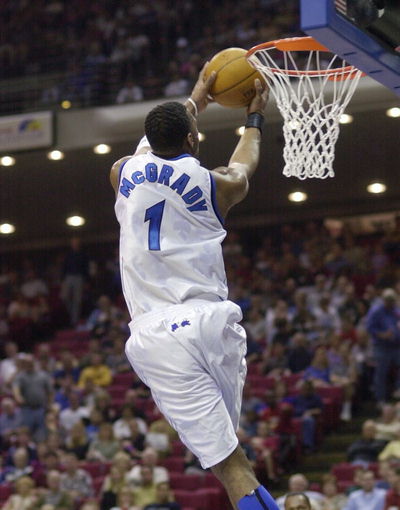
Top 100 NBA Players: #61 - Tracy McGrady


Tracy McGrady

Tracy McGrady is another example of a player whose promising career was derailed by injury too early, but when he was good, he was really good. He twice led the entire league in scoring before he turned 25, and he averaged at least 20-5-5 six times.

McGrady came straight to the NBA from high school, but he didn't become a star until his 4th season, when he would have been a college senior. That's the season when he left Toronto and Vince Carter's shadow and became a star in his own right in Orlando. That year he improved his scoring average by 11.4 points and won the Most Improved Player Award while making the All-Star team and All-NBA Second Team.

He continued to improve over the next two years, until the 2003 season, when he led the league with 32.1 points per game while grabbing 6.5 rebounds and passing out 5.5 assists per game. That year he also shot a career-high .457 from the field, which would drop off considerably every season afterward. After one more season of leading the league in scoring, he was traded to the Houston Rockets for Steve Francis.

In Houston he continued to be a star, but he only finished in the top 10 in scoring twice in 5 full seasons, and he missed 113 games over that time, which caused the Rockets to struggle in the postseason. In fact, McGrady was probably the best player in NBA history who never got past the first round of the playoffs until he took a free ride on the Spurs bench to reach the 2013 Finals. It wasn't really his fault, because his postseason numbers were pretty impressive. Just look at what he did from 2001 to 2005:

McGrady - 31.6 pts, 6.8 reb, 6.1 ast, 1.5 stl

While he may have failed to advance in the playoffs and fell from his peak far too early, McGrady has to be remembered as a great player. He averaged over 20 points per game in 8 straight seasons, led the league in scoring twice, and made the All-NBA First Team twice, but he can't be considered one of the 50 greatest of all time without being a real part of any playoff series win.

Thursday, September 1, 2011

Top 100 NBA Players: #34


George Gervin

(Kalb: #26, Simmons: #34, BBR: #41)

George Gervin was an amazing scorer and a big star for a number of years, but more than anyone else who reached this high on the list, he was not a winner. He was known for being somewhat selfish, but it doesn't diminish how great he was offensively.

Gervin was a four time scoring leader, and is one of 6 players all-time to win three straight scoring titles. In 1980 he averaged 33.1 points per game, and he eclipsed 30 points again 2 years later, when he again led the league with 32.3 nightly. He was twice the MVP runner-up, in 1978 and 1979, but he probably should have won in 1979, when it was given to Moses Malone. Here are how their numbers stacked up that season:

Malone - 24.8 pts, 17.6 reb, 1.8 ast, 1.5 blk, .540 FG%, .739 FT%
Gervin - 29.6 pts, 5.0 reb, 2.7 ast, 1.1 blk, .541 FG%, .826 FT%

Moses led the league in rebounding that year, and Gervin in scoring, so both were obvious choices. In the other four categories, Gervin was obviously the better player, especially if you know that Gervin was a shooting guard and Malone was a center, because Gervin shot a higher percentage than the MVP that year, and blocked nearly as many shots.

Gervin was the best player on his team for nearly his entire career, but he never saw much playoff success in that role. His best finish was losing in the Conference Finals three times, making him the best player to never play in the NBA Finals, joining Dominique Wilkins, Steve Nash, Alex English, Vince Carter, and Tracy McGrady on that dubious list.

For six straight seasons, Gervin was one of the top 3 players in the NBA, but because of his playoff failings he is usually not considered to be on the same level as those who were at his level during those years, including Moses Malone, Magic Johnson, and Kareem Abdul-Jabbar. His averages over that time were spectacular, and they are listed below:

Gervin (1977-1983) - 29.2 pts, 5.0 reb, 3.0 ast, 1.3 stl, .514 FG%, .834 FT%

Gervin had the disadvantage of never having a true star for a teammate. As the only star in San Antonio for a long time, he did get them to the playoffs in every season of his career, even though he couldn't get them through to the Finals. His career was still very impressive, even though it only lasted for 10 NBA seasons.


Payton may have been the better defensive player by far, but Gervin's offensive prowess was so great that there is no doubt he was better than Payton. Gervin's first 7 NBA seasons were all at least as good as Payton's best season, so even though Payton lasted much longer, Gervin got much higher. While Gervin was not a great playoff player, Payton's overall playoff success wasn't much better, so Gervin is definitely higher up on the list.

Monday, August 29, 2011

Top 100 NBA Players: #37


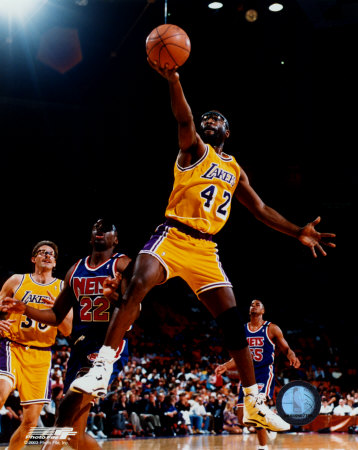
James Worthy

(Simmons: #48, BBR: #25)

James Worthy was one of the great sidekicks of the 1980's, playing alongside Magic Johnson on six teams that advanced to the NBA Finals and coming up big when it really mattered, which earned him the nickname "Big Game James."

While nobody will dispute the fact that Magic Johnson was a better player than James Worthy, Worthy was actually the Lakers' leading scorer in 3 of the 9 seasons they played together. For 7 straight seasons he averaged between 19.4 and 21.4 points. He always got between 5 and 6 rebounds per game, and the Lakers (almost) always made it to the NBA Finals. His steadiness makes it very difficult to pick out a single season and call it his best.

From 1984 to 1986, Worthy was the Lakers' third-best player, playing behind Magic and Kareem, and won a championship during that time. The Lakers went on to win two titles in 1987 and 1988, with Worthy supplanting Kareem as the #2 guy. In 1989, Magic had a down season and Worthy took over as the best player on the Lakers team that was swept in the Finals. In 1991, he made one final trip to the Finals, again playing behind Magic on the team that lost to Michael Jordan and Chicago.

Worthy was named the MVP of the 1988 NBA Finals after his great performances in the final two games of the title series. In game 6 he scored 28 points and grabbed 9 rebounds, then he easily surpassed that in game 7, when he put up a triple-double of 36 points, 16 rebounds, and 10 assists. While it was probably Worthy's performance in those two games that clinched the championship, he still wasn't the best Laker in those playoffs. Here are he and Magic's stats from 1988:

Magic - 19.9 pts, 5.4 reb, 12.6 ast, .514 FG%, .500 3P%, .852 FT%
Worthy - 21.1 pts, 5.8 reb, 4.4 ast, .523 FG%, .111 3P%, .758 FT%

Arguments have been made that Worthy would not have been considered one of the all-time greats if he hadn't been drafted by the Lakers, and that may just be true, but the fact is that it happened, and Worthy did exactly what he was supposed to do and fulfilled the role that was given to him perfectly for a decade, which allowed the Lakers to continue to prosper even after Kareem was well past his prime.


Worthy was never as big a star as Carter was, but he was much more consistent. He never had the huge career swoon that Carter had to recover from, and he made it farther in the playoffs than Carter ever did 7 times and has 3 championship rings to show for it. Worthy showed up when it counted, and that winning attitude puts him above Vince Carter in the all-time rankings.

Sunday, August 28, 2011

Top 100 NBA Players: #38


Vince Carter

(Simmons: #83, BBR: #80)

In Bill Simmons' The Book of Basketball, he uses his entire section on Vince Carter to complain about how Vince Carter would have been a better player if he had just cared more, and he has a point, which I will show you later, but when he was healthy and motivated, he showed the potential to be one of the best players of all time.

Vince Carter averaged over 20 points per game for 10 consecutive seasons, and he also averaged over 4 rebounds and 3 assists for that entire time as well. In his best season, 2000-2001, he averaged 27.6 points per game, fifth in the league, while averaging 5.5 rebounds and 3.9 assists as well. That year he also took Toronto to their only playoff series win, playing just as well in the playoffs as the regular season. That season, the only player in the league who was definitely better than Vince was Shaq, who had hit his prime.

Unfortunately, Carter was slowed by injuries over the next two seasons, and Toronto's momentum slowed, causing Vince to decide he didn't want to try anymore. He finally gave up in the beginning of the 2004-05 season, showing so little effort that it came as no surprise when he admitted after a trade to New Jersey that he hadn't been trying in Toronto. Here are his pre- and post-trade stats for that season:

Carter (TOR) - 15.9 pts, 3.3 reb, 3.1 ast, .411 FG%, .322 3P%, .694 FT%
Carter (NJN) - 27.5 pts, 5.9 reb, 4.7 ast, .462 FG%, .425 3P%, .817 FT%

The fact that he tanked that badly was so shameful that if I wasn't basing this top 100 on statistics and winning, I would have moved him down several spots. He is one of the most selfish players of all time, which is the reason he has seen so little playoff success. When he reached New Jersey, they immediately stopped competing for championships. The same thing happened in Orlando and Phoenix. Coincidence? Probably not.

There is no doubt that Vince Carter is a great player. His career scoring average is still over 22 per game, #26 all time and 8th among active players. He was a highlight reel of amazing dunks. He could do anything on the offensive end, but he could have been so much more. Even considering all of that, is it so bad to be one of the 40 best players of all time? I guess not.


It's tough to justify putting Vince ahead of Walt Frazier. Vince was not a winner, and Walt was. Vince was better at his peak, but not by much. The shortness of Frazier's career appears to be the thing that hurt him most, because Vince was able to put up 10 quality seasons, while Frazier only saw 8. Even without passing the second round of the playoffs, Carter had three great playoff seasons, which appears to have been just enough to pull him past Frazier, who would easily have been ahead of Carter if he had played one more decent season.

Thursday, August 11, 2011

Top 100 NBA Players: #53


Tracy McGrady

(Kalb: #41, Simmons: #75, BBR: #51)

Tracy McGrady is another example of a player whose promising career was derailed by injury too early, but when he was good, he was really good. He twice led the entire league in scoring before he turned 25, and he averaged at least 20-5-5 six times.

McGrady came straight to the NBA from high school, but he didn't become a star until his 4th season, when he would have been a college senior. That's the season when he left Toronto and Vince Carter's shadow and became a star in his own right in Orlando. That year he improved his scoring average by 11.4 points and won the Most Improved Player Award while making the All-Star team and All-NBA Second Team.

He continued to improve over the next two years, until the 2003 season, when he led the league with 32.1 points per game while grabbing 6.5 rebounds and passing out 5.5 assists per game. That year he also shot a career-high .457 from the field, which would drop off considerably every season afterward. After one more season of leading the league in scoring, he was traded to the Houston Rockets for Steve Francis.

In Houston he continued to be a star, but he only finished in the top 10 in scoring twice in 5 full seasons, and he missed 113 games over that time, which caused the Rockets to struggle in the postseason. In fact, McGrady is probably the best player in NBA history who never got past the first round of the playoffs. It wasn't really his fault, because his postseason numbers were pretty impressive. Just look at what he did from 2001 to 2005:

McGrady - 31.6 pts, 6.8 reb, 6.1 ast, 1.5 stl

While he may have failed to advance in the playoffs and fell from his peak far too early, McGrady has to be remembered as a great player. He averaged over 20 points per game in 8 straight seasons, led the league in scoring twice, and made the All-NBA First Team twice. It sad to say that at age 31, he's probably washed up and past his prime.


Nash has a little advantage over McGrady in playoff success, and a definite lead in longevity, but McGrady was so good early in his career that Nash can't really argue that he's the better player. Nash could pass McGrady if he is able to continue to contribute over the next couple years, but for now McGrady's career accomplishments are just a little bit more impressive.

Wednesday, March 9, 2011

College Basketball Rankings - 9 Mar

The regular season has ended, and most conferences are in the middle of their conference tournaments. In four days we will know exactly which teams will be competing for the championship this year. Only one team in my top 25 has finished the season (Belmont) and earned their tournament bid, but the rest should follow this week. Here are the final rankings of the regular season, with team name followed by weekly record, overall record, rating, and previous ranking.

1. Ohio State (1-0) (29-2) -22.62 (1)
2. Kansas (2-0) (29-2) -21.12 (2)
3. Duke (1-1) (27-4) -20.48 (3)
4. Texas (1-0) (25-6) -17.35 (7)
5. Purdue (0-1) (25-6) -17.31 (5)
6. BYU (1-1) (28-3) -17.24 (4)
7. Pittsburgh (2-0) (27-4) -17.15 (6)
8. Kentucky (1-0) (22-8) -16.45 (10)
9. San Diego State (1-0) (29-2) -16.08 (8)
10. North Carolina (2-0) (24-6) -15.94 (13)
11. Washington (1-1) (20-10) -15.91 (9)
12. Syracuse (1-0) (25-6) -15.55 (14)
13. Wisconsin (1-1) (23-7) -15.38 (11)
14. Belmont (3-0) (30-4) -15.16 (12)
15. Louisville (1-1) (23-8) -14.32 (16)
16. Notre Dame (1-0) (25-5) -14.21 (15)
17. Illinois (1-0) (19-12) -13.91 (19)
18. Cincinnati (2-0) (24-7) -13.12 (NR)
19. Georgetown (0-1) (21-9) -12.75 (18)
20. UNLV (1-0) (23-7) -12.62 (NR)
21. Florida (1-0) (24-6) -12.61 (25)
22. Arizona (2-0) (25-6) -12.54 (21)
23. Connecticut (1-2) (22-9) -12.38 (23)
24. Utah State (2-0) (28-3) -12.26 (NR)
25. West Virginia (2-0) (20-10) -12.17 (22)

Dropping out:
Vanderbilt (0-1) (21-9) -12.10 (17)
Marquette (1-2) (19-13) -12.03 (24)
Maryland (0-2) (18-13) -10.82 (20)

Ranked teams by conference:
Big East: 8
Big 10: 4
MWC: 3
Big 12: 2
ACC: 2
SEC: 2
Pac 10: 2
Atl Sun: 1
WAC: 1

Bubbling Up

Cincinnati ended the regular season in style, winning by 7 at Marquette before whipping Georgetown by 22 at home to close it out. For a team that opened the season with low expectations, this season couldn't have gone much better, with all 7 of their losses coming to Big East opponents that will be playing in March.

Utah State made a statement in their final regular season game, beating Louisiana Tech 72-30 on the road and allowing just 15 points in each half of the game. They are the runaway favorites to win the WAC title and earn a return trip to the NCAA's.

UNLV closed out their season with a 20-point road win at Utah, wrapping up a season that included just two losses to unranked teams. They may not have beaten BYU or San Diego State in the regular season, but they are the hottest of the three teams right now, and the conference tournament is on their home court, so I am picking them to take the automatic bid.

Syracuse took out a lot of frustration on DePaul in their final game of the season, winning the contest 107-59 after maintaining a 20-point lead for the final 32 minutes of the game. The win earned the Orange a double bye in the Big East tournament, which could come in very handy in this very deep conference.

Drifting Down

I've been a big proponent of Maryland all season long, but after losing to Miami and Virginia to close out the season in two games that weren't even close, the Terrapins have dropped from my rankings and from tournament contention. It was the first time all season they had lost back-to-back games that they should have won.

Being swept by a New Mexico team that probably won't make the tournament wasn't a good way to celebrate a huge victory over San Diego State, but that's what happened to BYU this week. The loss came on the heels of the suspension of their leading rebounder, and they'll have to use the Mountain West tournament as practice on how to play without Davies.

Vanderbilt moved up a little after nearly beating Kentucky on the road last week, but then they didn't take that momentum and turn it into an upset of Florida like I would have liked to see. The game caused the two teams to switch positions in my rankings and left Vandy cold heading into the conference tourney.

George Mason lost for the first time in nearly two months this week, dropping a game to VCU in the conference semifinals, but their spot in March Madness is still safe. They haven't beaten any ranked teams this year, but they've been good enough to present a challenge in the first couple rounds.

Saint Mary's lost to Gonzaga for the second time in as many weeks and lost 4 of their last 6 games overall, but they did reach the conference championship game, and Gonzaga is one of the hottest teams in the nation currently, but it still doesn't mean anything if they don't pick up a win in the NCAA Tournament.

NBA Player of the Day

Vince Carter - PHX - 32 pts, 6 reb, 3 ast, 3 stl, 13-17 FG, 5-7 3P, 1-2 FT
Vince Carter made up for his missed free throws that cost Phoenix their previous game with a huge fourth quarter that included 15 points and 2 3-pointers as Phoenix was able to take a late lead, then held on to beat the Rockets and remain in 9th place in the West.

Predictions - 9 Mar

Upset picks are in italics.
Possible upsets are underlined.

NBA

Warriors at Nets - Nets by 1
Thunder at 76ers - 76ers by 2
Jazz at Raptors - Jazz by 2
Bulls at Bobcats - Bulls by 7
Clippers at Celtics - Celtics by 11
Mavericks at Hornets - Hornets by 1
Cavaliers at Bucks - Bucks by 11
Pacers at Timberwolves - Pacers by 1
Knicks at Grizzlies - Grizzlies by 4
Pistons at Spurs - Spurs by 13
Magic at Kings - Magic by 8

College Basketball

Rutgers at (18) Saint John's - Saint John's by 11
(19) Connecticut vs. (22) Georgetown - Georgetown by 1
South Florida vs. Cincinnati - Cincinnati by 12
Marquette vs. West Virginia - West Virginia by 1

Prediction Results - 8 Mar

NBA: 4-2 (.667) 542-226 overall (.706)
College Basketball: 1-0 (1.000) 541-134 overall (.801)
Upsets: 0-1 (.000) 143-94 overall (.603)