Showing posts with label Gary Payton. Show all posts

Friday, September 17, 2021

Top 100 NBA Players: #44 - Gary Payton


Gary Payton

Teams

Seattle SuperSonics - 1990-03

Milwaukee Bucks - 2003

Los Angeles Lakers - 2003-04

Boston Celtics - 2004-05

Miami Heat - 2005-07


Playoffs

Appearances - 15 (1991,1992,1993,1994,1995,1996,1997,1998,2000,2002,2003,2004,2005,2006,2007)

Conference Finals - 4 (1993,1996,2004,2006)

NBA Finals - 3 (1996,2004,2006)

Championships - 1 (2006)


Awards and Honors

All-NBA First Team - 2 (1998,1999,2000,2002)

All-NBA Second Team - 5 (1995,1996,1997,1998,1999,2001,2002)

All-NBA Third Team - 2 (1994,2001,2003)

Defensive Player of the Year - 1 (1996)

Hall of Fame - 2013

*(actual in bold, deserved in italics)


All-Time Ranks

Total Steals - #4

Total Assists - #10

Steals Per Game - #29

Assists Per Game - #32

Total Points - #40

Three-Pointers Made - #91


League Leads

Total Steals (#1-1996, #2-1995, #3-1997,1998,2000, #4-1993)

Total Assists (#1-2000, #2-2003, #3-1999,2002, #5-1998)

Assists Per Game (#3-2002,2003, #4-1999,2000, #5-2001)

Steals Per Game (#1-1996, #3-1995,1997, #4-1998)

Total Points (#5-1999,2000)

Three-Pointers Made (#1-2000)


Gary Payton played 4 years of college basketball at Oregon State, where he set nearly every school record, and averaged 25.7 points, 4.7 rebounds, 8.1 assists, and 3.4 steals during his senior season, which led the Seattle SuperSonics to draft him #2 overall in the 1990 Draft.

Payton wasn't a great scorer right away, scoring only 7.2 per game as a rookie, but he averaged 6.2 assists and 2.0 steals that year, so his other skills were already NBA-ready. He improved over the next couple of years, raising his scoring average to 13.5 per game in his third season, and he helped the Sonics reach the Conference Finals that year, where the team fell to Phoenix in 7 games, but Payton earned his nickname "the Glove" for his tough defense during the series.

The next year, Payton was named to the All-Defensive First Team for the first time, an honor he would receive in each of the next 8 seasons as well, tying him for the record for most appearances on that list with 9. He also made the All-NBA Third Team that year, the first of 9 straight seasons he would be named to one of the All-NBA teams.

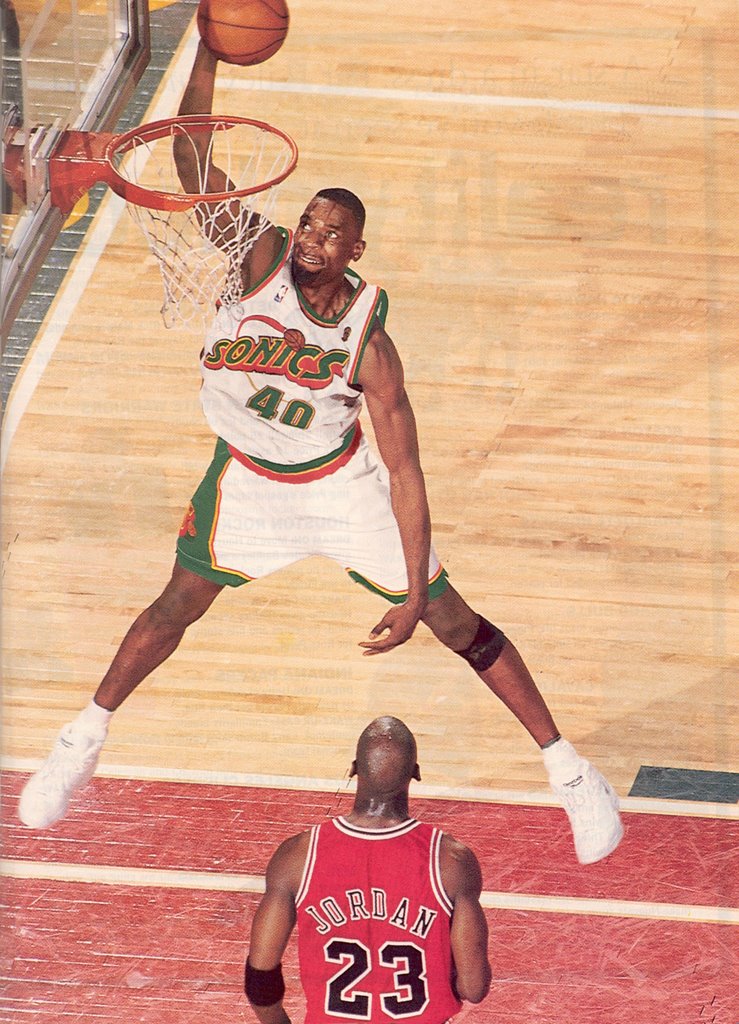
In 1995-96, he led the league in steals with 2.9 per game and was named the Defensive Player of the Year, and is still the only point guard to ever win the award. He also averaged 19.3 points and 7.5 assists that year, and Seattle finished with the best record in the West, then went all the way to the NBA Finals, where they faced the Chicago Bulls. Payton guarded Michael Jordan during that series, and Jordan averaged only 27.3 points per game, the lowest he would ever average in the Finals, but the Sonics would still lose in 6 games.

The Sonics were not able to repeat that level of success over the next several years, but Payton continued to improve each year, having his best individual season in 1999-00, when he averaged career-highs of 24.2 points and 6.5 rebounds, along with 8.9 assists, which was his best at the time as well, and he was named to the All-NBA First Team for the second time in 3 seasons.

Payton had two more great individual seasons with Seattle, but the team continued to struggle, and Payton did not get along with the team's new owner, who decided to trade his star, sending him to the Milwaukee Bucks in 2003 in exchange for Ray Allen. He finished out the season with the Bucks, then left as a free agent in search of a championship.

He signed with the Los Angeles Lakers, joining Kobe, Shaq, and Karl Malone on a superteam, and Payton was the only one of the stars to play in every game. They reached the NBA Finals as expected, but were upset by the Pistons in 5 games, with Payton averaging only 4.2 points per game in the series. He was traded to the Boston Celtics after the season.

Payton's averages had started to drop off, and he was traded at the deadline to the Atlanta Hawks for Antoine Walker, but the Hawks waived him later that week, and he then resigned with the Celtics to finish out the season, but that season ended in another first-round playoff disappointment.

He signed with the Miami Heat for the next season, playing as a backup for the first time in his career, and averaged only 7.7 points per game, his lowest since his rookie year. That team, led by Dwyane Wade and Shaq, were able to reach the NBA Finals, and this time Payton finally won his title, though he had little to do with it, scoring only 2.7 points per game in the Finals. He played one more season with Miami before retiring from the game.

Payton was one of the best defensive guards of all time, and was always a good passer, making him a perfect point guard. As his career went on, he became a very good scorer as well, scoring over 20 points per game 7 times as well. He also rarely missed a game, missing only 11 games in his first 16 seasons, with 3 of those happening because he had been traded and hadn't arrived with his new team yet. He only reached the NBA Finals once during his prime years, and didn't win a title until he was well past his prime, but he is still one of the greatest to ever play the game.


Monday, August 22, 2016

Top 100 NBA Players: #41 - Gary Payton


Gary Payton

Gary Payton may have been the best two-way point guard in the history of the league, getting it done consistently on both ends of the floor for more than a decade, and he played on some pretty good teams, missing the playoffs just twice in his 17-year career.

In 1995-96, Michael Jordan had just returned from his first retirement, and the Bulls had set an NBA record with 72 wins in the regular season, and then they walked right through the first three rounds of the playoffs with an 11-1 record, giving them an overall record of 83-11 up to that point. It may not seem like much, but the Sonics took two games from the Bulls in the Finals, which was quite an accomplishment considering that Chicago had only lost about once every three weeks during the previous 7 months. Payton was the star of that team, and probably would have won a title in any other season.

Payton's teammate, Shawn Kemp, started to go downhill after that season, leaving Payton without a teammate to help him return to the Finals. Over the next two years Seattle lost in the second round, but Payton was still putting up great numbers, which are below:

Payton - 23.9 pts, 4.5 reb, 7.9 ast, 2.0 stl, .438 FG%, .352 3P%, .874 FT%

He had his best overall season in 2000, at the age of 31, when he averaged 24.2 points, 6.5 rebounds, 8.9 assists, and 1.9 steals per game, and was probably the best guard in the entire league, but the season was followed by a first-round playoff exit.

He did eventually get back to the NBA Finals twice, once in 2004 with the Los Angeles Lakers, where he was just an average starter, then again with Miami in 2006, when he was no longer a relevant player, but still earned himself a championship ring in his 16th season.

As I mentioned above, Payton was more than just a great offensive player, he was also one of the top defensive point guards of all time. He led the league in steals once, in 1996, the same year he was named Defensive Player of the Year. He averaged over 2 steals per game 8 times, and still ranks #4 all time in total steals. In addition, he was named to the All-Defensive First Team 9 straight times, meaning that he was considered the best defensive point guard in the league for almost an entire decade.

Saturday, July 23, 2016

Top 100 NBA Players: #75 - Shawn Kemp


Shawn Kemp

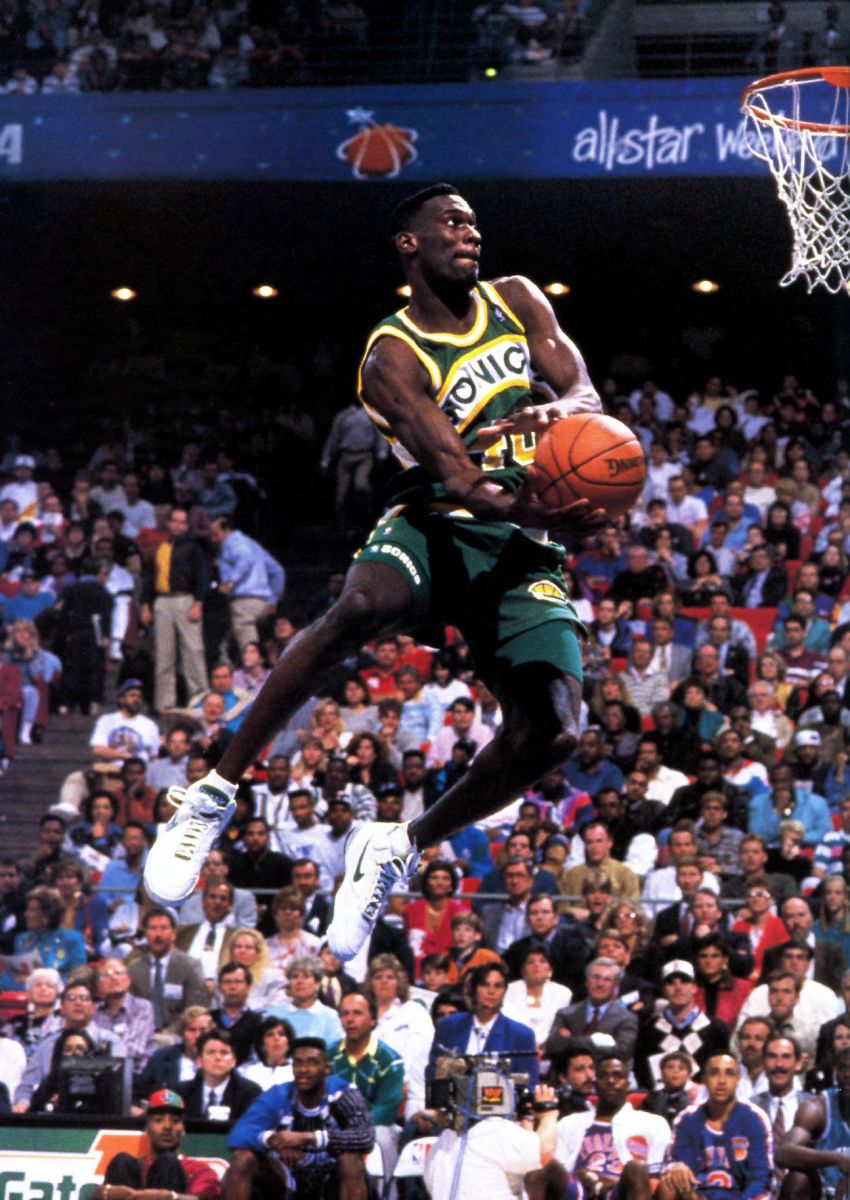
Shawn Kemp was one of the most dominant forces of the 90's, bringing down the house with thunderous dunks and leading the Sonics to multiple division titles and an appearance in the NBA Finals, but it all came crashing down too early, but there were signs that it was coming before most people noticed.

During Kemp's last four seasons in Seattle, there were very few players who could compare to him. He, along with Gary Payton, led Seattle to the NBA Finals, where they lost to Michael Jordan and the 72-win Chicago Bulls in 6 games. When he was traded to Cleveland, he continued to score in similar quantities and still made an All-Star team, but if you look at the other big-man stats, you'll see that the signs of his decline were already there.

Kemp (1993-1997) - 18.8 pts, 10.8 reb, 1.5 blk, .538 FG%
Kemp (1997-2000) - 18.5 pts, 9.1 reb, 1.1 blk, .441 FG%

The two rebounds per game drop certainly doesn't look good, but what is most alarming was the nearly 10% drop in shooting percentage, which means that he had to waste a much greater number of possessions to get himself up to the same number of points he was accustomed to scoring.

Kemp was probably the #2 player on that Finals team, although he and Payton were basically even, but he was the best player on the team that nearly made the Finals three years earlier, when they lost in game 7 to the Phoenix Suns, who went on to lose to Chicago in the Finals. Sadly, he let jealousy and drugs get in the way of a career that could have been truly memorable, and not just another in a long list of What Could Have Been's.

Thursday, September 1, 2011

Top 100 NBA Players: #34


George Gervin

(Kalb: #26, Simmons: #34, BBR: #41)

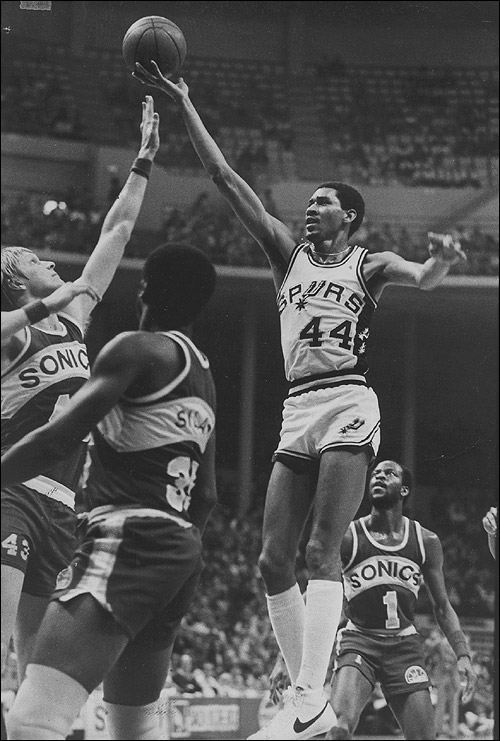
George Gervin was an amazing scorer and a big star for a number of years, but more than anyone else who reached this high on the list, he was not a winner. He was known for being somewhat selfish, but it doesn't diminish how great he was offensively.

Gervin was a four time scoring leader, and is one of 6 players all-time to win three straight scoring titles. In 1980 he averaged 33.1 points per game, and he eclipsed 30 points again 2 years later, when he again led the league with 32.3 nightly. He was twice the MVP runner-up, in 1978 and 1979, but he probably should have won in 1979, when it was given to Moses Malone. Here are how their numbers stacked up that season:

Malone - 24.8 pts, 17.6 reb, 1.8 ast, 1.5 blk, .540 FG%, .739 FT%
Gervin - 29.6 pts, 5.0 reb, 2.7 ast, 1.1 blk, .541 FG%, .826 FT%

Moses led the league in rebounding that year, and Gervin in scoring, so both were obvious choices. In the other four categories, Gervin was obviously the better player, especially if you know that Gervin was a shooting guard and Malone was a center, because Gervin shot a higher percentage than the MVP that year, and blocked nearly as many shots.

Gervin was the best player on his team for nearly his entire career, but he never saw much playoff success in that role. His best finish was losing in the Conference Finals three times, making him the best player to never play in the NBA Finals, joining Dominique Wilkins, Steve Nash, Alex English, Vince Carter, and Tracy McGrady on that dubious list.

For six straight seasons, Gervin was one of the top 3 players in the NBA, but because of his playoff failings he is usually not considered to be on the same level as those who were at his level during those years, including Moses Malone, Magic Johnson, and Kareem Abdul-Jabbar. His averages over that time were spectacular, and they are listed below:

Gervin (1977-1983) - 29.2 pts, 5.0 reb, 3.0 ast, 1.3 stl, .514 FG%, .834 FT%

Gervin had the disadvantage of never having a true star for a teammate. As the only star in San Antonio for a long time, he did get them to the playoffs in every season of his career, even though he couldn't get them through to the Finals. His career was still very impressive, even though it only lasted for 10 NBA seasons.


Payton may have been the better defensive player by far, but Gervin's offensive prowess was so great that there is no doubt he was better than Payton. Gervin's first 7 NBA seasons were all at least as good as Payton's best season, so even though Payton lasted much longer, Gervin got much higher. While Gervin was not a great playoff player, Payton's overall playoff success wasn't much better, so Gervin is definitely higher up on the list.

Wednesday, August 31, 2011

Top 100 NBA Players: #35


Gary Payton

(Kalb: #36, Simmons: #40, BBR: #36)

Gary Payton may have been the best two-way point guard in the history of the league, getting it done consistently on both ends of the floor for more than a decade, and he played on some pretty good teams, missing the playoffs just twice in his 17-year career.

In 1995-96, Michael Jordan had just returned from his first retirement, and the Bulls had set an NBA record with 72 wins in the regular season, and then they walked right through the first three rounds of the playoffs with an 11-1 record, giving them an overall record of 83-11 up to that point. It may not seem like much, but the Sonics took two games from the Bulls in the Finals, which was quite an accomplishment considering that Chicago had only lost about once every three weeks during the previous 7 months. Payton was the star of that team, and probably would have won a title in any other season.

Payton's teammate, Shawn Kemp, started to go downhill after that season, leaving Payton without a teammate to help him return to the Finals. Over the next two years Seattle lost in the second round, but Payton was still putting up great numbers, which are below:

Payton - 23.9 pts, 4.5 reb, 7.9 ast, 2.0 stl, .438 FG%, .352 3P%, .874 FT%

He did eventually get back to the NBA Finals twice, once in 2004 with the Los Angeles Lakers, where he was just an average starter, then again with Miami in 2006, when he was no longer a relevant player, but still earned himself a championship ring in his 16th season.

As I mentioned above, Payton was more than just a great offensive player, he was also one of the top defensive point guards of all time. He led the league in steals once, in 1996, the same year he was named Defensive Player of the Year. He averaged over 2 steals per game 8 times, and still ranks #4 all time in total steals. In addition, he was named to the All-Defensive First Team 9 straight times, meaning that he was considered the best defensive point guard in the league for almost an entire decade.


Payton, like Cousy, was the best guard in the league at one point, but Payton did it when there was a lot more competition, and his 2000 season was amazing, with 24.2 points, 6.5 rebounds, 8.9 assists, and 1.9 steals per game. Cousy had more playoff success, but he was only the top player on a Finalist twice, just once more than Payton. Payton's peak was higher, and he lasted a couple years longer than Cousy, plus he played in an era when there was more competition for the top spot, so the guy who was undeniably great on both ends gets the slight edge.

Tuesday, August 2, 2011

Top 100 NBA Players: #62


Shawn Kemp

(Simmons: #89, BBR: #76)

Shawn Kemp was one of the most dominant forces of the 90's, bringing down the house with thunderous dunks and leading the Sonics to multiple division titles and an appearance in the NBA Finals, but it all came crashing down too early, but there were signs that it was coming before most people noticed.

During Kemp's last four seasons in Seattle, there were very few players who could compare to him. He, along with Gary Payton, led Seattle to the NBA Finals, where they lost to Michael Jordan and the 72-win Chicago Bulls in 6 games. When he was traded to Cleveland, he continued to score in similar quantities and still made an All-Star team, but if you look at the other big-man stats, you'll see that the signs of his decline were already there.

Kemp (1993-1997) - 18.8 pts, 10.8 reb, 1.5 blk, .538 FG%
Kemp (1997-2000) - 18.5 pts, 9.1 reb, 1.1 blk, .441 FG%

The two rebounds per game drop certainly doesn't look good, but what is most alarming was the nearly 10% drop in shooting percentage, which means that he had to waste a much greater number of possessions to get himself up to the same number of points he was accustomed to scoring.

Kemp was probably the #2 player on that Finals team, although he and Payton were basically even, but he was the best player on the team that nearly made the Finals three years earlier, when they lost in game 7 to the Phoenix Suns, who went on to lose to Chicago in the Finals. Sadly, he let jealousy and drugs get in the way of a career that could have been truly memorable, and not just another in a long list of What Could Have Been's.


Kemp didn't have the prolonged playoff success of Billups, but a quick glance at this chart tells you that Kemp was a much better player in the regular season. His top 3 seasons all rank above anything Billups ever put up, and he did maintain a high level of play for just as long as Billups, which is enough for him to stay above the smaller man on this list.