Showing posts with label Chauncey Billups. Show all posts

Monday, September 6, 2021

Top 100 NBA Players: #55 - Chauncey Billups


Chauncey Billups

Teams

Boston Celtics - 1997-98

Toronto Raptors - 1998

Denver Nuggets - 1998-00, 2008-11

Minnesota Timberwolves - 2000-02

Detroit Pistons - 2002-08, 2013-14

New York Knicks - 2011

Los Angeles Clippers - 2011-13


Playoffs

Appearances - 12 (2001,2002,2003,2004,2005,2006,2007,2008,2009,2010,2011,2013)

Conference Finals - 7 (2003,2004,2005,2006,2007,2008,2009)

NBA Finals - 2 (2004,2005)

Championships - 1 (2004)


Awards and Honors

Finals MVP - 1 (2004)

All-NBA Second Team - 1 (2006)

All-NBA Third Team - 2 (2007,2009)

*(actual in bold, deserved in italics)


All-Time Ranks

Free Throw Percentage - #5

Three-Pointers Made - #17

Total Assists - #46

Assists Per Game - #95


League Leads

Free Throw Percentage (#2-1999,2008,2011, #4-2009,2010, #5-2005)

Total Assists (#2-2006)

Assists Per Game (#4-2006)

Three-Pointers Made (#5-2006)


Chauncey Billups was one of the greatest high school basketball players in the history of the state of Colorado before enrolling at the University of Colorado, where he averaged 18.5 points, 5.6 rebounds, and 5.1 assists per game over 2 seasons before he decided to enter the NBA Draft, where he was selected #3 overall by the Boston Celtics.

His pro career got off to a rough start. He didn't fit well with Boston's scheme, so he was traded midway through his rookie season to the Toronto Raptors, where he finished off the year. In the offseason, he was traded again, this time to Denver, his hometown, where he averaged 13.9 points per game in his lone full season with the team.

He suffered a shoulder injury early in his third season, and was then traded to the Orlando Magic, where he spent the rest of the year but never played in a game. He signed as a free agent with Minnesota after the season, hoping to get a chance to get his career going.

He spent his first season with the Wolves backing up Terrell Brandon, but when Brandon got hurt the next year, Billups got the chance to start, and he started to show some promise, averaging 12.5 points and 5.5 assists per game. However, the team decided to stick with Brandon the next year, and Billups was allowed to leave as a free agent.

Billups joined his 6th team, the Detroit Pistons, to start off his sixth season, and that's when everything changed. He averaged 16.2 points in his first season with the team, then played a big role in the playoffs. He scored 40 and 37 in back-to-back games to end the first round, then guided them past the second round as well before they fell to New Jersey in the Conference Finals, which would become a familiar place for Billups.

The next year, he was able to help the Pistons avenge their loss to the Nets the previous season, this time in the second round, before pushing past the Pacers in one of the lowest-scoring series of all time to reach his first NBA Finals. The Pistons were able to surprise everyone by beating the heavily-favored Lakers in 5 games, and Billups won the Finals MVP with his average of 21 points per game in the series.

Billups and the Pistons nearly repeated the feat the following year, returning to the NBA Finals as defending champs, but they fell to the Spurs in 7 games. After that loss, Billups' personal performance took a big leap forward, and he had his best season in 2005-06, when he averaged 18.5 points and 8.6 assists and was named to the All-NBA Second Team for the only time in his career. Unfortunately, they failed to reach the NBA Finals, losing to Miami in the Conference Finals in 6 games.

Billups played 2 more full seasons in Detroit, leading them back to the Conference Finals 2 more times, making it 6 years in a row, but they fell in that round both times in 6 games, ending up short of the ultimate goal again. Just 2 games into the next season, Billups was traded back to the Nuggets, where he teamed up with Carmelo Anthony to guide Denver to their first Conference Finals since 1985, making it 7 in a row for him, the first player to do that without doing it with the Lakers or Celtics.

The next year, Carmelo had asked to be traded to New York, and in order to make the deal work, Billups had to be traded as well. The pair helped the Knicks reach the playoffs, but Billups was injured in the first playoff game and missed the remainder of the series, which New York lost. After the season, he was waived by the Knicks.

He was claimed off waivers by the Clippers, where he was moved to shooting guard to play alongside Chris Paul, but he played only 20 games that year after tearing his Achilles, and only 22 the next year with various injuries. He was not resigned after the season, so he signed with Detroit again, but was only able to play in 19 games because of knee injuries, and he decided to retire after that season.

For a point guard, Billups did not average a lot of assists, only dishing out more than 7 per game twice in his career, but he knew how to win, and he is one of a very small group of players to reach the Conference Finals in 7 straight seasons, and he also has a Finals MVP to his name. He averaged at least 15 points per game for an entire decade starting from the day he first arrived in Detroit, and he should be remembered as one of the greatest players of all time.


Monday, August 1, 2016

Top 100 NBA Players: #64 - Richard Hamilton


Richard Hamilton

Richard Hamilton may not seem like an obvious choice to be included among the best players of all time, but many people overlook him because he doesn't have any single thing that sets him apart from other players. He wasn't a huge scorer or rebounder, he didn't hit a ton of threes, and he wasn't known for his defense, but he was a very consistent player for a full decade and is also a winner.

As I said above, Hamilton was not a huge scorer, but from 2000 through 2010, he scored at least 17.3 points per game, but never more than 20.1 per game. He has also shot over 83% from the free throw line for that entire time, which is a very solid average. That means that his team was always able to count on him to bring somewhere near 20 points every night for a decade, and they were always able to keep him on the court during crunch time, which is a very good attribute for a star player to have.

As a member of the Detroit Pistons, Hamilton made 6 straight appearances in the Eastern Conference Finals, twice advancing to the NBA Finals and winning one championship. When I highlighted Chauncey Billups at #79, I compared the two players' stats to show that Rip should have been the Finals MVP rather than Billups, and Hamilton was their best player more consistently over that 6-year stretch than anyone else.

Hamilton was also the type of player who always turned it on during the playoffs, scoring more in the playoffs during five of the six deep playoff runs. He never averaged 4 rebounds per game in a regular season, but his overall playoff rebound average is just shy of 4 per game. He even raised his already-impressive free throw shooting percentage to 86 percent in the postseason. It's no wonder the Pistons had so much success over that decade.

Tuesday, July 19, 2016

Top 100 NBA Players: #79 - Chauncey Billups


Chauncey Billups

Chauncey Billups was one of the most successful playoff players in modern years, leading his team to the Conference Finals in 7 straight years, a streak that has only been matched by two players in the past 35 years, Magic Johnson and Kareem Abdul-Jabbar. He may not have ever been considered a superstar, but he was a star player for nearly a decade, and a winner for most of that time.

On six of those 7 Conference Final teams, Billups was one of the top 3 players on his team, first for the Pistons teams that kept making deep playoff runs, then for Denver after a trade took him out west. Here are his stats for those seasons in the regular season and the playoffs.

Billups (Regular Season) - 17.1 pts, 3.3 reb, 6.4 ast
Billups (Playoffs) - 18.0 pts, 3.5 reb, 6.0 ast

You can see that he kicked it up one notch in the playoffs, but others have made more impressive jumps. When the Pistons won the NBA Finals, Billups was voted the MVP, even though Rip Hamilton was probably a better player throughout those playoffs, as you can see from these numbers:

Billups - 16.4 pts, 3.0 reb, 5.9 ast
Hamilton - 21.5 pts, 4.6 reb, 4.2 ast

Billups was definitely the best player for Detroit in their return trip to the Finals the next year, when he bumped those averages up to 18.7 points, 4.3 rebounds, and 6.5 assists, but Detroit lost to the Spurs, costing him a chance at consecutive Finals MVP's.

Billups is also one of the best free throw shooters of all time, with a career average of .894, which places him in sixth place in NBA history, behind only Steve Nash, Rick Barry, Stephen Curry, Mark Price, and Peja Stojakovic. His clutch free throw shooting was a very important reason for his success, because his team was able to keep one of its best players on the floor at the most important times.

Tuesday, August 9, 2011

Top 100 NBA Players: #55


Richard Hamilton

(BBR: #176)

Richard Hamilton may not seem like an obvious choice to be included among the best players of all time, but many people overlook him because he doesn't have any single thing that sets him apart from other players. He's not a huge scorer or rebounder, he doesn't hit a ton of threes, and he's not known for his defense, but he has been a very consistent player for the past decade and is also a winner.

As I said above, Hamilton is not a huge scorer, but from 2000 through 2010, he scored at least 17.3 points per game, but never more than 20.1 per game. He has also shot over 83% from the free throw line for that entire time, which is a very solid average. That means that his team was always able to count on him to bring somewhere near 20 points every night for a decade, and they were always able to keep him on the court during crunch time, which is a very good attribute for a star player to have.

As a member of the Detroit Pistons, Hamilton made 6 straight appearances in the Eastern Conference Finals, twice advancing to the NBA Finals and winning one championship. When I highlighted Chauncey Billups at #63, I compared the two players' stats to show that Rip should have been the Finals MVP rather than Billups, and Hamilton was their best player more consistently over that 6-year stretch than anyone else.

Hamilton is also the type of player who always turns it on during the playoffs, scoring more in the playoffs during five of the six deep playoff runs. He has never averaged 4 rebounds per game in a regular season, but his overall playoff rebound average is 4.0. He even raised his already-impressive free throw shooting percentage by 10 points in the postseason. It's no wonder the Pistons had so much success over the past decade.


Statistically, there is no way to formulate an argument that puts Hamilton over Howard. Hamilton has played for longer, but Howard's level of play has been so high throughout his entire career that he's obviously the better player. The reason that Rip sits ahead of him in the all-time rankings is that he led his teams deeper into the playoffs more often than Howard has so far. Unless Howard retires today, he will pass Hamilton next year, but for now Rip has the slight edge due to playoff success.

Tuesday, August 2, 2011

Top 100 NBA Players: #62


Shawn Kemp

(Simmons: #89, BBR: #76)

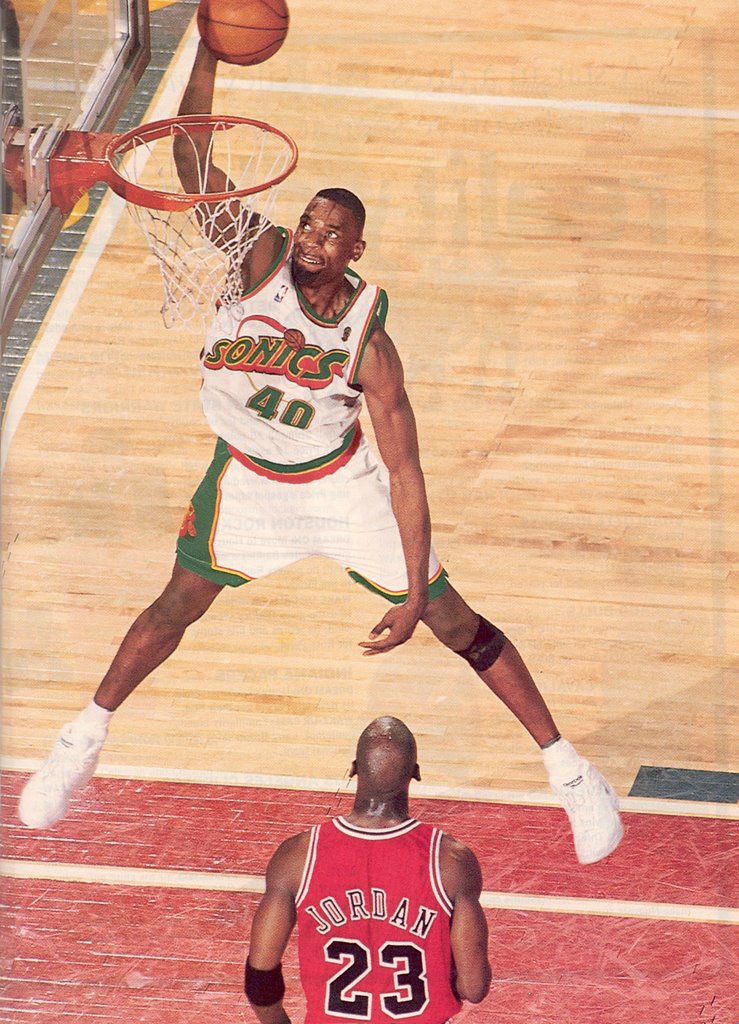
Shawn Kemp was one of the most dominant forces of the 90's, bringing down the house with thunderous dunks and leading the Sonics to multiple division titles and an appearance in the NBA Finals, but it all came crashing down too early, but there were signs that it was coming before most people noticed.

During Kemp's last four seasons in Seattle, there were very few players who could compare to him. He, along with Gary Payton, led Seattle to the NBA Finals, where they lost to Michael Jordan and the 72-win Chicago Bulls in 6 games. When he was traded to Cleveland, he continued to score in similar quantities and still made an All-Star team, but if you look at the other big-man stats, you'll see that the signs of his decline were already there.

Kemp (1993-1997) - 18.8 pts, 10.8 reb, 1.5 blk, .538 FG%
Kemp (1997-2000) - 18.5 pts, 9.1 reb, 1.1 blk, .441 FG%

The two rebounds per game drop certainly doesn't look good, but what is most alarming was the nearly 10% drop in shooting percentage, which means that he had to waste a much greater number of possessions to get himself up to the same number of points he was accustomed to scoring.

Kemp was probably the #2 player on that Finals team, although he and Payton were basically even, but he was the best player on the team that nearly made the Finals three years earlier, when they lost in game 7 to the Phoenix Suns, who went on to lose to Chicago in the Finals. Sadly, he let jealousy and drugs get in the way of a career that could have been truly memorable, and not just another in a long list of What Could Have Been's.


Kemp didn't have the prolonged playoff success of Billups, but a quick glance at this chart tells you that Kemp was a much better player in the regular season. His top 3 seasons all rank above anything Billups ever put up, and he did maintain a high level of play for just as long as Billups, which is enough for him to stay above the smaller man on this list.

Monday, August 1, 2011

Top 100 NBA Players: #63


Chauncey Billups

(BBR: #65)

Chauncey Billups has been one of the most successful playoff players in modern years, leading his team to the Conference Finals in 7 straight years, a streak that has only been matched by two players in the past 30 years, Magic Johnson and Kareem Abdul-Jabbar. He may not have ever been considered a superstar, but he has been a star player for nearly a decade now, and a winner for most of that time.

On six of those 7 Conference Final teams, Billups was one of the top 3 players on his team, first for the Pistons teams that kept making deep playoff runs, then for Denver after a trade took him out west. Here are his stats for those seasons in the regular season and the playoffs.

Billups (Regular Season) - 17.1 pts, 3.3 reb, 6.4 ast
Billups (Playoffs) - 18.0 pts, 3.5 reb, 6.0 ast

You can see that he kicked it up one notch in the playoffs, but others have made more impressive jumps. When the Pistons won the NBA Finals, Billups was voted the MVP, even though Rip Hamilton was probably a better player throughout those playoffs, as you can see from these numbers:

Billups - 16.4 pts, 3.0 reb, 5.9 ast
Hamilton - 21.5 pts, 4.6 reb, 4.2 ast

Billups was definitely the best player for Detroit in their return trip to the Finals the next year, when he bumped those averages up to 18.7 points, 4.3 rebounds, and 6.5 assists, but Detroit lost to the Spurs, costing him a chance at consecutive Finals MVP's.

Billups is also one of the best free throw shooters of all time, with a career average of .894, which places him in fifth place in NBA history, behind only Steve Nash, Rick Barry, Mark Price, and Peja Stojakovic. His clutch free throw shooting has been a very important reason for his success, because his team was able to keep one of its best players on the floor at the most important times.


It's hard to argue that Billups was a better player than Jones, especially when you look at the comparison in the chart above. We also know that both were top 3 players on some of the best teams during their prime years, but Jones was able to make the NBA Finals a lot more often than Billups. One major difference that shouldn't be overlooked is the fact that the NBA Finals was only the second or third round of the playoffs during the Celtics' glory years, which Jones was a part of. Today, the Conference Finals is the third round of the playoffs, so Billups' run of playoff success is just as impressive as Jones', and Billups has the added bonus of saying he was the best player on a Finals team, which Jones never was.