Showing posts with label Moses Malone. Show all posts

Thursday, October 7, 2021

Top 100 NBA Players: #24 - Moses Malone


Moses Malone

Teams

Utah Stars (ABA) - 1974-75

Spirits of Saint Louis (ABA) - 1975-76

Buffalo Braves - 1976

Houston Rockets - 1976-82

Philadelphia 76ers - 1982-86, 1993-94

Washington Bullets - 1986-88

Atlanta Hawks - 1988-91

Milwaukee Bucks - 1991-93

San Antonio Spurs - 1994-95


Playoffs

Appearances - 13 (1975,1977,1979,1980,1981,1982,1983,1984,1985,1987,1988,1989,1991)

Conference Finals - 4 (1977,1981,1983,1985)

NBA Finals - 2 (1981,1983)

Championships - 1 (1983)


Awards and Honors

MVP - 3 (1979,1981,1982,1983)

Finals MVP - 1 (1983)

All-NBA First Team - 4 (1979,1980,1981,1982,1983,1985)

All-NBA/ABA Second Team - 4 (1975,1980,1981,1984,1987)

Hall of Fame - 2001

*(actual in bold, deserved in italics)


All-Time Ranks

Total Rebounds - #3

Total Points - #9

Rebounds Per Game - #16

Total Blocks - #25

Points Per Game - #60

Total Steals - #97


League Leads

Rebounds Per Game (#1-1979,1981,1982,1983,1984,1985, #2-1978,1980, #3-1977, #4-1975,1986,1989)

Total Rebounds (#1-1979,1981,1982,1983,1985, #2-1977,1980, #3-1975,1984, #4-1989, #5-1986)

Points Per Game (#2-1981,1982, #5-1979,1980,1983)

Total Points (#2-1980,1981,1982, #3-1979)

Field Goal Percentage (#3-1975)


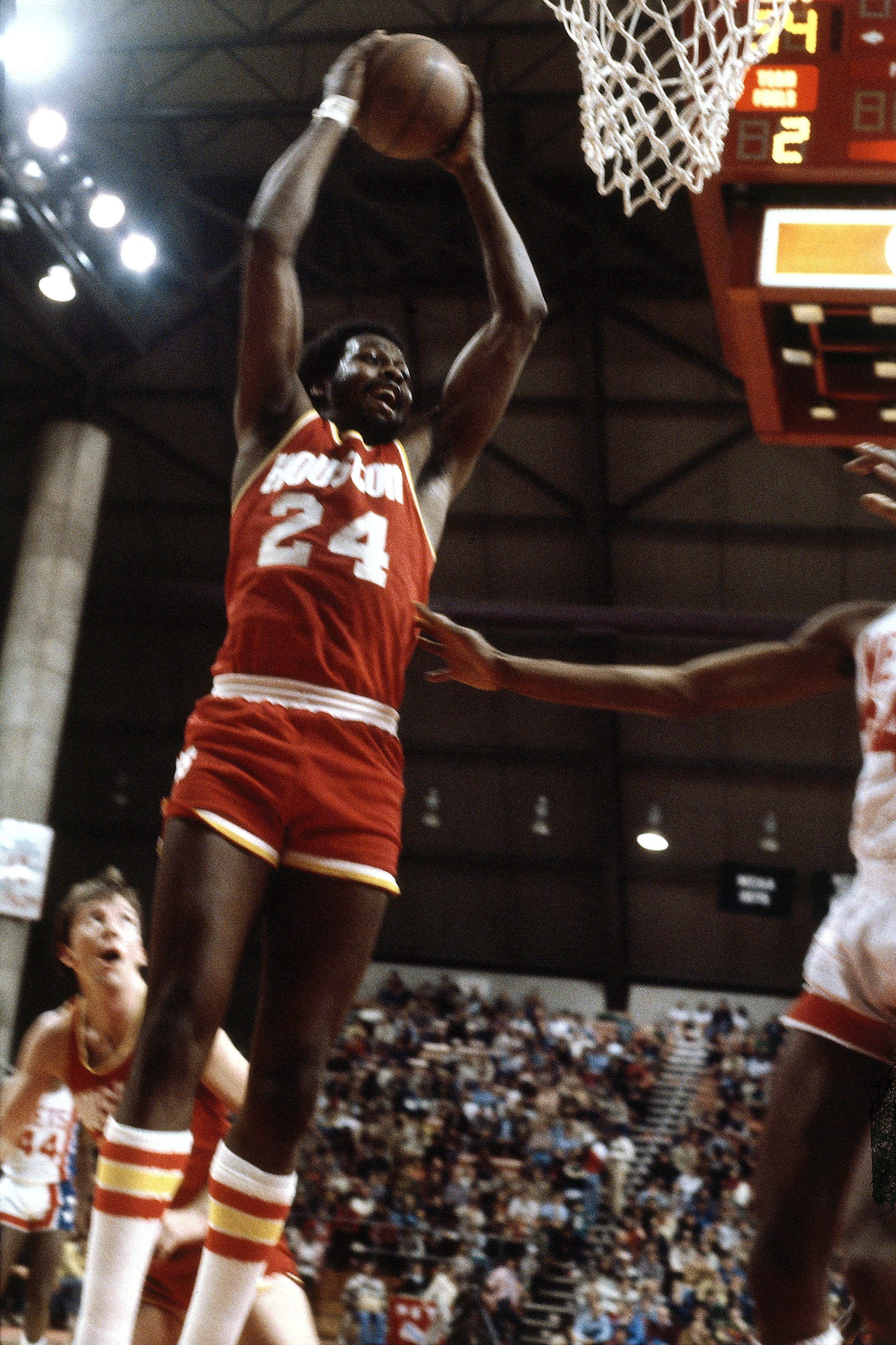
After leading Petersburg High School to consecutive undefeated seasons and back-to-back Virginia State Championships, Moses Malone had signed to play college basketball at Maryland, but when he was drafted in the 3rd round of the ABA Draft by the Utah Stars, he decided to turn pro instead.

Malone had a very good rookie season, averaging 18.8 points and 14.6 rebounds per game, being named to the All-Rookie First Team and leading the Stars to the playoffs. In the first round, he averaged 22.7 points and 17.5 rebounds, but it wasn't enough and the Stars lost to the Nuggets in 6 games.

The Stars folded at the beginning of the next season, and Malone was sold to Saint Louis, where he had a mediocre year as the ABA era was coming to an end. The Spirits were not invited to join the NBA in the merger that summer, and the New Orleans Jazz held Malone's NBA rights, but they gave them up in exchange for a first round draft pick, putting Malone in the ABA Dispersal Draft. He was the #5 overall pick in that draft by Portland, but they already had Maurice Lucas, so they traded Malone to Buffalo before the season.

In the first 2 games of the season, Buffalo only gave Malone 6 total minutes of playing time, and when he complained, they traded him to the Houston Rockets. He finally achieved some stability with the Rockets, playing with them for 6 years and achieving some of his best individual success.

In his first full season with Houston, Malone really started to blossom, averaging 19.4 points and 15 rebounds per game before missing the final third of the season with a stress fracture in his foot. When he was fully healed the next year, he had his first monster season, averaging 24.8 points and a career high 17.6 rebounds per game, which led the league and earned him his first MVP award, but the Rockets lost in the first round of the playoffs.

The next year, Malone was just as good, but came in #2 in rebounding and did not repeat as MVP. He did help Houston win a playoff series, with 37 points and 20 rebounds in the deciding game in the first round against San Antonio, but they were swept in the next round by Boston.

Malone had his best overall season the next year, averaging 27.8 points and 14.8 rebounds per game, finishing at the top of the league in rebounding and runner-up in scoring. The team barely made the playoffs with a 40-42 record, but Malone led them all the way to the NBA Finals, where the Celtics were too much for the Cinderella Rockets, beating them in 6 games.

Malone won his second MVP the next year, when he averaged 31.1 points a game to finish as the runner-up in the scoring race again, and led the league in rebounding for the third time with 14.7 per game. That season ended in disappointment, however, when the Rockets lost in the first round. After the season, the team was sold, and the new owners felt that Malone cost too much, so they traded him to the 76ers for Caldwell Jones and a first-round pick.

The 76ers already had Julius Erving and Maurice Cheeks on the roster, and the addition of Malone made them unstoppable. Malone won his second straight MVP, the only player to win back-to-back with different teams, with averages of 24.5 points and 15.3 rebounds, once again tops in the league in boards. Malone predicted that the 76ers would sweep through the playoffs in "fo, fo, fo", but he just missed on his prediction, as the team lost one game in the Conference Finals to Milwaukee. Malone was named the Finals MVP as well after averaging 25.8 points and 18 rebounds in the sweep of the Lakers.

Malone led the league in rebounding for the 4th straight time the next year, but the defending champs were shocked in the first round of the playoffs by the Nets. After adding Charles Barkley the next year, the Sixers bounced back with another strong season, reaching the Conference Finals while Malone led the league in rebounding for the 5th straight season and 6th overall. It would be the final time that Malone would win a playoff series. 

After one more season with the Sixers, Malone was traded to the Washington Bullets. He played two seasons for the Bullets, averaging at least 20 and 10 in each season. He then signed as a free agent with the Hawks, where he again averaged 20 and 10 in his first season with the team, making it 11 years in a row hitting those marks, and making him the first player in history to do it with 4 different teams.

In his third season with Atlanta, he was moved to the bench for the first time in his career, so he left as a free agent to sign with Milwaukee, where he started for one more year, averaging 15.6 and 9.1 rebounds per game. He injured his back in the preseason just before the next season started, and ended up playing only 11 games.

After that, Malone played two more seasons in a backup role, one back with the 76ers, followed by his final season backing up David Robinson in San Antonio. He finished his career with a 74-foot buzzer beater against the Hornets, only the 8th three-pointer he hit in his entire career.

Malone is the greatest offensive rebounder of all time, leading the league 9 times and setting the records for most in a season and in a game as well. He led the league in rebounding 6 times, and finished in the top 4 six other times, and is currently #3 on the all-time leaderboard, behind only Wilt Chamberlain and Bill Russell. He won 3 MVP awards, one of only 8 players to achieve that feat, and won a dominant Finals MVP in 1983, and he is definitely one of the greatest players of all time.


Friday, September 16, 2016

Top 100 NBA Players: #12 - Hakeem Olajuwon


Hakeem Olajuwon

Hakeem Olajuwon is undoubtedly one of the greatest centers of all time and easily the best modern defensive center the NBA has seen. He is the best player who was not born as a United States citizen, and he peaked at exactly the right time, which allowed him to win a couple of championships and cement his place as one of the all-time greats.

Hakeem grew up primarily playing soccer in his native Nigeria, but when he was introduced to basketball as a teenager, he knew he had found his calling in life. He was only offered a spot on one college team, at the University of Houston, and after a couple of years training with local pro and NBA MVP Moses Malone, Olajuwon led the Cougars to two consecutive national championship games before being drafted by the Houston Rockets as the #1 pick in the NBA Draft, two spots ahead of Michael Jordan.

The Rockets started seeing success pretty quickly, making it to the NBA Finals in Hakeem's second season, where they lost to the Boston Celtics, whose 1986 team is regarded as one of the greatest teams in history. It looked like the Rockets were going to be a force for years to come, but because of a series of injuries to Ralph Sampson and their inability to get any decent players to play with Olajuwon, Houston suffered through several disappointing seasons.

Everything finally came together in 1993-94, beginning with the retirement of Michael Jordan in the offseason. Olajuwon took advantage of the hole left at the top of the league and had one of the most impressive seasons in history, becoming the only player ever to win the regular season MVP, Finals MVP, and Defensive Player of the Year Award in the same season.

The next year, things didn't look quite as good, with David Robinson and the Spurs dominating the regular season and Olajuwon dealing with some health issues near the end of the year, but with a late-season trade that brought college teammate Clyde Drexler to town, the Rockets were able to become the lowest-seeded team in history to win the NBA Finals, and Olajuwon repeated as Finals MVP.

Olajuwon is well-known as a great shot-blocker, and he still holds the record for most shots blocked in a career, although they have only been recorded for half of the league's history. Not only was he great at blocking shots, he was always among the leaders in steals as well, and in 1989 he became the only player in history to record more than 200 blocks and 200 steals in the same season. In fact, there have only been 8 seasons in which a player reached 150-150, and four of those belong to Olajuwon. He is definitely one of the greatest defensive players of all time.

Olajuwon was also great on the offensive end of the court, averaging over 20 points per game for 13 consecutive seasons to start his career, and his moves in the low post have become legendary, especially his patented "Dream Shake," which involved numerous fakes and spins and allowed him to get a ton of easy shots near the hoop. He now hosts a camp each summer where he teaches footwork in the paint, and many NBA stars have trained with him, including Yao Ming, Kobe Bryant, and LeBron James.

What really made Olajuwon great is that he stepped up his game when it mattered most, especially against the toughest competition. During his two championship seasons, he outplayed David Robinson, Shaquille O'Neal, and Patrick Ewing in the playoffs, and also beat teams led by Karl Malone and Charles Barkley. When Robinson won the regular season MVP in 1995, Olajuwon made a point of completely dismantling him in the Western Conference Finals, and Robinson was never the same player again.

The thing that held him back from making the all-time top 10 was that his three-year peak was relatively short for a great player, and happened to coincide nicely with Jordan's first retirement, then abruptly ended when Jordan returned. He played in an era with many other great centers, and he was the best of any of them during his peak years, but he was only one of the top 5 players in the league for 5 seasons, which was a relatively short period, especially when compared to the players that make up my top 10.

Saturday, September 3, 2016

Top 100 NBA Players: #27 - Moses Malone


Moses Malone

Moses Malone is the greatest offensive rebounder in the history of the NBA, and was a trailblazer for many of today's players, becoming the first player to successfully jump directly from high school to the pros. He also had an incredibly long career, playing 19 NBA seasons and 21 professional seasons overall.

As I stated above, Malone was easily the best offensive rebounder to ever set foot on a basketball court. He has the three highest single season totals of all time, and is also the owner of 6 of the top 10 offensive rebounding seasons. He led the league in offensive rebounds in each of his first 7 seasons, and in total rebounding six times in his career. In 1978-79, he averaged 7.2 offensive rebounds per game, and 17.6 overall. He was truly a monster on the boards.

Malone was among the top 5 players in the league for five straight seasons early in his career, from 1978-1983. During that stretch, he was awarded the MVP three times, but he may not have been the best player during those seasons. I'm going to break down the best players from four of those seasons and show my pick for each season's MVP

Gervin (1979) - 29.6 pts, 5.0 reb, 2.7 ast, 1.7 stl, 1.1 blk, .541 FG%, .826 FT%, .585 Win%
Malone (1979) - 24.8 pts, 17.6 reb, 1.8 ast, 1.0 stl, 1.5 blk, .540 FG%, .739 FT%, .573 Win%

Gervin led the league in scoring, while Malone led the league in rebounding. Gervin was the better shooter, despite being the smaller player, and his team finished ahead of Malone's in the overall standings. They also advanced farther in the playoffs than the Rockets, all of which make a strong case for Gervin deserving that season's MVP.

Erving (1981) - 24.6 pts, 8.0 reb, 4.4 ast, 2.1 stl, 1.8 blk, .521 FG%, .787 FT%, .756 Win%
Malone (1981) - 27.8 pts, 14.8 reb, 1.8 ast, 1.0 stl, 1.9 blk, .522 FG%, .757 FT%, .488 Win%

Statistically, Malone was a much better player, but Erving had the advantage of playing for the team with the best record, which is probably why he won the MVP, but in retrospect, the 76ers fell in the Eastern Conference Finals, while Malone led the Rockets all the way to the NBA Finals, where they fell to Boston in 6 games. This one's not completely clear-cut, but I believe Malone was the better player that season.

Johnson (1982) - 18.6 pts, 9.6 reb, 9.5 ast, 2.7 stl, 0.4 blk, .537 FG%, .760 FT%, .695 Win%
Malone (1982) - 31.1 pts, 14.7 reb, 1.8 ast, 0.9 stl, 1.5 blk, .519 FG%, .762 FT%, .561 Win%

Malone had an amazing season, leading the league in rebounding again while averaging over 30 points for the only time in his career, but Magic came closer to a triple-double average than anybody since Oscar Robertson and led Los Angeles to the best record in the West and eventually an NBA Championship, while Houston lost in the first round. This should have been Johnson's first MVP.

Johnson (1983) - 16.8 pts, 8.6 reb, 10.5 ast, 2.2 stl, 0.6 blk, .548 FG%, .800 FT%, .707 Win%
Malone (1983) - 24.5 pts, 15.3 reb, 1.3 ast, 1.1 stl, 2.0 blk, .501 FG%, .761 FT%, .793 Win%

Johnson nearly matched everything he had done the year before, even upping the Lakers' winning percentage and shooting much better than big man Malone, while Moses saw a huge dip in his scoring numbers, which he made up for by winning more games with his new team, the 76ers. The two teams met in the Finals, with Malone's Rockets winning in 4 games, but I still think Magic was slightly better overall, because he could pass the ball and take it away from the other team.

It was during that championship run of 1983 when Moses famously predicted that Philly would sweep through the playoffs in "fo, fo, fo," which they came within one game of accomplishing, losing just once in the second round. Moses ran away with the Finals MVP award and took home his only championship during that season.

Most experts have Malone ranked a bit higher all-time, but there are several reasons to rank him a bit lower. The first is that he really didn't have that much playoff success. He had the one magical and dominant season in 1983, and he took his team to the Finals in 1981, but other than that, he only saw the Conference Finals two other times in 19 seasons. That equals 15 seasons of losing in the first round or missing the playoffs altogether.

Another problem with Malone is that he was traded often during the prime of his career. Usually when one of the best players in the league is traded, it's because there is some sort of problem with the player, and Malone was traded not just once, but 5 times during the best years of his career. In fact, more than half of my top 20 players played for only one team during their prime years. One mark of a truly great player is that he is untradeable.

Moses was also not a great shooter, especially for a big man. His career average was under 50%, which is unacceptable for a center, and he only shot over 50% five times in his 19 seasons. His longevity, durability, and dominance in one category for a long period of time certainly help him out here, but he is not one of history's top 25.

Friday, September 2, 2016

Top 100 NBA Players: #29 - Julius Erving


Julius Erving

When Julius Erving finally made his NBA debut in 1976, he was already an established superstar, having spent five seasons in the ABA and winning the final 3 MVP awards that league gave out. If I was doing a ranking of the top professional basketball players of all time, and not just NBA players, Erving would definitely jump up much closer to the top 10, but when you consider only the NBA portion of his career, it's still quite impressive.

Erving started out his time in the NBA as the second-best player in the entire league, with only Kareem playing at a higher level than the 76ers' new star. Each led his team to the top seed in his conference entering the playoffs, but Erving went a step beyond Kareem there, advancing to the NBA Finals in his "rookie" season, where they lost to Bill Walton and the Trail Blazers in Walton's only healthy season.

The next season Philadelphia once again took the top seed in the East, but they lost in the Eastern Conference Finals to the eventual champion Washington Bullets. Two years later, it was Philadelphia pulling off the conference final upset, taking down Larry Bird and the Celtics 4 games to 1, setting up a huge Finals showdown with the Los Angeles Lakers, who were led by another young star named Magic Johnson, who eventually led them to the championship and left Erving ringless still.

In 1981, Erving won his first and only NBA MVP award, although I feel that it should have gone to Moses Malone, while I will explain in more detail in a later profile. Malone ended up taking the Rockets all the way to the Finals, where they lost to Boston, while Erving lost to those same Celtics one round earlier. Even at age 30, there was no denying that Dr. J was still one of the league's premier players.

In 1982, Erving led the 76ers to the Finals for the third time in his NBA career, but they once again were no match for Magic Johnson and the Lakers. One of the reasons that Erving is not rated higher is that he was never quite good enough to lead a team all the way to the championship without more help, and that help came the next season in the form of Moses Malone.

With Malone as a teammate rather than an opponent, Erving and the 76ers returned to the NBA Finals, this time sweeping the Lakers and posting a total record of 12-1 during their dominant playoff run. Erving was finally an NBA Champion, but he wasn't the star of the show anymore. That was Moses, who won both the regular season and Finals MVP awards in the only championship season for either player.

Erving hung on for a few more seasons, but he was obviously on the downside of his career, and he was never one of the top 10 players again. In 11 NBA seasons, Erving never missed the playoffs, and he led his team to the NBA Finals 3 times and the conference finals twice before he was replaced by Malone. With Malone leading the way, he won a championship, and saw the conference finals one more time, but at that point he had also been surpassed by a young Charles Barkley. Overall, he was one of the league's most dynamic and exciting stars, and he saw quite a bit of success despite the fact that he never led a title run himself.

Saturday, August 27, 2016

Top 100 NBA Players: #36 - George Gervin


George Gervin

George Gervin was an amazing scorer and a big star for a number of years, but more than anyone else who reached this high on the list, he was not a winner. He was known for being somewhat selfish, but it doesn't diminish how great he was offensively.

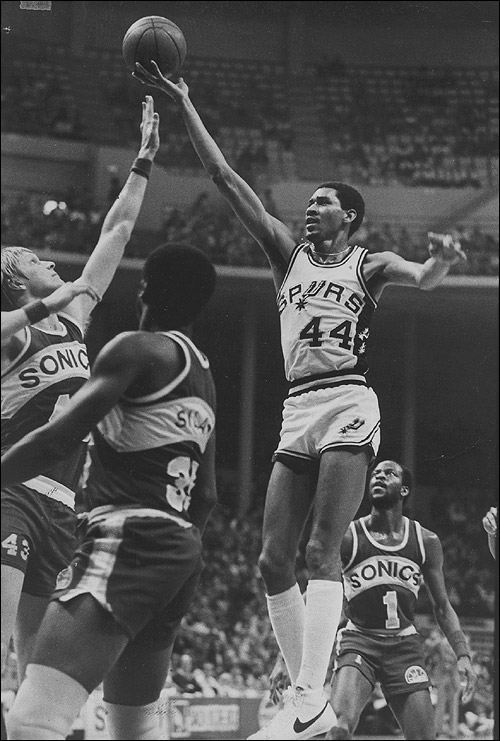
Gervin was a four time scoring leader, and is one of 7 players all-time to win three straight scoring titles. In 1980 he averaged 33.1 points per game, and he eclipsed 30 points again 2 years later, when he again led the league with 32.3 nightly. He was twice the MVP runner-up, in 1978 and 1979, but he probably should have won in 1979, when it was given to Moses Malone. Here are how their numbers stacked up that season:

Malone - 24.8 pts, 17.6 reb, 1.8 ast, 1.5 blk, .540 FG%, .739 FT%
Gervin - 29.6 pts, 5.0 reb, 2.7 ast, 1.1 blk, .541 FG%, .826 FT%

Moses led the league in rebounding that year, and Gervin in scoring, so both were obvious candidates. In the other four categories, Gervin was obviously the better player, especially if you know that Gervin was a shooting guard and Malone was a center, because Gervin shot a higher percentage than the MVP that year, and blocked nearly as many shots.

Gervin was the best player on his team for nearly his entire career, but he never saw much playoff success in that role. His best finish was losing in the Conference Finals three times, making him the best player to never play in the NBA Finals, joining Dominique Wilkins, Steve Nash, Alex English, and Vince Carter on that dubious list.

For six straight seasons, Gervin was one of the top 3 players in the NBA, but because of his playoff failings he is usually not considered to be on the same level as those who were his peers during those years, including Moses Malone, Magic Johnson, and Kareem Abdul-Jabbar. His averages over that time were spectacular, and they are listed below:

Gervin (1977-1983) - 29.2 pts, 5.0 reb, 3.0 ast, 1.3 stl, .514 FG%, .834 FT%

Gervin had the disadvantage of never having a true star for a teammate. As the only star in San Antonio for a long time, he did get them to the playoffs in every season of his career, even though he couldn't get them through to the Finals. His career was still very impressive, even though it only lasted for 10 NBA seasons.

Monday, April 23, 2012

Top 100 NBA Players: #11


Hakeem Olajuwon

(Kalb: #16, Simmons: #10, BBR: #9)

Hakeem Olajuwon is undoubtedly one of the greatest centers of all time and easily the best modern defensive center the NBA has seen. He is the best player who was not born as a United States citizen, and he peaked at exactly the right time, which allowed him to win a couple of championships and cement his place as one of the all-time greats.

Hakeem grew up primarily playing soccer in his native Nigeria, but when he was introduced to basketball as a teenager, he knew he had found his calling in life. He was only offered a spot on one college team, at the University of Houston, and after a couple of years training with local pro and NBA MVP Moses Malone, Olajuwon led the Cougars to two consecutive national championship games before being drafted by the Houston Rockets as the #1 pick in the NBA Draft, two spots ahead of Michael Jordan.

The Rockets started seeing success pretty quickly, making it to the NBA Finals in Hakeem's second season, where they lost to the Boston Celtics, whose 1986 team is regarded as one of the greatest teams in history. It looked like the Rockets were going to be a force for years to come, but because of a series of injuries to Ralph Sampson and their inability to get any decent players to play with Olajuwon, Houston suffered through several disappointing seasons.

Everything finally came together in 1993-94, beginning with the retirement of Michael Jordan in the offseason. Olajuwon took advantage of the hole left at the top of the league and had one of the most impressive seasons in history, becoming the only player ever to win the regular season MVP, Finals MVP, and Defensive Player of the Year Award in the same season.

The next year, things didn't look quite as good, with David Robinson and the Spurs dominating the regular season and Olajuwon dealing with some health issues near the end of the year, but with a late-season trade that brought college teammate Clyde Drexler to town, the Rockets were able to become the lowest-seeded team in history to win the NBA Finals, and Olajuwon repeated as Finals MVP.

Olajuwon is well-known as a great shot-blocker, and he still holds the record for most shots blocked in a career, although they have only been recorded for half of the league's history. Not only was he great at blocking shots, he was always among the leaders in steals as well, and in 1989 he became the only player in history to record more than 200 blocks and 200 steals in the same season. In fact, there have only been 8 seasons in which a player reached 150-150, and four of those belong to Olajuwon. He is definitely one of the greatest defensive players of all time.

Olajuwon was also great on the offensive end of the court, averaging over 20 points per game for 13 consecutive seasons to start his career, and his moves in the low post have become legendary, especially his patented "Dream Shake," which involved numerous fakes and spins and allowed him to get a ton of easy shots near the hoop. He now hosts a camp each summer where he teaches footwork in the paint, and many NBA stars have trained with him, including Yao Ming, Kobe Bryant, and LeBron James.

What really made Olajuwon great is that he stepped up his game when it mattered most, especially against the toughest competition. During his two championship seasons, he outplayed David Robinson, Shaquille O'Neal, and Patrick Ewing in the playoffs, and also beat teams led by Karl Malone and Charles Barkley. When Robinson won the regular season MVP in 1995, Olajuwon made a point of completely dismantling him in the Western Conference Finals, and Robinson was never the same player again.

The thing that held him back from making the all-time top 10 was that his three-year peak was relatively short for a great player, and happened to coincide nicely with Jordan's first retirement, then abruptly ended when Jordan returned. He played in an era with many other great centers, and he was the best of any of them during his peak years, but he was only one of the top 5 players in the league for 5 seasons, which was a relatively short period, especially when compared to the players that make up my top 10.


Hakeem Olajuwon was only the best player in the NBA for one season, while LeBron has already done it 6 times, but Hakeem has a couple of advantages over James. One is that he has won a couple of NBA Championships as the best player on his team, while LeBron has lost a couple of NBA Finals as his team's best player. Olajuwon also made one other trip to the penultimate series, so he also holds the edge in Finals appearances. The other thing that puts Olajuwon ahead is that he had a very long career, and was among the NBA's best for the majority of it, so LeBron needs to keep up his current level of play for a little longer in order to pass the best foreign player ever.

Saturday, October 22, 2011

Top 100 NBA Players - #25


Julius Erving

(Kalb: #15, Simmons: #16, BBR: #12)

When Julius Erving finally made his NBA debut in 1976, he was already an established superstar, having spent five seasons in the ABA and winning the final 3 MVP awards that league gave out. If I was doing a ranking of the top professional basketball players of all time, and not just NBA players, Erving would definitely jump up much closer to the top 10, but when you consider only the NBA portion of his career, it's still quite impressive.

Erving started out his time in the NBA as the second-best player in the entire league, with only Kareem playing at a higher level than the 76ers' new star. Each led his team to the top seed in his conference entering the playoffs, but Erving went a step beyond Kareem there, advancing to the NBA Finals in his "rookie" season, where they lost to Bill Walton and the Trail Blazers in Walton's only healthy season.

The next season Philadelphia once again took the top seed in the East, but they lost in the Eastern Conference Finals to the eventual champion Washington Bullets. Two years later, it was Philadelphia pulling off the conference final upset, taking down Larry Bird and the Celtics 4 games to 1, setting up a huge Finals showdown with the Los Angeles Lakers, who were led by another young star named Magic Johnson, who eventually led them to the championship and left Erving ringless still.

In 1981, Erving won his first and only NBA MVP award, although I feel that it should have gone to Moses Malone, an opinion I outlined in my previous player profile. Malone ended up taking the Rockets all the way to the Finals, where they lost to Boston, while Erving lost to those same Celtics one round earlier. Even at age 30, there was no denying that Dr. J was still one of the league's premier players.

In 1982, Erving led the 76ers to the Finals for the third time in his NBA career, but they once again were no match for Magic Johnson and the Lakers. One of the reasons that Erving is not rated higher is that he was never quite good enough to lead a team all the way to the championship without more help, and that help came the next season in the form of Moses Malone.

With Malone as a teammate rather than an opponent, Erving and the 76ers returned to the NBA Finals, this time sweeping the Lakers and posting a total record of 12-1 during their dominant playoff run. Erving was finally an NBA Champion, but he wasn't the star of the show anymore. That was Moses, who won both the regular season and Finals MVP awards in the only championship season for either player.

Erving hung on for a few more seasons, but he was obviously on the downside of his career, and he was never one of the top 10 players again. In 11 NBA seasons, Erving never missed the playoffs, and he led his team to the NBA Finals 3 times and the conference finals twice before he was replaced by Malone. With Malone leading the way, he won a championship, and saw the conference finals one more time, but at that point he had also been surpassed by a young Charles Barkley. Overall, he was one of the league's most dynamic and exciting stars, and he saw quite a bit of success despite the fact that he never led a title run himself.


Erving and Malone's careers followed very similar trajectories, except for the fact that Malone hung on a lot longer than Erving, as he was more willing to accept a reserve role. Both started their careers in the ABA, then came over to the NBA when that league folded, although Erving came over as a superstar, and Malone as a bit of an unknown. They both had failed trips to the Finals before teaming up in 1983 to win their only championship, but Erving gets the edge because he led Philly to 3 NBA Finals before Malone arrived, while Malone had only made it there once with the Rockets.

Friday, October 7, 2011

Top 100 NBA Players: #26


Moses Malone

(Kalb: #14, Simmons: #12, BBR: #15)

Moses Malone is the greatest offensive rebounder in the history of the NBA, and was a trailblazer for many of today's players, becoming the first player to successfully jump directly from high school to the pros. He also had an incredibly long career, playing 19 NBA seasons and 21 professional seasons overall.

As I stated above, Malone was easily the best offensive rebounder to ever set foot on a basketball court. He has the three highest single season totals of all time, and is also the owner of 6 of the top 10 offensive rebounding seasons. He led the league in offensive rebounds in each of his first 7 seasons, and in total rebounding six times in his career. In 1978-79, he averaged 7.2 offensive rebounds per game, and 17.6 overall. He was truly a monster on the boards.

Malone was among the top 5 players in the league for five straight seasons early in his career, from 1978-1983. During that stretch, he was awarded the MVP award three times, but he may not have been the best player during those seasons. I'm going to break down the best players from four of those seasons and show my pick for each season's MVP

Gervin (1979) - 29.6 pts, 5.0 reb, 2.7 ast, 1.7 stl, 1.1 blk, .541 FG%, .826 FT%, .585 Win%
Malone (1979) - 24.8 pts, 17.6 reb, 1.8 ast, 1.0 stl, 1.5 blk, .540 FG%, .739 FT%, .573 Win%

Gervin led the league in scoring, while Malone led the league in rebounding. Gervin was the better shooter, despite being the smaller player, and his team finished ahead of Malone's in the overall standings. They also advanced farther in the playoffs than the Rockets, all of which make a strong case for Gervin deserving that season's MVP.

Erving (1981) - 24.6 pts, 8.0 reb, 4.4 ast, 2.1 stl, 1.8 blk, .521 FG%, .787 FT%, .756 Win%
Malone (1981) - 27.8 pts, 14.8 reb, 1.8 ast, 1.0 stl, 1.9 blk, .522 FG%, .757 FT%, .488 Win%

Statistically, Malone was a much better player, but Erving had the advantage of playing for the team with the best record, which is probably why he won the MVP, but in retrospect, the 76ers fell in the Eastern Conference Finals, while Malone led the Rockets all the way to the NBA Finals, where they fell to Boston in 6 games. This one's not completely clear-cut, but I believe Malone was the better player that season.

Johnson (1982) - 18.6 pts, 9.6 reb, 9.5 ast, 2.7 stl, 0.4 blk, .537 FG%, .760 FT%, .695 Win%
Malone (1982) - 31.1 pts, 14.7 reb, 1.8 ast, 0.9 stl, 1.5 blk, .519 FG%, .762 FT%, .561 Win%

Malone had an amazing season, leading the league in rebounding again while averaging over 30 points for the only time in his career, but Magic came closer to a triple-double average than anybody since Oscar Robertson and led Los Angeles to the best record in the West and eventually an NBA Championship, while Houston lost in the first round. This should have been Johnson's first MVP.

Johnson (1983) - 16.8 pts, 8.6 reb, 10.5 ast, 2.2 stl, 0.6 blk, .548 FG%, .800 FT%, .707 Win%
Malone (1983) - 24.5 pts, 15.3 reb, 1.3 ast, 1.1 stl, 2.0 blk, .501 FG%, .761 FT%, .793 Win%

Johnson nearly matched everything he had done the year before, even upping the Lakers' winning percentage and shooting much better than big man Malone, while Moses saw a huge dip in his scoring numbers, which he made up for by winning more games with his new team, the 76ers. The two teams met in the Finals, with Malone's Rockets winning in 4 games, but I still think Magic was slightly better overall, because he could pass the ball and take it away from the other team.

It was during that championship run of 1983 when Moses famously predicted that Philly would sweep through the playoffs in "fo, fo, fo," which they came within one game of accomplishing, losing just once in the second round. Moses ran away with the Finals MVP award and took home his only championship during that season.

You may have noticed that most experts have Malone ranked a bit higher all-time, but there are several reasons to rank him a bit lower. The first is that he really didn't have that much playoff success. He had the one magical and dominant season in 1983, and he took his team to the Finals in 1981, but other than that, he only saw the Conference Finals two other times in 19 seasons. That equals 15 seasons of losing in the first round or missing the playoffs altogether.

Another problem with Malone is that he was traded often during the prime of his career. Usually when one of the best players in the league is traded, it's because there is some sort of problem with the player, and Malone was traded not just once, but 5 times during the best years of his career. In fact, more than half of my top 20 players played for only one team during their prime years. One mark of a truly great player is that he is untradeable.

Moses was also not a great shooter, especially for a big man. His career average was under 50%, which is unacceptable for a center, and he only shot over 50% five times in his 19 seasons. His longevity, durability, and dominance in one category for a long period of time certainly help him out here, but he is not one of history's top 25.


Malone and Wade each have one championship, one Finals MVP, and two Finals appearances in their careers. Malone had a lot fewer injury problems than Wade has had, but Wade was a better all-around player than Malone, who was more of an inside-only star. The thing that keeps Malone ahead was that he was a star player of 14 years, which is longer than Wade has been in the league so far. I'm not sure how much longer he can hold him off, though.

Thursday, September 1, 2011

Top 100 NBA Players: #34


George Gervin

(Kalb: #26, Simmons: #34, BBR: #41)

George Gervin was an amazing scorer and a big star for a number of years, but more than anyone else who reached this high on the list, he was not a winner. He was known for being somewhat selfish, but it doesn't diminish how great he was offensively.

Gervin was a four time scoring leader, and is one of 6 players all-time to win three straight scoring titles. In 1980 he averaged 33.1 points per game, and he eclipsed 30 points again 2 years later, when he again led the league with 32.3 nightly. He was twice the MVP runner-up, in 1978 and 1979, but he probably should have won in 1979, when it was given to Moses Malone. Here are how their numbers stacked up that season:

Malone - 24.8 pts, 17.6 reb, 1.8 ast, 1.5 blk, .540 FG%, .739 FT%
Gervin - 29.6 pts, 5.0 reb, 2.7 ast, 1.1 blk, .541 FG%, .826 FT%

Moses led the league in rebounding that year, and Gervin in scoring, so both were obvious choices. In the other four categories, Gervin was obviously the better player, especially if you know that Gervin was a shooting guard and Malone was a center, because Gervin shot a higher percentage than the MVP that year, and blocked nearly as many shots.

Gervin was the best player on his team for nearly his entire career, but he never saw much playoff success in that role. His best finish was losing in the Conference Finals three times, making him the best player to never play in the NBA Finals, joining Dominique Wilkins, Steve Nash, Alex English, Vince Carter, and Tracy McGrady on that dubious list.

For six straight seasons, Gervin was one of the top 3 players in the NBA, but because of his playoff failings he is usually not considered to be on the same level as those who were at his level during those years, including Moses Malone, Magic Johnson, and Kareem Abdul-Jabbar. His averages over that time were spectacular, and they are listed below:

Gervin (1977-1983) - 29.2 pts, 5.0 reb, 3.0 ast, 1.3 stl, .514 FG%, .834 FT%

Gervin had the disadvantage of never having a true star for a teammate. As the only star in San Antonio for a long time, he did get them to the playoffs in every season of his career, even though he couldn't get them through to the Finals. His career was still very impressive, even though it only lasted for 10 NBA seasons.


Payton may have been the better defensive player by far, but Gervin's offensive prowess was so great that there is no doubt he was better than Payton. Gervin's first 7 NBA seasons were all at least as good as Payton's best season, so even though Payton lasted much longer, Gervin got much higher. While Gervin was not a great playoff player, Payton's overall playoff success wasn't much better, so Gervin is definitely higher up on the list.