Showing posts with label Tracy McGrady. Show all posts

Wednesday, August 18, 2021

Top 100 NBA Players: #74 - Tracy McGrady


Tracy McGrady

Teams

Toronto Raptors - 1997-00

Orlando Magic - 2000-04

Houston Rockets - 2004-10

New York Knicks - 2010

Detroit Pistons - 2010-11

Atlanta Hawks - 2011-12

San Antonio Spurs - 2013


Playoffs

Appearances - 9 (2000,2001,2002,2003,2005,2007,2008,2012,2013)

Conference Finals - 1 (2013)

NBA Finals - 1 (2013)

Championships - 0


Awards and Honors

All-NBA First Team - 2 (2002,2003)

All-NBA Second Team - 3 (2001,2002,2004,2005,2007)

All-NBA Third Team - 2 (2005,2008)

Hall of Fame - 2017

*(actual in bold, deserved in italics)


All-Time Ranks

Total Points - #75

Points Per Game - #77


League Leads

Total Points (#2-2003, #3-2004, #4-2002)

Points Per Game (#1-2003,2004, #4-2002)

Three-Pointers Made (#4-2004, #5-2003)


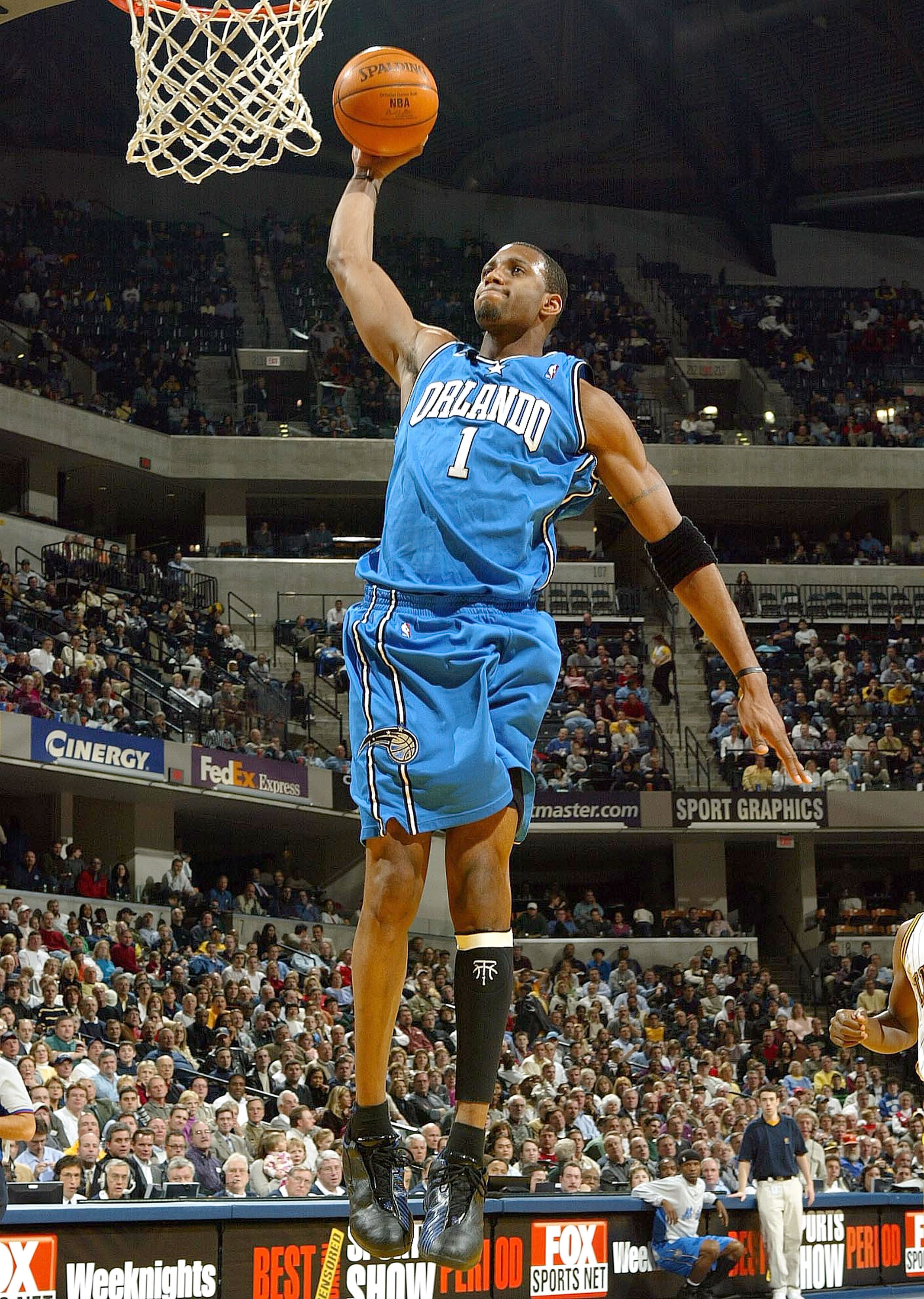
Tracy McGrady had a dominant senior year in high school, averaging 27.5 points, 8.7 rebounds, and 7.7 assists per game for a nationally ranked team, which got him enough attention that he decided to skip college and jump straight to the NBA, where he was the #9 overall pick by the Toronto Raptors.

He didn't get much playing time during his first two seasons, but he earned a starting spot late in his third season, and went on to finish with averages of 15.4 points and 6.3 rebounds while helping his cousin Vince Carter lead the Raptors to their first-ever playoff appearance. After that season, McGrady left Toronto to join the Orlando Magic, who had also signed Grant Hill that summer.

When Hill suffered an ankle injury early in the season, the Magic became McGrady's team, and he stepped up big time. He made the All-NBA Second Team after averaging 26.8 points and 7.5 rebounds, and was named the league's Most Improved Player as well. The Magic reached the playoffs, but as was the story for most of McGrady's career, they were eliminated in the first round.

The next year, he had very similar numbers to those of his first year in Orlando, but was still voted to the All-NBA First Team. His third year in Orlando was his masterpiece. He led the league in scoring, with 32.1 per game, along with 6.5 rebounds and 5.5 assists, and led the Magic to a 3-1 lead in the first round of the playoffs, but they once again failed to advance to the second round.

The 2003-04 season was a rough one in Orlando, with a lot of players missing time with injuries, a coach getting fired, and McGrady feuding with management, and it led to the Magic finishing with the worst record in the East, even with McGrady repeating as the league scoring leader. After the season, he was traded to the Houston Rockets.

In Houston, he joined young star Yao Ming in leading the Rockets to the #3 record in the West, averaging 25.7 points along the way, but the team still fell in the first round, getting blown out by Dallas in Game 7. Sadly, it would be the final season where McGrady was fully healthy.

He missed nearly half of the season in 2005-06, and the Rockets missed the playoffs as a result. Treatment started working the next season, and he was able to play most of the season, but lost to Utah in 7 games in the first round of the playoffs. They had a rematch with the Jazz the next season, but again failed to advance.

He had surgery on his shoulder and knee right after that playoff loss, and it caused him to miss quite a bit of time early in the season before it was determined that he would need season-ending surgery on the knee. That season, the Rockets were finally able to advance past the first round, but with McGrady on the bench in street clothes.

He attempted to come back the next season, but after a few games, the Rockets decided to stop using him and focus on trading him, and they were finally able to trade him to the Knicks. After short stints in New York, Detroit, and Atlanta, each with diminishing returns, McGrady left the NBA to play in China.

After having a solid regular season in China, McGrady signed with the San Antonio Spurs for the 2013 playoffs, and it would be his only foray past the first round of the playoffs. They advanced to the NBA Finals, and McGrady played sparingly in every round, and he ended up playing 31 total minutes in the playoffs without scoring a single point. He retired after the season.

For a while there, McGrady was one of the best scorers the league had seen. He had 7 straight seasons scoring at least 24 points per game split between his time in Orlando and Houston, but he was never able to get a team to advance in the playoffs, though he almost never had another star-level teammate who was healthy at the same time as him. Even without almost zero playoff success, his amazing scoring prowess is enough to earn him a spot as one of the greatest players of all time.




Thursday, August 4, 2016

Top 100 NBA Players: #61 - Tracy McGrady


Tracy McGrady

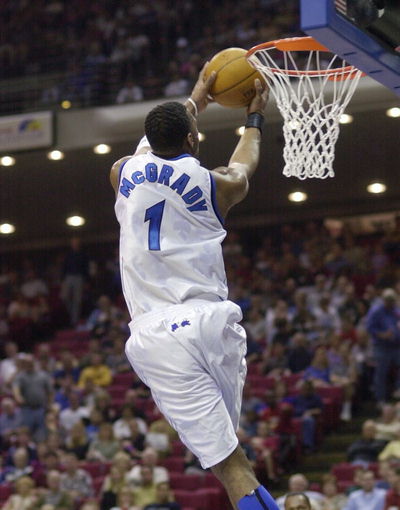
Tracy McGrady is another example of a player whose promising career was derailed by injury too early, but when he was good, he was really good. He twice led the entire league in scoring before he turned 25, and he averaged at least 20-5-5 six times.

McGrady came straight to the NBA from high school, but he didn't become a star until his 4th season, when he would have been a college senior. That's the season when he left Toronto and Vince Carter's shadow and became a star in his own right in Orlando. That year he improved his scoring average by 11.4 points and won the Most Improved Player Award while making the All-Star team and All-NBA Second Team.

He continued to improve over the next two years, until the 2003 season, when he led the league with 32.1 points per game while grabbing 6.5 rebounds and passing out 5.5 assists per game. That year he also shot a career-high .457 from the field, which would drop off considerably every season afterward. After one more season of leading the league in scoring, he was traded to the Houston Rockets for Steve Francis.

In Houston he continued to be a star, but he only finished in the top 10 in scoring twice in 5 full seasons, and he missed 113 games over that time, which caused the Rockets to struggle in the postseason. In fact, McGrady was probably the best player in NBA history who never got past the first round of the playoffs until he took a free ride on the Spurs bench to reach the 2013 Finals. It wasn't really his fault, because his postseason numbers were pretty impressive. Just look at what he did from 2001 to 2005:

McGrady - 31.6 pts, 6.8 reb, 6.1 ast, 1.5 stl

While he may have failed to advance in the playoffs and fell from his peak far too early, McGrady has to be remembered as a great player. He averaged over 20 points per game in 8 straight seasons, led the league in scoring twice, and made the All-NBA First Team twice, but he can't be considered one of the 50 greatest of all time without being a real part of any playoff series win.

Thursday, September 1, 2011

Top 100 NBA Players: #34


George Gervin

(Kalb: #26, Simmons: #34, BBR: #41)

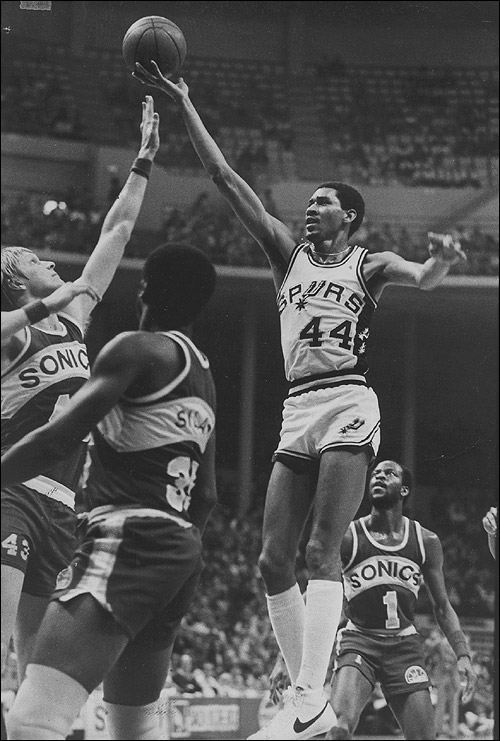
George Gervin was an amazing scorer and a big star for a number of years, but more than anyone else who reached this high on the list, he was not a winner. He was known for being somewhat selfish, but it doesn't diminish how great he was offensively.

Gervin was a four time scoring leader, and is one of 6 players all-time to win three straight scoring titles. In 1980 he averaged 33.1 points per game, and he eclipsed 30 points again 2 years later, when he again led the league with 32.3 nightly. He was twice the MVP runner-up, in 1978 and 1979, but he probably should have won in 1979, when it was given to Moses Malone. Here are how their numbers stacked up that season:

Malone - 24.8 pts, 17.6 reb, 1.8 ast, 1.5 blk, .540 FG%, .739 FT%
Gervin - 29.6 pts, 5.0 reb, 2.7 ast, 1.1 blk, .541 FG%, .826 FT%

Moses led the league in rebounding that year, and Gervin in scoring, so both were obvious choices. In the other four categories, Gervin was obviously the better player, especially if you know that Gervin was a shooting guard and Malone was a center, because Gervin shot a higher percentage than the MVP that year, and blocked nearly as many shots.

Gervin was the best player on his team for nearly his entire career, but he never saw much playoff success in that role. His best finish was losing in the Conference Finals three times, making him the best player to never play in the NBA Finals, joining Dominique Wilkins, Steve Nash, Alex English, Vince Carter, and Tracy McGrady on that dubious list.

For six straight seasons, Gervin was one of the top 3 players in the NBA, but because of his playoff failings he is usually not considered to be on the same level as those who were at his level during those years, including Moses Malone, Magic Johnson, and Kareem Abdul-Jabbar. His averages over that time were spectacular, and they are listed below:

Gervin (1977-1983) - 29.2 pts, 5.0 reb, 3.0 ast, 1.3 stl, .514 FG%, .834 FT%

Gervin had the disadvantage of never having a true star for a teammate. As the only star in San Antonio for a long time, he did get them to the playoffs in every season of his career, even though he couldn't get them through to the Finals. His career was still very impressive, even though it only lasted for 10 NBA seasons.


Payton may have been the better defensive player by far, but Gervin's offensive prowess was so great that there is no doubt he was better than Payton. Gervin's first 7 NBA seasons were all at least as good as Payton's best season, so even though Payton lasted much longer, Gervin got much higher. While Gervin was not a great playoff player, Payton's overall playoff success wasn't much better, so Gervin is definitely higher up on the list.

Friday, August 12, 2011

Top 100 NBA Players: #52


Bob McAdoo

(Kalb: #44, Simmons: #61, BBR: #39)

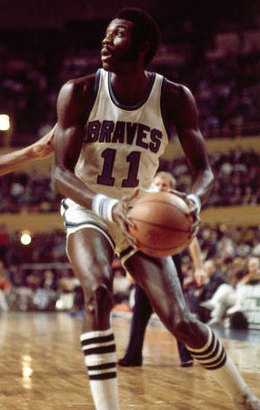
Bob McAdoo was a great player for a few years in the 1970's, and if he had maintained his early level of play for a full decade, he would have been one of the top ten players of all time easily. Instead, he developed a reputation for not caring, then tried to turn it around once he was past his peak by playing unselfishly for two champs.

McAdoo started off his career in style, averaging 18.0 points and 9.1 rebounds per game and winning the Rookie of the Year Award, but nobody saw what was coming next. He came in second in the MVP race by leading the league in scoring and field goal percentage, with 30.6 points, 15.1 rebounds, 3.3 blocks, and a .547 field goal percentage.

The next year he was even better, upping his scoring average to 34.5, while still grabbing 14.1 rebounds and leading the league in minutes played. That performance won him the MVP Award, and he definitely deserved it. Here are his stats and Rick Barry's, who should have come in second in the voting that year.

McAdoo - 34.5 pts, 14.1 reb, 2.2 ast, 2.1 blk, .512 FG%, .805 FT%
Barry - 30.6 pts, 5.7 reb, 6.2 ast, 2.9 stl, .464 FG%, .904 FT%

Barry was definitely good, but McAdoo was definitely the best player that year. The next season he led the league in scoring for the third straight season, and he is one of only eight players who can say that. (Most of the others have yet to appear on this list.) Here are his overall stats from that three-year period, when he was one of the top 2 players and the league scoring leader.

McAdoo - 32.1 pts, 13.8 reb, 2.8 ast, 2.5 blk, .514 FG%, .787 FT%

He remained a good player for the next two years, but his scoring average started to drop and he still could not get past the second round of the playoffs. From 1976 to 1982, he played for 6 different teams, wearing out his welcome more and more quickly in each stop. When he finally made it to Los Angeles in 1981, he finally found himself in a good situation and applied himself in a sixth man role, which helped the Lakers win the championship, to which he contributed 16.7 points and 6.8 rebounds per game. He was not the star anymore, but he had contributed to a title while he was still slightly relevant. He would win one more title before retiring, but by then he wasn't quite as important to the team.

McAdoo was the first high-scoring, outside-shooting big man, something that has become commonplace in today's game. If he had been born 25 years later, he could have dominated in an era in which his style was not so uncommon, and he may have been appreciated more.


McAdoo, like McGrady, won multiple scoring titles in a row, but he was a much better rebounder than McGrady was, even taking their positions into consideration. McAdoo's playoff success, although meager, still beat McGrady's handily. Even though McGrady was good for a little longer, McAdoo was so good for those three seasons that there is no way he can be any lower on this list.

Thursday, August 11, 2011

Top 100 NBA Players: #53


Tracy McGrady

(Kalb: #41, Simmons: #75, BBR: #51)

Tracy McGrady is another example of a player whose promising career was derailed by injury too early, but when he was good, he was really good. He twice led the entire league in scoring before he turned 25, and he averaged at least 20-5-5 six times.

McGrady came straight to the NBA from high school, but he didn't become a star until his 4th season, when he would have been a college senior. That's the season when he left Toronto and Vince Carter's shadow and became a star in his own right in Orlando. That year he improved his scoring average by 11.4 points and won the Most Improved Player Award while making the All-Star team and All-NBA Second Team.

He continued to improve over the next two years, until the 2003 season, when he led the league with 32.1 points per game while grabbing 6.5 rebounds and passing out 5.5 assists per game. That year he also shot a career-high .457 from the field, which would drop off considerably every season afterward. After one more season of leading the league in scoring, he was traded to the Houston Rockets for Steve Francis.

In Houston he continued to be a star, but he only finished in the top 10 in scoring twice in 5 full seasons, and he missed 113 games over that time, which caused the Rockets to struggle in the postseason. In fact, McGrady is probably the best player in NBA history who never got past the first round of the playoffs. It wasn't really his fault, because his postseason numbers were pretty impressive. Just look at what he did from 2001 to 2005:

McGrady - 31.6 pts, 6.8 reb, 6.1 ast, 1.5 stl

While he may have failed to advance in the playoffs and fell from his peak far too early, McGrady has to be remembered as a great player. He averaged over 20 points per game in 8 straight seasons, led the league in scoring twice, and made the All-NBA First Team twice. It sad to say that at age 31, he's probably washed up and past his prime.


Nash has a little advantage over McGrady in playoff success, and a definite lead in longevity, but McGrady was so good early in his career that Nash can't really argue that he's the better player. Nash could pass McGrady if he is able to continue to contribute over the next couple years, but for now McGrady's career accomplishments are just a little bit more impressive.