Showing posts with label David Robinson. Show all posts

Thursday, September 30, 2021

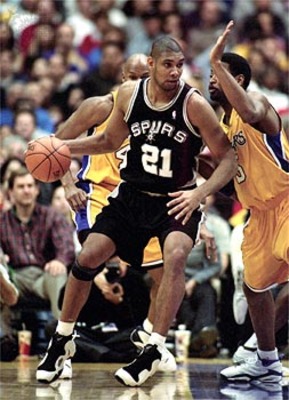
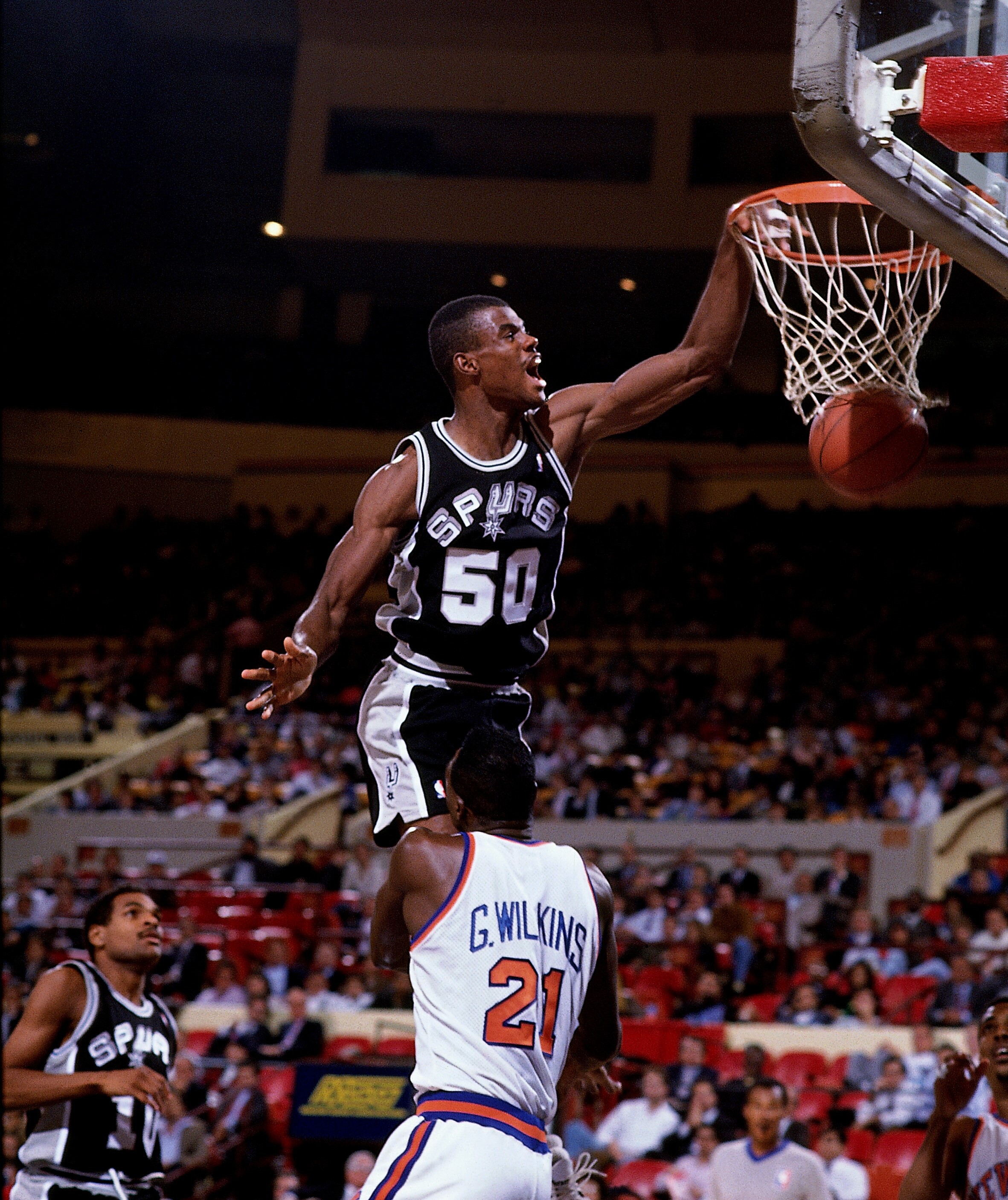
Top 100 NBA Players: #31 - David Robinson


David Robinson

Teams

San Antonio Spurs - 1989-03


Playoffs

Appearances - 12 (1990,1991,1993,1994,1995,1996,1998,1999,2000,2001,2002,2003)

Conference Finals - 4 (1995,1999,2001,2003)

NBA Finals - 2 (1999,2003)

Championships - 2 (1999,2003)


Awards and Honors

Rookie of the Year - 1990

MVP - 1 (1995)

Defensive Player of the Year - 1 (1992)

All-NBA First Team - 4 (1991,1992,1994,1995,1996,1998)

All-NBA Second Team - 2 (1990,1992,1993,1994,1998,1999)

All-NBA Third Team - 4 (1990,1993,2000,2001)

Hall of Fame - 2009

*(actual in bold, deserved in italics)


All-Time Ranks

Blocks Per Game - #4

Total Blocks - #7

Total Rebounds - #36

Rebounds Per Game - #42

Points Per Game - #43

Total Points - #46

Total Steals - #62

Field Goal Percentage - #78


League Leads

Total Blocks (#1-1991,1992, #3-1990,1994,1995,1996, #5-1993,2000)

Blocks Per Game (#1-1992, #2-1991, #3-1990,1994,1996, #4-1995, #5-1993,1998)

Rebounds Per Game (#1-1991, #2-1990,1996, #4-1992, #5-1998)

Total Rebounds (#1-1991,1996, #2-1990, #4-1995)

Total Points (#1-1994, #2-1995, #3-1996, #5-1991)

Points Per Game (#1-1994, #3-1995, #5-1996)

Field Goal Percentage (#5-1999)

Steals Per Game (#5-1992)


David Robinson was the college basketball player of the year at Navy in 1987, averaging 28.2 points, 11.8 rebounds, and 4.5 blocks per game, and was then drafted by the San Antonio Spurs with the #1 overall pick in the draft. Because he was a Navy graduate, he had to fulfill a 2-year active duty commitment before he was able to join the Spurs.

The Spurs won only 21 games the year before Robinson arrived, and in his rookie year he engineered the biggest single-season turnaround in league history at the time, leading them to 56 wins. He was the unanimous Rookie of the Year after averaging 24.3 points, 12.0 rebounds, and 3.9 blocks that year, and led them to the second round of the playoffs.

In his second season, he was already one of the best players in the entire league. He averaged 25.6 points and 3.9 blocks, and led the league with 13.0 rebounds per game, and made his first appearance on the All-NBA First Team. In his third season, he led the league in blocks with an incredible 4.5 per game and was named the Defensive Player of the Year, but a late-season injury kept him out of the playoffs, where the Spurs were swept in the first round.

In 1993-94, Robinson got into a race for the scoring title with Shaq, and knowing that he needed 70 points to lead the league, Robinson closed the season with a 71-point game against the Clippers to finish best in the league at 29.8 per game. He is one of only 6 players to ever score 70 in a single game, along with Wilt (6 times), Kobe, Baylor, Devin Booker, and David Thompson. 

The next year, Robinson was named the MVP after averaging 27.6 points, 10.8 rebounds, and 3.2 blocks per game and leading the Spurs to the best record in the league. He was able to lead the Spurs to the Conference Finals for the first time in his career, but they lost to Hakeem Olajuwon and the defending-champion Rockets one step short of the Finals.

After one more great year where the Spurs fell short in the playoffs, Robinson suffered a preseason back injury that caused him to miss more than a month at the start of the season, then broke his foot just 6 games after returning, which ended his season early. His absence caused the Spurs to plummet to the bottom of the league, but it turned out to be a good thing, because the Spurs won the Draft lottery and picked Tim Duncan with the #1 pick.

Robinson had one more year as the team's best player after returning from injury, averaging 21.6 points and 10.6 rebounds in his comeback season. The next year, Duncan became the team's biggest star, though Robinson was still very good, averaging 15.8 points and 10.0 rebounds, and the Spurs dominated their way to the NBA Finals, losing only one game in the first 3 rounds. In the first Finals in franchise history, the Spurs beat New York in 5 games, and Robinson finally had a championship.

The Spurs reached the Conference Finals again 2 years later, but were swept by the Lakers, then lost to LA again in the second round the year after that. In Robinson's final season, the Spurs were finally able to get back to the Finals, and Robinson finished off strong, scoring 13 points and grabbing 17 rebounds in the decisive Game 6 against New Jersey, finishing off his career with a second ring.

Robinson was one of the best players on earth in his first 7 seasons, leading the league once each in rebounding, blocks, and scoring, winning the Rookie of the Year, Defensive Player of the Year, MVP, and an Olympic Gold Medal in the process. He was definitely slowed down by the injuries he suffered in 1996, but he took on his slightly-reduced role well, and was a big part of their first title, and played well again to win his second. It's sad that injuries took him down right at his peak, because there is no telling how great he could have been, but he had already done enough to prove that he is one of the best basketball players of all time.


Sunday, September 18, 2016

Top 100 NBA Players: #9 - Shaquille O'Neal


Shaquille O'Neal

Shaq was one of the most physically imposing players in the history of any sport, and for a few years in his prime, he was absolutely unstoppable. He wasn't always the best player during the regular season, and he did battle a lot of injuries over the years, but he always turned his game up a notch during the playoffs, and he has plenty of rings to show for it.

When Shaq was drafted, there was no doubt that he would be the #1 overall pick, and the Rookie of the Year was practically a foregone conclusion as well, as the big man averaged 23.4 points, 13.9 rebounds, and 3.5 blocks per game as a rookie. It was also the first of only 2 times in his career that his team would fail to make the playoffs, losing the tiebreaker to the Indiana Pacers and landing back in the lottery.

His third season in the NBA was a memorable one. He led the league in scoring, led Orlando to the NBA Finals for the first time, and earned the distinction of being the last player to win a playoff series against Michael Jordan, although it should be noted that Jordan had just returned two months earlier from his baseball retirement. He should have won the MVP that year, but it was given to David Robinson instead, because he led the Spurs to the league's best record, but Shaq's numbers in leading Orlando to the top seed in the East were a bit better:

O'Neal - 29.3 pts, 11.4 reb, 2.7 ast, 2.4 blk, .583 FG%, .533 FT%
Robinson - 27.6 pts, 10.8 reb, 2.9 ast, 3.2 blk, .530 FG%, .774 FT%

Robinson certainly had a strong argument for the MVP, but Shaq was slightly better, and he proved it in the playoffs, although he was severely outplayed in the Finals by Hakeem Olajuwon as Orlando was swept. The next time he reached the Finals, he made sure the outcome was different.

Shaq struggled through a few injury-plagued years before finally hitting his stride in 2000 with the Lakers, and what a stride it was. He set career-highs is scoring and assists, and nearly beat his career highs in rebounding and blocks. That was also the year he won his only MVP award, and it wasn't even close. Karl Malone was arguably the next best player that year, but look at the difference in production:

O'Neal - 29.7 pts, 13.6 reb, 3.8 ast, 3.0 blk, .574 FG%, .524 FT%
Malone - 25.5 pts, 9.5 reb, 3.7 ast, 0.9 blk, .509 FG%, .797 FT%

The only category in which Malone was superior was free throw shooting, which comes as no surprise to anyone who ever saw Shaq play. The next season he should have won another MVP, but it was awarded to Allen Iverson, who led the league in scoring and earned Philadelphia the top seed in the East, even though they finished with the same record as the Lakers. Here are their stats from that season:

O'Neal - 28.7 pts, 12.7 reb, 3.7 ast, 2.8 blk, .572 FG%, .513 FT%
Iverson - 31.1 pts, 3.8 reb, 4.6 ast, 2.5 stl, .420 FG%, .814 FT%

Once again, Shaq was horrible from the line, but Iverson was equally bad from the field, so those cancel each other out. Shaq's blocks and Iverson's steals are also nearly equal, and Iverson scored a few more points, but the difference is in rebounds and assists. Iverson was just average in both categories, even though he played point guard, while Shaq was a great rebounder. This award should have been Shaq's, but he got his revenge in the Finals, where they dominated the 76ers and took home their second straight title in 5 games.

The Lakers would again win the championship in 2002, which put Shaq in some very exclusive company. Only 3 players had ever led teams to 3 consecutive titles, and O'Neal was the fourth, joining George Mikan, Bill Russell, and Michael Jordan. And though he was never the best player on a champion again, he did lead the Lakers back to the Finals once more, in 2004, and won a title as D-Wade's sidekick in 2006 for Miami.

Overall, despite his shortcomings at the line and the relatively short period that he was on top, O'Neal dominated the game at a level not seen since Wilt's heyday, and when he put everything into it, nobody could stop him. He retired with 4 championships, 3 Finals MVP's, one regular MVP, and 8 seasons as one of the top 5 players in the league.

Saturday, September 17, 2016

Top 100 NBA Players: #10 - Tim Duncan


Tim Duncan

Tim Duncan was one of the most consistent players in NBA history, and though his quiet demeanor makes him easy to overlook, he played at such a high level since the day he entered the league and saw so much success that he can't be left out of the top 10.

When Duncan arrived in the NBA in 1997 as the #1 overall pick, he was paired with recent MVP and fellow big man David Robinson in the frontcourt for the San Antonio Spurs, and he immediately established himself as one of the best players in the league. In fact, during his rookie season, only Karl Malone and Michael Jordan were better, and Duncan won the Rookie of the Month award every month of the season and was nearly a unanimous choice for Rookie of the Year.

The next season, with Jordan gone, Duncan took advantage of the void at the top and became the best player in the NBA in just his second season as a pro. His nearest competition that year was fellow power forward Karl Malone, and though Malone was voted MVP that season, Duncan took the more impressive trophy home that season, earning his first Finals MVP award. I believe that he should have won both awards that season, and here are the numbers for both players to show why:

Duncan - 21.7 pts, 11.4 reb, 2.4 ast, 2.5 blk, .495 FG%, .690 FT%
Malone - 23.8 pts, 9.4 reb, 4.1 ast, 0.6 blk, .493 FG%, .788 FT%

Malone was a slightly better offensive player than Duncan that year, but Duncan was easily the better defensive player, and the two teams ended up with identical records to finish the regular season, so Duncan should have been rewarded, but was overlooked because Malone was more experienced.

San Antonio was unable to repeat as champions the following season, because Duncan injured his knee right before the playoffs and the Spurs lost in the first round. After working hard for a couple seasons to get back to his peak level again, Duncan again became the league's dominant player in 2002, edging out Kobe and Shaq as the best players during the regular season and winning the MVP award. Unfortunately, he and the Spurs were no match for the Lakers in the playoffs, who knocked them out in the second round.

The next season, Duncan was once again the top player in the league and headed to the playoffs with his second MVP in hand, with different results this time. When they met up with the Lakers in the second round again, they avenged their previous losses and knocked out the 3-time defending champs in 6 games, clearing the path for Duncan to earn his second championship ring and the Finals MVP award to go with it.

Duncan remained one of the top 10 players in the league for the next several years, and the Spurs were perennial championship contenders, which is of itself a testament to his greatness. He just retired after his 19th season, and the Spurs made the playoffs in each of those seasons, winning 5 championships along the way. Duncan has won two MVP's and 3 Finals MVP's, although each of those numbers should have been increased by one, since Duncan didn't earn the MVP he deserved in 1999, and he was still the best Spur on the 2007 championship team, despite the fact that Tony Parker was awarded that season's Finals MVP.

There are only two other players who can claim that they were the best player for that many regular seasons and for that many championship teams as well: George Mikan and Michael Jordan. While Duncan lost a step over the last few years, he was still one of the best players on one of the best teams in the league in his 18th season, and still ranked as one of the top 20 players in the league at age 37. The five titles San Antonio won during the Duncan era puts San Antonio at #4 all time in total titles, behind only the Lakers, Celtics, and Bulls. About the only bad thing you can say about him is that he was never able to defend a championship the following year.

Friday, September 16, 2016

Top 100 NBA Players: #12 - Hakeem Olajuwon


Hakeem Olajuwon

Hakeem Olajuwon is undoubtedly one of the greatest centers of all time and easily the best modern defensive center the NBA has seen. He is the best player who was not born as a United States citizen, and he peaked at exactly the right time, which allowed him to win a couple of championships and cement his place as one of the all-time greats.

Hakeem grew up primarily playing soccer in his native Nigeria, but when he was introduced to basketball as a teenager, he knew he had found his calling in life. He was only offered a spot on one college team, at the University of Houston, and after a couple of years training with local pro and NBA MVP Moses Malone, Olajuwon led the Cougars to two consecutive national championship games before being drafted by the Houston Rockets as the #1 pick in the NBA Draft, two spots ahead of Michael Jordan.

The Rockets started seeing success pretty quickly, making it to the NBA Finals in Hakeem's second season, where they lost to the Boston Celtics, whose 1986 team is regarded as one of the greatest teams in history. It looked like the Rockets were going to be a force for years to come, but because of a series of injuries to Ralph Sampson and their inability to get any decent players to play with Olajuwon, Houston suffered through several disappointing seasons.

Everything finally came together in 1993-94, beginning with the retirement of Michael Jordan in the offseason. Olajuwon took advantage of the hole left at the top of the league and had one of the most impressive seasons in history, becoming the only player ever to win the regular season MVP, Finals MVP, and Defensive Player of the Year Award in the same season.

The next year, things didn't look quite as good, with David Robinson and the Spurs dominating the regular season and Olajuwon dealing with some health issues near the end of the year, but with a late-season trade that brought college teammate Clyde Drexler to town, the Rockets were able to become the lowest-seeded team in history to win the NBA Finals, and Olajuwon repeated as Finals MVP.

Olajuwon is well-known as a great shot-blocker, and he still holds the record for most shots blocked in a career, although they have only been recorded for half of the league's history. Not only was he great at blocking shots, he was always among the leaders in steals as well, and in 1989 he became the only player in history to record more than 200 blocks and 200 steals in the same season. In fact, there have only been 8 seasons in which a player reached 150-150, and four of those belong to Olajuwon. He is definitely one of the greatest defensive players of all time.

Olajuwon was also great on the offensive end of the court, averaging over 20 points per game for 13 consecutive seasons to start his career, and his moves in the low post have become legendary, especially his patented "Dream Shake," which involved numerous fakes and spins and allowed him to get a ton of easy shots near the hoop. He now hosts a camp each summer where he teaches footwork in the paint, and many NBA stars have trained with him, including Yao Ming, Kobe Bryant, and LeBron James.

What really made Olajuwon great is that he stepped up his game when it mattered most, especially against the toughest competition. During his two championship seasons, he outplayed David Robinson, Shaquille O'Neal, and Patrick Ewing in the playoffs, and also beat teams led by Karl Malone and Charles Barkley. When Robinson won the regular season MVP in 1995, Olajuwon made a point of completely dismantling him in the Western Conference Finals, and Robinson was never the same player again.

The thing that held him back from making the all-time top 10 was that his three-year peak was relatively short for a great player, and happened to coincide nicely with Jordan's first retirement, then abruptly ended when Jordan returned. He played in an era with many other great centers, and he was the best of any of them during his peak years, but he was only one of the top 5 players in the league for 5 seasons, which was a relatively short period, especially when compared to the players that make up my top 10.

Thursday, September 15, 2016

Top 100 NBA Players: #13 - Scottie Pippen


Scottie Pippen

Scottie Pippen is one of the more interesting cases on this list. He spent most of his career as the second-best player on his team, but he won a lot of championships and was actually a much better player than most people realize. 

When I profiled David Robinson a few spots ago, I mentioned that he was the committee's #4 choice to be on the Dream Team in 1992, behind only Magic, Michael, and Bird. Do you happen to know who their #5 choice was? Scottie Pippen. After picking the best four guys who were franchise players and well-respected superstars, they picked Scottie Pippen, who wasn't even the best player on his own team. That's because they saw that the Bulls were more than just Michael Jordan.

In 1992, just before that team was selected, Pippen put together a season that very few have ever come close to. His averages for that year were 21 points, 7.7 rebounds, 7.0 assists, 1.9 steals, and 51% shooting from the field. For reference, only 9 other players have ever averaged a 21-7-7, and only 6 others have done it while shooting over 50%. Those six? Bird, Wilt, Magic, Michael, Oscar, and LeBron. Not bad company, especially considering five of those players have yet to make an appearance in these rankings.

Jordan and Pippen played together for 10 season, and in each of those ten seasons they made the playoffs and advanced beyond the first round together. Jordan played 5 seasons without Pippen, three before he arrived and two after they separated in 1998. In those 5 seasons his teams made 3 playoff appearances and never advanced past the first round. Pippen, meanwhile, played 7 seasons without Jordan, making the playoffs 6 times and advancing past the first round twice. I'm not suggesting that Pippen was better than Jordan, but it's significant that Jordan needed Pippen in order to be successful.

Scottie Pippen was also recognized as being one of the best defensive small forwards of all time, as evidenced by the 8 straight seasons during the 1990's that he was named to the All-Defensive First Team. He led the league in steals in 1995, and finished in the top 5 three other times. Pippen was the player that the Bulls used to guard the other team's best player at four positions, and it was a tipped pass and steal by Pippen that sealed the 1997 Finals victory over Utah after Steve Kerr hit his famous series-winning shot.

Another thing Pippen has going for him is that he is one of a select group of players who has too many championship rings to fit on one hand. He was the second-best player on 6 championship games in 8 seasons, and was also the second-best player on a Portland team in 2000 that came within one game of the NBA Finals. 

Sunday, September 4, 2016

Top 100 NBA Players: #26 - David Robinson


David Robinson

David Robinson was one of the most impressive physical specimens to ever take the court to play basketball, and at one point he was widely considered to be the successor to Michael Jordan as the superstar of the NBA. According to Bill Simmons, "if we ever start cloning basketball players someday, Jordan, LeBron and Robinson will be one-two-three in some order."

Robinson was so highly though of early in his career that when the time came to pick the players for the first Dream Team to compete in the 1992 Olympics, Robinson was the committee's unanimous #4 choice, behind only Jordan, Bird, and Magic. At that point, Robinson had completed only 3 season in the NBA, during which time he had been named the unanimous Rookie of the Year, Defensive Player of the Year, and two-time All-NBA First Team and All-Defensive First Team center.

Robinson's peak corresponded with Michael Jordan's first retirement, which made many believe that he would become a completely dominant force and start to make a collection of MVP's and NBA titles, but Hakeem Olajuwon took advantage of Jordan leaving and finally earned two titles of his own before MJ returned. From 1994-96, Robinson was easily one of the top 3 players in the league, but was never the unquestioned superstar. Here are his stats compared with other top players from those seasons:

Robinson (1994) - 29.8 pts, 10.7 reb, 4.8 ast, 1.7 stl, 3.3 blk, .507 FG%, .749 FT%
Olajuwon (1994) - 27.3 pts, 11.9 reb, 3.6 ast, 1.6 stl, 3.7 blk, .528 FG%, .716 FT%

Robinson (1995) - 27.6 pts, 10.8 reb, 2.9 ast, 1.7 stl, 3.2 blk, .530 FG%, .774 FT%
O'Neal (1995) - 29.3 pts, 11.4 reb, 2.7 ast, 0.9 stl, 2.4 blk, .583 FG%, .533 FT%

Robinson (1996) - 25.0 pts, 12.2 reb, 3.0 ast, 1.4 stl, 3.3 blk, .516 FG%, .761 FT%
Jordan (1996) - 30.4 pts, 6.6 reb, 4.3 ast, 2.2 stl, 0.5 blk, .495 FG%, .834 FT%

None of those seasons had a clear top player, but in each case I would place Robinson one step below his nearest competition due to their higher level of playoff success in those seasons. His peak came to an abrupt end the next season, when back and foot injuries limited him to only 6 games and caused the Spurs to miss the playoffs for the first time since his arrival.

In a way that season was also a blessing in disguise, as their horrible record earned them the top pick in the NBA Draft, which gave them Tim Duncan, the perfect complement to Robinson on the inside. That combination gave the Spurs their first two championships, the first with Duncan narrowly edging Robinson for the Finals MVP, and the second coming by a much wider margin.

One of the signature moments of Robinson's career came on the closing day of the 1994 season, when he and Shaq were in a tight race for the scoring title in the first season someone besides Michael Jordan was sitting at the top in 8 years. Shaq had put up 32 points earlier in the day, so Robinson knew exactly what he needed to do, and he had the perfect opponent, the Los Angeles Clippers. He scored 71 points that day, destroying Gervin's old team record of 63 and taking the scoring title on the very last day.

Sunday, August 28, 2016

Top 100 NBA Players: #34 - Patrick Ewing


Patrick Ewing

Patrick Ewing is remembered for never having won an NBA title, but he was one of the top centers in the entire league for a decade, and he never missed more than 6 games in a season over that span, during which the New York Knicks made the playoffs every year with Ewing as their star player.

Ewing hit his peak in 1989-90, when he ranked as the third-best player in the entire league and the top center, falling behind only Michael Jordan and Charles Barkley in overall value. He was 27 years old at the time, and he appeared to be the next dominant center, although he never did dominate the game the way many expected. Here are his stats from his best season:

Ewing - 28.6 pts, 10.9 reb, 2.2 ast, 1.0 stl, 4.0 blk, .551 FG%, .775 FT%

You read that right. Besides averaging over 28 points and 10 rebounds every night, he was blocking 4 shots on average in every game. From there he kind of plateaued, maintaining his standing as one of the top 10 players in the league, but falling behind fellow centers David Robinson, Hakeem Olajuwon, and Shaquille O'Neal in production. Overall, he was still very impressive over the six seasons from 1989-1995, and those stats are below:

Ewing - 25.3 pts, 11.3 reb, 2.3 ast, 1.0 stl, 2.8 blk, .515 FG%, .749 FT%

That is what the Knicks were able to expect from Ewing every night for 6 straight years, quite impressive considering that no center today comes close to those numbers in a single season. For all the numbers he put up and all the seasons that they made the playoffs, Ewing still never saw big playoff success. The Knicks won their first round series nearly every season, but lost in the second round almost every time. The only two exceptions were 1993 and 1994, when they made the Eastern Conference Finals once and the NBA Finals after that, where they were beaten in 7 games by Houston.

Ewing hung around for a long time after his peak, but became less and less effective and was no longer the focal point of the Knicks' team, so when he finally made it back to the NBA Finals in 1999, he was more of an afterthought on a team featuring Latrell Sprewell, Allan Houston, and Marcus Camby. He never did get that elusive ring, which is the biggest reason that he's only at #34 all time.

Tuesday, July 26, 2016

Top 100 NBA Players: #71 - Blake Griffin


Blake Griffin

Blake Griffin has only played 6 seasons so far in his short career, but he has already compiled some impressive achievements, which is why he has already risen to #71 on the list of all time greats. He was the #1 overall pick in the 2009 NBA Draft, but missed his entire rookie season after fracturing his kneecap in the final game of the preseason.

When he finally made his debut in 2010, it was worth the wait. He was voted to the All-Star team by the coaches, the first rookie so honored since Tim Duncan 13 years earlier. He also reached 40 points in a game twice during the season, becoming the first rookie since Allen Iverson to achieve that. He was the unanimous Rookie of the Year, which hadn't happened in 21 years, and was last achieved by David Robinson. He also had 27 straight double-doubles during the season, the first rookie to do so in 43 years, and Sports Illustrated named it one of the 15 greatest rookie seasons of all time. Here are his numbers from that season:

Griffin (2011) - 22.5 pts, 12.1 reb, 3.8 ast, .506 FG%, .642 FT%

Griffin has been very consistent throughout his career, averaging at least 20 points per game 5 times in 6 seasons and at least 8 rebounds per game 5 times as well. His biggest failing so far is that he has not yet reached the Conference Finals, but he came close in 2015, when he had his best overall playoff performance in 14 games against the Spurs and Rockets. Here are his overall stats from those series:

Griffin (2015) - 25.5 pts, 12.7 reb, 6.1 ast, .511 FG%, .717 FT%

Those stats were all improvements over improvements over his regular season numbers, other than free throws, which were one point lower. The Clippers may have fallen to Houston in Game 7, but without Griffin they wouldn't have even gotten there. With a little more playoff success, he could have risen higher, but he's not doing to badly for a 26-year-old with plenty of good years ahead.


Tuesday, May 22, 2012

Top 100 NBA Players: #6


Shaquille O'Neal

(Kalb: #1, Simmons: #11, BBR: #11)

Shaq was one of the most physically imposing players in the history of any sport, and for a few years in his prime, he was absolutely unstoppable. He wasn't always the best player during the regular season, and he did battle a lot of injuries over the years, but he always turned his game up a notch during the playoffs, and he has plenty of rings to show for it.

When Shaq was drafted, there was no doubt that he would be the #1 overall pick, and the Rookie of the Year was practically a foregone conclusion as well, as the big man averaged 23.4 points, 13.9 rebounds, and 3.5 blocks per game as a rookie. It was also the first of only 2 times in his career that his team would fail to make the playoffs, losing the tiebreaker to the Indiana Pacers and landing back in the lottery.

His third season in the NBA was a memorable one. He led the league in scoring, led Orlando to the NBA Finals for the first time, and earned the distinction of being the last player to win a playoff series against Michael Jordan, although it should be noted that Jordan had just returned two months earlier from his baseball retirement. He should have won the MVP that year, but it was given to David Robinson instead, because he led the Spurs to the league's best record, but Shaq's numbers in leading Orlando to the top seed in the East were a bit better:

O'Neal - 29.3 pts, 11.4 reb, 2.7 ast, 2.4 blk, .583 FG%, .533 FT%
Robinson - 27.6 pts, 10.8 reb, 2.9 ast, 3.2 blk, .530 FG%, .774 FT%

Robinson certainly had a strong argument for the MVP, but Shaq was slightly better, and he proved it in the playoffs, although he was severely outplayed in the Finals by Hakeem Olajuwon as Orlando was swept. The next time he reached the Finals, he made sure the outcome was different.

Shaq struggled through a few injury-plagued years before finally hitting his stride in 2000 with the Lakers, and what a stride it was. He set career-highs is scoring and assists, and nearly beat his career highs in rebounding and blocks. That was also the year he won his only MVP award, and it wasn't even close. Karl Malone was arguably the next best player that year, but look at the difference in production:

O'Neal - 29.7 pts, 13.6 reb, 3.8 ast, 3.0 blk, .574 FG%, .524 FT%
Malone - 25.5 pts, 9.5 reb, 3.7 ast, 0.9 blk, .509 FG%, .797 FT%

The only category in which Malone was superior was free throw shooting, which comes as no surprise to anyone who ever saw Shaq play. The next season he should have won another MVP, but it was awarded to Allen Iverson, who led the league in scoring and earned Philadelphia the top seed in the East, even though they finished with the same record as the Lakers. Here are their stats from that season:

O'Neal - 28.7 pts, 12.7 reb, 3.7 ast, 2.8 blk, .572 FG%, .513 FT%
Iverson - 31.1 pts, 3.8 reb, 4.6 ast, 2.5 stl, .420 FG%, .814 FT%

Once again, Shaq was horrible from the line, but Iverson was equally bad from the field, so those cancel each other out. Shaq's blocks and Iverson's steals are also nearly equal, and Iverson scored a few more points, but the difference is in rebounds and assists. Iverson was just average in both categories, even though he played point guard, while Shaq was a great rebounder. This award should have been Shaq's, but he got his revenge in the Finals, where they dominated the 76ers and took home their second straight title in 5 games.

The Lakers would again win the championship in 2002, which put Shaq in some very exclusive company. Only 3 players had ever led teams to 3 consecutive titles, and O'Neal was the fourth, joining George Mikan, Bill Russell, and Michael Jordan. And though he was never the best player on a champion again, he did lead the Lakers back to the Finals once more, in 2004, and won a title as D-Wade's sidekick in 2006 for Miami.

Overall, despite his shortcomings at the line and the relatively short period that he was on top, O'Neal dominated the game at a level not seen since Wilt's heyday, and when he put everything into it, nobody could stop him. He retired with 4 championships, 3 Finals MVP's, one regular MVP, and 8 seasons as one of the top 5 players in the league.


Magic ended his career with one more title than Shaq, and a few more Finals appearances, but Magic was never as dominant as O'Neal was, especially from 1999-2001, where you can see the peak on the graph above. He also earns points for longevity, but in the end what set O'Neal apart from Magic was that for a couple of years there was no doubt who the best player in the league was, and during Magic's era there was always argument about that.

Sunday, May 6, 2012

Top 100 NBA Players: #9


Tim Duncan

(Kalb: #9, Simmons: #7, BBR: #17)

Tim Duncan has been one of the most consistent players in NBA history, and though his quiet demeanor makes him easy to overlook, he has played at such a high level since the day he entered the league and has seen so much success that he can't be left out of the top 10.

When Duncan arrived in the NBA in 1997 as the #1 overall pick, he was immediately paired with recent MVP and fellow big man David Robinson in the frontcourt for the San Antonio Spurs, and he immediately established himself as one of the best players in the league. In fact, during his rookie season, only Karl Malone and Michael Jordan were better, and Duncan won the Rookie of the Month award every month of the season and was nearly a unanimous choice for Rookie of the Year.

The next season, with Jordan gone, Duncan took advantage of the void at the top and became the best player in the NBA in just his second season as a pro. His nearest competition that year was fellow power forward Karl Malone, and though Malone was voted MVP that season, Duncan took the more impressive trophy home that season, earning his first Finals MVP award. I believe that he should have won both awards that season, and here are the numbers for both players to show why:

Duncan - 21.7 pts, 11.4 reb, 2.4 ast, 2.5 blk, .495 FG%, .690 FT%
Malone - 23.8 pts, 9.4 reb, 4.1 ast, 0.6 blk, .493 FG%, .788 FT%

Malone was a slightly better offensive player than Duncan that year, but Duncan was easily the better defensive player, and the two teams ended up with identical records to finish the regular season, so Duncan should have been rewarded, but was overlooked because Malone was more experienced.

San Antonio was unable to repeat as champions the following season, because Duncan injured his knee right before the playoffs and the Spurs lost in the first round. After working hard for a couple seasons to get back to his peak level again, Duncan again became the league's dominant player in 2002, edging out Kobe and Shaq as the best players during the regular season and winning the MVP award. Unfortunately, he and the Spurs were no match for the Lakers in the playoffs, who knocked them out in the second round.

The next season, Duncan was once again the top player in the league and headed to the playoffs with his second MVP in hand, with different results this time. When they met up with the Lakers in the second round again, they avenged their previous losses and knocked out the 3-time defending champs in 6 games, clearing the path for Duncan to earn his second championship ring and the Finals MVP award to go with it.

Duncan remained one of the top 10 players in the league for the next several years, and the Spurs were perennial championship contenders, which is of itself a testament to his greatness. He is currently playing his 15th season, and the Spurs have made the playoffs in each of those seasons, winning 4 championships along the way. Duncan has won two MVP's and 3 Finals MVP's, although each of those numbers should have been increased by one, since Duncan didn't earn the MVP he earned in 1999, and he was still the best Spur on the 2007 championship teams, despite the fact that Tony Parker was awarded that season's Finals MVP.

There are only two other players who can claim that they were the best player for that many regular seasons and for that many championship teams as well: George Mikan and Michael Jordan. While Duncan has lost a step over the last few years, he is still one of the best players on one of the best teams in the league, and still ranks as one of the top 20 players in the league at age 35. The four titles San Antonio has won during the Duncan era puts San Antonio at #4 all time in total titles, behind only the Lakers, Celtics, and Bulls. About the only bad thing you can say about him is that he was never able to defend a championship the following year.


Duncan and West's career charts match up more closely than any others I have seen so far, with the only difference being that Duncan has been a little more consistent as he nears the end of his career, while West was a little more up-and-down. West obviously made it to the Finals much more often than Duncan has, but Duncan has the advantage of having won the title each time he got there, and he was also able to claim the title of league's best player for several years, which West never accomplished.

Monday, April 23, 2012

Top 100 NBA Players: #11


Hakeem Olajuwon

(Kalb: #16, Simmons: #10, BBR: #9)

Hakeem Olajuwon is undoubtedly one of the greatest centers of all time and easily the best modern defensive center the NBA has seen. He is the best player who was not born as a United States citizen, and he peaked at exactly the right time, which allowed him to win a couple of championships and cement his place as one of the all-time greats.

Hakeem grew up primarily playing soccer in his native Nigeria, but when he was introduced to basketball as a teenager, he knew he had found his calling in life. He was only offered a spot on one college team, at the University of Houston, and after a couple of years training with local pro and NBA MVP Moses Malone, Olajuwon led the Cougars to two consecutive national championship games before being drafted by the Houston Rockets as the #1 pick in the NBA Draft, two spots ahead of Michael Jordan.

The Rockets started seeing success pretty quickly, making it to the NBA Finals in Hakeem's second season, where they lost to the Boston Celtics, whose 1986 team is regarded as one of the greatest teams in history. It looked like the Rockets were going to be a force for years to come, but because of a series of injuries to Ralph Sampson and their inability to get any decent players to play with Olajuwon, Houston suffered through several disappointing seasons.

Everything finally came together in 1993-94, beginning with the retirement of Michael Jordan in the offseason. Olajuwon took advantage of the hole left at the top of the league and had one of the most impressive seasons in history, becoming the only player ever to win the regular season MVP, Finals MVP, and Defensive Player of the Year Award in the same season.

The next year, things didn't look quite as good, with David Robinson and the Spurs dominating the regular season and Olajuwon dealing with some health issues near the end of the year, but with a late-season trade that brought college teammate Clyde Drexler to town, the Rockets were able to become the lowest-seeded team in history to win the NBA Finals, and Olajuwon repeated as Finals MVP.

Olajuwon is well-known as a great shot-blocker, and he still holds the record for most shots blocked in a career, although they have only been recorded for half of the league's history. Not only was he great at blocking shots, he was always among the leaders in steals as well, and in 1989 he became the only player in history to record more than 200 blocks and 200 steals in the same season. In fact, there have only been 8 seasons in which a player reached 150-150, and four of those belong to Olajuwon. He is definitely one of the greatest defensive players of all time.

Olajuwon was also great on the offensive end of the court, averaging over 20 points per game for 13 consecutive seasons to start his career, and his moves in the low post have become legendary, especially his patented "Dream Shake," which involved numerous fakes and spins and allowed him to get a ton of easy shots near the hoop. He now hosts a camp each summer where he teaches footwork in the paint, and many NBA stars have trained with him, including Yao Ming, Kobe Bryant, and LeBron James.

What really made Olajuwon great is that he stepped up his game when it mattered most, especially against the toughest competition. During his two championship seasons, he outplayed David Robinson, Shaquille O'Neal, and Patrick Ewing in the playoffs, and also beat teams led by Karl Malone and Charles Barkley. When Robinson won the regular season MVP in 1995, Olajuwon made a point of completely dismantling him in the Western Conference Finals, and Robinson was never the same player again.

The thing that held him back from making the all-time top 10 was that his three-year peak was relatively short for a great player, and happened to coincide nicely with Jordan's first retirement, then abruptly ended when Jordan returned. He played in an era with many other great centers, and he was the best of any of them during his peak years, but he was only one of the top 5 players in the league for 5 seasons, which was a relatively short period, especially when compared to the players that make up my top 10.


Hakeem Olajuwon was only the best player in the NBA for one season, while LeBron has already done it 6 times, but Hakeem has a couple of advantages over James. One is that he has won a couple of NBA Championships as the best player on his team, while LeBron has lost a couple of NBA Finals as his team's best player. Olajuwon also made one other trip to the penultimate series, so he also holds the edge in Finals appearances. The other thing that puts Olajuwon ahead is that he had a very long career, and was among the NBA's best for the majority of it, so LeBron needs to keep up his current level of play for a little longer in order to pass the best foreign player ever.

Wednesday, February 29, 2012

Top 100 NBA Players: #18


Scottie Pippen

(Kalb: #29, Simmons: #24, BBR: #22)

Scottie Pippen is one of the more interesting cases on this list. He spent most of his career as the second-best player on his team, but he won a lot of championships and was actually a much better player than most people realize. 

When I profiled David Robinson a few spots ago, I mentioned that he was the committee's #4 choice to be on the Dream Team in 1992, behind only Magic, Michael, and Bird. Do you happen to know who their #5 choice was? Scottie Pippen. After picking the best four guys who were franchise players and well-respected superstars, they picked Scottie Pippen, who wasn't even the best player on his own team. That's because they saw that the Bulls were more than just Michael Jordan.

In 1992, just before that team was selected, Pippen put together a season that very few have ever come close to. His averages for that year were 21 points, 7.7 rebounds, 7.0 assists, 1.9 steals, and 51% shooting from the field. For reference, only 8 other players have ever averaged a 21-7-7, and only 5 others have done it while shooting over 50%. Those five? Bird, Wilt, Magic, Michael, and Oscar. Not bad company, especially considering each of those players has yet to make an appearance in these rankings.

Jordan and Pippen played together for 10 season, and in each of those ten seasons they made the playoffs and advanced beyond the first round together. Jordan played 5 seasons without Pippen, three before he arrived and two after they separated in 1998. In those 5 seasons his teams made 3 playoff appearances and never advanced past the first round. Pippen, meanwhile, played 7 seasons without Jordan, making the playoffs 6 times and advancing past the first round twice. I'm not suggesting that Pippen was better than Jordan, but it's significant that Jordan needed Pippen in order to be successful.

Scottie Pippen was also recognized as being one of the best defensive small forwards of all time, as evidenced by the 8 straight seasons during the 1990's that he was named to the All-Defensive First Team. He led the league in steals in 1995, and finished in the top 5 three other times. Pippen was the player that the Bulls used to guard the other team's best player at four positions, and it was a tipped pass and steal by Pippen that sealed the 1997 Finals victory over Utah after Steve Kerr hit his famous series-winning shot.

Another thing Pippen has going for him is that he is one of a select group of players who has too many championship rings to fit on one hand. He was the second-best player on 6 championship games in 8 seasons, and was also the second-best player on a Portland team in 2000 that came within one game of the NBA Finals. 


Pippen never quite reached the career heights that Garnett did, but that is because Pippen recognized that he had an important role to play to help his team win championships, and that didn't always involve him being the man. Pippen only missed the playoffs once in his career, in his final season when he was riding the bench in Chicago as a 38-year-old. Both Pippen and Garnett were great all-around players, filling up every part of the stat sheet, but Pippen gains the edge over Garnett because of the 12 season in which he advanced past the first round of the playoffs, with 6 championships as the result, while Garnett has only passed the first round 3 times with one title.

Wednesday, February 1, 2012

Top 100 NBA Players: #21


Bob Pettit

(Kalb: #11, Simmons: #17, BBR: #21)

Of the top 25 players of all time, Bob Pettit is probably the least remembered. Part of that has to do with him retiring in 1965, long before most of today's sports fans were following the sport. It also has a lot to do with the fact that he played the majority of his career in Saint Louis, a city that no longer has an NBA team, and with no fan base left to celebrate him, he has been largely forgotten.

Here are some good reason to remember Pettit. For the 4 seasons before Wilt Chamberlain came into the league, Pettit was the best player in the league, winning 2 MVP's and playing in 2 NBA Finals. The MVP award was created in 1956, and Pettit was the first to ever win the award, in just his second year as a pro. Here are his stats from that season, compared with those of Bob Cousy, his nearest competitor:

Pettit - 25.7 pts, 16.2 reb, 2.6 ast, .429 FG%, .736 FT%
Cousy - 18.8 pts, 6.8 reb, 8.9 ast, .360 FG%, .844 FT%

Pettit was the league's leading scorer that year, while Cousy led the league in assists. Cousy was better at the guard stats, and Pettit at the big man stats, so the scoring title made him the better player. In 1957 and 1958, the MVP's were won by Cousy and Russell, but Pettit had a legitimate argument for both. Here are their statistical comparisons from those seasons:

Pettit (1957) - 24.7 pts, 14.6 reb, 1.9 ast, .415 FG%, .773 FT%
Cousy (1957) - 20.6 pts, 4.8 reb, 7.5 ast, .378 FG%, .821 FT%

Pettit (1958) - 24.6 pts, 17.4 reb, 2.2 ast, .410 FG%, .749 FT%
Russell (1958) - 16.6 pts, 22.7 reb, 2.9 ast, .442 FG%, .519 FT%

Pettit and Cousy were both slightly down in 1957, but since Pettit was already the better player before, I believe he was still the better player. The following season it was a little easier to make the comparison, since he and Russell were both big men, and while Russell was a little better from the field and on the boards, Pettit was much better from the line and at scoring in general.

There are only two retired players in NBA history to play at least 3 seasons and score at least 20 points per game in every season they played. Michael Jordan is one of them. The other is Bob Pettit. Pettit led the league in scoring twice, but after Wilt arrived he never led the league again. That didn't prevent him from becoming the first player ever to reach 20,000 points, and he was also the league's all-time leading scorer when he retired.

Another thing that sets Pettit apart and makes him memorable is that he played one of the greatest games in NBA Finals history, and it happened to come in the game in which Bill Russell lost his only NBA Finals. Pettit scored what was then a playoff record 50 points in Game 6, and they needed every one of them to beat Boston 110-109.

Besides that Finals victory, Pettit and the Hawks also made three other appearances in the Finals, losing to the Celtics each time. Pettit was easily the best player on each of those teams, and also on two other teams that lost in the Conference Finals. He was ranked among the top 5 players in the entire league for each of his first 10 season, falling out in season 11 due to an injury that caused him to retire.


David Robinson started off playing at a higher level than Pettit, and he also hung around longer and won one more championship than him, but he was never the best player in the NBA, which Pettit was for four seasons, and Pettit remained a superstar for much longer than Robinson. The four trips to the Finals were the final piece that pushed Pettit ahead of Robinson to a spot just outside the top 20 players of all time.

Saturday, December 31, 2011

Top 100 NBA Players: #22


David Robinson

(Kalb: #20, Simmons: #28, BBR: #7)

David Robinson was one of the most impressive physical specimens to ever take the court to play basketball, and at one point he was widely considered to be the successor to Michael Jordan as the superstar of the NBA. According to Bill Simmons, "if we ever start cloning basketball players someday, Jordan, LeBron and Robinson will be one-two-three in some order."

Robinson was so highly though of early in his career that when the time came to pick the players for the first Dream Team to compete in the 1992 Olympics, Robinson was the committee's unanimous #4 choice, behind only Jordan, Bird, and Magic. At that point, Robinson had completed only 3 season in the NBA, during which time he had been named the unanimous Rookie of the Year, Defensive Player of the Year, and two-time All-NBA First Team and All-Defensive First Team center.

Robinson's peak corresponded with Michael Jordan's first retirement, which made many believe that he would become a completely dominant force and start to make a collection of MVP's and NBA titles, but Hakeem Olajuwon took advantage of Jordan leaving and finally earned two titles of his own before MJ returned. From 1994-96, Robinson was easily one of the top 3 players in the league, but was never the unquestioned superstar. Here are his stats compared with other top players from those seasons:

Robinson (1994) - 29.8 pts, 10.7 reb, 4.8 ast, 1.7 stl, 3.3 blk, .507 FG%, .749 FT%
Olajuwon (1994) - 27.3 pts, 11.9 reb, 3.6 ast, 1.6 stl, 3.7 blk, .528 FG%, .716 FT%

Robinson (1995) - 27.6 pts, 10.8 reb, 2.9 ast, 1.7 stl, 3.2 blk, .530 FG%, .774 FT%
O'Neal (1995) - 29.3 pts, 11.4 reb, 2.7 ast, 0.9 stl, 2.4 blk, .583 FG%, .533 FT%

Robinson (1996) - 25.0 pts, 12.2 reb, 3.0 ast, 1.4 stl, 3.3 blk, .516 FG%, .761 FT%
Jordan (1996) - 30.4 pts, 6.6 reb, 4.3 ast, 2.2 stl, 0.5 blk, .495 FG%, .834 FT%

None of those seasons had a clear top player, but in each case I would place Robinson one step below his nearest competition due to their higher level of playoff success in those seasons. His peak came to abrupt end the next season, when back and foot injuries limited him to only 6 games and caused the Spurs to miss the playoffs for the first time since his arrival.

In a way that season was also a blessing in disguise, as their horrible record earned them the top pick in the NBA Draft, which gave them Tim Duncan, the perfect complement to Robinson on the inside. That combination gave the Spurs their first two championships, the first with Duncan narrowly edging Robinson for the Finals MVP, and the second coming by a much wider margin.

One of the signature moments of Robinson's career came on the closing day of the 1994 season, when he and Shaq were in a tight race for the scoring title in the first season someone besides Michael Jordan was sitting at the top in 8 years. Shaw had put up 32 points earlier in the day, so Robinson knew exactly what he needed to do, and he had the perfect opponent, the Los Angeles Clippers. He scored 71 points that day, destroying Gervin's old team record of 63 and taking the scoring title on the very last day.


Robinson was never the league superstar like Mikan was, but Robinson maintained a high level of play for a little longer, then settled in as a very good player for several years and won a couple championships, while Mikan retired as soon as he was no longer the big star. The fact that he was able to excel in both roles, and how good he was right from the start, gave him this spot just ahead of the first dominant big man.

Monday, September 12, 2011

Top 100 NBA Players: #30


Patrick Ewing

(Kalb: #38, Simmons: #39, BBR: #29)

Patrick Ewing is remembered for never having won an NBA title, but he was one of the top centers in the entire league for a decade, and he never missed more than 6 games in a season over that span, during which the New York Knicks made the playoffs every year with Ewing as their star player.

Ewing hit his peak in 1989-90, when he ranked as the third-best player in the entire league and the top center, falling behind only Michael Jordan and Charles Barkley in overall value. He was 27 years old at the time, and he appeared to be the next dominant center, although he never did dominate the game the way many expected. Here are his stats from his best season:

Ewing - 28.6 pts, 10.9 reb, 2.2 ast, 1.0 stl, 4.0 blk, .551 FG%, .775 FT%

You read that right. Besides averaging over 28 points and 10 rebounds every night, he was blocking 4 shots on average in every game. From there he kind of plateaued, maintaining his standing as one of the top 10 players in the league, but falling behind fellow centers David Robinson, Hakeem Olajuwon, and Shaquille O'Neal in production. Overall, he was still very impressive over the six seasons from 1989-1995, and those stats are below:

Ewing - 25.3 pts, 11.3 reb, 2.3 ast, 1.0 stl, 2.8 blk, .515 FG%, .749 FT%

That is what the Knicks were able to expect from Ewing every night for 6 straight years, quite impressive considering that no center today comes close to those numbers in a single season. For all the numbers he put up and all the seasons that they made the playoffs, Ewing still never saw big playoff success. The Knicks won their first round series nearly every season, but lost in the second round almost every time. The only two exceptions were 1993 and 1994, when they made the Eastern Conference Finals once and the NBA Finals after that, where they were beaten in 7 games by Houston.

Ewing hung around for a long time after his peak, but became less and less effective and was no longer the focal point of the Knicks' team, so when he finally made it back to the NBA Finals in 1999, he was more of an afterthought on a team featuring Latrell Sprewell, Allan Houston, and Marcus Camby. He never did get that elusive ring, which is the biggest reason that he's only at #30 all time.


Ewing was never as big a star as Rick Barry was, but Ewing did not cut out the prime years of his career like Barry did, so while Ewing was able to reach his peak and maintain it for a long period of time, Barry left at his peak, then had to regain momentum upon his return. Barry won a championship, but did little else in the playoffs, so Ewing's playoff failings aren't enough to drop him behind the old-time Warrior on this list.