Showing posts with label Clyde Drexler. Show all posts

Saturday, September 11, 2021

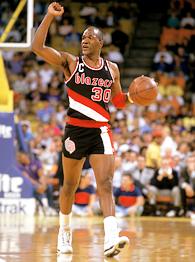
Top 100 NBA Players: #50 - Clyde Drexler


Clyde Drexler

Teams

Portland Trail Blazers - 1983-95

Houston Rockets - 1995-98


Playoffs

Appearances - 15 (1984,1985,1986,1987,1988,1989,1990,1991,1992,1993,1994,1995,1996,1997,1998)

Conference Finals - 5 (1990,1991,1992,1995,1997)

NBA Finals - 3 (1990,1992,1995)

Championships - 1 (1995)


Awards and Honors

All-NBA First Team - 1 (1992)

All-NBA Second Team - 2 (1988,1989,1991)

All-NBA Third Team - 2 (1990,1991,1995)

Hall of Fame - 2004

*(actual in bold, deserved in italics)


All-Time Ranks

Total Steals - #9

Steals Per Game - #14

Total Assists - #34

Total Points - #37

Points Per Game - #57

Assists Per Game - #78


League Leads

Steals Per Game (#3-1986, #5-1987,1988,1989)

Total Steals (#3-1986,1989, #4-1987)

Points Per Game (#4-1989,1992)

Total Points (#5-1992)


After leading Houston to consecutive Final Four appearances as a sophomore and junior as part of the Phi Slama Jama team, Clyde Drexler left school a year early to enter the NBA Draft, where he was selected by the Portland Trail Blazers at #14 overall.

After averaging only 7.7 points during his rookie season, Drexler would never again average less than 17 per game, and he would also average at least 5 rebounds and 5 assists per game in 11 of those 14 seasons as well. 

Early in his career, Drexler was regularly one of the league leaders in steals, averaging at least 2 per game for 6 straight seasons, finishing among the top 5 in the league in 4 of those years, but he was somehow never voted to a single All-Defensive Team in his career. His career high in steals came in 1988-89, when he had 2.7 per game.

Drexler also increased his scoring in every season through the end of the 1980s, peaking at 27.2 per game in 1989, when he finished 4th in the league in scoring, but despite leading Portland to the playoffs every season up to that point, they had only won a playoff series once, and had lost in the first round 4 consecutive times.

1990 is when the team success finally started to come as well. Drexler and the Blazers were able to advance through the first 3 rounds of the playoffs somewhat easily, but ran into the defending champion Detroit Pistons in the Finals. He averaged 26.4 points per game in the Finals, but it wasn't enough and the Blazers fell in 5 games.

The next year, the Blazers finished with the best record in the league and were favored to return to the Finals, but they were upset in the Conference Finals by the Lakers. Drexler had been named to the All-NBA Second Team that year for the second time, but his team continued to come up short.

He had his best individual season the next year. He scored 25 points per game, grabbed 6.6 rebounds and dished out 6.7 assists while earning a spot on the All-NBA First Team for the only time in his career, and was the runner-up in the MVP voting. He averaged 26.3 points per game during their playoff run, and they were able to return to the NBA Finals after a year away, but still didn't quite earn a title, falling to the defending-champion Bulls in 6 games.

Drexler missed over 30 games the next season due to injury, and his production started to slip, with his scoring hovering around 20 per game instead of the 25 he had averaged the year before. After 2 straight first round playoff exits, Drexler requested to be traded to a contending team, and he was sent home to Houston midway through the 1994-95 season, reuniting him with Hakeem Olajuwon, his college teammate.

Houston ended that season as the #6 seed in the West, but behind Olajuwon and Drexler, they were able to pull off upsets all the way through the playoffs, knocking off the top 3 seeds in the West in a row before upsetting the Orlando Magic, the top seed in the East, in a 4-game sweep. Drexler was a big part of the title, averaging 21.5 points and 9.5 rebounds in the Finals as he finally won a championship.

He played 3 more seasons with the Rockets, and he continued to average around 18 points per game in each of those seasons, but Houston was not able to get back to the Finals. They reached the Conference Finals in 1997, but were knocked out by the Jazz in 6 games, and after the 1998 season, Drexler decided to call it a career. 

Drexler was a very good all-around player for a long time, and had 14 straight seasons where he scored at least 17 points per game after his rookie season. He led the Blazers to 3 straight Conference Finals during his prime, including 2 NBA Finals, then won a championship as a star sidekick to Hakeem Olajuwon a few years later. He is often overlooked because he played the same position as Michael Jordan at the same time, but there is no doubt that Drexler is one of the greatest to ever play the game.


Friday, September 16, 2016

Top 100 NBA Players: #12 - Hakeem Olajuwon


Hakeem Olajuwon

Hakeem Olajuwon is undoubtedly one of the greatest centers of all time and easily the best modern defensive center the NBA has seen. He is the best player who was not born as a United States citizen, and he peaked at exactly the right time, which allowed him to win a couple of championships and cement his place as one of the all-time greats.

Hakeem grew up primarily playing soccer in his native Nigeria, but when he was introduced to basketball as a teenager, he knew he had found his calling in life. He was only offered a spot on one college team, at the University of Houston, and after a couple of years training with local pro and NBA MVP Moses Malone, Olajuwon led the Cougars to two consecutive national championship games before being drafted by the Houston Rockets as the #1 pick in the NBA Draft, two spots ahead of Michael Jordan.

The Rockets started seeing success pretty quickly, making it to the NBA Finals in Hakeem's second season, where they lost to the Boston Celtics, whose 1986 team is regarded as one of the greatest teams in history. It looked like the Rockets were going to be a force for years to come, but because of a series of injuries to Ralph Sampson and their inability to get any decent players to play with Olajuwon, Houston suffered through several disappointing seasons.

Everything finally came together in 1993-94, beginning with the retirement of Michael Jordan in the offseason. Olajuwon took advantage of the hole left at the top of the league and had one of the most impressive seasons in history, becoming the only player ever to win the regular season MVP, Finals MVP, and Defensive Player of the Year Award in the same season.

The next year, things didn't look quite as good, with David Robinson and the Spurs dominating the regular season and Olajuwon dealing with some health issues near the end of the year, but with a late-season trade that brought college teammate Clyde Drexler to town, the Rockets were able to become the lowest-seeded team in history to win the NBA Finals, and Olajuwon repeated as Finals MVP.

Olajuwon is well-known as a great shot-blocker, and he still holds the record for most shots blocked in a career, although they have only been recorded for half of the league's history. Not only was he great at blocking shots, he was always among the leaders in steals as well, and in 1989 he became the only player in history to record more than 200 blocks and 200 steals in the same season. In fact, there have only been 8 seasons in which a player reached 150-150, and four of those belong to Olajuwon. He is definitely one of the greatest defensive players of all time.

Olajuwon was also great on the offensive end of the court, averaging over 20 points per game for 13 consecutive seasons to start his career, and his moves in the low post have become legendary, especially his patented "Dream Shake," which involved numerous fakes and spins and allowed him to get a ton of easy shots near the hoop. He now hosts a camp each summer where he teaches footwork in the paint, and many NBA stars have trained with him, including Yao Ming, Kobe Bryant, and LeBron James.

What really made Olajuwon great is that he stepped up his game when it mattered most, especially against the toughest competition. During his two championship seasons, he outplayed David Robinson, Shaquille O'Neal, and Patrick Ewing in the playoffs, and also beat teams led by Karl Malone and Charles Barkley. When Robinson won the regular season MVP in 1995, Olajuwon made a point of completely dismantling him in the Western Conference Finals, and Robinson was never the same player again.

The thing that held him back from making the all-time top 10 was that his three-year peak was relatively short for a great player, and happened to coincide nicely with Jordan's first retirement, then abruptly ended when Jordan returned. He played in an era with many other great centers, and he was the best of any of them during his peak years, but he was only one of the top 5 players in the league for 5 seasons, which was a relatively short period, especially when compared to the players that make up my top 10.

Saturday, September 10, 2016

Top 100 NBA Players: #19 - Clyde Drexler


Clyde Drexler

Clyde Drexler is considered by most experts to be a second-tier star, not an all-time superstar, but these are misconceptions due to the fact that he was never able to measure up to Michael Jordan when they faced each other in the 1992 NBA Finals, but is there anybody who could?

Drexler was a great all-around player, averaging over 20 points, 5 rebounds, and 5 assists in 6 straight seasons during his prime, and during that same period he led the Trail Blazers to some of the best seasons in their history. In 1990, he led the Blazers from the third seed in the West to the NBA Finals, where they fell to the Detroit Pistons in 5 games. The next season Portland had the best regular season record, but lost in the Western Conference Finals to the Los Angeles Lakers.

In 1992, he again led the Blazers to the Finals, but they once again lost, this time to the Chicago Bulls. Many people remember Drexler for losing in those years, but he averaged over 21 points, 7 rebounds, and 7 assists per game during all three of those playoff campaigns and was by far the best player on his team, while the teams he lost to had great supporting stars.

Drexler suffered injuries during the next season, which caused people to forget about him as other teams began to dominate in the West, and when he became healthy again, Portland was no longer a championship contender, so he requested a trade and was sent to his hometown of Houston to be reunited with college teammate Hakeem Olajuwon. That season, the two superstars led the Rockets from the sixth seed in the West to their second straight NBA title, which finally earned Drexler his ring.

Many people try to discount Clyde's NBA championship by saying that he was no longer a star player when he won his title, and while he was no longer in his prime, he was definitely still a player capable of dominating. If you look at his stats in 1992, his best season, and 1995, when he won his title, you'll see that the dropoff isn't that big:

Drexler (1992) - 25.0 pts, 6.6 reb, 6.7 ast, 1.8 stl, .470 FG%, .337 3P%, .794 FT%
Drexler (1995) - 21.8 pts, 6.3 reb, 4.8 ast, 1.8 stl, .461 FG%, .360 3P%, .824 FT%

Drexler also played much bigger than his position. He is the all-time leader for offensive rebounds among guards, and is fourth all-time in overall rebounds and fifth in blocked shots for guards. The only guards with more rebounds are Jason Kidd, Oscar Robertson, and Kobe Bryant, and the only guards with more blocks are Ron Harper, Michael Jordan, Dwyane Wade, and Vince Carter. He is also one of five players in history to reach 20,000 points, 6,000 rebounds, and 6,000 assists during his career, joining John Havlicek, Oscar Robertson, Kobe Bryant, and LeBron James.

Thursday, June 30, 2016

Top 100 NBA Players: #98 - Robert Horry


Robert Horry

Horry is the only player to make this list on the strength of his playoff performance alone. He was never among the top players in the league in any single season, and never even performed at an All-Star level, but he is the only player in the history on the NBA to win more than 6 championships without playing for the 1960's Celtics.

Of course, being on the winning team is not enough to make a player one of the all-time greats. In fact, Horry was a non-factor during two of his title seasons (2001 and 2007), so those rings did not factor into his appearance in the top 100. However, in the other 5 title seasons, he was a significant contributor, and that is the reason he's here.

Horry was drafted by the Rockets at #11 in 1992, and when Michael Jordan retired after Horry's rookie season, a huge vacuum was created, which was filled by the Houston Rockets. In just his second season, he was the second-best player on the championship team, helping Hakeem Olajuwon win his first title. The next season, Clyde Drexler joined the Rockets in a midseason trade, and that trade boosted the Rockets to a repeat title, with Horry still chipping in as the #3 player on the team.

The next season was his personal best as a pro, with a scoring average of 12.0, and following that "breakout," he was traded to the Phoenix Suns, who soon offloaded him to the Lakers, which was a fortunate move for him. He joined a team that had just acquired both Shaquille O'Neal and Kobe Bryant, and within a couple years he was back at the pinnacle, although in a much-reduced role. He came off the bench for the 2000 and 2001 title teams, then earned back his starting role in 2002, becoming the third-best player on the team that completed the three-peat.

After failing to 4-peat, Horry left the Lakers to join the Spurs and bring him closer to his family in Houston, and that was another good move for him, as he was a strong contributor to the Spurs' 2005 title, behind only the three long-time Spurs stars. He held on for a few more years, and hit a few big shots along the way, but his final title was a gift from his teammates, with Horry only contributing 4.3 points per game in the playoffs.

The thing that helped Horry the most is that he always performed best in the playoffs, beating his regular season averages in every single one of his title runs. He earned the nickname "Big Shot Rob" for his many important late-game shots in the playoffs, and that ability earned him a spot among the top players of all time.

Monday, April 23, 2012

Top 100 NBA Players: #11


Hakeem Olajuwon

(Kalb: #16, Simmons: #10, BBR: #9)

Hakeem Olajuwon is undoubtedly one of the greatest centers of all time and easily the best modern defensive center the NBA has seen. He is the best player who was not born as a United States citizen, and he peaked at exactly the right time, which allowed him to win a couple of championships and cement his place as one of the all-time greats.

Hakeem grew up primarily playing soccer in his native Nigeria, but when he was introduced to basketball as a teenager, he knew he had found his calling in life. He was only offered a spot on one college team, at the University of Houston, and after a couple of years training with local pro and NBA MVP Moses Malone, Olajuwon led the Cougars to two consecutive national championship games before being drafted by the Houston Rockets as the #1 pick in the NBA Draft, two spots ahead of Michael Jordan.

The Rockets started seeing success pretty quickly, making it to the NBA Finals in Hakeem's second season, where they lost to the Boston Celtics, whose 1986 team is regarded as one of the greatest teams in history. It looked like the Rockets were going to be a force for years to come, but because of a series of injuries to Ralph Sampson and their inability to get any decent players to play with Olajuwon, Houston suffered through several disappointing seasons.

Everything finally came together in 1993-94, beginning with the retirement of Michael Jordan in the offseason. Olajuwon took advantage of the hole left at the top of the league and had one of the most impressive seasons in history, becoming the only player ever to win the regular season MVP, Finals MVP, and Defensive Player of the Year Award in the same season.

The next year, things didn't look quite as good, with David Robinson and the Spurs dominating the regular season and Olajuwon dealing with some health issues near the end of the year, but with a late-season trade that brought college teammate Clyde Drexler to town, the Rockets were able to become the lowest-seeded team in history to win the NBA Finals, and Olajuwon repeated as Finals MVP.

Olajuwon is well-known as a great shot-blocker, and he still holds the record for most shots blocked in a career, although they have only been recorded for half of the league's history. Not only was he great at blocking shots, he was always among the leaders in steals as well, and in 1989 he became the only player in history to record more than 200 blocks and 200 steals in the same season. In fact, there have only been 8 seasons in which a player reached 150-150, and four of those belong to Olajuwon. He is definitely one of the greatest defensive players of all time.

Olajuwon was also great on the offensive end of the court, averaging over 20 points per game for 13 consecutive seasons to start his career, and his moves in the low post have become legendary, especially his patented "Dream Shake," which involved numerous fakes and spins and allowed him to get a ton of easy shots near the hoop. He now hosts a camp each summer where he teaches footwork in the paint, and many NBA stars have trained with him, including Yao Ming, Kobe Bryant, and LeBron James.

What really made Olajuwon great is that he stepped up his game when it mattered most, especially against the toughest competition. During his two championship seasons, he outplayed David Robinson, Shaquille O'Neal, and Patrick Ewing in the playoffs, and also beat teams led by Karl Malone and Charles Barkley. When Robinson won the regular season MVP in 1995, Olajuwon made a point of completely dismantling him in the Western Conference Finals, and Robinson was never the same player again.

The thing that held him back from making the all-time top 10 was that his three-year peak was relatively short for a great player, and happened to coincide nicely with Jordan's first retirement, then abruptly ended when Jordan returned. He played in an era with many other great centers, and he was the best of any of them during his peak years, but he was only one of the top 5 players in the league for 5 seasons, which was a relatively short period, especially when compared to the players that make up my top 10.


Hakeem Olajuwon was only the best player in the NBA for one season, while LeBron has already done it 6 times, but Hakeem has a couple of advantages over James. One is that he has won a couple of NBA Championships as the best player on his team, while LeBron has lost a couple of NBA Finals as his team's best player. Olajuwon also made one other trip to the penultimate series, so he also holds the edge in Finals appearances. The other thing that puts Olajuwon ahead is that he had a very long career, and was among the NBA's best for the majority of it, so LeBron needs to keep up his current level of play for a little longer in order to pass the best foreign player ever.

Friday, March 23, 2012

Top 100 NBA Players: #14


Bill Russell

(Kalb: #4, Simmons: #2, BBR: #4)

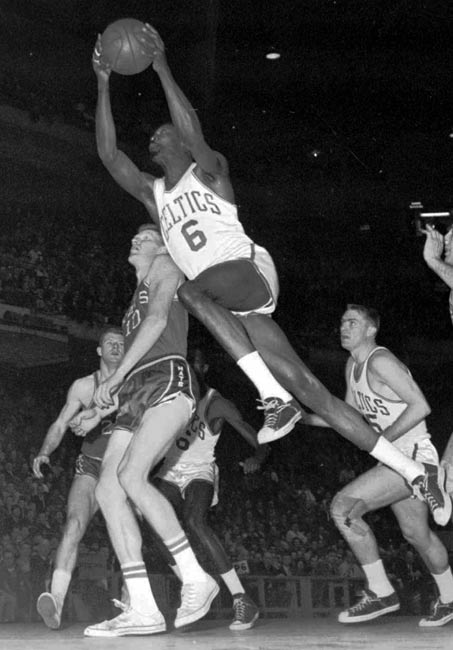
Bill Russell is usually on the short list of players considered to be the best of all time, and you can see that each of the other rankings I have referenced above had him among the top 4 players of all time, but I've chosen to rank him significantly lower. I mean no disrespect in ranking him this low, but when you look at the facts, it just makes sense.

As I described earlier in my biography of Oscar Robertson, Russell played in an era of inflated statistics, so when you look at his career averages of 15.1 points and 22.5 rebounds per game, you must remember that those numbers are much higher due to the faster pace of the game and the lower shooting percentages that produced more available rebounds. If you adjust his stats for deflation to today's rates, his career numbers would be 12.1 points and 13.3 rebounds per game. That would still place him among the greatest rebounders of all time, but makes him quite average offensively.

In order to be considered one of the all-time greatest players, a player needs to be exceptional in multiple facets of the game, whether it is offense, defense, longevity, or winning. Russell was a subpar offensive player, shooting just 44% from the field and 56% from the line for his career, and his longevity was just average at 13 seasons. Russell is, however, one of the game's greatest defensive players, and if blocked shots had been counted during his career, it may have been possible to rank him higher, but there is no way to prove what he did during those years.

When it comes to winning, there was no one better. In his 13 seasons in the NBA, he won 11 NBA Championships. The two times he didn't when occurred when he was injured and unable to compete or worn out from his first season as both a player and a coach. Of those 11 title teams, Russell was the best player on 8, the famous 8 consecutive titles that covered most of the 1960's. During their first title run the Celtics were still Bob Cousy's team, and by the time they won their final two titles they had become John Havlicek's team. The Finals MVP award did not exist during his career, but if it had, he would have deserved to win it eight times, and in recognition of that the NBA renamed the Finals MVP award after him in 2009.

There are only 4 players in history who can claim they were the best player on at least 3 consecutive title teams: George Mikan, Bill Russell, Michael Jordan, and Shaquille O'Neal. There are only a few others who can even claim they were the best on 3 total, such as Bird, Magic, Duncan, and Havlicek. Besides those titles in the NBA, he also won a gold medal in the 1956 Olympics, as well as 2 national championship in his final two years at the University of San Francisco. So despite his shortcomings on the offensive side of the ball and his average longevity, Russell will always have a place among the game's greats.


The question of Russell vs. Drexler seems almost silly, but I have already shows that Russell was slightly overrated and Drexler was vastly underrated, so when you compare the two, they're actually closer than you think. They were both very good defensive players, with the slight edge going to Russell, and Drexler's 15 seasons give him the longevity edge over Russell. Drexler was a far better offensive player than Russell, averaging over 20 points per game for the majority of his career, a number that Russell never matched in a single season. But Russell still gets the edge here for his winning ways, since Drexler's title came after he became Olajuwon's second banana, while Russell led his team to championships nearly every season.

Thursday, March 15, 2012

Top 100 NBA Players: #15


Clyde Drexler

(Kalb: #50, Simmons: #43, BBR: #23)

Clyde Drexler is considered by most experts to be a second-tier star, not an all-time superstar, but these are misconceptions due to the fact that he was never able to measure up to Michael Jordan when they faced each other in the 1992 NBA Finals, but is there anybody who could?

Drexler was a great all-around player, averaging over 20 points, 5 rebounds, and 5 assists in 6 straight seasons during his prime, and during that same period he led the Trail Blazers to some of the best seasons in their history. In 1990, he led the Blazers from the third seed in the West to the NBA Finals, where they fell to the Detroit Pistons in 5 games. The next season Portland had the best regular season record, but lost in the Western Conference Finals to the Los Angeles Lakers.

In 1992, he again led the Blazers to the Finals, but they once again lost, this time to the Chicago Bulls. Many people remember Drexler for losing in those years, but he averaged over 21 points, 7 rebounds, and 7 assists per game during all three of those playoff campaigns and was by far the best player on his team, while the teams he lost to had great supporting stars.

Drexler suffered injuries during the next season, which caused people to forget about him as other teams began to dominate in the West, and when he became healthy again, Portland was no longer a championship contender, so he requested a trade and was sent to his hometown of Houston to be reunited with college teammate Hakeem Olajuwon. That season, the two superstars led the Rockets from the sixth seed in the West to their second straight NBA title, which finally earned Drexler his ring.

Many people try to discount Clyde's NBA championship by saying that he was no longer a star player when he won his title, and while he was no longer in his prime, he was definitely still a player capable of dominating. If you look at his stats in 1992, his best season, and 1995, when he won his title, you'll see that the dropoff isn't that big:

Drexler (1992) - 25.0 pts, 6.6 reb, 6.7 ast, 1.8 stl, .470 FG%, .337 3P%, .794 FT%
Drexler (1995) - 21.8 pts, 6.3 reb, 4.8 ast, 1.8 stl, .461 FG%, .360 3P%, .824 FT%

Drexler also played much bigger than his position. He is the all-time leader for offensive rebounds among guards, and is third all-time in overall rebounds and blocked shots for guards. The only guards with more rebounds are Jason Kidd and Oscar Robertson, and the only guards with more blocks are Ron Harper and Michael Jordan. He is also one of three players in history to reach 20,000 points, 6,000 rebounds, and 6,000 assists during his career, joining John Havlicek and Oscar Robertson.


Robertson reached his peak early, then dropped off slowly throughout the rest of his career, while Drexler built up to his peak for a few seasons, then maintained it for several seasons. He also had a rebirth in Houston for one season that was much better than anything Robertson did after he went to Milwaukee. Both won titles late in their careers as #2 guys to some of the all-time greatest centers, but Drexler led Portland to two Finals while he was the star, something the Big O never did. The two spent an equal amount of time as superstars, and each earned a ring, but the difference here is what Clyde did in the playoffs while he was still the man.

Sunday, July 3, 2011

Top 100 NBA Players: #93


Terry Porter

(BBR: #145)

Today's entry in the all-time list is another member of the Portland Trail Blazers teams that made it to two NBA Finals in the early 1990's. For six seasons Terry Porter and Jerome Kersey started alongside each other in Portland, both hitting their peaks together during that time, then both lost their starting jobs in 1993-94 to younger players, Clifford Robinson and Rod Strickland, neither of whom ever measured up to their predecessors.

While Clyde Drexler was definitely the star and best player on those great Trail Blazer teams, without Porter and Kersey those teams would never have made it as far as they did. In both 1990 and 1992, when they advanced to the NBA Finals, Porter raised his scoring average above his regular season average by at least 3 points per game, from 17.6 to 20.6 in 1990 and from 18.1 to 21.4 in 1992. In both of those seasons he also led all playoff participants in 3-point field goals made.

Like Kersey, Porter became a championship chaser after leaving Portland, moving from team to team hoping to get that elusive ring. Kersey finally got his ring with the 1999 Spurs, and Porter joined him there the following season, but a repeat did not happen. Porter retired in 2002, just one year before San Antonio finally did get its second championship.


Now, on to the part about putting Porter ahead of Fat Lever. There are actually a lot of similarities between the two. Both were 6-3 and less than 200 pounds. Both were pretty good scorers and passers. Both had peaks that ended suddenly after their 8th season in the league. Lever was a much better rebounder, but Porter was able to hang around the league for longer. The thing that really puts Porter ahead of Lever is that he enjoyed a bit of playoff success, making it to 3 straight Western Conference Finals and 2 NBA Finals, while Lever only played in one Western Conference Final series in his career, and that was long before his peak years. Porter was never the statistical giant Lever became in the late 1980's, but Porter knew how to turn it on when it counted, which moves him just ahead of his contemporary on this list.