Showing posts with label Jerome Kersey. Show all posts

Sunday, July 24, 2011

Top 100 NBA Players: #71


Latrell Sprewell

(BBR: #154)

Latrell Sprewell's off-the-court problems often overshadowed his on-the-court success, which is a reason that many wouldn't call him one of the all-time greats, but when he was letting his play on the court do the talking, he was among the elite.

Sprewell started his career in Golden State, and was an immediate impact player for the Warriors. In just his second year he averaged 21.0 points per game while leading the league in minutes played and was named to the All-NBA First Team. What's strange is that it was the only time in his career that he would be voted All-NBA.

After a couple of subpar seasons, Sprewell put up a masterpiece in 1996-97, setting career highs in scoring, assists, and steals, causing the Warriors to feel like he earned the huge contract they had just given him. Although the Warriors failed to make the playoffs, he did get voted to the All-Star Team and started to look like one of the league's new superstars. Let's look at the numbers he put up that year.

Sprewell - 24.2 pts, 4.6 reb, 6.3 ast, 1.7 stl, .449 FG%, .354 3P%, .843 FT%

A lot was expected from Sprewell coming off a season like that, but after a disappointing start to the season, the incident for which he is most famous occurred, and only those who knew him well could have seen it coming. When his coach asked him to "put some mustard" on his passes, Sprewell lost it and choked his coach. After his teammates pulled him off, he left for a few minutes, then returned throwing punches before leaving for good. It turns out that this was not an isolated incident. Teammates reported other violent incidents, including once when he came after Jerome Kersey with a 2x4. He was suspended for the remainder of the season, then traded away as soon as the suspension was over.

He made his comeback with the New York Knicks in 1999, proclaiming himself a changed man, and his play and demeanor seemed to show that. He came off the bench in his first season there, playing an important role on a team that barely made the playoffs, but in the postseason he took over, becoming the best player on a team that surprised everyone and advanced to the NBA Finals, where they lost to the San Antonio Spurs.

That performance was enough for New York to give him a starting job the next season, and he once again put up quality numbers, and once again led a run deep into the playoffs, this time getting only as far as the Eastern Conference Finals. It appeared that Sprewell had really changed, but few realized that his time as an impact player was nearly over.

After a few more less successful years with the Knicks, he was traded to Minnesota, where he joined Kevin Garnett on a team that was primed for a playoff run. He adjusted well to being the sidekick to that season's MVP, and he once again saw his team advance to the Conference Finals, losing just one step short of the NBA Finals.

After that season, Minnesota offered him a contract extension worth $7 million a year, but having made nearly twice that during the season, he felt that he was being disrespected, despite the fact that his skills had obviously declined. It was at that point that he made one of the most ludicrous statements of all time, stating that he wouldn't accept that offer because he had "a family to feed." When his contract expired the next year, Minnesota let him walk, and with no other team willing to offer him more that $1 million per year, Sprewell never made it back into the league, feeling that taking less money was below him.

While his off-the-court troubles overshadowed a lot of what he did on the court, there is no doubting that he was a great player, especially during those glory years when he joined the Knicks. While he definitely could have been a little higher on this list if he had been able to better control his temper and his pride, he still deserves to be remembered for what he did accomplish.


Other than a couple of peaks and valleys from Sprewell, his career and that of Grant followed pretty similar paths statistically. While Grant may have experienced more playoff success in the form of 4 championships, he was just a good member of those teams, while any time Sprewell's teams made a deep playoff run, he was either the main reason or the #2 guy. Grant was never that guy on a team that went very far, which is why Sprewell gets the jump on him (figuratively, of course).

Sunday, July 3, 2011

Top 100 NBA Players: #93


Terry Porter

(BBR: #145)

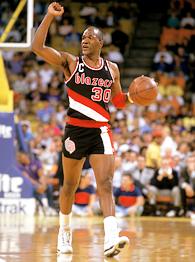
Today's entry in the all-time list is another member of the Portland Trail Blazers teams that made it to two NBA Finals in the early 1990's. For six seasons Terry Porter and Jerome Kersey started alongside each other in Portland, both hitting their peaks together during that time, then both lost their starting jobs in 1993-94 to younger players, Clifford Robinson and Rod Strickland, neither of whom ever measured up to their predecessors.

While Clyde Drexler was definitely the star and best player on those great Trail Blazer teams, without Porter and Kersey those teams would never have made it as far as they did. In both 1990 and 1992, when they advanced to the NBA Finals, Porter raised his scoring average above his regular season average by at least 3 points per game, from 17.6 to 20.6 in 1990 and from 18.1 to 21.4 in 1992. In both of those seasons he also led all playoff participants in 3-point field goals made.

Like Kersey, Porter became a championship chaser after leaving Portland, moving from team to team hoping to get that elusive ring. Kersey finally got his ring with the 1999 Spurs, and Porter joined him there the following season, but a repeat did not happen. Porter retired in 2002, just one year before San Antonio finally did get its second championship.


Now, on to the part about putting Porter ahead of Fat Lever. There are actually a lot of similarities between the two. Both were 6-3 and less than 200 pounds. Both were pretty good scorers and passers. Both had peaks that ended suddenly after their 8th season in the league. Lever was a much better rebounder, but Porter was able to hang around the league for longer. The thing that really puts Porter ahead of Lever is that he enjoyed a bit of playoff success, making it to 3 straight Western Conference Finals and 2 NBA Finals, while Lever only played in one Western Conference Final series in his career, and that was long before his peak years. Porter was never the statistical giant Lever became in the late 1980's, but Porter knew how to turn it on when it counted, which moves him just ahead of his contemporary on this list.

Tuesday, June 28, 2011

Top 100 NBA Players: #98

Jerome Kersey

(BBR: #256)

Jerome Kersey may not be a name that would normally come up in the conversation of best players ever, but when you look back at what he accomplished in the early 90's, he reminds you a lot of Lamar Odom today. Odom won two championships as the third or fourth best player on the Lakers, while Kersey lost in the Finals twice as the second or third best player on the Trail Blazers. Let's take a look at his career graph.


His career followed a somewhat normal trajectory, peaking in his late 20's, after which he held on for another 10 years chasing a championship. Because he was not a major contributor to the Spurs 1999 title team, it didn't contribute to his placement on this list. What got Kersey on this list and ahead of Lamar Odom was his playoff performance between 1990 and 1992. Let's compare these two players' regular season and playoff peaks:

Regular Season (5-year peak)
Jerome Kersey - 16.0 pts, 8.0 reb, 3.0 ast, .479 FG%, .701 FT%
Lamar Odom - 13.2 pts, 9.5 reb, 3.9 ast, .486 FG%, .682 FT%

Playoffs (3-year peak)
Jerome Kersey - 18.3 pts, 7.7 reb, 2.9 ast, .476 FG%, .719 FT%
Lamar Odom - 12.0 pts, 9.2 reb, 2.2 ast, .495 FG%, .634 FT%

As the above numbers show, the two players are pretty even as far as regular season performance goes, but when the playoffs came around, Kersey upped his game, while Odom struggled. Kersey may not have continued playing at his peak level for as long as Odom has, but he was the one who played better when it counted, even if he wasn't able to turn those playoff performances into championships.

One final point. In Elliott Kalb's Who's Better, Who's Best in Basketball?, while explaining why he left James Worthy off his top 50 all-time list, Kalb writes, "Put Jerome Kersey in Worthy's spot and Kersey has the rings." While this was clearly meant to say that Worthy was not worthy of the top 50, there's no doubt that he's a top 100 level talent, and if Kalb feels that Kersey was basically his equal, shouldn't that mean Kersey is also good enough to be considered among the top 100 players of all time? I say it does.