Showing posts with label Walt Bellamy. Show all posts

Saturday, September 10, 2016

Top 100 NBA Players: #18 - Oscar Robertson


Oscar Robertson

I know what you're thinking. How can Oscar Robertson be ranked below the top 10? He's the only person in NBA history to average a triple-double for an entire season, and he nearly did it four other times. Let me explain the factors that dropped the Big O from his usual spot in the top 10 of any other overall ranking you've probably ever seen.

First of all, let's consider his triple-double season. While I don't want to take anything away from him for such an amazing accomplishment, the fact is that his performance was a little inflated. The 1960's in general were an era of over-the-top stats, and 1962 in particular was the worst. That season, besides Oscar's huge numbers, we also saw Walt Bellamy win the Rookie of the Year with 31.6 points and 19.0 rebounds per game, and some guy named Wilt averaged over 50 points and 25 rebounds per game. It wasn't just a collision of great players that caused this unmatched season, it was a much higher pace of play which jacked up all of the statistics.

When you compare 1962 with 2012, you'll notice some major differences. The scoring average 50 years ago was 25% higher than it is today, the rebounding average was 69% higher, and the assist average was 16% higher, even in an era where they weren't given out as freely. The top 4 scoring seasons in history were Oscar's four best years, and the top 13 single season rebounding averages were all recorded by players in the 1960's. If you were to take Oscar's stats from that season and make them correspond to today's pace, here's the difference you would see:

Robertson 1962 (actual) - 30.8 pts, 12.5 reb, 11.4 ast
Robertson 1962 (adjusted) - 24.6 pts, 7.4 reb, 9.8 ast

Like I said, I am not saying that Oscar was not an incredible player, because even those numbers would put him among the top 3 players in the league today. Not only that, but I also believe that his skills would translate well to today's game, so he likely would be a potential MVP today if he weren't over 70 years old.

Now that his amazing stats have been somewhat put into perspective, let's look at another major determiner of greatness - winning when it matters. While Robertson was at his peak in Cincinnati, he led them as far as the Conference Finals twice, and failed to make the playoffs in 4 other seasons. When he finally did win a championship, with Milwaukee in 1971, it was with Kareem leading the way and Oscar setting him up. He did make a return trip to the Finals in his final season, 1974, where they lost to the Celtics in 7 games.

One final note about Robertson. He played in an era that was very different from today. There were numerous times during his college and pro career when he wasn't allowed to stay in the same hotels or eat at the same restaurants as teammates because of the color of his skin. The fact that he excelled amidst the turmoil of segregation is another testament to his greatness.

Friday, March 9, 2012

Top 100 NBA Players: #16


Oscar Robertson

(Kalb: #8, Simmons: #9, BBR: #3)

I know what you're thinking. How can Oscar Robertson be ranked below the top 10? He's the only person in NBA history to average a triple-double for an entire season, and he nearly did it four other times. Let me explain the factors that dropped the Big O from his usual spot in the top 10 of any other overall ranking you've probably ever seen.

First of all, let's consider his triple-double season. While I don't want to take anything away from him for such an amazing accomplishment, the fact is that his performance was a little inflated. The 1960's in general were an era of over-the-top stats, and 1962 in particular was the worst. That season, besides Oscar's huge numbers, we also saw Walt Bellamy win the Rookie of the Year with 31.6 points and 19.0 rebounds per game, and some guy named Wilt averaged over 50 points and 25 rebounds per game. It wasn't just a collision of great players that caused this unmatched season, it was a much higher pace of play which jacked up all of the statistics.

When you compare 1962 with 2012, you'll notice some major differences. The scoring average 50 years ago was 25% higher than it is today, the rebounding average was 69% higher, and the assist average was 16% higher, even in an era where they weren't given out as freely. The top 4 scoring seasons in history were Oscar's four best years, and the top 13 single season rebounding averages were all recorded by players in the 1960's. If you were to take Oscar's stats from that season and make them correspond to today's pace, here's the difference you would see:

Robertson 1962 (actual) - 30.8 pts, 12.5 reb, 11.4 ast
Robertson 1962 (adjusted) - 24.6 pts, 7.4 reb, 9.8 ast

Like I said, I am not saying that Oscar was not an incredible player, because even those numbers would put him among the top 3 players in the league today. Not only that, but I also believe that his skills would translate well to today's game, so he likely would be a potential MVP today if he weren't over 70 years old.

Now that his amazing stats have been somewhat put into perspective, let's look at another major determiner of greatness - winning when it matters. While Robertson was at his peak in Cincinnati, he led them as far as the Conference Finals twice, and failed to make the playoffs in 4 other seasons. When he finally did win a championship, with Milwaukee in 1971, it was with Kareem leading the way and Oscar setting him up. He did make a return trip to the Finals in his final season, 1974, where they lost to the Celtics in 7 games.

One final note about Robertson. He played in an era that was very different from today. There were numerous times during his college and pro career when he wasn't allowed to stay in the same hotels or eat at the same restaurants as teammates because of the color of his skin. The fact that he excelled amidst the turmoil of segregation is a testament to his greatness. It's too bad that he wasn't able to play in a day where he was treated the same way off the court as he was on the court.


Oscar Robertson was never the best player on an NBA champion or runner-up, while Dirk Nowitzki has achieved both in his career. Dirk has been able to maintain a high level of play for longer than Oscar, but Robertson's greatness in his first five seasons are still enough to put him ahead of the big German on the all-time list.

Monday, July 18, 2011

Top 100 NBA Players: #77


Jo Jo White

(Simmons: #95, BBR: #117)

Jo Jo White was one of the players who bridged the gap for the Celtics from the Bill Russell dynasty to the years of Larry Bird, and although he's not as famous as those who came before and after him, he had some pretty good days starring in Boston.

Jo Jo was not the best player on the Celtics during his time there, but playing alongside big men John Havlicek and Dave Cowens, he was able to keep the Celtics in contention through a big chunk of the 70's. From 1971 to 1977, he was one of the most consistent player in the league, and an All-Star in each of those seasons. His overall stats from that period are listed below.

White - 19.6 pts, 4.5 reb, 5.6 ast, 1.4 stl

It's also notable that during those six seasons White missed a total of 3 games, and played a total of 80 playoff games during those postseasons, which means he crammed 7 years worth of games into 6 years. Included in those 6 playoff runs were two championships, and White was one of Boston's top 3 players each time.

White had a major part in one of the most memorable Finals games of all time, the triple overtime thriller in 1976 against Phoenix. White played 60 minutes in that game and hit the technical free throw that gave Boston a 2-point lead with a second left in the second overtime, which prevented them from losing on Gar Heard's miracle shot. He then hit the two free throws that iced the game in the third overtime.


Jo Jo's career peak was nowhere near Bellamy's, but Bellamy's peak occurred early, and he was never able to duplicate that success. White reached his peak level in year 3 and stayed steady for 6 seasons before injuries knocked him off the top. With just the regular season stats, there's no way that White is put ahead of Bellamy, but when you include those 2 championships and his contributions to those teams, he's definitely worthy of passing Walt in the all-time rankings.

Sunday, July 17, 2011

Top 100 NBA Players: #78


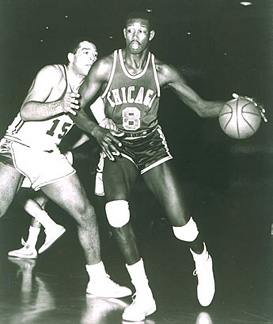
Walt Bellamy

(BBR: #83)

If you want to see a player whose career is filled with oddities, look no further than Walt Bellamy. To begin with, his best season was his first, in which he averaged 31.6 points and 19.0 rebounds while leading the league with a .519 field goal percentage. The scoring average was second to Wilt Chamberlain and the rebound average third to Wilt and Bill Russell. That season he won the only official award of his entire career, the Rookie of the Year.

Part of the reason that his stats were so strong early in his career was that nobody was playing defense back in the 1960's. In 1962, his rookie season, Bellamy's amazing season was barely even noticed, because it happened to be the same season that Oscar Robertson averaged a triple-double, and it was also the year that Wilt Chamberlain averaged over 50 points per game, including the record-setting 100-point game. It wasn't just Bellamy putting up crazy numbers that year, it was everybody.

Bellamy averaged at least 22 points and 14 rebounds per game in each of his first five seasons, yet was never named to an All-NBA Team. This is because he had the misfortune of playing at the same time as the two all-time greats I mentioned before, Russell and Wilt, so there was never room for the third-best center in the league.

Bellamy also holds the record for most games played in a season, with 88 games played in 1968-69. That was made possible by a midseason trade from New York to Detroit, who had a lot more games remaining on the schedule. With today's more balanced schedule, that record is unlikely to be broken. And it wasn't just that one season in which he was an iron man. Bellamy never missed more than one game in any of his first 11 seasons.

Bellamy also never made an appearance in the NBA Finals, at a time when the dominant centers seemed to be there every year. Walt Bellamy was a great player, but he was not the superstar that many expected, and he was never classified as a winner. For these reasons, Bellamy is the 30-point scorer most likely to be forgotten by the casual fan.


Bellamy was obviously a better player than Fulks, but Fulks had the winner's mentality and the mantle of league superstar. But what Bellamy lacked in winning, he made up for in durability and longevity. In the chart, you'll notice a second peak in the 11th year of his career. He is the only player I have profiled so far who was still effective enough to make a difference that late in his career, and that's why he deserves his place here at #78.