Showing posts with label Gus Williams. Show all posts

Thursday, August 5, 2021

Top 100 NBA Players: #87 - Gus Williams


Gus Williams

Teams

Golden State Warriors - 1975-77

Seattle SuperSonics - 1977-84

Washington Bullets - 1984-86

Atlanta Hawks - 1986-87


Playoffs

Appearances - 10 (1976,1977,1978,1979,1980,1982,1983,1984,1985,1986)

Conference Finals - 4 (1976,1978,1979,1980)

NBA Finals - 2 (1978,1979)

Championships - 1 (1979)


Awards and Honors

All-NBA First Team - 1 (1982)

All-NBA Second Team - 1 (1980,1983)

NBA Finals MVP - 0 (1979)

*(actual in bold, deserved in italics)


All-Time Ranks

Steals Per Game - #16

Total Steals - #29

Assists Per Game - #81

Total Assists - #86


League Leads

Total Steals (#3-1978,1984, #4-1980)

Steals Per Game (#2-1978, #3-1984, #4-1980)

Total Assists (#4-1983, #5-1984)

Three Pointers Made (#5-1985)


After a very strong senior season at USC, Gus Williams was a first-round pick by the Spirits of Saint Louis of the ABA and a second-round pick by the Golden State Warriors of the NBA, ultimately deciding to go with the Warriors, as the ABA was on its last legs and would merge with the NBA just a year later.

He spent 2 years with the Warriors, and was good, but not spectacular, being named to the All-Rookie Team in 1976 before being allowed to leave in free agency in 1977, when he signed with the Seattle SuperSonics, which was the best move he made in his career.

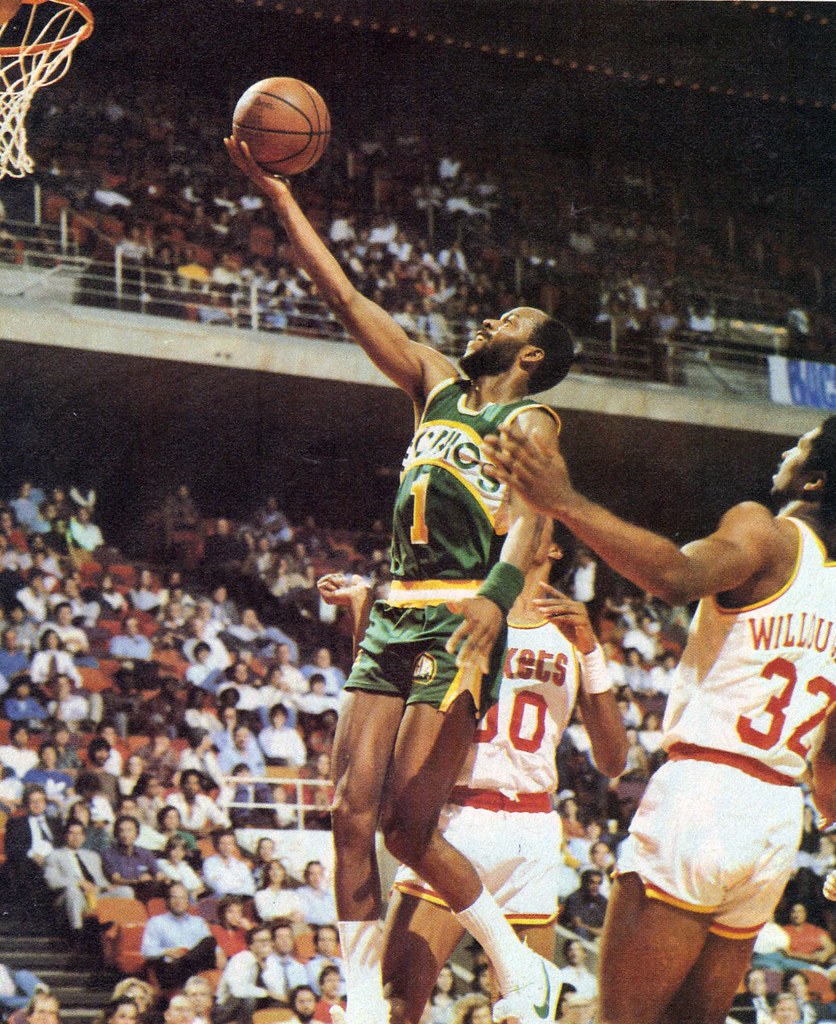
Williams' first three seasons in Seattle were great. He got better each season, reaching averages of 22.1 points, 4.8 assists, and 2.4 steals per game in 1980, which was the first time he was named to the All-NBA Team, and it was well-deserved. He also helped lead the Sonics on deep playoff runs in each of those seasons, reaching the Finals in 1978 and 1979, winning the title in 1979. Dennis Johnson was named the MVP of those Finals, but Johnson was the higher scorer in that series 29.0 to 22.6.

After reaching the Conference Finals in 1980, the third straight season making it at least that far in the playoffs, Johnson sat out a full season in a contract dispute. Based on his career trajectory, that could have been his best season, but we'll never know. Still, when he returned after a year off, he had by far his best regular season, 23.4 points, 6.9 assists, and 2.2 steals per game, earning him his only All-NBA First Team berth.

Williams played 2 more seasons with Seattle, averaging at least 18 points and 8 assists per game each season, but failed to be named to the All-NBA Team (which he deserved in 1983) or make another deep playoff run. After the 1984 season, he was traded to the Washington Bullets, the team he had faced twice in the NBA Finals a few years earlier.

Williams had one more really good season for the Bullets before his numbers started to dip significantly, and after two seasons in Washington, he signed with the Atlanta Hawks for his farewell season. 

He didn't have a long career, with only 11 seasons on the court, and he missed a full season at his peak, but he was a very good player on both ends of the court for many years, especially during his time in Seattle. He was also a proven winner, putting up the best numbers of his career in the NBA Finals, but he was overlooked when it came to the Finals MVP and the Hall of Fame. He is not being overlooked here, he has earned this spot among the greatest players of all time.




Friday, August 19, 2016

Top 100 NBA Players: #45 - Dennis Johnson


Dennis Johnson

Dennis Johnson is one of the most underrated guards of all time, as evidenced by the fact that he wasn't even elected to the Hall of Fame until after his death, which was a full 17 seasons after he retired. Not only did he win three championships, but he was an integral part of each of those teams.

He started his career with the Seattle SuperSonics, where in just his second season he helped take the extreme underdogs all the way to the NBA Finals. His averages went from 12.7 points and 3.6 rebounds in the regular season to 16.1 points and 4.6 rebounds in the playoffs, but in the last game of the NBA Finals, he choked, going 0-14 as the Sonics lost to the Bullets.

The next season, he came back at the same level at which he finished the previous season, matching the averages above and taking Seattle back to the Finals, and because he performed well throughout the playoffs and redeemed his previous failing, he was awarded the Finals MVP. In my profile of Gus Williams (#55) I showed why I thought the award should have gone to him instead, but there is no arguing that Johnson was one of the two stars on the title team, and that was in just his third season.

Johnson was even better the next season, averaging 19 points, 5.1 rebounds, and 4.1 assists per game while being named to the All-Defensive Team for the second of what would become nine straight seasons. Unfortunately, the Sonics lost in the Western Conference Finals that year to the Lakers, who featured Kareem Abdul-Jabbar and a rookie named Magic Johnson.

He was traded to the Phoenix Suns after that season in exchange for Paul Westphal, and while he continued to put up big numbers, he was not able to replicate the playoff success he enjoyed in Seattle. While he was a Sun, he made his only appearance on the All-NBA First Team and enjoyed his most impressive personal seasons.

After three season in Phoenix, he made his way to Boston via another trade, and was able to use his experience to help the Celtics make it to four straight NBA Finals, two of which earned him additional championship rings. While Kevin McHale and Robert Parish tend to be more recognized as stars during that period for Boston, more often than not it was Dennis Johnson playing second fiddle to Larry Bird on those great teams.

Above it all, Dennis Johnson was a winner, making the playoffs in every season after his rookie year ended. He made it at least to the Conference Finals 8 times in his career, and played in 6 NBA Finals. He was twice the second-best player on a champion, and he was always in the top 4 on those 8 teams that made deep playoff runs. Even though he never averaged 20 points per game for a full season, he was a huge asset if you wanted a winner.

Wednesday, August 10, 2016

Top 100 NBA Players: #55 - Gus Williams


Gus Williams

Gus Williams played like a superstar for several years in Seattle, yet then and now he is underappreciated for what he accomplished. Most fans today haven't even heard of him, and the professionals who have ranked the all-time greats like I'm doing also ignored him completely, but there are some good reasons to put him on this list.

Williams was the best player on the 1979 NBA Champion Seattle SuperSonics, but even then he was overlooked for a more recognizable teammate, Dennis Johnson, when it came to the voting for Finals MVP. The truth is that Johnson was awarded the MVP because of the way he had bounced back after going 0 for 14 in the deciding game of the Finals the previous season, but Williams was still the better overall player. Here are their stats from the playoffs:

Johnson - 20.9 pts, 6.1 reb, 4.1 ast, 1.6 stl, .450 FG%, .771 FT%
Williams - 26.6 pts, 4.1 reb, 3.7 ast, 2.0 stl, .476 FG%, .709 FT%

There was some pretty good balance between the two guards among these five categories during that postseason, but Williams outscored Johnson by more than 5 points per game, and in my opinion was the real reason that Seattle won the series and the championship.

Williams had been the second-best player on the Sonics during their run to the Finals the previous season, and he was once again the best player for Seattle as they advanced to the Western Conference Finals in 1980. That's 3 straight seasons of making at least the Conference Finals as the star of the team or his top sidekick. He was obviously feeling unappreciated at this point, so he sat out the following season in a contract dispute, a season that most likely would have been his best, judging by his career trajectory.

When he returned after a one-season hiatus, he picked up right where he left off statistically, actually improving in many categories, but he was never able to see the same playoff success as he had before. He never made it past the second round again in his career, but he was still enough of a star to be worthy of some recognition. Here are his stats for the 3 years before and after the holdout season.

Williams (1977-1980) - 19.8 pts, 3.3 reb, 4.2 ast, 2.3 stl
Williams (1981-1984) - 20.7 pts, 2.7 reb, 7.8 ast, 2.3 stl

He may not have received the recognition he deserved back when he was starring for Seattle or today, but he hasn't been forgotten here, and there is no way I can leave a player this talented off of my top 100.

Saturday, August 20, 2011

Top 100 NBA Players: #45


Dennis Johnson

(Simmons: #52, BBR: #99)

Dennis Johnson is one of the most underrated guards of all time, as evidenced by the fact that he wasn't even elected to the Hall of Fame until after his death, which was a full 17 seasons after he retired. Not only did he win three championships, but he was an integral part of each of those teams.

He started his career with the Seattle Supersonics, where in just his second season he helped take the extreme underdogs all the way to the NBA Finals. His averages went from 12.7 points and 3.6 rebounds in the regular season to 16.1 points and 4.6 rebounds in the playoffs, but in the last game of the NBA Finals, he choked, going 0-14 as the Sonics lost to the Bullets.

The next season, he came back in playoff form, matching the averages above and taking Seattle back to the Finals, and because he performed well throughout the playoffs and redeemed his previous failing, he was awarded the Finals MVP Award. In my profile of Gus Williams (#57) I showed why I thought the award should have gone to him instead, but there is no arguing that Johnson was one of the two stars on the title team, and that was in just his third season.

Johnson was even better the next season, averaging 19 points, 5.1 rebounds, and 4.1 assists per game while being named to the All-Defensive Team for the second of what would become nine straight seasons. Unfortunately, the Sonics lost in the Western Conference Finals that year to the Lakers, who featured Kareem Abdul-Jabbar and a rookie named Magic Johnson.

He was traded to the Phoenix Suns after that season in exchange for Paul Westphal, and while he continued to put up big numbers, he was not able to replicate the playoff success he enjoyed in Seattle. While he was a Sun, he made his only appearance on the All-NBA First Team and enjoyed his most impressive personal seasons.

After three season in Phoenix, he made his way to Boston via another trade, and was able to use his experience to help the Celtics make it to four straight NBA Finals, two of which earned him additional championship rings. While Kevin McHale and Robert Parish tend to be more recognized as stars during that period for Boston, more often than not it was Dennis Johnson playing second fiddle to Larry Bird on those great teams.

Above it all, Dennis Johnson was a winner, making the playoffs in every season after his rookie year ended. He made it at least to the Conference Finals 8 times in his career, and played in 6 NBA Finals. He was twice the second-best player on a champion, and he was always in the top 4 on those 8 teams that made deep playoff runs. Even though he never averaged 20 points per game for a full season, he was a huge asset if you wanted a winner.


Johnson and McHale played together on the great Celtic teams of the 1980's, and they took turns being the #2 and #3 guy on those teams. McHale was a slightly better player overall, but Johnson gets the edge over McHale because he had already built a nice playoff resume before he even came to Boston.

Monday, August 8, 2011

Top 100 NBA Players: #56


Dwight Howard

(Simmons: #91, BBR: #47)

Dwight Howard is one of the most impressive young players in the NBA today. He is the only player in NBA history to be named Defensive Player of the Year 3 straight times, and his career rebounding average is #12 all time and #1 among all active players.

Howard has only two real weaknesses: he is a horrible free throw shooter, and he turns the ball over about 3 times per game. Other than that, he is one of the most incredible talents to ever take the court. He has missed only 7 games in his 7 seasons, has the 4th-highest field goal percentage of all time, and leads the league in blocks and rebounds almost every year.

Howard has constantly improved throughout his career, starting out as the youngest player to ever average a double-double for a season, as a rookie at age 19. That year he averaged only 10 rebounds per game, but he has not let his average dip below 12 since. In his first two seasons, Orlando missed the playoffs, but since then they have made five straight appearances in the postseason.

In his fifth season, he led Orlando all the way to a surprise appearance in the NBA Finals, putting up his usual impressive numbers all the way. Those numbers are listed below:

Howard (2009 playoffs) - 20.3 pts, 15.3 reb, 2.6 blk, .601 FG%

The next season his numbers dipped slightly, and as a result the Magic made it only to the Eastern Conference Finals, but Howard was unquestionably their leader in both campaigns. In fact, other than his rookie season, he's been the best player in Orlando, going clear back to when he was just 19 years old.

Howard's career rebounding average currently stands at 12.9 per game, tops among active players, and the best of any player in the past 30 years other than Dennis Rodman. With Shaq's recent retirement, Howard also became the active leader in field goal percentage, with a .578 career mark that ranks fourth all-time.If he is able to remain healthy and have a career into his mid-30's, it's quite likely we could be talking about him as one of the top 5 centers of all time.


Howard has only played a short time, but in the time he's had he's already surpassed what Williams did in his too-short career. The biggest difference came because Howard didn't take a full season off in his prime like Williams did. Both led teams to the NBA Finals, with Howard's team falling just short of the title. That small difference wasn't enough for me to call Williams a better player, and who knows how high Howard will rise in the end.

Sunday, August 7, 2011

Top 100 NBA Players: #57

Gus Williams

(BBR: #170)

Gus Williams played like a superstar for several years in Seattle, yet then and now he is underappreciated for what he accomplished. Most fans today haven't even heard of him, and the professionals who have ranked the all-time greats like I'm doing also ignored him completely, but there are some good reasons to put him on this list.

Williams was the best player on the 1979 NBA Champion Seattle SuperSonics, but even then he was overlooked for a more recognizable teammate, Dennis Johnson, when it came to the voting for Finals MVP. The truth is that Johnson was awarded the MVP because of the way he had bounced back after going 0 for 14 in the deciding game of the Finals the previous season, but Williams was still the better overall player. Here are their stats from the playoffs:

Johnson - 20.9 pts, 6.1 reb, 4.1 ast, 1.6 stl, .450 FG%, .771 FT%
Williams - 26.6 pts, 4.1 reb, 3.7 ast, 2.0 stl, .476 FG%, .709 FT%

There was some pretty good balance between the two guards among these five categories during that postseason, but Williams outscored Johnson by more than 5 points per game, and in my opinion was the real reason that Seattle won the series and the championship.

Williams had been the second-best player on the Sonics during their run to the Finals the previous season, and he was once again the best player for Seattle as they advanced to the Western Conference Finals in 1980. That's 3 straight seasons of making at least the Conference Finals as the star of the team or his top sidekick. He was obviously feeling unappreciated at this point, so he sat out the following season in a contract dispute, a season that most likely would have been his best, judging by his career trajectory, which you can see in the chart below.

When he returned after a one-season hiatus, he picked up right where he left off statistically, actually improving in many categories, but he was never able to see the same playoff success as he had before. He never made it past the second round again in his career, but he was still enough of a star to be worthy of some recognition. Here are his stats for the 3 years before and after the holdout season.

Williams (1977-1980) - 19.8 pts, 3.3 reb, 4.2 ast, 2.3 stl
Williams (1981-1984) - 20.7 pts, 2.7 reb, 7.8 ast, 2.3 stl

He may not have received the recognition he deserved back when he was starring for Seattle or today, but he hasn't been forgotten here, and there is no way I can leave a player this talented off of my top 100.


Williams and Stoudemire both took an entire season off after their peak seasons, Stoudemire for knee surgery and Williams for a contract dispute. Their regular season success is pretty similar, with Williams holding a slight edge because we've been able to see his entire career already, and the slight edge in playoff success due to leading Seattle to the title puts him above Stoudemire any way you look at it.