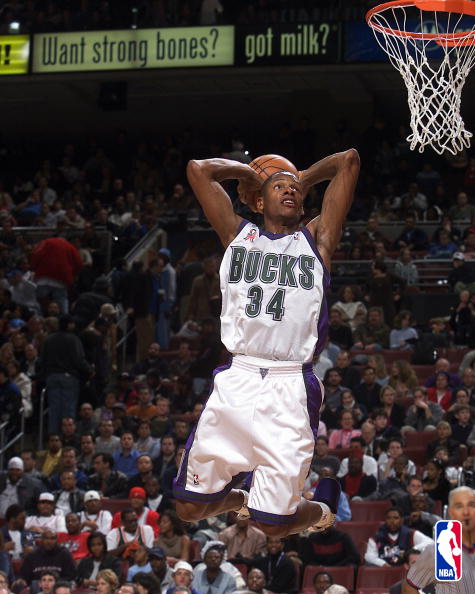
Sam Cassell
Teams
Houston Rockets - 1993-96
Phoenix Suns - 1996
Dallas Mavericks - 1996-97
New Jersey Nets - 1997-99
Milwaukee Bucks - 1999-03
Minnesota Timberwolves - 2003-05
Los Angeles Clippers - 2005-08
Boston Celtics - 2008
Playoffs
Appearances - 11 (1994,1995,1996,1998,1999,2000,2001,2003,2004,2006,2008)
Conference Finals - 5 (1994,1995,2001,2004,2008)
NBA Finals - 3 (1994,1995,2008)
Championships - 3 (1994,1995,2008)
Awards and Honors
All-NBA First Team - 0 (2004)
All-NBA Second Team - 1 (1998,2000,2004)
*(actual in bold, deserved in italics)
All-Time Ranks
Total Assists - #39
Free Throw Percentage - #47
Assists Per Game - #65
League Leads
Total Assists (#2-2000, #4-2004)
Assists Per Game (#3-2000, #5-2004)
Sam Cassell was an 18-point-per-game scorer in his 2 seasons at Florida State after transferring from junior college, and he led the ACC in steals, which led to the Houston Rockets picking him late in the first round of the 1993 NBA Draft.
He spent the first few years of his career as a backup to Kenny Smith, and he played an important sixth man role on championship teams for the Rockets in each of his first two seasons. He scored 7 points in the final 32 seconds of Game 3 of the NBA Finals as a rookie, and scored 31 in Game 2 of the Finals during his second season.
In his third season, he averaged 14.5 points per game, the first of 13 straight seasons where he would score in double figures. Following the season, he was traded to the Phoenix Suns in a deal for Charles Barkley, but would be traded again a few months later to Dallas in a deal for Jason Kidd, and then one more time late in the season to the New Jersey Nets.
In 1997-98, his first full year as a starter, he averaged 19.6 points and 8 assists per game for the Nets, leading them to the playoffs for the first time in 4 years, but they were swept by the Bulls in the first round. The Nets were expected to improve on that the next year, but Cassell was injured in the first game of the season, and played only 4 games for New Jersey before he was traded to Milwaukee, where he played the final 4 games of the season.
The team he joined in Milwaukee featured Ray Allen and Glenn Robinson, and he was one of the top point guards in the league in his first couple of seasons with the Bucks. In 2000, he finished with 18.6 points and 9 assists per game, which was #3 in the league, and in 2001, the threesome led the Bucks to the Conference Finals, where they fell in 7 games to the 76ers.
After averaging 19.7 points in each of the next 2 seasons with Milwaukee, he was traded yet again, this time to Minnesota. His first season there was his best individual season, with a career-high 19.8 points to go with 7.3 assists, and he and Kevin Garnett led the Wolves to the Conference Finals for the first time in their history, where they fell to the Lakers. That year he made his only All-Star and All-NBA teams, though he should have made the First Team that year instead of the Second Team.
When the team couldn't match their success the next year, Cassell was traded to the Clippers, who had not won a playoff series since moving to California. He scored 17.2 points per game in his first season with the Clippers, and led them to the second round of the playoffs for the first time ever, though that's as far as they would go.
After 2.5 years in LA, Cassell and the Clippers decided to part ways, and he signed for the rest of the season with the Boston Celtics, reuniting him with Kevin Garnett and Ray Allen, who had been his teammates in his two best seasons. He played just 17.6 minutes per game off the bench for Boston, the fewest since his rookie year, but was able to earn another championship at the tail end of his career. He was technically an active player the next season, but never played in a game, and retired after the season.
Cassell was one of the top point guards in the NBA for well over a decade, averaging over 17 points per game in 7 different seasons, and over 18 per game in 5 straight seasons during his prime. He helped lead two teams to the Conference Finals during his best seasons, and they were teams that did not usually experience playoff success, and won three championships in his bookend seasons, even though those were his worst individual seasons. All of this put together makes Cassell one of the most underrated players of all time, one who deserves mention among the best.