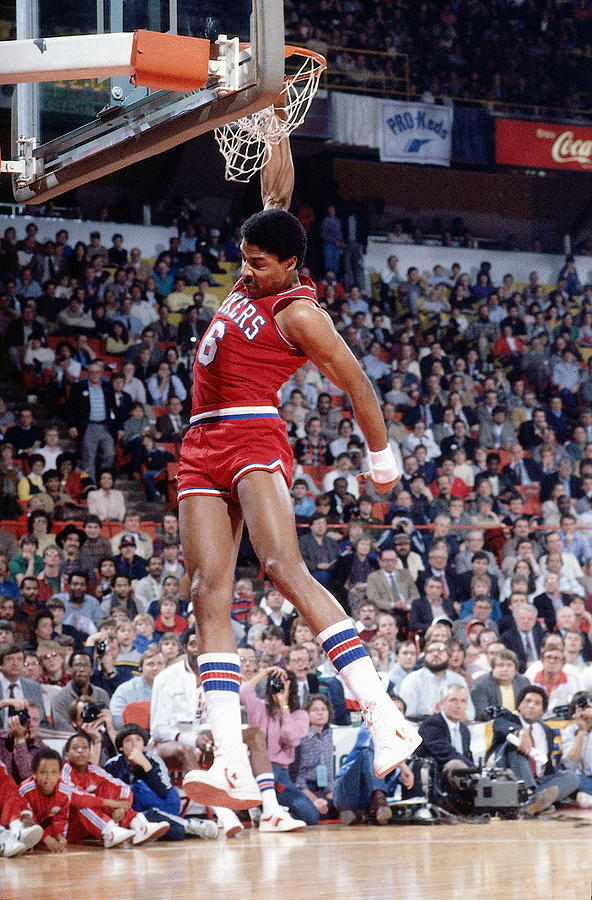
Julius Erving
Teams
Virginia Squires (ABA) - 1971-73
New York Nets (ABA) - 1973-76
Philadelphia 76ers - 1976-87
Playoffs
Appearances - 16 (1972,1973,1974,1975,1976,1977,1978,1979,1980,1981,1982,1983,1984,1985,1986,1987)
Conference Finals - 10 (1972,1974,1976,1977,1978,1980,1981,1982,1983,1985)
ABA/NBA Finals - 6 (1974,1976,1977,1980,1982,1983)
Championships - 3 (1974,1976,1983)
Awards and Honors
Rookie of the Year - 1972
MVP - 4 (1972,1974,1975,1976,1981)
Finals MVP - 2 (1974,1976)
All-ABA/NBA First Team - 9 (1972,1973,1974,1975,1976,1978,1980,1981,1982,1983)
All-ABA/NBA Second Team - 3 (1972,1977,1984)
Hall of Fame - 1993
*(actual in bold, deserved in italics)
All-Time Ranks
Total Points - #8
Total Steals - #8
Steals Per Game - #17
Points Per Game - #22
Total Blocks - #23
Total Rebounds - #35
Blocks Per Game - #43
Total Assists - #62
League Leads
Total Points (#1-1974,1976, #2-1973,1975, #3-1980, #5-1972,1981,1982)
Points Per Game (#1-1973,1974,1976, #2-1975, #4-1980, #5-1972,1982)
Total Steals (#2-1976, #3-1973,1974,1975)
Total Assists (#4-1974,1975, #5-1976)
Rebounds Per Game (#3-1972, #5-1973,1976)
Steals Per Game (#3-1974,1976, #4-1975)
Total Rebounds (#2-1972, #3-1976)
Total Blocks (#3-1974, #4-1975)
Blocks Per Game (#3-1974, #4-1975)
Field Goal Percentage (#4-1973)
Three-Pointers Made (#5-1976)
After playing 2 seasons of college basketball at Massachusetts and averaging 26.3 points and 20.2 rebounds per game, Julius Erving applied to be allowed to join the ABA as a hardship case, then signed as a free agent with the Virginia Squires.
Erving was the best player in the entire ABA as a rookie. He averaged 27.3 points, 15.7 rebounds, and 4.0 assists per game, but lost the Rookie of the Year and MVP awards to Artis Gilmore. He led the Squires to the Conference Finals, where they lost to Rick Barry and the Nets in 7 games, despite Erving averaging 33.3 points and 20.4 rebounds in the playoffs.
After the season, Erving discovered that his agent was a team employee who tricked him into signing for the team for less than he was worth, so he left the team to sign with the Atlanta Hawks of the NBA. At around the same time, he was drafted by the Milwaukee Bucks with the #12 pick in the NBA Draft, so both Milwaukee and Virginia disputed the validity of his contract with Atlanta, and a judge finally ruled that he would not be allowed to play for anyone but the Squires, so he returned to Virginia.
Erving averaged a career-high 31.9 points that season to lead the ABA, while also grabbing 12.2 rebounds per game. Even though he was teamed with George Gervin that year, the Squires lost in the first round of the playoffs, and Virginia sold him to the New York Nets after the season to save money.
In his first season with the Nets, Erving was named the MVP after he led the league in scoring for the second straight year with 27.4 per game while also averaging 10.7 rebounds, 5.2 assists, 2.3 steals, and 2.4 blocks. He also led the Nets all the way to the ABA Finals, where they beat the Utah Stars to win the championship, with Erving's 28.2 points and 11.4 rebounds earning him the Finals MVP.
He won the MVP in each of the next 2 seasons as well, closing out the final season of the ABA with another scoring title, his 3rd, and another championship and Finals MVP, his second of each. When the two leagues merged, the Nets appeared to be ready to contend immediately with the 3-time defending MVP on the roster, but they were forced to pay a double fee to enter the NBA because they played in the same city as the Knicks, and they couldn't afford to keep Erving, so they sold him to the 76ers in exchange for the money to pay the additional fee.
He made the All-NBA Second Team in his first season with the 76ers, averaging 21.6 points and 8.5 rebounds per game, and he led the Sixers all the way to the NBA Finals in the first year after the merger, knocking off the defending champion Celtics in the Conference Finals before falling to Bill Walton and Portland in the NBA Finals in 6 games.
He was able to take Philadelphia all the way back to the Conference Finals the next year, but without any other star teammates, he was unable to get the team any farther. As Maurice Cheeks started to grow into a star, the team started ascending again, reaching the NBA Finals in 1980 after beating Larry Bird and the Celtics in the Conference Finals, but losing to Magic, Kareem, and the Lakers in the Finals.
In 1981, Erving was named the MVP of the NBA, becoming the first and only player to win MVP in both leagues, and he did it with averages of 24.6 points and 8.0 rebounds per game. He led the 76ers back to the Conference Finals, but this time the Celtics beat them after overcoming a 3-1 deficit by winning the last 3 games by 2 points or fewer each.
In 1982 they turned the tables on the Celtics again, winning the Conference Finals in 7 games, but they met up with the Lakers in the Finals again, losing again in 6 games. After that season, the team added Moses Malone, and the pair of superstars led the 76ers to one of the most dominant seasons in history, and after sweeping the Lakers in the Finals, Erving finally had an NBA championship as well.
Erving was still a very good scorer at that point, but age was starting to catch up to him. He was able to help the Sixers to the Conference Finals once more, in 1985, and averaged over 20 points that season as well, but averaged only 18.1 and 16.8 in his final 2 seasons after exceeding 20 per game in each of his first 14 seasons. He retired at the conclusion of the 1987 season.
Erving was probably the best player in ABA history, winning 3 MVPs, 3 scoring titles, and 2 Finals MVPs in only 5 years as part of the league. His production dipped slightly in the NBA, but he still won an MVP and led his team to 3 NBA Finals before finally winning an NBA title as Moses Malone's sidekick. Erving is #8 on the all-time leaderboards for both points and steals, and is one of only 3 players in the top 100 all time in all 5 major stat categories, along with Karl Malone and Kevin Garnett, and he is definitely one of the greatest to ever play the game.


