Sunday, August 7, 2011

Top 100 NBA Players: #57

Gus Williams

(BBR: #170)

Gus Williams played like a superstar for several years in Seattle, yet then and now he is underappreciated for what he accomplished. Most fans today haven't even heard of him, and the professionals who have ranked the all-time greats like I'm doing also ignored him completely, but there are some good reasons to put him on this list.

Williams was the best player on the 1979 NBA Champion Seattle SuperSonics, but even then he was overlooked for a more recognizable teammate, Dennis Johnson, when it came to the voting for Finals MVP. The truth is that Johnson was awarded the MVP because of the way he had bounced back after going 0 for 14 in the deciding game of the Finals the previous season, but Williams was still the better overall player. Here are their stats from the playoffs:

Johnson - 20.9 pts, 6.1 reb, 4.1 ast, 1.6 stl, .450 FG%, .771 FT%
Williams - 26.6 pts, 4.1 reb, 3.7 ast, 2.0 stl, .476 FG%, .709 FT%

There was some pretty good balance between the two guards among these five categories during that postseason, but Williams outscored Johnson by more than 5 points per game, and in my opinion was the real reason that Seattle won the series and the championship.

Williams had been the second-best player on the Sonics during their run to the Finals the previous season, and he was once again the best player for Seattle as they advanced to the Western Conference Finals in 1980. That's 3 straight seasons of making at least the Conference Finals as the star of the team or his top sidekick. He was obviously feeling unappreciated at this point, so he sat out the following season in a contract dispute, a season that most likely would have been his best, judging by his career trajectory, which you can see in the chart below.

When he returned after a one-season hiatus, he picked up right where he left off statistically, actually improving in many categories, but he was never able to see the same playoff success as he had before. He never made it past the second round again in his career, but he was still enough of a star to be worthy of some recognition. Here are his stats for the 3 years before and after the holdout season.

Williams (1977-1980) - 19.8 pts, 3.3 reb, 4.2 ast, 2.3 stl
Williams (1981-1984) - 20.7 pts, 2.7 reb, 7.8 ast, 2.3 stl

He may not have received the recognition he deserved back when he was starring for Seattle or today, but he hasn't been forgotten here, and there is no way I can leave a player this talented off of my top 100.


Williams and Stoudemire both took an entire season off after their peak seasons, Stoudemire for knee surgery and Williams for a contract dispute. Their regular season success is pretty similar, with Williams holding a slight edge because we've been able to see his entire career already, and the slight edge in playoff success due to leading Seattle to the title puts him above Stoudemire any way you look at it.

Saturday, August 6, 2011

Top 100 NBA Players: #58


Amare Stoudemire

(BBR: #58)

Amare Stoudemire has been one of the best players in the league for the past decade, despite missing chunks of time for 3 separate injuries over that time. He was named to the All-NBA First Team the season after he had two major knee surgeries, and he still isn't slowing down.

Amare started out on the fast track. In just his third year he was the #3 player in the entire league, although he didn't get recognized for it at the time because everyone fell in love with new teammate Steve Nash. People attributed Amare's great season to Nash's skill at getting him the ball, and while it had to have helped, there's no doubt that he was improving also. Here are his numbers from that season:

Stoudemire - 26.0 pts, 8.9 reb, 1.6 blk, .559 FG%

His numbers were even better in the playoffs that year, when he led the Suns to the Western Conference Finals as their best player. Yes, you read that right, and this is coming from one of the biggest Steve Nash fans you will ever meet. Here are his playoff stats:

Stoudemire - 29.9 pts, 10.7 reb, 2.0 blk, .539 FG%

The argument that Nash made Stoudemire was put to the test last season, when Amare left Nash's side for the first time in 6 years to play in New York, and the result was one of his best seasons yet, despite what many Suns fans predicted. It only goes to show that Amare really was a superstar player in Phoenix, and that he really could have won the 2006 MVP if he hadn't blown out his knee.

Amare once again took the Suns to the Western Conference Finals in 2010, although he didn't play as well in the playoffs, allowing Jason Richardson to take the title of Best Sun in the playoffs, and as a result they once again failed to make the Finals.

Other than the season that was virtually lost to injury and his rookie season, Amare has always averaged over 20 points and 8 rebounds per game, and he was shot over 50% in six straight seasons. He has been in the top 10 in scoring 4 times and in shooting percentage 5 times. All that, and he is still only 28 years old, with plenty of time to progress as a player before he starts declining.


Amare is not the scorer that Dantley was, but he's already experienced much more playoff success than Dantley, and has also shot the ball better and rebounded it more often than Dantley. He's made more appearances on the All-NBA Team and been traded less. It all adds up to Amare being a better overall player than Dantley, and his best may be still to come.

Friday, August 5, 2011

Top 100 NBA Players: #59


Adrian Dantley

(Simmons: #66, BBR: #89)

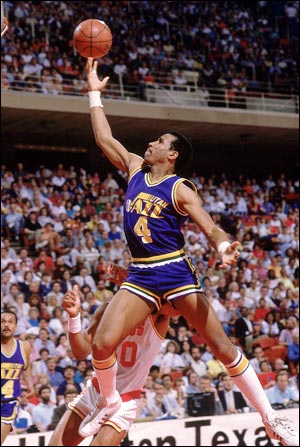
Adrian Dantley was one of the top scorers of the 1980's, leading the league in scoring twice and reaching the 30-point plateau four straight times, but he rarely saw the playoffs, and saw even less success when he did get there.

Even with all of Dantley's scoring exploits, he was only voted to the All-NBA team twice in his career, both times making the Second Team while leading all players in scoring. One reason held him back from All-NBA accolades was that he was pouring in the points while playing for losing teams. Even though he wasn't able to produce winning teams during his prime, he did put up some very impressive numbers while he was with Utah.

Dantley (Utah) - 461 games, 29.6 pts, 6.2 reb, 3.7 ast, 1.1 stl, .562 FG%
Dantley (Other) - 494 games, 19.3 pts, 5.3 reb, 2.3 ast, 0.9 stl, .511 FG%

Dantley was not a big man, only 6-5 and 208 pounds, but he spent the majority of his time in the lane, playing physically and making trips to the free throw line constantly. In fact, he led the league in free throws made five times and attempts three times. When he retired, he also had the highest field goal percentage of any player who did not play center.

Despite his amazing scoring, Dantley was traded five times during his career, always for less talented or washed-up players. Generally that would indicate that there are other problems going on off the court, much like the way Zach Randolph has been passed around throughout his short career. There's no way you can discount the big numbers, but he wasn't a winner, was traded over and over, and didn't maintain his high level of play as long as he should have.


Dantley was an immediate star in the league, winning the Rookie of the Year award while scoring over 20 points per game, while Stockton took a few years to catch on. Dantley's three best years were so far above anything Stockton ever did that he would have had to see it in person to believe it (he actually did, watching Dantley's best season from the Jazz bench as a rookie). Stockton may have lasted a couple more years as an effective player and had slightly more playoff success at his peak, but Dantley was so much better at his peak that he has to go ahead of him here.

Thursday, August 4, 2011

Top 100 NBA Players: #60


John Stockton

(Kalb: #27, Simmons: #25, BBR: #14)

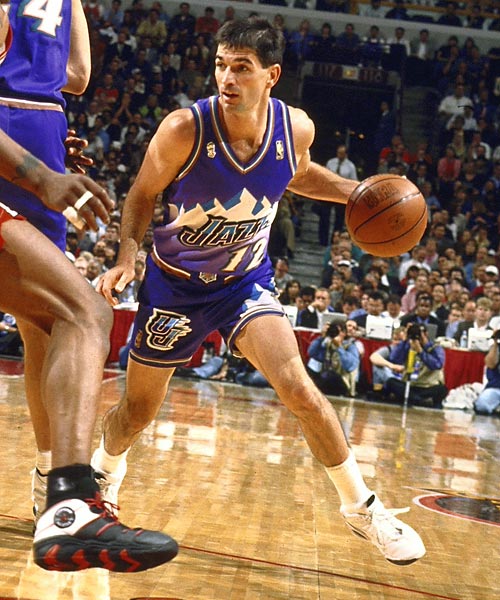
I realize that many may call it blasphemy to put Stockton this low in the all-time rankings, especially with all of the individual achievements in his career, and it hurts me to put him here too, because I have the utmost respect for him as a player and as a human being, but the fact is that he wasn't as good as many have made him out to be.

A few people will try to claim that his assist record should be discounted because assists were easier to get in his era than they were earlier days of the league, and will often compare his numbers to those of Bob Cousy to make their point, but the truth is that the average number of assists per game changed very little from 1951 through today. Assists did reach their peak in the mid-1980's, but the difference wasn't that huge. In 1956, when Cousy led the league with 8.9 assists per game, the average team got 24.3 per game, and when Stockton led the league with 14.2 assists per game in 1991, the team average leaguewide was 24.7. The only time in which assists were truly hard to get was the first four seasons of the NBA, in which the average for a team was still in the single digits.

The obvious question here is, "What caused the difference between Cousy and Stockton if assists were just as easy to get back then?" The real difference is specialization. Before the 1980's, most teams did not differentiate a point guard from a shooting guard. Whichever one got the ball took it up the court, and was more likely to record an assist. That is a small part of the reason that Stockton is ranked this low, but only a part.

Let's look for a moment at Stockton's other major achievement, which is his all-time record for steals. This one is especially misleading, because steals, unlike assists, have only been recorded for the past 38 years, meaning that there is no way to know whether he really has the most overall steals. If Jordan hadn't retired for five seasons in the prime of his career, he could easily have passed Stockton here. This record was also helped by the fact that he has played in the third-most games all-time. He was a good defensive player and led the league in steals twice, but this record doesn't help his all-time standing quite as much.

Another thing holding Stockton back was the lack of postseason success. He played in two NBA Finals late in his career, and he was still the #2 player on the Jazz, just as he had been for over a decade, but that seems to eclipse his previous playoff failings in the eyes of many. The truth is that in his 19 seasons, the Jazz made the playoffs every single season, but lost in the first round 9 times, and in the second round 5 more times. That leaves 3 Western Conference Finals seasons and the two trips to the Finals, where they lost to Michael Jordan and the Bulls. In 1996, he was not as good as Jeff Hornacek, which I detailed in my article on his back at #95, and he was still Malone's sidekick on those other teams. How can someone be considered one of the greatest of all time if he was never the best player on his own team?

To recap, I want to emphasize that I love John Stockton. I loved the way he played, and especially the way he showed up every night. In 17 different seasons he never missed a single game. He played his entire career with one team, showing great loyalty to the Utah team that took a chance on the small-school boy. The Jazz made the playoffs every single season that he was on the roster. I just can't overlook the fact that he wasn't ever a superstar. He only ranked among the top 15 players in the league once, and was never his team's best player. He rarely saw playoff success, and the majority of it came after he had started to decline as a player. He was very good at the things he was supposed to do, and not so great at the things he wasn't expected to do. Overall, he exceeded a lot of expectations, but he is not one of the top 50 players of all time. Sorry.


Stockton and Parish had two of the longest careers of anybody in NBA history, and both were able to maintain a relatively even level of play for a long period of time. Parish had more playoff success, but Stockton was a bigger reason for his team's overall success. What this one really came down to was that Stockton became a relevant player a year earlier in his career than Parish did, and started his decline at the same point.

Wednesday, August 3, 2011

Top 100 NBA Players: #61


Robert Parish

(Simmons: #59, BBR: #54)

Robert Parish was a member of 4 championship teams and played in the Finals 7 times in his career, but it's safe to say that without Larry Bird and Michael Jordan, those numbers would both be much smaller. Even though he wasn't the driving force behind those titles, he still has a place in the brotherhood of all-time greats.

Parish began his career in Golden State, playing for teams that consistently missed the playoffs, but his luck changed in 1980, when he was traded to Boston with a draft pick that became Kevin McHale for a #1 pick, which turned into Joe Barry Carroll. That trade set the Celtics' frontcourt for a decade and built a dynasty.

Parish was incredibly consistent in the 1980's, averaging over 16 points and 9 rebounds per game for 9 straight seasons, while shooting over 53% for 13 straight seasons, stretching that streak clear through 1993. While he was definitely a good player, he was just a piece in Boston, ranking as their 3rd-best player on two title teams, and lower than that for the rest of his time there.

Perhaps the most amazing thing about Parish was his durability. He played 21 seasons, and in the first 20 he never missed more than 10 games. That durability enabled him to pass Kareem Abdul-Jabbar as the player to appear in the most games in NBA history in 1996, his 20th season, during which he started 34 games for the Charlotte Hornets. While it's not the most desirable category to hold the record in, it's still an impressive achievement.


Parish may not have had the memorable highlights of Shawn Kemp, and he wasn't the team leader that Kemp was, but he was able to maintain a peak very close to the same level as Kemp's for a lot longer, and he had a lot more playoff success, even if it came riding the coattails of more talented teammates. The only thing that is keeping these two close together in the rankings is the fact that Parish could not have taken a team to the Finals by himself.

Tuesday, August 2, 2011

Top 100 NBA Players: #62


Shawn Kemp

(Simmons: #89, BBR: #76)

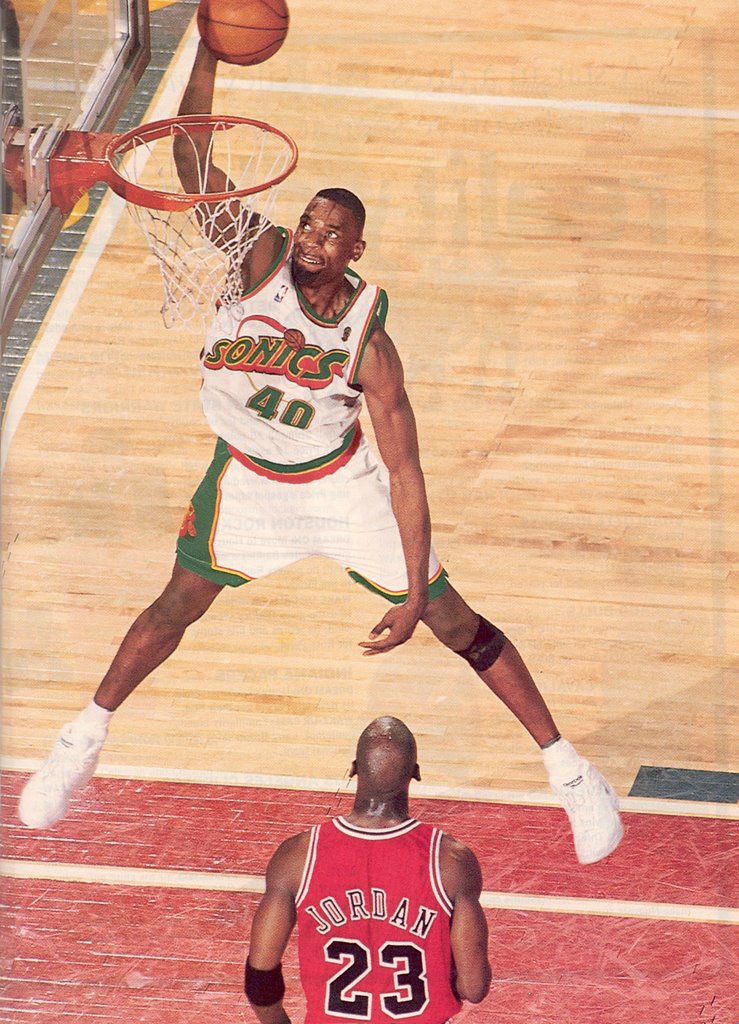
Shawn Kemp was one of the most dominant forces of the 90's, bringing down the house with thunderous dunks and leading the Sonics to multiple division titles and an appearance in the NBA Finals, but it all came crashing down too early, but there were signs that it was coming before most people noticed.

During Kemp's last four seasons in Seattle, there were very few players who could compare to him. He, along with Gary Payton, led Seattle to the NBA Finals, where they lost to Michael Jordan and the 72-win Chicago Bulls in 6 games. When he was traded to Cleveland, he continued to score in similar quantities and still made an All-Star team, but if you look at the other big-man stats, you'll see that the signs of his decline were already there.

Kemp (1993-1997) - 18.8 pts, 10.8 reb, 1.5 blk, .538 FG%
Kemp (1997-2000) - 18.5 pts, 9.1 reb, 1.1 blk, .441 FG%

The two rebounds per game drop certainly doesn't look good, but what is most alarming was the nearly 10% drop in shooting percentage, which means that he had to waste a much greater number of possessions to get himself up to the same number of points he was accustomed to scoring.

Kemp was probably the #2 player on that Finals team, although he and Payton were basically even, but he was the best player on the team that nearly made the Finals three years earlier, when they lost in game 7 to the Phoenix Suns, who went on to lose to Chicago in the Finals. Sadly, he let jealousy and drugs get in the way of a career that could have been truly memorable, and not just another in a long list of What Could Have Been's.


Kemp didn't have the prolonged playoff success of Billups, but a quick glance at this chart tells you that Kemp was a much better player in the regular season. His top 3 seasons all rank above anything Billups ever put up, and he did maintain a high level of play for just as long as Billups, which is enough for him to stay above the smaller man on this list.

Monday, August 1, 2011

Top 100 NBA Players: #63


Chauncey Billups

(BBR: #65)

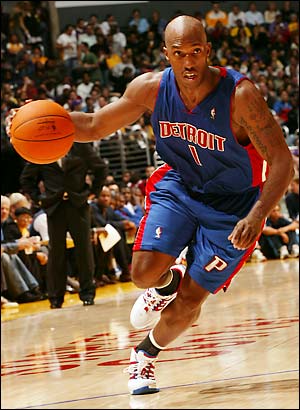
Chauncey Billups has been one of the most successful playoff players in modern years, leading his team to the Conference Finals in 7 straight years, a streak that has only been matched by two players in the past 30 years, Magic Johnson and Kareem Abdul-Jabbar. He may not have ever been considered a superstar, but he has been a star player for nearly a decade now, and a winner for most of that time.

On six of those 7 Conference Final teams, Billups was one of the top 3 players on his team, first for the Pistons teams that kept making deep playoff runs, then for Denver after a trade took him out west. Here are his stats for those seasons in the regular season and the playoffs.

Billups (Regular Season) - 17.1 pts, 3.3 reb, 6.4 ast
Billups (Playoffs) - 18.0 pts, 3.5 reb, 6.0 ast

You can see that he kicked it up one notch in the playoffs, but others have made more impressive jumps. When the Pistons won the NBA Finals, Billups was voted the MVP, even though Rip Hamilton was probably a better player throughout those playoffs, as you can see from these numbers:

Billups - 16.4 pts, 3.0 reb, 5.9 ast
Hamilton - 21.5 pts, 4.6 reb, 4.2 ast

Billups was definitely the best player for Detroit in their return trip to the Finals the next year, when he bumped those averages up to 18.7 points, 4.3 rebounds, and 6.5 assists, but Detroit lost to the Spurs, costing him a chance at consecutive Finals MVP's.

Billups is also one of the best free throw shooters of all time, with a career average of .894, which places him in fifth place in NBA history, behind only Steve Nash, Rick Barry, Mark Price, and Peja Stojakovic. His clutch free throw shooting has been a very important reason for his success, because his team was able to keep one of its best players on the floor at the most important times.


It's hard to argue that Billups was a better player than Jones, especially when you look at the comparison in the chart above. We also know that both were top 3 players on some of the best teams during their prime years, but Jones was able to make the NBA Finals a lot more often than Billups. One major difference that shouldn't be overlooked is the fact that the NBA Finals was only the second or third round of the playoffs during the Celtics' glory years, which Jones was a part of. Today, the Conference Finals is the third round of the playoffs, so Billups' run of playoff success is just as impressive as Jones', and Billups has the added bonus of saying he was the best player on a Finals team, which Jones never was.