Showing posts with label Pitching Triple Crown Winner. Show all posts

Thursday, August 2, 2018

Top 106 Baseball Players: #6 - Randy Johnson


Randy Johnson

Randy Johnson was one of the greatest power pitchers in history, and played a huge part in the only championship in Diamondbacks history.

Johnson began his career with Montreal in 1988, but after struggling to find his control, he was traded to the Mariners in 1989. During his first 3 seasons in Seattle, he led the league in walks allowed, a dubious distinction for a pitcher, and not generally a sign of future greatness.

Late in the 1992 season, he sought out Nolan Ryan to ask for advice, and Ryan helped him find the flaw in his delivery, and his entire career changed. He had led the league in both strikeouts and walks in 1992, but he would never lead the league in walks again, while finishing as the strikeout leader 8 more times.

In 1993 he became the top pitcher in the game, almost overnight, leading the league with 308 strikeouts, the first of many times he would reach 300. He was on pace for another 300-strikeout season in 1994 before the season ended early due to a strike.

He took his game to another level in 1995, and was finally recognized with his first Cy Young. He fell just short of 300 strikeouts, but still led the league, and also led the league in ERA at 2.48 and had an 18-2 record, good for the second-best win percentage in history. In his first career playoff series that year, he won two games against the Yankees, striking out 16 in 10 innings, including 3 innings in relief in the deciding Game 5.

A back injury limited him to 8 starts in 1996, but he came back to form in 1997 with 291 strikeouts, but requested a trade in 1998 when the Mariners refused to offer him an extension, and he got his wish minutes before the trade deadline, being dealt to the Astros. He had a 10-1 record in Houston, with a 1.28 ERA. He had the most strikeouts of any player in the league, though it didn't count as leading the league because it was split between the two leagues.

After his short stint in Houston, he signed with the Arizona Diamondbacks, who had just finished their first season. In his first 4 seasons in Arizona, he had 4 of the best pitching seasons in history, surpassing 300 strikeouts each time, setting an all-time record with 5 seasons in a row. He also won the Cy Young in all 4 seasons, tying Greg Maddux's record for consecutive Cy Young awards.

Johnson was incredible in the 2001 postseason, striking out 19 with a 1.13 ERA in 2 wins against the Braves in the NLCS, then pitching even better in the World Series. He struck out 19 against the Yankees as well, with an ERA of 1.04, while winning Games 2 and 6, then getting another win in relief in Game 7 as the Diamondbacks won their first and only championship, and he was named co-MVP of the Series, along with Curt Schilling.

In 2002 he won the pitching Triple Crown, winning 24 games, striking out 334, and recording an ERA of 2.32, which made him an easy choice for his 5th Cy Young, the second-most of any player in history. He missed most of the following season with various injuries, ending his streak of great seasons.

He had one more great season still in the tank, though, and he pulled it out in 2004, when he was 40 years old. He won the strikeout title yet again, became the oldest pitcher ever to throw a perfect game, and became the 4th pitcher ever to reach 4000 strikeouts. He finished as the Cy Young runner-up, the third time he had just fallen short of the award.

Over the final 5 years of his career, he reached some impressive milestones, including the 300 win mark, and passing Roger Clemens to take over 2nd place on the career strikeout list, behind his mentor, Nolan Ryan. He pitched his final game at age 46, and was elected to the Hall of Fame on the first ballot.

In addition to the record for consecutive 300-strikeout seasons and consecutive Cy Youngs, Johnson also holds the record for most strikeouts per 9 innings, with 10.61. He also holds the record for most strikeouts in a game by a lefty, with 20, and has 5 of the top 11 strikeout seasons in history. He was a very deserving World Series MVP in 2001, and one of the greatest players the game has ever seen.


Sunday, July 29, 2018

Top 106 Baseball Players: #10 - Roger Clemens*


Roger Clemens

Roger Clemens was a great pitcher over a very long period, and won more Cy Young awards than any other pitcher in history, but his career has been tainted by allegations of steroid use.

Clemens was called up to the Red Sox in 1984, and after pitching sparingly but well in his first two seasons, he jumped straight to superstar status in 1986. That year he led the league with a 2.48 ERA and 24 wins, with only 4 losses, and won both the Cy Young and the MVP. He also set the record for most strikeouts in a 9-inning game, when he sat down 20 batters in an April game, a number that has been matched twice since (3 if you count Randy Johnson's game that went to extra innings without him pitching).

The Red Sox reached the World Series that year, but Clemens did not pitch well enough to get Boston their first title in decades. He led the league in wins, complete games, and shutouts in 1987, and won another Cy Young as well. Though he still pitched just as well in 1988, he failed to win the Cy Young when his record fell to 18-12, though he did win his first strikeout crown that year.

From 1990 to 1992 he led the league in shutouts and ERA, and finished in the top 3 of the Cy Young voting each season, winning the award for the third time in 1991 when he took home the strikeout title as well. He struggled for the next four years, though he did win another strikeout crown in 1996, but it appeared that his best years were behind him, and when Boston did not offer him the contract he wanted, he signed with Toronto as a free agent.

He pitched 2 seasons for the Blue Jays, winning the pitching Triple Crown and the Cy Young award each time, but he grew tired of Toronto's mediocrity, and asked to be traded to a contender. He got his wish before the 1999 season, when he was traded to the Yankees, who had just won the World Series.

His numbers took an immediate nosedive when he reached New York, but he got his wish in the postseason, as he was a member of the championship team for the first time. He was better in 2000, especially in the playoffs. In his appearance in the ALCS, he pitched a complete-game one-hit shutout with 15 strikeouts against Seattle, then pitched 8 innings without giving up a run against the Mets in the World Series, earning him his second ring.

In 2001 he got off to a great start, becoming the first pitcher ever to start a season 20-1 and was awarded his 6th Cy Young award after the season. He pitched well through the postseason as well, and he held the Diamondbacks in check through 6 innings of Game 7 before Mariano Rivera blew a postseason save for the first time in his career, costing them the title.

Clemens pitched 2 more seasons for the Yankees, announcing before the 2003 season that it would be his last. During that season, he reached 300 career wins and 4000 strikeouts, doing both in the same game. Before the 2004 season started, he changed his mind on retiring, signing on with the Astros for a season, and he ended up with an 18-4 record and a 7th Cy Young, more than any other player in history, and he also became the oldest ever to win one at age 42.

He changed his mind about retirement again before the 2005 season, signing the largest contract ever for a pitcher, and had one of his best season, setting a career low in ERA at 1.87, but due to terrible run support his record was only 13-8. In April he pitched three straight shutouts that his team ended up losing 1-0 in extra innings.

Two months into his third retirement, he returned to the Astros again and pitched a decent season, then did the same thing the following year, pitching one final partial season with the Yankees before retiring from the Major Leagues for good, though he has pitched in the minors a few times since.

The biggest controversy of his career is the alleged use of steroids, which followed him for years. He was named in Jose Canseco's book on steroid use in baseball, as well as the Mitchell Report, and was indicted for lying to Congress about his use of steroids, though he was never convicted, and has never failed a drug test. The feeling among most fans and media members is that he probably did use PED's, and that has prevented him from being elected to the Hall of Fame, even though his career is first-ballot worthy.

In addition to the record 7 Cy Youngs, Clemens is one of 3 pitchers in the live-ball era to reach 350 wins, along with Greg Maddux and Warren Spahn, and is #9 among all pitchers in history in wins. He is also #3 in career strikeouts, behind Nolan Ryan and Randy Johnson. Even with the probable steroid use, there is no doubt that Clemens is one of the greatest baseball players of all time.


Thursday, July 19, 2018

Top 106 Baseball Players: #18 - Sandy Koufax


Sandy Koufax

For a few years in the early 1960's, Sandy Koufax was the most dominant pitcher in baseball, but was forced to retire at age 30 due to a life-threatening arm injury.

Koufax was signed by his hometown Brooklyn Dodgers when he was 19 years old, and was not allowed to pitch in the minors because of the size of his signing bonus. Over his first 6 seasons, he struggled with control, and was often kept on the bench for weeks at a time, and he didn't even appear in the Dodgers' World Series victory in 1955.

The Dodgers reached the World Series again in 1959, soon after their move to Los Angeles, and this time Koufax was given a couple of appearances, pitching 2 perfect innings in relief in game 1, then started game 5, giving up only 1 run over 7 innings, but that run lost them the game 1-0. They ended up winning the series after the next game, so his small mistake did not cost the team too much.

After struggling through the 1960 season, Koufax was ready to quit baseball, but the team convinced him to come back for one more season, and it was a good thing he did. That season he led the league in strikeouts for the first time, then in ERA the following year, and that was just the beginning.

In 1963, he won his first Triple Crown, leading the league with 25 wins, 306 strikeouts, and a 1.88 ERA, and it resulted in him winning the Cy Young unanimously, becoming the first ever to earn every vote. In that season's World Series, he pitched 2 complete games, outpitching Whitey Ford in both of his games, and gave up only 3 runs while striking out 23, which earned him the World Series MVP.

Early in the 1964 season, he felt something pop in his elbow, and after using pain injections to pitch through the pain, they shut him down, but he still led the league in ERA for the third season in a row. In 1965, he was told not to throw at all between starts to avoid losing his arm, but he still had his best season, winning another Triple Crown and unanimous Cy Young and setting a new record with 382 strikeouts in the season (since broken by Nolan Ryan).

He threw a perfect game in 1965, which was his 4th career no-hitter, which was also a record until broken by Nolan Ryan. The Dodgers returned to the World Series that year, and Koufax sat out Game 1 due to Yom Kippur, instead starting Game 2. He was pulled after 6 innings, and the Dodgers lost that game to Minnesota, but he came back with complete game shutouts in Games 5 and 7, finishing with 29 strikeouts and another World Series MVP.

Before the 1966 season, he was told by the team doctor that his arm would not last another season, but he decided to go for one more year. He won the Triple Crown for the third time in 4 seasons, and a third unanimous Cy Young, and also got the Dodgers back to the World Series. He pitched well in Game 1, allowing only 1 run in 6 innings, but was pulled in hopes of having him pitch in Game 5, which never happened due to Baltimore's sweep.

Koufax announced his retirement a few weeks later, and due to his early retirement, he was eligible for the Hall of Fame sooner, and became the youngest player ever elected in his first season on the ballot. He is one of only 4 Hall of Fame pitchers to have more strikeouts than innings pitched in his career, along with Pedro Martinez, Randy Johnson, and Nolan Ryan, and though his career was short, and his dominant seasons even shorter, he was so great at his best that he has to be included among the greatest players of all time.


Wednesday, July 18, 2018

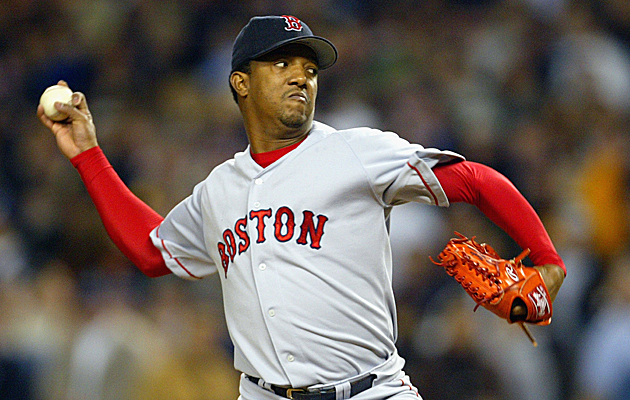
Top 106 Baseball Players: #19 - Pedro Martinez


Pedro Martinez

Pedro Martinez was the best pitcher in baseball for several years around the turn of the millennium, and a few of his seasons rank among the best seasons by a pitcher in history.

Pedro first pitched for the Dodgers in 1992, joining a team where his older brother Ramon was the star pitcher, but the team did not feel that he had the ability to be a starting ace, and he was traded to the Expos after the 1993 season.

He showed steady improvement through his first 3 seasons in Montreal, including a perfect game that he lost in the 10th inning in 1995 then took the league by storm in 1997, when he threw 305 strikeouts with an ERA of 1.90 and a league-leading 13 complete games. He won his first Cy Young that season, becoming the only Expo ever to win the award, and also became the only pitcher under 6 feet tall to ever throw 300 strikeouts in a season.

Rather than lose him to free agency the next year, Montreal traded Pedro to the Red Sox just days after he won the Cy Young, and his 7-year stretch in Boston was legendary. After coming in #2 in the Cy Young voting in his first season in Boston, he took home the award in 1999, when he won the Triple Crown with 23 wins, 313 strikeouts, and a 2.07 ERA. He was just as good in the playoffs, pitching 17 scoreless innings with 23 strikeouts, but they fell to the Yankees in the ALCS.

Between the end of 1999 and the beginning of 2000, he had 10 consecutive games with at least 10 strikeouts, 3 longer than the previous record of 7, which he also owned. He also set the record for consecutive innings with a strikeout, reaching 40 during 1999. He also became the first pitcher ever to start an All-Star game by striking out the side that season.

His very best season came in 2000, when he posted a 1.74 ERA, less than half of the next-lowest ERA, Roger Clemens' 3.70. He also set a record with a WHIP of 0.74 that season, allowing only 128 hits and 32 walks in 217 innings that season, and he was awarded his 3rd Cy Young in 4 years after the season.

A rotator cuff injury in 2001 caused him to miss half of the season, though he was still the best pitcher in the AL. He led the league in ERA and winning percentage in both 2002 and 2003, but was overlooked in the Cy Young voting each time, despite leading the winners in every major category each time.

In 2004 he had the highest ERA in his season up to that point, as it reached 3.90, but he was able to reach the World Series for the first time in his career, where he pitched 7 scoreless innings as Boston swept St. Louis to take home their first championship in decades.

After the title, he left Boston to sign with the Mets, where he had one more solid season, then faded into obscurity as injuries began to take their toll. He did get the opportunity to pitch in one more World Series with Philadelphia in 2009, but recorded a loss in each of his starts.

Martinez was the second-fastest pitcher to reach 3000 strikeouts, trailing only Randy Johnson, and is the only pitcher to retire with more than 3000 strikeouts in fewer than 3000 innings pitched. His career winning percentage of .687 is second to Whitey Ford in the modern era, and his peak was higher than any other modern pitcher. Though his great years ended abruptly, he is still definitely one of the greatest ever to play the game.


Monday, July 16, 2018

Top 106 Baseball Players: #21 - Christy Mathewson


Christy Mathewson

Christy Mathewson was the first great pitcher of the modern era, and he was the best pitcher in the league in most of the seasons in which he pitched.

He first signed with the Giants in 1900, but after pitching 3 games he was returned to his previous minor league club. Cincinnati saw his potential and picked him up, then traded him to the Giants for Amos Rusie before he even played a game for them.

In 1901, which was his official rookie season, he was the best pitcher in the league. That year he threw 36 complete games in 38 starts with an ERA of 2.41 and 221 strikeouts, though none was tops in the league. He led the league in strikeouts for the first time in 1903, and 4 more times in the next 5 years.

In 1905 he took home his first Triple Crown, leading the league with 31 wins (and only 9 losses), 206 strikeouts, and a 1.28 ERA. He also led the Giants to their first World Series, where he put on an amazing performance, pitching complete game shutouts in games 1, 4, and 7, and only giving up 13 hits over the course of the series as he won his only championship in dominant fashion.

He missed a chunk of the following season with diphtheria, which caused him to struggle for the rest of the season, but he recovered, and in 1908 had his best season, winning his second Triple Crown with a 1.43 ERA, 37 wins, and 259 strikeouts. He also led the league with 34 complete games and 11 shutouts, finishing one of the best pitching seasons ever.

He recorded a career-best 1.14 ERA in 1909, then led the Giants to 3 consecutive pennants from 1911 to 1913. The Giants lost all 3 World Series, but Mathewson pitched well throughout, posting an ERA below 1.00 in both 1912 and 1913, with a career-high World Series ERA of 2.00 in 1911. He did everything he could in those series, but couldn't win it on his own.

After expressing a desire to become a manager, he was traded to the Reds near the end of the 1916 season, where he was installed as player/manager, though he pitched only one game for his new team. After about 2 seasons as manager, he resigned to join the Army in World War I, where exposure to chemical weapons caused him to contract tuberculosis, which would kill him just a few years later.

Then the Hall of Fame was created in 1936, Mathewson was one of the original 5 players elected, and the only one who was not alive to witness his induction. He finished his career with 373 wins, the most in NL history, and #3 of all time, and his ERA of 2.13 is 9th all time, making him the only pitcher to be in the top 10 in each category. Add to that his 2 Triple Crowns and absolutely dominant 1905 World Series, and he is definitely one of the best players of all time.


Wednesday, July 4, 2018

Top 106 Baseball Players: #31 - Grover Cleveland Alexander


Grover Cleveland Alexander

Grover Cleveland Alexander was one of the greatest pitchers of the dead-ball era, then continued to have success for a decade afterward.

Alexander joined the Philadelphia Phillies in 1911, and was immediately a superstar, leading the league as a rookie with 28 wins (still the rookie record), 31 complete games, 7 shutouts, and 367 innings pitched, and he finished #3 in the MVP voting. He pitched well over the next two seasons, but then he became truly dominant.

In 1914 he led the league in wins and strikeouts, then had one of the best seasons in history in 1915, winning the Triple Crown with 31 wins, a 1.22 ERA and 241 strikeouts, to go along with 36 complete games and 12 shutouts. He repeated the feat in 1916 and 1917 as well, winning over 30 games and posting an ERA below 2.00 and basically beating down everyone in his path.

He led the Phillies to the World Series in 1915, and won Game 1 against the Red Sox, but they lost the next 4, and the Phillies would not win another World Series game until 1980. The Phillies traded him to the Cubs following his 3rd Triple Crown, fearful that he would be drafted into the military for World War I and be lost.

Their fears turned out to be partially founded, as he was drafted after pitching just 3 games for the Cubs, but he survived the war, though exposure to mustard gas did cause some hearing loss and epileptic seizures. When he came back, he was still the best pitcher in the league, winning his 4th Triple Crown in 1920.

After years of dealing with his epilepsy and his alcoholism that resulted from it, the Cubs decided to trade him to the Cardinals in 1926. The Cardinals won the pennant that year, and Alexander pitched complete game victories in games 2 and 6 against the Yankees, followed by a save to finish off game 7 and take the championship. At age 39, he had pitched over 20 innings with a 1.33 ERA and 17 strikeouts against one of the greatest teams in history, still one of the 5 greatest World Series performances in history.

Alexander finished his career with 373 wins, tied for the most in NL history and #3 among all pitchers. He also hold the NL record with 90 shutouts, and is only behind Walter Johnson on the all-time list. He is the only pitcher to win the Triple Crown 4 times, had one of the greatest World Series performances of all time at the tail end of his career, and is obviously one of the greatest to ever play the game.


Tuesday, July 3, 2018

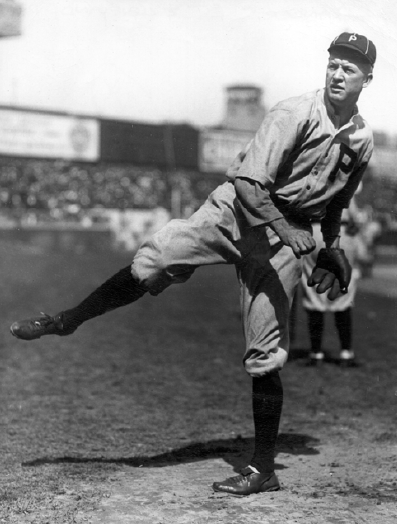
Top 106 Baseball Players: #32 - Lefty Grove


Lefty Grove

Lefty Grove was one of the greatest left-handed pitchers in history, and he spent almost an entire decade as the best pitcher in baseball, though few remember him today.

Grove did not pitch in the Majors until he was 25, in 1925, because his independent minor league team refused to send him to a Major League team for years. When he finally made his way to the Philadelphia Athletics, he was already ready for success. He led the league in strikeouts as a rookie, the first of 7 straight years that he would lead the league, an incredible way to start a career.

In 1926 he led the league in ERA, and in 1928 in strikeouts, then in 1930 and 1931 put it all together to win 2 straight pitching Triple Crowns. In 1930 he went 28-5 with a 2.54 ERA and 209 strikeouts, plus 9 saves to lead the league. The next year he went 31-4 with a 2.06 ERA and 175 strikeouts, and also led the league with 27 complete games and 4 shutouts, and took home the AL MVP award for his dominance.

He was also a part of the Athletics teams that reached 3 straight World Series, along with Jimmie Foxx, who was behind him in this countdown, and Lefty was a big part of those titles. In the 1929 World Series he pitched exclusively in relief, facing 22 batters, 10 of whom he struck out, and didn't give up a single run to finish as the best pitcher in that Series. The next year he went 2-1 with a 1.42 ERA as the A's repeated as champs, but his ERA "ballooned" to 2.42 the following year as they failed to three-peat.

Even as the most dominant period of his career was ending as he entered his mid-30's, he maintained his great ERA numbers. He was traded to the Red Sox before the 1934 season, and led the league in ERA 4 more times in Boston, in addition to the 5 times he won the title in Philadelphia. Those 9 ERA titles are the most of any pitcher in history.

He won his 300th game late in the 1941 season, and it would turn out to be his final victory, making his career record 300-141, the 8th-best winning percentage in history, and the highest of any member of the 300-win club. He is one of the few pitcher to ever win an MVP, was instrumental in 2 World Series titles, led the league in ERA more often than anyone else ever, and is definitely one of the greatest players of all time.


Wednesday, June 27, 2018

Top 106 Baseball Players: #38 - Steve Carlton


Steve Carlton

Steve Carlton was a great pitcher for well over a decade with the Philadelphia Phillies, and a former holder of many of the most prestigious records for pitchers.

Carlton first pitched for the Saint Louis Cardinals in 1965, and he had a couple of pretty good seasons with the Cardinals, but it was after he left that he became a real superstar. He pitched in the World Series for Saint Louis in 1967 and 1968, being tagged with a loss in the 1967 Series after pitching 6 innings and giving up only one unearned run, but he did earn a championship ring with that team.

The first record that Carlton broke in his career was the single-game strikeout record, which he took in 1969 when he struck out 19 New York Mets in one game, though he lost that game 4-3. That record has been exceeded on a few occasions, but it is one of the big ones for pitchers.

After winning 20 games for the first time in 1971, he demanded a higher salary, and instead was traded to the Phillies. During his first season with the team, he had one of the greatest pitching seasons ever. He won the pitching Triple Crown with 27 wins, a 1.97 ERA, and 310 strikeouts, and was also given the Cy Young unanimously. He also pitched 30 complete games that season, and set a record for winning the largest percentage of his team's games in history, winning 27 of his teams 59 wins that season, good for 46% of their total wins.

His 1973 season was a complete reversal, as he led the league in runs allowed and losses. He won the Cy Young again in 1977 after leading the league with 23 wins, and another in 1980. That season he was on top again with 24 wins and 286 strikeouts, and he also pitched 304 innings, a number that has not been reached since.

In that year's postseason, he went 3-0 with 23 strikeouts and won the final game of the World Series to earn his second championship, achieving the rare feat of being the best pitcher in both the regular season and the postseason in the same year.

He won his 4th Cy Young award in 1982 after leading the league in wins, complete games, shutouts, innings pitched, and strikeouts, and he became the first pitcher ever to reach 4. That mark has since been tied by Greg Maddux and exceeded by Roger Clemens and Randy Johnson. He also held the all-time strikeout record on several occasions from 1983 to 1984, when he and Nolan Ryan both surpassed Walter Johnson's record within weeks of each other, then kept passing the record back and forth for about a year, with Ryan eventually pulling away from Carlton.

Carlton was once the record holder for single-game strikeouts, career strikeouts, and Cy Young awards, though he no longer holds any of them. He struck out 4136 batters in his career, which was the most by a lefty at the time, since surpassed by Randy Johnson. He was twice a World Series champion, and was the best pitcher on one of those teams, and definitely one of the greatest players of all time.


Thursday, June 7, 2018

Top 106 Baseball Players: #56 - Tim Keefe


Tim Keefe

Many people have not heard of Tim Keefe, and that is probably because he retired 125 years ago, but he was an excellent pitcher back in the formative years of pro baseball, and was around for two changes in the placement of the mound.

Keefe debuted for the Troy Trojans in 1880, the final year that the mound was 45 feet from the plate, and he had an ERA of 0.86, still the best in baseball history. Somehow, even with his historic ERA, he only had a 6-6 record that season.

The Trojans folded 2 years later, and he moved to the New York Metropolitans, where he had one of the best seasons in history, pitching 68 games, all of them complete, and striking out 359 batters in 619 innings of work. On Independence Day, he pitched both games of a doubleheader, allowing only 3 total hits and winning both games.

After 2 years with the Metropolitans, the owner transferred him to the New York Giants, another team he owned in the rival National League. While with the Giants, he led the league in ERA and wins twice each, and strikeouts, complete games, and strikeouts once each. In 1888 he went 35-12 with a 1.74 ERA, 335 strikeouts, and 8 shutouts, all best in the league, which earned him the Triple Crown.

He was released midway through the 1891 season after a 5-11 start to the season, and joined the Phillies for the final few years of his career. It was during his final season of 1893 that the mound from 50 feet to 60.5 feet, which is the current distance.

125 years after his retirement, Keefe is still #10 all time on the pitching wins list with 342, and #3 in complete games with 554. He led the league in every major category at some point, and won the Triple Crown in 1888. He may have pitched in a very different era, but the way he dominated the league for seasons at a time have earned him a spot among the best players ever.

Wednesday, May 30, 2018

Top 106 Baseball Players: #64 - Dazzy Vance


Dazzy Vance

The majority of players on this list had their best years in their 20's, but that was not the case for Dazzy Vance, who only pitched 33 innings over 11 games before turning 30, then transformed into a superstar overnight when he turned 30.

Vance originally played for the Pittsburgh Pirates in 1915, then was sold to the Yankees after his first game, where he appeared in 8 games during his first season before being sent down to the minors. They discovered an arm injury the next year, and he spent years rehabbing, making 2 more appearances in 1918 for the Yankees before being sent to the minors again.

In 1921, while pitching in New Orleans in the minors, he said that he was suddenly able to pitch hard again, and the next year he joined the Brooklyn Robins (soon to be renamed the Dodgers), where he became an instant success.

In his first official Major League season, he led the league in strikeouts and shutouts as a 31-year-old rookie, and he ended up leading the league in strikeouts in each of his first 7 seasons. He put everything together in 1924, when he had one of the greatest pitching seasons ever, winning the Triple Crown with 28 wins, a 2.16 ERA, and 262 strikeouts, which was more than the next two pitchers in the league combined. He also led the league with 30 complete games, and was given the MVP award for his efforts.

He was never quite that good again, but very few ever have been, but he had another couple of years topping the league in ERA and shutouts, along with the 7 straight strikeout titles. Vance left Brooklyn for St. Louis in 1933, and the following season he got his only taste of the World Series, when he faced 7 batters and gave up one run at age 43, and he ended up with a championship ring, despite being a small contributor.

Even though Vance basically didn't even pitch in the Majors until his 30's, he still holds the record for consecutive seasons leading the league in strikeouts, and put up one of the greatest pitching seasons of all time. He was easily the best pitcher in the league for 5 seasons, and his absolute dominance more than makes up for the short overall career and lack of postseason success, and he deserves this spot on the all-time list.


Tuesday, May 15, 2018

Top 106 Baseball Players: #78 - Amos Rusie

Image result for amos rusie giants

Amos Rusie

Amos Rusie was the best pitcher in baseball for several years in the 1890's, and although his career was very short, his accomplishments over that short span make him worthy of this spot.

Rusie pitched for the Indianapolis Hoosiers in 1889, but was not very good, but the team folded at the end of his rookie year, and the league transferred most of the team to the New York Giants, which is where Rusie became a superstar.

In his first season in New York, he led the league in strikeouts with 341, but he also led the league in walks with 289, which is still a single-season record. He was known to throw the ball really hard and fast, but he obviously lacked control, leading the league with 36 wild pitches as well.

That would be the story for the next several years, with Rusie leading the league 5 times each in strikeouts and walks over the course of 6 seasons. His 1893 season was exceptional, as he started 52 games, with 50 complete games in the process, along with leading the league in strikeouts, walks and hits allowed.

In 1894 he won the pitching Triple Crown, leading the league in both wins and ERA for the first time while finishing 45 of his 50 starts. His ERA of 2.78 was far below the league average of 5.33 that season, and his 50 starts led the league once again.

After the 1895 season, he felt that he deserved a pay raise, but the team owner disagreed, so he sat out the entire 1896 season in protest. When he returned in 1897, he led the league in ERA for the second time, but his strikeout total dropped off to the lowest total of his Giants career. Injuries started to slow him the next season, and he ended up missing two full seasons due to a combination of arm trouble, hearing damage from a baseball hit to the head, and other personal problems.

 He was traded before the 1900 season to Cincinnati in exchange for Christy Mathewson, who had not yet pitched a game, but would go on to be one of the greatest pitchers in history, while Rusie pitched only 3 games for the Reds and had an ERA of 8.59 in those games, making it one of the most lopsided trades in history, despite it looking lopsided in the other direction at the time.

Though he had a penchant for walking record numbers of batters, Rusie had a very powerful arm and struck out batters at an amazing rate for his time, and even though his career lasted only 10 seasons, he was so dominant over his 7 season peak that he cannot be left off the list of the all-time greats.

Tuesday, May 8, 2018

Top 106 Baseball Players: #83 - Lefty Gomez


Lefty Gomez

Lefty Gomez was a great pitcher for the New York Yankees in the 1930's, and was a big part of the reason that they were constantly in the World Series, so he has a spot on this list despite his short career.

Gomez joined the Yankees in 1930, and by the middle of his second season had established himself as a starter for New York, surpassing 20 wins in both 1931 and 1932. He made his first World Series appearance in 1932, and was the best hurler in the Series, pitching a complete game in Game 2 as the Yankees beat the Cubs 5-2.

In 1933 he led the league in strikeouts for the first time while his other numbers all dropped, but he was just beginning to put it all together. In 1934 he led the league in strikeouts again, but this time he was also #1 in wins (26), ERA (2.33), complete games (25), and shutouts (6), earning the pitching Triple Crown, and he would have easily won the Cy Young if it existed at that time.

He had a couple more down years after his dominant season ended, but he was able to pull it all together again in 1937, when he won the pitching Triple Crown for the second time, with the exact same ERA and number of complete games and shutouts, along with league-leading 21 wins and 194 strikeouts. He is one of only 7 pitchers in history to win the Triple Crown twice.

In addition, he had another dominant postseason that year, pitching 2 complete games in the World Series, and only giving up 3 total runs as the Yankees won the World Series over the New York Giants for the second straight year. After one more really good year, his talents started to slip, and though he kept pitching until 1943, he was pretty much done by the end of 1939.

Overall, Gomez pitched in the World Series in 5 different seasons, with 7 total starts, finishing with a 6-0 record in those games and a handful of championship rings, and he was by far the best pitcher in the Series twice, in addition to his two seasons of absolute domination in the regular season. His career was shorter than that of most players on this list, but he was so good for those few years that he cannot be left off this list.


Monday, April 30, 2018

Top 106 Baseball Players: #91 - Rube Waddell


Rube Waddell

Rube Waddell was one of the greatest pitchers ever to take the mound at his peak, but other struggles prevented him from reaching his full potential as one of the greatest few pitchers to ever live.

In the first 5 years of his career, he played for 7 teams, including 4 minor league teams, because he quickly wore out his welcome everywhere he went. He was known to sneak off in the middle of a game to go fishing, or to leave the field to chase a passing fire truck. He was also a raging alcoholic, and it is said that he spent his entire first signing bonus on alcohol.

In 1902, he was picked up by the Philadelphia Athletics, where manager Connie Mack was able to keep him somewhat under control for a few years, and the following 6 years were some of the most productive any pitcher has ever had.

He led the league in strikeouts for 6 consecutive seasons, and topped 300 strikeouts in 1903 and 1904, a feat no other pitcher would reach in consecutive seasons until Sandy Koufax in 1965 and 1966. Not only did he have a huge number of strikeouts, but he led the league by an enormous margin each time, with no pitcher coming within 100 strikeouts of him in either of those seasons.

The next season he dropped to 287 strikeouts, but he accomplished another major feat when he won the pitching Triple Crown, topping the league with a 1.48 ERA and 27 wins as well as the usual strikeouts. His team reached the World Series that year, but he didn't pitch, and there is some controversy as to the reason, as he and the team claimed a shoulder injury, but had conflicting stories as to what happened. There is also a rumor that he was paid by a gambler to skip the Series, but that has not been proven.

After the 1907 season, despite still being the league's top pitcher, the A's grew tired of his antics and sold him to the Saint Louis Browns, where his performance regressed quickly, and by the end of 1910 he was out of the majors completely. He died of tuberculosis just a few years later, leaving behind a strange and amazing legacy.

It is unclear what caused Waddell's bizarre behavior, and it's unfortunate that there was no help available to him for his possible mental health disorder, because he was one of the most talented pitchers to ever take the mound, but even in his abbreviated career, he showed enough greatness to be included on this list of the all-time greats.