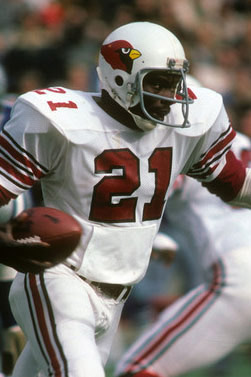
After having the second-most rushing yards in the nation as a senior at Citadel, Stump Mitchell was drafted by the Saint Louis Cardinals in the 9th round of the 1981 NFL Draft.
In his early years with the Cardinals, Mitchell was used mostly for returning kicks. As a rookie he led the league in kickoff return yards with 1292. He saw limited action as a running back in his first 4 seasons, but he was effective when he did carry the ball, averaging at least 4.8 yards per carry in each of those 4 seasons.
During the 1985 season, he was transitioned to playing running back full time by the end of the season, and he responded with his best season, gaining 1006 rushing yards, plus another 502 through the air, while leading the league with 5.5 yards per carry.
He spent the next 4 years as the Cardinals' starting running back, though his production wasn't quite as good as in his breakout year, but he still averaged more yards per carry than most other runners in the league all the way through. He retired after the 1989 season once injuries started to slow him down.
After his playing career, he became a coach, usually specializing in coaching running backs, and has been on the staff of 5 different NFL teams, and has also been a college and high school head coach over the past 35 years.
Mitchell's greatness was less about his volume, and more about his efficiency. He always gained more yardage than average throughout his career, and his per carry average is still in the top 25 of all time. He was able to transition that talent and knowledge into a second successful career, but should still be remembered for what he did on the field, where he was one of the best to do it.
Yards per Touch (#2-1977, #3-1975, #7-1974, #9-1976)
Terry Metcalf was a star in his junior season at Long Beach State, rushing for 1673 yards and 28 touchdowns in 12 games, and though his production dropped off as a senior, he was still drafted in the 3rd round by the Saint Louis Cardinals.
Metcalf was officially a running back, but he was also a very good kick returner, though those numbers are not factored into his ranking. In his second season, he averaged 31.2 yards per kick return, best in the league, while also generating 1095 scrimmage yards. He helped lead the Cardinals to a rare playoff appearance that year, and came in #2 in the MVP voting.
He was even better the next year, finishing with 1194 scrimmage yards and 11 touchdowns, while setting an NFL record for most total yards, with 2462 when adding in his return yards, a record which stood for 10 years. The Cardinals made the playoffs again that year, losing in the divisional round again, and Metcalf finished 3rd in the MVP voting.
The next season was his worst with the Cardinals, with career lows across the board, but he bounced back in 1977, earning a third trip to the Pro Bowl while averaging a career-best 5 yards per carry and finishing with 1142 scrimmage yards. After the season he decided to leave the NFL to play for Toronto in the Canadian Football League, where he spent the next 3 seasons playing at a high level.
He returned to the NFL for one final season in 1981, in a very limited role with the Washington Redskins before retiring for good. Though he only played 6 NFL seasons, he was very good at every aspect of his position, rushing, receiving and returning kicks.
Metcalf was very good at everything he did on the football field, and he is also the father of Eric Metcalf, himself a very good wide receiver and kick returner. He was in the running for 2 straight MVP awards, piled up yards no matter how he got the ball, and led a team that has had very little success in its history to 2 playoff berths, and is one of the best running backs of all time.
Yards per Rush (#1-1960, #7-1959, #8-1966, #10-1965,1967)
Rushing Yards per Game (#3-1960, #8-1962, #10-1959,1964)
Receiving Touchdowns (#9-1965)
Yards per Reception (#9-1960, #10-1965)
Total Touchdowns (#3-1962, #9-1965, #10-1960)
Points Scored (#5-1962)
Scrimmage Yards (#1-1960, #8-1959, #9-1965)
Yards per Touch (#2-1960, #3-1965, #6-1959,1967, #9-1966)
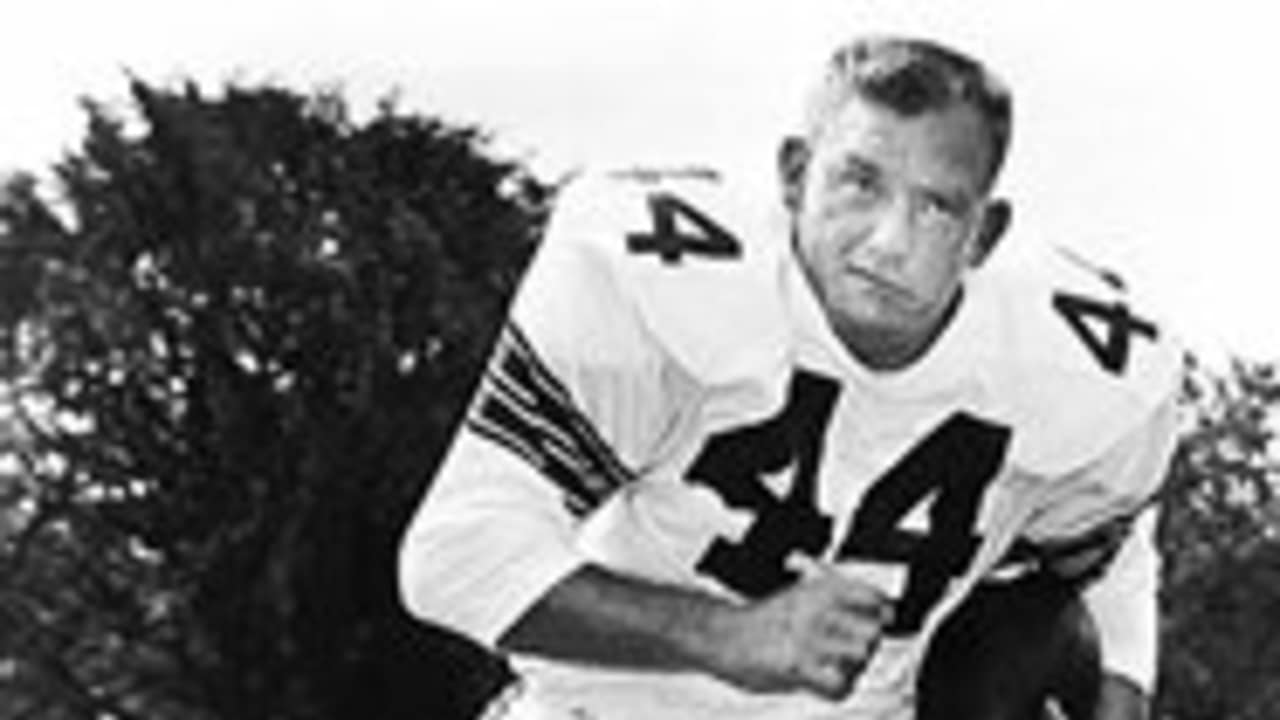
After a college career at Texas A&M that ended with him winning the 1957 Heisman Trophy, finishing with 6 rushing and 5 passing touchdowns, John David Crow was drafted with the second overall pick in the 1958 NFL Draft by the Chicago Cardinals.
He scored a touchdown on a fumble recovery in his very first NFL game, and was named to the Pro Bowl in just his second season. After those first two seasons in Chicago, the Cardinals moved to Saint Louis, and Crow had his best pro season during that first year in Missouri. He led the league with 5.9 yards per carry, 1533 scrimmage yards, but also with 11 fumbles. He finished 3rd in MVP voting that season and was named to his only All-Pro Team.
He struggled through injuries the next year, but bounced back in 1962, scoring a career-high 17 touchdowns, while also leading the league in fumbles again with 14. He missed all but three games the following season, and struggled when he returned in 1964, leading to his leaving the Cardinals to head west and play for the 49ers.
In his first season with San Francisco, he surpassed 1000 total yards for the second time in his career, and came in 3rd in Comeback Player of the Year voting while being named to the Pro Bowl for the 4th and final time. He played 3 more seasons with the 49ers, and his production dropped each year, and in his final season he switched over to tight end before retiring.
After his playing career ended, Crow joined the coaching ranks, starting out as an assistant to his college coach, Bear Bryant, at Alabama. He also spent time as an assistant in the NFL, then 6 seasons as a head coach at Northeast Louisiana. He passed away in 2015.
His pro career may not have lived up to the hype of a Heisman winner, but he had one very good season, and was a solid player for several other years. He overcame a minor stroke at birth that left his face disfigured, and was still able to become one of the best running backs of all time.
Bob Gibson was the first great modern power pitcher, who was largely responsible for the last change to the pitching mound and was an absolute monster in the World Series.
Gibson first appeared with the Cardinals in 1959, but was used sparingly through his first 2.5 seasons, partly due to racial prejudice on the part of his manager. When the manager was replaced midway through 1961, Gibson was installed as a full-time starter, and remained one for the remainder of his career.
He showed steady improvement, increasing his win total each year through 1966, but it was in the 1964 postseason when people really began to take notice. He started 3 games in the World Series, losing a close one in Game 2, then winning Games 5 and 7, the latter a complete game on 2 days rest, to earn the series victory for the Cardinals. He set a new World Series record with 31 strikeouts, and was named the MVP as well.
He had his first two 20-win seasons in 1965 and 1966, and was on pace for another when a ball hit by Roberto Clemente hit him in the leg, breaking his fibula in half. He missed 3 months, but returned in time to lead the Cardinals to the pennant, where he was again great. He pitched 3 complete games, giving up only 14 hits, and struck out 26 with an ERA of 1.00 as he won all 3 of his starts and won another World Series MVP.
In 1968 he had one of the greatest pitching seasons ever. He posted a live-ball era record 1.12 ERA, led the league with 268 strikeouts and 13 shutouts, and pitched 28 complete games. During June and July, he started 12 games, winning them all in complete games, 8 of which were shutouts. He also posted an 0.50 ERA during that time, and had a 47-inning scoreless streak as well, and was named both the Cy Young and MVP winner after the season.
In Game 1 of the World Series, Gibson set an all-time record with 17 strikeouts, still the most ever in a World Series game, and it was also just the second time ever that a pitcher struck out at least one batter in ever single inning of a World Series game. After that shutout, he pitched the Cardinals to another victory in Game 4, then started strong in Game 7 before giving up a 3-run triple in the seventh that ended up costing them the series. He struck out 35 in that series, breaking his own record, and would have easily been named MVP again with a 1.67 ERA if they had won, but they fell just short.
After that season, the league decided to lower the pitchers mound and reduce the size of the strike zone, a set of rules often referred to as the "Gibson Rules." He was still the top pitcher that season, matching his 28 complete games from the previous season, getting one more strikeout, while his ERA rose only to 2.18 despite the rule changes.
The following season he set another new career high in strikeouts and led the league in wins for the first time, which enabled him to win his 2nd Cy Young award. He was also used regularly as a pinch-hitter that year, hitting .303 in 109 at-bats, an amazing feat for a pitcher.
In 1971, he had 2 major accomplishments. He reached 200 wins first, then pitched a no-hitter 10 days later, the first of his career. In 1974, he became the second pitcher ever to reach 3000 strikeouts, and the first to do it in the NL.
Though he is not at the top of any major pitching leaderboards, he has a load of impressive accomplishments. He won 2 Cy Young awards and an MVP, and had one of the best pitching seasons ever in 1968. He was a 2-time World Series MVP, and still holds the World Series record for most strikeouts in a game and in a series, and he ranks first, second, and fifth on the second list. He was the first pitcher in over 50 years to reach 3000 strikeouts, and is definitely one of the greatest players ever to take the mound.
Albert Pujols is by far the greatest active player in baseball, and ranks among the all-time greats in many statistical categories, even if his glory years are behind him now.
Pujols was on the Cardinals' opening day roster in 2001, and the rookie did not disappoint. He set an NL rookie record with 130 RBI and led the Cardinals with 37 home runs, which earned him the unanimous Rookie of the Year award, and a 4th-place finish in the MVP race.
In his second season, he became the first player in history to hit .300 with 30 home runs, 100 runs, and 100 RBI's in each of his first 2 seasons, and he ended up doing it in each of his first 6 seasons. He finished as the MVP runner-up that season, with Barry Bonds beating him in the vote, which would be a common occurrence in his career.
In 2003, he won the batting title with a .359 average, along with league leads in hits, doubles, and runs scored, and finished as MVP runner-up to Bonds yet again. He also became only the second Cardinal ever to have 40 homers and 200 hits in a season, joining Rogers Hornsby.
In 2004, he became only the third player to reach 500 career RBI's in his 4th season, joining Ted Williams and Joe DiMaggio. He finished in 3rd place in the MVP vote, making him the second Cardinal ever to finish in the top 5 for 4 straight seasons, joining Stan Musial. He hit .500 with 4 home runs, 10 runs scored, and 9 RBI in the NLCS, earning the series MVP, but they were swept by the Red Sox in the World Series.
In 2005, he finally won his first MVP when Barry Bonds missed most of the season due to injury. His season stats were nearly identical to each of the previous 2 years, but that was enough this time. The Cardinals also made the playoffs again, and Pujols hit .556 in the first round, but his .304 average in the NLCS wasn't enough for a return trip to the World Series.
In 2006 he hit 49 home runs, the best of his career, and 20 of those were game winners, which broke Willie Mays' record set in 1962. That continued in the playoffs, with 2 more game-winning homers, one in Game 1 of the NLDS, and another in Game 1 of the World Series, and the Cards won the title over the Tigers in 5 games, giving Pujols his first championship.
After a slightly down season in 2007, he bounced back in 2008, taking home his second MVP, then repeated in 2009, when he had his best overall season and led the league in home runs and on-base percentage for the first time each. His third MVP tied Stan Musial for the most in Cardinals history, and was his first won by unanimous vote.
In 2010, he reached 400 career home runs, becoming the third-youngest player to reach that milestone, behind Alex Rodriguez and Ken Griffey Jr. He also reached 100 RBI for the 10th straight year, a streak which trails only the 11 by Al Simmons as the most to start a career, and he finished as the MVP runner-up for the 4th time in his career.
In 2011, he failed to bat .300 for the first time in his career, ending up at .299 with 99 RBI, falling just short of reaching those milestones for the 11th straight year. He was great in the playoffs, especially in the NLCS, when he hit .478 with 9 RBI to lead the Cardinals to another World Series. In Game 3, he became the third player ever to hit 3 home runs in a World Series game, joining Babe Ruth and Reggie Jackson on that exclusive list, and ended up taking home his second career title.
After that season, he was a free agent for the first time in his career, and he elected to sign with the Los Angeles Angels. He has played well since joining the Angels, but nowhere near the superstar level he had grown accustomed to in Saint Louis, but he has reached several big career milestones in Los Angeles.
He hit his 500th home run in 2014, becoming the third-youngest to reach that mark as well. In 2016, he became the second player to reach 300 intentional walks in his career, joining Barry Bonds, and later passed Mark McGwire for 10th place on the all-time home run leaderboard. In 2017 he reached 600 home runs, the 9th ever to do so, and was the first ever to reach that total on a grand slam.
Though stats for the 2018 season have not been included in this ranking, it's worth noting that Pujols reached 3000 hits earlier this season, making him the 4th player ever with 600 home runs and 3000 hits, joining Alex Rodriguez, Willie Mays, and Hank Aaron. He is the active leader in runs scored, doubles, home runs, RBI's, walks, and total bases, and is among the top 10 all-time in home runs, doubles, total bases, and RBI's, and is definitely one of the greatest players of all time.
Stan Musial was one of the most consistent hitters in baseball for over a decade, and held many NL and major league records at the time of his retirement.
Musial was called up by the Cardinals in the final month of the 1941 season, and he hit .426 in the 20 games he played. The Cardinals faced the Yankees in the 1942 World Series, Musial's first full season, and he contributed the winning RBI in game 2 of a series that resulted in his first championship.
The next season he won his first MVP, when he was just 22. He led the league in hits with 220, along with doubles, triples, batting average, on-base percentage, slugging percentage, and total bases. The Cardinals had a World Series rematch with the Yankees that year, but this time they fell in 5 games.
He should have won another MVP the next year, but his average fell to .347, and apparently that was too low for the voters. He led the Cardinals to the World Series for the third year in a row, and had his best championship performance, hitting .302 as the Cardinals took down the crosstown Browns in 6 games for another championship.
He missed the 1945 season after joining the Navy, but returned in 1946 even better than before. He won his second MVP that year after taking home another batting title with a .365 average, with 228 hits, while also leading the league in doubles, triples, and runs. The Cardinals won another championship that year, his third in 4 full seasons in the majors.
He struggled in 1947, when it was discovered that he was suffering from appendicitis and tonsillitis, but he put on having them removed until after the season. He still hit .312, but it was far below the standard he had set.
He had his best season when he came back healthy in 1948, falling just one home run short of winning the Triple Crown, while leading the league in hits, doubles, triples, runs, RBI's, batting average, on-base percentage, slugging percentage, and total bases. As he led the league in almost every single category, he was an easy choice to win his third MVP, becoming the first NL player to achieve that.
Musial was the MVP runner-up in each of the next 3 seasons, though this may have been because the voters were tired of voting for the same player every year. In 1954, he accomplished an amazing feat, hitting 5 home runs in one day, 3 in the first game and 2 in the second game of a doubleheader. He was the first ever to do that, and it's only happened once since.
Musial's stats began to decline starting in 1959, but he still had plenty of impressive accomplishments and milestones during that time. In 1962, he became the oldest player ever to hit 3 home runs in one game, at 41 years of age. The following season, he became a grandfather for the first time, and hit a home run in his first at bat that evening.
At the time of his retirement, he held 17 different MLB records, and though many have been eclipsed, he is still near the top of many leaderboards. He is #4 on the all-time hits list, #2 in total bases, #3 in doubles, #8 in RBI, and #10 in runs scored. He hit 475 home runs in his career without ever leading the league in a single season, and was the first person with 400 home runs and 3000 hits. He was a 3-time MVP, a 3-time champion, hit over .300 in 16 straight seasons, and is definitely one of the greatest players of all time.
John Smoltz was the anchor of the Braves pitching staff for two decades, and though he wasn't usually the biggest star on the staff, he was a great pitcher and nearly always pitched his best in the postseason.
Smoltz first arrived in Atlanta in 1988 and made his first All-Star team in 1989, but his coming-out show was the 1991 playoffs. In the NLCS, he won both of his starts, including a complete game shutout in Game 7 to send the Braves to their first World Series in Atlanta, and he struck out 15 batters in his 15 innings of work. His ERA in the World Series was 1.26, but the Braves lost 1-0 in Game 7 after he was pulled in the 8th inning of a scoreless game.
His success continued into the next season, when he led the league in strikeouts for the first time, then performed even better in the postseason. Smoltz was named the NLCS MVP after winning two of his 3 starts and striking out 19 Pirates over 20 innings of work, with an ERA of 2.66. He also pitched well in his two World Series starts, helping the Braves fend off elimination in Game 5 before they fell to Toronto in the next game.
In the 1993 NLCS, he received his first postseason loss, despite not giving up an earned run, then had his only poor postseason run in 1995, the year that the Braves finally broke through and won the championship behind the great pitching of Greg Maddux. He would bounce back with his best season in 1996.
That year he won the Cy Young, breaking Maddux's streak at 4, leading the league with 24 wins and 276 strikeouts. He also set a franchise record with 14 straight wins during the season, then pitched even better in the playoffs, recording 33 strikeouts in 38 innings, while posting an ERA below 1.20 in all 3 playoff series, but they Braves fell to the Yankees in the title round.
He pitched well again in 1997, and was effective in 1998 and 1999 when he pitched, but he missed about a quarter of his starts to injury, and it culminated in him missing the entire 2000 season following Tommy John surgery. When he returned in 2001, he was ineffective as a starter, so he was installed as the team's closer.
In his first full season as the closer, he set the NL record for saves in a season with 55, and he spent the next 2 seasons as one of the best closers in the game. He also joined Dennis Eckersley as only the second pitcher ever to have a 20-win season and a 50-save season. After the 2004 season, he was put back into the starting rotation.
Smoltz recorded his 200th win in 2007, and his 3000th strikeout in 2008, both of which were notable. His 200th win came against Tom Glavine, his former teammate, and made him the only pitcher in history with 200 wins and 150 saves. The 3000th strikeout made him the 4th pitcher ever to reach that milestone with one team, joining Steve Carlton, Walter Johnson, and Bob Gibson.
When he retired, he had the most postseason wins of any pitcher in history, but he has since been passed by Andy Pettitte, so he now stands in 2nd place, just ahead of Greg Maddux. He was the only player who was with the Braves through all 14 of their record consecutive division titles, and pitched better in the postseason every season, with the exception of his championship season. Add it all together, and you have one of the greatest baseball players of all time.
Cy Young is a name that is well known to baseball fans, though many do not know as much about the player as about the award that was named in his honor.
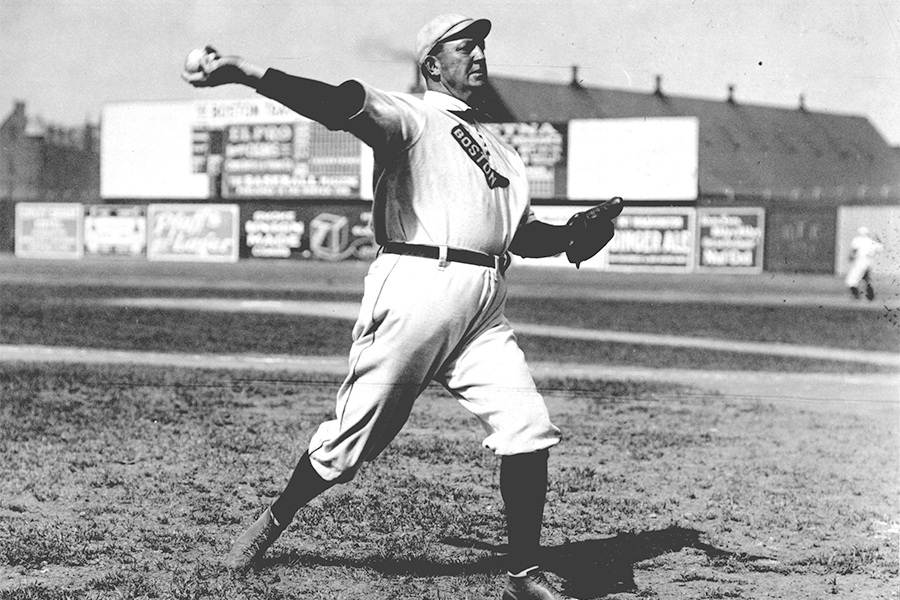
Young first pitched in the Major Leagues in 1890 with the Cleveland Spiders, and by his third season he was the best pitcher in the league, finishing with 36 wins, a 1.93 ERA, and 9 shutouts, all best in the league. Following that season, the pitching mound was moved back to its current distance, partially due to the speed with which he pitched.
In 1896 he led the league in strikeouts for the first time, and pitched his first no-hitter the next season. After the 1898 season, his team's owner purchased another team in St. Louis and transferred most of his best players over to his other team, first known as the Perfectos before changing to the Cardinals, but the team struggled in Young's two seasons there, and he jumped ship to the new American League and the Boston Americans when they formed in 1901.
His first season in Boston was a great one, as Young won the pitching Triple Crown with 33 wins, 158 strikeouts and a 1.62 ERA. Had the Cy Young award existed at the time, he definitely would have won it, but that season was a huge part of his legend that made the award a reality down the road.
The first World Series was held in 1903, with Young's Americans playing the Pittsburgh Pirates, and Young holds the distinction of throwing the first ever World Series pitch. Though he lost that game, he won his next 2 starts to lead them to a 5-3 series victory. He finished the series with a 1.85 ERA, and also had 3 RBI in game 5 as a batter.
In 1904, Young threw the first perfect game in AL history, and the first under current pitching rules. (When the previous 2 perfect games had been thrown, 8 balls equaled a walk.) That game was part of a longer streak of not allowing a hit, which extended to 76 batters, which is still the record today. He threw a third no-hitter in 1908, when he was 41 years old, and it stood as the record for the oldest pitcher to throw one for 82 years, when Nolan Ryan threw one at age 43.
Young is the all-time leader in many pitching categories, including wins, innings pitched, starts, and complete games, but also in runs allowed, hits allowed, and losses. The wins record is another that will probably never be broken, as he is 94 ahead of Walter Johnson, who is #2 on the list, and has more than double the total of active leader Bartolo Colon.
His pitching greatness over such a long period led to the creation of the Cy Young award in 1956, the year after he passed away. There have been many great pitchers over the years who have won that award, but very few who have ever reached the level of excellence achieved by its namesake, who is obviously one of the best baseball players of all time.
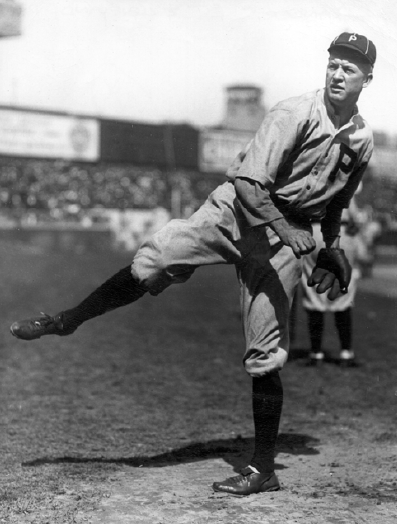
Grover Cleveland Alexander was one of the greatest pitchers of the dead-ball era, then continued to have success for a decade afterward.
Alexander joined the Philadelphia Phillies in 1911, and was immediately a superstar, leading the league as a rookie with 28 wins (still the rookie record), 31 complete games, 7 shutouts, and 367 innings pitched, and he finished #3 in the MVP voting. He pitched well over the next two seasons, but then he became truly dominant.
In 1914 he led the league in wins and strikeouts, then had one of the best seasons in history in 1915, winning the Triple Crown with 31 wins, a 1.22 ERA and 241 strikeouts, to go along with 36 complete games and 12 shutouts. He repeated the feat in 1916 and 1917 as well, winning over 30 games and posting an ERA below 2.00 and basically beating down everyone in his path.
He led the Phillies to the World Series in 1915, and won Game 1 against the Red Sox, but they lost the next 4, and the Phillies would not win another World Series game until 1980. The Phillies traded him to the Cubs following his 3rd Triple Crown, fearful that he would be drafted into the military for World War I and be lost.
Their fears turned out to be partially founded, as he was drafted after pitching just 3 games for the Cubs, but he survived the war, though exposure to mustard gas did cause some hearing loss and epileptic seizures. When he came back, he was still the best pitcher in the league, winning his 4th Triple Crown in 1920.
After years of dealing with his epilepsy and his alcoholism that resulted from it, the Cubs decided to trade him to the Cardinals in 1926. The Cardinals won the pennant that year, and Alexander pitched complete game victories in games 2 and 6 against the Yankees, followed by a save to finish off game 7 and take the championship. At age 39, he had pitched over 20 innings with a 1.33 ERA and 17 strikeouts against one of the greatest teams in history, still one of the 5 greatest World Series performances in history.
Alexander finished his career with 373 wins, tied for the most in NL history and #3 among all pitchers. He also hold the NL record with 90 shutouts, and is only behind Walter Johnson on the all-time list. He is the only pitcher to win the Triple Crown 4 times, had one of the greatest World Series performances of all time at the tail end of his career, and is obviously one of the greatest to ever play the game.
Steve Carlton was a great pitcher for well over a decade with the Philadelphia Phillies, and a former holder of many of the most prestigious records for pitchers.
Carlton first pitched for the Saint Louis Cardinals in 1965, and he had a couple of pretty good seasons with the Cardinals, but it was after he left that he became a real superstar. He pitched in the World Series for Saint Louis in 1967 and 1968, being tagged with a loss in the 1967 Series after pitching 6 innings and giving up only one unearned run, but he did earn a championship ring with that team.
The first record that Carlton broke in his career was the single-game strikeout record, which he took in 1969 when he struck out 19 New York Mets in one game, though he lost that game 4-3. That record has been exceeded on a few occasions, but it is one of the big ones for pitchers.
After winning 20 games for the first time in 1971, he demanded a higher salary, and instead was traded to the Phillies. During his first season with the team, he had one of the greatest pitching seasons ever. He won the pitching Triple Crown with 27 wins, a 1.97 ERA, and 310 strikeouts, and was also given the Cy Young unanimously. He also pitched 30 complete games that season, and set a record for winning the largest percentage of his team's games in history, winning 27 of his teams 59 wins that season, good for 46% of their total wins.
His 1973 season was a complete reversal, as he led the league in runs allowed and losses. He won the Cy Young again in 1977 after leading the league with 23 wins, and another in 1980. That season he was on top again with 24 wins and 286 strikeouts, and he also pitched 304 innings, a number that has not been reached since.
In that year's postseason, he went 3-0 with 23 strikeouts and won the final game of the World Series to earn his second championship, achieving the rare feat of being the best pitcher in both the regular season and the postseason in the same year.
He won his 4th Cy Young award in 1982 after leading the league in wins, complete games, shutouts, innings pitched, and strikeouts, and he became the first pitcher ever to reach 4. That mark has since been tied by Greg Maddux and exceeded by Roger Clemens and Randy Johnson. He also held the all-time strikeout record on several occasions from 1983 to 1984, when he and Nolan Ryan both surpassed Walter Johnson's record within weeks of each other, then kept passing the record back and forth for about a year, with Ryan eventually pulling away from Carlton.
Carlton was once the record holder for single-game strikeouts, career strikeouts, and Cy Young awards, though he no longer holds any of them. He struck out 4136 batters in his career, which was the most by a lefty at the time, since surpassed by Randy Johnson. He was twice a World Series champion, and was the best pitcher on one of those teams, and definitely one of the greatest players of all time.
Carlos Beltran is the most recent retiree on this list, having left the game after finally winning the World Series last year, a fitting close to a great 20-year career.
Beltran joined the Kansas City Royals near the end of the 1998 season, so he was still officially a rookie in 1999, when he batted .293 with 108 RBI to win the Rookie of the Year award. He missed a good chunk of the following season, and slumped so badly he lost his starting job, but won it back before the 2001 season.
During his entire career, Beltran only led the league in a category once, games played in 2002, when he didn't miss a game. Even though he wasn't dominant in the regular season, he was one of the better players in the league for several years, and he always played well in the playoffs, earning him the nickname Senor Octubre.
He was traded to the Houston Astros halfway through the 2004 season, where he was able to have his first and best playoff performance. Though the Astros failed to reach the World Series, Beltran tied Barry Bonds' playoff record with 8 home runs in a single postseason, which was incredible for only playing 12 games. He hit home runs in 5 straight games, a postseason record at the time, and hit a gamewinner in Game 4 of the NLCS.
Beltran signed with the Mets following that season, which is where he would spend the most time in his career. He had his best year there in 2006, setting career highs in runs, home runs, walks, and RBI, and he finished #4 in the MVP voting, his highest career finish. In that year's NLCS, he was great again, batting .296 with 3 home runs, but it wasn't enough to reach the World Series yet again.
He was traded again just before his contract expired, this time to San Francisco, and again he was a short-term rental. He left to sign with the Cardinals after the season, and in 2013 was finally able to reach the World Series, only to lose to the Red Sox in 6 games, even after he robbed David Ortiz of a grand slam in game 1.
He left for the Yankees immediately after losing the World Series, but only played one postseason game in 2.5 years there, before being traded again just before his contract expired, joining the Rangers for the end of the 2016 season, but Texas came up short in the playoffs, so Beltran decided to go back to Houston for one final shot at a title.
He played mostly as a DH in 2017, and had the lowest batting average of his career, but the Astros were great, making it clear to the World Series. Beltran did not play much in the playoffs, getting only 3 hits in the 2 early playoff series, then batting 0 for 3 in the World Series, but he was able to go out a champion, even if he wasn't really a contributor.
Beltran was a very good all-around player, one of 5 in history to reach 400 home runs and 300 steals, and one of only 4 who also reached 2500 hits and 1000 walks, along with Willie Mays, Barry Bonds, and Alex Rodriguez. Beltran was always better in the playoffs, playing well enough that he should have won a couple of titles in his prime, but there is still no doubt that he belongs with the greatest players of all time.
Rogers Hornsby was one of the greatest hitters in history, and a 2-time winner of the Triple Crown, but injuries and problems with managers and teammates shortened his career.
Hornsby's career started in 1915 with the Saint Louis Cardinals at 19 years old, and it took him a few years to work his way up to his peak. In 1917 he led the league in total bases and triples while batting .327, but those stats were tame compared to what was to come.
He burst onto the scene in 1920 with his first great season, and he was the best player in the NL for most of that decade. In 1920 he led the league with 218 hits, 44 doubles, 94 RBI, a .370 batting average, .559 slugging percentage, and 329 total bases. The MVP award did not exist at the time, but he most likely would have won it based on those numbers.
In 1921 he led the league in all of those same categories, but also added triples and runs scored to his collection while playing in every single game. In 1922 he fell behind in triples, but took the home run crown with a career-high 42, which earned him his first Triple Crown. His batting average was .401 that year, making him the only player in history to hit .400 with 40 home runs in a single season.
Hornsby missed a couple months in 1923 to a knee injury, so he led the league in batting and slugging, but none of the other categories due to the time missed. He returned with a vengeance in 1924, leading the league in runs, hits, doubles, walks, batting average, slugging, and total bases, and his batting average was .424, the highest of any player after 1900. The NL MVP award returned that year, but was given to Dazzy Vance, because one voter who did not like him left him off the ballot completely, though the Baseball Writers Association of America retroactively gave him the award in 1962, recognizing the obvious error in judgment.
In 1925 he won his second Triple Crown, with 29 homers, 143 RBI, and an average of .403, the third time he surpassed .400, becoming the first to do it twice, and one of only two to achieve the feat to this day (the other is Ted Williams).
He had his worst offensive year of the decade in 1926, but the Cardinals won the pennant and advanced to the World Series. He only hit .250 in the Series, but the Cardinals beat the Yankees in 7 games, with Hornsby recording the final out by tagging out Babe Ruth on a steal attempt.
A contract dispute after the championship led to him being traded to the Giants, and though he had a solid season, he didn't get along well with the team owner, who traded him again after the season to the Boston Braves. He led the league in batting for the 7th time during his season in Boston, but the Braves couldn't afford his contract and traded him to the Cubs after the season, his third time being traded in just over 2 years.
He led the league in hits in his first season in Chicago, and won the MVP for the second time after leading the Cubs to the pennant. He struggled again in the World Series, batting .238 and setting a record with 8 strikeouts in a 5-game loss to the Philadelphia Athletics. He broke his ankle early in the 1930 season, and for the rest of his career was used mainly as a pinch hitter.
Hornsby's domination of the 1920's was extremely rare. In fact, he led the NL in homers, RBI's, and batting average for the decade, making him one of only 4 players in history to win a decade Triple Crown, along with Honus Wagner, Ted Williams, and Albert Pujols.
Hornsby's career batting average of .358 is #2 all-time behind Ty Cobb, and is the best among right-handed hitters. Only Cobb, Wagner, and Tony Gwynn won more batting titles than Hornsby's 7, and he was the first NL player to reach 300 home runs. He only reached the postseason twice, and struggled both times, but he still ended up as a world champion, and is definitely deserving of recognition as one of the greatest baseball players of all time.
Kid Nichols was one of the great early pitchers in baseball history, and he is still among the all-time leaders in games won more than 100 years after his retirement.
Nichols reached the Major Leagues in 1890 with the Boston Beaneaters (later to become the Braves), and he was an immediate success. He had 222 strikeouts, an ERA of 2.23, 47 complete games, and led the league with 7 shutouts.
Over the next 8 seasons, he reached the 30-win plateau 7 times, which is still the career record. He started over 40 games in each of his first 10 seasons, and pitched at least 37 complete games in each of those seasons. He was occasionally used in relief, and actually led the league in saves in 4 different seasons.
In 1897 and 1898, he was the best pitcher in the league, leading all players in both wins and saves each time, and he posted a career-low 2.13 ERA in 1898. Though he never led the league in ERA or strikeouts, he was always among the leaders in each, finishing in the top 5 in ERA 6 times and strikeouts 7 times.
Nichols made history in 1900 when he reached the 300-win mark, which is a very exclusive club, and he is still the youngest player to reach that level, since he was only 30 at the time. The Beaneaters won 5 championships during his time there, though this was the era before the World Series began.
Nichols is currently #7 on the all-time wins list with 361, and #4 in complete games pitched. He reached 20 wins 11 times and 30 wins 7 times, leading the league in wins for 3 straight years, and even though he is hardly remembered today, there is plenty of evidence to show that he has earned a spot on the list of the top players of all time.
Johnny Mize was a great power hitter before and after World War II who was also great at getting on base and avoiding strikeouts, and he ended up with a handful of championship rings at the end of his career.
Mize reached the Majors in 1936 with the Saint Louis Cardinals, and he became an All-Star in his second season after batting .364 with 204 hits and 113 RBI. The following season, he led the league in triples and total bases, which was just a glimpse of the power to come.
He led the NL in batting average and home runs in 1939, and home runs and RBI the following season, each time falling one category short of the Triple Crown, and also just one spot away from being awarded the MVP. His numbers dipped slightly the next year, and he was traded to the Giants, who needed a replacement at first base due to military service.
Mize led the league in RBI in his first season in New York, then joined the military himself following the season, taking a 3-year hiatus to serve his country. Upon his return in 1946, he broke his toe, which caused him to fall one home run short of leading the league for a third time.
He had his best overall season in 1947, when he had fully recovered from injury. He led the league with 51 homers, 137 runs, and 138 RBI, and only struck out 42 times. That fact made him the only player in history to hit over 50 home runs in a season with fewer than 50 strikeouts, and it still hasn't been repeated in the 70 years since. Somehow, he still was only #3 in the MVP voting that year.
He led the league in home runs again in 1948, but his batting average dipped below .300 for the first time in his career, and the Giants traded him across town to the Yankees midway through the following season, where he would finish out his career.
He was a part-time player during his 4.5 seasons with the Yankees, but he did earn 5 championship rings during that time. In 1952, his 4th straight season in the World Series, he was the team's star, batting .400 with 6 RBI and 3 home runs as the Yankees beat the Dodgers in 7 games.
Mize still holds the Major League record for most 3-homer games with 6, which has since been tied by Sammy Sosa, but as was said above, he had a knack for hitting a lot of long balls without striking out like most sluggers, and he was able to make a huge contribution to a World Series title at the tail end of his career, which was enough to earn him a spot on the list of all time greats.
The majority of players on this list had their best years in their 20's, but that was not the case for Dazzy Vance, who only pitched 33 innings over 11 games before turning 30, then transformed into a superstar overnight when he turned 30.
Vance originally played for the Pittsburgh Pirates in 1915, then was sold to the Yankees after his first game, where he appeared in 8 games during his first season before being sent down to the minors. They discovered an arm injury the next year, and he spent years rehabbing, making 2 more appearances in 1918 for the Yankees before being sent to the minors again.
In 1921, while pitching in New Orleans in the minors, he said that he was suddenly able to pitch hard again, and the next year he joined the Brooklyn Robins (soon to be renamed the Dodgers), where he became an instant success.
In his first official Major League season, he led the league in strikeouts and shutouts as a 31-year-old rookie, and he ended up leading the league in strikeouts in each of his first 7 seasons. He put everything together in 1924, when he had one of the greatest pitching seasons ever, winning the Triple Crown with 28 wins, a 2.16 ERA, and 262 strikeouts, which was more than the next two pitchers in the league combined. He also led the league with 30 complete games, and was given the MVP award for his efforts.
He was never quite that good again, but very few ever have been, but he had another couple of years topping the league in ERA and shutouts, along with the 7 straight strikeout titles. Vance left Brooklyn for St. Louis in 1933, and the following season he got his only taste of the World Series, when he faced 7 batters and gave up one run at age 43, and he ended up with a championship ring, despite being a small contributor.
Even though Vance basically didn't even pitch in the Majors until his 30's, he still holds the record for consecutive seasons leading the league in strikeouts, and put up one of the greatest pitching seasons of all time. He was easily the best pitcher in the league for 5 seasons, and his absolute dominance more than makes up for the short overall career and lack of postseason success, and he deserves this spot on the all-time list.
Lou Brock is one of the few players in history who could be considered as the best baserunner in history, and his performance when he reached the World Series was otherworldly, making him an easy choice for this list.
Brock started his career with the Chicago Cubs, but partway through his third season with the club, he was traded away to the rival St. Louis Cardinals, where he would play the remainder of his career. When he arrived in St. Louis, they were in 8th place in the NL, but they would rally to win the NL pennant and reach the World Series.
He was solid in his first World Series appearance, batting .300 with 5 RBI in a 7-game win over the Yankees, who were in the World Series for the 14th time in 16 years. It would be a few years until the Cardinals would return, but Brock would be ready with an historic performance when it arrived.
In 1966 he began to hit his base-stealing prime, leading the league with 74, the first of 8 times he would lead the NL in the next 9 seasons. In 1967 he also led the league in runs scored, and the Cardinals reached the World Series. He was amazing that year, getting 12 hits for an average of .414 while stealing a record 7 bases to lead the team to another championship.
The next year he led the league in both doubles and triples in addition to steals, and the Cardinals earned a return trip to the World Series. As great as he was the year before, he was even better this time, tying the World Series record with 13 hits, and tying his own World Series record with 7 more steals, finishing with an average of .464. Unfortunately, the Cardinals blew a 3-1 lead to Detroit and lost that series.
He would not return to the postseason in his career, but he was still getting even better on the basepaths. In 1974, he broke the single-season stolen base record by swiping 118, a record that would be beaten 8 years later by Rickey Henderson. Three years later he broke Ty Cobb's career stolen base record, a record many felt would never be broken, and that record was also eclipsed by Rickey Henderson in 1991.
His career started to decline in 1975, and he even lost his starting job for a while in 1978, but he bounced back in 1979 with another All-Star season, batting .304 at 40 years old to earn the Comeback Player of the Year award. He retired after the season, making him the only player to win that award in his final season.
Brock doesn't own the regular season stolen base records anymore, but he does hold the record with 12 consecutive 50-steal seasons, along with the World Series records for hits in a series, steals in a series, and steals in a career, along with the highest batting average for any player with at least 20 Series games. He was always impressive on the bases, but he turned it up to the highest level in the World Series, and is definitely one of the greatest players of all time.
Enos Slaughter may not be a household name, but he was a very good player who spent 19 years in Major League Baseball, even after taking a 3-year break in the middle of his prime to serve our country during World War II.
He joined the Saint Louis Cardinals in 1938 at age 22, and gradually worked his way into being a star, a level he reached in 1942, when he led the league in hits, triples, and total bases, which earned him the #2 spot in the MVP voting. He also won his first World Series ring that season, in what would be the second-best season of his career.
Unfortunately, his peak coincided with World War II, and he left for 3 years to serve in the Army Air Corps. When he came back in 1946, he led the league with 130 RBI's and came in #3 in the MVP voting in his best overall season, then bookended his war service with another World Series title, this one ending on the play pictured above. On that play, Slaughter scored from first base on a double in the bottom of the 8th inning of Game 7, running through a stop sign at third base in the process, in a play that was dubbed the Mad Dash and was named one of the 10 Greatest Moments in baseball history by The Sporting News in 1999.
Slaughter remained a solid player for the Cardinals for another 7 years, making the All-Star team each season and earning MVP votes in most. He was surprised in 1954 to be traded to the Yankees, where he spent another 5 seasons, though he was not the same player as he was before the trade.
He probably wouldn't have made this list without his World Series performance in 1956, when he was 40 years old, and hit .350 with 4 RBI and 4 walks while leading all players with 6 runs scored, earning his third championship ring in the process. He would get one more in 1958, though he went hitless in that season's Series.
Slaughter was a very good player who had borderline Hall of Fame numbers and played great when it mattered most. He was on the Hall of Fame ballot for 15 years, getting a little closer to the minimum required each year, before being removed for reaching the maximum number of seasons. This may have been partly because of rumors that he tried to organize a boycott against Jackie Robinson in 1947, though he denies it ever happened. He was eventually elected in 1985 by the Veterans Committee, an honor I feel he deserved, just as he earned his spot on this list.
Frankie Frisch was one of the great players in the early days of the sport, and his competitiveness helped his teams reach the World Series 8 times in his career, coming away with 4 victories.
He is one of the few players ever to never play in the minor leagues, instead being brought straight to the New York Giants in 1919 at the age of 21 from Fordham University, where he was a 4-sport star. In just his third season, he led the Major Leagues in stolen bases, a feat he would match twice more in his career.
In addition to leading the league in steals, he also led the team to the World Series that year, where they beat the Yankees in 8 games (it was a best of 9 series that year), and a repeat title the following season, this time taking out the Yankees in 5 games. Frisch went 8 for 17 in that Series, his best career World Series performance.
He showed his all-around prowess over the next couple of seasons, in which he led the league once each in runs scored, hits, total bases, putouts, and strikeout average, and those two seasons ended in the World Series as well, though they lost in those appearances.
Near the end of the 1926 season he had a falling out with Giants manager John McGraw after McGraw berated him in front of the entire team for missing a sign, and he walked out on the team for a while, before returning to finish out the season with the understanding that he was leaving. After the season he was traded to Saint Louis for Rogers Hornsby.
During his time in Saint Louis, the Cardinals reached 4 World Series, while the Giants only made it once. He led the league in steals in his first season there, and in 1931 was awarded the NL MVP when he did it again. While they did get to 4 World Series and won 2 with Frisch on the roster, he did not play well in his Cardinal World Series trips.
There are two facets of Frisch's game that stand out above the others. For 15 consecutive seasons, from 1920 to 1934, he finished among the top 7 in the league in stolen bases, and was in the top 5 in 14 of those seasons. His strikeout rate was also remarkably low, with 13 seasons in which he was among the ten lowest in the league in strikeouts per at-bat, and he is still #13 all time in that stat, with only one strikeout per 33.5 at-bats in his career, never totaling more than 28 in a season. Taken all together, he had a great career that deserves to be remembered.
Lance Berkman was known as one of the members of the Houston Astros' "Killer B's" lineup early in his career, and while the other two are already in the Hall of Fame, Berkman is the one who has a World Series ring and a place on my list of the greatest players of all time.
Berkman reached the big leagues in 1999, and although he had played first base all his life, was placed in the outfield because Jeff Bagwell was already the starter at first, and wasn't going anywhere soon, so he spent the first 6 years of his career playing in an unnatural position, but it was worth it to get his bat in the lineup.
During his 12 seasons as an Astro, he reached 30 doubles 7 times, 30 home runs 5 times, and a .300 average 4 times, and also led the league in RBI's once. Houston was a perennial contender, and made 3 playoff runs, each time getting one step farther than the previous appearance, culminating in a World Series trip in 2005, where they lost to the White Sox. Berkman was the lone Astro star who played well in the Series, getting 5 hits, 5 walks, and 6 RBI in the four game sweep, while Bagwell and Biggio combined for 5 hits, 1 walk, and 1 RBI.
His production began to decline in 2009, and midway through 2010 he was traded away to the Yankees, where he played mostly DH, which still didn't help the aging star, and he was released at the season's end.
He signed on with the Saint Louis Cardinals, where he experienced a renaissance, batting .301 with 31 homers and making the All-Star team for the 6th time, which earned him the Comeback Player of the Year Award. He also helped the Cardinals win the World Series that year, and he wasn't just along for the ride. He led all players in the series with 11 hits, posting a .423 average, and played a major role in game 6, when he hit a home run in the first inning, scored a run with 2 outs in the bottom of the ninth to help send the game to extra innings, then earned an RBI in the bottom of the tenth to tie the game again.
It would be the last hurrah for Berkman. He played two more seasons, but spent far more time on the disabled list than on the field, which prompted him to retire in 2013. At the time, he was #4 all time in home runs among switch hitters, behind Mickey Mantle, Eddie Murray, and Chipper Jones. Throughout his career, he always played at another level in the playoffs, and as a result he was able to become a champion before he retired.
Dizzy Dean was a superstar pitcher for the St. Louis Cardinals in the 1930's, spending 6 years as one of the top pitchers in the entire league and leading the Cardinals to a World Series title, and he was also known as a bit of a braggart, but he backed it up with his performance.
One famous story occurred in 1937, when he bragged before a game that he would strike out Vince DiMaggio 4 times that day. He was successful the first three times they faced each other, then DiMaggio popped the ball up behind the plate the next time he came up. Dean yelled at his catcher to drop the ball, which he did, then Dean finished off the at-bat with another strikeout.
Before the 1934 season, he famously bragged that he and his brother, Paul, would combine to win 45 games that season. The brothers outdid that prediction, winning 49 games between them, not including the 4 games they won in the World Series. Dizzy won 30 games that season, and is still the last National League pitcher to reach that milestone, 84 years later.
That season was the biggest reason that Dean made this list. Not only did he win 30 games, he led the league in strikeouts for the third straight year, pitched 7 shutouts, and was named the league MVP, in addition to posting a 1.67 ERA in the World Series and pitching a complete game shutout in Game 7 to clinch the Series.
During the 1937 All-Star Game, Earl Averill hit a line drive straight back at the mound, hitting Dean in the foot and breaking his big toe. He rushed back from the injury too quickly, which caused him to change up his throwing motion to compensate for the injury, which in turn caused him to injure his throwing arm, effectively ending the productive portion of his career. He did pitch 4 more seasons with the Chicago Cubs, but was never the dominant pitcher he had been before the injury.
After retiring, he became a broadcaster for the St. Louis Cardinals and Browns. While calling a game for the Browns in 1947, he became frustrated with the string of poor pitching performances they had had, commenting on air that he could pitch better than 9 out of the 10 pitchers on their roster. In order to sell some tickets, the Browns had Dean pitch the final game of the season, in which he threw 4 shutout innings and recorded a hit in his lone at-bat, before pulling his hamstring rounding first base and exiting the game. He returned to the broadcast booth, happy that he had proven his point.
Dean retired with 4 strikeout titles, was once the MVP and twice the runner-up, was largely responsible for a World Series title, and was elected to the Hall of Fame in 1953. He may not be remembered much today, owing partly to retiring over 70 years ago and passing away over 40 years ago, but at his best he was one of the best pitchers baseball has seen.