It was only a couple of weeks ago that I finished my countdown of the top 100 NBA players of all time, but since then another season has ended, and I've spent some time adding in the new set of statistics to determine new spots in the rankings for current players. Here is how that list looks now, with previous ranking in parentheses. Current players are in bold.
1. (1) Michael Jordan
2. (2) Wilt Chamberlain
3. (3) Kareem Abdul-Jabbar
4. (5) Kobe Bryant
5. (4) Karl Malone
6. (6) Shaquille O'Neal
7. (7) Magic Johnson
8. (8) Larry Bird
9. (12) LeBron James
10. (9) Tim Duncan
11. (10) Jerry West
12. (11) Hakeem Olajuwon
13. (13) Elgin Baylor
14. (19) Kevin Garnett
15. (17) Dirk Nowitzki
16. (14) Bill Russell
17. (15) Clyde Drexler
18. (16) Oscar Robertson
19. (18) Scottie Pippen
20. (20) Charles Barkley
21. (27) Dwyane Wade
22. (21) Bob Pettit
23. (22) David Robinson
24. (23) George Mikan
25. (24) John Havlicek
26. (25) Julius Erving
27. (26) Moses Malone
28. (33) Paul Pierce
29. (28) Elvin Hayes
30. (29) Jason Kidd
31. (30) Patrick Ewing
32. (31) Rick Barry
33. (32) Allen Iverson
34. (34) George Gervin
35. (35) Gary Payton
36. (36) Bob Cousy
37. (40) Pau Gasol
38. (37) James Worthy
39. (38) Vince Carter
40. (39) Walt Frazier
41. (41) Alex English
42. (68) Kevin Durant
43. (42) Ray Allen
44. (43) Isiah Thomas
45. (44) Dolph Schayes
46. (45) Dennis Johnson
47. (46) Kevin McHale
48. (47) Dave Cowens
49. (48) Dominique Wilkins
50. (49) Reggie Miller
51. (50) Shawn Marion
52. (51) Chris Webber
53. (52) Bob McAdoo
54. (53) Tracy McGrady
55. (54) Steve Nash
56. (55) Richard Hamilton
57. (56) Dwight Howard
58. (57) Gus Williams
59. (84) Rajon Rondo
60. (58) Amare Stoudemire
61. (NR) Russell Westbrook
62. (59) Adrian Dantley
63. (60) John Stockton
64. (61) Robert Parish
65. (62) Shawn Kemp
66. (63) Chauncey Billups
67. (66) Carmelo Anthony
68. (64) Sam Jones
69. (65) Michael Finley
70. (87) Tony Parker
71. (67) Sidney Moncrief
72. (69) Elton Brand
73. (70) Kevin Johnson
74. (71) Latrell Sprewell
75. (72) Horace Grant
76. (73) Anfernee Hardaway
77. (74) Antoine Walker
78. (75) Grant Hill
79. (86) Chris Bosh
80. (76) Hal Greer
81. (77) Jo Jo White
82. (78) Walt Bellamy
83. (79) Joe Fulks
84. (80) Bob Lanier
85. (81) Mark Aguirre
86. (82) Chris Mullin
87. (83) Neil Johnston
88. (91) Carlos Boozer
89. (NR) Chris Paul
90. (85) Max Zaslofsky
91. (88) Jerry Lucas
92. (89) Manu Ginobili
93. (90) Bill Sharman
94. (92) Tom Chambers
95. (93) Terry Porter
96. (94) Fat Lever
97. (95) Jeff Hornacek
98. (NR) Joe Johnson
99. (96) Walter Davis
100. (97) Bob Dandridge
Dropped Out
(98) Jerome Kersey
(99) Lamar Odom
(100) Cliff Hagan
Of the 30 active players among the top 100, 15 moved upward in the overall rankings at the conclusion of the season, and three of them entered the top 100 for the first time. Several who are still in their prime years still found themselves dropping this season, like Manu Ginobili, Amare Stoudemire, Carmelo Anthony, and Dwight Howard, while others are still active but peaked long ago and won't be moving up again, such as Tracy McGrady, Vince Carter, and Grant Hill.
LeBron James cemented his status as one of the top 10 players of all time at age 27 by winning his first NBA Championship, with the regular season and Finals MVP awards to go along with it. Another good year should vault him to #6, while another great year like this one could get him to #5, or even #4 if something happens to Kobe Bryant.
Kevin Durant made one of the biggest jumps with his third straight season leading the league in scoring, and getting his team to the NBA Finals for the first time helped his cause even more. Very few players have led the league in scoring 3 straight seasons, the others being Bob McAdoo, Michael Jordan, Wilt Chamberlain, George Mikan, Neil Johnston, and George Gervin. Of those, only Jordan and Wilt ever went for more than 3 in a row, which the 23-year-old will be trying to accomplish next season.
Rajon Rondo also moved up big following his amazing playoff performance, in which he recorded four triple-doubles, which gives him 10 for his career in the playoffs, tying him for third all time at age 25. He recorded one of them in game 7 of the second round, which allowed him to join Larry Bird as the only Celtics to post a triple-double in a game 7, then he did it again in the Eastern Conference Finals. He's still ranked behind his "Big 3" teammates on the all-time list, but by the time he retires he may be the greatest of the four.
Russell Westbrook debuted at #61 after being one of the top players all season long, then helping to lead the Thunder to the NBA Finals for the first time since 1996, when they were still the Seattle Supersonics. With him and fellow 23-year-old Kevin Durant, Oklahoma City has a great foundation laid for a decade of dominance.
Tony Parker established himself as San Antonio's star this year, leading them to the league's best record and 10 straight wins to open the playoffs before his team collapsed against the much younger Thunder. Parker still has several good seasons in front of him, and could end up inside the top 25 if he can keep the Spurs near the top of the league for the remainder of his prime years.
Chris Paul had yet another strong season, and this time he matched his longest playoff run by reaching the second round of the playoffs with his new team, the Los Angeles Clippers. He also led the league in steals for the fourth time, and was among the top 4 in assists for the sixth straight season. All he needs is a deep playoff run to make a real move up the rankings.
It took 11 seasons, 7 playing at an All-Star level, for Joe Johnson to make his way into the top 100, but he still hasn't seen a win in the second round of the playoffs, which is the main thing holding him back from becoming a top-50 caliber player. Maybe his trade to Brooklyn will give him the supporting cast he needs to take the next step, although it could decrease his numbers enough that it won't be all that helpful.
Wednesday, July 4, 2012


Thursday, June 21, 2012
Top 100 NBA Players: #1

Michael Jordan
(Kalb: #3, Simmons: #1, BBR: #1)
Ask 100 people who the greatest player of all time is, and the top response will most likely be Michael Jordan, but it would be far from a landslide. Many others would get a significant number of votes, from Wilt Chamberlain, Bill Russell, and Oscar Robertson to Shaquille O'Neal, Kobe Bryant, and even LeBron James. So what makes Michael Jordan the best player of all time?
There are five factors that I feel qualify a player to be considered one of the greatest of all time. Those are offensive and defensive prowess, regular season and playoff dominance, and longevity. By using these 5 factors, I'll show that Michael Jordan is the greatest player of all time.
First, offensive prowess. The purpose of offense is to score points, and there has never been a greater scorer than Michael Jordan. Wilt Chamberlain may own the record for points in a game and points per game for a full season, but Michael Jordan owns the record for most points per game over a full career. Among the top 20 players of all time, the five with the highest career scoring averages are, in order:
Michael Jordan
Wilt Chamberlain
LeBron James
Elgin Baylor
Jerry West
Next, defensive prowess. This one is a little tougher to define, especially since the All-Defensive Team has only existed since 1969, Bill Russell's final season. Three players have appeared on the All-Defensive First Team nine times in their career, and if you add in Bill Russell and Wilt Chamberlain, both of whom were said to have blocked at least 8 shots in a game quite regularly, this is the list you come up with:
Michael Jordan
Kobe Bryant
Kevin Garnett
Bill Russell
Wilt Chamberlain
Then let's consider regular season dominance. Michael Jordan was the best player in the league for his final 9 seasons with the Chicago Bulls, and would have made it at least 11 if he hadn't kept retiring prematurely. He was the best player in 1988, and he was the best player in 1998, a feat only Kareem can match with his 1970 and 1980 seasons. The list of players who spent the longest time as the league's top star is as follows:
Wilt Chamberlain
Michael Jordan
Kareem Abdul-Jabbar
LeBron James
Larry Bird
Perhaps the most important category is playoff dominance. The whole point of playing the game is to win championships, and Jordan was the best player on more champions than anybody but Bill Russell. He made 6 trips to the NBA Finals in his career, and won all 6 times. The record for highest scoring average in a Finals series is 41.0, and it's no surprise that Jordan holds that record for his performance against the Phoenix Suns in 1993. Here is the list of the players who have led their teams to the most championships:
Bill Russell
Michael Jordan
Magic Johnson
Tim Duncan
Shaquille O'Neal
Larry Bird
Finally, let's look at longevity. When looking at this category, I'm looking at more than just playing for a long time. You must also play at a high level for a long period of time, and Michael Jordan fits that bill as well. In his first game after turning 40, he obliterated the old record for points by a player of that age. Kareem had held the record of 27, but Jordan poured in 43 that night, and scored at least 30 points 9 other times after his 40th birthday, meaning he owns the 10 highest-scoring games for a 40-year old player. Here are the 5 players who had the most productive seasons after the age of 35:
Karl Malone
Elgin Baylor
Kareem Abdul-Jabbar
Michael Jordan
Jerry West
There's only one player that appears on all 5 of these lists, and you've probably already guessed who that is. It's also worth noting that only one other player appears even 3 times on these lists, and that is Wilt Chamberlain, the player I ranked as second-best all time. Michael Jordan is the only player in history who has been dominant in every important facet of the game, which is what makes him the greatest of all time.
With that in mind, are there any current players that have a chance at displacing Jordan at the top? In my opinion, there are only two that have a chance, and the two happen to be facing each other in the NBA Finals right now. The obvious one is LeBron James, who has already cracked two of these lists, and has already made the All-Defensive First Team four times, and has a head start on the longevity since he started so young. A championship would start him down the road in the fifth category as well. The other is Kevin Durant, who is a great offensive player and is improving on defense, and also entered the league very young, which could help his longevity.

While there is nobody who can measure up to what Wilt did in his first few years, Jordan became just as dominant a player after that point, even beating Wilt at the tail of of his career, when Wilt was returning from injury and Jordan from retirement. What sets Jordan apart is that he took home 6 NBA titles, while Wilt only won 2, and he wasn't even the best player during one of those playoff runs. All of this leads me to believe that Michael Jordan is still the best player ever to play the game of basketball.
Saturday, June 16, 2012
Top 100 NBA Players: #2
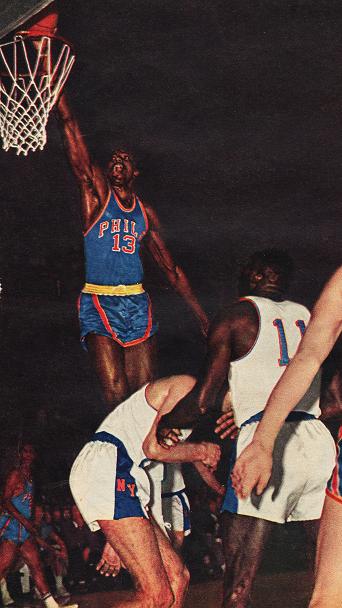
Wilt Chamberlain
Every serious basketball fan has an opinion about Wilt Chamberlain. Either he is the greatest basketball player who ever lived, or he was vastly overrated and couldn't win when it mattered. The truth is somewhere between the two, and I'll explain why.
First of all, when it comes to regular season dominance, Wilt Chamberlain is the best player to ever set foot on a basketball court. Most people know about his 100-point game, but just one year earlier he also grabbed 55 rebounds in a game, which is still a record. But let's start back at the beginning.
When Wilt entered the NBA in 1959, he broke his first record before playing a game when he signed the richest contract in history, making $30,000 during his rookie season. That season turned out to be the most dominant rookie season ever in any sport, as he set new records for scoring and rebounding and won the All-Star MVP, regular season MVP, and Rookie of the Year awards. He also took a Warriors team that had missed the playoffs the previous year all the way to the Conference Finals, where they lost to the Boston Celtics, which would be a recurring theme throughout his career.
Two years later he had the most dominant season in history, even by today's standards. That year he averaged 50.4 points, 25.7 rebounds, and 2.4 assists while playing 48.5 minutes per game. That season represents two records which will never be broken, and his rebounding record (27.2 per game) from the previous season is just as unreachable today. The fact that games have only 48 minutes make his minutes record the most solid record in sports, and it was reached by playing all but a handful of minutes during the season and having several games go into overtime.
The scoring record is also pretty impressive. During that season he reached 50 points 45 times, which is more than any other player has done it in an entire career. Michael Jordan had 37 50-point outings for second on the all-time list, but he's far behind Wilt's 122. His 100-point game is also interesting, since he could have scored more, but the game ended immediately after he scored his final basket and the fans rushed the court. The game was such a blowout that the referees decided to call off the final minute.
Throughout the process of unveiling these rankings, I have made a point of mentioning that the pace of the game was much faster in the 1960's, which caused statistics to balloon out of proportion. In 1962 alone, Wilt averaged 50 points, Oscar Robertson averaged a triple-double, and Elgin Baylor had the highest scoring season ever by anyone not named Wilt. In order to bring these numbers into perspective, I've adjusted them to the pace of today's game, and in most cases it makes those seasons become just very good, but Wilt's 1962 season still stands the test of time. Here are what his averages look like adjusted for inflation:
Chamberlain (1962) adjusted - 40.3 pts, 15.2 reb, 2.1 ast
Even adjusted, Wilt's 1962 season stands alone as the greatest season ever in the NBA. Through the 1960's, he was the best player in every single season, even if he only won 4 MVP awards. So how can a player who was the best in the league for 10 seasons (a record, by the way) not be the best player of all time? The answer lies in the other argument I mentioned in the opening paragraph, that Wilt was not a winner.
While Wilt was the best regular season player of all time, he had the misfortune of running into the best playoff player of all time 8 times in one decade, that man being Bill Russell. In those 8 seasons, the Celtics beat Wilt's teams 7 times, each time in the Conference Finals or the Finals, with Wilt and the 76ers triumphing once, in 1967. With the help of Jerry West, he was able to win a second championship in 1972.
The persistent rumor that Wilt's teams did not win was slightly overblown. In 14 seasons, his teams won two championships, reached 6 NBA Finals, and played in the Conference Finals 12 times. If Boston and Philadelphia had been in different conferences, it's likely he would have played in the Finals at least 10 times. Even in his final season, he was still a great player, averaging a league-leading 18.6 rebounds per game and setting a league record with a 72.7% field goal percentage at age 36.
Wilt had most of the factors that lead to a high ranking on this list. He was a great offensive player. He was a great defensive player. He was a great player in the regular season. He had the longevity that is needed for greatness. What he lacked, and what ultimately kept him from the #1 spot was that greatness in the playoffs, where he was good but not great. Every player I've chronicled so far is lacking at least somewhat in one of those areas, but in my next post you'll see the one player who can be considered great in every one of those areas.

Kareem's numbers throughout the early part of his career were pretty incredible, but they look pretty average when compared to those of Wilt's first decade. Kareem may have won more championships, although half of those had more to do with Magic than Kareem, and Kareem didn't dominate a decade the way Wilt did the 1960's, although he is one of only two players to come close. It seems pretty clear to me that Wilt was the better overall player.
Monday, June 11, 2012
NBA Finals Preview
The waiting game is over. Only two teams remain. Miami, eager to make up for last season's disappointment in the Finals, closed out the Eastern Conference Finals with two huge wins over the Boston Celtics. Oklahoma City, a team that has been on the rise for years, came back from a 2-0 deficit and ended San Antonio's 20-game winning streak with four straight wins to advance to their first Finals since the move to the Midwest. It's shaping up to be a very fun and competitive Finals.
Oklahoma City is entering the NBA Finals with three days more rest than the Miami Heat, thanks to their ability to close out their series a game earlier than their new opponent. But how much does rest really matter? In the history of the NBA, 61 teams have entered the Finals with at least a day more rest than their opponent, and those teams have a record of 34-27, for a winning percentage of .557. It's not a huge advantage, but it has been becoming more important in recent years, so that gives a slight advantage to OKC.
There is also a great individual matchup going on in this year's Finals. For only the 6th time in history, the league's MVP is going up against the league's scoring leader for the championship trophy. In the previous 5 matchups, the scoring leaders have a 3-2 advantage, but all three of those victories belong to Michael Jordan, when they beat LA in 1991, Phoenix in 1993, and Utah in 1997. In each of those seasons Jordan probably should have been the MVP, so maybe they shouldn't really count. I would say that the advantage here goes to Miami.
The biggest factor in the series may be home court advantage. In NBA Finals history, the team with home court advantage has won 47 out of 65 series, for a winning percentage of .723. Add to that the fact that Oklahoma City is undefeated on its home court in this season's playoffs, and all they need to do is win those four games and the title is theirs. Big advantage to the Oklahoma City Thunder.
Overall, I put the odds of the Thunder winning the series at 55.8%, and my Finals pick is Oklahoma City in 7 games.
Oklahoma City is entering the NBA Finals with three days more rest than the Miami Heat, thanks to their ability to close out their series a game earlier than their new opponent. But how much does rest really matter? In the history of the NBA, 61 teams have entered the Finals with at least a day more rest than their opponent, and those teams have a record of 34-27, for a winning percentage of .557. It's not a huge advantage, but it has been becoming more important in recent years, so that gives a slight advantage to OKC.
There is also a great individual matchup going on in this year's Finals. For only the 6th time in history, the league's MVP is going up against the league's scoring leader for the championship trophy. In the previous 5 matchups, the scoring leaders have a 3-2 advantage, but all three of those victories belong to Michael Jordan, when they beat LA in 1991, Phoenix in 1993, and Utah in 1997. In each of those seasons Jordan probably should have been the MVP, so maybe they shouldn't really count. I would say that the advantage here goes to Miami.
The biggest factor in the series may be home court advantage. In NBA Finals history, the team with home court advantage has won 47 out of 65 series, for a winning percentage of .723. Add to that the fact that Oklahoma City is undefeated on its home court in this season's playoffs, and all they need to do is win those four games and the title is theirs. Big advantage to the Oklahoma City Thunder.
Overall, I put the odds of the Thunder winning the series at 55.8%, and my Finals pick is Oklahoma City in 7 games.
Friday, June 8, 2012
Top 100 NBA Players: #3

Kareem Abdul-Jabbar
Kareem Abdul-Jabbar dominated the 1970's in a way no decade has been dominated before or since, then adjusted to his role as sidekick to another superstar better than any other player in history, which allowed him to finish his career with 6 championships and 10 NBA Finals appearances.
There was no doubt that Kareem (then Lew Alcindor) would be the top pick in the 1969 NBA Draft, after he led UCLA to an 88-2 record in 3 seasons and 3 straight NCAA championships, where he was named the Most Outstanding Player each time. He easily won the Rookie of the Year trophy, and should have been given the MVP as well, but it was awarded to Willis Reed, who led the New York Knicks to the league's best record and their first championship that season. Here are how their numbers stacked up that year:
Alcindor - 28.8 pts, 14.5 reb, 4.1 ast, .518 FG%, .653 FT%
Reed - 21.7 pts, 13.9 reb, 2.0 ast, .507 FG%, .756 FT%
Although Reed may have led his team to a few more wins (Milwaukee had the second-best record), it's very easy to see that Kareem had the bigger impact, leading a team in its second year of existence to the league's second-best record and a trip to the Conference Finals. In fact, from 1969-1980, a span of 11 seasons, Kareem was the best player 8 times, with the only exceptions coming in two seasons in which he missed time with a broken hand and one season in which George Gervin was on top of his game. He holds the record for most MVP's won, with 6, but I believe he should have been awarded 8.
Even with how great he was for so long, he was only able to make it to 3 NBA Finals during his time as team leader, winning twice. There were even two seasons right during his peak seasons in which his teams missed the playoffs completely, which no other top 10 player can say. That all changed in 1981, when Magic Johnson became the center of the Lakers' offense and Kareem became their #2 star.
In the final 8 seasons of Kareem's career in Los Angeles, the Lakers made it to the Finals 7 times, and Kareem was a major contributor for most of those teams, although by the time he retired he was not near the player he had once been, posting just 10 points per game along with fewer than 5 rebounds.
Kareem is the NBA's all-time leader in All-Star appearances, MVP awards, points scored, and minutes played, and he is also one of only 3 players in history to win the scoring title, MVP, and Finals MVP in the same season, along with Michael Jordan and Shaquille O'Neal. That season was 1971, just his second season as a pro, when he averaged 31.7 points and 16.0 rebounds, took 133 out of 153 MVP votes, then led Milwaukee to the title by winning 12 of 14 in the playoffs and sweeping the Baltimore Bullets in the Finals. He was the first to do it, and it wouldn't happen again for 20 years, when Jordan won his first title.

In terms of longevity, Kareem and Karl Malone are basically even. When you look at playoff success, the edge goes to Abdul-Jabbar, who won a couple of titles as the star player and several more playing with Magic as the star. When looking at regular season dominance, there is no doubt that Kareem was better, as he was the best player 8 times, while Malone spent nearly as long as the league's #2 player. Overall, it's easy to see that Kareem was the better player, and deserves the #3 spot among the all-time greats.
Thursday, May 31, 2012
Top 100 NBA Players: #4
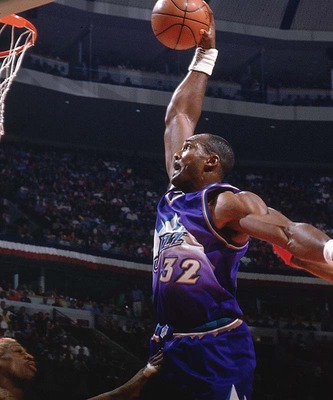
Karl Malone
How can a player who never won a championship be ranked at #4, ahead of many of the greatest champions of all time? By being consistently among the best players in the league for a longer period than any other player in history, with the possible exception of Kareem Abdul-Jabbar, that's how.
Karl Malone was never the best player in the NBA for any single season, but he spent a longer period of time as the second-best player in the league than anyone else, and he led his team to the playoffs in each of his 19 seasons, making 3 appearances in the Finals and 3 more in the Conference Finals.
Malone was awarded two MVP awards during his career, but neither one was deserved. He won the first because voters were tired of picking one superstar, and he won the other because they weren't ready to recognize a new superstar yet. The first came in 1997, when he somehow beat out Michael Jordan to win the league's top individual award, but the numbers tell a different story:
Malone - 27.4 pts, 9.9 reb, 4.5 ast, 1.4 stl, .550 FG%, .755 FT%
Jordan - 29.6 pts, 5.9 reb, 4.3 ast, 1.7 stl, .486 FG%, .833 FT%
The two players each beat the other in 3 of these categories, which puts them pretty close to each other, but the Bulls won 5 more games than the Jazz that season, picking up 69 wins in all, tying the second-best record of all time, behind only their 72-10 record from the previous season, when Jordan took 109 out of 113 first-place votes for MVP.
Two years later, Malone was awarded his second MVP, but I feel that the voters weren't ready to hand the award to second-year player Tim Duncan, who had been nearly as good offensively and much better defensively than Malone, even with both teams finishing with identical records. I broke down the statistics on this one when I introduced Tim Duncan back at #9, if you want to look at it in more detail.
All of this would seem to drag Malone down a couple of spots, but there are also several very impressive aspects of Malone's career. Consider that he is one of only 2 players ever to average over 20 points per game for 17 straight seasons, along with Kareem, and he is also #2 all time in points scored, to Kareem as well. He never led the league in any major statistical category, but he was always among the league leaders in points and rebounds.
The fact that he played 19 seasons is pretty impressive in itself, and the fact that he made the playoffs in each of those seasons is more impressive still, but when you consider that he was not just playing, but playing at an All-Star level clear up to the end, that is something that sets him apart. He is the oldest player ever to record a triple-double, doing it at age 40 during his final season, and is also the oldest player ever to score 50 points, doing it at age 36 in a playoff game. He is also the oldest player ever to start for an NBA Finals team, holding the power forward position for the Los Angeles Lakers in his final season, the only time in his career he wasn't the best player on his team.
Malone's run as the league's #2 man almost as impressive. He first cracked the league's top 5 in 1988, when he was just 24 years old, and remained there until he was 36 years old in the year 2000. He was definitely the second-best player in the league for each of Michael Jordan's final three seasons with the Bulls, and seemed poised to take over as the top player when Tim Duncan strode in and dominated the 1999 season. Then, when Duncan was hurt near the end of the 2000 season, it seemed once again that an opening had been created for Malone, but Shaq stepped in to fill the void instead, and Malone lost his final chance to be the league's alpha dog.
In addition to him playing at a high level for so many years, he also rarely missed a game. Until his final season, he never missed more than 2 games in a single season, and nearly half the games he missed up to that point were due to suspensions. He was given the nickname "the Mailman" because he always delivered, and even though he may have missed a couple of deliveries in the Finals, can you really fault him for not being able to beat Michael Jordan at his peak? Malone played at a higher level for a longer period of time than any other player in the history of the NBA, and that's why he's the #4 player of all time.

Malone may not have won the championships that Kobe has, but he spent 17 seasons as one of the league's premier players, while Kobe has only played 15 total season to this point. Malone never had the mid-career lull that Kobe did, instead making it at least to the Conference Finals 5 times in 7 seasons during his prime years. While Kobe will most likely pass Malone at some point, for now Malone's longevity has given him the edge over Bryant.
Sunday, May 27, 2012
NBA Playoff MVP Rankings - 27 May
The playoffs are halfway over, and only 4 teams remain, but there are plenty of players that have stood out at this point in the playoffs. These are the players that are most likely to win the Finals MVP award should their team win the title this year, with their playoff averages listed after their name.
Playoff Most Valuable Player
1. LeBron James - MIA - 29.0 pts, 8.7 reb, 5.9 ast, 2.5 stl, .493 FG%, .769 FT%
The regular season MVP has played even better in the playoffs, with the highlight coming in a must-win game 4 against Indiana, when the Heat were in danger of going down 3-1 in the series. LeBron was huge that night, finishing with 40 points, 18 rebounds, and 9 assists as Miami turned the series around and got themselves back on track for a return trip to the NBA Finals.
2. Kevin Durant - OKC - 26.7 pts, 8.1 reb, 3.4 ast, 1.1 blk, 1.3 stl, .488 FG%, .367 3P%, .836 FT%
Durant's scoring is a little bit down from the regular season, when he won his third straight scoring title, but he hasn't had to carry as big a load because of help from his teammates and somewhat weak competition so far. He'll have to turn it up in the next round if he wants to get past the Spurs, but if OKC advances to the title, Durant could become the new favorite to grab a Finals MVP.
3. Rajon Rondo - BOS - 15.3 pts, 6.7 reb, 12.3 ast, 2.7 stl, .455 FG%, .692 FT%
Rajon Rondo has become the leader of a team that includes 3 future Hall-of-Famers, and he showed it last night in game 7 against Philadelphia, when he scored 7 straight points to put the game out of reach and put the Celtics into the Conference Finals for the third time in five seasons. Even more impressive is the fact that he has now recorded 3 triple-doubles in this year's playoffs, and last night he became the second Celtic ever to record one in game 7, joining Larry Bird.
4. Russell Westbrook - OKC - 24.1 pts, 4.7 reb, 4.4 ast, 1.9 stl, .472 FG%, .815 FT%
Westbrook has been one Thunder player that has stepped up big in the playoffs, with his 37-point performance in game 4 against the Lakers a prime example. They needed every point he scored, since they won by only 3 points, and a loss would have left the series tied and guaranteed a return trip to Los Angeles, which they were happy to avoid.
5. Dwyane Wade - MIA - 23.8 pts, 4.5 reb, 3.6 ast, 1.3 blk, 2.0 stl, .486 FG%, .663 FT%
He may have put up a clunker in game 3 against the Pacers, scoring only 5 points on 2-13 shooting in 37 minutes, but he made up for it in a big way a week later in the deciding game 6, when he poured in 41 points and grabbed 10 rebounds, leading the Miami Heat back to the Eastern Conference Finals yet again, and keeping the argument open about which of the superstar teammates is the better player.
6. Tim Duncan - SAS - 17.6 pts, 9.0 reb, 2.9 ast, 1.9 blk, 1.0 stl, .540 FG%, .792 FT%
Maybe it's the extra rest he's gotten from sweeping through the first 2 rounds of the playoffs, but Tim Duncan has looked like the Tim Duncan of old rather than old Tim Duncan so far in the playoffs. Even when he had to play on consecutive nights because of scheduling issues at the Staples Center, Duncan put up 21 points to go along with 9 rebounds and 3 blocks as San Antonio closed out the Clippers and won their 18th straight game.
7. Kevin Garnett - BOS - 19.2 pts, 10.8 reb, 1.6 ast, 1.5 blk, 1.4 stl, .505 FG%, .811 FT%
Not sure what's going on with the old guys in this year's playoffs, but they look younger than ever, despite the compacted schedule that was supposed to wear them out. Garnett has recorded 9 double-doubles in 13 playoff games so far, which is the same number he recorded in the final 7 weeks of the regular season, which covered 31 games.
8. Paul Pierce - BOS - 19.3 pts, 6.9 reb, 3.5 ast, 1.0 blk, 1.5 stl, .417 FG%, .347 3P%, .913 FT%
Pierce has not been shooting particularly well from the field so far in the playoffs, but he has been automatic from the line, currently riding a streak of 30 straight free throws made that stretches clear back to game 3 against Philadelphia, and that can be a very important quality for your star player to have in close playoff games. Pierce is also hitting the boards harder in the playoffs, grabbing 1.7 more per game than he did in the regular season.
9. Tony Parker - SAS - 19.1 pts, 3.4 reb, 7.1 ast, 1.0 stl, .430 FG%, .810 FT%
Parker was definitely the Spurs' MVP during the regular season, but in the playoffs he's been kind of mediocre so far. He's getting the same numbers he did in the regular season, but he's shooting a lot more to get there. He shot only 36% in the Clippers series, including an abysmal 1-9 performance in game 1, but the Spurs have continued to win anyway.
10. James Harden - OKC - 17.0 pts, 5.0 reb, 3.1 ast, 2.0 stl, .419 FG%, .901 FT%
The Beard has been spectacular so far in the playoffs, showing everybody why he won the Sixth Man Award this season, and it never showed more than in game 4 against Dallas, when he scored 29 points as the Thunder finished off a sweep of the defending champions. 15 of those points came in the fourth quarter, as he led Oklahoma City back from a 13-point deficit to win by 6.
Playoff Predictions
In the second round I predicted all 4 series winners correctly, and I was within 1 game of getting all four of them exactly correct, making my total 10 of 12 correct so far with 9 of them within 1 game of my prediction.
Conference Finals
Spurs over Thunder in 5
Heat over Celtics in 5
NBA Finals
Spurs over Heat in 6
Playoff Most Valuable Player
1. LeBron James - MIA - 29.0 pts, 8.7 reb, 5.9 ast, 2.5 stl, .493 FG%, .769 FT%
The regular season MVP has played even better in the playoffs, with the highlight coming in a must-win game 4 against Indiana, when the Heat were in danger of going down 3-1 in the series. LeBron was huge that night, finishing with 40 points, 18 rebounds, and 9 assists as Miami turned the series around and got themselves back on track for a return trip to the NBA Finals.
2. Kevin Durant - OKC - 26.7 pts, 8.1 reb, 3.4 ast, 1.1 blk, 1.3 stl, .488 FG%, .367 3P%, .836 FT%
Durant's scoring is a little bit down from the regular season, when he won his third straight scoring title, but he hasn't had to carry as big a load because of help from his teammates and somewhat weak competition so far. He'll have to turn it up in the next round if he wants to get past the Spurs, but if OKC advances to the title, Durant could become the new favorite to grab a Finals MVP.
3. Rajon Rondo - BOS - 15.3 pts, 6.7 reb, 12.3 ast, 2.7 stl, .455 FG%, .692 FT%
Rajon Rondo has become the leader of a team that includes 3 future Hall-of-Famers, and he showed it last night in game 7 against Philadelphia, when he scored 7 straight points to put the game out of reach and put the Celtics into the Conference Finals for the third time in five seasons. Even more impressive is the fact that he has now recorded 3 triple-doubles in this year's playoffs, and last night he became the second Celtic ever to record one in game 7, joining Larry Bird.
4. Russell Westbrook - OKC - 24.1 pts, 4.7 reb, 4.4 ast, 1.9 stl, .472 FG%, .815 FT%
Westbrook has been one Thunder player that has stepped up big in the playoffs, with his 37-point performance in game 4 against the Lakers a prime example. They needed every point he scored, since they won by only 3 points, and a loss would have left the series tied and guaranteed a return trip to Los Angeles, which they were happy to avoid.
5. Dwyane Wade - MIA - 23.8 pts, 4.5 reb, 3.6 ast, 1.3 blk, 2.0 stl, .486 FG%, .663 FT%
He may have put up a clunker in game 3 against the Pacers, scoring only 5 points on 2-13 shooting in 37 minutes, but he made up for it in a big way a week later in the deciding game 6, when he poured in 41 points and grabbed 10 rebounds, leading the Miami Heat back to the Eastern Conference Finals yet again, and keeping the argument open about which of the superstar teammates is the better player.
6. Tim Duncan - SAS - 17.6 pts, 9.0 reb, 2.9 ast, 1.9 blk, 1.0 stl, .540 FG%, .792 FT%
Maybe it's the extra rest he's gotten from sweeping through the first 2 rounds of the playoffs, but Tim Duncan has looked like the Tim Duncan of old rather than old Tim Duncan so far in the playoffs. Even when he had to play on consecutive nights because of scheduling issues at the Staples Center, Duncan put up 21 points to go along with 9 rebounds and 3 blocks as San Antonio closed out the Clippers and won their 18th straight game.
7. Kevin Garnett - BOS - 19.2 pts, 10.8 reb, 1.6 ast, 1.5 blk, 1.4 stl, .505 FG%, .811 FT%
Not sure what's going on with the old guys in this year's playoffs, but they look younger than ever, despite the compacted schedule that was supposed to wear them out. Garnett has recorded 9 double-doubles in 13 playoff games so far, which is the same number he recorded in the final 7 weeks of the regular season, which covered 31 games.
8. Paul Pierce - BOS - 19.3 pts, 6.9 reb, 3.5 ast, 1.0 blk, 1.5 stl, .417 FG%, .347 3P%, .913 FT%
Pierce has not been shooting particularly well from the field so far in the playoffs, but he has been automatic from the line, currently riding a streak of 30 straight free throws made that stretches clear back to game 3 against Philadelphia, and that can be a very important quality for your star player to have in close playoff games. Pierce is also hitting the boards harder in the playoffs, grabbing 1.7 more per game than he did in the regular season.
9. Tony Parker - SAS - 19.1 pts, 3.4 reb, 7.1 ast, 1.0 stl, .430 FG%, .810 FT%
Parker was definitely the Spurs' MVP during the regular season, but in the playoffs he's been kind of mediocre so far. He's getting the same numbers he did in the regular season, but he's shooting a lot more to get there. He shot only 36% in the Clippers series, including an abysmal 1-9 performance in game 1, but the Spurs have continued to win anyway.
10. James Harden - OKC - 17.0 pts, 5.0 reb, 3.1 ast, 2.0 stl, .419 FG%, .901 FT%
The Beard has been spectacular so far in the playoffs, showing everybody why he won the Sixth Man Award this season, and it never showed more than in game 4 against Dallas, when he scored 29 points as the Thunder finished off a sweep of the defending champions. 15 of those points came in the fourth quarter, as he led Oklahoma City back from a 13-point deficit to win by 6.
Playoff Predictions
In the second round I predicted all 4 series winners correctly, and I was within 1 game of getting all four of them exactly correct, making my total 10 of 12 correct so far with 9 of them within 1 game of my prediction.
Conference Finals
Spurs over Thunder in 5
Heat over Celtics in 5
NBA Finals
Spurs over Heat in 6
Subscribe to:
Posts (Atom)