Friday, September 9, 2011

Top 100 NBA Players: #31


Rick Barry

(Kalb: #22, Simmons: #26, BBR: #46)

Rick Barry is today most remembered for his unique style of free throw shooting, but he was one of the best players in the NBA for many years, and if he hadn't jumped to the ABA for five years, he could have been one of the 10 best players in NBA history.

Barry started out his career with the San Francisco Warriors, where he won the Rookie of the Year award after averaging 25.7 points and 10.6 rebounds per game at only 21 years of age. The next season he was even better, putting up one of the best seasons in history for a non-MVP. Here are his stats from that year, along with those of Wilt Chamberlain, who was the MVP that season:

Barry - 35.6 pts, 9.2 reb, 3.6 ast, .451 FG%, .884 FT%
Chamberlain - 24.1 pts, 24.2 reb, 7.8 ast, .683 FG%, .441 FT%

You can see that Wilt was the better player that season and deserved the MVP, since he led the league in rebounding, minutes played, and field goal percentage, while Barry only led the league in scoring. The two players led their respective teams to the Finals, where Wilt and the 76ers beat Barry and the Warriors in six games, proving that the MVP was awarded properly.

After that season, Barry had a disagreement with the Warriors over incentive bonuses, so he left to sign a contract with the Oakland Oaks of the ABA. Barry was not allowed to play the next season because of a clause in his Warriors contract, but when he made it to the league he was pretty good, although not as good as in his NBA days. After four seasons, a judge ruled that Barry's original contract with San Francisco was still binding, and that he could not play for anyone else, so he went back to the Golden State Warriors, who had changed their name in his absence.

He had an immediate impact upon his return, leading Golden State to the Western Conference Finals and leading the league in free throw percentage, but he was still building up to his second career peak in 1975, when he started to look like the Barry of old at age 30, once again establishing himself as the #2 player in the league, although this time he ranked behind Bob McAdoo, who rightfully won the MVP. Here are their stats from that year:

Barry - 30.6 pts, 5.7 reb, 6.2 ast, 2.9 stl, .464 FG%, .904 FT%
McAdoo - 34.5 pts, 14.1 reb, 2.2 ast, 2.1 blk, .512 FG%, .805 FT%

Barry was the league leader in steals and free throw percentage, while McAdoo led in scoring, but McAdoo's awesome rebounding average and field goal percentage were the big reason he was a better player that year, and it helped that he was 7 years younger. Barry had the last laugh in the playoffs, however, as McAdoo's Braves lost in the first round, while Barry and the Warriors swept the highly-favored Bullets in the Finals for the franchise's third championship and first in California.

Barry was named the MVP of the Finals, and although he wasn't as good as in the regular season, there was no other choice for this award. The second best player on that team was probably Jamaal Wilkes, who was a rookie, and here is a comparison of their playoff stats from 1975:

Barry - 28.2 pts, 5.5 reb, 6.1 ast, 2.9 stl, .444 FG%, .918 FT%
Wilkes - 15.0 pts, 7.0 reb, 1.6 ast, 1.5 stl, .446 FG%, .702 FT%

There was definitely no disputing why the Warriors won the title. This was one of the few teams to ever win a title without two verifiable star players, so that title has a lot of weight in Barry's placement among the all-time greats. By giving up 5 years during what should have been the prime of his career, he hurt his standing greatly, but he was still one of the best of all time with just ten seasons on the court.


You can see that Barry's missing years occurred right during Iverson's peak years, and there's no doubt it would have been the same for Barry, but immediately before and after his disappearance, he put up seasons that Iverson would have killed to have (literally). Barry's championship also helped him immensely, since Iverson's lone trip to the Finals ended in defeat, so Barry has to be recognized as the better player overall.

Thursday, September 8, 2011

Top 100 NBA Players: #32


Allen Iverson

(Kalb: #33, Simmons: #29, BBR: #37)

Allen Iverson was an incredibly talented player, the shortest man ever to win the scoring title, which he did four times, and a player who fell just as quickly as he rose to prominence. Other than his shooting percentage, he was a very solid all-around player.

As I said above, Iverson won 4 scoring titles, in 1999, 2001, 2002, and 2005, all with the Philadelphia 76ers. He had his highest scoring season in 2006, when he put up 33 per game, but that year he was beaten out by Kobe's 35.4 per game, one of the highest averages in history. Iverson's signature season was the second season in which he was the scoring leader, and his stats from that year's regular season and playoffs are listed below:

Iverson (Regular) - 31.1 pts, 3.8 reb, 4.6 ast, 2.5 stl, .420 FG%, .320 3P%, .814 FT%, 42.0 min
Iverson (Playoffs) - 32.9 pts, 4.7 reb, 6.1 ast, 2.4 stl, .389 FG%, .338 3P%, .774 FT%, 46.2 min

Iverson was everything to the Sixers that season, and led the league in steals as well as scoring. He also led Philadelphia to the NBA Finals, where they lost to the Lakers, but he played nearly every minute during the postseason and found a way to increase his already impressive averages. It may have been the only time that he saw any sort of playoffs success, but it was a season for the ages.

Iverson led the league in minutes per game 7 times, scoring 4 times, and steals 3 times, and in each of his first 12 seasons averaged at least 22 points, 3 rebounds, 4.6 assists, 1.9 steals, and 39.4 minutes played. Those numbers alone are pretty impressive, but those were the minimum numbers he reached in 12 seasons.

One of Iverson's biggest struggles was clashing with his coaches over attitude problems. He is infamous for his distaste of practice, and his feud with Larry Brown was very well chronicled. The 76ers actually traded him during the 2000 offseason, but because of a problem with another player's contract, the deal was cancelled, and Iverson went on to lead the team to the Finals. He finally wore out his welcome in Philly in 2006, then in Denver, Detroit and Memphis over the next three years, before finally disappearing for good one year ago.


Iverson and Pierce were pretty even during their playing careers, with Iverson being a little more up-and-down than the more consistent Pierce. Pierce was the #2 player on two Finalists, while Iverson was the best on one, so that comparison is a wash. The real reason that Iverson takes this spot over Pierce is that he was better in 7 of his first 13 seasons than Pierce, but Pierce is looking like a pretty good pick to be better than Iverson in his 14th year, so this ranking is likely to change by next summer.

Wednesday, September 7, 2011

Football Predictions - 8-12 Sep

The first weekend of college football is gone, and the opening weekend is coming up for the NFL, so I'm giving you my picks for every one of this weekend's NFL games and all of the college games involving ranked teams (or teams that should be ranked). Last week I got 89% correct on college football. Will I match that this week? Check back to find out. Predicted winner is listed after each matchup, and upset picks are in italics.

Thursday

Arizona at (9) Oklahoma State - Cowboys

New Orleans at Green Bay - Packers

Friday

(21) Missouri at Arizona State - Sun Devils

Saturday

Florida Atlantic at (17) Michigan State - Spartans
Toledo at (15) Ohio State - Buckeyes
Oregon State at (8) Wisconsin - Badgers
(16) Mississippi State at Auburn - Bulldogs
Norfolk State at (19) West Virginia - Mountaineers
Eastern Illinois at Northwestern - Wildcats
New Mexico State at Minnesota - Golden Gophers
(6) Stanford at Duke - Cardinal
(11) Virginia Tech at East Carolina - Hokies
North Carolina State at Wake Forest - Wolfpack
(3) Alabama at (23) Penn State - Crimson Tide
Wofford at Clemson - Tigers
(25) TCU at Air Force - Falcons
Nevada at (13) Oregon - Ducks
(12) South Carolina at Georgia - Gamecocks
Charleston Southern at (5) Florida State - Seminoles
New Mexico at (14) Arkansas - Razorbacks
Alabama-Birmingham at (18) Florida - Gators
Ball State at (22) South Florida - Bulls
Fresno State at (10) Nebraska - Cornhuskers
Brigham Young at (24) Texas - Cougars
Northwestern State at (2) Louisiana State - Tigers

Sunday

Atlanta at Chicago - Bears
Buffalo at Kansas City - Chiefs
Cincinnati at Cleveland - Browns
Detroit at Tampa Bay - Buccaneers
Tennessee at Jacksonville - Titans
Indianapolis at Houston - Colts
Philadelphia at Saint Louis - Eagles
Pittsburgh at Baltimore - Ravens
Minnesota at San Diego - Chargers
NY Giants at Washington - Giants
Carolina at Arizona - Cardinals
Seattle at San Francisco - 49ers
Dallas at NY Jets - Jets

Monday

New England at Miami - Patriots
Oakland at Denver - Raiders

Tuesday, September 6, 2011

College Football Rankings - 6 Sep

One week is down in the current college football season, and while there were a lot of blowouts, there were also quite a few surprises. Six teams left my rankings, so there are also six new teams, joining the other 19, including a few that lost their opening games. Mississippi State and LSU were the big winners of the opening weekend, both playing much better than expected, one over a top-ranked team, and one over a nobody. Games against teams that are not part of the FBS do not help improve a team's ranking. Each team's current rankings is followed by last week's ranking, the team name, overall record, and current AP rank.

TW - LW - TEAM - RECORD - AP
1. (1) Stanford (1-0) (6)
2. (3) Boise State (1-0) (4)
3. (16) Mississippi State (1-0) (16)
4. (11) Louisiana State (1-0) (2)
5. (7) Oklahoma (1-0) (1)
6. (5) Alabama (1-0) (3)
7. (4) Arizona State (1-0) (26)
8. (8) South Carolina (1-0) (12)
9. (9) Arkansas (1-0) (14)
10. (21) Texas A&M (1-0) (7)
11. (NR) South Florida (1-0) (22)
12. (6) Florida State (1-0) (5)
13. (12) North Carolina State (1-0)  (41)
14. (13) Florida (1-0) (18)
15. (2) Oregon (0-1) (13)
16. (15) Arizona (1-0) (44)
17. (22) Ohio State (1-0) (15)
18. (14) Wisconsin (1-0) (8)
19. (18) Virginia Tech (1-0) (11)
20. (19) Nebraska (1-0) (10)
21. (NR) Minnesota (0-1) (NR)
22. (NR) TCU (0-1) (25)
23. (NR) Northwestern (1-0) (30)
24. (NR) Clemson (1-0) (47)
25. (NR) Miami (0-1) (NR)

Dropping out:

(24) Northern Illinois (1-0) (44)
(10) Oklahoma State (1-0) (9)
(25) Missouri (1-0) (21)
(17) USC (1-0) (28)
(23) Notre Dame (0-1) (36)
(20) Auburn (1-0) (27)

Ranked Teams by Conference:

SEC - 6
ACC - 5
Big 10 - 5
Pac 10 - 4
MWC - 2
Big 12 - 2
Big East - 1

Stanford tore up San Jose State in the season opener, outscoring them 57-3, but each of those points was absolutely necessary due to the huge talent gap between the two schools. If just one of those touchdowns had been taken away, I'm not sure you could make a case for them to remain #1, so they did what was necessary.

Boise State went into Atlanta and took down the Georgia Bulldogs, who were not ranked in my initial rankings, but were sitting just outside at #26 and playing a virtual home game. The Broncos did the same thing they've done for the past few seasons, beat a very strong team from a power conference on the road to make a statement, although we'll have to see if it's enough to impress the computers by season's end.

LSU's win over Oregon was double impressive, because the game was played at a neutral site, and Oregon only lost once last season, in the National Championship Game to Auburn. The Ducks are not accustomed to losing, but the Tigers ran all over them, and the game wasn't as close as the score looked.

South Florida pulled one of the biggest upsets of the weekend when they took out Notre Dame in South Bend after a game that took most of the day due to weather delays. The Bulls are coached by Skip Holtz, who is the son of former Notre Dame coach Lou Holtz and a former Irish player also, so the upset was especially sweet for him.

Minnesota vaulted into the rankings despite losing its opening game, because they nearly beat a ranked USC team on the road, with the outcome in doubt until the final 40 seconds. The fact that they were in Los Angeles and not expected to perform well made that performance a virtual victory for the Gophers, who took USC's place in my rankings.

Prediction Results - 1-4 Sep

College Football: 24-3 (.889)

Monday, September 5, 2011

Top 100 NBA Players: #33


Paul Pierce

(Simmons: #54, BBR: #43)

Paul Pierce is best known today as a member of Boston's "Big Three," the three superstars that were brought together in 2007 and brought a championship to Boston in 2008, and he's also known as the one chosen from among those three to win the Finals MVP Award that season, which leads many to believe that before the arrival of Garnett and Allen that Pierce and the Celtics couldn't win, but that isn't exactly true.

Pierce hit his peak as a player from 2001-2003, back when Antoine Walker was also playing in Boston, and the Celtics were actually a pretty good team. They won playoff series in both of those seasons, and even reached the Eastern Conference Finals in 2002, with Pierce as the team leader. Here are his combined stats from those two seasons:

Pierce - 26.0 pts, 7.1 reb, 3.8 ast, 1.8 stl, 0.9 blk, .429 FG%, .360 3P%, .805 FT%

Other than the field goal percentage, which was pretty low even for a guard, Pierce was great all-around. He has managed to improve his shooting over the course of the past 8 seasons, and he has kept most of the other numbers relatively close to that level.

He remained one of the better players in the league for the next few seasons, but the Celtics started to slide, so they picked up a couple of stars to help share the load, and the result was their first title in two decades. Pierce was named the MVP of the Finals, but Kevin Garnett should have won it, as the numbers from that year's playoffs show:

Garnett - 20.4 pts, 10.5 reb, 3.3 ast, 1.3 stl, 1.1 blk, .495 FG%, .810 FT%
Pierce - 19.7 pts, 5.0 reb, 4.6 ast, 1.1 stl, 0.3 blk, .441 FG%, .802 FT%

A quick glance at those numbers shows that Garnett was by far the better player, performing better in every key category but one, assists, and that one was pretty close. I believe the reason Pierce won was his "comeback" from a "major injury" in game 1, which exhibited worse acting than a lot of reality shows. He couldn't even get up and walk off the court, but just minutes later he was back and scored 15 points in the third quarter to lead them to victory.

In 2010 Boston made another trip to the Finals, and people once again talked as if Pierce was the star of that team and the driving force behind it, but I showed earlier in my article about Rajon Rondo (#84) that the star power of the team had shifted to the point guard position. That's not to say the Pierce wasn't important on those Finals teams, because any team needs at least two stars to get to the Finals in today's league, and Pierce was one of them on both of those teams.


Pierce has a couple of real advantages over Gervin, the first being his ability to win in the playoffs, which Gervin didn't have, and the other being his longevity, which escaped the Spurs superstar, who left the NBA in his early 30's. Pierce was never the best player in the league, but he did make the top 5 in his fourth season, and he's remained a star in all but one of his seasons since, even playing at an All-Star level this season, at an age when Gervin was already gone.

Thursday, September 1, 2011

Top 100 NBA Players: #34


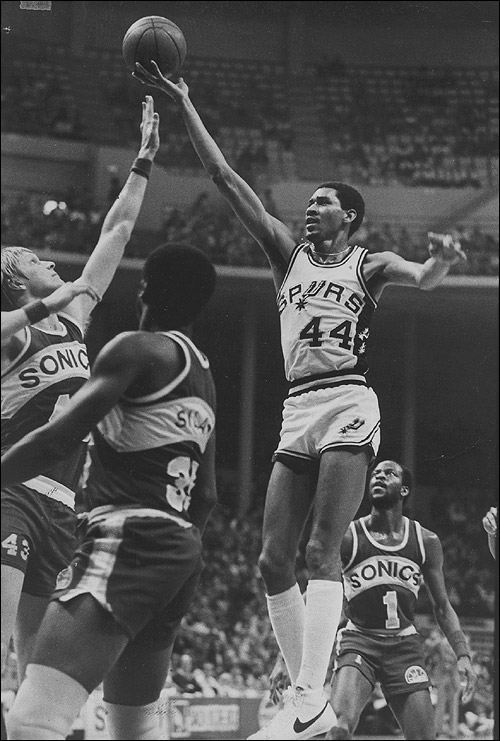
George Gervin

(Kalb: #26, Simmons: #34, BBR: #41)

George Gervin was an amazing scorer and a big star for a number of years, but more than anyone else who reached this high on the list, he was not a winner. He was known for being somewhat selfish, but it doesn't diminish how great he was offensively.

Gervin was a four time scoring leader, and is one of 6 players all-time to win three straight scoring titles. In 1980 he averaged 33.1 points per game, and he eclipsed 30 points again 2 years later, when he again led the league with 32.3 nightly. He was twice the MVP runner-up, in 1978 and 1979, but he probably should have won in 1979, when it was given to Moses Malone. Here are how their numbers stacked up that season:

Malone - 24.8 pts, 17.6 reb, 1.8 ast, 1.5 blk, .540 FG%, .739 FT%
Gervin - 29.6 pts, 5.0 reb, 2.7 ast, 1.1 blk, .541 FG%, .826 FT%

Moses led the league in rebounding that year, and Gervin in scoring, so both were obvious choices. In the other four categories, Gervin was obviously the better player, especially if you know that Gervin was a shooting guard and Malone was a center, because Gervin shot a higher percentage than the MVP that year, and blocked nearly as many shots.

Gervin was the best player on his team for nearly his entire career, but he never saw much playoff success in that role. His best finish was losing in the Conference Finals three times, making him the best player to never play in the NBA Finals, joining Dominique Wilkins, Steve Nash, Alex English, Vince Carter, and Tracy McGrady on that dubious list.

For six straight seasons, Gervin was one of the top 3 players in the NBA, but because of his playoff failings he is usually not considered to be on the same level as those who were at his level during those years, including Moses Malone, Magic Johnson, and Kareem Abdul-Jabbar. His averages over that time were spectacular, and they are listed below:

Gervin (1977-1983) - 29.2 pts, 5.0 reb, 3.0 ast, 1.3 stl, .514 FG%, .834 FT%

Gervin had the disadvantage of never having a true star for a teammate. As the only star in San Antonio for a long time, he did get them to the playoffs in every season of his career, even though he couldn't get them through to the Finals. His career was still very impressive, even though it only lasted for 10 NBA seasons.


Payton may have been the better defensive player by far, but Gervin's offensive prowess was so great that there is no doubt he was better than Payton. Gervin's first 7 NBA seasons were all at least as good as Payton's best season, so even though Payton lasted much longer, Gervin got much higher. While Gervin was not a great playoff player, Payton's overall playoff success wasn't much better, so Gervin is definitely higher up on the list.

College Football Predictions - 1-4 Sep

These are my predictions for the winner's of each of this weekend's games that involve either a team ranked in the USA Today top 25 or my personal top 25. Last season my winning percentage was around 70%, so let's see if I can match that this season. Predicted winner is underlined.

Thursday

UC-Davis at Arizona State
(20) Mississippi State at Memphis
UNLV at (11) Wisconsin

Friday

Youngstown State at (17) Michigan State
(14) TCU at Baylor

Saturday

Tulsa at (1) Oklahoma
Kent State at (2) Alabama
(3) Oregon vs. (4) LSU
(5) Boise State at (19) Georgia
Louisiana-Monroe at (6) Florida State
San Jose State at (7) Stanford
Louisiana-Lafayette at (9) Oklahoma State
Chattanooga at (10) Nebraska
East Carolina vs. (12) South Carolina
Appalachian State at (13) Virginia Tech
Missouri State at (15) Arkansas
South Florida at (16) Notre Dame
Akron at (18) Ohio State
Miami-Ohio at (21) Missouri
Florida Atlantic at (22) Florida
Utah State at (23) Auburn
Minnesota at (25) USC
Liberty at North Carolina State
Army at Northern Illinois
Northern Arizona at Arizona

Sunday

Marshall at (24) West Virginia
SMU at (8) Texas A&M

No upset picks this week, because very few teams are playing opponents that even have a chance. Check back Monday to see how I did.