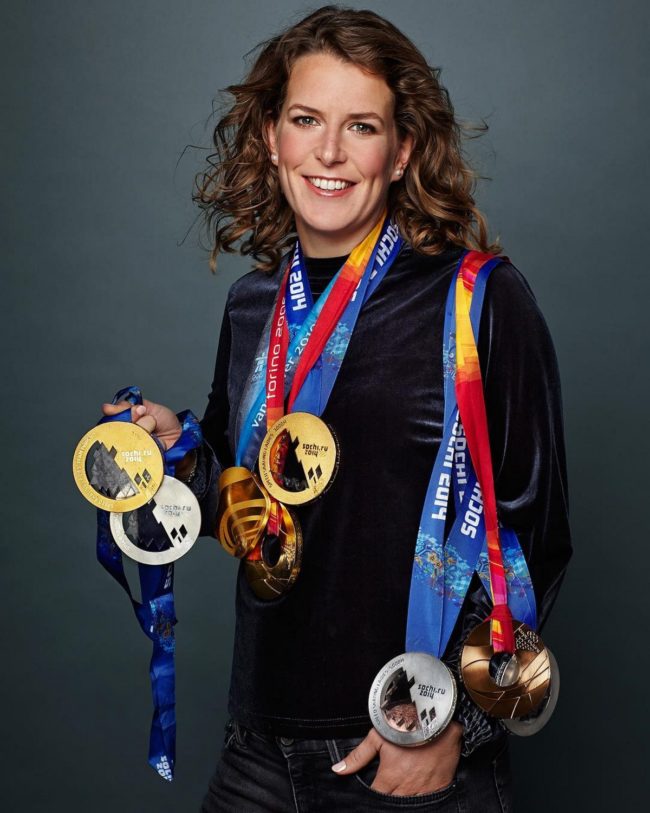
Marit Bjorgen
Norway
Cross Country Skiing
Overall Ranks
#4 among Norwegian Olympians
#3 among Cross Country Skiers
#2 among Norwegian Cross Country Skiers
#1 among Female Norwegian Olympians
Olympic Results
2002
Relay - Silver
2006
10 km - Silver
2010
Sprint - Gold
10 km - Bronze
30 km - Silver
Skiathlon - Gold
Relay - Gold
2014
30 km - Gold
Skiathlon - Gold
Team Sprint - Gold
2018
10 km - Bronze
30 km - Gold
Skiathlon - Silver
Relay - Gold
Team Sprint - Bronze
Total
Events - 24
Gold - 8
Silver - 4
Bronze - 3
Marit Bjorgen was born on March 21, 1980 in Trondheim, Norway, and though her Olympic career started slowly, by the time she retired she was undoubtedly one of the all-time greats. She made her first Olympic team in 2002, when she was 21 years old, competing in Salt Lake City.
Her first Olympic event was the 15 km race, where she finished in 50th place, more than 7 minutes behind the gold medalist. She then took the first leg for Norway in the relay, where they were expected to win due to Russia losing a couple of their best skiers to doping. Bjorgen had Norway in 4th place after her leg, 14 seconds behind Germany, but the next skier took the lead back late in her leg, and they held it until the final 100 meters, when the final German skier shot ahead and took the gold, leaving Norway to take silver after losing by 1.3 seconds.
She also competed in the 30km, where she finished in 14 place, just over 6 minutes behind the official champion, but nearly 8 minutes behind the original champion, who lost her medal to doping. In 2003, she broke through at the World Championship, winning gold in the sprint, then followed that up with 3 golds, a silver, and a bronze in 2005.
Expectations were high for Bjorgen heading to Turin, but she got bronchitis the week before the games, and it affected her performance. She withdrew halfway through her first event, the skiathlon, where she was a pre-race favorite. In the team sprint, the Canadian skier snapped a pole early in the final, and the Norwegian coach gave her a new one, enabling her to stay with the leaders. Norway never took the lead, but remained close for most of the race, eventually finishing in 4th. Many were angry at the coach for helping an opponent, but the Canadians, who finished 2nd, were very grateful.
She was the favorite in the 10km race, but Sara Renner of Canada led most of the race, until she dropped off in the final quarter of the race. At that point, Kristina Smigun of Estonia took the lead, and she pulled away from the pack to win easily. Bjorgen had her best finish of the Olympics though, outskiing the rest of the pack to come in second and earn a silver medal.
In the relay, Bjorgen was assigned to the anchor leg, and they were one of the favorites. They stayed near the front for the entire race, and Bjorgen was in 2nd place when she took off for her leg, but she didn't ski well, and the team dropped to 5th and out of the medals. She failed to advance out of the quarterfinal round in the sprint, and left Turin before the 30km, which would have been her final event.
She didn't perform well in the next two world championships, but returned for the 2010 Olympics, where she would finally perform up to her potential. She started out in the 10km race, where she was able to finished in 3rd place, earning a bronze medal to open the games.
Her second event was the sprint, and she was the fastest qualifier this time, then went on to win both of her heats to advance easily to the final. In the final, Justyna Kowalczyk of Poland kept it close for a while, but in the final 300 meters, Bjorgen pulled away to win by over a second, and she finally had her first Olympic gold medal.
Next up was the 15 km skiathlon, and Bjorgen was able to stay with the lead pack for most of the race, which consisted of 7 skiers at the halfway point, when they switched out their skis. The lead pack was down to 4 by the final section of the race, when Bjorgen pulled away from the others to win gold by 9 seconds, while the other three finished within half a second of each other.
She was again assigned the anchor leg in the relay. Sweden led them by 2 seconds after the first leg, then Italy took the lead in the second leg, with Norway 8 seconds back, but their third skier took the lead right at the switch-over point, barely ahead of Italy, but Bjorgen left Italy in the dust, and by the end, she coasted to the finish line and won the race by over 25 seconds.
Before her final event, the 30 km, her chief competitor, Kowalczyk, questioned her use of an asthma drug, which was normally banned, but for which Bjorgen had a valid exemption. There were several skiers close together through 20 km, but at that point Bjorgen and Kowalczyk pulled away from the field, with Bjorgen eventually gaining a 6-second advantage with just a few kilometers to go. On the final climb, Kowalczyk caught up, and it came down to a final sprint to the finish, with Bjorgen coming up just short, losing by 0.3 seconds and finishing up her great Olympics with a silver.
She won 4 golds and a silver in each of the next 2 World Championships, meaning that expectations were still high in Sochi. She started out with the skiathlon, where she was the defending champ. A group of 6 reached the midway point together, and five of them remained together for the entire second half. On the final climb, Charlotte Kalla of Sweden tried to break away, but Bjorgen kept pace, and the pair ended up in a sprint for the finish, which Bjorgen won by 1.8 seconds.
In the sprint, she qualified in third, and advanced to the semifinal, but in that race she finished last and failed to make the final. In the 10km, Bjorgen was in second place for the majority of the race, behind Kowalczyk's time, but she faded over the final 2 km and finished in 5th. They were also expected to win the relay, but fell behind early and were never able to make up group, spending nearly the entire race in 5th place.
After a few disappointing finishes, she finally put it back together in the team sprint. Norway was in second when she started her first leg, but she took the lead quickly, and they never gave it back, extending it each time that Bjorgen was on the course, and they ended up winning the gold medal by over 9 seconds over Finland.
In the final event, the 30km, Bjorgen and two Norwegian teammates pulled away from the field after 10 km, extending their lead to a full minute and maintaining it for the remainder of the race. The three took turns in the lead, working as a team until the final 2 km, when Bjorgen and Therese Johaug left their teammate behind, then sprinted it out for the finish, which Bjorgen took by 2.6 seconds to win her 3rd gold of the games.
She came back for one final run at the Olympics in 2018. She entered 5 events, the first of which was the skiathlon, which she had won the last two times. She was in the back of the lead pack of 9 with 3 km to go when Kalla pulled away from the pack, and she had to fight her way through the pack before pursuing Kalla, and by that point it was too late, though Bjorgen was able to come through with a silver medal.
Bjorgen was one of the favorites in the 10km, and she was the first of the favorites to compete, setting the mark to beat. Unfortunately, two were able to beat it, and Bjorgen ended up having to settle for bronze. In the relay Bjorgen skied the anchor leg again. Norway was behind early, 30 seconds behind Russia at the midway point, but the third skier closed the gap, and Bjorgen was only 3 seconds behind when she took over, and she soon took the lead over Sweden and their sprint champion. She maintained the lead, never allowing a chance to get passed, and ended up winning the gold medal by 2 seconds.
In the team sprint, Norway, Sweden, and the USA were together heading into the final downhill, with Sweden leading and Norway in second heading into the final sprint, when Jessie Diggins of the USA passed Falla of Norway, then caught Nilsson of Sweden at the finish line to take the gold, while Norway ended up with a bronze medal.
In her final Olympic event, the 30 km, Bjorgen left no doubt who would win from the start. She broke away from the pack at the 10 km mark, and was 51 seconds ahead by the midway point, and 80 seconds ahead with 10 km to go. Her lead ballooned to over 2 minutes in the final kilometers, when she finally slowed down to celebrate, which cost her some time, leaving her a win by "only" 1 minute and 50 seconds.
She retired after the 2018 Olympics as the most decorated Winter Olympian of all time, with 15 total medals, which is #3 among all Olympians ever. She also had the most Winter Olympic golds of all time until this year, when she was passed by Johannes Hosflot Klaebo, also of Norway, who currently has 11. Even though she only won a single medal at each of her first two Olympics, she overcame and retired as one of the greatest Olympians of all time.