Showing posts with label San Diego Chargers. Show all posts

Thursday, August 8, 2024

Top 100 NFL Running Backs - #13: James Brooks


James Brooks

Teams

San Diego Chargers (1981-1983)

Cincinnati Bengals (1984-1991)

Cleveland Browns (1992)

Tampa Bay Buccaneers (1992)


Playoffs

Appearances - 4 (1981,1982,1988,1990)

Conf Champ Games - 2 (1981,1988)

Super Bowls - 1 (1988)

Championships - 0


Awards and Honors

Pro Bowl - 4 (1986,1988,1989,1990)


All-Time Ranks

Yards per Rush - #24

Rushing Yards - #56

Total Touchdowns - #72

Scrimmage Yards - #76

Rushing Touchdowns - #88

Yards per Touch - #96


League Leads

Rushing Yards (#7-1989, #8-1986,1990)

Rushing Touchdowns (#8-1982, #10-1989)

Yards per Rush (#1-1986, #2-1988,1989, #3-1982,1990, #5-1981, #8-1985)

Rushing Yards per Game (#8-1989, #10-1986,1990)

Total Touchdowns (#4-1988, #7-1985)

Scrimmage Yards (#3-1986, #5-1989, #10-1990)

Yards per Touch (#2-1986, #3-1988, #5-1985,1989, #9-1981,1990)


As a junior at Auburn, James Brooks averaged 7.4 yards per carry, then piled up 1314 rushing yards as a senior, after which he was drafted #24 overall in the 1981 NFL Draft by the San Diego Chargers.

He played his first 3 seasons in San Diego, serving mostly as a backup to Chuck Muncie on offense, but making a name for himself returning kicks. In both 1981 and 1982, he led the league in all-purpose yards, and in 1982 he also had the most kick return yards of any player. After his third season, he was traded to the Cincinnati Bengals, where he would have a chance to start.

His breakthrough started in 1985, when he gained 929 yards and scored 7 touchdowns on the ground, while also picking up 576 yards receiving with another 5 touchdowns. He had his best season in 1986, when he had 1087 yards and 5 touchdowns on the ground, led the league with 5.3 yards per carry, and had a career-high 686 yards receiving, putting him at 1773 scrimmage yards, good for 3rd place in the league.

He missed half of the 1987 season with injuries, and was obviously hampered when he did play, but he was back at full health in 1988, scoring a career-high 8 touchdowns while gaining 5.1 yards per carry, and earning a second Pro Bowl berth. He also helped the Bengals reach the Super Bowl, gaining 56 yards in the contest, but Cincinnati lost to San Francisco 20-16.

In 1989, he topped his previous career highs when he gained 1239 rushing yards on 5.6 yards per rush, and he had 1545 scrimmage yards, #5 in the league for the year. His 1990 season was nearly as good, with 1004 yards on 5.1 yards per carry, but in 1991 he began to be used less and less as the season wore on, and at the end of the year, he was traded to the Browns.

He played in only 4 games for the Browns and gained only 38 yards before being traded to Tampa Bay, then was injured in his second game with the Bucs, and decided to retire rather than attempt a return from the injury at 34 years of age.

Brooks was not recognized as a great back during his career, and still is forgotten my most fans. He is #24 all-time in yards per carry, led the league once in that category and finishing in the top 5 six different times. He is #41 in all-purpose yards, including 2 seasons leading the league. He may not be a household name, but he was one of the greatest of all time.


Wednesday, July 31, 2024

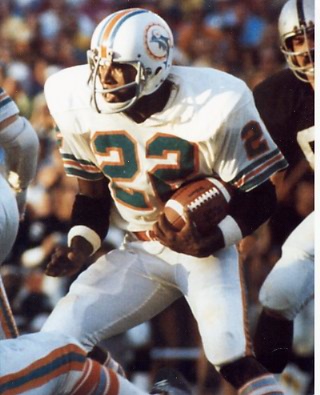
Top 100 NFL Running Backs - #20: Mercury Morris


Mercury Morris

Teams

Miami Dolphins (1969-1975)

San Diego Chargers (1976)


Playoffs

Appearances - 5 (1970,1971,1972,1973,1974)

Conf Champ Games - 3 (1971,1972,1973)

Super Bowls - 3 (1971,1972,1973)

Championships - 2 (1972,1973)


Awards and Honors

Pro Bowl - 3 (1971,1972,1973)


All-Time Ranks

Yards per Rush - #9


League Leads

Rushing Yards (#10-1972)

Rushing Touchdowns (#1-1972, #3-1973)

Yards per Rush (#1-1973, #3-1972)

Rushing Yards per Game (#7-1973)

Total Touchdowns (#4-1972, #8-1973)

Yards per Touch (#1-1973, #8-1972)


Mercury Morris set the single game, single season, and career college rushing yard records while playing for West Texas State, though the season record was broken a week later, and the career record 2 years later. He was drafted in the third round of the 1969 NFL/AFL Draft by the Miami Dolphins.

Morris was mostly used as a kick returner in his first 3 seasons, but when he did get the chance to carry the ball, he was excellent. In 1970, he averaged 6.8 yards per carry, and he averaged 5.5 in 1971, both of which would have led the league if he had enough carries. He was named to the Pro Bowl as a kick returner in 1971.

He became Miami's starter in 1972, and rushed for exactly 1000 yards, his career high, and led the league with 12 touchdowns while picking up 5.3 yards per carry. The Dolphins went undefeated that season, and Morris had 76 rushing yards in the AFC Championship game, followed by 34 yards in Miami's 14-7 Super Bowl win over the Redskins.

In 1973, he led the league by averaging 6.4 yards per carry and 6.6 yards per touch, and he finished with 954 yards and 10 touchdowns. The Dolphins returned to the Super Bowl that year after Morris had 86 yards on 14 carries in the AFC Championship Game, and he added another 34 yards in the Super Bowl, where the Dolphins beat the Vikings 24-7.

Morris suffered a knee injury early in 1974 and was limited to only 5 games before a neck injury ended his season. He had a decent comeback season in 1975, rushing for 875 yards, but the Dolphins chose to trade him away to the Chargers after the season. His neck continued to bother him during the 1976 season, so he decided to retire after one season out west.

Morris did not rack up huge rushing numbers, as he shared the backfield with Larry Csonka and Jim Kiick through most of his career, but he was one of the most efficient runners of all time, averaging 5.1 yards per carry for his career, good enough to land him in the top 10 all time. His two best years coincided with Miami's back to back championships, including their undefeated season, and Morris is definitely one of the best of all time.


Tuesday, July 30, 2024

Top 100 NFL Running Backs - #21: LaDainian Tomlinson


LaDainian Tomlinson

Teams

San Diego Chargers (2001-2009)

New York Jets (2010-2011)


Playoffs

Appearances - 6 (2004,2006,2007,2008,2009,2010)

Conf Champ Games - 2 (2007,2010)

Super Bowls - 0

Championships - 0


Awards and Honors

MVP - 1 (2006)

Offensive Player of the Year - 1 (2006)

All-Pro First Team - 3 (2004,2006,2007)

All-Pro Second Team - 3 (2002,2003,2005)

Pro Bowl - 5 (2002,2004,2005,2006,2007)

Hall of Fame - 2017


All-Time Ranks

Rushing Touchdowns - #2

Total Touchdowns - #3

Scrimmage Yards - #6

Rushing Yards - #7

Rushing Yards per Game - #18

Yards per Rush - #86

Receptions - #86


League Leads

Rushing Yards (#1-2006,2007, #2-2002, #3-2003, #6-2005, #7-2004, #9-2001, #10-2008)

Rushing Touchdowns (#1-2004,2006,2007, #3-2005, #4-2001, #5-2002,2009, #6-2003, #7-2008)

Yards per Rush (#4-2003,2006)

Rushing Yards per Game (#1-2006, #2-2007, #3-2002, #5-2003, #6-2005, #10-2004)

Receptions (#4-2003)

Total Touchdowns (#1-2006, #2-2004,2007, #3-2003,2005, #6-2002, #8-2008, #10-2001)

Scrimmage Yards (#1-2003, #2-2006,2007, #3-2002, #5-2004,2005, #8-2008, #9-2001)

Yards per Touch (#6-2006,2011)


As a senior at TCU, LaDainian Tomlinson rushed for 2158 yards and 22 touchdowns, gained 5.8 yards per carry, and finished 4th in the Heisman voting, which helped him to be picked #5 overall in the 2001 NFL Draft by the San Diego Chargers.

Tomlinson surpassed 1000 rushing yards in each of his first 9 seasons in the NFL, even when his yards per carry were low. As a rookie he gained 1236 yards on only 3.6 yards per carry, but when he raised that to 4.5 yards per carry in his second season, his yardage total jumped to 1683, and he ended up with 2172 scrimmage yards, third-best in the NFL.

He emerged as a superstar in 2003. He had 1645 yards and 13 touchdowns rushing on the season, gaining a career-high 5.3 yards per carry, and gained an additional 725 yards through the air, putting him at 2370 on the season, the fifth-best total of all time. He was the runner-up for Offensive Player of the Year that season.

His per carry average plummeted in 2004, down to only 3.9 yards per rush, but he led the league in rushing touchdowns that season for the first time, as he reached the end zone 17 times, including 12 games in a row during the season. That earned him his first All-Pro First Team honors, and he was far from being done. 

He improved across the board in 2005, up to 1462 yards and 18 touchdowns, but it was 2006 where he really made his mark on history. He led the league in rushing that year with 1815 yards, and set records that still stand with 28 rushing touchdowns and 31 total touchdowns. He won both the MVP and Offensive Player of the Year awards, and led the Chargers to a playoff berth for just the second time in his career.

He again led the league in rushing yards and touchdowns in 2007, but this time with only 1474 yards and 15 touchdowns, far from the heights he had reached the previous season. He and the Chargers reached the AFC Championship game that year, but he injured his knee in the previous game, and was only able to gain 5 yards before sitting out the rest of the team's loss to the Patriots.

His return from injury was not as good as he hoped for. He gained only 1110 yards on the season, the lowest of his career to that point, and only picked up 3.8 yards per carry. He missed the Pro Bowl for the first time in years, and it didn't get better the next year, as he gained only 730 yards on the season. After 9 years in San Diego, he was released by the team, and he chose to sign with the New York Jets on a 2-year contract.

He rushed for 914 yards in his first season as a Jet, and reached the AFC Championship Game for the second time in his career, but it ended again in a disappointing loss, with Tomlinson gaining only 16 yards in a loss to Pittsburgh. He played one final season as a backup in New York before retiring from the NFL.

Tomlinson is #7 on the all-time list for rushing yards, and #2 in rushing touchdowns, and still holds the record for most touchdowns in a season. His 2006 season was probably the best by any running back in the past 20 years, and he is even among the all-time top 100 in receptions, even though he only finished in the top 10 once in that category in his career. There is no doubt that LT is one of the greatest to ever play the game.


Sunday, July 21, 2024

Top 100 NFL Running Backs - #28: Paul Lowe


Paul Lowe

Teams

Los Angeles/San Diego Chargers (1960-1968)

Kansas City Chiefs (1968-1969)


Playoffs

Appearances - 7 (1960,1961,1963,1964,1965,1968,1969)

Conf Champ Games - 6 (1960,1961,1963,1964,1965,1969)

Championship Games/Super Bowls - 6 (1960,1961,1963,1964,1965,1969)

Championships - 2 (1963,1969)


Awards and Honors

All-Pro First Team - 2 (1960,1965)

All-Pro Second Team - 1 (1963)

Pro Bowl - 2 (1963,1965)

AFL Player of the Year - 1 (1965)


All-Time Ranks

Yards per Rush - #16


League Leads

Rushing Yards (#1-1965, #2-1960,1963, #4-1961, #7-1966)

Rushing Touchdowns (#1-1961,1965, #2-1960,1963)

Yards per Rush (#1-1960,1965, #2-1963, #4-1961, #6-1966, #8-1964)

Rushing Yards per Game (#1-1965, #2-1960,1963, #4-1961, #7-1966, #9-1964)

Total Touchdowns (#4-1963, #6-1960,1961, #7-1965)

Scrimmage Yards (#4-1960,1963,1965, #10-1961)

Yards per Touch (#2-1960, #5-1963, #8-1965, #9-1961)


Paul Lowe was a backup quarterback at Oregon State as a sophomore, but had to sit out his junior year due to grades, then was moved to running back as a senior, but gained only 162 yards on the season and went undrafted in the 1959 NFL Draft. When the AFL started in 1960, he tried out and made the Los Angeles Chargers roster.

As a rookie, he gained 855 rushing yards, #2 in the league, and led the league with 6.3 yards per carry, which earned him All-AFL First Team honors. The Chargers played in the initial AFL Championship Game, and Lowe rushed for 165 yards and a touchdown in their 24-16 loss to the Oilers.

 He ended up rushing for only 767 yards in his second season, but he did lead the league with 9 rushing touchdowns on the season. The Chargers had a rematch with Houston in the championship game, but Lowe was held to 30 yards, and the Oilers won 10-3.

A broken arm caused him to miss the entire 1962 season, but he came back strong in 1963, rushing for 1010 yards with 8 touchdowns on 5.7 yards per carry, which earned him the Comeback Player of the Year Award. After the Chargers missed the playoffs with Lowe out, they made the championship game again in 1963, and Lowe's 94 yards and a touchdown contributed to a blowout 51-10 victory over the Patriots.

He played through injuries in 1964, but was limited to only 496 yards. When healthy again in 1965, he was named AFL Player of the Year and Comeback Player of the Year as he led the league with 1121 yards, breaking the league record, and also led the league with 5.0 yards per carry and 6 touchdowns. 

His production dropped to 643 yards in 1966, then 71 in 1967, and the Chargers released him after the first game of the 1968 season. He signed with Kansas City, but separated his shoulder on his first carry for the team. He came back in 1969, but gained only 33 yards before being forced to retire by an ulcer. The Chiefs went on to win that season's Super Bowl, and the team awarded him a ring.

Lowe played in the AFL for his entire career, and ended up #2 in the league's history in rushing yards, and his 4.9 yards per carry are the AFL record, and #16 among all players in AFL or NFL history. He helped the Chargers reach 5 AFL Championship games, and was a big part of the one they won. He was always among the league leaders in multiple rushing categories when he was healthy, and he should be remembered as one of the greatest to ever play the game.


Wednesday, June 26, 2024

Top 100 NFL Running Backs - #48: Keith Lincoln


Keith Lincoln

Teams

San Diego Chargers (1961-1966,1968)

Buffalo Bills (1967-1968)


Playoffs

Appearances - 4 (1961,1963,1964,1965)

Conf Champ Games - 4 (1961,1963,1964,1965)

Champ Games - 4 (1961,1963,1964,1965)

Championships - 1 (1963)


Awards and Honors

AFL Championship MVP - 1 (1963)

All-Pro First Team - 2 (1963,1964)

Pro Bowl - 5 (1962,1963,1964,1965,1967)


All-Time Ranks

Yards per Rush - #49

Yards per Touch - #72


League Leads

Rushing Yards (#4-1963, #6-1964,1967, #7-1962)

Rushing Touchdowns (#4-1963, #7-1964,1967)

Yards per Rush (#1-1963, #5-1962, #7-1964, #10-1967)

Rushing Yards per Game (#4-1963, #6-1964, #8-1962, #9-1967)

Receiving Touchdowns (#10-1967)

Total Touchdowns (#8-1967, #9-1965, #10-1963)

Scrimmage Yards (#6-1967, #7-1963)

Yards per Touch (#1-1963,1965, #3-1967, #6-1962, #9-1964)


After switching from quarterback to running back after his freshman season at Washington State, Keith Lincoln gained 1500 yards on the ground over 3 seasons, then was drafted by the Chicago Bears in the 5th round of the 1961 NFL Draft and the San Diego Chargers in the 2nd round of the 1961 AFL Draft, choosing the latter.

Lincoln didn't get a lot of playing time as a rookie, but he had the longest reception in the league that year, with a 91-yard touchdown catch that accounted for almost half of his yards that year. He had an 86-yard rush for a touchdown the next season, which was also the longest in the league.

In 1963, he had his best season by far. He rushed for 6.5 yards per carry, the only time he would average over 5 in his career, and he also led the league in yards per touch at 7.6. He led the Chargers to the AFL Championship Game, where he gained 206 yards on the ground and 123 through the air, for a total of 329 yards and 2 touchdowns in a 51-10 blowout of the Patriots. The rushing yards and total yards were records at the time, with the total record standing for 8 years, and the rushing record for 22. His performance won him the game's MVP award.

He got the Chargers back to the title game the next season, but in the first quarter he was the recipient of a monstrous hit that broke one of his ribs and knocked him out of the game, and the Chargers failed to repeat. 

He led the league in yards per touch again in 1965, and again took San Diego to the championship game, but once again they fell short, and Lincoln only gained 23 yards in the game. He played one more season with the Chargers before he was traded away to the Buffalo Bills.

He played one full season in Buffalo, and played well enough to be named to the Pro Bowl for the 5th time in his career, setting a career high with 1159 scrimmage yards, but after struggling at the beginning of the 1968 season, he was released by the Bills, signing back with the Chargers to appear in a single game before retiring.

Lincoln never piled up big yardage, but he always gained a lot of yards each time he touched the ball, leading the league in yards per carry once and yards per touch twice. His performance in the 1963 Championship Game is one of the greatest of all time, and is the biggest reason he is this high on the list of the greatest backs of all time.


Sunday, June 16, 2024

Top 100 NFL Running Backs - #55: Darren Sproles


Darren Sproles

Teams

San Diego Chargers (2005-2010)

New Orleans Saints (2011-2013)

Philadelphia Eagles (2014-2019)


Playoffs

Appearances - 9 (2006,2007,2008,2009,2011,2013,2017,2018,2019)

Conf Champ Games - 2 (2007,2017)

Super Bowls - 1 (2017)

Championships - 1 (2017)


Awards and Honors

All-Pro Second Team - 1 (2014)

Pro Bowl - 3 (2014,2015,2016)


All-Time Ranks

Yards per Touch - #63


League Leads

Receptions (#7-2011)

Yards per Touch (#3-2010, #4-2011, #7-2013, #8-2012, #10-2009)


After graduating from Kansas State as the school's all-time leading rusher, racking up 4979 yards over 4 years, Darren Sproles was drafted by the San Diego Chargers in the 4th round of the 2005 NFL Draft.

Sproles was never a full-time starting running back in the NFL, but he was used to catch a lot of passes out of the backfield, and was one of the top kick returners throughout his career. After hardly playing as a rookie, he broke his ankle in the 2006 preseason and ended up missing the entire season.

In 2007, Sproles scored his first two career touchdowns in the same game, one on a kickoff return and one on a punt return. Later in the season, he also had a game with 2 rushing touchdowns. The next season he became the second player ever to have 50 rushing yards, 50 receiving yards, and 100 return yards in one game, joining Gale Sayers on that very exclusive list.

In the first playoff game of the 2008 season, Sproles started in place of LaDainian Tomlinson, who was injured, and had 328 all-purpose yards, the third-most by a player in playoff history. After 6 seasons with the Chargers, Sproles left as a free agent to sign with the Saints for the 2011 season.

2011 was a down year for running backs overall, but not for Sproles, who had his best overall season. He had 603 rushing yards, which was a career high, and 710 receiving yards, also the best of his career. He caught 86 passes, #7 in the league, and finished with 1313 scrimmage yards and 9 touchdowns.

Over the next couple of seasons in New Orleans, he saw his opportunities to run the ball shrink, though he still caught a lot of passes, gaining over 600 yards receiving in each of those seasons. After the 2013 season ended, he was traded to the Philadelphia Eagles.

Sproles played mostly as a return specialist in Philadelphia, but his contributions were finally recognized, as he was named to the Pro Bowl in each of his first 3 seasons with the Eagles, and made the All-Pro Second Team in 2014. In 2017, he broke his arm and tore his ACL on the same play, causing him to miss the rest of the season, including the team's Super Bowl win over the Patriots.

He announced before the 2018 season that it would be his last, but after missing most of the season with a hamstring injury, he decided to play just one more. He ended up tearing his hip flexor and again missing most of the season, leading to his retirement for good.

Sproles finished his career at #5 on the all-purpose yardage list, and holds the record for most all-purpose yards in a season. He may not have gotten the chance to run the ball as much in the NFL as he did in college, but he became a very good pass catcher out of the backfield, and was frequently among the league leaders in yards per touch, and should be listed among the greatest to play the game.


Friday, June 14, 2024

Top 100 NFL Running Backs - #57: Chuck Muncie


Chuck Muncie

Teams

New Orleans Saints (1976-1980)

San Diego Chargers (1980-1984)


Playoffs

Appearances - 3 (1980,1981,1982)

Conf Champ Games - 2 (1980,1981)

Super Bowls - 0

Championships - 0


Awards and Honors

Pro Bowl - 3 (1979,1981,1982)


All-Time Ranks

Rushing Touchdowns - #32

Rushing Yards - #73

Yards per Rush - #86

Rushing Yards per Game - #86

Total Touchdowns - #95


League Leads

Rushing Yards (#7-1979, #9-1981)

Rushing Touchdowns (#1-1981, #4-1982, #5-1983, #6-1979, #9-1977)

Yards per Rush (#2-1979, #3-1980, #9-1981)

Rushing Yards per Game (#9-1979,1981)

Total Touchdowns (#1-1981, #4-1982, #6-1983)

Scrimmage Yards (#8-1979)

Yards per Touch (#8-1980, #9-1979)


As a senior at Cal, Chuck Muncie rushed for 1460 yards and 13 touchdowns, and finished #2 in voting for the Heisman Trophy, then was drafted by the New Orleans Saints with the #3 overall pick in the 1976 NFL Draft.

Muncie came on slowly through his first few seasons in the league, but finally busted out in 1979, when he rushed for 1198 yards and 11 touchdowns, becoming the first Saint to ever exceed 1000 yards in a season, and also the first in team history to be named to the Pro Bowl.

During his time with the Saints, he was frequently late for team meetings and practices, and he finally wore out his welcome early in the 1980 season, and the team traded him to San Diego. He immediately made an impact for the Chargers, and they reached the AFC Championship game in each of his first two seasons with the team. He played well in both playoff runs, but they fell a step short of the Super Bowl each time.

He had his best overall season in 1981, when he rushed for 1144 yards and a league-leading 19 touchdowns. He had 120 yards and a touchdowns in their first playoff game, and another 94 yards in the conference championship game loss.

After the 1982 season, a former teammate revealed that he and Muncie were frequent users of cocaine. He spent several weeks in rehab, but still played most of the 1983 season, though his performance dropped off noticeably. Before the second game of the next season, Muncie missed the team's flight, and the team traded him away to the Miami Dolphins.

That trade was voided after he failed a drug test upon arriving in Miami, and he ended up receiving an indefinite suspension from the league. He was reinstated in 1985 and traded to the Vikings, but ended up being suspended again after skipping required therapy sessions related to his rehab. He decided to retire to focus on getting clean. It took many years and a stint in prison, but by the early 1990s, Muncie was clean, and spent the rest of his life helping mentor youth.

Muncie was extremely talented, but his personal demons kept him from reaching his full potential. He still managed to have several very good seasons in the NFL, and for several years held the record for most rushing touchdowns in a season. Though he should have been better, he still did enough to be ranked among the best to ever play the game.


Sunday, June 9, 2024

Top 100 NFL Running Backs - #62: Ronnie Harmon


Ronnie Harmon

Teams

Buffalo Bills (1986-1989)

San Diego Chargers (1990-1995)

Houston/Tennessee Oilers (1996-1997)

Chicago Bears (1997)


Playoffs

Appearances - 5 (1988,1989,1992,1994,1995)

Conf Champ Games - 2 (1988,1994)

Super Bowls - 1 (1994)

Championships - 0


Awards and Honors

Pro Bowl - 1 (1992)


All-Time Ranks

Yards per Touch - #57


League Leads

Receptions (#6-1992, #9-1987)

Receiving Yards (#10-1992)

Yards per Touch (#2-1991,1992, #3-1993, #4-1990, #9-1987, #10-1995)


As a senior at Iowa, Ronnie Harmon gained 1111 yards on the ground and another 597 through the air, with 10 total touchdowns, which got the Buffalo Bills to select him with the 16th overall pick in the 1986 NFL Draft.

He only touched the ball 76 times as a rookie, then was promoted to starting running back in 1987. He gained only 485 rushing yards, but he gained 477 yards through the air, setting the stage for the rest of his career, where he was much more known for catching passes out of the backfield than running the ball.

 With the addition of Thurman Thomas to the team in 1988, Harmon's opportunities started to dry up. He signed with the San Diego Chargers in 1990, which is where he finally got a chance to showcase his skills. He didn't get a ton of carries with the Chargers, but regularly gained a lot of yards on receptions.

After averaging 5.5 yards per carry in his first season with the Chargers, he raised that to 6.1 in 1991, which was the best of his career, while also gaining 544 yards on the ground, the most rushing yards in a season in his career. He also gained 555 yards receiving, putting him over 1000 yards for the first time in his career.

In 1992, he was named to the Pro Bowl for the first and only time in his career, mainly due to his 79 receptions for 914 yards, both of which were among the top 10 in the league, impressive for a running back. 

He remained with the Chargers for 3 more seasons in pretty much the same role, and appeared in Super Bowl XXIX against the 49ers, where he caught 8 passes for 68 yards, both tops on the team as they fell to San Francisco 49-26.

He moved on to the Houston Oilers, staying with them when they moved to Tennessee, then finished out his career with one final game as a Chicago Bear. His career spanned 12 seasons, and he only missed 11 total games.

Harmon was never a big star, and he ended his career with less than 3000 rushing yards, but he is the only player in history to average at least 4.5 yards per carry and 10 yards per reception in his career. He gained over 6000 yards through the air in his career, a great total for a back, and he obviously knew his role and did it well, which is why he makes this list of the best running backs of all time.


Monday, August 19, 2019

Top 50 NFL Quarterbacks: #7 - Drew Brees


Drew Brees

Drew Brees was not expected to be one of the all-time greats when his career began, as he was considered small for an NFL quarterback and didn't come from a traditional college powerhouse. He was drafted by the San Diego Chargers in the second round of the 2001 NFL Draft, but only saw action in one game during his rookie season.

He won the starting job from Doug Flutie before the 2002 season, and was a usable starter, but did nothing of note. His second season as a starter was a disaster, and he lost his starting job back to Flutie midway through the season. When San Diego picked up Philip Rivers on Draft Day in 2004, it appeared that Brees was headed out of town, but that isn't quite what happened.

His impending replacement seemed to wake him up, and he started to show flashes of his future brilliance in 2004, putting up 3159 yards and 27 touchdowns with only 7 interceptions. He also had his first playoff appearance, although it ended quickly, going down 20-17 in the wild card round. He was about as good in 2005, but tore his labrum and rotator cuff in his throwing shoulder in the final game of the season, and San Diego did not want to commit much to him, so he walked away, signing with New Orleans, which turned out to be the best decision he ever made.

In his first season with the Saints, he led the league in passing with 4418 yards, which would turn out to be one of the lowest totals of his Saints career, and led the Saints to the playoffs, one season after they finished 3-13. Not only did they make the playoffs, they went clear to the NFC Championship Game, where they fell to the Bears, but it was just the start of something great.

After putting up nearly the same numbers in 2007 but missing the playoffs, he had an amazing season in 2008, becoming only the second player in league history to reach 5000 yards, coming up just 15 yards short of breaking Dan Marino's 24-year-old record. He also led the league with 34 touchdown passes, but New Orleans missed the playoffs again, making his amazing season a little less meaningful.

In 2009 he had the lowest passing yard total of his Saints career, reaching "only" 4388, but did lead the league with 34 touchdowns, and New Orleans led the NFC with a 13-3 record. He had a great postseason, throwing three touchdowns in each of the playoff games leading up to the Super Bowl, which was a first in Saints history. In the Super Bowl, he outplayed Peyton Manning by throwing 288 yards and 2 touchdowns as the Saints won 31-17, earning Brees the Super Bowl MVP.

His follow-up season wasn't quite as good, with 4620 yards, 33 touchdowns, and a career-high 22 interceptions, and the Saints ended up losing in the wild card round. 2011, however, was a different story, as he destroyed Dan Marino's yardage record, breaking it with a week to spare and ending up with 5476. He also led the league in touchdowns with 46 and set another record with a 71.2% completion percentage. He was also great in the playoffs, throwing 466 yards and 3 touchdowns in a wild card win, then throwing 462 yards and 4 touchdowns in a loss to the 49ers in the divisional round.

The Saints were severely hampered by the Bountygate scandal the next year, causing them to win only 7 games as several players and coaches were suspended during the season, but Brees was his usual awesome self, leading the league with 5177 yards and 43 touchdowns. He also became the first and only player to reach 5000 yards in consecutive seasons.

In 2013 he did it again, passing for 5162 yards and 39 touchdowns, but was overshadowed by Peyton Manning breaking his yardage record by a single yard while setting the touchdown record as well. He did get the full-strength Saints back to the playoffs, but they only reached the second round of the playoffs.

The 2014 season was a bit of a disappointment for Brees, as he missed the 5000 yards plateau for the first time in 4 years, ending the season just short at 4952, which was still enough to lead the league, and the Saints missed the playoffs despite playing in the weakest division. While that would still be considered a career year for most players, for Brees it was a little lackluster.

The last 4 years have been full of records and milestones. In 2015 he tied the record for touchdown passes in a game with 7. He also led the league in passing yards for the season, and repeated the feat in 2016, giving him 7 seasons as the top dog, which is also a record. He also surpassed 5000 yards again in 2016 for the 5th time in his career, and he owns five of the eleven 5000 yard seasons in history, with 6 others (Tom Brady, Peyton Manning, Dan Marino, Patrick Mahomes, Ben Roethlisberger, and Matthew Stafford) reaching that level once each.

In 2018, he broke 2 of the big passing records, breaking Brett Favre's record for career completions in Week 3, then breaking Peyton Manning's record for career yardage in Week 5. He is also within striking distance of Peyton's career touchdown record this season, needing only 20 to become the all-time leader, though Tom Brady is also right on his heels, needing only 23 himself.

Brees has had less playoff success than most of the other members of the top 10, but he did have a big Super Bowl victory and one other great playoff run two years later. What qualifies him to be this high is his record-setting passing. In addition to the records listed above, he also holds the record for most consecutive 4000 yard seasons, with 12, a streak that came to an end last season after he fell 8 yards short of that number. He also has the highest completion percentage in a season, which he has broken twice, and the highest in a career. He was the first QB ever to throw 40 touchdowns in back-to-back seasons, and holds the record for most consecutive games with a touchdown pass, breaking a very old record belonging to Johnny Unitas. There is no doubt that he is one of the greatest to ever play the game.


Monday, July 22, 2019

Top 50 NFL Quarterbacks: #23 - Tobin Rote


Tobin Rote

Rote was one of the early pioneers in the NFL, playing most of his career in the 1950's, and while his name isn't remembered much today, he was a very good quarterback who had a couple of great seasons.

Rote was drafted by Green Bay in 1950, and he spent his first 7 years playing for the Packers, who were a struggling team at the time. He improved steadily every year, culminating in his career year in 1956, during which he led the league in completions, passing yards and touchdowns, and led all quarterbacks in rushing yards and touchdowns. Even with his great performance, his team finished 4-8, and he was traded to Detroit, while Green Bay replaced him with Bart Starr.

In his first season with the Lions, he split time at QB with Bobby Layne, but Layne broke his leg late in the season and Rote was given the starting duties just in time for a one-game tiebreaker against the San Francisco 49ers. The Lions trailed 27-7 early in the third quarter, but Rote led them on 4 scoring drives and they won 31-27.

The following week they faced Cleveland in the NFL Championship Game, and he had one of the greatest performances in championship history, finishing with 280 yards, 4 touchdowns without an interception, plus a rushing touchdown, as they destroyed the Browns 59-14. Championship MVP's were not named back then, but it is a sure thing that he would have been the choice.

Rote played for 2 more years in Detroit, but the team could not match their previous greatness, and Rote was released after the 1959 season. Finding no NFL team to join, he went to play in the CFL, where he played 3 seasons and set a number of records (although none of that was taken into account for this list).

In 1963 the AFL came calling, and he joined the San Diego Chargers, where he recorded his career highs in passing yards, completion percentage, and touchdown passes. He did have one last hurrah, as he won the AFL MVP and led his team to the championship that season, whipping the Boston Patriots 51-10 behind his 3 touchdowns, two passing and one on the ground, his second great championship performance. The aging QB played two more seasons before retiring.

While a few of the prime years of his career were cut out by his time in Canada, Rote was a two-time champion who led the league in multiple categories over and over, and he was great in championship situations, which is why he is able to live on on this list of the all-time greats.


Tuesday, June 25, 2019

Top 50 NFL Quarterbacks: #38 - Philip Rivers


Philip Rivers

Philip Rivers has been the starting quarterback of the Chargers for over a decade, and has not missed a game since taking over the starting job when Drew Brees left prior to the 2006 season, giving him the longest current streak of games started, and the third-longest of all time.

Rivers did not start a game in his first two seasons with San Diego, throwing a total of 30 passes while backing up Drew Brees. When Brees left as a free agent in 2006, Rivers was promoted and immediately became a strong player, leading the Chargers to a 14-2 record in his first season at the helm. They lost to New England in their first playoff game, however, wasting their best chance at a title.

He was pretty solid again the next season, leading the Chargers to another division title, and this time they won a couple playoff games, ultimately falling to the Patriots once again in the AFC title game, coming up just a game short of making the Super Bowl. It was revealed after the game that Rivers had played most of the game on a torn ACL, but he refused to abandon his team.

The following season was his best as a pro, as he threw for a league-leading 34 touchdowns and led the Chargers to their third straight division title, as well as an upset of Peyton Manning and the Colts in the wild card game. It was also the first time he eclipsed 4000 yards, something he has done 9 more times since.

Over the course of his career he has also slowly taken over most of the Chargers franchise passing records, many of them from Dan Fouts. He set the team record for TD passes in a season in 2008, topping Fouts by one, then took the single-game passing yardage record from him in 2010 when he recorded 455. In 2015 he took the career TD record, and in 2016 the career yardage record.

He has also led the league in passing yards once, with 4710 in 2010, and completion percentage, at 69.5% in 2013. He has reached 4000 yards 10 times, and 30 touchdowns 6 times, while winning 4 division titles and starting every game for 13 straight seasons. While he has only made it to the conference title game once in his career, he has still been so good for so long that he has earned the right to sit ahead of the man whose records he keeps surpassing.


Sunday, June 23, 2019

Top 50 NFL Quarterbacks: #39 - Dan Fouts


Dan Fouts

Dan Fouts was a 3rd-round draft pick of the Chargers in 1973, and though he was their primary starter almost immediately, it took him several years to break through to elite status. In his 6th season, Don Coryell was hired as the coach, and Fouts started to show some promise, throwing for 2999 yards and 24 touchdowns, but San Diego failed to make the playoffs.

He became a superstar in 1979, when he set a new NFL record with 4082 passing yards while guiding the Chargers to the best record in the league at 12-4. He also led the league in completion percentage, but dropped a real dud in their first playoff game, tossing 5 picks in a 17-14 loss.

In 1980 he obliterated his own record from the previous season, putting up 4715 yards while leading his team back to the playoffs, where he improved on his previous performance, getting past 300 yards with 2 touchdowns in consecutive games, but it wasn't enough to reach the Super Bowl, as Jim Plunkett and the Raiders knocked them out in the AFC title game.

In 1981 he again beat his own passing record, for the third straight year, this time reaching 4802 yards and 33 touchdowns, also the best in the league. While he couldn't be matched in the regular season, he was once again disappointed in the playoffs, losing to Cincinnati in the AFC title game, once again ending up one step short of the ultimate goal.

He may have broken his own record yet again in 1982, but the season was cut down to 9 games by a strike. He finished the season with 2883 yards, which put him on pace for 5125, and he also ended up with 17 touchdowns, the second year in a row that he led the league in both categories. Also for the third year in a row, San Diego lost in its 2nd playoff game.

That was his final chance at winning a title, sadly. The Chargers were not able to make the playoffs again during his final 5 seasons, and although he remained a good quarterback, he was not near the level of his record-breaking years. The length of his solid years was enough to push him into the top 40, but the biggest reason he is here is for his amazing 4-year run, which has only been matched by a few quarterbacks in the history of the league.


Wednesday, December 7, 2016

Football Predictions - 7 Dec thru 12 Dec

Upset picks are in italics.

Thursday

Oakland at Kansas City - Chiefs by 2

Saturday

Navy vs. Army - Midshipmen by 7

Sunday

Arizona at Miami - Cardinals by 1
Pittsburgh at Buffalo - Steelers by 1
Denver at Tennessee - Broncos by 3
Washington at Philadelphia - Eagles by 3
San Diego at Carolina - Chargers by 2
Cincinnati at Cleveland - Bengals by 9
Chicago at Detroit - Lions by 10
Houston at Indianapolis - Colts by 5
Minnesota at Jacksonville - Vikings by 5
NY Jets at San Francisco - Jets by 1
New Orleans at Tampa Bay - Buccaneers by 3
Atlanta at Los Angeles - Falcons by 11
Seattle at Green Bay - Seahawks by 3
Dallas at NY Giants - Cowboys by 5

Monday

Baltimore at New England - Patriots by 7

Prediction Results

NFL: 10-5 (.667) 113-77 overall (.595)
Upsets: 0-2 (.000) 18-21 overall (.462)
College Football: 10-6 (.625) 613-219 overall (.737)
Upsets: 0-2 (.000) 42-68 overall (.382)

Tuesday, September 20, 2016

NFL Rankings - 20 Sep

A few teams that opened the season with upset losses rebounded this week with dominant victories, which earned three teams with 1-1 records spots in the top 5 after week 2. There are still 8 teams that are undefeated, and 8 more that are winless, but they are all over the spectrum in terms of talent. Here are this week's full rankings and playoff picks:


Rec
ProjRec


TW
LW
Team
Rating
W
L
W
L
MOV
SOS
Seed
1
1
Pittsburgh
-13.44
2
0
14
2

32
A1
2
7
Arizona
-12.24
1
1
12
4

19
N1
3
5
Carolina
-10.84
1
1
11
5

10
N3
4
11
San Diego
-9.166
1
1
11
5

20
A2
5
2
New England
-8.7
2
0
11
5

9
A3
6
8
Minnesota
-8.5
2
0
12
4

5
N2
7
3
Green Bay
-7.396
1
1
12
4

7
N5
8
9
Cincinnati
-6.99
1
1
11
5

1
A5
9
4
Kansas City
-5.849
1
1
10
6

4
A6
10
13
NY Jets
-3.885
1
1
9
7

27

11
6
San Francisco
-3.882
1
1
9
7

16
N6
12
10
Denver
-3.834
2
0
9
7

22

13
15
Houston
-3.82
2
0
10
6

28
A4
14
22
Philadelphia
-2.202
2
0
9
7

25
N4
15
16
Miami
-0.605
0
2
6
10

21

16
14
Baltimore
1.4329
2
0
9
7

31

17
21
NY Giants
2.4347
2
0
9
7

23

18
18
Seattle
2.6252
1
1
7
9

8

19
25
Tennessee
2.7246
1
1
7
9

14

20
28
Atlanta
3.3631
1
1
6
10

26

21
20
Buffalo
3.5388
0
2
5
11

13

22
17
Tampa Bay
3.9107
1
1
7
9

3

23
26
Dallas
4.0231
1
1
7
9

29

24
12
Jacksonville
4.3223
0
2
6
10

2

25
24
New Orleans
4.7873
0
2
5
11

6

26
23
Detroit
4.9304
1
1
7
9

30

27
19
Oakland
5.07
1
1
6
10

15

28
31
Los Angeles
7.6635
1
1
5
11

24

29
29
Washington
9.9703
0
2
4
12

11

30
27
Chicago
10.127
0
2
4
12

12

31
30
Indianapolis
10.151
0
2
3
13

18

32
32
Cleveland
13.127
0
2
2
14

17


Playoff Picks

Wild Card

(3) Patriots over (6) Chiefs
(5) Bengals over (4) Texans
(3) Panthers over (6) 49ers
(5) Packers over (4) Eagles

Divisional

(1) Steelers over (5) Bengals
(3) Patriots over (2) Chargers
(1) Cardinals over (5) Packers
(3) Panthers over (2) Vikings

Conference Championships

(1) Steelers over (3) Patriots
(3) Panthers over (1) Cardinals

Super Bowl

(1) Steelers over (3) Panthers