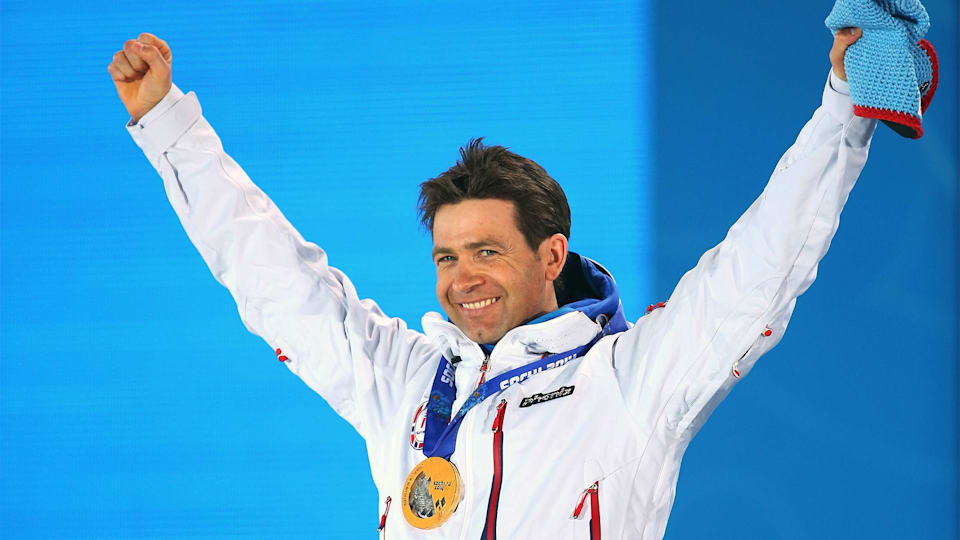
Ole Einar Bjorndalen
Norway
Biathlon
Overall Ranks
#3 among Norwegian Olympians
#1 among Biathletes
Olympic Results
1998
Sprint - Gold
Relay - Silver
2002
Sprint - Gold
Pursuit - Gold
Individual - Gold
Relay - Gold
2006
Pursuit - Silver
Mass Start - Bronze
Individual - Silver
2010
Individual - Silver
Relay - Gold
2014
Sprint - Gold
Mixed Relay - Gold
Relay - Bronze
Total
Events - 27
Gold - 8
Silver - 4
Bronze - 2
Ole Einar Bjorndalen was born on January 27, 1974 in Drammen, Norway, and left home at 16 to study at a sports academy, where he specialized in cross country skiing and biathlon, eventually shifting his focus completely to biathlon. At age 19, he won 3 gold medals at the Junior World Championships, and that helped him earn a spot on the Olympic team in 1994, just after his 20th birthday.
His first event was the relay, where he took the first leg, and even though he didn't miss a shot, he still was in 10th place at the end of his turn. His teammates were also perfect in shooting, but weren't able to get any higher than 7th place, which is where they finished. He also competed in the individual 20 km and the 10 km sprint, but wasn't close to the top in either, a disappointing start to his Olympic career.
He kept working hard, and by 1997, he won a bronze medal in the pursuit at the World Championships, and again made the Olympic team heading to Nagano in 1998, competing in the same 3 events. His first event that year was the 20 km individual, and he had the fastest skiing time in the event, but he missed 4 shots, which were each assigned a 1-minute penalty, which dropped him to 7th place overall.
Next was the sprint event, which had to be postponed by a day after heavy fog made the shooting impossible. With better conditions the next day, Bjorndalen dominated, with the fastest time at both shooting checkpoints, and no misses, and he ended up winning the race by over a minute, making his first gold medal one of his most dominant.
Norway and Germany were expected to battle for gold in the relay, but Norway got off to a rough start, sitting in 6th place after the first leg. The next two skiers moved them up to 4th, but they were still a minute and 43 seconds behind the Germans when Bjorndalen started his anchor leg. He flew past Russia and Belarus, and made up a lot of ground on Germany, but there just wasn't enough time, and Norway ended up taking the silver medal, 20 seconds behind Germany.
He won several more world championship medals over the next few years, but no individual golds, so what happened in Salt Lake City was a bit of a surprise. He started out by doing a cross-country skiing event, the 30 km. In that event Johann Muhlegg of Spain was far ahead of the field, winning by over 2 minutes, with Bjorndalen leading the rest of the pack heading into the final lap, but he was passed by 4 others before the finish. He originally finished in 6th place, but was moved up to 5th when Muhlegg failed a drug test, meaning that Bjorndalen finished only 13.5 seconds behind the true champion while racing in an event that wasn't even his main sport.
After that, he never skied another Olympic cross-country race, but he was about to make history in the biathlon. He started with the 20 km individual, where he was again the fastest skier in the event. He did miss 2 shots, down from 4 in the previous Olympics, and luckily this time, the two athletes that were within a minute of him on the skiing portion also missed at least 2 shots, so Bjorndalen won gold by 36 seconds over Frank Luck of Germany, who hadn't missed a shot but skied slower.
Next, he attempted to defend his gold medal in the sprint. He was one of the final athletes to start, and Sven Fischer of Germany held the lead for most of the race, but a miss at the final shooting station forced him to ski a penalty loop, and Bjorndalen made it through without a miss, which enabled him to win by 29 seconds, which was almost exactly the time Fischer lost to the penalty loop, giving him his second gold medal of 2002.
The next event was the pursuit, which was being contested for the first time in the Olympics. Skiers started according to their finish in the sprint, so Bjorndalen started with a 29 second lead. He missed two shots during the event, and was only the 6th fastest skier, but his head start was enough that noone was ever able to catch him, and he ended up winning by 43 seconds to become the first biathlete ever to win 3 golds in a single Olympics.
He finished up his Olympics with the relay, where his team was favored. They started out 18 seconds behind Russia after the first leg, but they took the lead early in the second leg, and never gave it up. They led by 21 seconds at the midway point, and by just over a minute when Bjorndalen started the anchor leg, and he was able to race without pushing too hard, bringing home the gold medal by just over 45 seconds. He thus became the only man ever to win ever biathlon event in a single Olympics.
At the 2005 World Championships, he won 4 golds, only missing out in the individual 20 km, which was his first event in Torino in 2006. For the third straight Olympics, he was the fastest skier in the event, but Michael Greis of Germany had missed only one shot, while Bjorndalen missed 2, dropping him behind by 16 seconds and leaving him with the silver medal.
Next was the sprint, which he had won twice in a row, both times without missing a shot, but he was unable to repeat that again. He missed 3 shots this time, and the 3 resulting penalty loops dropped him out of contention, finishing in 11th place, though he was probably fast enough to win if he had shot cleanly.
He started 1:14 behind in the pursuit, but was again the fastest skier in the event, which allowed him to make up a lot of ground, but he was again betrayed by his shooting. He missed 3 shots, and the penalty loops caused him to end up losing by 2.7 seconds, but he still ended up with a silver medal, which was impressive when you consider where he started.
He was again the anchor on the relay team, but his teammates all struggled with their shooting, and Norway was in 10th place by the time he got on the course. He skied the fastest leg of anyone by over 30 seconds, but was only able to move his team up to 5th place by the finish.
After that was an event new to the Olympics, the mass start 15 km race. Bjorndalen led the entire race until the final shooting station, where he missed twice, and the ensuing penalty loops caused him to lose his lead, and he was unable to catch back up before the finish, and he ended up with a bronze medal, 12 seconds behind the winner.
He again won 4 gold medals at the 2009 World Championships, giving him good momentum heading to Vancouver in 2010. The first event that year was the sprint, and the weather got worse throughout the event, and Bjorndalen started near the middle of the event. After 3 missed at the first shooting station, he was basically out of the running, and he finished in 16th place.
This meant that he started the pursuit 1:41 behind the leader, and despite a good race time and only 2 misses, he was only able to move up to 7th by the end of the event. In the 20 km individual, he was the fastest skier in the event for the 4th Olympics in a row, but Emil Hegle Svendsen, also of Norway, missed 1 less shot, and Bjorndalen ended up with a silver medal.
He also competed in the mass start, but with 7 missed shots out of 20, the worst in the competition, he only managed to finish in 26th place. He was assigned to the anchor leg in the relay again, and this time, despite a slow start, Norway was able to take a small lead after 2 legs, which was a virtual tie with Austria when Bjorndalen started. He had a really good ski time, and missed only 2 shots, while his rival missed 4, allowing him to have a comfortable victory by 38 seconds to finish with his only gold of the games.
He returned for another Olympic run in 2014, when he was 40 years old. He started out with the sprint event, where he was in 5th place for most of the race, but thanks to missing only a single shot, he was in position to sprint to the finish with a chance at a medal, and he ended up pulling it off, winning the gold medal by 1.3 seconds, which was his 12 total Olympic medal, which tied him for the most ever for a Winter Olympian at the time.
He took that tiny lead into the pursuit, but he missed 3 total shots over the course of the event, and ended up finishing 4th, just 1.7 seconds away from earning a record-breaking medal. In the individual 20 km, he missed 4 shots, one at each station, and the 4 penalty minutes dropped him from 6th to 33rd place.
He struggled again in the mass start, missing 6 shots, the most in the event, and he finished 21st out of 26 who finished the event. Next was a new event, the mixed relay, with 2 women doing a 6 km leg, followed by 2 men skiing 7.5 km each. Norway was only a second behind when Bjorndalen took off on the third leg, and he gave them a huge lead of 43 seconds, and it was more than enough for the anchor to bring home for another gold, making him the most decorated Winter Olympian ever.
His final event was the relay, where he again took the third leg. The Bo brothers took the first two legs, and had Norway in the lead for the entire first half, and they gave Bjorndalen a 20 second lead. He didn't miss a shot, but his skiing was slower than usual, and by the time he finished, the lead was down to 2 seconds. On the final leg, his teammate missed 4 times, and the Norwegians ended up in 4th place. That would change in 2020, when it was discovered that the Russians had been doping, and Norway was moved up to the bronze medal position, giving Bjorndalen his 14 medal overall.
He tried to make the team again in 2018, but was chosen for the team, so his Olympic career ended after 6 trips to the Olympics. He retired later that year, but by then he was no longer the most decorated Winter Olympian, as Marit Bjorgen had surpassed him by winning her 15th Olympic medal that year. He is known as the King of Biathlon, and it is well-deserved, as he is the greatest Olympic biathlete in history, and one of the greatest Olympians ever.


