Showing posts with label Joe Montana. Show all posts

Saturday, August 31, 2019

Top 50 NFL Quarterbacks: #2 - Joe Montana


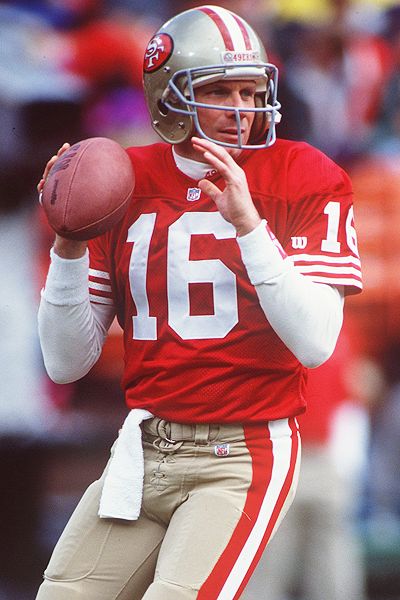
Joe Montana

Joe Montana was a 3rd round pick by the 49ers in 1979, but hardly even saw the field as a rookie. He took over the starting job midway through his second season, but both he and the team were horrible. That would all change in his 3rd season.

1981 would be the first year that he showed his true promise. He led the league in completion percentage with 63.7%, threw 3565 yards, 19 touchdowns, and 12 interceptions, and led the 49ers to the best record in the league at 13-3. In his first ever playoff appearance, he was able to get past the Giants and Cowboys to reach his first Super Bowl, then won the Super Bowl MVP after throwing 157 yards and a touchdown while running for another.

The 1982 season was a strange one for Montana. The season was shortened to 9 games by a strike, but he led the league in touchdowns with 17 and had the highest per-game yardage of his career, but the 49ers finished at 3-6 the year after winning it all.

His personal rise continued in 1983, as he reached 3910 passing yards and 26 touchdowns, and the team made it back to the playoffs, advancing as far as the NFC title game before falling to Washington, ending up one game short of getting back to the championship.

He finally put it all together in 1984, with 3630 yards and 28 touchdowns, while San Francisco finished at 15-1, becoming the first team in history to reach 15 wins in a regular season. Despite throwing more picks than touchdowns in the first two playoff games, the 49ers still advanced to the Super Bowl again, where Montana put on a show, throwing 331 yards and 3 touchdowns while winning his second Super Bowl MVP.

They followed up their second Super Bowl win with another dud, although Montana did have a pretty good season overall. The 49ers barely made it into the playoffs, then lost in the wild card game, meaning that they followed up a championship season with no playoff wins just like before.

Montana suffered a serious back injury during week one of the 1986 season, and he was told by doctors that he should retire, but after surgery and rehab, he came back to finish out the season, and though his numbers for the season looked terrible, he won the Comeback Player of the Year award for making it back from such a terrible injury.

He missed 5 more game in 1987 due to injury, but set a career high with 31 touchdowns, which led the league for the entire season. That is also the season that Steve Young first joined the team, and he started to show some promise filling in for Montana through injuries. The Niners would fail to win a playoff game for the third season in a row, leading many to wonder whether Montana should be replaced by Young permanently.

Young did start a few games in 1988, and Montana's numbers took a hit as a result, but the 49ers would make the playoffs, and Montana would lead a great playoff run, with a total of 8 touchdowns and only 1 interception in the three games, and it ended with a 3rd Super Bowl victory. He threw 357 yards and 2 touchdowns in the Super Bowl, with 215 of those yards going to Jerry Rice, who took home the MVP.

Despite being a 3-time champion, Montana had never won a regular-season MVP, but that changed in 1989, when he put up his best season ever. He completed 70.2% of his passes, which led the league for the 5th time, and had 26 touchdowns with only 8 picks, and the 49ers finished at 14-2, best in the league by far. That year's playoff run was one of the greatest of all time, with a total of 800 yards and 11 touchdowns without an interception over 3 games, a feat only matched by Joe Flacco in 2012. His Super Bowl performance was also one of the best ever, with 297 yards and 5 touchdowns without an interception, earning him a 3rd Super Bowl MVP, becoming the first player ever to achieve that feat.

He was great again in 1990, taking home his second straight MVP award while setting a career high with 3944 passing yards, but his interceptions did double to 16, which makes it rank just a notch lower in his career hierarchy. They seemed well on their way to a third straight Super Bowl win, which has never been achieved, but he suffered a severe elbow injury late in the NFC title game, which allowed the Giants to end their chance at a three-peat.

The elbow injury turned out to be very severe, causing Montana to miss nearly two full seasons, with only a relief appearance in the final game of 1992 in that entire time. After the season ended, a full-blown quarterback controversy ensued, due to Steve Young leading them to the playoffs and winning the MVP in 1992. The result was that Montana was traded to Kansas City prior to the 1993 season, allowing him to continue his career.

He was definitely not the same player with the Chiefs, tossing a career low in yardage for a season in which he started most of the games, and had only 13 touchdown passes, but he did get the Chiefs to the AFC title game, which didn't do much for his ranking, but shows that he was a winner. He played one more mediocre season before retiring.

While many consider Montana the greatest of all time due to his 4-0 record in Super Bowls, his injury-plagued career was cut short, causing him to miss out on several years that could have catapulted him to the top. He had only 2 MVP seasons, but 3 Super Bowl MVP's and 4 championships. He had 9 seasons as an elite quarterback in the NFL, comprising the entire decade of the 1980's, other than the 1986 season that he nearly missed. He was the greatest QB of all time until the end of the 2017 season, when he was surpassed by a passer whose career was nearly twice as long, but there is no doubt that Montana is one of the greatest to ever play the game.


Friday, August 21, 2015

Top 50 NFL Quarterbacks: #1 - Peyton Manning


Peyton Manning

Peyton Manning is always included in conversations about the greatest quarterbacks of all time, but he is rarely called the greatest due to the fact that despite his amazing regular season statistics, he has only won one Super Bowl in his career. While he may not be the greatest champion in league history, he is the greatest regular season player ever, and has greater longevity than nearly every other QB in history.

He began his career as a #1 pick in 1998, going to the Indianapolis Colts, where he was immediately inserted as the starting quarterback. In his 17 seasons, he has only missed a total of 16 games, comprising the entire 2011 season, when he sat out due to two neck surgeries. His rookie season was the only time in his entire career when he wasn't one of the top passers in the entire league, with 3739 yards, 26 touchdowns, and 28 interceptions, each of which was the worst he would ever have.

He vaulted to the top of the league in his second season, with 4135 yards, 26 touchdowns, and only 15 interceptions, and the Colts improved by 10 games, to 13-3. They would lose in their first playoff game, however, which would become a pattern in his career, with 9 seasons ending with a loss in his first playoff game.

In his third season, he led the league with 4413 yards and 33 touchdowns, the first of many times he would lead the league in each. He failed to win a playoff game once again, and didn't even get the Colts to the playoff the following year. It would be the final time he would miss the playoffs. He got them back in 2002, but again lost in round 1.

In 2003, he led the league in yardage for the second time, winning his first MVP award while leading Indy to a 12-4 record, and once the playoffs started, he finally got things on track. In his first ever playoff win, he threw 377 yards and 5 touchdowns, destroying the Broncos 41-10. He threw 304 yards and 3 touchdowns in the next round, getting to his first AFC title game, where the Colts fell to Tom Brady and the Patriots 24-14.

He followed up his first MVP season with a repeat performance, throwing 4557 yards, his best to that point, along with 49 touchdowns, which broke Dan Marino's long-standing record of 48, and had only 10 interceptions. He was awarded his 2nd MVP for that amazing performance, but fell to New England in the playoffs again.

In 2005 he posted his worst statistical season since he was a rookie, missing the 4000 yard mark for only the second time in his career, but the Colts finished with a 14-2 record, the best of Manning's career. It was Pittsburgh that would end his season early this time, the third straight season he fell to the eventual champions in the playoffs.

In 2006 he was back on top, leading the league in touchdown passes for the third time, and he finally exorcised his playoff demons, taking out the Patriots in the AFC title game and reaching his first Super Bowl. He was not great in that game, with 247 yards and 1 touchdown, but it was enough for him to earn the Super Bowl MVP.

He was his usual great self in 2007, but was overshadowed by Tom Brady, who broke his record when he reached 50 touchdown passes while leading the Patriots to an undefeated season. Manning would bow out in his first playoff game once again. When Brady was hurt at the beginning of 2008, Manning looked to have a clear path to another title, but despite winning his 3rd MVP, he couldn't get past his first playoff opponent again.

In 2009 he was even better, with 4500 yards and 33 touchdowns, and the Colts were better also, getting back to 14-2. He pushed right through the playoffs, getting to the Super Bowl for the second time, and while he played better than the previous game, his 333 yards and 1 touchdown weren't enough to stop Drew Brees and the Saints.

In 2010 he set a new career high with 4700 yards, but the Colts only won 10 games, their lowest total in 8 years. After another first round playoff exit, he went to a doctor about neck pain that he had been having for several years, and discovered that he would need surgery on his neck, and the recovery cost him the entire 2011 season. Nervous about how he would fare after his return, the Colts released him before the 2012 season.

He signed with Denver during the offseason, and posted one of the best seasons of his career, with 4659 yards and 37 touchdowns while leading the Broncos to a 13-3 record. He was awarded the Comeback Player of the Year Award for his great season, meaning that each of the top 3 of all time have been recipients of the award. He was also back to his old tricks in the playoffs, losing in the first game once again.

The 2013 season would be truly historic, and ranks as one of the best seasons ever by any quarterback. He broke Drew Brees' passing yard record when he finished with 5477, and he broke Tom Brady's touchdown record with 55. He also threw only 10 interceptions all season, and was one of the easiest choices for MVP in history. The first two playoff games went great, with another win over Tom Brady and the Patriots in the AFC title game earning a third Super Bowl berth, but the big game couldn't have gone much worse, and they were destroyed 43-8.

In 2014 he became one of the oldest passers ever to play at an elite level, passing for 4727 yards and 39 touchdowns, a bit lower than the previous season but still better than most of the league. He was disappointed with another quick playoff exit, continuing his career trend.

While it is obvious that Tom Brady is the better playoff quarterback, with twice as many Super Bowl appearances and 4 wins to Manning's one, Brady has been nowhere near the same player as Manning in the regular season. Manning has thrown for over 4000 yards 14 times, a league record, while Brady has only 7. He has thrown 30 touchdowns 9 times, while Brady has done it only 5. He has a record 5 MVP's, while Brady has only 2. He owns the single season records for both touchdowns and yardage, along with the career record for touchdowns. He has also played 2 more seasons than Brady, and 3 more at an elite level, which is the biggest reason he is at the top. If you judge the two based on per-season greatness, Brady's pace is slightly ahead of Manning's, meaning that if he lasts two or three years longer than Manning while still playing well, the #1 spot will most likely be his, at least until Aaron Rodgers passes them both. For now, Manning still holds the spot he took from Joe Montana 5 years ago.

Thursday, August 20, 2015

Top 50 NFL Quarterbacks: #2 - Tom Brady


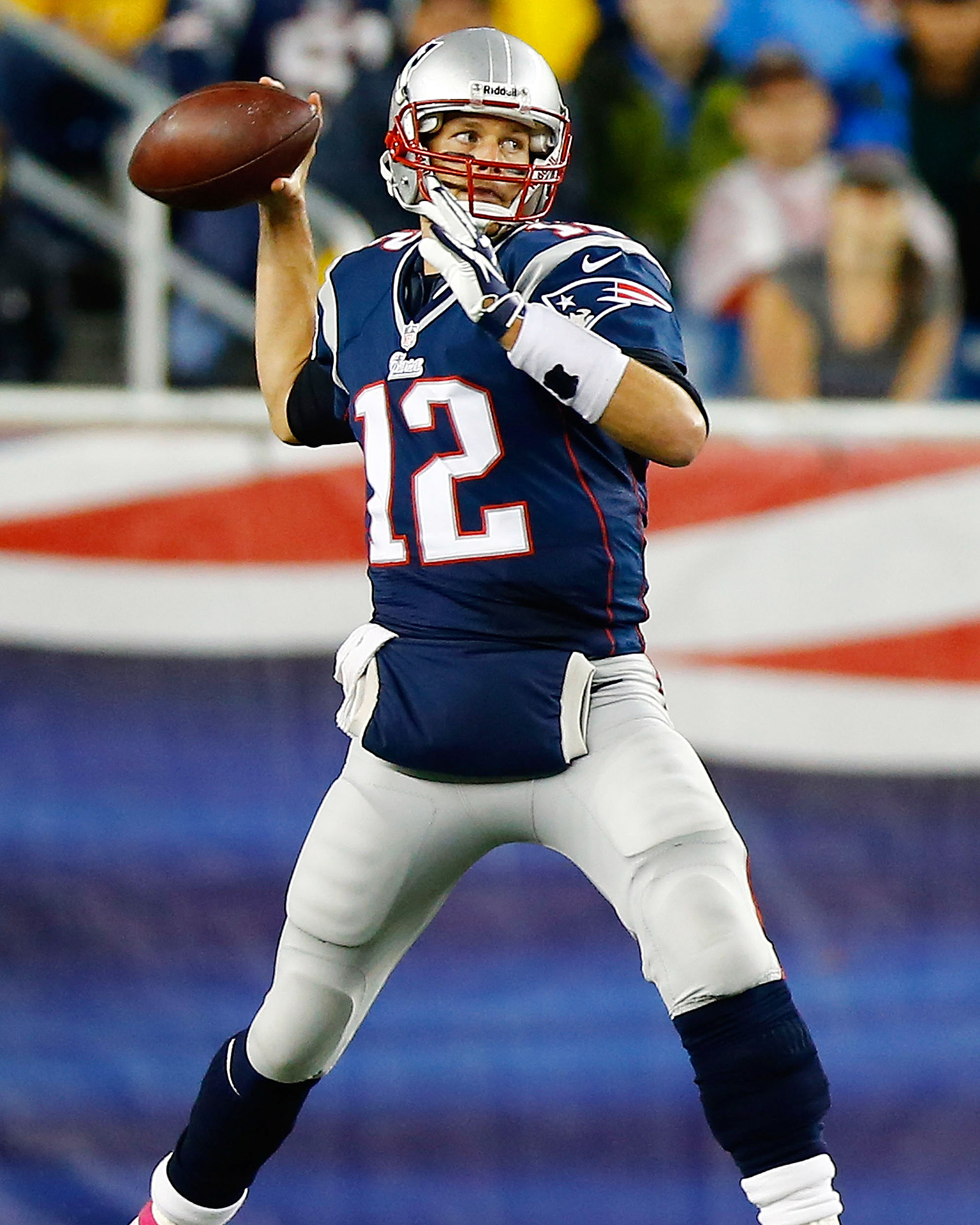
Tom Brady

Tom Brady is universally recognized as one of the greatest quarterbacks of all time, due to his 4 Super Bowl victories, tied for the most all time, and 6 Super Bowl appearances, which put him ahead of John Elway last season for the most all time.

He began his career as a 6th-round pick in 2000, and he spent his rookie season riding the bench behind Drew Bledsoe, completing only one pass for 6 yards all season long. He took over as the starter in the third game in 2001, and has started in every game he played since.

 He was a decent player in his first season, but his totals in every category turned out to be career lows. He did enough to get New England to the playoffs, and even survived the first two rounds of the playoffs somehow, without throwing a single touchdown pass on the way to the Super Bowl. In the Super Bowl, he threw 145 yards and 1 touchdown, but was awarded the MVP anyway, even though Adam Vinatieri was really the reason they won.

He was a little better in his second season, even leading the league in touchdown passes with 28, but the Patriots missed the playoffs, which would be the only time in his entire career as a starter that he would fail to make the postseason.

His regular season numbers remained steady in 2003, even dropping off a little, but he led New England to a 14-2 record, then threw one touchdown in his first two playoff games, which was better than his previous postseason run, and had a great Super Bowl, throwing 354 yards and 3 touchdowns while winning his second Super Bowl MVP.

He remained a steady passer again in 2004, among the top 5 in the league, putting up nearly identical numbers while leading the Patriots to an identical 14-2 record. He threw 3 touchdowns leading up to the Super Bowl, once again slightly better than the previous year, and threw 236 yards and 2 touchdowns in the Super Bowl, which was somewhat average for a winning QB, and did not win the MVP.

He raised his numbers in 2005, leading the league with 4110 yards, but lost in the second round of the playoffs, which was the first time Brady ever lost in the postseason, which was pretty amazing after winning his first 10 games. When he dropped his numbers back down to his average in 2006, the team's playoff performance improved, but they lost in the AFC title game to Peyton Manning and the Colts.

His 2007 season was the best he ever had, and is the second-best ever recorded by a quarterback in history. He led the league with 4806 yards and a record-setting 50 touchdowns, and the Patriots became the first team to ever finish a season 16-0. They won two playoff games easily, and appeared headed to a perfect 19-0, but Brady was outplayed by Eli Manning in the Super Bowl, throwing only 266 yards and 1 touchdown as the perfect season ended one game short.

There would be no repeat in 2008, as Brady tore his ACL in the first game of the season, and the Patriots missed the playoffs as a result of losing their star. He came back very strong in 2009, posting his second-best season in both yardage and touchdowns, and was given the Comeback Player of the Year award for his amazing bounceback, though the Patriots failed to win a single playoff game for the first time with Brady at the helm.

He was even better in 2010, dropping his yardage a bit, but throwing 36 touchdowns with only 4 interceptions on the season for an amazing 9:1 TD:INT ratio. Once again, the Patriots would lose their first playoff game, leaving Brady without a playoff victory in 3 full seasons.

He had his second-best season in 2011, breaking Dan Marino's single season passing yardage record one week after Drew Brees did it, which means that he never actually held the record. He finished with 5235 yards and 39 touchdowns, then led another Super Bowl run, but it ended the same way as it did 4 years earlier, with a mediocre performance in the Super Bowl that ended in a loss to the Giants and Eli Manning. His best two seasons both ended in Super Bowl losses to New York.

He was the best QB in the league in 2012, putting together 4827 yards, 34 touchdowns, and 8 interceptions while taking New England to a 12-4 record. He played well in his first playoff game, but struggled against Baltimore in the AFC title game, falling short in his bid to reach a record 6th Super Bowl.

He had a significant dropoff in 2013, falling down to 4343 yards and 25 touchdowns, but the Patriots reached 12-4 again, and Brady led them back to the AFC title game, where they lost to Peyton Manning and the Broncos, leaving him out of the Super Bowl again.

His 2014 season started off rough, but he rebounded nicely as the season went on, and ended up with 4109 yards and 33 touchdowns, and New England reached 12-4 for the third straight year. The playoffs that season would be the best of his entire career. He threw 3 touchdowns in each of the first two playoff games, which earned him a trip to his 6th Super Bowl. In that game he threw 328 yards and 4 touchdowns, which earned him his record-tying 3rd Super Bowl MVP.

Brady is ahead of Joe Montana for several reasons. He has played in 2 more Super Bowls than Montana, and won 4, tying him with Joe. Both won 3 Super Bowl MVP's and 2 regular season MVP's, but Brady reached more conference title games, with an NFL-record 9 to Montana's 6. He was the first QB to ever throw 50 touchdowns, and the 3rd ever to reach 5000 yards. In addition, he has been an elite quarterback for 11 full seasons, two more than Montana. Without last season, he wouldn't be ranked ahead of him, but everything that happened last season vaulted him into the #2 spot.

Wednesday, August 19, 2015

Top 50 NFL Quarterbacks: #3 - Joe Montana


Joe Montana

Putting Joe Montana anywhere outside of the top 2 quarterbacks of all time may seem almost sacrilegious, but a couple of severe injuries shortened his career, which allowed two active quarterbacks to pass him on the all-time list within the past 5 years.

Joe Montana was a 3rd round pick by the 49ers in 1979, but hardly even saw the field as a rookie. He took over the starting job midway through his second season, but both he and the team were horrible. That would all change in his 3rd season.

1981 would be the first year that he showed his true promise. He led the league in completion percentage with 63.7%, threw 3565 yards, 19 touchdowns, and 12 interceptions, and led the 49ers to the best record in the league at 13-3. In his first ever playoff appearance, he was able to get past the Giants and Cowboys to reach his first Super Bowl, then won the Super Bowl MVP after throwing 157 yards and a touchdown while running for another.

The 1982 season was a strange one for Montana. The season was shortened to 9 games by a strike, but he led the league in touchdowns with 17 and had the highest per-game yardage of his career, but the 49ers finished at 3-6 the year after winning it all.

His personal rise continued in 1983, as he reached 3910 passing yards and 26 touchdowns, and the team made it back to the playoffs, advancing as far as the NFC title game before falling to Washington, ending up one game short of getting back to the championship.

He finally put it all together in 1984, with 3630 yards and 28 touchdowns, while San Francisco finished at 15-1, becoming the first team in history to reach 15 wins in a regular season. Despite throwing more picks than touchdowns in the first two playoff games, the 49ers still advanced to the Super Bowl again, where Montana put on a show, throwing 331 yards and 3 touchdowns while winning his second Super Bowl MVP.

They followed up their second Super Bowl win with another dud, although Montana did have a pretty good season overall. The 49ers barely made it into the playoffs, then lost in the wild card game, meaning that they followed up a championship season with no playoff wins just like before.

Montana suffered a serious back injury during week one of the 1986 season, and he was told by doctors that he should retire, but after surgery and rehab, he came back to finish out the season, and though his numbers for the season looked terrible, he won the Comeback Player of the Year award for making it back from such a terrible injury.

He missed 5 more game in 1987 due to injury, but set a career high with 31 touchdowns, which led the league for the entire season. That is also the season that Steve Young first joined the team, and he started to show some promise filling in for Montana through injuries. The Niners would fail to win a playoff game for the third season in a row, leading many to wonder whether Montana should be replaced by Young permanently.

Young did start a few games in 1988, and Montana's numbers took a hit as a result, but the 49ers would make the playoffs, and Montana would lead a great playoff run, with a total of 8 touchdowns and only 1 interception in the three games, and it ended with a 3rd Super Bowl victory. He threw 357 yards and 2 touchdowns in the Super Bowl, with 215 of those yards going to Jerry Rice, who took home the MVP.

Despite being a 3-time champion, Montana had never won a regular-season MVP, but that changed in 1989, when he put up his best season ever. He completed 70.2% of his passes, which led the league for the 5th time, and had 26 touchdowns with only 8 picks, and the 49ers finished at 14-2, best in the league by far. That year's playoff run was one of the greatest of all time, with a total of 800 yards and 11 touchdowns without an interception over 3 games, a feat only matched by Joe Flacco in 2012. His Super Bowl performance was also one of the best ever, with 297 yards and 5 touchdowns without an interception, earning him a 3rd Super Bowl MVP, becoming the first player ever to achieve that feat.

He was great again in 1990, taking home his second straight MVP award while setting a career high with 3944 passing yards, but his interceptions did double to 16, which makes it rank just a notch lower in his career hierarchy. They seemed well on their way to a third straight Super Bowl win, which has never been achieved, but he suffered a severe elbow injury late in the NFC title game, which allowed the Giants to end their chance at a three-peat.

The elbow injury turned out to be very severe, causing Montana to miss nearly two full seasons, with only a relief appearance in the final game of 1992 in that entire time. After the season ended, a full-blown quarterback controversy ensued, due to Steve Young leading them to the playoffs and winning the MVP in 1992. The result was that Montana was traded to Kansas City prior to the 1993 season, allowing him to continue his career.

He was definitely not the same player with the Chiefs, tossing a career low in yardage for a season in which he started most of the games, and had only 13 touchdown passes, but he did get the Chiefs to the AFC title game, which didn't do much for his ranking, but shows that he was a winner. He played one more mediocre season before retiring.

While many consider Montana the greatest of all time due to his 4-0 record in Super Bowls, his injury-plagued career was cut short, causing him to miss out on several years that could have catapulted him to the top. He had only 2 MVP seasons, but 3 Super Bowl MVP's and 4 championships. He had 9 seasons as an elite quarterback in the NFL, comprising the entire decade of the 1980's, other than the 1986 season that he nearly missed. The quarterbacks who have passed him up both have had longer careers, more league-leading seasons in different categories, and more playoff seasons, but it still does not mean that Montana is not one of the best to ever play the game.

Sunday, August 16, 2015

Top 50 NFL Quarterbacks: #6 - Dan Marino


Dan Marino

Dan Marino is the only quarterback in the top 10 to have never won a Super Bowl, and he only reached one in his career, but what he accomplished throughout his lengthy career was enough to overcome that and earn him one of the top spots in the all-time rankings.

He was the 27th pick in the 1983 NFL Draft, the sixth quarterback taken in that first round, but he ended up with the best career of any of them. He earned the starting job in just the sixth week of his rookie season, and ended up with the most passing yardage in the AFC, but that was nothing compared to what was coming.

In 1984, he posted the greatest season by a quarterback in the history of the league, even today. He set new NFL records with 5084 yards and 48 touchdowns, destroying the old records of 4802 yards and 36 touchdowns. Both were way above the average starter numbers in the league of 2799 and 18, the greatest difference in history for either category. He also led Miami to an AFC-best 14-2 record and was obviously awarded the MVP following the season.

He also had the best playoff performance of his career that season, putting up 683 yards, 7 touchdowns, and 3 interceptions in the two games that led Miami to the Super Bowl, and his 421 yards and 4 touchdowns are still AFC title game records. The Super Bowl didn't go quite as well, with 318 yards, but only 1 touchdown and two picks, and the Dolphins lost 38-16 to Joe Montana and the 49ers. It would be the only Super Bowl appearance of his career.

His production dropped off significantly the next season, but he was still good enough to lead the league in both yards and touchdowns, at 4137 and 30, which just goes to show how great his previous season was. Miami was able to make it only as far as the AFC title game that year, losing to New England 31-14.

In 1986 he again led the league in yardage and touchdowns for the third straight year, this time throwing 4746 yards and 44 touchdowns, marking only the second time a player reached 40 touchdowns, joining himself in the club. His Dolphins failed to make the playoffs that year, however, which made it somewhat of a waste.

He had a bit of a down year in 1987, but made a nice personal comeback in 1988, leading the league in yardage again with 4434, becoming the first player ever to reach 4000 yards 4 times, passing Dan Fouts, who had done it three times. The Dolphins missed the playoffs for the third straight season, though, so his production continued to do nothing.

After a fourth straight playoff-free season, Miami finally made it back in 1990, although Marino threw only 3563 yards. He was decent in the playoffs, throwing 5 touchdowns in 2 games, but he couldn't get past Buffalo, which was on its way to its first Super Bowl defeat.

Two years later he reached 4000 yards yet again, leading the league in yardage for the 5th and final time in his career, and he also got Miami back to the AFC title game for the first time in 7 years, but they lost to Buffalo again, leaving Marino short of the ultimate prize one more time.

He tore his Achilles tendon early in 1993, causing him to miss the final 11 games, the first major injury of his career. Many doubted that he would be able to return to his previous form, but he came back strong in 1994, tossing 4453 yards and 30 touchdowns and earning the Comeback Player of the Year Award, but Miami would fall in the second round again.

From there on it was a slow decline for Marino, who would continue to get Miami to the playoffs, but could never win more than one game in a single postseason. He was no longer among the elite quarterbacks, but he played through 1999, a career that spanned 17 seasons.

Marino may not have the championship resume of any other player in the top 10, but what he does have is eight full seasons as an elite quarterback, including 2 seasons as the best passer in the league and the 1984 season, which was the greatest in NFL history. He was also very good in that playoff run, and though that would be one of only 3 deep playoff runs in his career, his regular season prowess was enough to earn him a spot among the best to ever play the game.

Thursday, August 13, 2015

Top 50 NFL Quarterbacks: #9 - Steve Young


Steve Young

Steve Young had quite a long career in the NFL before becoming a star player, finally becoming a starter in the league at age 30. He spent 2 years playing for a horrible Buccaneers team before he was traded to the 49ers to back up Joe Montana in 1987.

When Joe Montana went down with an elbow injury at the end of the 1990 season, Young took over at the helm of a team that had just narrowly missed a third straight Super Bowl win. He ended up missing 5 games that season due to a knee injury, and the result was a 10-6 record without a playoff berth.

In his second season as a starter for San Francisco, he threw 3465 yards, #2 in the league, while leading the league in completion percentage at 66.7% and touchdowns with 25, while tossing only 7 picks all year. The 49ers finished at 14-2, best in the league, and Young was awarded the MVP, but the season ended with a loss to Dallas in the NFC Championship Game.

He was even better in 1993, increasing his passing yardage to 4023, touchdowns to 29, and completion percentage to 68.0%. The 49ers won the division again, but once again they lost to Dallas in the NFC title game.

The next season was the best of his career in many ways. He led the league in touchdowns and completion percentage, both new career highs, led the 49ers to a 13-3 record, and won another MVP award. The playoffs were different this time, with Young leading them past Dallas in the NFC title game to get back to the Super Bowl for the first time as a starter. His performance in the Super Bowl was one of the best of all time, with 325 yards and 6 touchdowns, which set a Super Bowl record, as the 49ers destroyed the Chargers 49-26. He is the only player in Super Bowl history to lead all players in both passing and rushing yards in the championship game.

Over the next three seasons a series of minor injuries hampered him, causing him to miss several games, but he still led the league in completion percentage each season, but lost to Green Bay each season in the playoffs. He had a renaissance season in 1998, when he set new career highs in passing yards and touchdowns, although the season still ended with a playoff loss.

Young and Rodgers have had very similar careers. Each began as a backup to a legend for several seasons, then had immediate success as a starter. Each has won 2 MVP's and a Super Bowl MVP, and each was always among the league leaders in every passing category. Young is ahead of Rodgers right now for one reason, and that is that he had one more full season as an elite quarterback, although that should change by the end of next season.

Saturday, July 25, 2015

Top 50 NFL Quarterbacks: #27 - Ken Anderson


Ken Anderson

Ken Anderson is one of the best quarterbacks in history that has yet to be elected to the Hall of Fame, but his long career as one of the top quarterbacks in the league should be enough for him to be a member.

Anderson was a 3rd round draft pick of the Cincinnati Bengals in 1971, and by the end of his rookie year he had taken over as the starting quarterback for Cincy. He improved steadily for his first 5 seasons, hitting his first peak in 1975, when 3000 yards and 20 touchdowns for the first time in his career and led the Bengals to an 11-3 record, the best record they achieved during Anderson's career. They earned the wild card that season, but could not beat the Raiders, even with Anderson's 201 yards and 2 touchdowns.

Things went downhill from there for the rest of the decade, with Anderson throwing more interceptions that touchdowns and missing the playoffs for 5 straight seasons. It appeared that his run as Cincinnati's starter was drawing to a close, especially after he was benched at halftime of the opening game in 1981. Coach Forrest Gregg decided to give him one more chance, starting him in week 2, and it turned out to be the jump start he needed to have the best season of his career.

By the end of the season, he had thrown for 3754 yards, eclipsing his previous career high by nearly 600 yards, and 29 touchdowns, 8 higher than his old record. He was named the league MVP and Comeback Player of the Year for his performance. The Bengals finished at 12-4, the top record in the AFC, and defeated Buffalo and San Diego on their way to the Super Bowl. It was the first time the franchise had even won a playoff game. Anderson was very good in the Super Bowl, throwing for 300 yards and 2 touchdowns while running for another, but Joe Montana and San Francisco beat them 26-21.

He was even better the next season, which was shortened to 9 games by a strike, throwing for 2495 yards and an NFL record 70.6% completion percentage, topped off by a 7-2 record and a return trip to the playoffs, but they were blown out in their first playoff game. He remained the starter for a couple more years, but was always hurt or ineffective, and was replaced by Boomer Esiason as the starter. He remained on as his backup for two seasons before retiring.

Other than the Super Bowl season, he did not have any playoff success at all, but he was one of the top quarterbacks in the league for 4 seasons, and was a solid player for several more. He won the MVP in 1981 and should have won it in 1975, all while leading a franchise that had always been a laughing stock to the brink of a championship. All of that is why he is one of the all-time greats.

Saturday, July 11, 2015

Top 50 NFL Quarterbacks: #41


Boomer Esiason

Boomer Esiason, like Jim Plunkett, did not make many playoff appearances as a starter, making it out of the regular season just twice in his career, but unlike Plunkett, Boomer was a great QB during the regular season.

Boomer was drafted in 1984 by the Bengals to eventually replace Ken Anderson, and his time to take over came in his second season. While Cincinnati did not see a ton of success during his run as starter, he did finish in the top 10 in both passing yards and touchdowns 7 times in his first 9 seasons.

The biggest reason he is on this list is the 1988 season, in which he finished with 3572 yards, 28 touchdowns, and just 14 interceptions while leading the Bengals to a 12-4 record and the #1 seed in the AFC. For his efforts during that season, Esiason was awarded the league MVP award, becoming only the second Bengal ever to receive it.

That postseason was also the best in Bengal history, as they won each of their first two playoff games easily on their way to face San Francisco in Super Bowl XXIII. Cincinnati took the lead on a field goal with 1:22 remaining in the game, but Joe Montana led a 92-yard touchdown drive to seal the win and keep Cincinnati from their first title. Esiason threw for only 144 yards and one pick in the game, which happened to be his best game of a subpar postseason in which the team rode running back Ickey Woods as far as he could take them.

The Bengals made it back to the playoffs 2 years later, and Esiason played better than the previous time, with 254 yards and 3 touchdowns over two playoff games, but they were knocked out in the divisional round by the Raiders. Boomer Esiason would never see the playoffs again.

A few years later he was traded to the New York Jets, and he had a bit of a renaissance that year, throwing for 3421 yards and 16 touchdowns during the season, but by that point he was 32 years old and on the downside of his career, and he retired in 1997 without ever winning a title.

Boomer never suffered a major injury during the prime of his career, which allowed him to rack up some big numbers. He is currently among the top 20 all-time in passing yards and touchdown passes, and is #1 all-time in both categories among left-handed quarterbacks, but the lack of success in the postseason prevented him from climbing any higher on the all-time list of greatest quarterbacks.

Thursday, July 2, 2015

Top 50 NFL Quarterbacks: #50


Phil Simms

Phil Simms was the first quarterback selected in the 1979 NFL Draft, a draft that included Joe Montana, so he was often looked at as a disappointment, but he was actually a pretty good quarterback when he wasn't injured. He began his career as the Giants' starter, but saw very little success through his first three seasons, He suffered through season-ending injuries in 1981, 1982, and 1983, first a separated shoulder, then a torn knee ligament, and a broken thumb.

While recovering from his thumb injury, Simms committed himself to watching more game film, and the result was a breakout season in 1984, with over 4000 passing yards and his first Pro Bowl appearance, in which he was voted the MVP. It was also the first of three straight playoff appearances for the Giants under Simms.

The biggest reason he is on this list is his performance in Super Bowl XXI, in which the 14-2 Giants faced John Elway and the Denver Broncos, the third trip to the big game for Elway. It was the first time New York had ever played in the Super Bowl, but Simms played the game of his life, connecting on 22 out of 25 passes for 268 yards and 3 touchdowns as the Giants won 39-20. For his efforts, Simms was named Super Bowl MVP, and his 88% completion percentage is still the best ever in a Super Bowl.

A player strike shortened the following season, and Phil and the Giants struggled to get back to Super Bowl form, but in 1990 they were finally back on track, with Phil having a great season, when Simms broke his foot in game 14 and was replaced at QB by Jeff Hostetler, who took the Giants to 5 straight wins and another Super Bowl win.

After the Super Bowl win, the Giants replaced Simms as the starter with Hostetler, and he only played after Hostetler was injured near the end of the 1991 season. He won back his starting job at that point, only to lose it again due to an arm injury early in 1992. He won his starting job back before the 1993 season and had his best season since 1988, but the Giants decided to release him following the season after he required yet another surgery, and he decided to retire rather than looking for a new team at age 38.

Simms is a player who may never have lived up to his full potential due to five different season-ending injuries, each to a different body part, but the fact is that he still won a Super Bowl for the Giants, something fewer than 40 quarterbacks can say, and he set them up for another. Maybe he didn't quite measure up to Joe Montana, but I would not go so far as to call his career disappointing, not while he owns a Super Bowl ring and Super Bowl MVP award.