Showing posts with label Steve Young. Show all posts

Wednesday, August 28, 2019

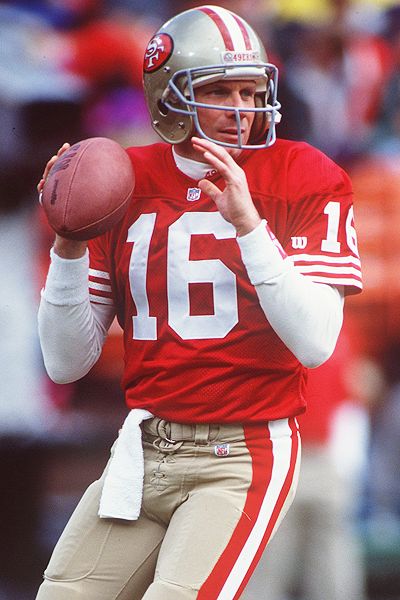
Top 50 NFL Quarterbacks: #3 - Steve Young


Steve Young

Steve Young had quite a long career in the NFL before becoming a star player, finally becoming a starter in the league at age 30. He spent 2 years playing for a horrible Buccaneers team before he was traded to the 49ers to back up Joe Montana in 1987, but ended up becoming one of the best players ever.

When Joe Montana went down with an elbow injury at the end of the 1990 season, Young took over at the helm of a team that had just narrowly missed a third straight Super Bowl win. He ended up missing 5 games in 1991 due to a knee injury, but he was already the best QB in the league in a down year for passers overall. Unfortunately, the result was a 10-6 record without a playoff berth.

In his second season as a starter for San Francisco, he threw 3465 yards, #2 in the league, while leading the league in completion percentage at 66.7% and touchdowns with 25, while tossing only 7 picks all year. The 49ers finished at 14-2, best in the league, and Young was awarded the MVP, but the season ended with a loss to Dallas in the NFC Championship Game.

He was even better in 1993, increasing his passing yardage to 4023, touchdowns to 29, and completion percentage to 68.0%. The 49ers won the division again, but once again they lost to Dallas in the NFC title game. He had been the best passer in the league for 3 years, but hadn't been able to break through that final barrier.

The next season was the best of his career in many ways. He led the league in touchdowns and completion percentage, both new career highs, led the 49ers to a 13-3 record, and won another MVP award. The playoffs were different this time, with Young leading them past Dallas in the NFC title game to get back to the Super Bowl for the first time as a starter. His performance in the Super Bowl was the best of all time, with 325 yards and 6 touchdowns, which set a Super Bowl record, as the 49ers destroyed the Chargers 49-26. He is the only player in Super Bowl history to lead all players in both passing and rushing yards in the championship game.

Over the next three seasons a series of minor injuries hampered him, causing him to miss several games, but he still led the league in completion percentage each season. All 3 of those seasons ended with losses to Green Bay in the playoffs. 

He had a renaissance season in 1998, when he set new career highs in passing yards and touchdowns, once again ranking as the best quarterback in the league, but the season still ended with a playoff loss. He had 2 concussions within the first 3 weeks in 1999, and ended up having to retire as a result.

In addition to being a great passer, Young was one of the best running quarterbacks throughout his career, leading all passers in rushing yards 3 times and coming in second twice. He is currently #3 all-time in rushing yards by a QB, and #2 in rushing touchdowns, and is also the all-time playoff leader in both categories. He led the league in touchdown passes a record 4 times, and completion percentage 5 times. And even though he only reached one Super Bowl as a starter, it was the best performance by a quarterback in the history of the title game. Add it all together, and you have one of the greatest players of all time.


Wednesday, August 19, 2015

Top 50 NFL Quarterbacks: #3 - Joe Montana


Joe Montana

Putting Joe Montana anywhere outside of the top 2 quarterbacks of all time may seem almost sacrilegious, but a couple of severe injuries shortened his career, which allowed two active quarterbacks to pass him on the all-time list within the past 5 years.

Joe Montana was a 3rd round pick by the 49ers in 1979, but hardly even saw the field as a rookie. He took over the starting job midway through his second season, but both he and the team were horrible. That would all change in his 3rd season.

1981 would be the first year that he showed his true promise. He led the league in completion percentage with 63.7%, threw 3565 yards, 19 touchdowns, and 12 interceptions, and led the 49ers to the best record in the league at 13-3. In his first ever playoff appearance, he was able to get past the Giants and Cowboys to reach his first Super Bowl, then won the Super Bowl MVP after throwing 157 yards and a touchdown while running for another.

The 1982 season was a strange one for Montana. The season was shortened to 9 games by a strike, but he led the league in touchdowns with 17 and had the highest per-game yardage of his career, but the 49ers finished at 3-6 the year after winning it all.

His personal rise continued in 1983, as he reached 3910 passing yards and 26 touchdowns, and the team made it back to the playoffs, advancing as far as the NFC title game before falling to Washington, ending up one game short of getting back to the championship.

He finally put it all together in 1984, with 3630 yards and 28 touchdowns, while San Francisco finished at 15-1, becoming the first team in history to reach 15 wins in a regular season. Despite throwing more picks than touchdowns in the first two playoff games, the 49ers still advanced to the Super Bowl again, where Montana put on a show, throwing 331 yards and 3 touchdowns while winning his second Super Bowl MVP.

They followed up their second Super Bowl win with another dud, although Montana did have a pretty good season overall. The 49ers barely made it into the playoffs, then lost in the wild card game, meaning that they followed up a championship season with no playoff wins just like before.

Montana suffered a serious back injury during week one of the 1986 season, and he was told by doctors that he should retire, but after surgery and rehab, he came back to finish out the season, and though his numbers for the season looked terrible, he won the Comeback Player of the Year award for making it back from such a terrible injury.

He missed 5 more game in 1987 due to injury, but set a career high with 31 touchdowns, which led the league for the entire season. That is also the season that Steve Young first joined the team, and he started to show some promise filling in for Montana through injuries. The Niners would fail to win a playoff game for the third season in a row, leading many to wonder whether Montana should be replaced by Young permanently.

Young did start a few games in 1988, and Montana's numbers took a hit as a result, but the 49ers would make the playoffs, and Montana would lead a great playoff run, with a total of 8 touchdowns and only 1 interception in the three games, and it ended with a 3rd Super Bowl victory. He threw 357 yards and 2 touchdowns in the Super Bowl, with 215 of those yards going to Jerry Rice, who took home the MVP.

Despite being a 3-time champion, Montana had never won a regular-season MVP, but that changed in 1989, when he put up his best season ever. He completed 70.2% of his passes, which led the league for the 5th time, and had 26 touchdowns with only 8 picks, and the 49ers finished at 14-2, best in the league by far. That year's playoff run was one of the greatest of all time, with a total of 800 yards and 11 touchdowns without an interception over 3 games, a feat only matched by Joe Flacco in 2012. His Super Bowl performance was also one of the best ever, with 297 yards and 5 touchdowns without an interception, earning him a 3rd Super Bowl MVP, becoming the first player ever to achieve that feat.

He was great again in 1990, taking home his second straight MVP award while setting a career high with 3944 passing yards, but his interceptions did double to 16, which makes it rank just a notch lower in his career hierarchy. They seemed well on their way to a third straight Super Bowl win, which has never been achieved, but he suffered a severe elbow injury late in the NFC title game, which allowed the Giants to end their chance at a three-peat.

The elbow injury turned out to be very severe, causing Montana to miss nearly two full seasons, with only a relief appearance in the final game of 1992 in that entire time. After the season ended, a full-blown quarterback controversy ensued, due to Steve Young leading them to the playoffs and winning the MVP in 1992. The result was that Montana was traded to Kansas City prior to the 1993 season, allowing him to continue his career.

He was definitely not the same player with the Chiefs, tossing a career low in yardage for a season in which he started most of the games, and had only 13 touchdown passes, but he did get the Chiefs to the AFC title game, which didn't do much for his ranking, but shows that he was a winner. He played one more mediocre season before retiring.

While many consider Montana the greatest of all time due to his 4-0 record in Super Bowls, his injury-plagued career was cut short, causing him to miss out on several years that could have catapulted him to the top. He had only 2 MVP seasons, but 3 Super Bowl MVP's and 4 championships. He had 9 seasons as an elite quarterback in the NFL, comprising the entire decade of the 1980's, other than the 1986 season that he nearly missed. The quarterbacks who have passed him up both have had longer careers, more league-leading seasons in different categories, and more playoff seasons, but it still does not mean that Montana is not one of the best to ever play the game.

Sunday, August 16, 2015

In Defense of Kurt Warner

It seems that there are several people who do not agree with Kurt Warner being placed above John Elway in my all-time rankings, and I believe that I may not have adequately proven that Warner was a greater overall quarterback, so let me go a little deeper into the numbers to show why Warner belongs where I have placed him.

First of all, let's start by examining the careers of the 4 quarterbacks already included in the top 10. Each of them had a very similar length of time as an elite quarterback, with 5 years each for Young and Warner, and 6 years for Rodgers and Elway. You may think that Elway was better than that, but if you actually look at his numbers, he was only among the best in 1986, 1987, 1993, and 1996-1998. Besides those years, he was a fairly mediocre, although consistent, quarterback.

Now let's compare the best season for each against the average starter in the league for that season, the only fair way to compare players from different eras:

Rodgers (2011) - 4643 yards, 45 touchdowns, 6 interceptions
Average (2011) - 3341 yards, 21 touchdowns, 13 interceptions

His yardage was 39.0% higher than the average, touchdowns 114.3%, and interceptions far lower than the average.

Young (1998) - 4170 yards, 36 touchdowns, 12 interceptions
Average (1998) - 2647 yards, 17 touchdowns, 11 interceptions

His yardage was 57.5% higher than the average, touchdowns 111.8%, with interceptions slightly higher (9.1%) than average.

Elway (1993) - 4030 yards, 25 touchdowns, 10 interceptions
Average (1993) - 2603 yards, 14 touchdowns, 11 interceptions

His yardage was 54.8% higher than the average, touchdowns 78.6%, with interceptions slightly lower than the average.

Warner (1999) - 4353 yards, 41 touchdowns, 13 interceptions
Average (1999) - 2789 yards, 17 touchdowns, 12 interceptions

His yardage was 56.1% higher than the average, touchdowns 141.2%, and interceptions slightly higher (8.3%) than average.

If you were to rank each of these passers against each other in each of these categories, Young comes out best in yardage, Warner in touchdowns, and Rodgers in interceptions, with Elway left out. If you rank them overall based on their rank in each category, Warner comes in first due to finishing #1 in TD's, #2 in yardage, and #3 in interceptions, with Rodgers second with a #1 in picks, #2 in touchdowns, and #4 in yardage. Young comes in third with #1 in yardage but #3 in touchdowns and #4 in interceptions, and Elway comes in last due to being #2 in picks, #3 in yardage, and last in touchdowns.

When you look at the playoff successes of these 4, each was responsible for one Super Bowl victory. (John Elway's first Super Bowl win was 100% due to Terrell Davis. Elway's performance in that game was the worst ever for a winning QB.) Let's look at their stats in Super Bowl MVP games:

Rodgers (2011) - 304 yards, 3 touchdowns, 0 interceptions
Young (1995) - 325 yards, 6 touchdowns, 0 interceptions
Elway (1999) - 336 yards, 1 touchdown, 1 interception
Warner (2000) - 414 yards, 2 touchdowns, 0 interceptions

In comparing the players based on these performances, Warner and Young come out tied for first, with Young #1 in touchdowns and #3 in yards while Warner was #1 in yards and #3 in touchdowns, both without interceptions. Elway comes in last again, with the fewest touchdowns and the only interception, even with the second-most yards.

Other than their championship seasons, Rodgers has advanced to one NFC title game, Young 3 of them, Elway 4 Super Bowls (including the first win), and Warner 2 Super Bowls, showing a clear demarcation between the first two and the last. When you look at how Warner and Elway performed in the Super Bowls in which they weren't MVP, you can see that Warner was far superior to Elway in championship games.

Warner (2 games) - 742 yards, 4 touchdowns, 3 interceptions
Elway (4 games) - 792 yards, 2 touchdowns, 7 interceptions

As you can clearly see, Warner had nearly as many yards in two games as Elway had in 4, meaning he averaged nearly twice as many per game. The interceptions are nearly identical, slightly in Warner's favor as well, but the touchdowns are far apart, with Warner throwing twice as many in half as many games. Elway may have been good at getting his team to the Super Bowl, but he wasn't good once he got there.

No matter which way you look at it, Warner's career was the best of any of these quarterbacks up to this point (Rodgers could easily pass all of them in the next year or two). People tend to look back at Elway's career with rose-colored glasses due to the storybook ending, but he just wasn't quite as great as most think. Elway has the slight edge in elite regular seasons and a decent edge in deep playoff runs, but Warner has a huge edge in MVP season performance, Super Bowl MVP performance, and Super Bowl losing performance, all of which proves my point that Warner was a greater overall quarterback than John Elway.


Thursday, August 13, 2015

Top 50 NFL Quarterbacks: #9 - Steve Young


Steve Young

Steve Young had quite a long career in the NFL before becoming a star player, finally becoming a starter in the league at age 30. He spent 2 years playing for a horrible Buccaneers team before he was traded to the 49ers to back up Joe Montana in 1987.

When Joe Montana went down with an elbow injury at the end of the 1990 season, Young took over at the helm of a team that had just narrowly missed a third straight Super Bowl win. He ended up missing 5 games that season due to a knee injury, and the result was a 10-6 record without a playoff berth.

In his second season as a starter for San Francisco, he threw 3465 yards, #2 in the league, while leading the league in completion percentage at 66.7% and touchdowns with 25, while tossing only 7 picks all year. The 49ers finished at 14-2, best in the league, and Young was awarded the MVP, but the season ended with a loss to Dallas in the NFC Championship Game.

He was even better in 1993, increasing his passing yardage to 4023, touchdowns to 29, and completion percentage to 68.0%. The 49ers won the division again, but once again they lost to Dallas in the NFC title game.

The next season was the best of his career in many ways. He led the league in touchdowns and completion percentage, both new career highs, led the 49ers to a 13-3 record, and won another MVP award. The playoffs were different this time, with Young leading them past Dallas in the NFC title game to get back to the Super Bowl for the first time as a starter. His performance in the Super Bowl was one of the best of all time, with 325 yards and 6 touchdowns, which set a Super Bowl record, as the 49ers destroyed the Chargers 49-26. He is the only player in Super Bowl history to lead all players in both passing and rushing yards in the championship game.

Over the next three seasons a series of minor injuries hampered him, causing him to miss several games, but he still led the league in completion percentage each season, but lost to Green Bay each season in the playoffs. He had a renaissance season in 1998, when he set new career highs in passing yards and touchdowns, although the season still ended with a playoff loss.

Young and Rodgers have had very similar careers. Each began as a backup to a legend for several seasons, then had immediate success as a starter. Each has won 2 MVP's and a Super Bowl MVP, and each was always among the league leaders in every passing category. Young is ahead of Rodgers right now for one reason, and that is that he had one more full season as an elite quarterback, although that should change by the end of next season.

Thursday, July 23, 2015

Top 50 NFL Quarterbacks: #29 - Troy Aikman


Troy Aikman

Troy Aikman is the first quarterback to appear on this list who won at least 3 Super Bowls, so it seems a little strange to see him ranked this low. The truth is, apart from those 3 championship seasons, he didn't do that much, and he had a rather short career, so he doesn't even get the benefit of longevity.

Aikman was the #1 overall pick in the 1989 draft, but his rookie season was a disaster. His record as a starter was 0-11, and he threw twice as many interceptions as touchdowns. In all, over his first three years, he threw for 31 touchdowns and 46 interceptions, and the Cowboys were 14-24 when he started.

Everything turned around very quickly. Aikman was finally fully healthy in 1992, and Michael Irvin and Emmitt Smith had blossomed into star players. That year, Dallas finished with a 13-3 record and upset MVP Steve Young and the San Francisco 49ers in the NFC Championship Game to get to the Super Bowl. He was even named the MVP of the Super Bowl after throwing 273 yards and 4 touchdowns without an interception in the 52-17 blowout.

The next season he led the league with a 69.1% completion percentage, but he threw only 15 touchdowns over a full season. Dallas did earn the best record in the league at 12-4, but it was Emmitt Smith who was named the league MVP. They returned to the Super Bowl by running through San Francisco again, then beat Buffalo again in the Super Bowl, but this time Aikman did not throw a touchdown pass, as Emmitt Smith ran the Bills into the ground en route to his first Super Bowl MVP.

He was even less effective the next season, throwing only 13 touchdowns to 12 interceptions, and he was unable to get past San Francisco in the NFC Championship, so they failed to three-peat. In 1995 he managed to get his interceptions back down, and the Cowboys returned to the Super Bowl, where they beat the Steelers, though Aikman only threw 1 TD.

He played 5 more seasons, but was not too effective, winning only one more playoff game for the remainder of his career. In all, he only reached 20 touchdowns once in his career and never reached 3500 yards in a season. He was only a top quarterback for 4 seasons, and though he won three titles during that span, he did nothing else of note in his entire career, and wasn't even that great when they won the final 2 titles. #29 is right where he belongs.