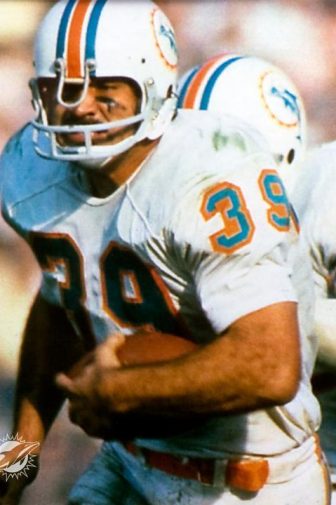
Larry Csonka
Teams
Miami Dolphins (1968-1974,1979)
New York Giants (1976-1978)
Playoffs
Appearances - 6 (1970,1971,1972,1973,1974,1979)
Conf Champ Games - 3 (1971,1972,1973)
Super Bowls - 3 (1971,1972,1973)
Championships - 2 (1972,1973)
Awards and Honors
All-Pro First Team - 2 (1971,1973)
All-Pro Second Team - 1 (1972)
Pro Bowl - 5 (1970,1971,1972,1973,1974)
Super Bowl MVP - 1 (1973)
Comeback Player of the Year - 1 (1979)
Hall of Fame - 1987
All-Time Ranks
Rushing Touchdowns - #49
Rushing Yards - #52
Yards per Rush - #86
League Leads
Rushing Yards (#3-1971, #4-1972, #5-1970,1973)
Rushing Touchdowns (#3-1974, #4-1968,1979, #9-1970, #10-1971)
Yards per Rush (#1-1971, #4-1972, #5-1970, #8-1969,1973, #10-1968)
Rushing Yards per Game (#3-1971, #4-1972, #5-1970, #7-1969, #8-1973, #9-1968, #10-1974)
Total Touchdowns (#6-1979, #8-1968, #10-1974)
Scrimmage Yards (#5-1971)
Yards per Touch (#6-1971)
After rushing for 1127 yards and 8 touchdowns as a senior at Syracuse and finishing 4th in the Heisman voting, Larry Csonka was drafted by the Miami Dolphins with the 8th overall pick in the 1968 NFL Draft.
Csonka was a decent fullback during his first couple of years in Miami, but missed several games each year with concussions. When Don Shula was hired as coach before the 1970 season, he taught Csonka how to protect his head while running to reduce the likelihood of concussions, and he didn't miss a single game over the next 4 seasons.
In 1970, he rushed for 874 yards and 6 touchdowns, and was named to his first Pro Bowl. In 1971, he was the best running back in the league, gaining 1051 yards on the ground and scoring 7 touchdowns, gaining 5.4 yards per carry, best in the league, and helped lead the Dolphins to the Super Bowl, where they lost to the Cowboys 24-3.
In 1972, he and Mercury Morris became the first pair of teammates in history to each rush for 1000 yards, with Csonka gaining a career-high 1117 on the ground. The Dolphins finished that year undefeated, and when they returned to the Super Bowl, Csonka gained 112 rushing yards in their 14-7 victory over the Redskins to cap off a perfect season, still the most recent one in the NFL.
Csonka was still very good in 1973, reaching 1000 rushing yards for the 3rd year in a row, and leading the Dolphins to their 3rd straight Super Bowl. Csonka was named MVP of that Super Bowl after scoring 2 touchdowns and setting a then-record with 145 rushing yards in the game, winning a second straight championship.
The next season, Csonka gained only 749 rushing yards, but had 9 touchdowns, his best to that point in his career, but the Dolphins were upset in the playoffs, preventing a third straight title. After that season, he and two teammates decided to leave Miami to join the new World Football League, where they played for the Memphis Southmen.
After the WFL folded early in 1976, Csonka joined the New York Giants as a free agent, where he played 3 seasons, but never reached 600 yards in a season or 4 yards per carry. When his contract ended, he signed with the Dolphins as a free agent, gaining 837 yards and scoring a career-best 12 touchdowns while earning the Comeback Player of the Year award. After the season, he was unable to come to terms on a new contract with Miami, and instead retired.
For a few years in the early 1970s, Csonka was a star player on one of the greatest teams in the league, and was instrumental in 2 championship runs. He received MVP votes in 2 different seasons, and was among the league leaders in yards per carry during his entire first tenure with the Dolphins. His bruising style probably led to his early decline, but he was great at his peak, and is one of the greatest players of all time.


