Tuesday, June 11, 2019

Top 50 NFL Quarterbacks: #45 - Jeff Hostetler


Jeff Hostetler

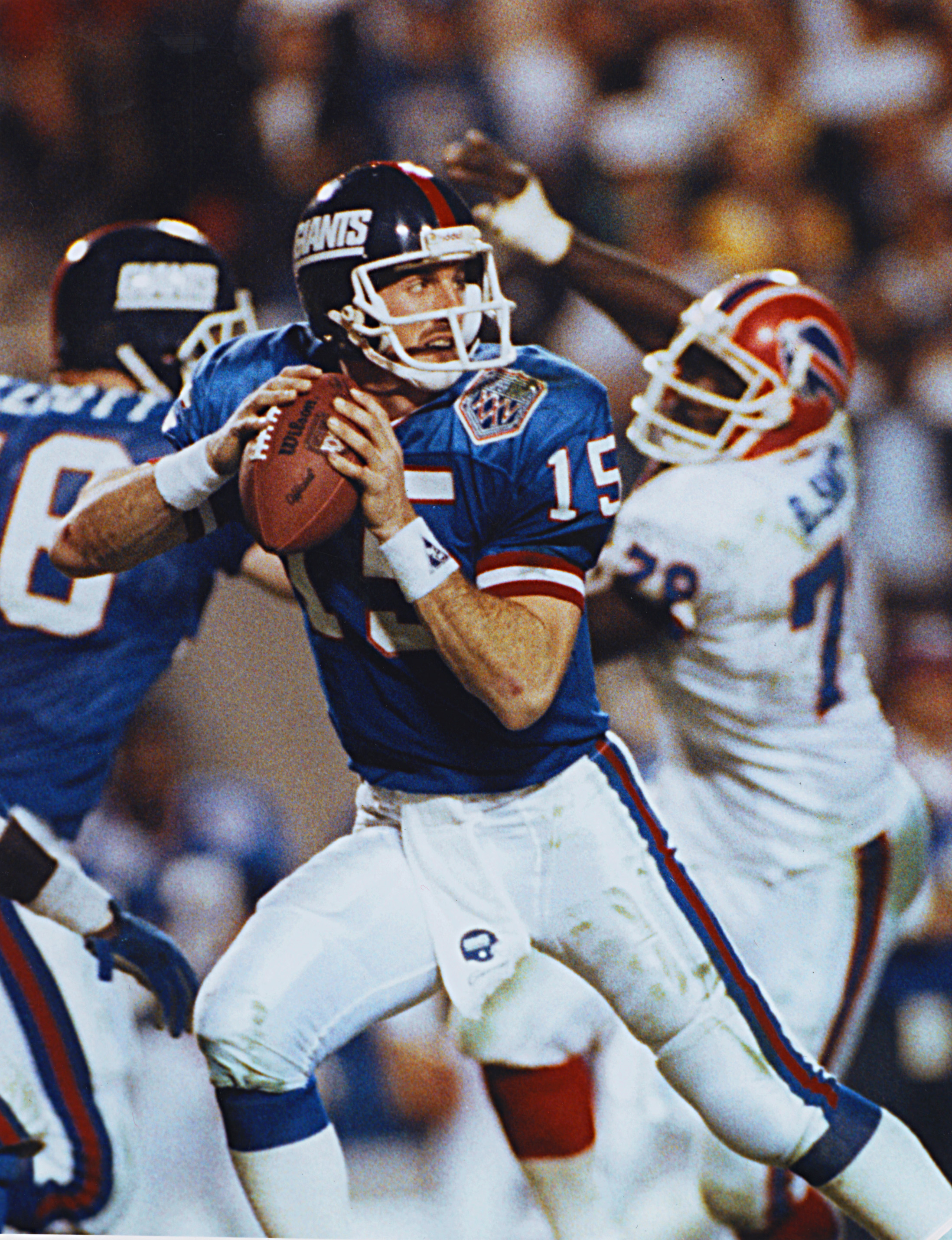
Jeff Hostetler is one of the few backup quarterbacks to lead his team to a Super Bowl victory, and as a result he was able to earn a starting job for several years and became a pretty good quarterback.

Hostetler was drafted by the Giants in 1984, but didn't even take his first snap until 1988, when he moved up to the backup role behind Phil Simms. He played well when he was needed, but it wasn't often, and near the end of the 1990 season he was considering retirement when his moment finally came.

Phil Simms injured his foot late in the 14th game of the season, which they eventually lost to the Bills, but Hostetler led them to victory in their final two games, then guided them through the playoffs as well, throwing 3 touchdowns and running for another without an interception in 3 playoff games, and the Giants held on in the Super Bowl against Buffalo to become world champions.

When Simms was healthy again before the next season, Hostetler was able to win the starting job in training camp, but he broke his back in game 12, which resulted in him missing the remainder of the season. The next year, Simms won the starting job in camp, but was lost for the season in week 4, giving the job back to Hostetler again, but missed 3 games of his own with injuries.

After the season, the Giants decided not to resign him, so he went west to claim the starting job with the Raiders. His first season in LA was his best, with 14 passing touchdowns and a career high 5 rushing touchdowns, and he led the Raiders to a huge wild card win with 294 yards and 3 touchdowns before they fell to the Bills in the divisional round. In his 5 career playoff starts, Hostetler had a 4-1 record with 7 touchdowns and 0 interceptions.

He was elected to his only Pro Bowl the following season, and had a couple more solid but injury-ridden seasons with the Raiders, but the twin peaks of his career were the two playoff runs while he was starting, when he really stepped up his play over his regular season levels. He may have had a short starting career, but he played best when he needed to, and has a Super Bowl title and a spot on this countdown of the best quarterbacks of all time to show for it.


Sunday, June 9, 2019

Top 50 NFL Quarterbacks: #46 - Norm Van Brocklin


Norm Van Brocklin

Norm Van Brocklin may not be a household name, but he was a great quarterback way back in the 1950's, winning titles with two different teams and setting a huge record that has still never been broken.

He began his career in 1949 with the Los Angeles Rams, but the team already had a star quarterback named Bob Waterfield, so he hardly played as a rookie. After that season, the Rams got a new coach with a new approach, a platoon system at quarterback that gave each of them equal time. It worked well, with the Rams advancing to the title game, which they lost 30-28.

The following year the Rams returned to the NFL championship game and earned their revenge, beating the Cleveland Browns 24-17 on Van Brocklin's first-ever playoff TD, a 73-yard pass late in the 4th quarter. That play enabled them to overcome Waterfield's two earlier interceptions, and Van Brocklin was a champ for the first time.

1951 was also the season that Van Brocklin set his most famous record. In the season opener, the Rams were hosting the New York Yanks, who would finish in last place, and Waterfield was out with an injury, so Van Brocklin got to take every snap of the game. That perfect set of circumstances led to him throwing for 554 yards, a record that still stands 68 years later. He also threw 5 touchdowns in that game, which was a huge blowout for the future champs.

The next year the Rams lost a tiebreaker game to Detroit after the regular season, which kept them from their 4th straight championship game, and Waterfield retired after the season ended, which handed the quarterback reins exclusively to Van Brocklin for the first time. The following season was one of his best, with new career highs in passing yards, touchdowns, and TD:INT ratio, but it was also the first time in his career that his team missed the playoffs.

He continued to be one of the better quarterbacks in the league for several more years with the Rams, but only made it back to the title game once more, another loss to Cleveland in 1955. He had won a title in 1951, but had yet to win one as a starter. He grew tired of LA's offensive scheme and decided to retire after the 1957 season, only to unretire after being told he would be traded to Philadelphia.

When he arrived, the Eagles had missed the playoffs 8 straight years, and they did no better in his first season with the new squad, but they improved the following season, posting a winning record for the first time in nearly a decade, then made the big jump in 1960, earning the best record in the league at 10-2. Van Brocklin also won the league MVP honor that season, with 2471 yards and 24 touchdowns, both among the league leaders.

Because they won the Eastern Division, they got to play in the 1960 championship game, in which they faced the Green Bay Packers. The Eagles won that game 17-13 behind 204 yards and a touchdown from Van Brocklin, and he finally earned his title as a starter. He retired a couple weeks after the game to begin a career as a coach, which didn't go nearly as well, but he remains the only quarterback to beat the Packers in a playoff game while Vince Lombardi was the coach.

Other than his one huge single-game passing record, Van Brocklin didn't do anything super flashy during his career, but was a very good quarterback for an entire decade and won 2 NFL titles while narrowly missing a third. That is enough to say that he deserves a place among the all-time greats.


Saturday, June 8, 2019

Top 50 NFL Quarterbacks: #47 - Kordell Stewart


Kordell Stewart

Kordell Stewart was one of the most versatile players in history, playing every skill position at some point and even punting once in an emergency situation, and while his passing numbers were somewhat lacking at times, he was a strong runner who made defenses plan differently.

He was drafted by the Pittsburgh Steelers in 1995, but they were hoping that he would agree to play another position, as they had 3 other quarterbacks on the roster at the time. He did play multiple positions as a rookie, and was able to record touchdowns passing, rushing, and receiving that year. In his second year, he scored 2 rushing touchdowns in a playoff game during his regular spot duty.

In his third season, he was able to secure the starting quarterback job he coveted, and he led the Steelers to the AFC title game, with 21 passing touchdowns and 11 rushing touchdowns during the season, becoming the first QB ever to surpass 20 and 10 in a season.

The team was in turmoil for the next couple seasons, losing many of its starters and going through multiple offensive coordinators, and Stewart did not perform well, throwing more picks than touchdowns and losing his starting job. He opened the 2000 season on the bench, but was able to earn it back, and he rode that momentum to his best season as a passer in 2001.

That year, he made his only Pro Bowl appearance after throwing for a career-high 3109 yards and leading the Steelers to a 13-3 record, though they again fell short of the Super Bowl, and Stewart's TD:INT radio was a mediocre 14:11, and he would lose his starting job again the next year after being unable to reduce the turnovers.

He played for a few more years with the Bears and Ravens, but was never able to regain his form from his three good seasons. He threw more interceptions than touchdowns in his career, but he has the 4th-most rushing touchdowns of all time for a quarterback, behind only Cam Newton, Steve Young, and Jack Kemp. He made up for his shortcomings as a passer with his rushing ability, and though he never developed into the all-around quarterback most on this list did, he still deserves to be remembered as one of the best to play the game.


Thursday, June 6, 2019

Top 50 NFL Quarterbacks: #48 - Steve Grogan


Steve Grogan

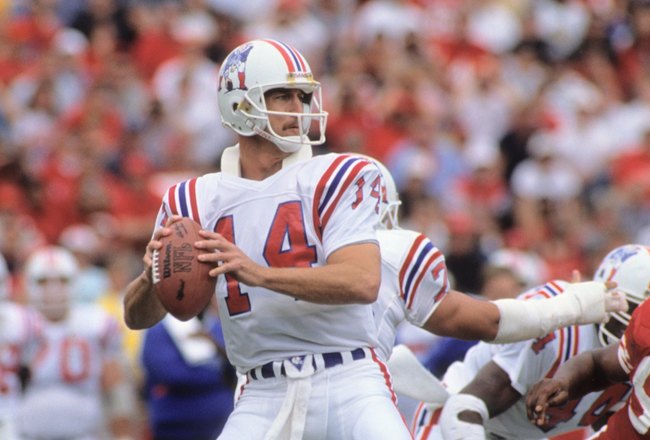
Steve Grogan had one of the most injury-plagued careers of any quarterback in history, but on those rare occasions when he was healthy, he was one of the top quarterbacks in the league.

Grogan was drafted by the Patriots in the 5th round in 1975 to back up Jim Plunkett, who was a Heisman winner and #1 overall pick, but by the end of his rookie season he had taken over the starting job, leading to Plunkett being traded to the 49ers after the season.

During his first full season as a starter, he led the Patriots to an 11-3 record, the best in franchise history to that point, and their first playoff berth in over a decade. That year he also set a record that would stand for 35 years, most rushing touchdowns by a quarterback in a season, with 12, which was 3 times as many as any other QB that year, and wasn't broken until Cam Newton had 14 in a 16-game season in 2011.

In 1978, he led the Patriots to a division title and their first-ever home playoff game on a team that set the record for most rushing yards by a team (3156), which still stands today. It was also the only team ever to have 4 players record over 500 rushing yards, and QB Grogan was among them. The following season he led all players in passing touchdowns with 28, but it would also be his final full season.

His injury problems started in 1980, when he missed 4 games due to 2 sprained knees, one of each. In 1981, he missed 4 games with a neck injury and 4 more with a knee injury. The Patriots drafted Tony Eason in 1983 as insurance, and he came in handy when Grogan broke his leg near the end of that season, missing the final 4 games and most of the 1984 season.

In 1985, he was finally looking healthy again, and the Patriots were winning, but then he broke his led and injured his MCL, which kept him out until the Super Bowl. Eason still started the Super Bowl, but after being unable to complete a pass, Grogan took over and led the Patriots to 10 points, the only points scored against the Bears in that entire postseason.

He continued to play off and on between injuries through the 1990 season, when the Patriots decided it was time to part ways. When he retired, he was the franchise's all-time leader in passing yards and touchdowns, and the only Patriot to play longer for the franchise is Tom Brady.

He may have never won a playoff game as a starter, never been voted to a Pro Bowl, and be largely forgotten today, but he had a good run of great years early in his career, and was a solid player in stretches for another decade. He was one of the early dual-threat quarterbacks, having led the league in both rushing touchdowns and passing touchdowns at one point, and helped a franchise that had never seen any success reach a Super Bowl.


Tuesday, June 4, 2019

Top 50 NFL Quarterbacks: #49 - Jim Kelly


Jim Kelly

Jim Kelly is best known for being the only quarterback to start in 4 consecutive Super Bowls, but his making this list actually has very little to do with that. He quarterbacked some great teams and was always solid in the regular season, but was usually not at his best during the playoffs, which may be a big part of the reason he never won a Super Bowl.

Kelly was drafted by Buffalo in 1983, but he had no desire to play for the Bills, so he signed on with the USFL's Houston Gamblers, where he set league records for passing that nobody else was close to, but when the league folded in 1986, he had no choice but to join Buffalo.

The Bills were struggling through the rebuilding process for his first couple of seasons in Buffalo, but starting in 1988, they would make the playoffs 8 times in 9 seasons. He peaked in 1990, when he led the Bills to a 13-3 record, best in the AFC, and led the league with a 63.3% completion percentage while throwing a career-low 9 interceptions.

That season was the only time he played well in the playoffs, throwing for 639 yards and 5 touchdowns in the first two games, which earned Buffalo its first-ever Super Bowl berth. Kelly was solid in the Super Bowl, throwing for 212 yards, but did not throw a touchdown, and the Bills lost at the last moment when Scott Norwood missed what would have been the winning field goal with 8 seconds left in the game.

The following season he led them back to 13-3, led the league with 33 touchdowns, and they again made the Super Bowl, but it was in spite of Kelly, who threw for only 390 yards, 3 touchdowns, and 5 interceptions in the two games leading up to the big game. He added 4 more picks in the Super Bowl as the Bills lost to Washington 37-24.

In 1992 he missed the first two playoff games due to injury, which were the biggest comeback in playoff history and a blowout upset of the Steelers. He returned in time to help Buffalo upset Miami, but struggled in the Super Bowl, throwing 2 picks before going down again and being replaced as Dallas ran away 52-17.

It was more of the same in 1993, as Buffalo advanced to the Super Bowl, while Kelly threw for only 447 yards and 2 touchdowns in the first two playoff games, then again failed to throw a touchdown in the Super Bowl as they fell to Dallas, this time 30-13.

He played another 3 years, making two more playoff appearances, but he lost his best chance at a title when that kick missed in his first trip to the big game. He never played up to his potential again in the playoffs, and that is a big part of the reason that he isn't ranked higher on this list, but he was good enough in all those years of leading Buffalo to the playoffs that he has to be part of this countdown.


Sunday, June 2, 2019

Top 50 NFL Quarterbacks: #50 - Joe Theismann


Joe Theismann

Today, Joe Theismann is probably best known for the gruesome leg injury that ended his career in 1985, but in the few seasons leading up to that he had become one of the top quarterbacks in the game, and who knows how much more he would have accomplished had he been able to keep playing.

He was drafted by the Miami Dolphins in 1971, but after being unable to reach a contract agreement, he elected to play in the CFL, where he was an all-star twice in three seasons. In 1974, Miami gave up and traded his rights to Washington, and he decided to move back to the States and join his new team. He was a punt returner for his first couple of seasons, before moving up to backup quarterback for two years, then finally starting quarterback in 1978, at the age of 29.

He improved slowly year by year, increasing his passing yardage each year through 1981, when he threw for 3568, but Washington could not make the playoffs. That changed in 1982, when the season was shortened to 9 games by a strike. Theismann led the Redskins to an 8-1 record, tops in the league, then plowed through the first three rounds of the playoffs, winning all three games by at least 14 points.

The Redskins relied heavily on running back John Riggins in Super Bowl XVII, but it was Theismann who made one of the biggest plays of the game. Late in the third quarter, with his team trailing 17-13, Theismann's pass was tipped at the line and was about to be intercepted when Theismann stepped in and batted the ball away, preventing a sure touchdown and a double-digit deficit. Washington went on to win 27-17.

The following season was the best of his career, as he threw for career highs of 3714 yards and 29 touchdowns, and again led Washington to the league's best record, this time at 14-2. He was named the league MVP for his performance, and it kept going in the playoffs, as the Redskins outscored their first two opponents 75-28 on their way to a repeat appearance in the Super Bowl. He lost the chance at a repeat title, though, when he was outplayed by Jim Plunkett and the Raiders, losing the game 38-9.

1984 brought another playoff berth and division title, but they were surprised by the Chicago Bears in the playoffs, ending their season prematurely. He was off to a rough start in 1985 when his career ended on a sack by Lawrence Taylor. As he was taken down, his lower leg was snapped in half, and when it healed, his right leg was significantly shorter than the left, forcing him to retire.

He got a late start on his career, and it ended earlier than expected, but at his peak in 1982 and 1983, he led his team to a 28-4 overall record and won an MVP and a Super Bowl. The strength of those two seasons is what earned him this position on the all-time list.


Saturday, June 1, 2019

Top 50 NFL Quarterbacks: Intro

Four years ago I released the first version of my rankings of the 50 greatest NFL quarterbacks of all time. While I feel that it was a somewhat good representation of their greatness over time, I did feel like there were some flaws in the system, causing some players to be ranked too high or too low, or to miss out on the top 50 altogether.

One issue I discovered is that players from all eras were being judged on the basis of the current game, which emphasizes passing more than it did in previous eras. I felt it was more fair to judge players based on how well they performed in the league in which they played, so I calculated the average quarterback output in each major category on a per dropback basis for each season, then calculated how far above or below average each quarterback was during that specific season. Each positive score was added together to attain a cumulative career score for each player, while negative scores were discarded.

Another issue that I discovered is that the rushing abilities of many quarterbacks was being minimized, which made many of the other per dropback averages look bad. I was able to incorporate this more fully into the formula this time, putting it on equal footing with yards gained through the air, because both are positives for the team.

This system rewards not only short periods of greatness, but also sustained periods of solid play, with the top players on the list having sustained periods of greatness. Players need to play at a high level, meaning minimizing turnovers and yards lost, while maximizing positive yardage and scoring. In addition, longevity is very important, though that longevity must go along with solid play. Also, winning matters, because quarterback is the single most important position in sports and has the greatest impact on team success, so playoff performance is also included in the formula, giving players a bonus for how well they performed in postseason games. Winning the Super Bowl does not always mean positive points for a player, because sometimes the team wins in spite of quarterback play, but great play, especially in a championship situation, can give a big boost to a player.

Nine of the 10 players from my previous top 10 remained in those spots in this iteration of the rankings, and 38 of the previous top 50 are back this time, with only 3 of those spots being taken by current players who played their way onto the list and 9 coming from older players who were missed on the previous version. 30 teams have a representative on the list, meaning a player who earned points while playing for that team, with just the Texans and Jaguars, two of the newest franchises, being shut out. An additional 4 teams, the Buccaneers, Cardinals, Jets, and Lions, are not the primary team of any player on the list, while the 49ers top the list with 4 such players.

There are 9 players each whose primary decade was the 2010's, 2000's, or 1990's, with slightly fewer in each of the earlier decades when there were fewer teams and players. There are also 9 current quarterbacks on the list, with three others who have retired in the past few years. 60 total championships are represented, including many before the creation of the Super Bowl, but 24 of the players represented do not have a ring.

I plan to reveal the 50 players over the course of the summer, finishing up before the new season starts, and I will update this post with a list of the players who have been revealed and a link to their writeup. While no ranking system can be perfect, especially with differing opinions and favoritism toward players on your favorite team, I feel that this ranking is a very good representation of the best players ever at the position. My purpose is not to create arguments about a player's worthiness to be on the list or at a certain rank, but rather to celebrate the greatness of these 50 men. I hope you enjoy it.

1. Tom Brady - Patriots - 2010's
2. Joe Montana - 49ers - 1980's
3. Steve Young - 49ers - 1990's
4. Peyton Manning - Colts - 2000's
5. Otto Graham - Browns - 1950's
6. Aaron Rodgers - Packers - 2010's
7. Drew Brees - Saints - 2010's
8. Brett Favre - Packers - 1990's
9. Dan Marino - Dolphins - 1980's
10. John Elway - Broncos - 1990's
11. Sid Luckman - Bears - 1940's
12. Terry Bradshaw - Steelers - 1960's
13. Bart Starr - Packers - 1960's
14. Roger Staubach - Cowboys - 1970's
15. Kurt Warner - Rams - 2000's
16. Fran Tarkenton - Vikings - 1970's
17. Donovan McNabb - Eagles - 2000's
18. Ben Roethlisberger - Steelers - 2000's
19. Steve McNair - Titans - 2000's
20. Johnny Unitas - Colts - 1960's
21. Matt Ryan - Falcons - 2010's
22. Randall Cunningham - Eagles - 1990's
23. Tobin Rote - Chargers - 1950's
24. Russell Wilson - Seahawks - 2010's
25. Ken Anderson - Bengals - 1970's
26. Len Dawson - Chiefs - 1960's
27. Cam Newton - Panthers - 2010's
28. Troy Aikman - Cowboys - 1990's
29. Jeff Garcia - 49ers - 2000's
30. Daryle Lamonica - Raiders - 1960's
31. Warren Moon - Oilers - 1990's
32. Rich Gannon - Raiders - 2000's
33. Ken Stabler - Raiders - 1970's
34. Alex Smith - Chiefs - 2010's
35. Daunte Culpepper - Vikings - 2000's
36. Charlie Conerly - Giants - 1950's
37. Jim McMahon - Bears - 1980's
38. Philip Rivers - Chargers - 2010's
39. Dan Fouts - Chargers - 1980's
40. Tony Romo - Cowboys - 2010's
41. Michael Vick - Eagles - 2000's
42. Roman Gabriel - Rams - 1960's
43. Boomer Esiason - Bengals - 1980's
44. Y.A. Tittle - 49ers - 1950's
45. Jeff Hostetler - Giants - 1990's
46. Norm Van Brocklin - Rams - 1950's
47. Kordell Stewart - Steelers - 1990's
48. Steve Grogan - Patriots - 1980's
49. Jim Kelly - Bills - 1990's
50. Joe Theismann - Redskins - 1980's