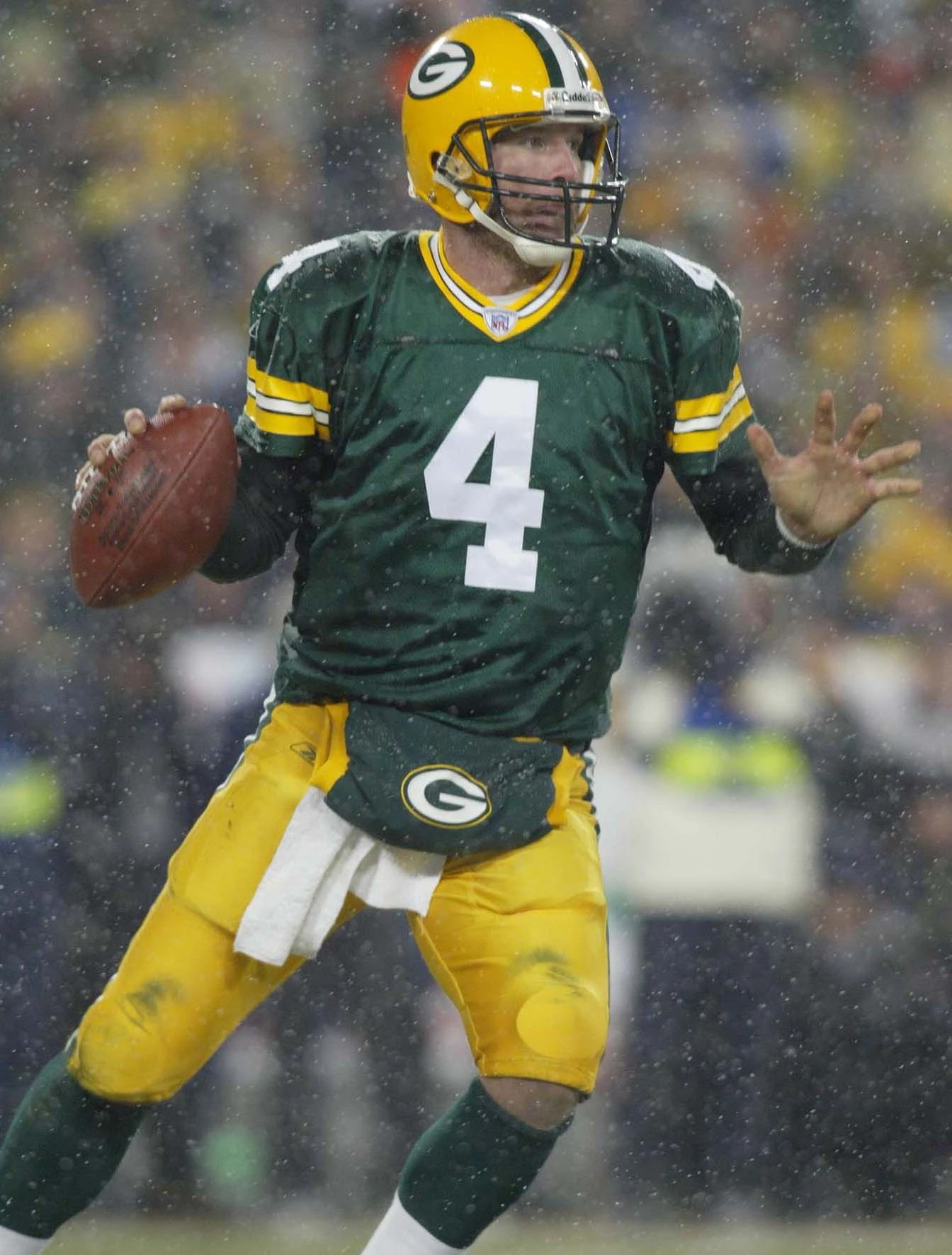
Brett Favre is yet another quarterback whose name is all over the NFL record book, but it didn't start out looking like it would lead there. He was a second-round pick of Atlanta in 1991, but only threw 4 passes in his rookie season with the Falcons, 2 of them resulting in interceptions. He was traded to Green Bay after the season for a first-round pick.
In the fourth game of his Packers career, Favre took over the starting job from Don Majkowski, and he would not give it up for the rest of his time with the team. His first two years in Green Bay were decent, but nothing special, but he started to show his greatness in 1994, when he threw 3882 yards, 33 touchdowns, and only 14 interceptions while leading Green Bay to the playoffs for the second straight year, where they lost to Dallas in the second round.
1995 was even better, with the highest passing total of his career (4413), which led the league, along with 38 touchdowns, also #1 in the league. Green Bay won the division with an 11-5 record, and Favre won his first MVP award. In the first two round of the playoffs, he threw 5 touchdowns without a pick, but he tossed 2 in the NFC title game, which led to them losing to Dallas for the third straight season to end their run.
In 1996 he dropped his yardage total back below 4000, but threw one more touchdown while getting the Packers to the best record in the league at 13-3, earning him his second straight MVP. He didn't have amazing numbers in the playoffs, but was able to finally break through and reach the Super Bowl, where he was good. He passed for 246 yards and 2 touchdowns and ran for another, but became the only QB in history to score 3 touchdowns in a Super Bowl win without being awarded the MVP.
Three-peats of any kind are a very difficult feat in sports, but Favre accomplished one in 1997, when he led the league in touchdowns for the third straight season and was awarded his 3rd consecutive MVP, becoming the first and only player ever so honored. That amazing season was followed up with another run to the Super Bowl, where they met John Elway and the Broncos, and though Favre outplayed Elway significantly, Terrell Davis led the Broncos to victory with his 3rd touchdown late in the game.
In 1998 he led the league in passing yards for the second time, reaching 4212, but threw 23 interceptions, and his down season led to the Packers falling in the wild card round to the 49ers, marking the first time in 4 years that they failed to reach the NFC title game.
He and the Packers had a couple of down years after that, with Favre throwing a lot of interceptions and Green Bay missing the playoffs, but he made a bit of a comeback in 2001, raising his TD's back up to 32 while dropping his picks down to 15. He also led them to their first playoff victory since the Super Bowl loss, but it was just a single game, and Favre ended up throwing 6 interceptions in their second round loss to Kurt Warner and the Rams.
He remained a solid quarterback on a decent team for several more seasons, with nearly every season ending with speculation of retirement, followed by a decision to play one more season to chase another Super Bowl. His final season in Green Bay came in 2007, when he threw 4155 yards and 28 touchdowns at age 38 and led the Packers to the NFC Championship Game for the 4th time in his career.
The Packers were desperate to move on and allow Aaron Rodgers to take over the starting job, and Favre felt that they forced him into retirement, but he quickly decided to unretire, which forced the Packers to trade him away to avoid a quarterback controversy. He was sent to the Jets for a year, where he had a pretty mediocre year, followed by another retirement, and another decision to come back.
When he came back in 2009, he joined the Minnesota Vikings, and had his best season since his 3 MVP years early in his career. He finished with 4202 yards, 33 touchdowns, and a career-low 7 picks. He led the Vikings to the playoffs, and even won a playoff game, which earned them a spot in the NFC title game, the fifth of Favre's career. The playoff win earned Favre the distinction of being the oldest quarterback ever to win a playoff game, at age 40, which has since been surpassed by Tom Brady.
He played one more season with Minnesota, but was terrible, with only 11 touchdown passes and 2509 yards, the lowest total since his rookie season, which ended with 0 yards. He finally retired for good at the end of the 2010 season after a career that spanned 20 years.
Favre had three excellent MVP seasons, and 6 other seasons as one of the best in the league. He led his teams to 5 conference title games and 2 Super Bowls, coming away victorious once, but what really sets him apart is the volume of his career. He was #1 all time in passing yards, completions, attempts, interceptions, wins, games started, consecutive starts, and touchdowns when he retired, though most of those have now been eclipsed. He is also the only player in history to win 3 straight MVP's, which is pretty remarkable, so there is no doubt that he deserves to be remembered as one of the best of all time.
Dan Marino is the only quarterback in the top 10 to have never won a Super Bowl, and he only reached one in his career, but what he accomplished throughout his lengthy career was enough to overcome that and earn him one of the top spots in the all-time rankings.
He was the 27th pick in the 1983 NFL Draft, the sixth quarterback taken in that first round, but he ended up with the best career of any of them. He earned the starting job in just the sixth week of his rookie season, and ended up with the most passing yardage in the AFC, but that was nothing compared to what was coming.
In 1984, he posted the greatest season by a quarterback in the history of the league to that point. He set new NFL records with 5084 yards and 48 touchdowns, destroying the old records of 4802 yards and 36 touchdowns. Both were way above the average starter numbers in the league of 2799 and 18. He also led Miami to an AFC-best 14-2 record and was obviously awarded the MVP following the season.
He also had the best playoff performance of his career that season, putting up 683 yards, 7 touchdowns, and 3 interceptions in the two games that led Miami to the Super Bowl, and his 421 yards and 4 touchdowns are still AFC title game records. The Super Bowl didn't go quite as well, with 318 yards, but only 1 touchdown and two picks, and the Dolphins lost 38-16 to Joe Montana and the 49ers. It would be the only Super Bowl appearance of his career.
His production dropped off significantly the next season, but he was still good enough to lead the league in both yardage and touchdowns, at 4137 and 30, which just goes to show how great his previous season was. Miami was able to make it only as far as the AFC title game that year, losing to New England 31-14.
In 1986 he led the league in yardage and touchdowns for the third straight year, this time throwing 4746 yards and 44 touchdowns, marking only the second time a player reached 40 touchdowns, joining himself in the club. His Dolphins failed to make the playoffs that year, however, which made it somewhat of a waste.
He had a bit of a down year in 1987, but made a nice personal comeback in 1988, leading the league in yardage again with 4434, becoming the first player ever to reach 4000 yards 4 times, passing Dan Fouts, who had done it three times. The Dolphins missed the playoffs for the third straight season, though, so his production continued to do nothing.
After a fourth straight playoff-free season, Miami finally made it back in 1990, although Marino threw only 3563 yards. He was decent in the playoffs, throwing 5 touchdowns in 2 games, but he couldn't get past Buffalo, which was on its way to its first Super Bowl defeat.
Two years later he reached 4000 yards yet again, leading the league in yardage for the 5th and final time in his career, and he also got Miami back to the AFC title game for the first time in 7 years, but they lost to Buffalo again, leaving Marino short of the ultimate prize one more time.
He tore his Achilles tendon early in 1993, causing him to miss the final 11 games, the first major injury of his career. Many doubted that he would be able to return to his previous form, but he came back strong in 1994, tossing 4453 yards and 30 touchdowns and earning the Comeback Player of the Year Award, but Miami would fall in the second round again.
From there on it was a slow decline for Marino, who would continue to get Miami to the playoffs, but could never win more than one game in a single postseason. He was no longer among the elite quarterbacks, but he played through 1999, a career that spanned 17 seasons.
Marino may not have the championship resume of any other player in the top 10, but what he does have is eight full seasons as an elite quarterback, including 2 seasons as the best passer in the league and the 1984 season, which is still one of the 5 greatest in NFL history. He was also very good in that playoff run, and though that would be one of only 3 deep playoff runs in his career, his regular season prowess was enough to earn him a spot among the best to ever play the game.
John Elway was the top overall pick in the 1983 NFL Draft, and by the time he retired he had set records with 5 Super Bowl starts and 148 regular season wins, both of which have been surpassed in recent years.
He went through the usual struggles as a rookie, throwing twice as many interceptions as touchdowns and being benched for a while as a result, but he began improving quickly, and by 1986 he was one of the top passers in the game. He was in the top 10 in passing yards and touchdowns that year and led Denver to an 11-5 record. One of his most famous moments came in the AFC Championship Game against Cleveland, when he led a 98-yard drive in the closing minutes to score the tying touchdown, the only TD pass he threw in the game. In his first Super Bowl appearance, he threw for 304 yards but was outplayed by Phil Simms on the way to a 39-20 loss.
In 1987 his numbers and Denver's record both dipped slightly, but he still ended up winning the MVP after most other passers slipped more. He was very good in the playoffs again, breaking Cleveland's collective heart in the AFC title game with another great game, but threw 3 interceptions in the Super Bowl, which ended in a 42-10 loss.
The Broncos missed the playoffs in 1988, but led them back to the playoffs in 1989 with another average season of 3051 yards, 18 touchdowns, and 18 interceptions. He played well in the early playoff rounds again, knocking off Cleveland once again to reach his third Super Bowl in 4 years, but fell apart in the Super Bowl as usual, with only 108 yards and 2 interceptions without a touchdown pass.
Both Elway and the Broncos struggled through the next few years, putting up average passing numbers with too many interceptions while usually making the playoffs but failing to advance very far. The doldrums disappeared very suddenly in 1993 for Elway, as he had his best statistical season, setting career bests with 4030 yards, 25 touchdowns, and 10 interceptions, but the season ended in the wild card round.
He stayed statistically good for the next few years, but could not do anything in the playoffs. When he finally had a solid team around him in 1997, he threw for a career high of 27 touchdowns and the Broncos earned a 12-4 record. While leading them through the first 3 rounds of the playoffs, he threw for only 603 yards and 3 touchdowns while Terrell Davis carried the team on the ground. In the Super Bowl he had only 123 yards and one interception and no touchdowns once again, but Terrell Davis' 3 touchdowns earned them a Super Bowl victory.
In his final season, he led Denver to a 14-2 record, best in his career, and took the Broncos back to the Super Bowl after throwing only 255 yards and 2 touchdowns in the first two playoff games. He finally had a decent Super Bowl in his fifth try, reaching 336 yards and tossing one touchdown on his way to earning his first Super Bowl MVP award.
John Elway was one of the top quarterbacks in the league for a long, long time, playing a total of 16 seasons, although he was usually not the best, reaching 3500 yards 5 times and 20 touchdowns only 6 times. What makes him one of the all-time greats was what he did in the playoffs, leading the Broncos to 5 Super Bowls, which was a record for a starter until Tom Brady overtook him. What held him back from being any higher was his subpar performance nearly every time he reached the Super Bowl, which seems odd for a player knows for his clutch play throughout his career. Still, there is no doubt that he is one of the greatest of all time.
Sid Luckman is the oldest quarterback to make this countdown, arriving in the league as the #2 overall pick in 1939, and he entered a league where the quarterback position didn't exist yet. He started out as a punter, but helped lead the transition into quarterbacks taking care of the ball and actually passing more than a few times a game.
In his second season, he earned 941 yards, which was average for the time, with 4 touchdown passes and 9 picks on the season. It may not have looked impressive, but it was enough for an 8-3 record and a berth in the championship game against Sammy Baugh's Redskins. He threw for 88 yards and a touchdown and ran for another, which were just 2 of the 11 touchdowns they scored in a 73-0 romp, the biggest blowout in NFL championship history.
The next season he upped his performance just a little, and Chicago finished at 10-1, beating Green Bay in a tiebreaker before destroying the Giants for their second straight title, 37-9. Luckman was still not amazing in the title win, throwing for 160 yards without a touchdown.
The next season was more of the same, with Luckman having an average season and the Bears destroying the competition, finishing the season undefeated at 11-0. In their 3rd straight title game, the Bears were finally defeated, giving the game to Baugh and the Redskins 14-6, with Luckman finishing with as many yards as interceptions (2).
1943 is when he became a superstar. That season he surpassed Sammy Baugh, if only for one season, beating his nemesis and all others with 2194 yards and 28 touchdowns, leading Chicago to an 8-1-1 record and their 4th straight title game, and also won the league MVP award. He also finally had a great title game, throwing for 286 yards and 5 touchdowns as they destroyed Baugh and the Redskins 41-21.
He spent the next two seasons playing only part-time while serving stateside with the Marine Corps during World War II, and the Bears struggled, missing the playoffs both times. When the war ended and he returned to playing full-time, he picked up where he had left off, leading the league in yardage and touchdowns and taking Chicago back to the title game, where they beat the Giants again, this time 24-14, overcoming Luckman's 2 interceptions to take their 4th title in 5 tries.
In 1947 he set a new career high with 2712 yards and also had 24 touchdown passes, but nearly doubled his career high in interceptions with 31, which caused the Bears to miss making the title game for the first time with Luckman since he was a rookie. He played 3 more seasons, but was declining quickly and retired in 1950.
He finished his career with 4 championships and 5 trips to the title game, and though he was rarely great in the playoffs, he was nearly always better than the opposing quarterback. He doesn't qualify to reach the top 10, however, because he wasn't the driving force behind most of those titles, just a very good game manager.
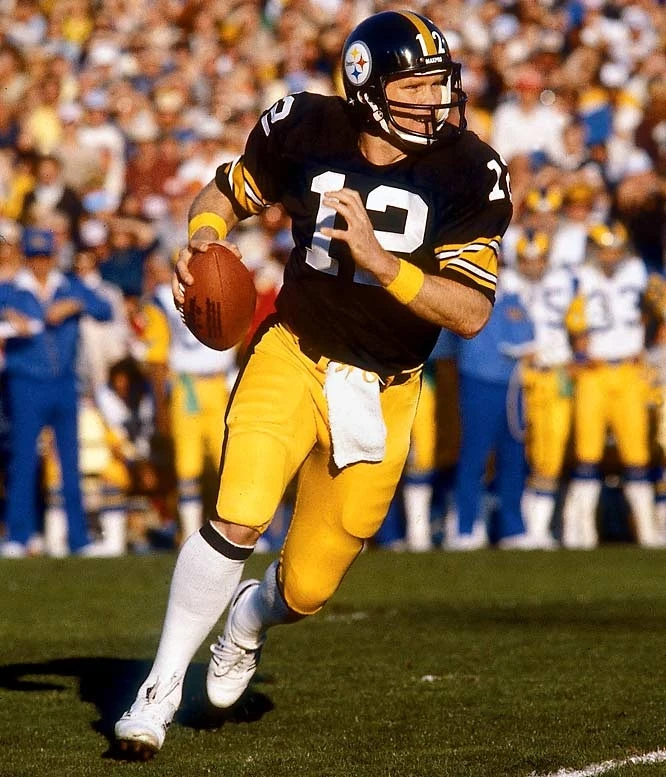
Terry Bradshaw is well-known for being the first quarterback to win both a third and a fourth Super Bowl, but he was also famous during his playing days for throwing tons of interceptions, and his career touchdown total did not exceed his interception total until the final game of his career.
Bradshaw started out as the #1 overall pick in 1970, and he struggled mightily as a rookie, throwing only 1410 yards and 6 touchdowns with 24 interceptions. He spent his first 5 seasons never throwing more touchdowns than picks, but somehow got Pittsburgh to the playoffs in 1974. During the postseason, they were able to run past their first two opponents to reach the Super Bowl, where they prevailed despite only 96 yards from Bradshaw.
The championship win seemed to awaken Bradshaw, and he went on to have his best season to that point in 1975, when he reached 2000 yards for only the second time and threw twice as many TD's as picks, a huge improvement for him. The Steelers finished with the league's best record and romped through the playoffs again on their way to a repeat championship, this time behind 209 yards from Bradshaw.
He missed 4 games due to injury the following season, giving them a tougher draw in the playoffs, and they ended up going down in the AFC title game, losing the chance at a three-peat. The loss seemed to impact him the next year, as he was back to throwing tons of interceptions, and Pittsburgh lost in the first round.
He had his best overall season in 1978, setting a career high in passing yards and leading the league in touchdowns, and Pittsburgh finished at 14-2, two games ahead of any other team in the league. They destroyed Denver and Houston to reach the Super Bowl, then Bradshaw put on his best championship performance, throwing 318 yards and 4 touchdowns as they beat Roger Staubach and Dallas 35-31 and he was named the game's MVP, which went nicely next to the regular season MVP from that season.
He upped his yardage to 3724 in 1979, guiding Pittsburgh back to the top record in the league. They again had an easy run back to the Super Bowl, and Bradshaw put on another good performance, with 309 yards and 2 touchdowns in the 31-19 win over the Rams. No other QB had won 3 Super Bowls, and now Bradshaw was a 4-time champ.
They missed out on the three-peat again in 1980, when they didn't even make the playoffs despite a decent season from Bradshaw. Injuries to his throwing arm started to take a toll, and he retired in 1983 after throwing 2 touchdowns in his final game to bring his career TD total to 212, surpassing his INT total of 210.
Bradshaw is one of the few QB's in history to win 4 titles, but he wasn't very good during the first two title runs. He was never considered a great passer, reaching 300 yards in a game only 7 times in his entire career. One thing that really helped him was the fact that two of those 7 big games came in the Super Bowl, so he really stepped up when he needed to later in his career. He can't be left out of the conversation of the all-time greats, but he just wasn't ever the dominant QB that most of the players ahead of him were.
Bart Starr has won more NFL championships than any other quarterback in history not named Tom Brady, winning two Super Bowls and 3 NFL Championships before that, and is the only QB to win the NFL championship in 3 consecutive seasons since the playoff system was instituted, yet somehow he finds himself outside the top 10 quarterbacks of all time.
The biggest reason that Starr finds himself this low in the rankings is that despite his long (16 year) career, he was only among the top quarterbacks for five seasons, and those happen to be the seasons that the Packers won.
He started out as a 17th round pick in 1956, and spent his first 5 seasons splitting time at quarterback with lower-caliber players. He then spent 10 seasons as a full-time starter, but the most touchdowns he ever threw in a season was 16. During that same timespan, at total of 10 other quarterbacks passed for at least 30 touchdowns in a season, so it wasn't the run-happy era many assume it was, it was just that Starr was an average quarterback.
What makes him one of the greats was his ability to win when it mattered. He won his first title in 1961, when he threw 164 yards and 3 touchdowns as the Packers trounced the Giants 37-0. It was easily his best performance in a title game, as he threw only 4 total touchdowns in his other 4 championships, with 684 yards total. He was named the MVP of the first two Super Bowls, but it was due more to the lack of other decent choices than his level of performance.
He was also a league MVP in 1966, a season in which he passed for 2257 yards and 14 touchdowns, but threw only 3 picks. The team's 12-2 record was the bigger reason for his MVP, since there were players with twice as many touchdowns and 1000 more passing yards who were overlooked, including Len Dawson and Sonny Jurgensen.
Bart Starr was a very good quarterback who played for the greatest coach in history, and that enabled him to become a 5-time champion. That has allowed him to be remembered as one of the all-time greats, but without factoring in playoff success, he wouldn't even be part of the top 50.
Roger Staubach was a 10th round pick in the 1964 Draft by the Dallas Cowboys, who drafted him before his senior season at Navy so that they could hold on to his rights. After graduating in 1965, he served out his commitment in the Navy, spending some time in Vietnam, before finally being released in 1969 at age 27.
He played very little during his first two seasons, but took over the starting role early in 1971 and won all 10 games he started, which earned Dallas the league's best record at 11-3, but he didn't stop there. He led them right through the first two rounds of the playoffs and to the Super Bowl, where he threw for 119 yards and 2 touchdowns as they beat Miami 24-3, and Staubach was named the Super Bowl MVP in his first season as a starter.
He injured his shoulder at the beginning of the next season, missing almost the entire season, but when Craig Morton started to struggle in the first playoff game, Staubach came in and threw 2 touchdown passes in the final 90 seconds to lead them to a comeback victory over the 49ers, which earned him the starting job permanently.
In 1973 he led the league in touchdown passes with 23, but that would surprisingly be the only time in his career he led the league in any category. Their playoff run ended early that year, then they missed them completely in 1974, but he still had plenty left in the tank.
In 1975 he got the Cowboys back to the playoffs, taking the only wild card spot, but he led them to two straight upset wins, including a 37-7 win over the Rams, in which he threw 220 yards and 4 touchdowns. In his second Super Bowl appearance, he threw 3 interceptions to offset his 2 touchdowns as they lost to Pittsburgh 21-17.
Two years later, he took them to another Super Bowl, this time against the Denver Broncos, led by Craig Morton, who was Dallas' starter before Staubach, and even though he only threw one touchdown, it was more than enough to win his second title.
He reached his 4th Super Bowl in 1978, earning a rematch with the Steelers, who had beaten them 3 years earlier, but the result was the same. He played much better this time, with 228 yards and 3 touchdowns, but he was outplayed by Bradshaw again as Dallas lost in a shootout 35-31.
He turned in one of his best seasons in 1979, which would be his last. He set career highs in passing yards (3586), and touchdowns (27) and led Dallas to the NFC's top record, but was denied a shot at a third straight Super Bowl trip by a loss to the Rams. He decided to retire at age 37 due to a series of concussions that were affecting his health.
His career may have been only 11 seasons, and he was only a starter for 8 of them, but he reached four Super Bowls and won two. He also finished in the top 5 in passing yards in 6 straight seasons, and was also one of the top rushing quarterbacks in his era. The fact that he made the Super Bowl in half of his seasons as a starter is amazing, and he is definitely one of the greatest to ever play the game.