Showing posts with label Los Angeles Dodgers. Show all posts

Thursday, July 19, 2018

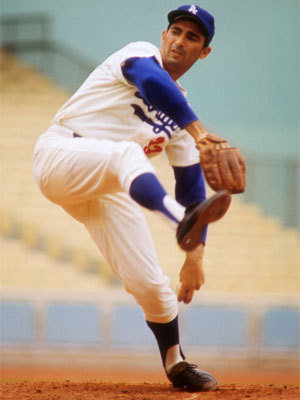
Top 106 Baseball Players: #18 - Sandy Koufax


Sandy Koufax

For a few years in the early 1960's, Sandy Koufax was the most dominant pitcher in baseball, but was forced to retire at age 30 due to a life-threatening arm injury.

Koufax was signed by his hometown Brooklyn Dodgers when he was 19 years old, and was not allowed to pitch in the minors because of the size of his signing bonus. Over his first 6 seasons, he struggled with control, and was often kept on the bench for weeks at a time, and he didn't even appear in the Dodgers' World Series victory in 1955.

The Dodgers reached the World Series again in 1959, soon after their move to Los Angeles, and this time Koufax was given a couple of appearances, pitching 2 perfect innings in relief in game 1, then started game 5, giving up only 1 run over 7 innings, but that run lost them the game 1-0. They ended up winning the series after the next game, so his small mistake did not cost the team too much.

After struggling through the 1960 season, Koufax was ready to quit baseball, but the team convinced him to come back for one more season, and it was a good thing he did. That season he led the league in strikeouts for the first time, then in ERA the following year, and that was just the beginning.

In 1963, he won his first Triple Crown, leading the league with 25 wins, 306 strikeouts, and a 1.88 ERA, and it resulted in him winning the Cy Young unanimously, becoming the first ever to earn every vote. In that season's World Series, he pitched 2 complete games, outpitching Whitey Ford in both of his games, and gave up only 3 runs while striking out 23, which earned him the World Series MVP.

Early in the 1964 season, he felt something pop in his elbow, and after using pain injections to pitch through the pain, they shut him down, but he still led the league in ERA for the third season in a row. In 1965, he was told not to throw at all between starts to avoid losing his arm, but he still had his best season, winning another Triple Crown and unanimous Cy Young and setting a new record with 382 strikeouts in the season (since broken by Nolan Ryan).

He threw a perfect game in 1965, which was his 4th career no-hitter, which was also a record until broken by Nolan Ryan. The Dodgers returned to the World Series that year, and Koufax sat out Game 1 due to Yom Kippur, instead starting Game 2. He was pulled after 6 innings, and the Dodgers lost that game to Minnesota, but he came back with complete game shutouts in Games 5 and 7, finishing with 29 strikeouts and another World Series MVP.

Before the 1966 season, he was told by the team doctor that his arm would not last another season, but he decided to go for one more year. He won the Triple Crown for the third time in 4 seasons, and a third unanimous Cy Young, and also got the Dodgers back to the World Series. He pitched well in Game 1, allowing only 1 run in 6 innings, but was pulled in hopes of having him pitch in Game 5, which never happened due to Baltimore's sweep.

Koufax announced his retirement a few weeks later, and due to his early retirement, he was eligible for the Hall of Fame sooner, and became the youngest player ever elected in his first season on the ballot. He is one of only 4 Hall of Fame pitchers to have more strikeouts than innings pitched in his career, along with Pedro Martinez, Randy Johnson, and Nolan Ryan, and though his career was short, and his dominant seasons even shorter, he was so great at his best that he has to be included among the greatest players of all time.


Wednesday, July 18, 2018

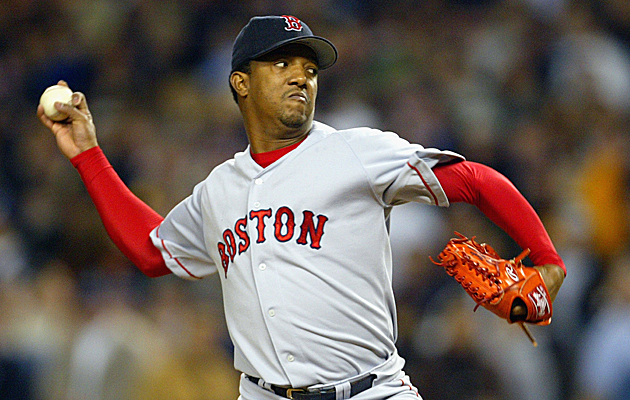
Top 106 Baseball Players: #19 - Pedro Martinez


Pedro Martinez

Pedro Martinez was the best pitcher in baseball for several years around the turn of the millennium, and a few of his seasons rank among the best seasons by a pitcher in history.

Pedro first pitched for the Dodgers in 1992, joining a team where his older brother Ramon was the star pitcher, but the team did not feel that he had the ability to be a starting ace, and he was traded to the Expos after the 1993 season.

He showed steady improvement through his first 3 seasons in Montreal, including a perfect game that he lost in the 10th inning in 1995 then took the league by storm in 1997, when he threw 305 strikeouts with an ERA of 1.90 and a league-leading 13 complete games. He won his first Cy Young that season, becoming the only Expo ever to win the award, and also became the only pitcher under 6 feet tall to ever throw 300 strikeouts in a season.

Rather than lose him to free agency the next year, Montreal traded Pedro to the Red Sox just days after he won the Cy Young, and his 7-year stretch in Boston was legendary. After coming in #2 in the Cy Young voting in his first season in Boston, he took home the award in 1999, when he won the Triple Crown with 23 wins, 313 strikeouts, and a 2.07 ERA. He was just as good in the playoffs, pitching 17 scoreless innings with 23 strikeouts, but they fell to the Yankees in the ALCS.

Between the end of 1999 and the beginning of 2000, he had 10 consecutive games with at least 10 strikeouts, 3 longer than the previous record of 7, which he also owned. He also set the record for consecutive innings with a strikeout, reaching 40 during 1999. He also became the first pitcher ever to start an All-Star game by striking out the side that season.

His very best season came in 2000, when he posted a 1.74 ERA, less than half of the next-lowest ERA, Roger Clemens' 3.70. He also set a record with a WHIP of 0.74 that season, allowing only 128 hits and 32 walks in 217 innings that season, and he was awarded his 3rd Cy Young in 4 years after the season.

A rotator cuff injury in 2001 caused him to miss half of the season, though he was still the best pitcher in the AL. He led the league in ERA and winning percentage in both 2002 and 2003, but was overlooked in the Cy Young voting each time, despite leading the winners in every major category each time.

In 2004 he had the highest ERA in his season up to that point, as it reached 3.90, but he was able to reach the World Series for the first time in his career, where he pitched 7 scoreless innings as Boston swept St. Louis to take home their first championship in decades.

After the title, he left Boston to sign with the Mets, where he had one more solid season, then faded into obscurity as injuries began to take their toll. He did get the opportunity to pitch in one more World Series with Philadelphia in 2009, but recorded a loss in each of his starts.

Martinez was the second-fastest pitcher to reach 3000 strikeouts, trailing only Randy Johnson, and is the only pitcher to retire with more than 3000 strikeouts in fewer than 3000 innings pitched. His career winning percentage of .687 is second to Whitey Ford in the modern era, and his peak was higher than any other modern pitcher. Though his great years ended abruptly, he is still definitely one of the greatest ever to play the game.


Thursday, July 5, 2018

Top 106 Baseball Players: #30 - Frank Robinson


Frank Robinson

Frank Robinson was a groundbreaking player and manager for multiple teams in a long and outstanding career.

Robinson joined the Cincinnati Reds in 1956 when he was 20 years old, and he led the league in runs scored as a rookie, while also tying the rookie home run record, which was 38 (broken by Aaron Judge last season). That solid debut season earned him the Rookie of the Year Award.

He maintained that level of play for several seasons, before exploding in 1961, when he led the league with a .611 slugging percentage to go along with 117 runs and 124 RBI's. That season he led the Reds to the pennant, which resulted in a World Series loss to the Yankees, but he was awarded his first MVP award for the stellar season.

The next season he improved in nearly every single category, and had arguably his best season, when he hit .342, led the league with 134 runs and 51 doubles, and set career highs with 208 hits and 136 RBI. He only finished 4th in the MVP voting that year, even though he was even more deserving than the year before.

After 3 more years with the Reds, the team decided to move on from Robinson, trading him to the Orioles, and in his first season in Baltimore he had a season for the ages. He won the Triple Crown with 49 home runs, 122 RBI, and a .316 average, while also leading the league in runs and total bases, earning another MVP, and becoming the only player ever to win an MVP in each league.

The Orioles advanced to the World Series that year, and Robinson was named the MVP after hitting 2 home runs in the 4-game sweep of the Dodgers, including a solo shot to score the only run in the decisive final game. In a series dominated by pitching, Robinson was the offensive constant that made the difference.

From 1969 to 1971, the Orioles made 3 more playoff appearances, reaching the World Series each time, and they won the title in 1970 against Robinson's old team, the Reds, earning him a second championship ring. After the 1971 season, he was traded to the Dodgers, then to the Angels the following season.

Around this time Robinson decided that he wanted to become a manager, and because of that desire, he was traded to the Indians, where he was installed as player/manager, making him the first black manager in league history. Several years later, when he was hired to manage the Giants, he became the first black manager in the NL as well.

At the time of his retirement as a player, Robinson was #4 in home runs, behind Ruth, Aaron, and Mays, and has since fallen back to #10. His number was retired by Cincinnati, Baltimore, and Cleveland, making him one of only 2 players (along with Nolan Ryan) to have his number retired by 3 teams. He is still the only player to win an MVP in each league, a rare batting Triple Crown winner, a World Series MVP, and one of the greatest baseball players of all time.


Sunday, June 24, 2018

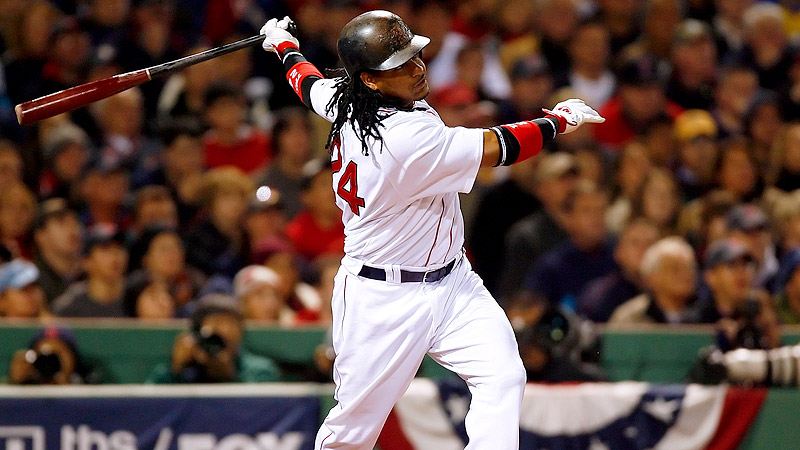
Top 106 Baseball Players: #41 - Manny Ramirez*


Manny Ramirez

Manny Ramirez was one of the most colorful players in recent memory, and was well-known for his great playoff performances, but he is the second straight player in this countdown whose reputation was tarnished by testing positive for steroids.

Manny first played in the Majors for the Indians near the end of 1993, and came in #2 in the Rookie of the Year voting in 1994. In 1995, he reached 30 home runs and 100 RBI's, which are benchmarks he would reach 11 more times in the next 13 seasons, which is a testament to his incredible consistency.

That was also the first of 5 consecutive seasons in which the Indians would reach the postseason with Ramirez on board. That included trips to the World Series in 1995 and 1997, when they lost to the Braves and the Marlins, and while Ramirez didn't play well in those World Series losses, he hit 13 total home runs in those 5 postseasons.

During the 1999 season, he led the entire league in RBI with 165, and finished third in the MVP voting, the highest he would get in his career. After the Indians failed to reach the playoffs in 2000, he left as a free agent to sign with the Red Sox, with the largest contract in history at that time.

In his second season with Boston, he led the league in batting average at .349, but the Red Sox did not reach the playoffs in his first two seasons there. The addition of David Ortiz to the team in 2003 was the boost the team needed, vaulting them into the playoffs, where they lost in 7 games to the Yankees during the ALCS.

In 2004, Ramirez led the league with 43 home runs and a .613 slugging percentage, and the Red Sox returned to the playoffs, where they again met the Yankees in the ALCS. This time, they fell behind 3-0, but rallied to win 4 in a row behind the greatness of his teammate, Ortiz. In the World Series, Ramirez hit .412 in a 4-game sweep to win the World Series MVP award.

The Red Sox won another World Series in 2007, and this time Ramirez was even better. In the ALCS, he hit .409 with 10 RBI as Boston beat Cleveland, and he hit .348 total for the postseason. He also broke the all-time record for playoff home runs that year, hitting his 23rd to pass Bernie Williams, and he would eventually extend his record to 29.

Ramirez was traded to the Dodgers midway through the following season, and he was great in the postseason for LA, batting over .500 in each of the teams' postseason series, but they would fail to reach the World Series that season. He began the 2009 season on a good pace, but just a month into the season was informed that he had failed a drug test and would be suspended for 50 games.

This was the second time that Ramirez had been caught cheating. He had tested positive in 2003, when the league randomly tested players to determine the extent of steroid use in baseball, but players were given immunity for positive tests during that round of testing. After joining the Rays in 2011, Ramirez again tested positive for a banned substance, and chose to retire rather than face a 100-game suspension.

Ramirez finished his career with 555 home runs, #15 all-time, and is also #18 all-time in RBI. He hit 21 grand slams in his career, good for third place in history, and is still the all-time leader in postseason home runs. He was a World Series MVP, and a very consistent performer in the regular season, and even with the proof that he cheated on multiple occasions, he is still one of the greatest ever to play the game.


Monday, June 18, 2018

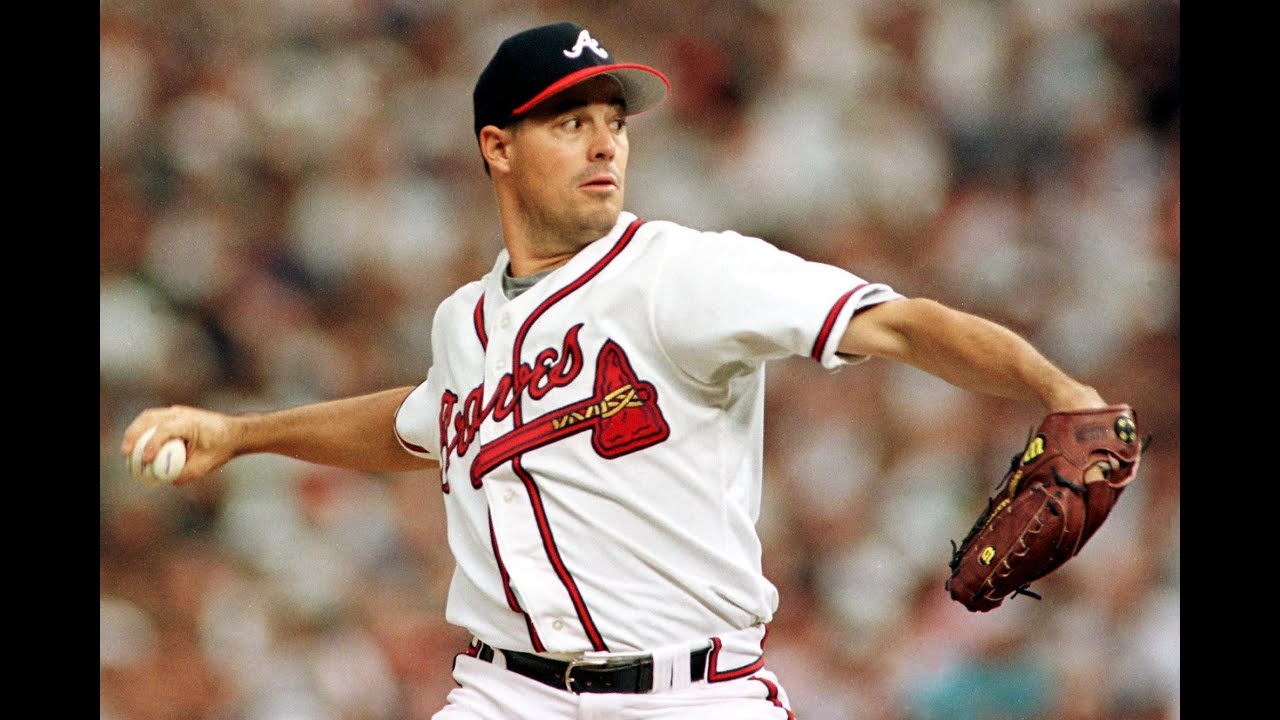
Top 106 Baseball Players: #46 - Greg Maddux


Greg Maddux

Greg Maddux was one of the most dominant pitchers in recent memory, and his run of Cy Youngs in the 1990's was one of the most amazing runs in baseball history.

Maddux reached the Majors in 1986 with the Cubs, and in his final start of the season had the rare opportunity of pitching against his brother Mike, who was also a rookie pitching for the Phillies. Younger brother Greg won the matchup, earning his second career win.

He posted a losing record in 1987, his first full season, but he would not have another losing record for 18 years. He improved steadily over the next several seasons, culminating in his first Cy Young season in 1992, when he recorded a 2.18 ERA and led the league in wins, starts, and innings pitched.

He was unable to negotiate a new contract with the Cubs after that season, so he signed with the Atlanta Braves, and he was even better than expected when he arrived. He led the league in ERA and complete games that season, and won his second straight Cy Young.

During the strike-shortened 1994 season, he led the league in ERA and shutouts again, along with wins and shutouts, and his ERA of 1.56 was the lowest of any pitcher since 1968. That year he finished #5 in the MVP voting and was the unanimous choice for the Cy Young award, his third in a row.

After three straight great seasons, he somehow had his best season in 1995. He finished with a 19-2 record, an ERA of 1.63, 10 complete games, and 3 shutouts, and a second straight unanimous Cy Young, and 4th in a row overall, something that had never been done before and has only been done once since.

That was also the year that Atlanta finally broke through in the playoffs. Maddux had pitched in the NLCS twice before, but 1995 was his first time in the World Series, where he gave up only 4 earned runs over 16 innings as the Braves beat the Indians to take home the championship.

In 1996 his ERA "ballooned" to 2.72, and he finished 5th in the Cy Young voting, breaking his winning streak at 4. The Braves returned to the World Series, and Maddux had his best postseason up to then, giving up only 7 runs in 37 innings, but the Braves fell to the Yankees in the championship round.

He pitched several more good seasons for Atlanta, even leading the league in ERA again in 1998, but nowhere near the level he was at during his Cy Young peak. He set a league record with 17 straight seasons of at least 15 wins, and is only of only 4 pitcher to record an ERA lower than 1.65 since 1920, and the only one to do it twice.

Maddux is #8 all-time in games won, trailing only Warren Spahn in the live-ball era, and is the only pitcher in history with more than 300 wins, 3000 strikeouts, and fewer than 1000 walks (999 to be exact). His playoff record of 11-14 was somewhat lacking, but he was great in 3 World Series seasons, and reached a level of dominance rarely seen during his Cy Young streak, and there is no doubt he belongs here among the top 50 players of all time.


Friday, June 15, 2018

Top 106 Baseball Players: #49 - Gary Sheffield


Gary Sheffield

Gary Sheffield was a great player for 8 different teams over the course of 22 seasons, and the reason for so many changes in scenery appears to have been his bad habit of bashing his management and teammates.

Sheffield first played in the Majors in 1988, when he was called up by the Milwaukee Brewers during the final month of the season. He hit a home run in his first at-bat, but overall did not play very well in his first couple seasons. His average improved to .294 in 1990, but he ended the season with a .194 average and a ticket out of town due to his claims of racism by the manager in moving him to third base.

He was traded to the Padres before the 1992 season, and contended for the Triple Crown, falling short by 2 home runs and 9 RBI, but he did win the batting title, making him the only Padre not named Tony Gwynn to achieve that. He also had the opportunity to bat against his uncle, Dwight Gooden, in a game that May, quite a rare occurrence.

He didn't start off very well the next season, and was traded to the Marlins midway through the season. He missed a lot of time over the next two seasons, but when he was healthy again in 1996, he had one of his best seasons, with 42 home runs, 120 RBI, and 142 walks. The next year, Florida advanced clear to the World Series, with Sheffield walking 20 times in 16 postseason games and knocking in 5 runs in the Marlins' championship round.

He was traded to the Dodgers early the next season because the Marlins knew they couldn't afford a contract extension. With LA, he had 3 straight very solid seasons, getting at least 100 RBI, 90 walks, and 30 runs each year while always batting over .300. After just over 3 years with the team, he began publicly criticizing the team's management, and was traded to Atlanta before the 2002 season.

In 2003 with the Braves, he had his best overall season, setting career highs with a .330 average, 126 runs, 190 hits, 37 doubles, and 132 RBI, to go along with 39 home runs. He was easily the best player in the league that year, but only came in #3 in the MVP voting, most likely because he was not well-liked.

He signed with the Yankees after that season, and had two more All-Star level seasons where he was also on the MVP radar, but a wrist injury cut his 2006 season short, and he was traded to the Tigers after the season. He would spend two seasons as the team's DH before they decided to move on. He signed with the Mets, where he was able to hit his 500th home run, and he also became the third player ever to hit a home run as a teen and a 40-year old, after Ty Cobb and Rusty Staub.

Sheffield has been on the Hall of Fame ballot for 4 years, but is nowhere near the number of votes needed for election, and many feel that his personality is hurting his chances, despite his solid career numbers. He was the best player on a World Series champion, and the best player in the league one year, and hit 500 homers, which is still quite rare. Whether he makes it or not, he still definitely belongs on this list of the greatest baseball players of all time.


Monday, June 4, 2018

Top 106 Baseball Players: #59 - Don Sutton


Don Sutton

Don Sutton's career was not one of dominance, but of quiet consistency, with 21 seasons of double-digit wins and triple-digit strikeouts, but only a couple of instances of leading the league in any category during his career.

Sutton reached the majors in 1966 with the LA Dodgers, and he was very good as a rookie, recording 209 strikeouts, the most by any rookie in 55 years. While he never led the league in strikeouts, he surpassed 200 K's 5 times, finished in the top ten 14 times, and is #7 all-time in strikeouts in league history.

In the early 1970's, he had 5 straight seasons in which he finished among the top 5 in Cy Young voting, getting as high as third place when he set a career high with 21 wins in 1976. He led the league with 9 shutouts in 1972, and also had the most starts in 1974 with 40.

The Dodgers reached 3 World Series in the 1970's, but lost in all 3 appearances. In 1974, they lost to the Athletics in 5 games, with Sutton recording the only win for the Dodgers, in addition to the two wins he had recorded in the NLCS. He also won a game against the Yankees in the 1977 World Series, but went 0-3 in his 3 postseason appearances in 1978.

Sutton led the league with a 2.20 ERA in 1980, and over the next 7 years Sutton bounced from Houston to Milwaukee to Oakland and finally to the Angels, before returning to the Dodgers for one final season with the team where he spent his first 15 seasons. He was released in August of 1988, just months before the Dodgers finally won a World Series.

Sutton's career was far from spectacular, but he was a very good pitcher who maintained a high level of play for a very long time. He pitched in 4 World Series, starting out great in his first appearance, but slowly going downhill in each subsequent appearance. He never won an MVP, Cy Young, or World Series, but he is a Hall of Famer, and his longevity at an All-Star level is what earned him a spot on the list of the all-time greats.


Saturday, May 12, 2018

Top 106 Baseball Players: #81 - Duke Snider


Duke Snider

Duke Snider was the star centerfielder for the Dodgers in the 1950's, at a time when it was a very prestigious position in New York City, with Mickey Mantle and Willie Mays manning the position for the other 2 teams at the time.

Snider reached the Major Leagues with Brooklyn in 1947, the same season that Jackie Robinson joined the team, but spent a lot of time in the minors over his first 2 seasons. He became the full-time centerfielder in 1949, and in 1950 he led the league with 199 hits, which would be his career high.

He was a pretty good player for a few years, then had his coming out party in the 1952 World Series, when he hit .345 with 4 home runs and 8 RBI's in a losing effort against the Yankees. Even though he did not quite get the title that year, it was the beginning of his time as a superstar in the league.

For the next few years he just kept getting better, surpassing 120 runs scored and batted in for 3 straight seasons, and he was the league leader in runs scored in all 3 of those seasons, and he also reached at least 40 home runs in each while finishing in the top 4 of the MVP voting.

In 1955 he was able to get his revenge on the Yankees, as he led the Dodgers to their only title in Brooklyn, this time hitting .320 with 7 RBI's and another 4 home runs as they won it all. In doing so, he became the first and so far only player ever to hit 4 home runs in a single World Series twice.

In 1956 his production dropped just slightly, with the exception of his home runs total,which was a career high 43, good enough to lead the league for the first time. The next season was the final one for the Dodgers in Brooklyn, and Snider was the last person ever to hit a home run at Ebbets field.

He followed the Dodgers to Los Angeles, but he had already reached the downhill side of his career, and while he was still a good player, he was not the superstar he had been on the other side of the country. He did win another World Series in LA in 1959, but wasn't as dominant as before.

Snider played 18 seasons in the majors, leading the league once each in RBI's, walks, hits, and home runs, along with the 3 straight seasons of leading the league in runs scored. He made the World Series 6 times with the Dodgers, winning it all twice, and was usually at his best in the postseason, which is why he belongs on this list of the all-time greats.


Thursday, May 10, 2018

Top 106 Baseball Players: #82 - Eddie Murray


Eddie Murray

Eddie Murray played 21 seasons in Major League Baseball, earning the nickname "Steady Eddie" along the way, and it fits, since his batting average stayed within a 40 point range for his first 12 seasons, and he missed very few games each season.

His rookie season was 1977, and he started out solid, with a .283 average and 27 homers, and was given the Rookie of the Year award for his efforts. Two years later he helped lead the Orioles to the World Series, and while he was great in the ALCS, with 5 hits and 5 walks in 17 plate appearances, he struggled in the final round, getting only 4 hits in the 7 games.

Over the next 6 years, he became an RBI machine surpassing 110 in each complete season, and leading the league with 78 in the strike-shortened 1981 season. He also led the league in home runs that season, the only time he would accomplish that, though he was quite a consistent long ball hitter through his career.

In 1983 he helped lead the Orioles back to the World Series, and was solid throughout both rounds, getting 9 hits in 9 games, including 3 home runs, and he was able to finish the season with a championship ring, the only one he would earn.

He continued to be Steady Eddie for more than a decade with multiple teams, even leading the league in batting in 1990, and he returned to Baltimore late in his career just in time to hit his 500th home run, which made him the third player in history to reach 500 home runs and 3000 hits, joining Willie Mays and Hank Aaron, later to be joined by Alex Rodriguez, Rafael Palmeiro, and Albert Pujols.

In 1995, at the age of 39, he was able to help the Cleveland Indians get to the World Series, and he hit a home run in each round of the playoffs, even at his advanced age, but he failed to get a second ring, just as he did the following season when he reached the playoffs again in Baltimore, which was the only time he ever reached the playoffs without making the World Series.

Although he was never a superstar, he was a very good player for a very long time, finishing in the top 5 of the MVP voting 6 times, reaching the World Series 3 times, each time in a different decade, and surpassing the two biggest batting milestones by showing up every day and doing his job well, which is why he deserves his spot on this list of the all-time greats.


Saturday, May 5, 2018

Top 106 Baseball Players: #86 - Clayton Kershaw


Clayton Kershaw

Clayton Kershaw is the second active player to appear in my countdown, and the final active pitcher, and is also the youngest player in the countdown by about 5 years, and though he is probably only about halfway through his career, he has definitely done enough so far to deserve a spot on this list.

Kershaw reached the majors in early 2008, at age 20, and was the youngest player in the league for that entire season. He pitched pretty well in his second and third seasons, but he became the dominant superstar we all know in his 4th season, when he completely took the league by storm.

That year, Kershaw took home the pitching Triple Crown, leading the NL with 21 wins, a 2.28 ERA, and 248 strikeouts, and was awarded the Cy Young Award as well, becoming the youngest pitcher to earn the award in his lifetime.

The next season he was still the best pitcher in all of baseball, but his numbers were not quite as gaudy, so as a result he was not given the Cy Young he deserved. He still led all of baseball in ERA again, but slight dips elsewhere caused him to be voted runner-up.

The next year he led the league in strikeouts once again, while dropping his league-leading ERA even lower than he had before, finishing at 1.83, the lowest of any player since the year 2000. He won his second Cy Young that year, and even earned his first playoff victory, when he struck out 12 in 7 innings against Atlanta, before falling back to earth in the NLCS against Saint Louis.

Even after that amazing season, he found a way to improve again in 2014, improving in every single pitching category that is tracked. He led the league in ERA for the 4th straight year, the only pitcher ever to do that, and took home his 3rd Cy Young as well as the NL MVP, the first pitcher to win the award in 46 years.

In 2015, he set a career high and led the league with 301 strikeouts, but because his ERA "ballooned" to 2.13, he only came in 3rd in the Cy Young voting, though it was his 5th straight year in the top 3. Those 5 seasons represent one of the greatest 5-year pitching stretches in history.

Kershaw's weakness has always been the playoffs, where his career ERA is 4.35, nearly 2 runs higher than his regular season ERA of 2.37, which is the lowest of any pitcher in the past 100 years. He has had some great games in the playoffs, but doesn't seem to have the same consistency as usual in the postseason.

Kershaw has the best ERA, win percentage, WHIP, and number of shutouts among all active pitchers, and many of those numbers are also very high among all-time pitchers, including those from the dead-ball era. If he is able to maintain the same level of play for another decade, he would be one of the top 10 players of all time, and a couple of World Series wouldn't hurt either.