Showing posts with label Dominique Wilkins. Show all posts

Sunday, August 22, 2021

Top 100 NBA Players: #70 - Dominique Wilkins


Dominique Wilkins

Teams

Atlanta Hawks - 1982-94

Los Angeles Clippers - 1994

Boston Celtics - 1994-95

San Antonio Spurs - 1996-97

Orlando Magic - 1999


Playoffs

Appearances - 10 (1983,1984,1986,1987,1988,1989,1991,1993,1995,1999)

Conference Finals - 0

NBA Finals - 0

Championships - 0


Awards and Honors

All-NBA First Team - 1 (1986)

All-NBA Second Team - 4 (1987,1988,1991,1993)

All-NBA Third Team - 2 (1989,1991,1993,1994)

Hall of Fame - 2006

*(actual in bold, deserved in italics)


All-Time Ranks

Points Per Game - #14

Total Points - #16

Total Steals - #64


League Leads

Total Points (#2-1986,1988, #3-1987, #4-1985,1993, #5-1990,1991)

Points Per Game (#1-1986, #2-1987,1988,1993, #4-1994, #5-1990)


Dominique Wilkins was the SEC Player of the Year as a sophomore at Georgia, then left school after his junior year to enter the NBA Draft, where he was selected by the Utah Jazz with the 3rd overall pick. Wilkins refused to play for Utah, so he was traded to the Atlanta Hawks for 2 players and cash.

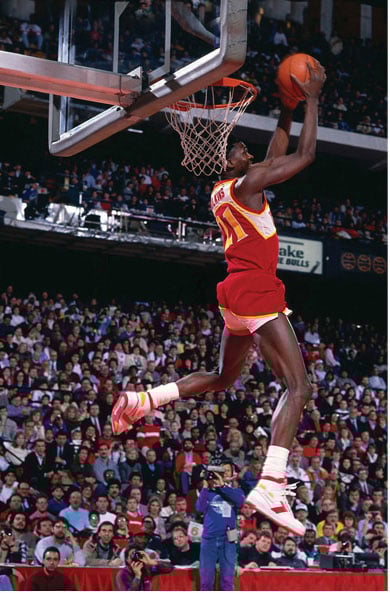
Wilkins averaged 17.5 points per game as a rookie while starting every game, then bumped it up to 21.6 during his second season. In 1985, he finished sixth in the league in scoring with 27.4 points per game, and won the Slam Dunk contest at All-Star Weekend, living up to his nickname, "The Human Highlight Film."

He became a true superstar the next season, when he led the league in scoring at 30.3 per game, along with 7.9 rebounds, his first All-Star appearance, and a spot on the All-NBA First Team. He also led the Hawks past the Pistons in the first round of the playoffs, but they fell to the Celtics in 5 games in the second round.

Wilkins finished second to Michael Jordan in scoring in each of the next 2 seasons, even when he averaged a career-high 30.7 in 1988, but the Hawks lost in the second round of the playoffs both times. In 1988, the Hawks pushed the Celtics to 7 games, and Game 7 featured Wilkins and Larry Bird scoring back and forth throughout the 4th quarter, with the Celtics eventually winning by 2. It would be the closest Wilkins ever got to a championship.

His scoring dipped a little over the next 3 years, down to around 26 per game, and the Hawks either missed the playoffs or fell in the first round each year. In 1991-92, he was having a small resurgence when he tore his Achilles, ending his season with the first and only major injury of his career.

He made a strong comeback the next year, averaging 29.9 points per game, to come in second in scoring for the third time, once again coming in behind Michael Jordan. He also got Atlanta back to the playoffs, but they lost in the first round to the Bulls in his only career matchup against Jordan in the playoffs.

The next season, Wilkins had Atlanta in first place in the East as the trade deadline approached, and the Hawks made a surprising move by trading him away to the Clippers for Danny Manning. It is still the only time in history that a first-place team has traded their leading scorer at the deadline. He averaged 29.1 points per game during his time in LA, raising his season average up to 26.0, and earning himself a spot on the All-NBA Third Team, the 7th time in 9 years he would be voted to one of the teams.

Wilkins signed as a free agent with Boston after the season, but the team was not good and Wilkins struggled, scoring less than 20 per game for the first time since he was a rookie, and he decided to leave the NBA to play in Greece. After one very successful season in Europe, he returned to the NBA to play for the Spurs, and he led them in scoring while coming off the bench during the season David Robinson was out with an injury.

After one season in San Antonio, he left again to play in Italy, then made one final return to the NBA, to play alongside his brother Gerald in Orlando. He averaged only 5 points in 9 minutes per game, then retired from the game for good.

Wilkins was one of the best scorers the league has seen, putting up 10 straight seasons of at least 25 points per game and winning a scoring title. He was also a decent rebounder, averaging 6-7 per game for most of his career, but he was never able to break through in the playoffs. It didn't help that he never played with another star in his prime, the closest thing being a couple of seasons with late-career Moses Malone, but Wilkins is definitely one of the greatest players of all time, and the greatest player never to reach the Conference Finals.


Saturday, August 27, 2016

Top 100 NBA Players: #36 - George Gervin


George Gervin

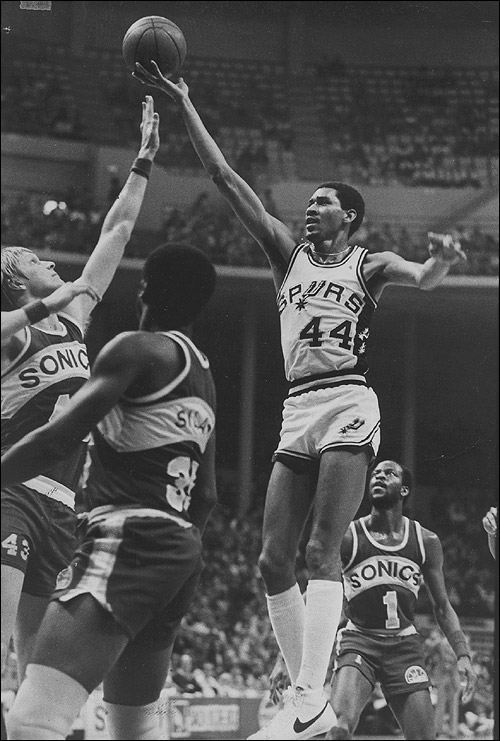
George Gervin was an amazing scorer and a big star for a number of years, but more than anyone else who reached this high on the list, he was not a winner. He was known for being somewhat selfish, but it doesn't diminish how great he was offensively.

Gervin was a four time scoring leader, and is one of 7 players all-time to win three straight scoring titles. In 1980 he averaged 33.1 points per game, and he eclipsed 30 points again 2 years later, when he again led the league with 32.3 nightly. He was twice the MVP runner-up, in 1978 and 1979, but he probably should have won in 1979, when it was given to Moses Malone. Here are how their numbers stacked up that season:

Malone - 24.8 pts, 17.6 reb, 1.8 ast, 1.5 blk, .540 FG%, .739 FT%
Gervin - 29.6 pts, 5.0 reb, 2.7 ast, 1.1 blk, .541 FG%, .826 FT%

Moses led the league in rebounding that year, and Gervin in scoring, so both were obvious candidates. In the other four categories, Gervin was obviously the better player, especially if you know that Gervin was a shooting guard and Malone was a center, because Gervin shot a higher percentage than the MVP that year, and blocked nearly as many shots.

Gervin was the best player on his team for nearly his entire career, but he never saw much playoff success in that role. His best finish was losing in the Conference Finals three times, making him the best player to never play in the NBA Finals, joining Dominique Wilkins, Steve Nash, Alex English, and Vince Carter on that dubious list.

For six straight seasons, Gervin was one of the top 3 players in the NBA, but because of his playoff failings he is usually not considered to be on the same level as those who were his peers during those years, including Moses Malone, Magic Johnson, and Kareem Abdul-Jabbar. His averages over that time were spectacular, and they are listed below:

Gervin (1977-1983) - 29.2 pts, 5.0 reb, 3.0 ast, 1.3 stl, .514 FG%, .834 FT%

Gervin had the disadvantage of never having a true star for a teammate. As the only star in San Antonio for a long time, he did get them to the playoffs in every season of his career, even though he couldn't get them through to the Finals. His career was still very impressive, even though it only lasted for 10 NBA seasons.

Thursday, August 11, 2016

Top 100 NBA Players: #54 - Dominique Wilkins


Dominique Wilkins

Dominique Wilkins was one of the most entertaining and exciting players in the league for an entire decade, but he had a couple of flaws that kept him from becoming one of the best of all time. He was an incredible dunker, and won two dunk contests and nearly won two others.

For 10 straight seasons, Wilkins averaged more than 25 points per game, finishing in the top 7 in the league in each season in which he played enough games. He led the league in scoring in 1986, when Jordan was out with the only major injury of his career, and finished second to him 3 other times. The only problem was that he was too focused on getting his points. Former teammate Doc Rivers said that you could ask Wilkins how many points he had at any time, and he would immediately answer correctly.

Wilkins is the greatest player to never play in the Conference Finals, another fatal flaw. Only a couple of other players in my entire top 100 can say that, which has to be taken into consideration when considering his place in history. It wasn't that he didn't score in the playoffs, because his average was nearly identical to his regular season average, but he didn't have what it took to win.

Wilkins was a good rebounder, averaging 6.7 per game over his career, and he also shot over 81% from the free throw line for his career. What that does is prove that Wilkins was not a one-trick pony, but actually a pretty good all-around player. The problem that he had was that he never had a true star teammate, which made the Hawks a one-man show during his time there. Everybody knows that no team can win the championship without at least two star players.

Thursday, September 1, 2011

Top 100 NBA Players: #34


George Gervin

(Kalb: #26, Simmons: #34, BBR: #41)

George Gervin was an amazing scorer and a big star for a number of years, but more than anyone else who reached this high on the list, he was not a winner. He was known for being somewhat selfish, but it doesn't diminish how great he was offensively.

Gervin was a four time scoring leader, and is one of 6 players all-time to win three straight scoring titles. In 1980 he averaged 33.1 points per game, and he eclipsed 30 points again 2 years later, when he again led the league with 32.3 nightly. He was twice the MVP runner-up, in 1978 and 1979, but he probably should have won in 1979, when it was given to Moses Malone. Here are how their numbers stacked up that season:

Malone - 24.8 pts, 17.6 reb, 1.8 ast, 1.5 blk, .540 FG%, .739 FT%
Gervin - 29.6 pts, 5.0 reb, 2.7 ast, 1.1 blk, .541 FG%, .826 FT%

Moses led the league in rebounding that year, and Gervin in scoring, so both were obvious choices. In the other four categories, Gervin was obviously the better player, especially if you know that Gervin was a shooting guard and Malone was a center, because Gervin shot a higher percentage than the MVP that year, and blocked nearly as many shots.

Gervin was the best player on his team for nearly his entire career, but he never saw much playoff success in that role. His best finish was losing in the Conference Finals three times, making him the best player to never play in the NBA Finals, joining Dominique Wilkins, Steve Nash, Alex English, Vince Carter, and Tracy McGrady on that dubious list.

For six straight seasons, Gervin was one of the top 3 players in the NBA, but because of his playoff failings he is usually not considered to be on the same level as those who were at his level during those years, including Moses Malone, Magic Johnson, and Kareem Abdul-Jabbar. His averages over that time were spectacular, and they are listed below:

Gervin (1977-1983) - 29.2 pts, 5.0 reb, 3.0 ast, 1.3 stl, .514 FG%, .834 FT%

Gervin had the disadvantage of never having a true star for a teammate. As the only star in San Antonio for a long time, he did get them to the playoffs in every season of his career, even though he couldn't get them through to the Finals. His career was still very impressive, even though it only lasted for 10 NBA seasons.


Payton may have been the better defensive player by far, but Gervin's offensive prowess was so great that there is no doubt he was better than Payton. Gervin's first 7 NBA seasons were all at least as good as Payton's best season, so even though Payton lasted much longer, Gervin got much higher. While Gervin was not a great playoff player, Payton's overall playoff success wasn't much better, so Gervin is definitely higher up on the list.

Thursday, August 18, 2011

Top 100 NBA Players: #47


Dave Cowens

(Kalb: #32, Simmons: #31, BBR: #67)

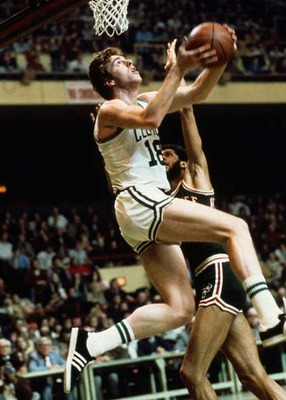
Dave Cowens was just one in a long line of star players to wear Celtic green, and though he won two championships with the team, that is actually quite low to be considered an all-time Celtic legend. That's not to say that Cowens wasn't a great player, because he was definitely one of the best players in the NBA for a few years.

For four seasons, from 1972 to 1976, Cowens was one of the very best players in the entire league, ranking as one of the top 5 players in the league three times and in the top 10 the other year. During those years, he took the Celtics to two Eastern Conference Finals and two NBA championships. His average stats over that period were very impressive, and they are listed below.

Cowens - 19.7 pts, 15.7 reb, 4.3 ast, 1.2 stl, 1.1 blk

He finished among the top 3 rebounders in each of those seasons, with three straight seasons as the runner-up. He even won an MVP award in 1973, but he wasn't even the best player on his own team that season. John Havlicek, even though he was nearing the end of his career, was still better that season. Here is a statistical comparison:

Cowens - 20.5 pts, 16.2 reb, 4.1 ast, .452 FG%, .779 FT%
Havlicek - 23.8 pts, 7.1 reb, 6.6 ast, .450 FG%, .858 FT%

Cowens had a large lead in rebounding, and Havlicek had the big edge in free throw shooting, so Havlicek's edge in scoring and passing show that he was a better player that year. However, the basketball gods made up for the mistake by giving JoJo White the Finals MVP Award over Cowens, despite Cowens' overall playoff edge. Here are their postseason stats from 1976:

Cowens - 21.0 pts, 16.4 reb, 4.6 ast, .457 FG%, .759 FT%
White - 22.7 pts, 3.9 reb, 5.4 ast, .445 FG%, .821 FT%

White may have scored a few more points than Cowens, but their assist numbers were even closer, and Cowens led all postseason players in rebounding that year. Cowens was the top player on that championship team, and the second-best player on the previous championship team, and was the best player on two Conference Finalists as well. For those few seasons, he was one of the top players in the game.

That's when things got weird. After the Finals win, he spent the night sleeping on a park bench in Boston. When the following season began, Cowens didn't show up, instead spending a couple of months as a cab driver and saying that he felt burnt out. He eventually returned, but was never quite as good as he was before. He ended up retiring at age 31, which is usually the time when most superstars are riding the back end of their peak years.


Wilkins may have been flashier and had a longer career peak, but Cowens was a winner, making it to the Conference Finals in 5 straight seasons, and he was a top-2 player on four of those teams. If Cowens hadn't burnt out, he could have been just as good as Wilkins overall, but the fact that he made a difference in the playoffs gives him an edge over Wilkins, who could never clear the second round.

Wednesday, August 17, 2011

Top 100 NBA Players: #48


Dominique Wilkins

(Kalb: #49, Simmons: #55, BBR: #32)

Dominique Wilkins was one of the most entertaining and exciting players in the league for an entire decade, but he had a couple of flaws that kept him from becoming one of the best of all time. He was an incredibly dunker, and won two dunk contests and nearly won two others.

For 10 straight seasons, Wilkins averaged more than 25 points per game, finishing in the top 7 in the league in each season in which he played enough games. He led the league in scoring in 1986, when Jordan was out with the only major injury of his career, and finished second to him 3 other times. The only problem was that he was too focused on getting his points. Former teammate Doc Rivers said that you could ask Wilkins how many points he had at any time, and he would immediately answer correctly.

Wilkins is the greatest player to never play in the Conference Finals, another fatal flaw. Only a couple of other players in my entire top 100 can say that, which has to be taken into consideration when considering his place in history. It wasn't that he didn't score in the playoffs, because his average was nearly identical to his regular season average, but he didn't have what it took to win.

Wilkins was a good rebounds, averaging 6.7 per game over his career, and he also shot over 81% from the free throw line for his career. What that does is prove that Wilkins was not a one-trick pony, but actually a pretty good all-around player. The problem that he had was that he never had a true star teammate, which made the Hawks a one-man show during his time there. Everybody knows that no team can win the championship without at least two star players.


Even though Miller had a lot more playoff heroics and success than Wilkins, it is obvious from the chart above that Wilkins was the better player for the majority of his career. During their peak seasons, Miller was only better twice, when Wilkins missed half a season due to injury, and when he was finally traded away from Atlanta. Wilkins' scoring average was always at least 6 points higher, and his shooting percentages weren't far behind Miller's. Overall, the Human Highlight Film takes this one.