Sunday, August 4, 2024

Top 100 NFL Running Backs - #16: Tony Dorsett


Tony Dorsett

Teams

Dallas Cowboys (1977-1987)

Denver Broncos (1988)


Playoffs

Appearances - 8 (1977,1978,1979,1980,1981,1982,1983,1985)

Conf Champ Games - 5 (1977,1978,1980,1981,1982)

Super Bowls - 2 (1977,1978)

Championships - 1 (1977)


Awards and Honors

Offensive Rookie of the Year - 1977

All-Pro First Team - 1 (1981)

All-Pro Second Team - 2 (1982,1983)

Pro Bowl - 4 (1978,1981,1982,1983)

Hall of Fame - 1994


All-Time Ranks

Rushing Yards - #10

Scrimmage Yards - #13

Rushing Touchdowns - #24

Rushing Yards per Game - #30

Total Touchdowns - #35

Yards per Rush - #86


League Leads

Rushing Yards (#2-1981,1982, #3-1978, #6-1980,1983,1985, #7-1984, #9-1977)

Rushing Touchdowns (#2-1977, #3-1980, #10-1982)

Yards per Rush (#3-1977, #5-1981, #8-1978, #10-1983)

Rushing Yards per Game (#2-1981, #4-1978,1982, #6-1979,1980, #7-1985, #9-1983, #10-1977,1984)

Total Touchdowns (#2-1977, #6-1980, #8-1978)

Scrimmage Yards (#2-1978,1981, #6-1985, #7-1982,1983,1984, #8-1977, #9-1979,1980)

Yards per Touch (#6-1977, #8-1978)


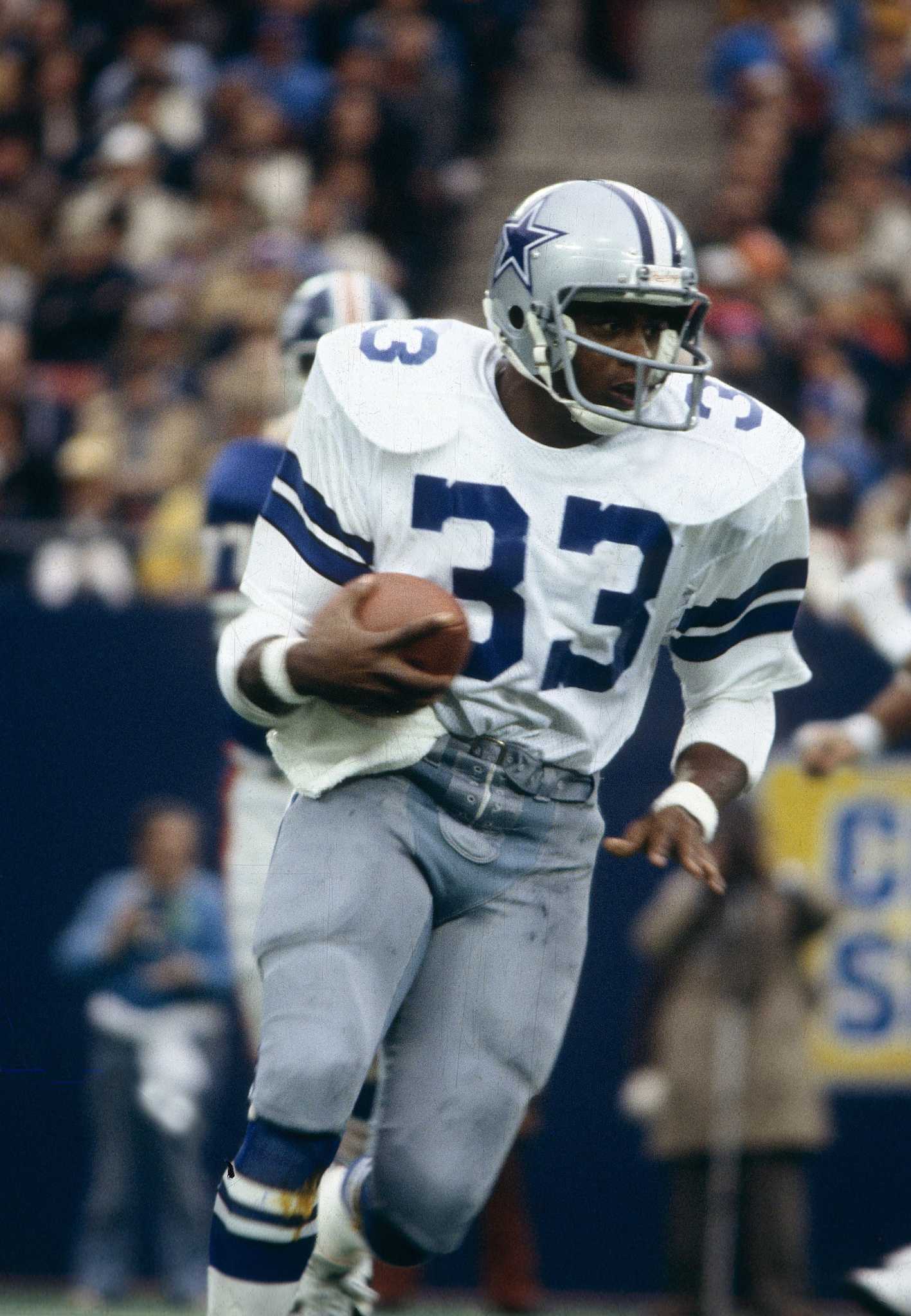
Tony Dorsett finished #4 in the Heisman voting as a junior after piling up 1544 yards and 11 touchdowns, then won the Heisman as a senior when he had 1948 yards and 21 touchdowns and won a national championship for Pittsburgh, after which he was drafted #2 overall by the Dallas Cowboys in the 1977 NFL Draft.

Dorsett had an immediate impact, rushing for 1007 yards and 12 touchdowns as a rookie, which earned him the Offensive Rookie of the Year award, and he was able to help lead the Cowboys to the Super Bowl, where he ran for 66 yards and a touchdown as the Cowboys beat the Broncos 27-10.

Dorsett ran for another 1325 yards in 1978, which earned him his first Pro Bowl spot, and he finished #2 in the league in scrimmage yards with 1703. He and the Cowboys returned to the Super Bowl that year, and Dorsett had 96 rushing yards in the game, but the Steelers prevented a repeat championship, winning the game 35-31.

Dorsett surpassed 1000 yards in each of the next 2 seasons as well, then set a new franchise record in 1981 with 1646 rushing yards, and he also gained 1971 scrimmage yards, which put him at #2 in the league again. Dallas fell just short of the Super Bowl that year, but Dorsett made the All-Pro First Team and came in #3 in MVP voting.

His streak of 5 straight 1000-yards seasons was interrupted in 1982 by a strike, but he led the league in carries that year, and set an unbreakable record by completing a 99-yard rush for a touchdown against Minnesota, which was later tied by Derrick Henry. 

He rushed for over 1000 yards in each of the next 3 seasons, but in that final season of the streak, the team signed Herschel Walker, who began eating into Dorsett's playing time and carries, and after having 2 games in 1987 where he did not play even though he was healthy, he demanded a trade, and the team shipped him off to Denver.

He played well in Denver, gaining 703 yards on the season at age 34, but he injured his knee during the following preseason and was forced to retire from the NFL. At that point, he was #2 on the all-time rushing list, trailing only Walter Payton.

Dorsett never led the league in any major rushing category, but he was always near the top of the leaderboard in rushing yards and scrimmage yards for nearly a decade. For a smaller back, he was incredibly durable, only missing a few game in his first 9 seasons. He contributed to 5 deep playoff runs and a championship, won the Rookie of the Year, and had great longevity in a position where it is rare, and he was definitely one of the greatest of all time.


Saturday, August 3, 2024

Top 100 NFL Runnings Backs - #17: Priest Holmes


Priest Holmes

Teams

Baltimore Ravens (1997-2000)

Kansas City Chiefs (2001-2007)


Playoffs

Appearances - 3 (2000,2003,2006)

Conf Champ Games - 1 (2000)

Super Bowls - 1 (2000)

Championships - 1 (2000)


Awards and Honors

Offensive Player of the Year - 1 (2002)

All-Pro First Team - 3 (2001,2002,2003)

Pro Bowl - 3 (2001,2002,2003)


All-Time Ranks

Rushing Touchdowns - #16

Total Touchdowns - #29

Yards per Rush - #35

Rushing Yards per Game - #35

Rushing Yards - #48

Scrimmage Yards - #84


League Leads

Rushing Yards (#1-2001, #3-2002, #9-2003)

Rushing Touchdowns (#1-2002,2003, #3-2004)

Yards per Rush (#4-2001, #5-2002, #7-1998)

Rushing Yards per Game (#1-2004, #2-2002, #3-2001)

Total Touchdowns (#1-2002,2003, #4-2004, #10-2001)

Scrimmage Yards (#1-2001,2002, #5-2003)

Yards per Touch (#6-1999, #10-2002)


After gaining only 1276 rushing yards in 4 seasons at Texas, Priest Holmes went undrafted in the 1997 NFL Draft, then joined the Baltimore Ravens as a free agent for the 1997 season.

Holmes appeared in 7 games as a rookie, and only touched the ball once, on a kickoff return late in the season. Early in his second season, he emerged as the starter for the Ravens, and responded with 1008 yards on the ground.

He struggled with injuries in 1999, missing nearly half of the season, and finished with 506 yards. The team drafted Jamal Lewis, who took over as the starter early in 2000, and the Ravens made their first playoff appearance that year since leaving Cleveland, and ended up winning the Super Bowl, with Holmes contributing only 8 yards in the victory.

He left as a free agent before the 2001 season, joining the Kansas City Chiefs, and he immediately became a superstar. He led the league with 1555 rushing yards that year, and also with 2169 scrimmage yards, becoming the first undrafted player ever to lead the league in either category.

He was even better in 2002. He rushed for 1615 yards and a league-leading 21 touchdowns, and again led the league with 2287 scrimmage yards, and had 24 total touchdowns. The 21 touchdowns are the 6th-highest total in a season in history, and he did all of that despite missing the final 2 games of the season with a hip injury, and was rewarded with the Offensive Player of the Year award.

In 2003, he set a new league record with 27 rushing touchdowns, and had 1420 rushing yards and 2110 scrimmage yards. He is one of only 4 players in history to have 3 straight 2000-yard scrimmage seasons, along with Marshall Faulk, Walter Payton, and Tiki Barber. His touchdown record was broken 2 years later by Shaun Alexander, but Holmes still has the #2 spot on that list.

Holmes started the 2004 looking just as great as in the previous 3 seasons, and was leading the league with 892 rushing yards and 14 touchdowns through just 8 games when he went down with a knee injury that ended his season. He had 1079 scrimmage yards at that point, and was on pace to join Faulk as the only backs to reach 2000 4 times in a row.

When he returned in 2005, he wasn't quite as explosive, but he had 451 yards through 7 games, before another catastrophic injury ended another season, this time to his spine. He missed the remainder of 2005 and the entire 2006 season, and missed the first half of 2007 before finally returning after missing nearly 2 entire years. Unfortunately, he suffered a neck injury a month later and immediately retired.

Holmes spent three and a half years as a bona fide superstar, leading the league in rushing yards once, and rushing touchdowns, total touchdowns, and scrimmage yards twice, and he was on pace to lead the league in all 4 before a knee injury stopped him. He won the Offensive Player of the Year once, and set the touchdown record the next year, and there is no doubt that he was one of the greatest to ever play the game.


Friday, August 2, 2024

Top 100 NFL Running Backs - #18: Leroy Kelly

Leroy Kelly

Teams

Cleveland Browns (1964-1973)


Playoffs

Appearances - 7 (1964,1965,1967,1968,1969,1971,1972)

Conf Champ Games - 4 (1964,1965,1968,1969)

Champ Games - 2 (1964,1965)

Championships -1 (1964)


Awards and Honors

All-Pro First Team - 3 (1966,1967,1968)

All-Pro Second Team - 1 (1969)

Pro Bowl - 6 (1966,1967,1968,1969,1970,1971)

Hall of Fame - 1994


All-Time Ranks

Rushing Touchdowns - #28

Total Touchdowns - #40

Rushing Yards - #63


League Leads

Rushing Yards (#1-1967,1968, #2-1966, #7-1969, #8-1971)

Rushing Touchdowns (#1-1966,1967,1968, #2-1969,1971, #9-1970)

Yards per Rush (#1-1966,1967, #2-1968, #8-1969)

Rushing Yards per Game (#1-1967, #2-1966,1968, #7-1969, #9-1971)

Total Touchdowns (#1-1966,1968, #2-1967,1971, #5-1969)

Scrimmage Yards (#1-1967,1968, #2-1966, #7-1969, #9-1971)

Yards per Touch (#4-1966,1968, #8-1967)


After averaging over 5 yards per carry and winning a CIAA championship at Morgan State, Leroy Kelly was drafted by the Cleveland Browns in the 8th round of the 1964 NFL Draft.

In his first two seasons, he was a backup to Jim Brown, so he barely ever took the field at running back, but he was a very good kick returner, averaging over 24 yards per kick return in each of those seasons. After the 1965 season, Jim Brown retired, and Kelly was elevated to starter, and he immediately established himself as the best running back in the league.

In his first season as a starter, he rushed for 1141 yards on a league-best 5.5 yards per carry, and also led the league with 15 rushing touchdowns, and his 1507 scrimmage yards per #2 in the league, as were his rushing yards. He was the runner-up for MVP, and was named to the All-Pro First Team.

The next year, he led the league in pretty much every rushing category, including carries, rushing yards, rushing touchdowns, yards per carry, yards per game, touches, and scrimmage yards. He finished #3 in that year's MVP voting.

He continued his dominant run in 1968, when he led the league with 1239 yards and 16 touchdowns, both career highs, and he also led the league and set career highs in scrimmage yards and total touchdowns. He was the MVP runner-up once again, and led the Browns to the NFC Championship Game, but didn't play well in that game, and the Browns lost to the Colts 34-0.

His numbers dipped a bit in 1969, down to just 817 yards and 9 touchdowns, but he was still good enough to make the All-Pro Second Team. He got them back to the NFC Title Game that year, and had an 80-yard day, but the Browns fell to the Vikings 27-7.

At that point he began to slow down, but he played 4 more years with the Browns, then one year with the Chicago Fire of the WFL before retiring. At that time, he was #4 on the all-time list for yardage and #3 for touchdowns.

The Browns were used to having the best running back in the league with Jim Brown around, and they were able to keep that going for 3 more seasons after Brown's retirement thanks to Kelly. He was either the league leader or runner-up in every single rushing category for 3 straight seasons, and he is still #63 in all-time rushing yards 50 years after his retirement. Though he isn't as famous as his predecessor, he is one of the best to ever play the game.


Thursday, August 1, 2024

Top 100 NFL Running Backs - #19: Eric Dickerson


Eric Dickerson

Teams

Los Angeles Rams (1983-1987)

Indianapolis Colts (1987-1991)

Los Angeles Raiders (1992)

Atlanta Falcons (1993)


Playoffs

Appearances - 5 (1983,1984,1985,1986,1987)

Conf Champ Games - 1 (1985)

Super Bowls - 0

Championships - 0


Awards and Honors

Offensive Rookie of the Year - 1983

Offensive Player of the Year - 1 (1986)

All-Pro First Team - 5 (1983,1984,1986,1987,1988)

Pro Bowl - 6 (1983,1984,1986,1987,1988,1989)

Hall of Fame - 1999


All-Time Ranks

Rushing Yards per Game - #4

Rushing Yards - #9

Rushing Touchdowns - #13

Scrimmage Yards - #18

Total Touchdowns - #26

Yards per Rush - #64


League Leads

Rushing Yards (#1-1983,1984,1986,1988, #2-1987, #3-1989, #8-1985)

Rushing Touchdowns (#1-1984, #2-1983,1985, #3-1988, #5-1986, #10-1987,1989)

Yards per Rush (#2-1984, #3-1987, #7-1986,1989, #10-1983)

Rushing Yards per Game (#1-1983,1984,1986,1987,1988, #3-1989, #5-1985)

Total Touchdowns (#2-1983,1988, #3-1984, #7-1985, #9-1986)

Scrimmage Yards (#1-1983,1984,1986,1988, #3-1987, #7-1989)


During his senior season at SMU, Eric Dickerson finished 3rd in Heisman voting after rushing for 1617 yards and 17 touchdowns on 7.0 yards per carry, and he was then drafted #2 overall by the Los Angeles Rams in the 1983 NFL Draft.

Dickerson set rookie records all over the place in his first season, with 1808 yards, 18 touchdowns, and 2212 scrimmage yards, leading the league in rushing and scrimmage yards and winning the Offensive Rookie of the Year award. He also finished as the MVP runner-up behind Joe Theismann and made the All-Pro First Team.

In his second season, Dickerson rushed for a new record 2105 yards, a record that still stands 40 years later. He also led the league with 14 rushing touchdowns and 2244 scrimmage yards, but since Dan Marino became the first 5000-yard passer that same year, he finished as MVP runner-up once again.

He sat out the first two games of 1985 in a contract dispute, then rushed for 1234 yards once he returned, by far his lowest per game average of the 1980s. Even though his regular season wasn't up to his usual standard, he rushed for 248 yards against Dallas in a playoff game, which is a postseason record that still stands.

In 1986, he played in every game, and returned to form with 1821 rushing yards, his third time leading the league, and he also had the most scrimmage yards once again, with 2026. He was named the Offensive Player of the Year, and was runner-up to Lawrence Taylor for the MVP, his third time in 4 years coming in second place.

The Rams grew tired of his constant contract disputes, and they shipped him away to Indianapolis just 3 games into the 1987 season. That season was shortened by a strike, but he still managed to gain 1288 yards and make the All-Pro First Team again.

In his first full season with the Colts, Dickerson led the league in both rushing yards and scrimmage yards for the 4th time each, with 1659 on the ground and 2036 overall. He had one more good season with Indy, gaining 1311 yards in 1989, but contract disputes and team suspensions cost him 11 games over his final 2 seasons with the team, until they finally traded him away to the Raiders in 1992.

He played one season back in LA, sharing the backfield with Marcus Allen, but only gained 729 yards, and it only took one year to wear out his welcome again. He was traded to the Falcons, where he played in only 4 games before they decided to trade him away to Green Bay. Upon arrival in Green Bay, he failed his physical and chose to retire from football.

In 5 of his first 6 seasons, Dickerson led the league in yards per game, and led the league in rushing yards in 4 of those seasons. He was the 3-time runner-up for MVP, but did pick up an Offensive Player of the Year award, as well as Offensive Rookie of the Year. He was the fastest player ever to reach 10000 yards, and is still #9 on the all-time rushing yard list, and he was definitely one of the best to ever carry the football.


Wednesday, July 31, 2024

Top 100 NFL Running Backs - #20: Mercury Morris


Mercury Morris

Teams

Miami Dolphins (1969-1975)

San Diego Chargers (1976)


Playoffs

Appearances - 5 (1970,1971,1972,1973,1974)

Conf Champ Games - 3 (1971,1972,1973)

Super Bowls - 3 (1971,1972,1973)

Championships - 2 (1972,1973)


Awards and Honors

Pro Bowl - 3 (1971,1972,1973)


All-Time Ranks

Yards per Rush - #9


League Leads

Rushing Yards (#10-1972)

Rushing Touchdowns (#1-1972, #3-1973)

Yards per Rush (#1-1973, #3-1972)

Rushing Yards per Game (#7-1973)

Total Touchdowns (#4-1972, #8-1973)

Yards per Touch (#1-1973, #8-1972)


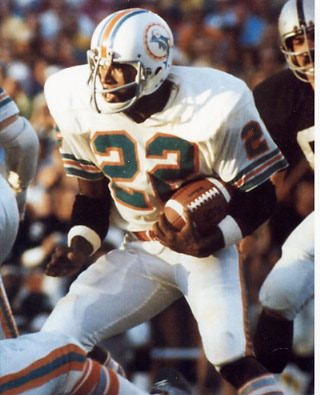
Mercury Morris set the single game, single season, and career college rushing yard records while playing for West Texas State, though the season record was broken a week later, and the career record 2 years later. He was drafted in the third round of the 1969 NFL/AFL Draft by the Miami Dolphins.

Morris was mostly used as a kick returner in his first 3 seasons, but when he did get the chance to carry the ball, he was excellent. In 1970, he averaged 6.8 yards per carry, and he averaged 5.5 in 1971, both of which would have led the league if he had enough carries. He was named to the Pro Bowl as a kick returner in 1971.

He became Miami's starter in 1972, and rushed for exactly 1000 yards, his career high, and led the league with 12 touchdowns while picking up 5.3 yards per carry. The Dolphins went undefeated that season, and Morris had 76 rushing yards in the AFC Championship game, followed by 34 yards in Miami's 14-7 Super Bowl win over the Redskins.

In 1973, he led the league by averaging 6.4 yards per carry and 6.6 yards per touch, and he finished with 954 yards and 10 touchdowns. The Dolphins returned to the Super Bowl that year after Morris had 86 yards on 14 carries in the AFC Championship Game, and he added another 34 yards in the Super Bowl, where the Dolphins beat the Vikings 24-7.

Morris suffered a knee injury early in 1974 and was limited to only 5 games before a neck injury ended his season. He had a decent comeback season in 1975, rushing for 875 yards, but the Dolphins chose to trade him away to the Chargers after the season. His neck continued to bother him during the 1976 season, so he decided to retire after one season out west.

Morris did not rack up huge rushing numbers, as he shared the backfield with Larry Csonka and Jim Kiick through most of his career, but he was one of the most efficient runners of all time, averaging 5.1 yards per carry for his career, good enough to land him in the top 10 all time. His two best years coincided with Miami's back to back championships, including their undefeated season, and Morris is definitely one of the best of all time.


Tuesday, July 30, 2024

Top 100 NFL Running Backs - #21: LaDainian Tomlinson


LaDainian Tomlinson

Teams

San Diego Chargers (2001-2009)

New York Jets (2010-2011)


Playoffs

Appearances - 6 (2004,2006,2007,2008,2009,2010)

Conf Champ Games - 2 (2007,2010)

Super Bowls - 0

Championships - 0


Awards and Honors

MVP - 1 (2006)

Offensive Player of the Year - 1 (2006)

All-Pro First Team - 3 (2004,2006,2007)

All-Pro Second Team - 3 (2002,2003,2005)

Pro Bowl - 5 (2002,2004,2005,2006,2007)

Hall of Fame - 2017


All-Time Ranks

Rushing Touchdowns - #2

Total Touchdowns - #3

Scrimmage Yards - #6

Rushing Yards - #7

Rushing Yards per Game - #18

Yards per Rush - #86

Receptions - #86


League Leads

Rushing Yards (#1-2006,2007, #2-2002, #3-2003, #6-2005, #7-2004, #9-2001, #10-2008)

Rushing Touchdowns (#1-2004,2006,2007, #3-2005, #4-2001, #5-2002,2009, #6-2003, #7-2008)

Yards per Rush (#4-2003,2006)

Rushing Yards per Game (#1-2006, #2-2007, #3-2002, #5-2003, #6-2005, #10-2004)

Receptions (#4-2003)

Total Touchdowns (#1-2006, #2-2004,2007, #3-2003,2005, #6-2002, #8-2008, #10-2001)

Scrimmage Yards (#1-2003, #2-2006,2007, #3-2002, #5-2004,2005, #8-2008, #9-2001)

Yards per Touch (#6-2006,2011)


As a senior at TCU, LaDainian Tomlinson rushed for 2158 yards and 22 touchdowns, gained 5.8 yards per carry, and finished 4th in the Heisman voting, which helped him to be picked #5 overall in the 2001 NFL Draft by the San Diego Chargers.

Tomlinson surpassed 1000 rushing yards in each of his first 9 seasons in the NFL, even when his yards per carry were low. As a rookie he gained 1236 yards on only 3.6 yards per carry, but when he raised that to 4.5 yards per carry in his second season, his yardage total jumped to 1683, and he ended up with 2172 scrimmage yards, third-best in the NFL.

He emerged as a superstar in 2003. He had 1645 yards and 13 touchdowns rushing on the season, gaining a career-high 5.3 yards per carry, and gained an additional 725 yards through the air, putting him at 2370 on the season, the fifth-best total of all time. He was the runner-up for Offensive Player of the Year that season.

His per carry average plummeted in 2004, down to only 3.9 yards per rush, but he led the league in rushing touchdowns that season for the first time, as he reached the end zone 17 times, including 12 games in a row during the season. That earned him his first All-Pro First Team honors, and he was far from being done. 

He improved across the board in 2005, up to 1462 yards and 18 touchdowns, but it was 2006 where he really made his mark on history. He led the league in rushing that year with 1815 yards, and set records that still stand with 28 rushing touchdowns and 31 total touchdowns. He won both the MVP and Offensive Player of the Year awards, and led the Chargers to a playoff berth for just the second time in his career.

He again led the league in rushing yards and touchdowns in 2007, but this time with only 1474 yards and 15 touchdowns, far from the heights he had reached the previous season. He and the Chargers reached the AFC Championship game that year, but he injured his knee in the previous game, and was only able to gain 5 yards before sitting out the rest of the team's loss to the Patriots.

His return from injury was not as good as he hoped for. He gained only 1110 yards on the season, the lowest of his career to that point, and only picked up 3.8 yards per carry. He missed the Pro Bowl for the first time in years, and it didn't get better the next year, as he gained only 730 yards on the season. After 9 years in San Diego, he was released by the team, and he chose to sign with the New York Jets on a 2-year contract.

He rushed for 914 yards in his first season as a Jet, and reached the AFC Championship Game for the second time in his career, but it ended again in a disappointing loss, with Tomlinson gaining only 16 yards in a loss to Pittsburgh. He played one final season as a backup in New York before retiring from the NFL.

Tomlinson is #7 on the all-time list for rushing yards, and #2 in rushing touchdowns, and still holds the record for most touchdowns in a season. His 2006 season was probably the best by any running back in the past 20 years, and he is even among the all-time top 100 in receptions, even though he only finished in the top 10 once in that category in his career. There is no doubt that LT is one of the greatest to ever play the game.


Sunday, July 28, 2024

Top 100 NFL Running Backs - #22: Gale Sayers


Gale Sayers

Teams

Chicago Bears (1965-1971)


Playoffs

Appearances - 0

Conf Champ Games - 0

Champ Games - 0

Championships - 0


Awards and Honors

Rookie of the Year - 1965

All-Pro First Team - 5 (1965,1966,1967,1968,1969)

Pro Bowl - 4 (1965,1966,1967,1969)

Hall of Fame - 1977


All-Time Ranks

Yards per Rush - #10

Rushing Yards per Game - #33

Yards per Touch - #90


League Leads

Rushing Yards (#1-1966,1969, #2-1965, #3-1967, #5-1968)

Rushing Touchdowns (#2-1965,1966, #3-1969, #4-1967)

Yards per Rush (#1-1968, #2-1966, #3-1965, #4-1967, #6-1969)

Rushing Yards per Game (#1-1966,1968,1969, #3-1965,1967)

Total Touchdowns (#1-1965, #3-1967, #5-1966)

Scrimmage Yards (#1-1966, #3-1965, #4-1969)

Yards per Touch (#1-1968, #2-1965, #3-1966)


After averaging 6.5 yards per carry through his college career at Kansas, Gale Sayers was drafted by the Bears #4 overall in the 1965 NFL Draft, and by the Chiefs #5 overall in the 1965 AFL Draft, and he decided to join the Bears.

Sayers ran away with the Rookie of the Year award, gaining 867 yards on the ground, 507 through the air, and 898 on kick and punt returns while setting a league record with 22 total touchdowns: 14 rushing, 6 receiving, 1 on a punt return, and 1 on a kick return. He also tied the single-game record with 6 touchdowns in a game against San Francisco that year.

In his second season, he led the league in rushing yards with 1231 and scrimmage yards with 1678, and also led the league in yards per kick return, earning a spot on the All-Pro First Team for the second straight year. His production dropped off a bit in his third season, as he began to share the backfield, but he still made the All-Pro First Team.

In 1968, he was back to leading the backfield, and he was #1 in the league with 856 yards through 9 games, when he suffered a major injury to his right knee, tearing both the ACL and MCL and damaging cartilage. He still led the league in yards per carry and yards per touch, but missed the final 5 games of the season.

He made it back in time for the beginning of the 1969 season, and he got better as the season went on, ending up with his second rushing title, gaining 1032 yards on the ground and leading the league in carries for the first time. For the 5th season in a row, he finished in the top 5 in MVP voting, despite the Bears missing the playoffs a 5 times.

He injured his left knee in the 1970 preseason, but still attempted to play through it, but only lasted 2 games before injuring the knee worse, which caused him to miss the rest of the season. He missed the first 3 games of the 1971 season as he worked his way back from that injury, then played 2 games before injuring his ankle, which ended his season again. He planned to come back in 1972, but instead retired after struggling in the preseason.

Sayers may have been the most talented back to ever carry a football, but injuries ended 3 of his 7 seasons early, and forced him to retire at age 29. He was voted to the All-Pro First team in all 5 of his full or nearly-full seasons, led the league in rushing yards twice, yards per carry once, scrimmage yards once, and total touchdowns once, while also being one of the best return men in the league. He didn't play for long, but he was undoubtedly one of the best to ever play the game.